

Financial Conflicts of Interest and Reporting Bias Regarding the Association between Sugar-Sweetened Beverages and Weight Gain: A Systematic Review of Systematic Reviews
Open accessThe DOI matches its Crossref record; 50 of the 51 references it cites were found in a registry or an index.
Abstract
BACKGROUND: Industry sponsors' financial interests might bias the conclusions of scientific research. We examined whether financial industry funding or the disclosure of potential conflicts of interest influenced the results of published systematic reviews (SRs) conducted in the field of sugar-sweetened beverages (SSBs) and weight gain or obesity. METHODS AND FINDINGS: We conducted a search of the PubMed, Cochrane Library, and Scopus databases to identify published SRs from the inception of the databases to August 31, 2013, on the association between SSB consumption and weight gain or obesity. SR conclusions were independently classified by two researchers into two groups: those that found a positive association and those that did not. These two reviewers were blinded with respect to the stated source of funding and the disclosure of conflicts of interest. We identified 17 SRs (with 18 conclusions). In six of the SRs a financial conflict of interest with some food industry was disclosed. Among those reviews without any reported conflict of interest, 83.3% of the conclusions (10/12) were that SSB consumption could be a potential risk factor for weight gain. In contrast, the same percentage of conclusions, 83.3% (5/6), of those SRs disclosing some financial conflict of interest with the food industry were that the scientific evidence was insufficient to support a positive association between SSB consumption and weight gain or obesity. Those reviews with conflicts of interest were five times more likely to present a conclusion of no positive association than those without them (relative risk: 5.0, 95% CI: 1.3-19.3). An important limitation of this study is the impossibility of ruling out the existence of publication bias among those studies not declaring any conflict of interest. However, the best large randomized trials also support a direct association between SSB consumption and weight gain or obesity. CONCLUSIONS: Financial conflicts of interest may bias conclusions from SRs on SSB consumption and weight gain or obesity.
Overview
The claims and statistics of this paper haven’t been checked yet.
Free: it reads the open-access text and checks the first 5 claims that cite a source we can check. Create a free account to check every claim.
Integrity signals
Registry
Cites
Statistics
Figures
Verification
Claims the paper makes
The claims and statistics of this paper haven’t been checked yet.
Free: it reads the open-access text and checks the first 5 claims that cite a source we can check. Create a free account to check every claim.
Claims other papers make about this one
Each is checked against this paper’s own text: does it say what the citing paper says it does?
The source backs part of the claim, not all of it — or backs it for a different population, condition or comparison.
In the citing paper
“Reviews of the health effects of sugar sweetened beverages that are performed by authors with financial ties to food companies are five times more likely to conclude that there is no association of sugar consumption with weight gain compared to those with other sponsors (relative risk: 5.0, 95% CI: 1.3–19.3)[42].”
From Relationship between research outcomes and risk of bias, study sponsorship, and author financial conflicts of interest in reviews of the effects of artificially sweetened beverages on weight outcomes: a systematic review of reviews (2016) · cites this paper as [42]
Experimental — accuracy not yet measuredIn the citing paper
“Reviews of the health effects of sugar sweetened beverages performed by authors with financial ties to the sugar industry are five times more likely to conclude there is no association of sugar consumption with weight gain [42].”
Self-check
Percentages, sums and reported differences re-computed from the paper’s own numbers.
The self-check needs the paper’s full text.
Citations
Cites
Preferred Reporting Items for Systematic Reviews and Meta-Analyses: the PRISMA statement
Moher, D., Liberati, A., Tetzlaff, J., Altman, D. G., & for the PRISMA Group (2009) · BMJ · doi:10.1136/bmj.b2535 · Cited by 83,823
Preferred Reporting Items for Systematic Reviews and Meta-Analyses: The PRISMA Statement
Moher, D., Liberati, A., Tetzlaff, J., Altman, D. G., & The PRISMA Group (2009) · PLoS Medicine · doi:10.1371/journal.pmed.1000097 · Cited by 64,042 · cited 1×
“Methods Standard methods for conducting and reporting SRs were used [13].”
MethodPreferred reporting items for systematic reviews and meta-analyses: the PRISMA Statement.
(2009) · PubMed Central · Cited by 44,859
Preferred Reporting Items for Systematic Reviews and Meta-Analyses: The PRISMA Statement
Moher, D., Liberati, A., Tetzlaff, J., & Altman, D. G. (2009) · Journal of Clinical Epidemiology · doi:10.1016/j.jclinepi.2009.06.005 · Cited by 19,575
Intake of sugar-sweetened beverages and weight gain: a systematic review
Malik, V. S., Schulze, M. B., & Hu, F. B. (2006) · The American Journal of Clinical Nutrition · doi:10.1093/ajcn/84.2.274 · Cited by 2,100 · cited 1×
“Similarly, another food industry–funded SR [27] did not include one of the RCTs already included in a previous SR [28], and therefore available at the time of the literature search.”
BackgroundSelf-citationEffects of soft drink consumption on nutrition and health: a systematic review and meta-analysis
Vartanian, L. R., Schwartz, M. B., & Brownell, K. D. (2007) · American Journal of Public Health · doi:10.2105/ajph.2005.083782 · Cited by 1,863 · cited 1×
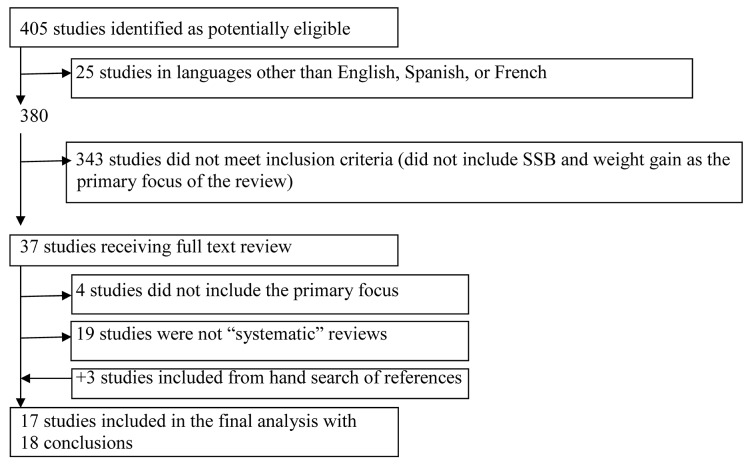
“Results Our final study was based on 17 out of 405 potentially eligible articles (Figure 1) [14–30].”
Scope and Impact of Financial Conflicts of Interest in Biomedical Research: A Systematic Review
Bekelman, J. E., Li, Y., & Gross, C. P. (2003) · JAMA · doi:10.1001/jama.289.4.454 · Cited by 1,816 · cited 2×
“This issue has been thoroughly discussed in pharmaceutical studies, where the dangers of the use of so-called scientific evidence in industry marketing and profit-making strategies have been noted [3–6].”
BackgroundMalik, V. S., Pan, A., Willett, W. C., & Hu, F. B. (2013) · The American Journal of Clinical Nutrition · doi:10.3945/ajcn.113.058362 · Cited by 1,668 · cited 3×
“We identified only two SRs [15,29] that specifically reported using the PRISMA guidelines as the standard method for conducting and reporting the meta-analysis.”
BackgroundMethodMoodie, R., Stuckler, D., Monteiro, C., Sheron, N., Neal, B., Thamarangsi, T., Lincoln, P., & Casswell, S. (2013) · The Lancet · doi:10.1016/s0140-6736(12)62089-3 · Cited by 1,663
Te Morenga, L., Mallard, S., & Mann, J. (2012) · BMJ · doi:10.1136/bmj.e7492 · Cited by 1,629 · cited 3×
“One of the reviews [15] was identified twice because the analyses were reported separately for adults and children/ adolescents and achieved different conclusions; therefore we included a total of 18 conclusions from the 17 SRs in the analysis.”
MethodThe truth about the drug companies: how they deceive us and what to do about it
(2005) · Choice Reviews Online · doi:10.5860/choice.42-5297 · Cited by 885
Hu, F. B. (2013) · Obesity Reviews · doi:10.1111/obr.12040 · Cited by 884
A Trial of Sugar-free or Sugar-Sweetened Beverages and Body Weight in Children
de Ruyter, J. C., Olthof, M. R., Seidell, J. C., & Katan, M. B. (2012) · New England Journal of Medicine · doi:10.1056/nejmoa1203034 · Cited by 814 · cited 1×
“The two largest and best RCTs in children [36,37] and the largest study assessing the biological plausibility of gene–SSB interactions in adults [38] also support a detrimental effect of SSB on overweight/obesity.”
BackgroundA Randomized Trial of Sugar-Sweetened Beverages and Adolescent Body Weight
Ebbeling, C. B., Feldman, H. A., Chomitz, V. R., Antonelli, T. A., Gortmaker, S. L., Osganian, S. K., & Ludwig, D. S. (2012) · New England Journal of Medicine · doi:10.1056/nejmoa1203388 · Cited by 699 · cited 1×
“The two largest and best RCTs in children [36,37] and the largest study assessing the biological plausibility of gene–SSB interactions in adults [38] also support a detrimental effect of SSB on overweight/obesity.”
BackgroundStuckler, D., McKee, M., Ebrahim, S., & Basu, S. (2012) · PLoS Medicine · doi:10.1371/journal.pmed.1001235 · Cited by 666 · cited 1×
“Furthermore, we must take into account the fact that the potential misleading role of the food industry on health issues is greater in developing countries than in developed ones [42].”
BackgroundSugar-Sweetened Beverages and Genetic Risk of Obesity
Qi, Q., Chu, A. Y., Kang, J. H., Jensen, M. K., Curhan, G. C., Pasquale, L. R., Ridker, P. M., Hunter, D. J., Willett, W. C., Rimm, E. B., et al. (2012) · New England Journal of Medicine · doi:10.1056/nejmoa1203039 · Cited by 598
Big food, food systems, and global health
Stuckler, D., & Nestle, M. (2012) · PLoS Medicine · doi:10.1371/journal.pmed.1001242 · Cited by 516 · cited 1×
“The influence of biased reviews on policy makers and medical practitioners might also be another potential threat for public health [40,41].”
BackgroundRelationship between Funding Source and Conclusion among Nutrition-Related Scientific Articles
Lesser, L. I., Ebbeling, C. B., Goozner, M., Wypij, D., & Ludwig, D. S. (2007) · PLoS Medicine · doi:10.1371/journal.pmed.0040005 · Cited by 421 · cited 2×
“formulation of governmental and professional dietary guidelines as well as public health interventions and regulation [7], heightening our concern regarding possible partiality or distortion of facts.”
BackgroundResultSugar-sweetened beverages and body mass index in children and adolescents: a meta-analysis
Forshee, R. A., Anderson, P. A., & Storey, M. L. (2008) · The American Journal of Clinical Nutrition · doi:10.1093/ajcn/87.6.1662 · Cited by 314 · cited 2×
“Results Our final study was based on 17 out of 405 potentially eligible articles (Figure 1) [14–30].”
BackgroundGibson, S. (2008) · Nutrition Research Reviews · doi:10.1017/s0954422408110976 · Cited by 236 · cited 2×
“Results Our final study was based on 17 out of 405 potentially eligible articles (Figure 1) [14–30].”
BackgroundHauner, H., Bechthold, A., Boeing, H., Brönstrup, A., Buyken, A., Leschik-Bonnet, E., Linseisen, J., Schulze, M., Strohm, D., & Wolfram, G. (2012) · Annals of Nutrition and Metabolism · doi:10.1159/000335326 · Cited by 233 · cited 1×
“Four SRs did not report on sources of funding [16,20,24,30], although two of these SRs explicitly declared having no conflicts of interest [20,30].”
BackgroundSelf-citationFood Politics: How the Food Industry Influences Nutrition and Health
Nestle, M. (2007) · doi:10.1525/9780520934467 · Cited by 223
Intake of calorically sweetened beverages and obesity
Olsen, N. J., & Heitmann, B. L. (2009) · Obesity Reviews · doi:10.1111/j.1467-789x.2008.00523.x · Cited by 199 · cited 1×
“Four SRs did not report on sources of funding [16,20,24,30], although two of these SRs explicitly declared having no conflicts of interest [20,30].”
BackgroundThe Role of Sugar-Sweetened Beverage Consumption in Adolescent Obesity: A Review of the Literature
Harrington, S. (2008) · The Journal of School Nursing · doi:10.1177/10598405080240010201 · Cited by 199
To what extent have sweetened beverages contributed to the obesity epidemic?
Woodward-Lopez, G., Kao, J., & Ritchie, L. (2011) · Public Health Nutrition · doi:10.1017/s1368980010002375 · Cited by 194 · cited 1×
“Results Our final study was based on 17 out of 405 potentially eligible articles (Figure 1) [14–30].”
Osei-Assibey, G., Dick, S., Macdiarmid, J., Semple, S., Reilly, J. J., Ellaway, A., Cowie, H., & McNeill, G. (2012) · BMJ Open · doi:10.1136/bmjopen-2012-001538 · Cited by 188 · cited 2×
“We identified two SRs without conflicts of interest [14,16] and one SR funded by the food industry [19] that did not include in their search strategy all the available literature when the review was undertaken.”
BackgroundWang, A. T., McCoy, C. P., Murad, M. H., & Montori, V. M. (2010) · BMJ · doi:10.1136/bmj.c1344 · Cited by 173 · cited 3×
“This issue has been thoroughly discussed in pharmaceutical studies, where the dangers of the use of so-called scientific evidence in industry marketing and profit-making strategies have been noted [3–6].”
BackgroundWhy corporate power is a public health priority
Hastings, G. (2012) · BMJ · doi:10.1136/bmj.e5124 · Cited by 164 · cited 1×
“Public health organizations should play a leading role in addressing these issues, to revitalize their upstream political functions and to regain their role in society [43].”
BackgroundMattes, R. D., Shikany, J. M., Kaiser, K. A., & Allison, D. B. (2011) · Obesity Reviews · doi:10.1111/j.1467-789x.2010.00755.x · Cited by 160 · cited 1×
“Among the 17 SRs included in our study, only three [15,17,29] reported a flowchart of the study search and selection process as recommended by PRISMA.”
Is Sugar Consumption Detrimental to Health? A Review of the Evidence 1995—2006
Ruxton, C. H. S., Gardner, E. J., & McNulty, H. M. (2009) · Critical Reviews in Food Science and Nutrition · doi:10.1080/10408390802248569 · Cited by 160 · cited 2×
“We identified two SRs without conflicts of interest [14,16] and one SR funded by the food industry [19] that did not include in their search strategy all the available literature when the review was undertaken.”
BackgroundMethodA Critical Examination of the Evidence Relating High Fructose Corn Syrup and Weight Gain
Forshee, R. A., Storey, M. L., Allison, D. B., Glinsmann, W. H., Hein, G. L., Lineback, D. R., Miller, S. A., Nicklas, T. A., Weaver, G. A., & White, J. S. (2007) · Critical Reviews in Food Science and Nutrition · doi:10.1080/10408390600846457 · Cited by 138 · cited 1×
“Similarly, another food industry–funded SR [27] did not include one of the RCTs already included in a previous SR [28], and therefore available at the time of the literature search.”
BackgroundBeverage consumption and adult weight management: a review
Dennis, E. A., Flack, K. D., & Davy, B. M. (2009) · Eating Behaviors · doi:10.1016/j.eatbeh.2009.07.006 · Cited by 128 · cited 2×
“Results Our final study was based on 17 out of 405 potentially eligible articles (Figure 1) [14–30].”
BackgroundCope, M. B., & Allison, D. B. (2010) · International Journal of Obesity · doi:10.1038/ijo.2009.239 · Cited by 126
Environmental Tobacco Smoke: The Brown and Williamson Documents
Barnes, D. E. (1995) · JAMA · doi:10.1001/jama.1995.03530030068036 · Cited by 96
Food company sponsorship of nutrition research and professional activities: a conflict of interest?
Nestle, M. (2001) · Public Health Nutrition · doi:10.1079/phn2001253 · Cited by 95
Toward More Uniform Conflict Disclosures — The Updated ICMJE Conflict of Interest Reporting Form
Drazen, J. M., de Leeuw, P. W., Laine, C., Mulrow, C., DeAngelis, C. D., Frizelle, F. A., Godlee, F., Haug, C., Hébert, P. C., James, A., et al. (2010) · New England Journal of Medicine · doi:10.1056/nejme1006030 · Cited by 92
Soft drinks and weight gain: how strong is the link?
(2008) · PubMed Central · Cited by 68
Funding food science and nutrition research: financial conflicts and scientific integrity
Rowe, S. B., Alexander, N., Clydesdale, F. M., Applebaum, R. S., Atkinson, S. A., Black, R. M., Dwyer, J. T., Hentges, E., Higley, N. A., Lefevre, M., et al. (2009) · American Journal of Clinical Nutrition · doi:10.3945/ajcn.2009.27604 · Cited by 65
Industry funding and the reporting quality of large long-term weight loss trials
Thomas, O., Thabane, L., Douketis, J., Chu, R., Westfall, A. O., & Allison, D. B. (2008) · International Journal of Obesity · doi:10.1038/ijo.2008.137 · Cited by 62 · cited 1×
“We agree with this view, as industry-funded research projects, large and small, comprise a large proportion of all food science and nutrition research [32,33], but the present results remain as a reason for concern when interpreting reviews funded by food industries with vested interests in the conclusions of those re…”
ResultNutritively Sweetened Beverage Consumption and Obesity: The Need for Solid Evidence on a Fluid Issue
Allison, D. B., & Mattes, R. D. (2009) · JAMA · doi:10.1001/jama.2008.974 · Cited by 54 · cited 1×
“The influence of sugar-sweetened beverages (SSBs) on weight gain and obesity has been extensively researched and debated in the last few years [8,9].”
BackgroundQuality of reviews on sugar-sweetened beverages and health outcomes: a systematic review
Weed, D. L., Althuis, M. D., & Mink, P. J. (2011) · American Journal of Clinical Nutrition · doi:10.3945/ajcn.111.015875 · Cited by 54 · cited 1×
“The influence of sugar-sweetened beverages (SSBs) on weight gain and obesity has been extensively researched and debated in the last few years [8,9].”
BackgroundPLoS Medicine Series on Big Food: The Food Industry Is Ripe for Scrutiny
Editors, T. P. M. (2012) · PLoS Medicine · doi:10.1371/journal.pmed.1001246 · Cited by 49
Althuis, M. D., & Weed, D. L. (2013) · American Journal of Clinical Nutrition · doi:10.3945/ajcn.113.058917 · Cited by 45 · cited 1×
“After that year, research funded by the food industry on this topic centered more on methodological issues than on providing new numerical results [39].”
BackgroundToward More Uniform Conflict Disclosures
Drazen, J. M., de Leeuw, P. W., Laine, C. M., Mulrow, C. D., DeAngelis, C. D., Frizelle, F., Godlee, F., Haug, C. J., Hébert, P. C., James, A., et al. (2010) · JAMA · doi:10.1001/jama.2010.918 · Cited by 39
Climate Change, Nuclear Economics, and Conflicts of Interest
Shrader‐Frechette, K. (2009) · Science and Engineering Ethics · doi:10.1007/s11948-009-9181-y · Cited by 32 · cited 1×
“Examples of this include biased findings by the tobacco industry [1] and the energy industry’s approach to climate change [2].”
BackgroundResearch Evidence for Reducing Sugar Sweetened Beverages in Children
Clabaugh, K. C., & Neuberger, G. B. (2011) · Issues in Comprehensive Pediatric Nursing · doi:10.3109/01460862.2011.593369 · Cited by 30 · cited 3×
“We contacted the corresponding authors for the other two SRs [16,24], who confirmed that there were no conflicts of interest when the SRs were performed.”
BackgroundReducing potential bias in industry-funded nutrition research
Lesser, L. I. (2009) · American Journal of Clinical Nutrition · doi:10.3945/ajcn.2009.28093 · Cited by 14 · cited 1×
“Our results confirm the hypothesis that authors of SRs may draw their conclusions in ways consistent with their sponsors’ interests [45].”
ResultEthical quandaries posing as conflicts of interest
Kottow, M. (2010) · Journal of Medical Ethics · doi:10.1136/jme.2009.034710 · Cited by 9 · cited 3×
“This issue has been thoroughly discussed in pharmaceutical studies, where the dangers of the use of so-called scientific evidence in industry marketing and profit-making strategies have been noted [3–6].”
BackgroundHarmonizing Reporting of Financial Conflicts
Kuehn, B. M. (2013) · JAMA · doi:10.1001/jama.2012.156627 · Cited by 2 · cited 1×
“In this context, journal editors have a role in reducing this potential bias by formulating and reinforcing policies that require the disclosure of conflicts of interest, and assuring that objective standards are achieved [46].”
BackgroundHentges, E. (2009) · American Journal of Clinical Nutrition · doi:10.3945/ajcn.2009.28276 · Cited by 1 · cited 1×
“In their view, the body of literature would be poorer in both breath and scope if some segments were excluded from the research arena [31].”
Background
Research works printed but not linked: 1
- Lesser LI (2009) Reducing potential bias in industry-funded nutrition research. Am J Clin Nutr 90: 699– 700. 19625682 · DOI
Cited by
Shamseer, L., Moher, D., Clarke, M., Ghersi, D., Liberati, A., Petticrew, M., Shekelle, P., Stewart, L. A., & the PRISMA-P Group (2015) · BMJ · doi:10.1136/bmj.g7647 · Cited by 13,120
The Global Syndemic of Obesity, Undernutrition, and Climate Change: The Lancet Commission report
Swinburn, B. A., Kraak, V. I., Allender, S., Atkins, V. J., Baker, P. I., Bogard, J. R., Brinsden, H., Calvillo, A., De Schutter, O., Devarajan, R., et al. (2019) · The Lancet · doi:10.1016/s0140-6736(18)32822-8 · Cited by 3,081
Fructose and sugar: A major mediator of non-alcoholic fatty liver disease
Jensen, T., Abdelmalek, M. F., Sullivan, S., Nadeau, K. J., Green, M., Roncal, C., Nakagawa, T., Kuwabara, M., Sato, Y., Kang, D.-H., et al. (2018) · Journal of Hepatology · doi:10.1016/j.jhep.2018.01.019 · Cited by 941
“Of note, studies funded by the food industry, and/ or in which the authors are funded by the food industry, often fail to show a relationship between sugar intake and metabolic disease.(155,156) Experimentally, the data that uric acidmay have a role in NAFLD is countered by a report in which exogenously administered u…”
Sugar consumption, metabolic disease and obesity: The state of the controversy
Stanhope, K. L. (2016) · Critical Reviews in Clinical Laboratory Sciences · doi:10.3109/10408363.2015.1084990 · Cited by 739
“Does this conflict of interest influence the conclusions? Two recent studies that examined whether industry funding or the disclosure of potential conflicts of interest influenced the results of published systematic reviews conducted in the field of sugar-sweetened beverages and weight gain or obesity suggest it may (…”
Sweetening of the global diet, particularly beverages: patterns, trends, and policy responses
Popkin, B. M., & Hawkes, C. (2016) · The Lancet Diabetes & Endocrinology · doi:10.1016/s2213-8587(15)00419-2 · Cited by 737
Metadata
- Authors
- Bes-Rastrollo, M., Schulze, M. B., Ruiz-Canela, M., & Martinez-Gonzalez, M. A.
- Affiliations
- German Institute of Human Nutrition (DE)
- ORCID
- Schulze, Matthias B.
- Venue
- PLoS Medicine
- Publisher
- Public Library of Science (PLoS)
- Published
- 2013-12-31
- Volume
- 10
- Issue
- 12
- Pages
- e1001578
- ISSN
- 1549-1277 (ISSN-L)
- 1549-1676
- PMC
- PMC3876974
- OpenAlex
- W2114549073
- Cited by
- 343
- References
- 51
- Citations by year
- 2026: 6 · 2025: 19 · 2024: 37 · 2023: 23 · 2022: 16 · 2021: 21 · 2020: 31 · 2019: 33 · 2018: 35 · 2017: 38 · 2016: 42 · 2015: 27 · 2014: 14 · 2013: 1
- FWCI
- 4.58
- Type
- journal article
- Language
- en
- Open access
- gold
- doi.org
- Licence
- Locations
- PLoS Medicine (publishedVersion, cc-by)
- PubMed Central (publishedVersion, cc-by)
- PubMed (publishedVersion)
- RePEc: Research Papers in Economics (publishedVersion)
- Deposito Adademico Digital Universidad De Navarra (University of Navarra) (submittedVersion, other-oa)
- DOAJ (DOAJ: Directory of Open Access Journals) (submittedVersion, cc-by-sa)
- Figshare (submittedVersion, cc-by)
- Topics
- Health Sciences › Nursing › Issues, ethics and legal aspects › Pharmaceutical industry and healthcare
- Health Sciences › Medicine › Public Health, Environmental and Occupational Health › Global Public Health Policies and Epidemiology
- Social Sciences › Decision Sciences › Statistics, Probability and Uncertainty › Meta-analysis and systematic reviews
- Keywords
- financial conflicts of interest, industry funding, sugar-sweetened beverages, weight gain, obesity, reporting bias, conflict of interest disclosure, publication bias
- MeSH terms
- Beverages, Humans, Obesity, Sweetening Agents, Weight Gain, Conflict of Interest
About these checks
Registry, retraction, Cites and statistics results are computed, not judged, with one exception: a printed reference that no index lists is read once by a model before it counts as a citation error. Claims are extracted by a model and kept only when their quote appears verbatim in the text; each cited source is then checked, with a model’s help, for whether it says what the claim relies on. Those verdicts can be wrong — read the claim’s quote and the cited source before relying on one.
Statistics and arithmetic are recomputed, not judged.
Confidence bands are shown only for fields calibrated on our annotated test set. None is calibrated yet, so no band is shown.
What counts as a claim ›How we measure confidence ›How we check this ›
Are you an author, or do you see a problem with this page? Request a review
Data sources
Bibliographic data: Semantic Scholar, OpenAlex, Crossref.
Contains information from the Semantic Scholar Academic Graph Datasets, made available under the ODC Attribution License (ODC-BY 1.0).
Semantic Scholar’s data is described in: Kinney, R., et al. (2023). The Semantic Scholar Open Data Platform. arXiv:2301.10140.
