

Financial Conflicts of Interest and Reporting Bias Regarding the Association between Sugar-Sweetened Beverages and Weight Gain: A Systematic Review of Systematic Reviews
Open accessThe DOI matches its Crossref record; 50 of the 51 references it cites were found in a registry or an index.
Abstract
BACKGROUND: Industry sponsors' financial interests might bias the conclusions of scientific research. We examined whether financial industry funding or the disclosure of potential conflicts of interest influenced the results of published systematic reviews (SRs) conducted in the field of sugar-sweetened beverages (SSBs) and weight gain or obesity. METHODS AND FINDINGS: We conducted a search of the PubMed, Cochrane Library, and Scopus databases to identify published SRs from the inception of the databases to August 31, 2013, on the association between SSB consumption and weight gain or obesity. SR conclusions were independently classified by two researchers into two groups: those that found a positive association and those that did not. These two reviewers were blinded with respect to the stated source of funding and the disclosure of conflicts of interest. We identified 17 SRs (with 18 conclusions). In six of the SRs a financial conflict of interest with some food industry was disclosed. Among those reviews without any reported conflict of interest, 83.3% of the conclusions (10/12) were that SSB consumption could be a potential risk factor for weight gain. In contrast, the same percentage of conclusions, 83.3% (5/6), of those SRs disclosing some financial conflict of interest with the food industry were that the scientific evidence was insufficient to support a positive association between SSB consumption and weight gain or obesity. Those reviews with conflicts of interest were five times more likely to present a conclusion of no positive association than those without them (relative risk: 5.0, 95% CI: 1.3-19.3). An important limitation of this study is the impossibility of ruling out the existence of publication bias among those studies not declaring any conflict of interest. However, the best large randomized trials also support a direct association between SSB consumption and weight gain or obesity. CONCLUSIONS: Financial conflicts of interest may bias conclusions from SRs on SSB consumption and weight gain or obesity.
Overview
The claims and statistics of this paper haven’t been checked yet.
Free: it reads the open-access text and checks the first 5 claims that cite a source we can check. Create a free account to check every claim.
Integrity signals
Registry
Cites
Statistics
Figures
Verification
Claims the paper makes
The claims and statistics of this paper haven’t been checked yet.
Free: it reads the open-access text and checks the first 5 claims that cite a source we can check. Create a free account to check every claim.
Claims other papers make about this one
Each is checked against this paper’s own text: does it say what the citing paper says it does?
The source backs part of the claim, not all of it — or backs it for a different population, condition or comparison.
In the citing paper
“Reviews of the health effects of sugar sweetened beverages that are performed by authors with financial ties to food companies are five times more likely to conclude that there is no association of sugar consumption with weight gain compared to those with other sponsors (relative risk: 5.0, 95% CI: 1.3–19.3)[42].”
From Relationship between research outcomes and risk of bias, study sponsorship, and author financial conflicts of interest in reviews of the effects of artificially sweetened beverages on weight outcomes: a systematic review of reviews (2016) · cites this paper as [42]
Experimental — accuracy not yet measuredIn the citing paper
“Reviews of the health effects of sugar sweetened beverages performed by authors with financial ties to the sugar industry are five times more likely to conclude there is no association of sugar consumption with weight gain [42].”
Self-check
Percentages, sums and reported differences re-computed from the paper’s own numbers.
The self-check needs the paper’s full text.
Citations
Cites
Preferred Reporting Items for Systematic Reviews and Meta-Analyses: the PRISMA statement
Moher, D., Liberati, A., Tetzlaff, J., Altman, D. G., & for the PRISMA Group (2009) · BMJ · doi:10.1136/bmj.b2535 · Cited by 83,823
Preferred Reporting Items for Systematic Reviews and Meta-Analyses: The PRISMA Statement
Moher, D., Liberati, A., Tetzlaff, J., Altman, D. G., & The PRISMA Group (2009) · PLoS Medicine · doi:10.1371/journal.pmed.1000097 · Cited by 64,042 · cited 1×
“Methods Standard methods for conducting and reporting SRs were used [13].”
MethodPreferred reporting items for systematic reviews and meta-analyses: the PRISMA Statement.
(2009) · PubMed Central · Cited by 44,859
Preferred Reporting Items for Systematic Reviews and Meta-Analyses: The PRISMA Statement
Moher, D., Liberati, A., Tetzlaff, J., & Altman, D. G. (2009) · Journal of Clinical Epidemiology · doi:10.1016/j.jclinepi.2009.06.005 · Cited by 19,575
Intake of sugar-sweetened beverages and weight gain: a systematic review
Malik, V. S., Schulze, M. B., & Hu, F. B. (2006) · The American Journal of Clinical Nutrition · doi:10.1093/ajcn/84.2.274 · Cited by 2,100 · cited 1×
“Similarly, another food industry–funded SR [27] did not include one of the RCTs already included in a previous SR [28], and therefore available at the time of the literature search.”
BackgroundSelf-citationEffects of soft drink consumption on nutrition and health: a systematic review and meta-analysis
Vartanian, L. R., Schwartz, M. B., & Brownell, K. D. (2007) · American Journal of Public Health · doi:10.2105/ajph.2005.083782 · Cited by 1,863 · cited 1×
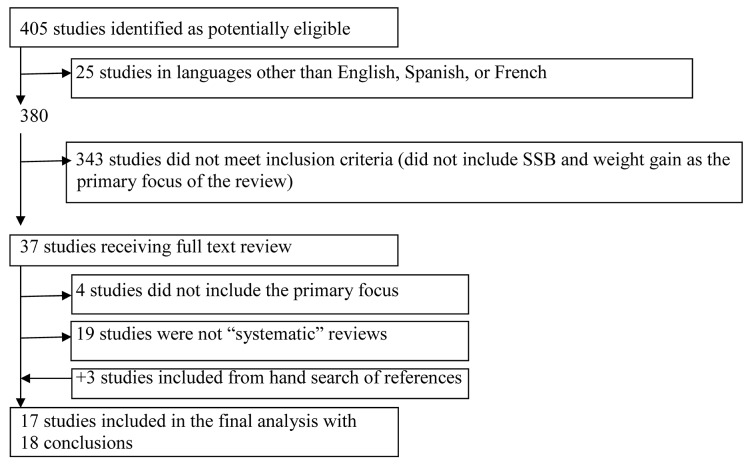
“Results Our final study was based on 17 out of 405 potentially eligible articles (Figure 1) [14–30].”
Scope and Impact of Financial Conflicts of Interest in Biomedical Research: A Systematic Review
Bekelman, J. E., Li, Y., & Gross, C. P. (2003) · JAMA · doi:10.1001/jama.289.4.454 · Cited by 1,816 · cited 2×
“This issue has been thoroughly discussed in pharmaceutical studies, where the dangers of the use of so-called scientific evidence in industry marketing and profit-making strategies have been noted [3–6].”
BackgroundMalik, V. S., Pan, A., Willett, W. C., & Hu, F. B. (2013) · The American Journal of Clinical Nutrition · doi:10.3945/ajcn.113.058362 · Cited by 1,668 · cited 3×
“We identified only two SRs [15,29] that specifically reported using the PRISMA guidelines as the standard method for conducting and reporting the meta-analysis.”
BackgroundMethodMoodie, R., Stuckler, D., Monteiro, C., Sheron, N., Neal, B., Thamarangsi, T., Lincoln, P., & Casswell, S. (2013) · The Lancet · doi:10.1016/s0140-6736(12)62089-3 · Cited by 1,663
Te Morenga, L., Mallard, S., & Mann, J. (2012) · BMJ · doi:10.1136/bmj.e7492 · Cited by 1,629 · cited 3×
“One of the reviews [15] was identified twice because the analyses were reported separately for adults and children/ adolescents and achieved different conclusions; therefore we included a total of 18 conclusions from the 17 SRs in the analysis.”
Method
Research works printed but not linked: 1
- Lesser LI (2009) Reducing potential bias in industry-funded nutrition research. Am J Clin Nutr 90: 699– 700. 19625682 · DOI
Cited by
Items 101–200 of 341
Assessment of Antipsychotic Medications on Social Media: Machine Learning Study
Álvarez-Mon, M. Á., Donat‐Vargas, C., Santoma-Vilaclara, J., de Anta, L., Goena, J., Sánchez-Bayona, R., Mora, F., Ortega, M. A., Lahera, G., Rodríguez–Jiménez, R., et al. (2021) · Frontiers in Psychiatry · doi:10.3389/fpsyt.2021.737684 · Cited by 25
“Previous research has suggested that it may be in the best interest of health care providers and the pharmaceutical industry to focus on disease diagnosis and treatment (62, 63).”
BackgroundRaichand, S., Dunn, A. G., Ong, M.-S., Bourgeois, F. T., Coiera, E. W., & Mandl, K. D. (2017) · Systematic Reviews · doi:10.1186/s13643-017-0495-6 · Cited by 24
“These studies have often examined financial and non-financial competing interests [10, 11, 15].”
BackgroundHarris, J., Anderson, M., Clément, C., & Nisbett, N. (2019) · IDS Bulletin · doi:10.19088/1968-2019.112 · Cited by 21
Berman, A. (2020) · European Journal of International Law · doi:10.1093/ejil/chab014 · Cited by 29
Dietary Sodium 'Controversy'—Issues and Potential Solutions
Campbell, N. R. C., He, F. J., Cappuccio, F. P., & MacGregor, G. A. (2021) · Current Nutrition Reports · doi:10.1007/s13668-021-00357-1 · Cited by 21
Science and Public Health on Trial
Schillinger, D., & Jacobson, M. F. (2016) · JAMA · doi:10.1001/jama.2016.10516 · Cited by 21
‘Spin’ in reports of clinical research
Mahtani, K. R. (2016) · BMJ Evidence-Based Medicine · doi:10.1136/ebmed-2016-110570 · Cited by 22
“As an example, an overview of systematic reviews examined whether financially related COI influenced the overall conclusions from systematic reviews that examined the relationship between the consumption of sugar-sweetened beverages (SSBs) and weight gain or obesity.(11) Of the included studies, 5/6 systematic reviews…”
BackgroundGonzález‐Palacios, S., Navarrete‐Muñoz, E. M., de la Hera, M. G., Torres‐Collado, L., Santa‐Marina, L., Amiano, P., López-Espinosa, M.-J., Tardón, A., Galán, I. R., Vrijheid, M., et al. (2019) · Nutrients · doi:10.3390/nu11081772 · Cited by 27
“The association between SCB and obesity has been extensively investigated, and despite some controversy [15,16], the present evidence supports a positive association between SCB consumption and weight gain, particularly among adults [17–19] and, to a lesser extent, among children [20–24].”
ResultLauber, K., McGee, D., & Gilmore, A. (2021) · BMJ Global Health · doi:10.1136/bmjgh-2021-006176 · Cited by 33
Evaluation of Drinks Contribution to Energy Intake in Summer and Winter
Malisova, O., Bountziouka, V., Zampelas, A., & Kapsokefalou, M. (2015) · Nutrients · doi:10.3390/nu7053724 · Cited by 23
“It has been the focus of many studies and of scientific reviews, some of which have been questioned for their scientific objectivity; it was observed that financial conflicts of interest, namely industry funding, may bias conclusions from systematic reviews on SSB consumption and weight gain or obesity [34,35].”
Eisner, M., Humphreys, D. K., Wilson, P., & Gardner, F. E. M. (2015) · PLoS ONE · doi:10.1371/journal.pone.0142803 · Cited by 23
“Systematic reviews and meta-analyses consistently show a positive association between reported effect sizes and a CoI of the study authors.[3, 35, 36] Therefore practitioners, researchers and policy makers in public health increasingly expect transparency about conflicts of interests in academic research.”
BackgroundConflict of Interests in the Scientific Production on Vitamin D and COVID-19: A Scoping Review
Passini, C. S. M., Cavalcanti, M. B., Ribas, S. A., de Carvalho, C. M. P., Santos, C. R. B., & Lamarca, F. (2022) · Frontiers in Public Health · doi:10.3389/fpubh.2022.821740 · Cited by 19
Is Sugar the new Tobacco? Insights from Laboratory Studies, Consumer Surveys and Public Health
Bodo, Y. L., Paquette, M.-C., Vallières, M., & Alméras, N. (2015) · Current Obesity Reports · doi:10.1007/s13679-015-0141-3 · Cited by 21
Connell, J., Toma, R., Ho, C. H.-C., Shen, N., Moura, P., Le, T., Patridge, E. V., Antoine, G., Keiser, H., Julian, C., et al. (2023) · American Journal of Lifestyle Medicine · doi:10.1177/15598276231216393 · Cited by 21
Newton, A., Lloyd‐Williams, F., Bromley, H., & Capewell, S. (2016) · BMC Public Health · doi:10.1186/s12889-016-3393-2 · Cited by 28
“Industry funded literature reviews are also known to be susceptible to industry influence from CoI [9, 15, 16].”
BackgroundAlimentação e saúde: a fundamentação científica do guia alimentar para a população brasileira
Louzada, M. L. D. C., Canella, D. S., Jaime, P. C., & Monteiro, C. A. (2021) · Universidade de São Paulo. Faculdade de Saúde Pública eBooks · doi:10.11606/9788588848344 · Cited by 71
Conflicts of Interest in GM Bt Crop Efficacy and Durability Studies
Guillemaud, T., Lombaert, E., & Bourguet, D. (2016) · PLOS ONE · doi:10.1371/journal.pone.0167777 · Cited by 18
“[2] and has been identified in other fields, including those of tobacco [7], biomedical [8], nuclear [9], sugar [10] and pharmaceutical [11] research.”
BackgroundResearch agendas for profitable invasive species
Kourantidou, M., & Kaiser, B. (2018) · Journal of Environmental Economics and Policy · doi:10.1080/21606544.2018.1548980 · Cited by 19
Joksimovic, L., Koucheki, R., Popovic, M. M., Ahmed, Y., Schlenker, M. B., & Ahmed, I. I. K. (2017) · British Journal of Ophthalmology · doi:10.1136/bjophthalmol-2017-310313 · Cited by 19
Griffin, T. L., Jackson, D. M., McNeill, G., Aucott, L. S., & Macdiarmid, J. I. (2015) · Journal of Nutrition Education and Behavior · doi:10.1016/j.jneb.2015.03.009 · Cited by 19
Tiller, N. B., & Ekkekakis, P. (2023) · Kinesiology Review · doi:10.1123/kr.2022-0039 · Cited by 19
Zoellner, J., Porter, K., You, W., Reid, A., Frederick, C., Hilgart, M. M., Brock, D. P., Tate, D. F., & Ritterband, L. M. (2021) · Contemporary Clinical Trials · doi:10.1016/j.cct.2021.106566 · Cited by 17
The Problem of Biased Data and Potential Solutions for Health and Environmental Assessments
Suter, G. W., & Cormier, S. M. (2014) · Human and Ecological Risk Assessment An International Journal · doi:10.1080/10807039.2014.974499 · Cited by 17
“However, statistical evidence for the occurrence of funding bias is extensive (Als-Nielsen et al. 2003; Bekelman et al. 2003; Bes-Rastrollo et al. 2013; Blumenthal 2003; Krauth et al. 2014; Lexchin et al. 2003; Lund et al. 2012; McGarity and Wagner 2008; Nieto et al. 2007).”
BackgroundKrimsky, S., & Schwab, T. (2017) · PLoS ONE · doi:10.1371/journal.pone.0172317 · Cited by 18
“The “funding effect” has been reported across a number of fields, including pharmaceuticals [8], chemical toxicology [9], tobacco [10], surgery [11], mobile phones [12], nutrition [13], and biotechnology.”
BackgroundPublic-Private Partnerships and Undernutrition: Examples and Future Prospects
Hoddinott, J. F., Gillespie, S., & Yosef, S. (2016) · World review of nutrition and dietetics · doi:10.1159/000442110 · Cited by 17
Gómez‐Donoso, C., Martínez‐González, M. Á., Martínez, J. A., Sayón-Orea, C., de la Fuente‐Arrillaga, C., & Bes‐Rastrollo, M. (2019) · PLoS ONE · doi:10.1371/journal.pone.0226565 · Cited by 21
Self-citationMacintyre, A. K., Marryat, L., & Chambers, S. (2018) · Pediatric Obesity · doi:10.1111/ijpo.12284 · Cited by 20
“Even with methodological issues (6), and concerns over industry funding (7), available evidence has formed the basis for levies on SSBs, such as in Mexico (2), and the forthcoming ‘sugar tax’ in the United Kingdom.”
Costly Distractions: Focusing on Individual Behavior Undermines Support for Systemic ReformsPreprint
Hagmann, D., Liao, Y.-T., Chater, N., & Loewenstein, G. F. (2023) · SSRN Electronic Journal · doi:10.2139/ssrn.4426034 · Cited by 26
Industry-Funded Research and Bias in Food Science
Rao, A. (2020) · Quantitative Marketing and Economics · doi:10.1007/s11129-021-09244-z · Cited by 15
Vaganay, A. (2016) · PLoS ONE · doi:10.1371/journal.pone.0163702 · Cited by 20
Involvement of the food industry in nutrition conferences in Latin America and the Caribbean
Mialon, M., Jaramillo, Á., Caro, P., Flores, M., González, L., Gutiérrez‐Gómez, Y. Y., Mendivil, L. L., López‐Arana, S., López-Bautista, F., Mata, C. L., et al. (2020) · Public Health Nutrition · doi:10.1017/s1368980020003870 · Cited by 19
“There is evidence that the food industry’s involvement in nutrition research more broadly, through its funding to studies, leads to biased results towards the products manufactured by these companies(20,21).”
BackgroundKeller, F., Marczewski, K., & Pavlović, D. (2016) · Croatian Medical Journal · doi:10.3325/cmj.2016.57.398 · Cited by 14
Álvarez-Mon, M. Á., Fernandez-Lazaro, C. I., Llavero-Valero, M., Álvarez‐Mon, M., Mora, S., Martínez‐González, M. Á., & Bes‐Rastrollo, M. (2022) · International Journal of Environmental Research and Public Health · doi:10.3390/ijerph19020784 · Cited by 17
“First, it may be in the best interest of business organizations such as pharmaceutical companies and health providers to focus on disease diagnosis and treatment rather than on promoting health and preventing disease [49,50].”
BackgroundSelf-citationMcCambridge, J., & Golder, S. (2023) · Addictive Behaviors · doi:10.1016/j.addbeh.2023.107932 · Cited by 15
Mirmiran, P., Ejtahed, H., Bahadoran, Z., Bastan, S., & Azizi, F. (2015) · PubMed Central · Cited by 19
Davis, M. M., Spurlock, M., Ramsey, K., Smith, J. B., Beamer, B. A., Aromaa, S., & McGinnis, P. B. (2017) · The Journal of School Nursing · doi:10.1177/1059840517703744 · Cited by 18
Framework legislation for non-communicable diseases: and for the Sustainable Development Goals?
Magnusson, R. (2017) · BMJ Global Health · doi:10.1136/bmjgh-2017-000385 · Cited by 14
Commercial interests, agenda setting, and the epistemic trustworthiness of nutrition science
Jukola, S. (2019) · Synthese · doi:10.1007/s11229-019-02228-3 · Cited by 17
The intersections of industry with the health research enterprise
Akl, E. A., & Khamis, A. M. (2019) · Health Research Policy and Systems · doi:10.1186/s12961-019-0457-7 · Cited by 16
“A study examining systematic reviews on sugar-sweetened beverages found that authors with industry-related financial conflicts of interest (COIs) were five times more likely to report no positive association between the sugar-sweetened beverages and weight gain, compared to reviewers with no industry-related COIs [27].”
BackgroundInfluentialZoellner, J., You, W., Porter, K., Kirkpatrick, B. M., Reid, A., Brock, D. P., Chow, P. I., & Ritterband, L. M. (2024) · International Journal of Behavioral Nutrition and Physical Activity · doi:10.1186/s12966-024-01594-7 · Cited by 17
“Epidemiological data, including high-quality systematic reviews, demonstrate relationships between SSB and weight among adolescents and adults [20, 21, 28, 103, 104].”
BackgroundCaivano, S., Lopes, R. F., Sawaya, A. L., Domene, S. M. Á., & Martins, P. (2017) · DEMETRA Alimentação Nutrição & Saúde · doi:10.12957/demetra.2017.26928 · Cited by 58
KONES, R. J., Rumana, U., & Merino, J. (2014) · Current Medical Research and Opinion · doi:10.1185/03007995.2014.925438 · Cited by 15
Conflicts of Interest in Nutrition Research
Ludwig, D. S., Kushi, L. H., & Heymsfield, S. B. (2018) · JAMA · doi:10.1001/jama.2018.5658 · Cited by 14
Castetbon, K., Assakali, W., Thiébaut, I., & Desbouys, L. (2023) · Trials · doi:10.1186/s13063-023-07643-z · Cited by 13
Lafontan, M., Visscher, T. L. S., Farpour‐Lambert, N. J., & Yumuk, V. (2015) · Obesity Facts · doi:10.1159/000375103 · Cited by 14
Comparing alternative design options for chronic disease prevention interventions
Golfam, M., Beall, R. F., Brehaut, J., Saeed, S., Relton, C., Ashbury, F. D., & Little, J. (2014) · European Journal of Clinical Investigation · doi:10.1111/eci.12371 · Cited by 15
Badejo, A. A., Olawoyin, B., Salawu, S. O., Fasuhanmi, O. S., Boligon, A. A., & Enujiugha, V. N. (2017) · Journal of Food Measurement & Characterization · doi:10.1007/s11694-017-9593-3 · Cited by 12
Ferrell, S. C., Demla, S., Anderson, J. M., Weaver, M., Torgerson, T., Hartwell, M. L., & Vassar, M. B. (2021) · Journal of Substance Abuse Treatment · doi:10.1016/j.jsat.2021.108598 · Cited by 10
Buchman, D. Z., & Rosenbaum, D. (2024) · Public Health Ethics · doi:10.1093/phe/phae002 · Cited by 11
Jane, B., & Gibson, K. (2017) · Journal of Public Health · doi:10.1093/pubmed/fdx065 · Cited by 13
Children’s Right to Freedom From Obesity: Responsibilities of the Food Industry
Cathaoir, K. Ó. (2018) · Nordic Journal of Human Rights · doi:10.1080/18918131.2018.1505090 · Cited by 10
Hoffmann, N. (2018) · Journal of Contemporary African Studies · doi:10.1080/02589001.2019.1579893 · Cited by 10
“…the strong association between industry funding of clinical trials and pro-industry results (Mirowski and Van Horn 2005; Norris et al. 2011; Bes-Rastrollo et al. 2013), scholars have only recently begun to examine the role of a conflict of interests in policy experiments (Faulkner 2014;…”
BackgroundBragg, M. A., Elbel, B. D., & Nestle, M. (2020) · International Journal of Environmental Research and Public Health · doi:10.3390/ijerph17051624 · Cited by 11
Sugar Consumption and Oral Health
Heilmann, A., Machuca, C., & Watt, R. G. (2020) · Textbooks in contemporary dentistry · doi:10.1007/978-3-030-50123-5_19 · Cited by 12
Mapping the (anti-)corruption field: key topics and changing trends, 1968–2020
Alvarez, J. P., & Sanz, I. P. (2021) · Journal of Computational Social Science · doi:10.1007/s42001-021-00110-2 · Cited by 22
Is the Psychopathic Brain an Artifact of Coding Bias? A Systematic Review
Jalava, J., Griffiths, S. Y., Larsen, R. R., & Alcott, B. E. (2021) · Frontiers in Psychology · doi:10.3389/fpsyg.2021.654336 · Cited by 13
“These include funding bias (e.g., Jørgensen et al., 2006; Bes-Rastrollo et al., 2013; Mandrioli et al., 2016), citation bias [Duyx et al.”
BackgroundRegional survey supports national initiative for ‘water‐only’ schools in New Zealand
Mansoor, O., Ali, R., & Richards, R. F. (2017) · Australian and New Zealand Journal of Public Health · doi:10.1111/1753-6405.12705 · Cited by 11
del Pino, A., & Royo‐Bordonada, M. Á. (2016) · Public Health Ethics · doi:10.1093/phe/phw029 · Cited by 10
Controversy and debate: Memory-Based Methods Paper 4
Martín‐Calvo, N., & Martínez‐González, M. Á. (2018) · Journal of Clinical Epidemiology · doi:10.1016/j.jclinepi.2018.08.004 · Cited by 10
Conflicts of interest in nutritional sciences: The forgotten bias in meta-analysis
Lucas, M. (2015) · World Journal of Methodology · doi:10.5662/wjm.v5.i4.175 · Cited by 14
Hakoum, M. B., Bou-Karroum, L., Al‐Gibbawi, M., Khamis, A. M., Raslan, A. S., Badour, S. A., Agarwal, A., Alturki, F., Guyatt, G. H., El‐Jardali, F., et al. (2020) · BMJ Open · doi:10.1136/bmjopen-2019-032425 · Cited by 9
Allegiance Effects in Clinical Psychology Research and Practice
Boccaccini, M. T., Marcus, D. K., & Murrie, D. C. (2017) · Wiley eBooks · doi:10.1002/9781119095910.ch16 · Cited by 13
Identifying and mitigating bias in multiple aspects of modern clinical research
Thambiraj, G., & Armoundas, A. A. (2026) · Communications Medicine · doi:10.1038/s43856-026-01721-4 · Cited by 10
Wiessing, K. R., Xin, L., Budgett, S. C., & Poppitt, S. D. (2015) · European Journal of Clinical Nutrition · doi:10.1038/ejcn.2015.107 · Cited by 12
Should comparative effectiveness research ignore industry-funded data?
Dunn, A. G., & Coiera, E. W. (2014) · Journal of Comparative Effectiveness Research · doi:10.2217/cer.14.31 · Cited by 8
Gomes, F. D. S., Silva, G. D. A. E., & de Castro, I. R. R. (2017) · Cadernos de Saúde Pública · doi:10.1590/0102-311x00023316 · Cited by 9
Navarrete‐Muñoz, E. M., Tardón, A., Romaguera, D., Martínez‐González, M. Á., & Vioqué, J. (2017) · Gaceta Sanitaria · doi:10.1016/j.gaceta.2017.04.002 · Cited by 9
Macedo, R. C. O., Vieira, A., Moritz, C. E. J., & Reischak-Oliveira, Á. (2018) · British Journal Of Nutrition · doi:10.1017/s0007114518001538 · Cited by 12
“industry on several health outcomes has been discussed, as well as how it could modify guidelines of nutrition((41,51,52)).”
Dissidents and dietary sodium: concerns about the commentary by O’Donnellet al.
Campbell, N. R. C. (2016) · International Journal of Epidemiology · doi:10.1093/ije/dyw292 · Cited by 12
Vos, M., van Soest, A. P. M., van Wingerden, T., Janse, M. L., Dijk, R. M., Brouwer, R. J., de Koning, I., Feskens, E. J. M., & Sierksma, A. (2020) · Advances in Nutrition · doi:10.1093/advances/nmaa052 · Cited by 6
The Human Right to Science: History, Development, and Normative Content
Romano, C. P. R., & Boggio, A. (2024) · Oxford University Press eBooks · doi:10.1093/law/9780197768990.001.0001 · Cited by 20
Dunn, A. G., Zhou, X., Hudgins, J. D., Arachi, D., Mandl, K. D., Coiera, E. W., & Bourgeois, F. T. (2016) · Journal of Clinical Epidemiology · doi:10.1016/j.jclinepi.2016.07.010 · Cited by 10
Conflicts of interest and the (in)dependence of experts advising government on immunization policies
Bélisle‐Pipon, J., Ringuette, L., Cloutier, A.-I., Doudenkova, V., & Williams–Jones, B. (2018) · Vaccine · doi:10.1016/j.vaccine.2018.10.058 · Cited by 9
Sweeteners: Regulatory Aspects
García‐Almeida, J. M., Cornejo-Pareja, I. M., Muñoz‐Garach, A., Gómez‐Pérez, A. M., & García-Alemán, J. (2018) · Reference series in phytochemistry · doi:10.1007/978-3-319-27027-2_12 · Cited by 7
Christian, A. (2022) · Frontiers in Research Metrics and Analytics · doi:10.3389/frma.2022.775336 · Cited by 8
“…editing technologies 16See the following systematic reviews on the corrupting influence of financial conflicts of interest onmedical research (Bes-Rastrollo et al., 2013; Feuerstein et al., 2013; Lieb et al., 2016; Mandrioli et al., 2016; Probst et al., 2016; Narain et al., 2017; Zhang et…”
BackgroundSisti, J. S., Mezzacca, T. A., Anekwe, A. V., & Farley, S. M. (2020) · Journal of Community Health · doi:10.1007/s10900-020-00911-y · Cited by 7
“Corporations can reformulate and limit advertising of unhealthy products, cease funding and lobbying for state-level legislation that would preempt the rights of localities to tax sugary drink sales, and reduce their role in nutrition research [31, 32].”
BackgroundThe Health of People: How the social sciences can improve population health
Science, C. F. S. (2017) · SAGE Publications Ltd eBooks · doi:10.4135/9781473998889 · Cited by 10
Understanding and Managing Corporate Conflicts of Interest
Cullerton, K. B., & White, M. J. (2022) · Oxford University Press eBooks · doi:10.1093/oso/9780197578742.003.0030 · Cited by 6
Zaltz, D. A., Bisi, L. E., Ruskin, G., & Hoe, C. (2022) · Globalization and Health · doi:10.1186/s12992-022-00884-8 · Cited by 9
Poli, A., Marangoni, F., Agostoni, C. V., Brancati, F., Capurso, L., Colombo, M. L., Ghiselli, A., Vecchia, C. L., Molinari, E., Morelli, L., et al. (2018) · European Journal of Nutrition · doi:10.1007/s00394-018-1633-1 · Cited by 6
“, bias leading to distortion of information in the service of what may be perceived to be righteous ends) [9].”
BackgroundDietary disclosures: how important are non-financial interests?
Schwab, T. (2018) · BMJ · doi:10.1136/bmj.k1451 · Cited by 6
Pradhan, R., Garnick, K., Barkondaj, B., Jordan, H. S., Ash, A. S., & Yu, H. (2018) · Journal of Clinical Epidemiology · doi:10.1016/j.jclinepi.2018.05.024 · Cited by 6
Sugar-Sweetened Beverage Taxes: the Potential for Cardiovascular Health
Backholer, K., & Baker, P. (2018) · Current Cardiovascular Risk Reports · doi:10.1007/s12170-018-0593-6 · Cited by 7
An Evidence-Hierarchical Decision Aid for Ranking in Evidence-Based Medicine
Landes, J. (2020) · Boston studies in the philosophy of science · doi:10.1007/978-3-030-29179-2_11 · Cited by 7
The role of public health dietary messages and guidelines in tackling overweight and obesity issues
Lee, Y. Y., Tan, D., Siri, J. G., Newell, B., Gong, Y., Proust, K., & Marsden, T. (2020) · Malaysian Journal of Nutrition · doi:10.31246/mjn-2019-0084 · Cited by 9
“Acquiring and using this knowledge depends on early and consistent community engagement and participation in both research and policy processes, before problems and potential solutions are formulated (Bodison et al., 2015).”
BackgroundConflicts of interest among scientific foundations and societies in the field of childhood nutrition
Guzmán-Caro, G., López, F. J. G., & Royo‐Bordonada, M. Á. (2020) · Gaceta Sanitaria · doi:10.1016/j.gaceta.2020.03.008 · Cited by 6
Hakoum, M. B., Noureldine, H. A., Habib, J. R., Abou-Jaoude, E. A., Raslan, R., Jouni, N., Hasbani, D. J., Lopes, L. C., Guyatt, G. H., & Akl, E. A. (2020) · Journal of Clinical Epidemiology · doi:10.1016/j.jclinepi.2020.05.026 · Cited by 7
In reply—Fructose as a Driver of Diabetes: An Incomplete View of the Evidence
DiNicolantonio, J. J., O’Keefe, J. H., & Lucan, S. C. (2015) · Mayo Clinic Proceedings · doi:10.1016/j.mayocp.2015.04.018 · Cited by 7
“Another systematic review revealed a striking dichotomy: more than 80% of industryfunded studies reported no relationship between sugar-sweetened beverage consumption and weight gain, whereas more than 80% of noneindustryfunded studies found a positive correlation between intake of sugar-sweetened beverages and weight…”
BackgroundConnell, J., Toma, R., Ho, C. H.-C., Shen, N., Moura, P., Le, T., Cai, Y., Tanton, D., Banavar, G. S., & Vuyisich, M. (2021) · Research Square · doi:10.21203/rs.3.rs-504357/v1 · Cited by 8
Software engineering principles address current problems in the systematic review ecosystem
Bashir, R., & Dunn, A. G. (2018) · Journal of Clinical Epidemiology · doi:10.1016/j.jclinepi.2018.12.014 · Cited by 6
Sweet Beverages and Cancer: A Scoping Review of Quantitative Studies
Yeary, K. H.-C. K., Quisenberry, A. J., Hall, M. G., Yu, H., Henry, W. A. E., Rodriguez, E. M., & Zoellner, J. (2022) · Cancer Prevention Research · doi:10.1158/1940-6207.capr-21-0507 · Cited by 5
O’Connor, C., & Freeborn, D. (2025) · Philosophy of Science · doi:10.1017/psa.2025.1 · Cited by 5
Sugar's web of influence 2: Biasing the science
Gornall, J. (2015) · BMJ · doi:10.1136/bmj.h215 · Cited by 5
Quality Assessment of Systematic Review of the Bariatric Surgery for Diabetes Mellitus
Jin, X., Wang, J., Li, X., An, P., Wang, H., Mao, W., Zhou, Q. X., Chen, Y., Wang, J., Chen, K., et al. (2019) · Journal of Diabetes Research · doi:10.1155/2019/9541638 · Cited by 5
Decolonising research, advocacy and public policy on healthy diets
Mialon, M. (2023) · PLOS Global Public Health · doi:10.1371/journal.pgph.0002140 · Cited by 4
“For example, research where a conflict of interest or funding from the food industry was declared is five times more likely to report no association between the consumption of sugarsweetened beverages and weight gain, compared to independent research [8].”
ResultSystem-practice entanglements and the harms of Ultra-Processed Foods
Bennett, J., Broom, A. F., Kenny, K., Sholl, J., & Raubenheimer, D. (2025) · Food Culture & Society · doi:10.1080/15528014.2025.2474269 · Cited by 5
Lawrence, M. A. (2023) · Public Health Nutrition · doi:10.1017/s1368980023000629 · Cited by 4
“For example, it has been reported that findings from systematic reviews of sugar-sweetened beverage consumption and weight gain in which the researchers’ declared interests with UPF manufacturers were less likely to be counter to the sponsor’s interests than reviews on the same topic where no interests were declared(2…”
BackgroundBlanchard, L., Bridge, G., Bidonde, J., Egan, M., Rutter, H., Petticrew, M. P., Lucas, P. J., Kent, M. P., Bennett, C., Ray, S., et al. (2025) · Obesity Reviews · doi:10.1111/obr.13952 · Cited by 4
“For example, the influence of the food industry, which has competing interests, on food and nutrition research has been demonstrated multiple times [62–64].”
Disclosures of Coca-Cola funding: transparent or opaque?
Tseng, M., Barnoya, J., Kruger, S., Lachat, C. K., Vandevijvere, S., & Villamor, E. (2018) · Public Health Nutrition · doi:10.1017/s1368980018000691 · Cited by 4
Disease Prevention with a Plant-based Lifestyle
Vyas, S. V. (2019) · BRILL eBooks · doi:10.1163/9789004391192_005 · Cited by 7
Metadata
- Authors
- Bes-Rastrollo, M., Schulze, M. B., Ruiz-Canela, M., & Martinez-Gonzalez, M. A.
- Affiliations
- German Institute of Human Nutrition (DE)
- ORCID
- Schulze, Matthias B.
- Venue
- PLoS Medicine
- Publisher
- Public Library of Science (PLoS)
- Published
- 2013-12-31
- Volume
- 10
- Issue
- 12
- Pages
- e1001578
- ISSN
- 1549-1277 (ISSN-L)
- 1549-1676
- PMC
- PMC3876974
- OpenAlex
- W2114549073
- Cited by
- 343
- References
- 51
- Citations by year
- 2026: 6 · 2025: 19 · 2024: 37 · 2023: 23 · 2022: 16 · 2021: 21 · 2020: 31 · 2019: 33 · 2018: 35 · 2017: 38 · 2016: 42 · 2015: 27 · 2014: 14 · 2013: 1
- FWCI
- 4.58
- Type
- journal article
- Language
- en
- Open access
- gold
- doi.org
- Licence
- Locations
- PLoS Medicine (publishedVersion, cc-by)
- PubMed Central (publishedVersion, cc-by)
- PubMed (publishedVersion)
- RePEc: Research Papers in Economics (publishedVersion)
- Deposito Adademico Digital Universidad De Navarra (University of Navarra) (submittedVersion, other-oa)
- DOAJ (DOAJ: Directory of Open Access Journals) (submittedVersion, cc-by-sa)
- Figshare (submittedVersion, cc-by)
- Topics
- Health Sciences › Nursing › Issues, ethics and legal aspects › Pharmaceutical industry and healthcare
- Health Sciences › Medicine › Public Health, Environmental and Occupational Health › Global Public Health Policies and Epidemiology
- Social Sciences › Decision Sciences › Statistics, Probability and Uncertainty › Meta-analysis and systematic reviews
- Keywords
- financial conflicts of interest, industry funding, sugar-sweetened beverages, weight gain, obesity, reporting bias, conflict of interest disclosure, publication bias
- MeSH terms
- Beverages, Humans, Obesity, Sweetening Agents, Weight Gain, Conflict of Interest
About these checks
Registry, retraction, Cites and statistics results are computed, not judged, with one exception: a printed reference that no index lists is read once by a model before it counts as a citation error. Claims are extracted by a model and kept only when their quote appears verbatim in the text; each cited source is then checked, with a model’s help, for whether it says what the claim relies on. Those verdicts can be wrong — read the claim’s quote and the cited source before relying on one.
Statistics and arithmetic are recomputed, not judged.
Confidence bands are shown only for fields calibrated on our annotated test set. None is calibrated yet, so no band is shown.
What counts as a claim ›How we measure confidence ›How we check this ›
Are you an author, or do you see a problem with this page? Request a review
Data sources
Bibliographic data: Semantic Scholar, OpenAlex, Crossref.
Contains information from the Semantic Scholar Academic Graph Datasets, made available under the ODC Attribution License (ODC-BY 1.0).
Semantic Scholar’s data is described in: Kinney, R., et al. (2023). The Semantic Scholar Open Data Platform. arXiv:2301.10140.
