

Financial Conflicts of Interest and Reporting Bias Regarding the Association between Sugar-Sweetened Beverages and Weight Gain: A Systematic Review of Systematic Reviews
Open accessThe DOI matches its Crossref record; 50 of the 51 references it cites were found in a registry or an index.
Abstract
BACKGROUND: Industry sponsors' financial interests might bias the conclusions of scientific research. We examined whether financial industry funding or the disclosure of potential conflicts of interest influenced the results of published systematic reviews (SRs) conducted in the field of sugar-sweetened beverages (SSBs) and weight gain or obesity. METHODS AND FINDINGS: We conducted a search of the PubMed, Cochrane Library, and Scopus databases to identify published SRs from the inception of the databases to August 31, 2013, on the association between SSB consumption and weight gain or obesity. SR conclusions were independently classified by two researchers into two groups: those that found a positive association and those that did not. These two reviewers were blinded with respect to the stated source of funding and the disclosure of conflicts of interest. We identified 17 SRs (with 18 conclusions). In six of the SRs a financial conflict of interest with some food industry was disclosed. Among those reviews without any reported conflict of interest, 83.3% of the conclusions (10/12) were that SSB consumption could be a potential risk factor for weight gain. In contrast, the same percentage of conclusions, 83.3% (5/6), of those SRs disclosing some financial conflict of interest with the food industry were that the scientific evidence was insufficient to support a positive association between SSB consumption and weight gain or obesity. Those reviews with conflicts of interest were five times more likely to present a conclusion of no positive association than those without them (relative risk: 5.0, 95% CI: 1.3-19.3). An important limitation of this study is the impossibility of ruling out the existence of publication bias among those studies not declaring any conflict of interest. However, the best large randomized trials also support a direct association between SSB consumption and weight gain or obesity. CONCLUSIONS: Financial conflicts of interest may bias conclusions from SRs on SSB consumption and weight gain or obesity.
Overview
The claims and statistics of this paper haven’t been checked yet.
Free: it reads the open-access text and checks the first 5 claims that cite a source we can check. Create a free account to check every claim.
Integrity signals
Registry
Cites
Statistics
Figures
Verification
Claims the paper makes
The claims and statistics of this paper haven’t been checked yet.
Free: it reads the open-access text and checks the first 5 claims that cite a source we can check. Create a free account to check every claim.
Claims other papers make about this one
Each is checked against this paper’s own text: does it say what the citing paper says it does?
The source backs part of the claim, not all of it — or backs it for a different population, condition or comparison.
In the citing paper
“Reviews of the health effects of sugar sweetened beverages that are performed by authors with financial ties to food companies are five times more likely to conclude that there is no association of sugar consumption with weight gain compared to those with other sponsors (relative risk: 5.0, 95% CI: 1.3–19.3)[42].”
From Relationship between research outcomes and risk of bias, study sponsorship, and author financial conflicts of interest in reviews of the effects of artificially sweetened beverages on weight outcomes: a systematic review of reviews (2016) · cites this paper as [42]
Experimental — accuracy not yet measuredIn the citing paper
“Reviews of the health effects of sugar sweetened beverages performed by authors with financial ties to the sugar industry are five times more likely to conclude there is no association of sugar consumption with weight gain [42].”
Self-check
Percentages, sums and reported differences re-computed from the paper’s own numbers.
The self-check needs the paper’s full text.
Citations
Cites
Preferred Reporting Items for Systematic Reviews and Meta-Analyses: the PRISMA statement
Moher, D., Liberati, A., Tetzlaff, J., Altman, D. G., & for the PRISMA Group (2009) · BMJ · doi:10.1136/bmj.b2535 · Cited by 83,823
Preferred Reporting Items for Systematic Reviews and Meta-Analyses: The PRISMA Statement
Moher, D., Liberati, A., Tetzlaff, J., Altman, D. G., & The PRISMA Group (2009) · PLoS Medicine · doi:10.1371/journal.pmed.1000097 · Cited by 64,042 · cited 1×
“Methods Standard methods for conducting and reporting SRs were used [13].”
MethodPreferred reporting items for systematic reviews and meta-analyses: the PRISMA Statement.
(2009) · PubMed Central · Cited by 44,859
Preferred Reporting Items for Systematic Reviews and Meta-Analyses: The PRISMA Statement
Moher, D., Liberati, A., Tetzlaff, J., & Altman, D. G. (2009) · Journal of Clinical Epidemiology · doi:10.1016/j.jclinepi.2009.06.005 · Cited by 19,575
Intake of sugar-sweetened beverages and weight gain: a systematic review
Malik, V. S., Schulze, M. B., & Hu, F. B. (2006) · The American Journal of Clinical Nutrition · doi:10.1093/ajcn/84.2.274 · Cited by 2,100 · cited 1×
“Similarly, another food industry–funded SR [27] did not include one of the RCTs already included in a previous SR [28], and therefore available at the time of the literature search.”
BackgroundSelf-citationEffects of soft drink consumption on nutrition and health: a systematic review and meta-analysis
Vartanian, L. R., Schwartz, M. B., & Brownell, K. D. (2007) · American Journal of Public Health · doi:10.2105/ajph.2005.083782 · Cited by 1,863 · cited 1×
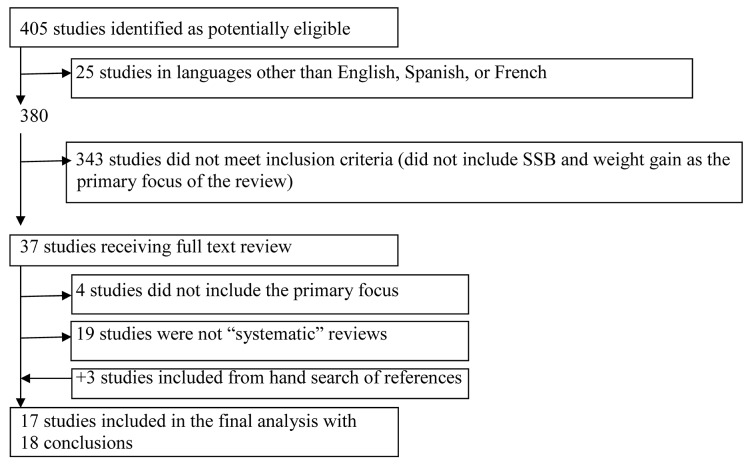
“Results Our final study was based on 17 out of 405 potentially eligible articles (Figure 1) [14–30].”
Scope and Impact of Financial Conflicts of Interest in Biomedical Research: A Systematic Review
Bekelman, J. E., Li, Y., & Gross, C. P. (2003) · JAMA · doi:10.1001/jama.289.4.454 · Cited by 1,816 · cited 2×
“This issue has been thoroughly discussed in pharmaceutical studies, where the dangers of the use of so-called scientific evidence in industry marketing and profit-making strategies have been noted [3–6].”
BackgroundMalik, V. S., Pan, A., Willett, W. C., & Hu, F. B. (2013) · The American Journal of Clinical Nutrition · doi:10.3945/ajcn.113.058362 · Cited by 1,668 · cited 3×
“We identified only two SRs [15,29] that specifically reported using the PRISMA guidelines as the standard method for conducting and reporting the meta-analysis.”
BackgroundMethodMoodie, R., Stuckler, D., Monteiro, C., Sheron, N., Neal, B., Thamarangsi, T., Lincoln, P., & Casswell, S. (2013) · The Lancet · doi:10.1016/s0140-6736(12)62089-3 · Cited by 1,663
Te Morenga, L., Mallard, S., & Mann, J. (2012) · BMJ · doi:10.1136/bmj.e7492 · Cited by 1,629 · cited 3×
“One of the reviews [15] was identified twice because the analyses were reported separately for adults and children/ adolescents and achieved different conclusions; therefore we included a total of 18 conclusions from the 17 SRs in the analysis.”
Method
Research works printed but not linked: 1
- Lesser LI (2009) Reducing potential bias in industry-funded nutrition research. Am J Clin Nutr 90: 699– 700. 19625682 · DOI
Cited by
Items 201–300 of 341
Dunn, A. G., Orenstein, L., Coiera, E. W., Mandl, K. D., & Bourgeois, F. T. (2019) · Journal of Clinical Epidemiology · doi:10.1016/j.jclinepi.2019.01.009 · Cited by 4
What Is and What Is Not a Conflict of Interest in the Sphere of Public Health
Royo‐Bordonada, M. Á., & López, F. J. G. (2019) · Springer eBooks · doi:10.1007/978-3-030-28626-2_14 · Cited by 5
Pan, J. H., Aykin‐Burns, N., Krager, K. J., Shin, H. R., Lee, C. H., Lee, J. H., Kong, B. C., Myoung, J., Choi, K., & Kim, J. K. (2025) · Experimental & Molecular Medicine · doi:10.1038/s12276-025-01584-0 · Cited by 3
Polson, C., Siex, P., Anderson, J. M., Weaver, M., Roberts, W., Hartwell, M. L., & Vassar, M. B. (2021) · Pain Medicine · doi:10.1093/pm/pnab223 · Cited by 4
Facts, Interests, and Values: Identifying Points of Convergence and Divergence for Food Systems
Deconinck, K. (2023) · Oxford University Press eBooks · doi:10.1093/oso/9780198882121.003.0002 · Cited by 4
García, G., Pérez‐Ríos, M., Ruano‐Raviña, A., & Candal‐Pedreira, C. (2024) · Journal of Clinical Epidemiology · doi:10.1016/j.jclinepi.2024.111313 · Cited by 3
Current philosophical perspectives on drug approval in the real world
Landes, J., & Auker‐Howlett, D. (2024) · Journal of Causal Inference · doi:10.1515/jci-2023-0011 · Cited by 3
How governments influence public health research: a scoping review
Senior, H. J., Teimouri, N., Waller, M., Capewell, S., & Cullerton, K. B. (2025) · Health Promotion International · doi:10.1093/heapro/daaf097 · Cited by 3
Pieper, D., Li, L., & Büchter, R. B. (2016) · Springer eBooks · doi:10.1007/978-3-319-25655-9_22 · Cited by 3
The semiconscious choice of food as a potential obesogenity marker
Plaza, P. D., & Alejandra, M. (2016) · Cited by 3
Mishali, M., Kisner, M., & Avrech, T. (2019) · International Dairy Journal · doi:10.1016/j.idairyj.2019.02.019 · Cited by 4
Value-aware nutrition science: building credibility through reflexivity
Penders, B., Bordoni, A., Daniel, H., Larqué, E., Laitinen, K., Pérez-Cueto, F. J. A., & WG2, F. (2025) · European Journal of Nutrition · doi:10.1007/s00394-025-03699-6 · Cited by 5
“This paper further discusses other potential sources of conflict, in response to wider calls for higher level consensus on standards that would provide venues for more transparent reporting in the field of nutrition [2, 3].”
Sweeteners: Regulatory Aspects
García‐Almeida, J. M., Cornejo-Pareja, I. M., Muñoz‐Garach, A., Gómez‐Pérez, A. M., & García-Alemán, J. (2016) · Reference series in phytochemistry · doi:10.1007/978-3-319-26478-3_12-1 · Cited by 3
Reflections from a casualty of the food industry research funding debate
Gillison, F. (2019) · BMJ · doi:10.1136/bmj.l2034 · Cited by 3
Evidence-Based Policymaking in the Food–Health Nexus
Rocha, C., & Harris, J. (2019) · IDS Bulletin · doi:10.19088/1968-2019.118 · Cited by 6
“Major discrepancies have been found, for example, between the results of industry-funded and non-industry-funded studies on the health impacts of sugar consumption and SSBs (Bes-Rastrollo et al. 2013; Vartanian, Schwartz and Brownell 2007).”
ResultJuárez, L. M., & Caballero, D. C. (2020) · AIBR Revista de Antropologia Iberoamericana · doi:10.11156/aibr.150104 · Cited by 3
Louzada, M. L. D. C., Canella, D. S., Jaime, P. C., & Monteiro, C. A. (2019) · Universidade de São Paulo. Faculdade de Saúde Pública eBooks · doi:10.11606/9788588848351 · Cited by 7
E‐synthesis for carcinogenicity assessments: A case study of processed meat
Pretis, F. D., Jukola, S., & Landes, J. (2022) · Journal of Evaluation in Clinical Practice · doi:10.1111/jep.13697 · Cited by 3
Reading the conflict of interest statement is as important as reading the result section
Pisinger, C. H. (2016) · Preventive Medicine · doi:10.1016/j.ypmed.2016.01.025 · Cited by 3
“The tobacco industry has been a ‘role model’ (Barnes & Bero, 1996; Bero, 2005; Proctor, 2011) for e.g. the food and sweet beverage industry (Bes-Rastrollo et al., 2013; Brownell & Warner, 2009) — so why expect that other industries with huge economic interests have a higher moral?”
BackgroundFood system PPPs: can they advance public health and business goals at the same time?
Fanzo, J., Shawar, Y. R., Shyam, T., Das, S., & Shiffman, J. (2020) · doi:10.36072/dp.6 · Cited by 8
Carr, M., Reddy, V., Anderson, M. C., Weaver, M., Hartwell, M. L., & Vassar, M. B. (2022) · Substance Abuse · doi:10.1080/08897077.2022.2074598 · Cited by 3
“COIs are more likely to conclude results as being supportive of treatment.(15,16,28) Our analysis shows over 30% of the”
Quis custodiet ipsos custodes?
González‐Marrón, A., Martínez-Sánchez, J. M., Martín‐Sánchez, J. C., Santander, N. M., & Cartanyà‐Hueso, À. (2018) · Medicina de Familia SEMERGEN · doi:10.1016/j.semerg.2018.06.001 · Cited by 2
Snellman, A., Carlberg, S., & Olsson, L. (2023) · Systematic Reviews · doi:10.1186/s13643-023-02342-x · Cited by 3
“An investigation of SRs published up to 2013 on sugar-sweetened beverages and weight gain or obesity found 35% of the SRs disclosed financial conflict of interest [9].”
BackgroundObesity and Metabolic Syndrome
Ettinger, S. E. (2016) · Elsevier eBooks · doi:10.1016/b978-0-12-803013-4.00001-6 · Cited by 4
Funding matters: time to update preferred reporting items for systematic reviews and meta-analyses?
Burgert, J. M., & Richards, G. C. (2025) · Journal of Clinical Epidemiology · doi:10.1016/j.jclinepi.2025.111678 · Cited by 2
Hu, B., Yi, Z., Bao, R., Zhao, Z., Liu, C., & Lin, A. (2025) · Journal of Medical Internet Research · doi:10.2196/68180 · Cited by 6
Disciplinary Differences in Conflict of Interest Policy Communication, Attitudes, and Knowledge
Canary, H. E., Hansen, K. D., Rinehart, M. D., May, K., & Barlow, J. (2015) · Journal of Research Administration · Cited by 2
Lucko, A., Doktorchik, C. T. A., & Campbell, N. R. C. (2018) · Journal of Clinical Hypertension · doi:10.1111/jch.13168 · Cited by 4
Crosbie, E., Schmidt, L., Krieger, J., & Nestle, M. (2022) · Oxford University Press eBooks · doi:10.1093/oso/9780197578742.003.0014 · Cited by 2
Ética de la salud pública: Casos de todo el mundo
de la Salud, O. P. (2022) · Pan American Health Organization eBooks · doi:10.37774/9789275325629 · Cited by 8
Summerville, L., Boas, S. R., Wee, C. E., Isbester, K., & Kumar, A. R. (2023) · Plastic & Reconstructive Surgery · doi:10.1097/prs.0000000000010606 · Cited by 2
“37 The code of the Pharmaceutical Research and Manufacturers of America, an organization representing pharmaceutical companies, includes provisions regarding consulting payments to physicians, including establishment of a written contract specifying the “nature of consulting services to be provided…”
BackgroundKeller, F., Marczewski, K., & Pavlović, D. (2016) · InTech eBooks · doi:10.5772/65104 · Cited by 2
“Conversely, also a declared conflict of interest can still negatively influence science and practice [28].”
BackgroundHashemipour, M. A., Pourmonajemzadeh, S., Tavana, S. Z., & Navabi, N. (2018) · Science and Engineering Ethics · doi:10.1007/s11948-018-0022-8 · Cited by 2
“Therefore, it is expected that authors converge their benefits of publication with each other, or disclose the COI of the research before publication (Ancker and Flanagin 2007; Bes-Rastrollo et al. 2013).”
BackgroundFeeding the World: Are Biotechnologies the Solution?
Bertheau, Y. (2015) · Wiley eBooks · doi:10.1002/9781118864463.ch06 · Cited by 2
Conflictos de interés en nutrición humana y dietética
Baladía, E., & Martínez-Rodríguez, R. (2016) · Revista Española de Nutrición Humana y Dietética · doi:10.14306/renhyd.20.2.261 · Cited by 2
A call to the European Congress on Obesity: It’s time to remove corporate sponsorship
British Medical Journal Publishing Group (2023) · BMJ · doi:10.1136/bmj.p755 · Cited by 2
Food industry donations to patient advocacy organisations focussed on non-communicable diseases
Giudice, I. M. D., Tsai, K. A., Arshonsky, J., Bond, S., & Bragg, M. A. (2022) · Public Health Nutrition · doi:10.1017/s1368980022001859 · Cited by 1
Maganja, D., Stanton, R. A., Bhaumik, S., & Jones, A. (2025) · Nutrition Reviews · doi:10.1093/nutrit/nuae210 · Cited by 1
Rethinking fussiness in commercial food contexts
Bennett, J., Harper, I., Broom, A. F., Kenny, K., Harris, H. A., Wright, F., & Raubenheimer, D. (2026) · Health Promotion International · doi:10.1093/heapro/daag063 · Cited by 1
Mert-Biberoğlu, F., Erdem, N. Z., Özdenkaya, Y., Özdemir, E. M., & Saka, B. (2023) · Obesity Surgery · doi:10.1007/s11695-023-06560-z · Cited by 1
de Lima, R. C., Silva, G. B. E., Mendonça, V. S., Malhão, T. A., Diógenes, M. E. L., & Huguenin, G. V. B. (2024) · Nutrition Reviews · doi:10.1093/nutrit/nuae110 · Cited by 1
Haozous, E. A., Yeary, K. H. K., Maybee, W., Porter, C., Zoellner, J., John, B., Henry, W. A. E., & Haring, R. C. (2024) · EXPLORE · doi:10.1016/j.explore.2024.103066 · Cited by 2
Teimouri, N., Sievert, K., Hannah, A., Meciar, S., Gill, K.-A., Senior, H. J., & Cullerton, K. B. (2026) · Obesity Reviews · doi:10.1111/obr.70153 · Cited by 1
“However, although detailed studies have examined industry influence on research in several food and beverage sectors [14, 15, 32], the meat industry has been largely unexamined.”
On the pitfalls of disclosure statements
Tseng, M., Hodge, A. M., Lachat, C. K., Vandevijvere, S., & Villamor, E. (2016) · Public Health Nutrition · doi:10.1017/s1368980016000070 · Cited by 1
Una evaluación crítica de la relación entre la industria alimentaria y la investigación en salud
León, J., Pastor‐Valero, M., & Hernández‐Aguado, I. (2017) · Gaceta Sanitaria · doi:10.1016/j.gaceta.2016.10.012 · Cited by 2
“…industria en productos lácteos Hubo resultados más favorables con financiación industrial (p < 0,001) No menciona fuente de financiación 15 Bes-Rastrollo et al.12 , 2013 Revisión sistemática 17 revisiones sistemáticas Relación financiación industria en bebidas azucaradas Hubo resultados…”
BackgroundThe Economic Impact of Dietary Sodium Reduction In Canada
Qureshi, H., Clement, F. M., Weaver, C., Campbell, N. R. C., & McBrien, K. (2017) · Value in Health · doi:10.1016/j.jval.2017.08.1197 · Cited by 1
Science for policy: the need for a Commission for Science
Hendy, S. (2016) · Policy Quarterly · doi:10.26686/pq.v12i3.4608 · Cited by 1
La influencia de la industria alimentaria en la ética del nutriólogo ¿A quién le conviene qué?
Suárez, C. C., & Hernández, K. G. C. (2019) · RESPYN Revista de Salud Pública y Nutrición · doi:10.29105/respyn18.4-3 · Cited by 4
Ethical Considerations (Conflict of Interest, Surgical Innovation, and End of Life)
Buie, W. D., & MacLean, A. R. (2021) · Springer eBooks · doi:10.1007/978-3-030-66049-9_69 · Cited by 1
Burkard, M., Huth, K., & Leitzmann, C. (2017) · Springer eBooks · doi:10.1007/978-3-662-54475-4_17 · Cited by 1
Al-Rawi, O. (2023) · Medicine Conflict & Survival · doi:10.1080/13623699.2023.2231690 · Cited by 1
“A ‘systematic review of systematic reviews’ demonstrated that the findings of reviews declaring financial conflicts of interest with the food & beverage industry were in direct contradiction to those which did not (Bes-Rastrollo et al. 2013).”
BackgroundLibro de ponencias del VI Congreso de la FEDN (2014)
Baladía, E. (2014) · Revista Española de Nutrición Humana y Dietética · doi:10.14306/renhyd.18.0.129 · Cited by 1
Hauner, H., & Holzapfel, C. (2015) · Adipositas - Ursachen Folgeerkrankungen Therapie · doi:10.1055/s-0037-1618942 · Cited by 2
Dafermos, G. N., & Pol, J. L. V. (2014) · Cited by 2
Reasons for Specifically Targeting Sugar-Sweetened Beverages
Bodo, Y. L., Paquette, M.-C., & Wals, P. D. (2016) · Springer eBooks · doi:10.1007/978-3-319-33648-0_2 · Cited by 1
“…on SSB consumption and weight gain (2006–2013) and suggest that it may have introduced a bias in their conclusions, since industry-funded reviews are significantly more likely to suggest weak evidence of an association than other reviews (Bes-Rastrollo et al. 2013; Massougbodji et al. 2014).”
BackgroundMartínez‐Ávila, D., & Gomes, L. (2018) · Liinc em Revista · doi:10.18617/liinc.v14i2.4313 · Cited by 1
Holla, R., & Schuftan, C. (2020) · World Nutrition · doi:10.26596/wn.2020114100-110 · Cited by 1
“…sector, research is often conducted or sponsored by food and beverage companies; this may influence the results and/or conclusions of the research (Bes-Rastrollo et al., 2013; Katzmarzyk et al., 2016; Siri-Tarino et al., 2010), as researchers can be pressured to change the design of the study,…”
BackgroundArtificial Sweeteners in Animal Models of Binge Eating
Awad, G., Befort, K., & Olmstead, M. C. (2020) · Neuromethods · doi:10.1007/978-1-0716-0924-8_7 · Cited by 1
Smith, M. J., Katikireddi, S. V., Hilton, S., & Skivington, K. (2022) · Journal of Clinical Epidemiology · doi:10.1016/j.jclinepi.2022.09.006 · Cited by 3
Scott, C. (2017) · LSHTM Research Online (London School of Hygiene and Tropical Medicine) · doi:10.17037/pubs.03894606 · Cited by 4
Pearson, R. L. (2017) · American Journal of Health Education · doi:10.1080/19325037.2017.1360811 · Cited by 1
“inactivity as more important causes of obesity and related health issues.(9) Education alone has not proven adequate to prevent”
BackgroundHardy, L. L. (2017) · International Journal of Epidemiology · doi:10.1093/ije/dyx205 · Cited by 1
“Mixed findings may arise from heterogeneity among study methods and measures, or potential bias resulting from conflict of interest in the expansion of beverage industry-sponsored research.(9) In the USA, more than half of pregnant women are overweight/obese;(10) so understanding how maternal nutrition not only influe…”
BackgroundDelgado, J. R., & Vázquez, H. (2017) · Pediatría Atención Primaria · Cited by 8
Public-Private Partnerships in Public Health Research and Policy
Ruggiero, E. D., Viehbeck, S. M., Mwatsama, M. K., Brown, A., Graff, H. M., & Landon, J. (2017) · Oxford University Press eBooks · doi:10.1093/obo/9780199756797-0161 · Cited by 1
COMIDA CHATARRA Y OBESIDAD: UN DULCE PERO NADA FELIZ CAMINO A LA DIABETES
Arias, P. (2018) · Revista de la Sociedad Argentina de Diabetes · doi:10.47196/diab.v51i2.52 · Cited by 1
Conflictos de interés: Poderoso caballero es Don Dinero
Bes‐Rastrollo, M., & Martínez‐González, M. Á. (2019) · Medicina de Familia SEMERGEN · doi:10.1016/j.semerg.2018.12.004 · Cited by 1
Self-citationA Janus-faced food industry? : ethical reflections on corporate responsibility for health
Tempels, T. (2019) · doi:10.18174/501690 · Cited by 1
Children, media and food. Food advertising aimed at children audience in Spanish TV.Preprint
Jiménez-Marín, G., Garcia, J. D., & Medina, I. G. (2020) · doi:10.21203/rs.3.rs-21000/v1 · Cited by 1
Berendsen, B. (2016) · Research Publications (Maastricht University) · doi:10.26481/dis.20160624bbb · Cited by 4
The Conflict-of-Interest Discount in the Marketplace of IdeasPreprint
Barrios, J. M., Lancieri, F., Levy, J., Singh, S. K., Valletti, T., & Zingales, L. (2024) · SSRN Electronic Journal · doi:10.2139/ssrn.4979205 · Cited by 2
From Dietary Guidelines to Dietary Guidance?
Clevers, E., & Urlings, M. J. E. (2015) · European Journal of Nutrition & Food Safety · doi:10.9734/ejnfs/2015/17435 · Cited by 1
“The food industry uses its power to influence science [66,67], the consumer [68,69], and policy-makers [70], and thus the dynamics of dietary guidelines and dietary guidance.”
BackgroundSerra‐Majem, L. (2016) · REVISTA ESPAÑOLA DE COMUNICACIÓN EN SALUD · doi:10.20318/recs.2016.3130
Indústria de alimentos em evento de pediatria : conflitos de interesse?
Bento, A. D. S. (2016) · RIUnB Institutional Repository (University of Brasília) · doi:10.26512/2016.08.d.21756
The maladies of enlightenment science
Wyatt, T. (2017) · Ethics in Science and Environmental Politics · doi:10.3354/esep00177
Etiquetado de alimentos en Ecuador: Respuesta a la carta de Fornasini et al.
Díaz, A. (2018) · Revista Panamericana de Salud Pública · doi:10.26633/rpsp.2018.70
“Finalmente, ratificando lo planteado en las conclusiones del trabajo –respecto a que las medidas regulatorias confrontan con una férrea oposición por parte de la industria de productos ultraprocesados– consideramos importante transparentar el hecho que autores de la carta tienen estrechos vínculos con este sector, ya…”
BackgroundBig and Bigger Agribusiness: Farm to Table
Luzkow, J. L. (2018) · Springer eBooks · doi:10.1007/978-3-319-93994-0_8
Macht Zucker krank? Wie viel Zucker macht krank?
Schulze, M. B. (2018) · Aktuelle Ernährungsmedizin · doi:10.1055/a-0660-6142
“In einer Übersichtsarbeit konnten 18 solche systematischen Übersichtsarbeiten identifiziert werden [5].”
BackgroundSelf-citationThe global diffusion of non-communicable diseases
Labonté, R., & Rückert, A. (2019) · Oxford University Press eBooks · doi:10.1093/oso/9780198835356.003.0011
Recomendaciones nutricionales y evidencia científica: ¿hay más dudas que certezas?
Delgado, J. R. (2019) · Pediatría Atención Primaria
Adekola, J. (2019) · Springer eBooks · doi:10.1007/978-3-030-19314-0_6
A Guideline for Conducting Systematic Reviews
Posadzki, P., & Ernst, E. (2019) · Wiley eBooks · doi:10.1002/9781118907283.ch32
Evidencia sobre conflictos de intereses en medicina
Mariño, M. A. G. (2020) · Revista de la Facultad de Medicina · doi:10.15446/revfacmed.v68n1.73475
Gómez‐Donoso, C., Martínez‐González, M. Á., & Bes‐Rastrollo, M. (2020) · Mètode: Revista de difusió de la investigació de la Universitat de Valencia · doi:10.7203/metode.11.16202
“…systematic reviews on the association between sugar-sweetened beverages and weight gain, in which the authors concluded that studies with industry sponsorship were five times more likely not to show an association compared with those funded by non-industry sponsors (Bes-Rastrollo et al., 2013).”
ResultSelf-citationÁlvarez-Mon, M. Á., Fernandez-Lazaro, C. I., Llavero-Valero, M., Álvarez‐Mon, M., Mora, S., Martínez‐González, M. Á., & Bes‐Rastrollo, M. (2020) · JMIR Public Health and Surveillance · doi:10.2196/25768
Self-citationvan Maanen, H. (2014) · Huisarts en Wetenschap · doi:10.1007/s12445-014-0063-4
Wenger, D., Nowlin, R., Johnson, A., Anderson, M., Weaver, M., Hartwell, M. L., & Vassar, M. B. (2021) · Annals of Otology Rhinology & Laryngology · doi:10.1177/00034894211051822
Thom, M. (2020) · Springer eBooks · doi:10.1007/978-3-030-49176-5_2
Editors' Wishes for an Illuminated Season and an Open New Year
Editors, T. P. M. (2013) · PLoS Medicine · doi:10.1371/journal.pmed.1001579 · Cited by 1
“Among our research articles this month is a ‘‘systematic review of systematic reviews’’ by Bes-Rastrollo and colleagues [3], which suggests that systematic reviews with stated sponsorship by, or conflicts of interests related to, food companies are more than five times more likely to report a non-positive association…”
BackgroundFüeßl, H. S. (2014) · MMW - Fortschritte der Medizin · doi:10.1007/s15006-014-3158-8
International Food Policy Research Institute (2015) · CGSPace A Repository of Agricultural Research Outputs (Consultative Group for International Agricultural Research) · doi:10.2499/9780896298859 · Cited by 3
Tourish, D. (2019) · Cambridge University Press eBooks · doi:10.1017/9781108616669.012
Gestión de conflicto de intereses en investigación y práctica clínica en nutrición
Almendra‐Pegueros, R., & Medina, Ú. (2021) · Revista de Nutrición Clínica y Metabolismo · doi:10.35454/rncm.v4supl1.335
Lawrence, M. A. (2023) · British Journal Of Nutrition · doi:10.1017/s0007114523000429
“reported that findings from systematic reviews of sugarsweetened beverage consumption and weight gain in which the researchers’ declared interests with UPF manufacturers were less likely to be counter to the sponsor’s interests than reviews on the same topic where no interests were declared(2).”
BackgroundPublic research and private knowledge – science in times of diverse research funding
(2023) · Frontiers research topics · doi:10.3389/978-2-83251-564-8
Diálogos sobre nutrição e pobreza: 20 anos de integração entre pesquisa, serviço e política pública
Sawaya, A. L., Bógus, C. M., Franco, M. D. C., de Albuquerque, M. P., Wanderley, M. B., Bueno, N. B., & Domene, S. M. Á. (2023) · Universidade de São Paulo. Instituto de Estudos Avançados eBooks · doi:10.11606/9786587773469 · Cited by 1
Evidence-Based Policymaking in the Food–Health Nexus
Rocha, C., & Harris, J. (2023) · doi:10.32920/24148014.v1
Karr, G., Prête, G., Duboc, S., & Zmirou‐Navier, D. (2023) · Environmental Sciences Europe · doi:10.1186/s12302-023-00760-1 · Cited by 1
“Problematic corporate influence has been described in various sectors, including, among others, tobacco [24–26], chemicals [27–30], climate change [3, 4], nutrition [19, 31, 32], asbestos [4, 33], and pesticides [11, 34–37].”
BackgroundScience for policy: The need for a Commission for Science
Hendy, S. (2023) · New Zealand Science Review · doi:10.26686/nzsr.v73i2.8544
Metadata
- Authors
- Bes-Rastrollo, M., Schulze, M. B., Ruiz-Canela, M., & Martinez-Gonzalez, M. A.
- Affiliations
- German Institute of Human Nutrition (DE)
- ORCID
- Schulze, Matthias B.
- Venue
- PLoS Medicine
- Publisher
- Public Library of Science (PLoS)
- Published
- 2013-12-31
- Volume
- 10
- Issue
- 12
- Pages
- e1001578
- ISSN
- 1549-1277 (ISSN-L)
- 1549-1676
- PMC
- PMC3876974
- OpenAlex
- W2114549073
- Cited by
- 343
- References
- 51
- Citations by year
- 2026: 6 · 2025: 19 · 2024: 37 · 2023: 23 · 2022: 16 · 2021: 21 · 2020: 31 · 2019: 33 · 2018: 35 · 2017: 38 · 2016: 42 · 2015: 27 · 2014: 14 · 2013: 1
- FWCI
- 4.58
- Type
- journal article
- Language
- en
- Open access
- gold
- doi.org
- Licence
- Locations
- PLoS Medicine (publishedVersion, cc-by)
- PubMed Central (publishedVersion, cc-by)
- PubMed (publishedVersion)
- RePEc: Research Papers in Economics (publishedVersion)
- Deposito Adademico Digital Universidad De Navarra (University of Navarra) (submittedVersion, other-oa)
- DOAJ (DOAJ: Directory of Open Access Journals) (submittedVersion, cc-by-sa)
- Figshare (submittedVersion, cc-by)
- Topics
- Health Sciences › Nursing › Issues, ethics and legal aspects › Pharmaceutical industry and healthcare
- Health Sciences › Medicine › Public Health, Environmental and Occupational Health › Global Public Health Policies and Epidemiology
- Social Sciences › Decision Sciences › Statistics, Probability and Uncertainty › Meta-analysis and systematic reviews
- Keywords
- financial conflicts of interest, industry funding, sugar-sweetened beverages, weight gain, obesity, reporting bias, conflict of interest disclosure, publication bias
- MeSH terms
- Beverages, Humans, Obesity, Sweetening Agents, Weight Gain, Conflict of Interest
About these checks
Registry, retraction, Cites and statistics results are computed, not judged, with one exception: a printed reference that no index lists is read once by a model before it counts as a citation error. Claims are extracted by a model and kept only when their quote appears verbatim in the text; each cited source is then checked, with a model’s help, for whether it says what the claim relies on. Those verdicts can be wrong — read the claim’s quote and the cited source before relying on one.
Statistics and arithmetic are recomputed, not judged.
Confidence bands are shown only for fields calibrated on our annotated test set. None is calibrated yet, so no band is shown.
What counts as a claim ›How we measure confidence ›How we check this ›
Are you an author, or do you see a problem with this page? Request a review
Data sources
Bibliographic data: Semantic Scholar, OpenAlex, Crossref.
Contains information from the Semantic Scholar Academic Graph Datasets, made available under the ODC Attribution License (ODC-BY 1.0).
Semantic Scholar’s data is described in: Kinney, R., et al. (2023). The Semantic Scholar Open Data Platform. arXiv:2301.10140.
