

Potentially modifiable lifestyle factors, cognitive reserve, and cognitive function in later life: A cross-sectional study
Open accessThe DOI matches its Crossref record; 39 of the 39 references it cites were found in a registry or an index.
Abstract
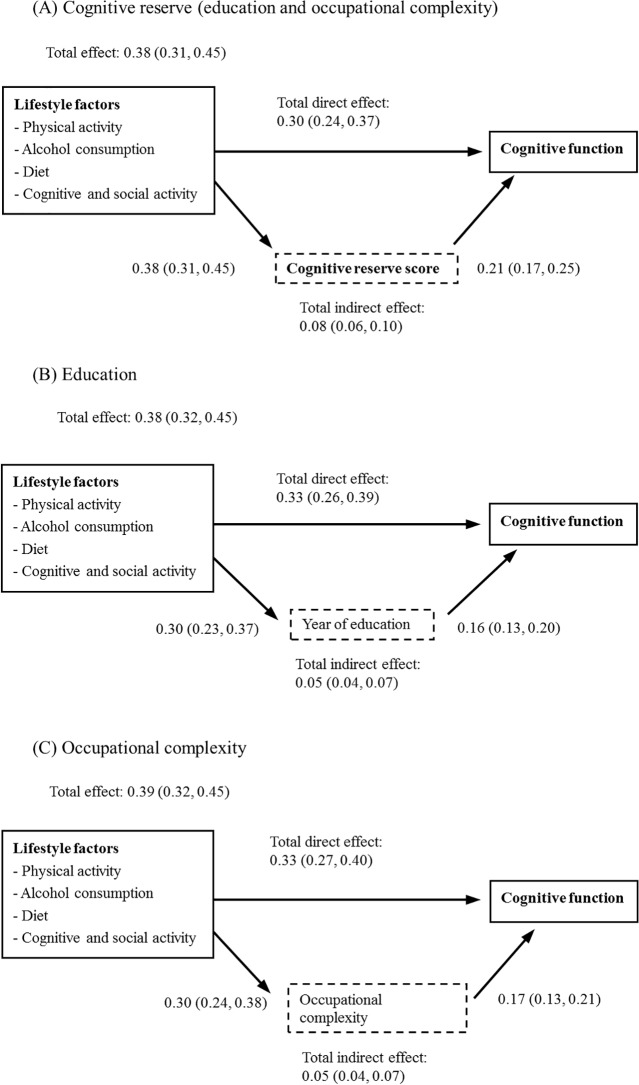
BACKGROUND: Potentially modifiable lifestyle factors may influence cognitive health in later life and offer potential to reduce the risk of cognitive decline and dementia. The concept of cognitive reserve has been proposed as a mechanism to explain individual differences in rates of cognitive decline, but its potential role as a mediating pathway has seldom been explored using data from large epidemiological studies. We explored the mediating effect of cognitive reserve on the cross-sectional association between lifestyle factors and cognitive function in later life using data from a population-based cohort of healthy older people. METHODS AND FINDINGS: We analysed data from 2,315 cognitively healthy participants aged 65 y and over in the Cognitive Function and Ageing Study Wales (CFAS-Wales) cohort collected in 2011-2013. Linear regression modelling was used to investigate the overall associations between five lifestyle factors-cognitive and social activity, physical activity, diet, alcohol consumption, and smoking-and cognition, adjusting for demographic factors and chronic conditions. Mediation analysis tested for indirect effects of the lifestyle factors on cognition via cognitive reserve. After controlling for age, gender, and the presence of chronic conditions, cognitive and social activity, physical activity, healthy diet, and light-to-moderate alcohol consumption were positively associated with cognitive function, together accounting for 20% (95% CI 17%-23%) of variance in cognitive test scores. Cognitive reserve was an important mediator of this association, with indirect effects via cognitive reserve contributing 21% (95% CI 15%-27%) of the overall effect on cognition. The main limitations of the study derive from the cross-sectional nature of the data and the challenges of accurately measuring the latent construct of cognitive reserve. CONCLUSIONS: Cross-sectional associations support the view that enhancing cognitive reserve may benefit cognition, and maintenance of cognitive health may be supported by a healthy and active lifestyle, in later life.
Overview
The claims and statistics of this paper haven’t been checked yet.
Free: it reads the open-access text and checks the first 5 claims that cite a source we can check. Create a free account to check every claim.
Integrity signals
Registry
Cites
Statistics
Figures
Verification
Claims the paper makes
The claims and statistics of this paper haven’t been checked yet.
Free: it reads the open-access text and checks the first 5 claims that cite a source we can check. Create a free account to check every claim.
Claims other papers make about this one
Each is checked against this paper’s own text: does it say what the citing paper says it does?
The cited source says what the claim attributes to it.
In the citing paper
“The small effect size is unsurprising given the range of factors that contribute to maintaining healthy cognitive function [119, 120].”
From Social Isolation and Cognitive Function in Later Life: A Systematic Review and Meta-Analysis (2019) · cites this paper as [120]
The cited source says what the claim attributes to it.
In the citing paper
“and that other lifestyle factors may contribute to the maintenance of cognitive health [119, 120]”
From Social Isolation and Cognitive Function in Later Life: A Systematic Review and Meta-Analysis (2019) · cites this paper as [120]
Self-check
Percentages, sums and reported differences re-computed from the paper’s own numbers.
The self-check needs the paper’s full text.
Citations
Cites
Folstein, M. F., Folstein, S. E., & McHugh, P. R. (1975) · Journal of Psychiatric Research · doi:10.1016/0022-3956(75)90026-6 · Cited by 88,282
SPSS and SAS procedures for estimating indirect effects in simple mediation models
Preacher, K. J., & Hayes, A. F. (2004) · Behavior Research Methods, Instruments, & Computers · doi:10.3758/bf03206553 · Cited by 17,383
Reconsidering Baron and Kenny: myths and truths about mediation analysis
Zhao, X., Lynch, J. G., & Chen, Q. (2010) · Journal of Consumer Research · doi:10.1086/651257 · Cited by 12,583 · cited 1×
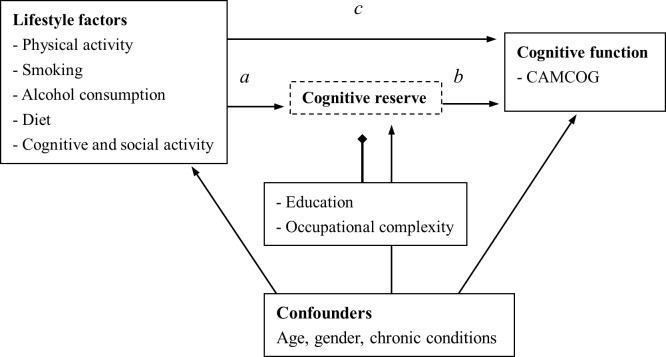
“To investigate the potential 270 mediating effect of cognitive reserve on the association between lifestyle factors and 271 cognitive function, three pathways (a, b, c) were estimated using linear regression modelling 272 and adjusting for age, gender and chronic conditions (Fig 1) [24].”
MethodWhat is cognitive reserve? Theory and research application of the reserve concept
STERN, Y. (2002) · Journal of the International Neuropsychological Society · doi:10.1017/s1355617702813248 · Cited by 3,951 · cited 2×
“trajectories of cognitive health and rates of cognitive decline [10].”
BackgroundPotential for primary prevention of Alzheimer's disease: an analysis of population-based data
Norton, S., Matthews, F. E., Barnes, D. E., Yaffe, K., & Brayne, C. (2014) · The Lancet Neurology · doi:10.1016/s1474-4422(14)70136-x · Cited by 2,466 · cited 2×
“relationships between exposures and outcomes and examine additional variables 265 hypothesised to be on the causal pathway [22, 23].”
BackgroundResultSelf-citationAn active and socially integrated lifestyle in late life might protect against dementia
Fratiglioni, L., Paillard-Borg, S., & Winblad, B. (2004) · The Lancet Neurology · doi:10.1016/s1474-4422(04)00767-7 · Cited by 2,135
Hertzog, C., Kramer, A. F., Wilson, R. S., & Lindenberger, U. (2008) · Psychological Science in the Public Interest · doi:10.1111/j.1539-6053.2009.01034.x · Cited by 1,495
Brain foods: The effects of nutrients on brain function.
Gómez-Pinilla, F. (2008) · Nature Reviews Neuroscience · doi:10.1038/nrn2421 · Cited by 1,372 · cited 1×
“networks and hence enhancing cognitive reserve, resulting in greater resilience against the 126 effects of developing neuropathology [13,14].”
BackgroundLeisure-time physical activity at midlife and the risk of dementia and Alzheimer's disease
Rovio, S., Kåreholt, I., Helkala, E.-L., Viitanen, M., Winblad, B., Tuomilehto, J., Soininen, H., Nissinen, A., & Kivipelto, M. (2005) · The Lancet Neurology · doi:10.1016/s1474-4422(05)70198-8 · Cited by 1,054 · cited 1×
“Targeting 104 potentially-modifiable lifestyle factors could have positive benefits for cognitive health in 105 later life and serve as a counterweight to elevated genetic risk [8].”
BackgroundBrain reserve and dementia: a systematic review
VALENZUELA, M. J., & SACHDEV, P. (2006) · Psychological Medicine · doi:10.1017/s0033291705006264 · Cited by 932 · cited 2×
“that place complex demands, is a key determinant of level of cognitive reserve [11,12].”
Background
Cited by
Items 301–325 of 325
Current Strategies for Healthy Aging: The Interplay Between Nutrition, Metabolism, and Exercise
Matos, A., Tihon, C., Costa, C., & Domingues, C. (2025) · Cureus · doi:10.7759/cureus.96848 · Cited by 1
“Physical exercise has been linked to beneficial effects on various brain functions, such as appetite and stress regulation, mood, memory, and cognitive function, in addition to effects on various systems, such as the cardiovascular, endocrine, and musculoskeletal systems [6].”
Jung, M., Cachutt, R. E., Kim, H., & Lee, S. (2025) · American Journal of Health Promotion · doi:10.1177/08901171251404884
Lin, J., Xiao, J., Li, Q., & Cao, L. (2023) · Figshare · doi:10.6084/m9.figshare.24062456
Li, C., Jin, S., Cao, X., Han, L., Sun, N., Allore, H. G., Hoogendijk, E. O., Xu, X., Qiushi, F., Liu, X., et al. (2022) · Figshare · doi:10.6084/m9.figshare.20428486
Zhu, L., Shen, X., Shi, X., & Ouyang, X. (2024) · Figshare · doi:10.6084/m9.figshare.25980464
Fernández‐Gonzalo, S., Navarra‐Ventura, G., Bacardit, N., Gomà, G., de Haro, C., Subirá, C., López‐Aguilar, J., Magrans, R., Sarlabous, L., Aquino‐Esperanza, J., et al. (2020) · Figshare · doi:10.6084/m9.figshare.13126478
Qiu, X., Kuang, J., Huang, Y., Wei, C., & Zheng, X. (2024) · Figshare · doi:10.6084/m9.figshare.26758712
Shen, S., Cheng, J., Li, J., Xie, Y., Wang, L., Zhou, X., Zhou, W., Zhu, L., Wang, T., 涂江龙, et al. (2022) · Figshare · doi:10.6084/m9.figshare.20390778
Lv, J., Gao, D., Yong, W., Yu, W., Wang, L., Ma, S., Li, H., Zhang, S., Guo, Z., Yan, H., et al. (2026) · Frontiers in Neurology · doi:10.3389/fneur.2025.1665841
Luo, Y., Li, M., & Zhang, Z. (2026) · Nutrients · doi:10.3390/nu18020363
“These magnitudes are comparable to those reported for other social and behavioral risk factors in aging research [33,34] and may accumulate over time to meaningfully influence cognitive trajectories at the population level.”
Cognitive and Physical Correlates of Walking Speed, Mobility, and Frailty in Geriatric Individuals
Düzce, S., Ünlüer, N. Ö., & Ateş, Y. (2026) · Physical & Occupational Therapy In Geriatrics · doi:10.1080/02703181.2026.2636580
Drenthen, G. S., Backes, W. H., Köhler, S., Deckers, K., Schram, M. T., Eussen, S. J. P. M., Jansen, W. J., & Jansen, J. F. A. (2026) · GeroScience · doi:10.1007/s11357-026-02206-x
Nutakki, C. S., Naldi, G., D'Angelo, E. U., & Diwakar, S. (2025) · Gender and Technology Conference (GTC) · doi:10.1109/gtc64325.2025.11478218
“Factors associated with ADL, like physical activity, daily activities, smoking, alcohol intake, and mobile phone usage have been studied for their effect on cognition and both implicit and explicit memory [12], [13].”
Crocetta, A., Manuello, J., Liloia, D., Duca, S., Costa, T., & Cauda, F. (2026) · Psychoradiology · doi:10.1093/psyrad/kkag016 · Cited by 1
“…that certain lifestyle proxies, such as education, influence cognitive performance and decline (Hall et al. , 2007 ; Hindle et al. , 2014 ; Clare et al. , 2017 ; Ko et al. , 2020 ; Manuello et al. , 2024 ), understanding the underlying neural mechanisms of cognitive resilience during…”
Jiang, Y., Ding, Y., Cao, Q., Wu, X., Li, X., Xu, Y., Zhao, Z., Xu, M., Lu, J., Wang, T., et al. (2026) · General Psychiatry · doi:10.1002/gps3.70013
Tang, S., Wei, Y., Dong, H., Zhang, K., Wang, C., Song, J., Qing, H., & Wu, Y. (2026) · JMIR Public Health and Surveillance · doi:10.2196/73659
“…and objective factors such as the lack of credible internet-based health information sources [78], low-level electronic health literacy [79,80], and declines in cognitive [81,82] and physical function [83], the ability of older adults to discriminate health information gradually declines [84].”
Self-citationOparaugo, G., & Gaur, R. (2026) · Cureus · doi:10.7759/cureus.108502
“A similar pattern was observed in the study by Jia et al. [21], while Clare et al. also failed to establish a significant relationship between smoking and dementia [17].”
InfluentialBraun, A. L., Angerer, S., & Latzke, M. (2026) · Aging & Mental Health · doi:10.1080/13607863.2026.2672101
“Investing in social capital—in this sense—is a direct investment into the cognitive reserve, which has been hypothesized to buffer social stress and helps to stimulate neuropathways to prevent cognitive decline also in later life (Clare et al., 2017).”
Fang, L., Cheng, L., & Cai, Y. (2026) · Acta Psychologica · doi:10.1016/j.actpsy.2026.107187 · Cited by 1
Wang, K., Zhao, Z., Chen, J., Kong, W., Wang, Y., Liang, Y., Lin, Y., Li, C., Wang, J., Gong, H., et al. (2026) · Frontiers in Psychiatry · doi:10.3389/fpsyt.2026.1851947
Porras-Roque, M. S., Cruz, K. M. L.-D. L., & Ríos, O. G. V. (2026) · Frontiers in Public Health · doi:10.3389/fpubh.2026.1876477
Li, G., & Li, Y. (2026) · Brain Structure and Function · doi:10.1007/s00429-026-03132-6
“Lifestyle factors collectively account for approximately 20–21% of the vari - ance in cognitive function, underscoring exercise as a sub - stantial but not exclusive determinant of cognitive resilience (Clare et al. 2017 ).”
Education, Personality, and Lifestyle Pathways to Cognition Across Groups
Ivleva, V., & Kairys, A. (2026) · GeroPsych · doi:10.1024/1662-9647/a000370
Xi, J.-Y., Wang, Y.-J., Li, X.-H., Ming, R.-Q., Yan, H.-L., Li, X., Sun, J., Hu, W., Hu, J., Yan, B., et al. (2026) · Frontiers in Nutrition · doi:10.3389/fnut.2026.1845959
“The mediating role of life-style observed in our study is consistent with evidence from other settings where behavioral factors were shown to partially explain health disparities (40–43).”
Picciotto, G., Natolo, L., & Fabio, R. A. (2026) · Aging Neuropsychology and Cognition · doi:10.1080/13825585.2026.2745811
“These proxies are not direct measures of CR but indices of lifestyle factors thought to contribute to the development of the neural resources underlying CR (Clare et al., 2017; Jones et al., 2011; Stern et al., 2020).”
Metadata
- Authors
- Clare, L., Wu, Y.-T., Teale, J. C., MacLeod, C., Matthews, F., Brayne, C., Woods, B., & CFAS-Wales study team
- Affiliations
- Australian National University (AU)
- University of Exeter (GB)
- Bangor University (GB)
- University of Cambridge (GB)
- Corresponding author
- Clare, Linda
- Venue
- PLOS Medicine
- Publisher
- Public Library of Science (PLoS)
- Published
- 2017-03-21
- Volume
- 14
- Issue
- 3
- Pages
- e1002259
- ISSN
- 1549-1277 (ISSN-L)
- 1549-1676
- PMC
- PMC5360216
- OpenAlex
- W2584171552
- Cited by
- 325
- References
- 39
- Citations by year
- 2026: 27 · 2025: 52 · 2024: 51 · 2023: 45 · 2022: 33 · 2021: 36 · 2020: 37 · 2019: 25 · 2018: 15 · 2017: 4
- FWCI
- 18.20
- Type
- journal article
- Language
- en
- Open access
- gold
- doi.org
- Licence
- Locations
- PLoS Medicine (publishedVersion, cc-by)
- PubMed Central (publishedVersion, cc-by)
- PubMed (publishedVersion)
- Edinburgh Research Explorer (University of Edinburgh) (submittedVersion, cc-by)
- DOAJ (DOAJ: Directory of Open Access Journals) (submittedVersion, cc-by-sa)
- Figshare (submittedVersion)
- Figshare (submittedVersion, cc-by)
- Repository@Hull (Worktribe) (University of Hull) (submittedVersion, cc-by)
- Open Research Exeter (University of Exeter) (submittedVersion, cc-by)
- Bangor University Research Portal (Bangor University) (submittedVersion, other-oa)
- Apollo (University of Cambridge) (submittedVersion, cc-by)
- Apollo (cc-by)
- Funders
- Economic and Social Research Council (RES-060-25-0060)
- Medical Research Council (U105292687)
- Topics
- Health Sciences › Medicine › Psychiatry and Mental health › Dementia and Cognitive Impairment Research
- Health Sciences › Medicine › Public Health, Environmental and Occupational Health › Aging, Health, and Disability
- Social Sciences › Psychology › Developmental and Educational Psychology › Aging and Gerontology Research
- Keywords
- cognitive reserve, lifestyle factors, cognitive function, older adults, mediation analysis, cognitive activity, social activity, physical activity, diet, alcohol consumption, smoking, dementia risk, cognitive decline
- MeSH terms
- Aged, Aged, 80 and over, Cognition, Cross-Sectional Studies, Educational Status, Female, Humans, Life Style, Male, Occupations, Wales, Cognitive Reserve
About these checks
Registry, retraction, Cites and statistics results are computed, not judged, with one exception: a printed reference that no index lists is read once by a model before it counts as a citation error. Claims are extracted by a model and kept only when their quote appears verbatim in the text; each cited source is then checked, with a model’s help, for whether it says what the claim relies on. Those verdicts can be wrong — read the claim’s quote and the cited source before relying on one.
Statistics and arithmetic are recomputed, not judged.
Confidence bands are shown only for fields calibrated on our annotated test set. None is calibrated yet, so no band is shown.
What counts as a claim ›How we measure confidence ›How we check this ›
Are you an author, or do you see a problem with this page? Request a review
Data sources
Bibliographic data: Semantic Scholar, OpenAlex, Crossref.
Contains information from the Semantic Scholar Academic Graph Datasets, made available under the ODC Attribution License (ODC-BY 1.0).
Semantic Scholar’s data is described in: Kinney, R., et al. (2023). The Semantic Scholar Open Data Platform. arXiv:2301.10140.
