

The DOI matches its Crossref record; 39 of the 40 references it cites were found in a registry or an index.
Reduced Susceptibility to Interference in the Consolidation of Motor Memory before Adolescence
Open accessAbstract
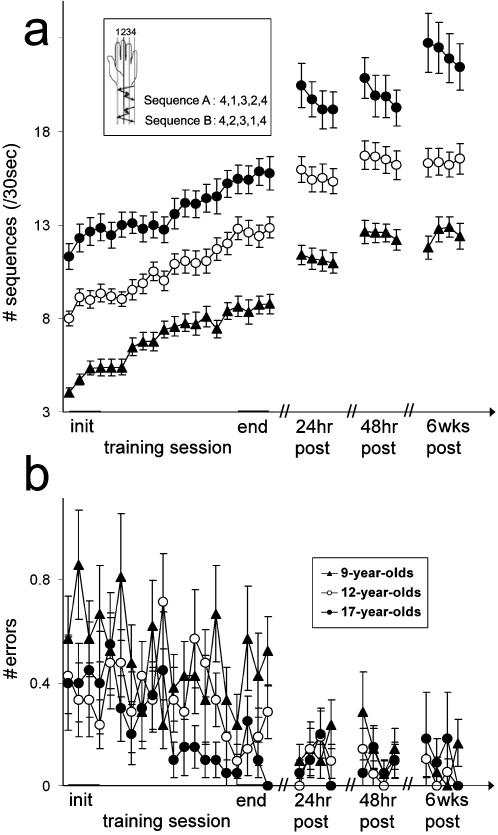
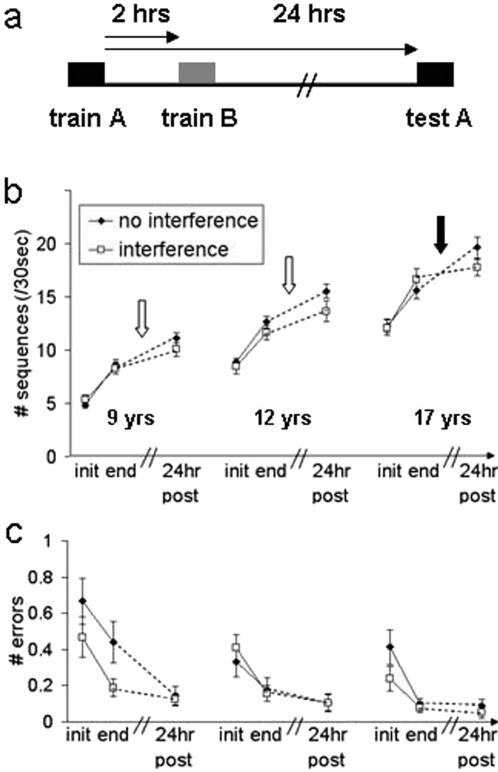
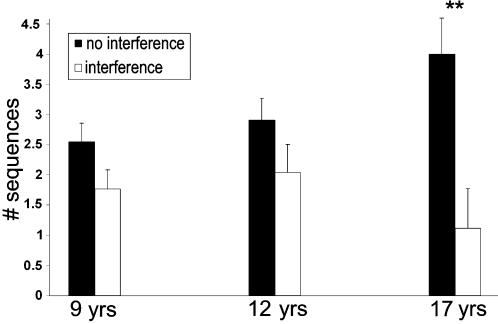
Are children superior to adults in consolidating procedural memory? This notion has been tied to "critical," early life periods of increased brain plasticity. Here, using a motor sequence learning task, we show, in experiment 1, that a) the rate of learning during a training session, b) the gains accrued, without additional practice, within a 24 hours post-training interval (delayed consolidation gains), and c) the long-term retention of these gains, were as effective in 9, 12 and 17-year-olds and comparable to those reported for adults. However, a follow-up experiment showed that the establishment of a memory trace for the trained sequence of movements was significantly more susceptible to interference by a subsequent motor learning experience (practicing a reversed movement sequence) in the 17-year-olds compared to the 9 and 12-year-olds. Unlike the 17-year-olds, the younger age-groups showed significant delayed gains even after interference training. Altogether, our results indicate the existence of an effective consolidation phase in motor learning both before and after adolescence, with no childhood advantage in the learning or retention of a motor skill. However, the ability to co-consolidate different, successive motor experiences, demonstrated in both the 9 and 12-year-olds, diminishes after puberty, suggesting that a more selective memory consolidation process takes over from the childhood one. Only the adult consolidation process is gated by a recency effect, and in situations of multiple, clashing, experiences occurring within a short time-interval, adults may less effectively establish in memory experiences superseded by newer ones.
Overview
The claims and statistics of this paper haven’t been checked yet.
Run the check — free, no account needed. It reads the open-access text and checks the sources it cites.
Integrity signals
Registry
Cites
Statistics
Figures
Verification
Claims the paper makes
The claims and statistics of this paper haven’t been checked yet.
Run the check — free, no account needed. It reads the open-access text and checks the sources it cites.
Claims other papers make about this one
Each is checked against this paper’s own text: does it say what the citing paper says it does?
The cited source doesn’t support the claim as written.
In the citing paper
“In the respective studies, the sleep-dependent overnight gains in skill were measured with reference to performance before sleep rather than with reference to performance changes across a corresponding wake interval, which excludes that the absent gain of skill across sleep in children is due to a relatively greater capability in children to stabilize memories during wakefulness (318).”
From About Sleep's Role in Memory (2013) · cites this paper as [318]
Checked by a reasoning model — may be wrong.
Experimental — accuracy not yet measuredThe source backs part of the claim, not all of it — or backs it for a different population, condition or comparison.
In the citing paper
“In children, skill performance is generally much slower, less accurate, and less automated than in adults, particularly in the initial stage of training (318, 385, 1185), which gives rise to the question of whether sleep enhances skill memories also in children if presleep performance is improved to a level comparable with that in adults.”
From About Sleep's Role in Memory (2013) · cites this paper as [318]
Experimental — accuracy not yet measured
Self-check
Percentages, sums and reported differences re-computed from the paper’s own numbers.
The self-check needs the paper’s full text.
Citations
Cites
The information capacity of the human motor system in controlling the amplitude of movement.
Fitts, P. M. (1954) · Journal of Experimental Psychology · doi:10.1037/h0055392 · Cited by 6,466
The information capacity of the human motor system in controlling the amplitude of movement.
Fitts, P. M. (1992) · Journal of Experimental Psychology General · doi:10.1037//0096-3445.121.3.262 · Cited by 6,296
Memory - A century of consolidation
McGaugh, J. L. (2000) · Science · doi:10.1126/science.287.5451.248 · Cited by 4,250
The period of susceptibility to the physiological effects of unilateral eye closure in kittens
Hubel, D. H., & Wiesel, T. N. (1970) · The Journal of Physiology · doi:10.1113/jphysiol.1970.sp009022 · Cited by 3,030
Functional MRI evidence for adult motor cortex plasticity during motor skill learning
Kami, A., Meyer, G., Jezzard, P., Adams, M. M., Turner, R., & Ungerleider, L. G. (1995) · Nature · doi:10.1038/377155a0 · Cited by 1,883
Karni, A., Meyer, G., Rey-Hipolito, C., Jezzard, P., Adams, M. M., Turner, R., & Ungerleider, L. G. (1998) · Proceedings of the National Academy of Sciences · doi:10.1073/pnas.95.3.861 · Cited by 1,410
Self-citationPractice with Sleep Makes Perfect
Walker, M. P., Brakefield, T., Morgan, A., Hobson, J. A., & Stickgold, R. (2002) · Neuron · doi:10.1016/s0896-6273(02)00746-8 · Cited by 1,307
Hensch, T. K. (2004) · Annual Review of Neuroscience · doi:10.1146/annurev.neuro.27.070203.144327 · Cited by 1,300
Dissociable stages of human memory consolidation and reconsolidation
Walker, M. P., Brakefield, T., Allan Hobson, J., & Stickgold, R. (2003) · Nature · doi:10.1038/nature01930 · Cited by 1,025
Neural Correlates of Motor Memory Consolidation
Shadmehr, R., & Holcomb, H. H. (1997) · Science · doi:10.1126/science.277.5327.821 · Cited by 1,022
Consolidation in human motor memory
Brashers-Krug, T. M., Shadmehr, R., & Bizzi, E. (1996) · Nature · doi:10.1038/382252a0 · Cited by 976
The time course of learning a visual skill
Karni, A., & Sagi, D. (1993) · Nature · doi:10.1038/365250a0 · Cited by 792
Self-citationVisual discrimination learning requires sleep after training
Stickgold, R., James, L., & Hobson, J. A. (2000) · Nature Neuroscience · doi:10.1038/81756 · Cited by 715
Kleim, J. A., Hogg, T. M., VandenBerg, P. M., Cooper, N. R., Hines, R. M., & Remple, M. S. (2004) · Journal of Neuroscience · doi:10.1523/jneurosci.3440-03.2004 · Cited by 595
Sleep forms memory for finger skills
Fischer, S., Hallschmid, M., Elsner, A. L., & Born, J. (2002) · Proceedings of the National Academy of Sciences · doi:10.1073/pnas.182178199 · Cited by 589
Cognitive approaches to the development of short-term memory
Gathercole, S. E. (1999) · Trends in Cognitive Sciences · doi:10.1016/s1364-6613(99)01388-1 · Cited by 582
Adaptation to visuomotor transformations: consolidation, interference, and forgetting
Krakauer, J. W., Ghez, C., & Ghilardi, M. F. (2005) · The Journal of Neuroscience · doi:10.1523/jneurosci.4218-04.2005 · Cited by 500
A refined model of sleep and the time course of memory formation
Walker, M. P. (2005) · Behavioral and Brain Sciences · doi:10.1017/s0140525x05000026 · Cited by 481
Korman, M., Raz, N., Flash, T., & Karni, A. (2003) · Proceedings of the National Academy of Sciences · doi:10.1073/pnas.2035019100 · Cited by 378
Self-citationEllenbogen, J. M., Hulbert, J. C., Stickgold, R., Dinges, D. F., & Thompson-Schill, S. L. (2006) · Current Biology · doi:10.1016/j.cub.2006.05.024 · Cited by 377
Off-Line Learning and the Primary Motor Cortex
Robertson, E. M., Press, D. Z., & Pascual‐Leone, Á. (2005) · Journal of Neuroscience · doi:10.1523/jneurosci.1851-05.2005 · Cited by 250
Implicit Sequence Learning in Children
Meulemans, T., der Linden, M. V., & Perruchet, P. (1998) · Journal of Experimental Child Psychology · doi:10.1006/jecp.1998.2442 · Cited by 231
Harrison, R. V., Gordon, K. A., & Mount, R. J. (2005) · Developmental Psychobiology · doi:10.1002/dev.20052 · Cited by 225
Tong, C., Wolpert, D. M., & Flanagan, J. R. (2002) · Journal of Neuroscience · doi:10.1523/jneurosci.22-03-01108.2002 · Cited by 206
Age‐related modifications of NREM sleep EEG: from childhood to middle age
Gaudreau, H., Carrier, J., & Montplaisir, J. Y. (2001) · Journal of Sleep Research · doi:10.1046/j.1365-2869.2001.00252.x · Cited by 204
From primed to learn: the saturation of repetition priming and the induction of long-term memory
Hauptmann, B., & Karni, A. (2002) · Cognitive Brain Research · doi:10.1016/s0926-6410(01)00124-0 · Cited by 169
Self-citationFonseca, R., Nägerl, U. V., Morris, R., & Bonhoeffer, T. (2004) · Neuron · doi:10.1016/j.neuron.2004.10.033 · Cited by 167
Vision calibrates sound localization in developing barn owls
Knudsen, E., & Knudsen, P. (1989) · Journal of Neuroscience · doi:10.1523/jneurosci.09-09-03306.1989 · Cited by 146
Interaction of cognitive aging and memory deficits related to epilepsy surgery
Helmstaedter, C., Reuber, M., & Elger, C. E. (2002) · Annals of Neurology · doi:10.1002/ana.10260 · Cited by 115
Pre- and postoperative verbal memory in pediatric patients with temporal lobe epilepsy
Gleißner, U., Sassen, R., Lendt, M., Clusmann, H., Elger, C. E., & Helmstaedter, C. (2002) · Epilepsy Research · doi:10.1016/s0920-1211(02)00158-4 · Cited by 100
Roth, D. A.-E., Kishon-Rabin, L., Hildesheimer, M., & Karni, A. (2005) · Learning & Memory · doi:10.1101/87505 · Cited by 89
Self-citationEffector-independent and effector-dependent learning in the discrete sequence production task
Verwey, W. B., & Wright, D. L. (2004) · Psychological Research · doi:10.1007/s00426-003-0144-7 · Cited by 78
Memory: An Overview, With Emphasis on Developmental, Interpersonal, and Neurobiological Aspects
Siegel, D. J. (2001) · Journal of the American Academy of Child & Adolescent Psychiatry · doi:10.1097/00004583-200109000-00008 · Cited by 60
Developmental Differences in Implicit and Explicit Memory Performance
Perez, L. A., Peyni̇rci̇oğlu, Z. F., & Blaxton, T. A. (1998) · Journal of Experimental Child Psychology · doi:10.1006/jecp.1998.2449 · Cited by 59
Skill Learning: Putting Procedural Consolidation in Context
Robertson, E. M. (2004) · Current Biology · doi:10.1016/j.cub.2004.11.048 · Cited by 47
Maquet, P., Laureys, S., Perrin, F., Ruby, P. M., Melchior, G., Boly, M., Dang‐Vu, T. T., Desseilles, M., & Peigneux, P. (2003) · Learning & Memory · doi:10.1101/lm.64303 · Cited by 38
Cortical plasticity: Learning while you sleep?
Sengpiel, F. (2001) · Current Biology · doi:10.1016/s0960-9822(01)00383-9 · Cited by 5
European sleep medicine is airborne
Pollmächer, T. (2006) · Journal of Sleep Research · doi:10.1111/j.1365-2869.2006.00526.x · Cited by 1
Learning, Memory, Cognition ‐ 2
(2006) · Journal of Sleep Research · doi:10.1111/j.1365-2869.2006.00540_55.x · Cited by 1
Cited by
Sorted by citations
Rasch, B., & Born, J. (2013) · Physiological Reviews · doi:10.1152/physrev.00032.2012 · Cited by 2,783
“In children, skill performance is generally much slower, less accurate, and less automated than in adults, particularly in the initial stage of training (318, 385, 1185), which gives rise to the question of whether sleep enhances skill memories also in children if presleep performance is improved to a level comparable…”
BackgroundAstill, R. G., Van der Heijden, K. B., Van IJzendoorn, M. H., & Van Someren, E. J. W. (2012) · Psychological Bulletin · doi:10.1037/a0028204 · Cited by 707
Sleep in children improves memory performance on declarative but not procedural tasks
Wilhelm, I., Diekelmann, S., & Born, J. (2008) · Learning & Memory · doi:10.1101/lm.803708 · Cited by 265
Motor sequence learning and movement disorders
Doyon, J. (2008) · Current Opinion in Neurology · doi:10.1097/wco.0b013e328304b6a3 · Cited by 194
Sleep-dependent memory consolidation – What can be learnt from children?
Wilhelm, I., Prehn-Kristensen, A., & Born, J. (2012) · Neuroscience & Biobehavioral Reviews · doi:10.1016/j.neubiorev.2012.03.002 · Cited by 161
Metadata
- Authors
- Dorfberger, S., Adi-Japha, E., & Karni, A.
- Affiliations
- University of Haifa (IL)
- Venue
- PLoS ONE
- Publisher
- Public Library of Science (PLoS)
- Published
- 2007-02-28
- Volume
- 2
- Issue
- 2
- Pages
- e240
- ISSN
- 1932-6203 (ISSN-L)
- PMC
- PMC1800346
- OpenAlex
- W2022592098
- Cited by
- 109
- References
- 40
- Citations by year
- 2026: 5 · 2025: 2 · 2024: 4 · 2023: 4 · 2022: 5 · 2021: 2 · 2020: 2 · 2019: 1 · 2018: 5 · 2017: 5 · 2016: 13 · 2015: 9 · 2014: 10 · 2013: 14 · 2012: 12
- FWCI
- 2.00
- Type
- journal article
- Language
- en
- Open access
- gold
- doi.org
- Locations
- PLoS ONE (publishedVersion, cc-by)
- Europe PMC (PubMed Central) (publishedVersion, cc-by)
- PubMed Central (publishedVersion, cc-by)
- PubMed (publishedVersion)
- DOAJ (DOAJ: Directory of Open Access Journals) (submittedVersion, cc-by-sa)
- Topics
- Life Sciences › Neuroscience › Cognitive Neuroscience › Memory and Neural Mechanisms
- Life Sciences › Neuroscience › Cognitive Neuroscience › Motor Control and Adaptation
- Life Sciences › Neuroscience › Cognitive Neuroscience › Memory Processes and Influences
- Keywords
- motor memory consolidation, procedural memory, motor sequence learning, adolescence, age differences, interference, recency effect, memory traces, neuroplasticity, puberty, long-term retention, children versus adults
- MeSH terms
- Adolescent, Psychology, Adolescent, Child, Psychology, Child, Female, Humans, Learning, Male, Memory, Motor Activity, Neuronal Plasticity, Psychomotor Performance, Retention, Psychology
About these checks
Registry, retraction, Cites and statistics results are computed, not judged, with one exception: a printed reference that no index lists is read once by a model before it counts as a citation error. Claims are extracted by a model and kept only when their quote appears verbatim in the text; each cited source is then checked, with a model’s help, for whether it says what the claim relies on. Those verdicts can be wrong — read the claim’s quote and the cited source before relying on one.
Statistics and arithmetic are recomputed, not judged.
Confidence bands are shown only for fields calibrated on our annotated test set. None is calibrated yet, so no band is shown.
What counts as a claim ›How we measure confidence ›How we check this ›
Are you an author, or do you see a problem with this page? Request a review
