

The DOI matches its Crossref record; 36 of the 37 references it cites were found in a registry or an index.
Racial Differences in the Human Endogenous Circadian Period
Open accessAbstract
The length of the endogenous period of the human circadian clock (tau) is slightly greater than 24 hours. There are individual differences in tau, which influence the phase angle of entrainment to the light/dark (LD) cycle, and in doing so contribute to morningness-eveningness. We have recently reported that tau measured in subjects living on an ultradian LD cycle averaged 24.2 hours, and is similar to tau measured using different experimental methods. Here we report racial differences in tau. Subjects lived on an ultradian LD cycle (1.5 hours sleep, 2.5 hours wake) for 3 days. Circadian phase assessments were conducted before and after the ultradian days to determine the change in circadian phase, which was attributed to tau. African American subjects had a significantly shorter tau than subjects of other races. We also tested for racial differences in our previous circadian phase advancing and phase delaying studies. In the phase advancing study, subjects underwent 4 days of a gradually advancing sleep schedule combined with a bright light pulse upon awakening each morning. In the phase delaying study, subjects underwent 4 days of a gradually delaying sleep schedule combined with evening light pulses before bedtime. African American subjects had larger phase advances and smaller phase delays, relative to Caucasian subjects. The racial differences in tau and circadian phase shifting have important implications for understanding normal phase differences between individuals, for developing solutions to the problems of jet lag and shift work, and for the diagnosis and treatment of circadian rhythm based sleep disorders such as advanced and delayed sleep phase disorder.
Overview
The claims and statistics of this paper haven’t been checked yet.
Run the check — free, no account needed. It reads the open-access text and checks the sources it cites.
Integrity signals
Registry
Cites
Statistics
Figures
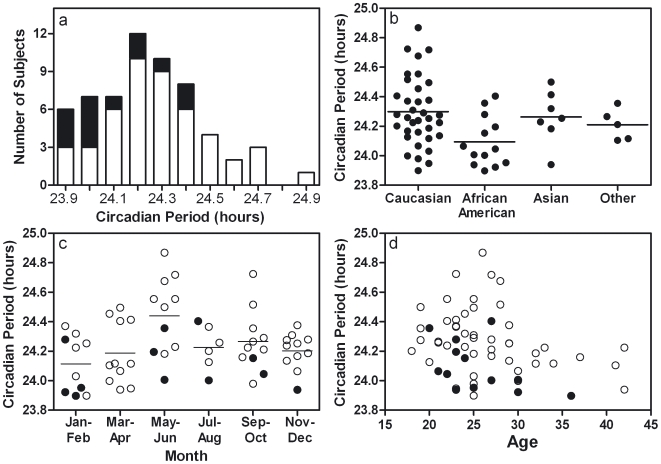
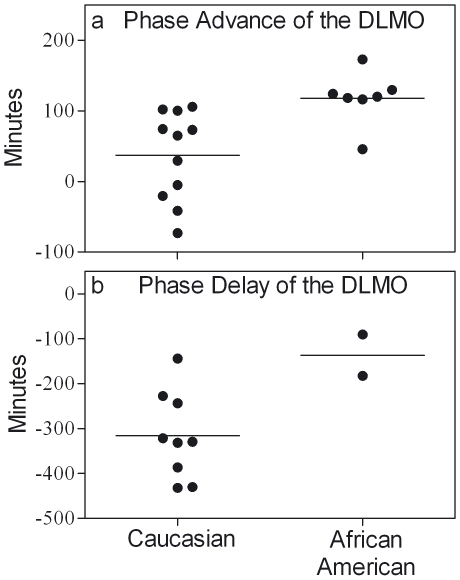
Verification
Claims the paper makes
The claims and statistics of this paper haven’t been checked yet.
Run the check — free, no account needed. It reads the open-access text and checks the sources it cites.
Claims other papers make about this one
Each is checked against this paper’s own text: does it say what the citing paper says it does?
The source backs part of the claim, not all of it — or backs it for a different population, condition or comparison.
In the citing paper
“Healthy adults show interindividual differences in the free-running circadian period (tau),94–98 which shows robust stability within individuals.97”
From Circadian rhythms, sleep deprivation, and human performance (2013) · cites this paper as [95]
Experimental — accuracy not yet measuredIn the citing paper
“This was argued to be due to the shorter τ reported previously in individuals with black ethnicity (45)”
From Chronotype: Implications for Epidemiologic Studies on Chrono-Nutrition and Cardiometabolic Health (2019) · cites this paper as [45]
In the citing paper
“Such genetic variants may underlie some of the interindividual (44) and interethnic differences (45) in the period (or τ) of the endogenous circadian cycle that manifest themselves as differences in chronotype.”
From Chronotype: Implications for Epidemiologic Studies on Chrono-Nutrition and Cardiometabolic Health (2019) · cites this paper as [45]
Self-check
Percentages, sums and reported differences re-computed from the paper’s own numbers.
The self-check needs the paper’s full text.
Citations
Cites
A self-assessment questionnaire to determine morningness- eveningness in human circadian rhythms
Home, J. K. (1976) · Medical Entomology and Zoology · Cited by 4,783
(1976) · PubMed · Cited by 3,979
JOURNAL OF CLINICAL ENDOCRINOLOGY AND METABOLISM
Hoskins, R. G. (1953) · The Journal of Clinical Endocrinology & Metabolism · doi:10.1210/jcem-13-4-473 · Cited by 3,780
A functional analysis of circadian pacemakers in nocturnal rodents
Pittendrigh, C. S., & Daan, S. (1976) · Journal of Comparative Physiology A · doi:10.1007/bf01417856 · Cited by 2,129
Stability, precision, and near-24-hour period of the human circadian pacemaker
Czeisler, C. A., Duffy, J. F., Shanahan, T. L., Brown, E. N., Mitchell, J. F., Rimmer, D. W., Ronda, J. M., Silva, E. J., Allan, J. S., Emens, J. S., et al. (1999) · Science · doi:10.1126/science.284.5423.2177 · Cited by 1,705
Pittendrigh, C. S., & Daan, S. (1976) · Journal of Comparative Physiology ? A · doi:10.1007/bf01417860 · Cited by 1,636
Handbook of behavioral neurobiology
Blass, E. M. (1988) · Plenum Press eBooks · Cited by 1,122
Duffy, J. F., Rimmer, D. W., & Czeisler, C. A. (2001) · Behavioral Neuroscience · doi:10.1037/0735-7044.115.4.895 · Cited by 571
Aschoff, J., & Wever, R. (1981) · Springer eBooks · doi:10.1007/978-1-4615-6552-9_17 · Cited by 533
Salivary Melatonin as a Circadian Phase Marker: Validation and Comparison to Plasma Melatonin
Voultsios, A., Kennaway, D. J., & Dawson, D. E. (1997) · Journal of Biological Rhythms · doi:10.1177/074873049701200507 · Cited by 466
The human circadian clock entrains to sun time
Roenneberg, T., Kumar, C., & Merrow, M. W. (2007) · Current Biology · doi:10.1016/j.cub.2006.12.011 · Cited by 464
Enhanced Fitness Conferred by Naturally Occurring Variation in the Circadian Clock
Michael, T. P., Salomé, P. A., Yu, H. J., Spencer, T. R., Sharp, E. L., McPeek, M. A., Alonso, J. M., Ecker, J. R., & McClung, C. R. (2003) · Science · doi:10.1126/science.1082971 · Cited by 458
Circadian rhythm abnormalities in totally blind people: incidence and clinical significance
Sack, R. L., Lewy, A. J., Blood, M. L., KEITH, L. D., & Nakagawa, H. (1992) · The Journal of Clinical Endocrinology & Metabolism · doi:10.1210/jcem.75.1.1619000 · Cited by 408
Chronobiology of aging: Temperature, sleep-wake rhythms and entrainment
Weitzman, E. D., Moline, M. L., Czeisler, C. A., & Zimmerman, J. C. (1982) · Neurobiology of Aging · doi:10.1016/0197-4580(82)90018-5 · Cited by 367
Race and Financial Strain are Independent Correlates of Sleep in Midlife Women: The SWAN Sleep Study
(2009) · Sleep · doi:10.5665/sleep/32.1.73 · Cited by 326
Freerunning and Entrained Circadian Rhythms
Aschoff, J. (1981) · Springer eBooks · doi:10.1007/978-1-4615-6552-9_6 · Cited by 283
Wright, K. P., Gronfier, C., Duffy, J. F., & Czeisler, C. A. (2005) · Journal of Biological Rhythms · doi:10.1177/0748730404274265 · Cited by 217
Racial Differences in Reported Napping and Nocturnal Sleep in 2- to 8-Year-Old Children
Crosby, B. (2005) · PEDIATRICS · doi:10.1542/peds.2004-0815d · Cited by 207
A three pulse phase response curve to three milligrams of melatonin in humans
Burgess, H. J., Revell, V. L., & Eastman, C. I. (2007) · The Journal of Physiology · doi:10.1113/jphysiol.2007.143180 · Cited by 176
Intrinsic circadian period of adolescent humans measured in conditions of forced desynchrony
Carskadon, M. A., Labyak, S. E., Acebo, C., & Seifer, R. (1999) · Neuroscience Letters · doi:10.1016/s0304-3940(98)00971-9 · Cited by 173
The Sleep of African Americans: A Comparative Review
Durrence, H. H., & Lichstein, K. L. (2006) · Behavioral Sleep Medicine · doi:10.1207/s15402010bsm0401_3 · Cited by 171
Phase advancing the human circadian clock with blue-enriched polychromatic light
Smith, M. R., Revell, V. L., & Eastman, C. I. (2009) · Sleep Medicine · doi:10.1016/j.sleep.2008.05.005 · Cited by 114
Self-citationEndogenous and exogenous components in the circadian variation of core body temperature in humans
Hiddinga, A. E., BEERSMA, & van den Hoofdakker, R. H. (1997) · Journal of Sleep Research · doi:10.1046/j.1365-2869.1997.00047.x · Cited by 105
Phase Delaying the Human Circadian Clock with Blue-Enriched Polychromatic Light
Smith, M. R., & Eastman, C. I. (2009) · Chronobiology International · doi:10.1080/07420520902927742 · Cited by 100
Self-citationLee, C., Smith, M. R., & Eastman, C. I. (2006) · Chronobiology International · doi:10.1080/07420520600827160 · Cited by 99
Self-citationLatitudinal Clines in the Properties of a Circadian Pacemaker
Pittendrigh, C. S., & Takamura, T. (1989) · Journal of Biological Rhythms · doi:10.1177/074873048900400209 · Cited by 91
Sex differences in human circadian rhythms: Intrinsic periods and sleep fractions
Wever, R. A. (1984) · Cellular and Molecular Life Sciences · doi:10.1007/bf01946652 · Cited by 90
Are there ethnic differences in sleep architecture?
Profant, J., Ancoli‐Israel, S., & Dimsdale, J. E. (2002) · American Journal of Human Biology · doi:10.1002/ajhb.10032 · Cited by 87
Influence of eye colors of Caucasians and Asians on suppression of melatonin secretion by light
Higuchi, S., Motohashi, Y., Ishibashi, K., & Maeda, T. (2007) · American Journal of Physiology-Regulatory, Integrative and Comparative Physiology · doi:10.1152/ajpregu.00355.2006 · Cited by 86
When the Human Circadian System is Caught Napping: Evidence for Endogenous Rhythms Close to 24 Hours
Campbell, S. S., Dawson, D. E., & Zulley, J. (1993) · SLEEP · doi:10.1093/sleep/16.7.638 · Cited by 77
Rao, U., Poland, R. E., Lutchmansingh, P., Ott, G. E., McCracken, J. T., & Lin, K. (1999) · Journal of Psychiatric Research · doi:10.1016/s0022-3956(99)00019-9 · Cited by 70
Effect of Ethnicity on Sleep: Complexities for Epidemiologic Research
Stepnowsky, C. J., Moore, P., & Dimsdale, J. E. (2003) · SLEEP · doi:10.1093/sleep/26.3.329 · Cited by 70
Seasonality in freerunning circadian rhythms in man
Wirz‐Justice, A., Wever, R. A., & Aschoff, J. (1984) · Die Naturwissenschaften · doi:10.1007/bf00396615 · Cited by 63
Human Tau in an Ultradian Light-Dark Cycle
Burgess, H. J., & Eastman, C. I. (2008) · Journal of Biological Rhythms · doi:10.1177/0748730408318592 · Cited by 45
Effects of Aging on the Intrinsic Circadian Period of Totally Blind Humans
Kendall, A. R., Lewy, A. J., & Sack, R. L. (2001) · Journal of Biological Rhythms · doi:10.1177/074873040101600110 · Cited by 44
Research works printed but not linked: 1
- [14]Pittendrigh CS Daan S 1976 A functional analysis of circadian pacemakers in nocturnal rodents. IV. Entrainment: pacemaker as clock. Journal of Comparative Physiology 106 291 331
Cited by
Sorted by citations
An update on adolescent sleep: New evidence informing the perfect storm model ☆
Crowley, S. J., Wolfson, A. R., Tarokh, L., & Carskadon, M. A. (2018) · Journal of Adolescence · doi:10.1016/j.adolescence.2018.06.001 · Cited by 684
Sex difference in the near-24-hour intrinsic period of the human circadian timing system
Duffy, J. F., Cain, S. W., Chang, A., Phillips, A. J. K., Münch, M. Y., Gronfier, C., Wyatt, J. K., Dijk, D., Wright, K. P., & Czeisler, C. A. (2011) · Proceedings of the National Academy of Sciences · doi:10.1073/pnas.1010666108 · Cited by 601
Beale, A. D., Pedrazzoli, M., Gonçalves, B. D. S. B., Beijamini, F., Duarte, N. E., Egan, K. J., Knutson, K. L., von Schantz, M., & Roden, L. C. (2017) · Scientific Reports · doi:10.1038/s41598-017-05712-3 · Cited by 467
Role of the circadian system in cardiovascular disease
Thosar, S. S., Butler, M. P., & Shea, S. A. (2018) · Journal of Clinical Investigation · doi:10.1172/jci80590 · Cited by 443
Circadian rhythms, sleep deprivation, and human performance
Goel, N., Basner, M., Rao, H., & Dinges, D. F. (2013) · Progress in Molecular Biology and Translational Science · doi:10.1016/b978-0-12-396971-2.00007-5 · Cited by 400
Metadata
- Authors
- Smith, M. R., Burgess, H. J., Fogg, L. F., & Eastman, C. I.
- Affiliations
- Rush University Medical Center (US)
- Corresponding author
- Eastman, Charmane I.
- Venue
- PLoS ONE
- Publisher
- Public Library of Science (PLoS)
- Published
- 2009-06-30
- Volume
- 4
- Issue
- 6
- Pages
- e6014
- ISSN
- 1932-6203 (ISSN-L)
- PMC
- PMC2699031
- OpenAlex
- W2000253660
- Cited by
- 113
- References
- 37
- Citations by year
- 2026: 5 · 2025: 3 · 2024: 5 · 2023: 6 · 2022: 9 · 2021: 8 · 2020: 7 · 2019: 9 · 2018: 7 · 2017: 10 · 2016: 4 · 2015: 13 · 2014: 6 · 2013: 4 · 2012: 8
- FWCI
- 2.54
- Type
- journal article
- Language
- en
- Open access
- gold
- doi.org
- Locations
- PLoS ONE (publishedVersion, cc-by)
- PubMed Central (publishedVersion, cc-by)
- PubMed (publishedVersion)
- Figshare (submittedVersion, cc-by)
- DOAJ (DOAJ: Directory of Open Access Journals) (submittedVersion, cc-by-sa)
- Funders
- National Institutes of Health
- National Heart, Lung, and Blood Institute (R01HL086934)
- National Institute of Nursing Research (R01NR007677)
- Topics
- Life Sciences › Neuroscience › Endocrine and Autonomic Systems › Circadian rhythm and melatonin
- Social Sciences › Psychology › Experimental and Cognitive Psychology › Sleep and Work-Related Fatigue
- Social Sciences › Psychology › Experimental and Cognitive Psychology › Sleep and related disorders
- Keywords
- circadian period, racial differences, African Americans, circadian phase, chronotype, phase shifting, light pulses, jet lag, shift work, circadian rhythm sleep disorders, delayed sleep phase syndrome
- MeSH terms
- Adult, Biological Clocks, Black or African American, Circadian Rhythm, Ethnicity, Female, Humans, Iris, Light, Male, Surveys and Questionnaires, Sleep, Sleep Wake Disorders, Time Factors, Wakefulness, Photoperiod
About these checks
Registry, retraction, Cites and statistics results are computed, not judged, with one exception: a printed reference that no index lists is read once by a model before it counts as a citation error. Claims are extracted by a model and kept only when their quote appears verbatim in the text; each cited source is then checked, with a model’s help, for whether it says what the claim relies on. Those verdicts can be wrong — read the claim’s quote and the cited source before relying on one.
Statistics and arithmetic are recomputed, not judged.
Confidence bands are shown only for fields calibrated on our annotated test set. None is calibrated yet, so no band is shown.
What counts as a claim ›How we measure confidence ›How we check this ›
Are you an author, or do you see a problem with this page? Request a review
