

The DOI matches its Crossref record; 27 of the 27 references it cites were found in a registry or an index.
Monitoring Bacterial Community of Human Gut Microbiota Reveals an Increase in Lactobacillus in Obese Patients and Methanogens in Anorexic Patients
Open accessAbstract
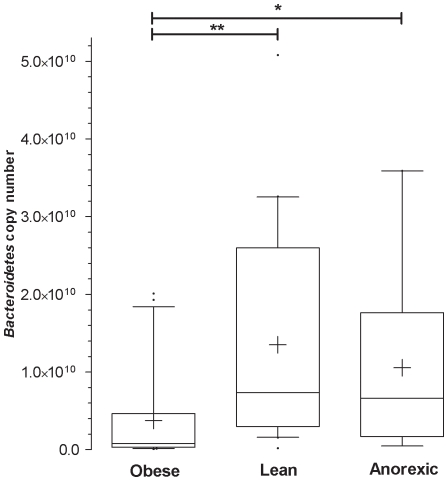
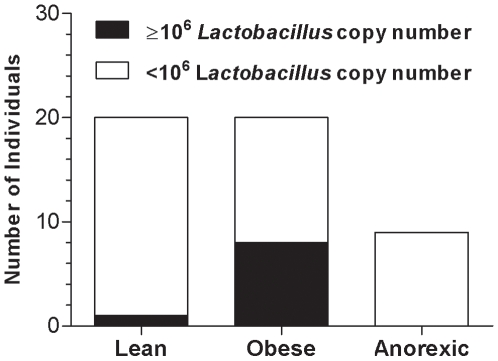
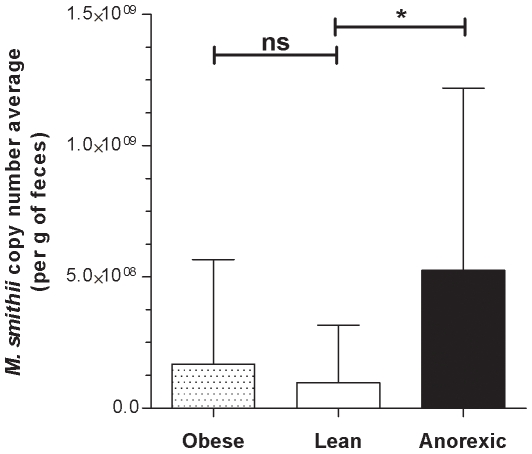
BACKGROUND: Studies of the bacterial communities of the gut microbiota have revealed a shift in the ratio of Firmicutes and Bacteroidetes in obese patients. Determining the variations of microbial communities in feces may be beneficial for the identification of specific profiles in patients with abnormal weights. The roles of the archaeon Methanobrevibacter smithii and Lactobacillus species have not been described in these studies. METHODS AND FINDINGS: We developed an efficient and robust real-time PCR tool that includes a plasmid-based internal control and allows for quantification of the bacterial divisions Bacteroidetes, Firmicutes, and Lactobacillus as well as the methanogen M. smithii. We applied this technique to the feces of 20 obese subjects, 9 patients with anorexia nervosa, and 20 normal-weight healthy controls. Our results confirmed a reduction in the Bacteroidetes community in obese patients (p<0.01). We found a significantly higher Lactobacillus species concentration in obese patients than in lean controls (p=0.0197) or anorexic patients (p=0.0332). The M. smithii concentration was much higher in anorexic patients than in the lean population (p=0.0171). CONCLUSIONS: Lactobacillus species are widely used as growth promoters in the farm industry and are now linked to obesity in humans. The study of the bacterial flora in anorexic patients revealed an increase in M. smithii. This increase might represent an adaptive use of nutrients in this population.
Overview
The claims and statistics of this paper haven’t been checked yet.
Run the check — free, no account needed. It reads the open-access text and checks the sources it cites.
Integrity signals
Registry
Cites
Statistics
Figures
Verification
Claims the paper makes
The claims and statistics of this paper haven’t been checked yet.
Run the check — free, no account needed. It reads the open-access text and checks the sources it cites.
Claims other papers make about this one
Each is checked against this paper’s own text: does it say what the citing paper says it does?
In the citing paper
“Surprisingly though, literature on this area is scarce, with only a handful of studies measuring gut microbial profile in patients with AN [29,30,31,32] and no data are available on other forms of eating disorders.”
In the citing paper
“The bloom of Methanobrevibacter, a bacterial genus that generates methane from hydrogen and carbon dioxide, is another example that the gut ecosystem of AN patients increases energy harvest in response to low nutrient availability [31].”
Self-check
Percentages, sums and reported differences re-computed from the paper’s own numbers.
The self-check needs the paper’s full text.
Citations
Cites
Primer3 on the WWW for General Users and for Biologist Programmers
Rozen, S., & Skaletsky, H. (2003) · Humana Press eBooks · doi:10.1385/1-59259-192-2:365 · Cited by 15,068
An obesity-associated gut microbiome with increased capacity for energy harvest
Turnbaugh, P. J., Ley, R. E., Mahowald, M. A., Magrini, V., Mardis, E. R., & Gordon, J. I. (2006) · Nature · doi:10.1038/nature05414 · Cited by 12,444
Human gut microbes associated with obesity
Ley, R. E., Turnbaugh, P. J., Klein, S., & Gordon, J. I. (2006) · Nature · doi:10.1038/4441022a · Cited by 8,785
Diversity of the Human Intestinal Microbial Flora
Eckburg, P. B., Bik, E. M., Bernstein, C. N., Purdom, E., Dethlefsen, L., Sargent, M., Gill, S. R., Nelson, K. E., & Relman, D. A. (2005) · Science · doi:10.1126/science.1110591 · Cited by 7,913
A core gut microbiome in obese and lean twins
Turnbaugh, P. J., Hamady, M., Yatsunenko, T., Cantarel, B. L., Duncan, A., Ley, R. E., Sogin, M. L., Jones, W. J., Roe, B. A., Affourtit, J. P., et al. (2009) · Nature · doi:10.1038/nature07540 · Cited by 7,823
Obesity alters gut microbial ecology
Ley, R. E., Bäckhed, F., Turnbaugh, P., Lozupone, C. A., Knight, R. D., & Gordon, J. I. (2005) · Proceedings of the National Academy of Sciences · doi:10.1073/pnas.0504978102 · Cited by 6,176
Metagenomic Analysis of the Human Distal Gut Microbiome
Gill, S. R., Pop, M., DeBoy, R. T., Eckburg, P. B., Turnbaugh, P. J., Samuel, B. S., Gordon, J. I., Relman, D. A., Fraser-Liggett, C. M., & Nelson, K. E. (2006) · Science · doi:10.1126/science.1124234 · Cited by 4,699
Human gut microbiota in obesity and after gastric bypass
Zhang, H., DiBaise, J. K., Zuccolo, A., Kudrna, D., Braidotti, M., Yu, Y., Parameswaran, P., Crowell, M. D., Wing, R., Rittmann, B. E., et al. (2009) · Proceedings of the National Academy of Sciences · doi:10.1073/pnas.0812600106 · Cited by 1,880
The ribosomal database project (RDP-II): introducing myRDP space and quality controlled public data
Cole, J. R., Chai, B., Farris, R. J., Wang, Q., Kulam-Syed-Mohideen, A. S., McGarrell, D. M., Bandela, A. M., Cardenas, E., Garrity, G. M., & Tiedje, J. M. (2006) · Nucleic Acids Research · doi:10.1093/nar/gkl889 · Cited by 1,171
Symbiotic gut microbes modulate human metabolic phenotypes
Li, M., Wang, B., Zhang, M., Rantalainen, M., Wang, S., Zhou, H., Zhang, Y., Shen, J., Pang, X., Zhang, M., et al. (2008) · Proceedings of the National Academy of Sciences · doi:10.1073/pnas.0712038105 · Cited by 1,144
Exploring Microbial Diversity and Taxonomy Using SSU rRNA Hypervariable Tag Sequencing
Huse, S. M., Dethlefsen, L., Huber, J. A., Welch, D. B. M., Relman, D. A., & Sogin, M. L. (2008) · PLoS Genetics · doi:10.1371/journal.pgen.1000255 · Cited by 1,020
A humanized gnotobiotic mouse model of host-archaeal-bacterial mutualism
Samuel, B. S., & Gordon, J. I. (2006) · Proceedings of the National Academy of Sciences · doi:10.1073/pnas.0602187103 · Cited by 674
Gut Microbiota and Its Possible Relationship With Obesity
DiBaise, J. K., Zhang, H., Crowell, M. D., Krajmalnik‐Brown, R., Decker, G. A., & Rittmann, B. E. (2008) · Mayo Clinic Proceedings · doi:10.4065/83.4.460 · Cited by 616
Diversity of the human gastrointestinal tract microbiota revisited
Rajilić‐Stojanović, M., Smidt, H., & De Vos, W. M. (2007) · Environmental Microbiology · doi:10.1111/j.1462-2920.2007.01369.x · Cited by 559
The Macaque Gut Microbiome in Health, Lentiviral Infection, and Chronic Enterocolitis
McKenna, P. M., Hoffmann, C., Minkah, N. K., Aye, P. P., Lackner, A. A., Liu, Z. Z., Lozupone, C., Hamady, M., Knight, R. D., & Bushman, F. D. (2008) · PLoS Pathogens · doi:10.1371/journal.ppat.0040020 · Cited by 445
Ménard, J.-P., Fenollar, F., Henry, M., Bretelle, F., & Raoult, D. (2008) · Clinical Infectious Diseases · doi:10.1086/588661 · Cited by 324
Self-citationMethanogens in human and animal intestinal Tracts
Miller, T. L., & Wolin, M. J. (1986) · Systematic and Applied Microbiology · doi:10.1016/s0723-2020(86)80010-8 · Cited by 196
Weaver, G. A., Krause, J. A., Miller, T. L., & Wolin, M. J. (1986) · Gut · doi:10.1136/gut.27.6.698 · Cited by 196
Kanamori, Y., Sugiyama, M., Hashizume, K., Yuki, N., Morotomi, M., & Tanaka, R. (2004) · Journal of Pediatric Surgery · doi:10.1016/j.jpedsurg.2004.07.013 · Cited by 106
Obesity pandemics and the modification of digestive bacterial flora
Raoult, D. (2008) · European Journal of Clinical Microbiology & Infectious Diseases · doi:10.1007/s10096-008-0490-x · Cited by 97
Self-citationArmougom, F., & Raoult, D. (2008) · BMC Genomics · doi:10.1186/1471-2164-9-576 · Cited by 86
Self-citationGrowth-promoting effects of single-dose intragastrically administered probiotics in chickens
Khan, M., Raoult, D., Richet, H., Lépidi, H., & Scola, B. L. (2007) · British Poultry Science · doi:10.1080/00071660701716222 · Cited by 85
Self-citationImmunonutritional effects during synbiotics therapy in pediatric patients with short bowel syndrome
Uchida, K., Takahashi, T., Inoue, M., Morotomi, M., Otake, K., Nakazawa, M., Tsukamoto, Y., Miki, C., & Kusunoki, M. (2007) · Pediatric Surgery International · doi:10.1007/s00383-006-1866-6 · Cited by 59
Breath Methane Production in Children With Constipation and Encopresis
Fiedorek, S. C., Pumphrey, C. L., & Casteel, H. B. (1990) · Journal of Pediatric Gastroenterology and Nutrition · doi:10.1097/00005176-199005000-00010 · Cited by 59
Charrel, R. N., Scola, B. L., & Raoult, D. (2004) · BMC Microbiology · doi:10.1186/1471-2180-4-21 · Cited by 39
Self-citationSay hello to our little friends
Walker, A. W. (2007) · Nature Reviews Microbiology · doi:10.1038/nrmicro1720 · Cited by 24
Walker, A. W., Cerdeño-Tárraga, A. M., & Bentley, S. D. (2006) · Nature Reviews Microbiology · doi:10.1038/nrmicro1483 · Cited by 13
Cited by
Sorted by citations
The impact of the gut microbiota on human health: an integrative view
Clemente, J. C., Ursell, L. K., Parfrey, L. W., & Knight, R. (2012) · Cell · doi:10.1016/j.cell.2012.01.035 · Cited by 3,710
Human Genetics Shape the Gut Microbiome
Goodrich, J. K., Waters, J. L., Poole, A. C., Sutter, J. L., Koren, O., Blekhman, R., Beaumont, M., Van Treuren, W., Knight, R., Bell, J. T., et al. (2014) · Cell · doi:10.1016/j.cell.2014.09.053 · Cited by 3,164
Gut Microbiota in Human Adults with Type 2 Diabetes Differs from Non-Diabetic Adults
Larsen, N., Vogensen, F. K., van den Berg, F. W. J., Nielsen, D. S., Andreasen, A. S., Pedersen, B. K., Al-Soud, W. A., Sørensen, S. J., Hansen, L. H., & Jakobsen, M. (2010) · PLoS ONE · doi:10.1371/journal.pone.0009085 · Cited by 2,952
The Firmicutes/Bacteroidetes Ratio: A Relevant Marker of Gut Dysbiosis in Obese Patients?
Magne, F., Gotteland, M., Gauthier, L., Zazueta, A., Pesoa, S., Navarrete, P., & Balamurugan, R. (2020) · Nutrients · doi:10.3390/nu12051474 · Cited by 2,335
The keystone-pathogen hypothesis
Hajishengallis, G., Darveau, R. P., & Curtis, M. A. (2012) · Nature Reviews Microbiology · doi:10.1038/nrmicro2873 · Cited by 1,790
Metadata
- Authors
- Armougom, F., Henry, M., Vialettes, B., Raccah, D., & Raoult, D.
- Affiliations
- Centre National de la Recherche Scientifique (FR)
- Hôpital de la Timone (FR)
- Hôpital Sainte-Marguerite (FR)
- Corresponding author
- Raoult, Didier
- Venue
- PLoS ONE
- Publisher
- Public Library of Science (PLoS)
- Published
- 2009-09-23
- Volume
- 4
- Issue
- 9
- Pages
- e7125
- ISSN
- 1932-6203 (ISSN-L)
- PMC
- PMC2742902
- OpenAlex
- W2037701117
- Cited by
- 905
- References
- 27
- Citations by year
- 2026: 22 · 2025: 31 · 2024: 41 · 2023: 52 · 2022: 68 · 2021: 74 · 2020: 65 · 2019: 81 · 2018: 74 · 2017: 57 · 2016: 62 · 2015: 58 · 2014: 58 · 2013: 58 · 2012: 45
- FWCI
- 13.70
- Type
- journal article
- Language
- en
- Open access
- gold
- doi.org
- Locations
- PLoS ONE (publishedVersion, cc-by)
- PubMed Central (publishedVersion, cc-by)
- PubMed (publishedVersion)
- DOAJ (DOAJ: Directory of Open Access Journals) (submittedVersion, cc-by-sa)
- Topics
- Life Sciences › Biochemistry, Genetics and Molecular Biology › Molecular Biology › Gut microbiota and health
- Life Sciences › Agricultural and Biological Sciences › Food Science › Probiotics and Fermented Foods
- Health Sciences › Dentistry › Periodontics › Oral microbiology and periodontitis research
- Keywords
- gut microbiota, obesity, anorexia nervosa, Lactobacillus, Methanobrevibacter smithii, methanogenic archaea, Bacteroidetes, Firmicutes, fecal microbiota, real-time PCR quantification, microbial community shifts
- MeSH terms
- Adolescent, Adult, Aged, Anorexia Nervosa, Feces, Humans, Intestines, Lactobacillus, Middle Aged, Obesity, Plasmids, Body Mass Index, Case-Control Studies, Reverse Transcriptase Polymerase Chain Reaction, Methanobrevibacter
About these checks
Registry, retraction, Cites and statistics results are computed, not judged, with one exception: a printed reference that no index lists is read once by a model before it counts as a citation error. Claims are extracted by a model and kept only when their quote appears verbatim in the text; each cited source is then checked, with a model’s help, for whether it says what the claim relies on. Those verdicts can be wrong — read the claim’s quote and the cited source before relying on one.
Statistics and arithmetic are recomputed, not judged.
Confidence bands are shown only for fields calibrated on our annotated test set. None is calibrated yet, so no band is shown.
What counts as a claim ›How we measure confidence ›How we check this ›
Are you an author, or do you see a problem with this page? Request a review
