

Socioeconomic Inequality in the Prevalence of Autism Spectrum Disorder: Evidence from a U.S. Cross-Sectional Study
Open accessThe DOI matches its Crossref record; 41 of the 41 references it cites were found in a registry or an index.
Abstract
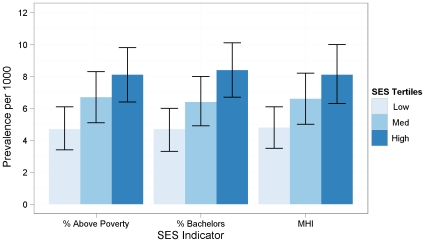
BACKGROUND: This study was designed to evaluate the hypothesis that the prevalence of autism spectrum disorder (ASD) among children in the United States is positively associated with socioeconomic status (SES). METHODS: A cross-sectional study was implemented with data from the Autism and Developmental Disabilities Monitoring Network, a multiple source surveillance system that incorporates data from educational and health care sources to determine the number of 8-year-old children with ASD among defined populations. For the years 2002 and 2004, there were 3,680 children with ASD among a population of 557,689 8-year-old children. Area-level census SES indicators were used to compute ASD prevalence by SES tertiles of the population. RESULTS: Prevalence increased with increasing SES in a dose-response manner, with prevalence ratios relative to medium SES of 0.70 (95% confidence interval [CI] 0.64, 0.76) for low SES, and of 1.25 (95% CI 1.16, 1.35) for high SES, (P<0.001). Significant SES gradients were observed for children with and without a pre-existing ASD diagnosis, and in analyses stratified by gender, race/ethnicity, and surveillance data source. The SES gradient was significantly stronger in children with a pre-existing diagnosis than in those meeting criteria for ASD but with no previous record of an ASD diagnosis (p<0.001), and was not present in children with co-occurring ASD and intellectual disability. CONCLUSIONS: The stronger SES gradient in ASD prevalence in children with versus without a pre-existing ASD diagnosis points to potential ascertainment or diagnostic bias and to the possibility of SES disparity in access to services for children with autism. Further research is needed to confirm and understand the sources of this disparity so that policy implications can be drawn. Consideration should also be given to the possibility that there may be causal mechanisms or confounding factors associated with both high SES and vulnerability to ASD.
Overview
The claims and statistics of this paper haven’t been checked yet.
Free: it reads the open-access text and checks the first 5 claims that cite a source we can check. Create a free account to check every claim.
Integrity signals
Registry
Cites
Statistics
Figures
Verification
Claims the paper makes
The claims and statistics of this paper haven’t been checked yet.
Free: it reads the open-access text and checks the first 5 claims that cite a source we can check. Create a free account to check every claim.
Self-check
Percentages, sums and reported differences re-computed from the paper’s own numbers.
The self-check needs the paper’s full text.
Citations
Cites
(1943) · The Nervous child · Cited by 8,870
Autistic disturbances of affective contact.
Kanner, L. (1968) · PubMed · Cited by 3,140
Easy SAS Calculations for Risk or Prevalence Ratios and Differences
Spiegelman, D. (2005) · American Journal of Epidemiology · doi:10.1093/aje/kwi188 · Cited by 1,738 · cited 1×
“We computed x(2) tests and 95% confidence intervals based on a Poisson distribution and log-link function [37].”
MethodEpidemiological Surveys of Autism and Other Pervasive Developmental Disorders: An Update
Fombonne, E. (2003) · Journal of Autism and Developmental Disorders · doi:10.1023/a:1025054610557 · Cited by 1,505 · cited 1×
“A number of investigators and recent reviews of the epidemiology of autism have concluded that any association observed between autism risk and SES has been due to such bias [26,27,30,31].”
BackgroundThe Epidemiology of Autism Spectrum Disorders
Newschaffer, C. J., Croen, L. A., Daniels, J., Giarelli, E., Grether, J. K., Levy, S. E., Mandell, D. S., Miller, L. A., Pinto-Martin, J., Reaven, J., et al. (2007) · Annual Review of Public Health · doi:10.1146/annurev.publhealth.28.021406.144007 · Cited by 1,228 · cited 1×
“A number of investigators and recent reviews of the epidemiology of autism have concluded that any association observed between autism risk and SES has been due to such bias [26,27,30,31].”
BackgroundSelf-citationRacial/Ethnic Disparities in the Identification of Children With Autism Spectrum Disorders
Mandell, D. S., Wiggins, L. D., Carpenter, L. A., Daniels, J., DiGuiseppi, C., Durkin, M. S., Giarelli, E., Morrier, M. J., Nicholas, J. S., Pinto-Martin, J. A., et al. (2009) · American Journal of Public Health · doi:10.2105/ajph.2007.131243 · Cited by 946 · cited 1×
“In a previous analysis of ADDM Network data for children identified by the surveillance system as meeting diagnostic criteria for ASD, Mandell and colleagues found nonHispanic white and Asian children to be more likely than nonHispanic black and Hispanic children to have a pre-existing ASD diagnosis [39].”
MethodSelf-citationApplying an equity lens to child health and mortality: more of the same is not enough
Victora, C. G., Wagstaff, A., Schellenberg, J. A., Gwatkin, D., Claeson, M., & Habicht, J.-P. (2003) · The Lancet · doi:10.1016/s0140-6736(03)13917-7 · Cited by 820
Epidemiology of autistic conditions in young children: 1. Prevalence
Lotter, V. (1966) · Social Psychiatry · doi:10.1007/bf00584048 · Cited by 780
Risk Factors for Autism: Perinatal Factors, Parental Psychiatric History, and Socioeconomic Status
Larsson, H. J., Eaton, W. W., Madsen, K. M., Vestergaard, M., Olesen, A. V., Agerbo, E., Schendel, D., Thorsen, P., & Mortensen, P. B. (2005) · American Journal of Epidemiology · doi:10.1093/aje/kwi123 · Cited by 727 · cited 1×
“However, a nearly equivalent number of studies, both clinical [19–23] and epidemiological [24–28], have failed to find associations between SES and ASD, and one casecontrol study found lower educational attainment of mothers of children with autism compared to controls [29].”
Result
Research works printed but not linked: 3
- Susser MW Hopper K Watson W 1985 Sociology in medicine, third edition. New York Oxford University Press 603
- Durkin MS Schupf N Stein ZA Susser MW 2007 Childhood cognitive disability. Wallace RB Hightstown, NJ McGraw-Hill 1173 1184 Public health and preventive medicine, fifteenth edition
- American Psychiatric Association 2000 Diagnostic and Statistical Manual of Mental Disorders (DSM-IV-TR) Edition 4, Text Revision. Arlington, VA American Psychiatric Association
Cited by
Items 201–300 of 549
Ethnic Disparities in the Diagnosis of Autism in Southern Israel
Kerub, O., Haas, E. J., Meiri, G., Bilenko, N., Flusser, H., Michaelovski, A., Dinstein, I., Davidovitch, N., & Menashe, I. (2020) · Autism Research · doi:10.1002/aur.2421 · Cited by 18
“ASD rates also vary between racial and ethnic groups in the United States [Braun et al., 2015; Durkin et al., 2017; Durkin et al., 2010; Maenner, Arneson, & Durkin, 2009; Mandell et al., 2009; Wiggins et al., 2019; Zablotsky et al., 2019].”
BackgroundCounty-Level Prevalence Estimates of Autism Spectrum Disorder in Children in the United States
Bradshaw, J. L., Eberth, J. M., Zgodic, A., Federico, A., Flory, K., & McLain, A. C. (2023) · Journal of Autism and Developmental Disorders · doi:10.1007/s10803-023-05920-z · Cited by 22
“Sociodemographic factors that have demonstrated an effect on ASD prevalence estimates include race/ethnicity, maternal education, income level, and geographic region (Durkin et al., 2010; Nevison & Zahorodny, 2019 ; Shaw et al., 2020 ; Shenouda et al., 2022 ; Zablotsky et al., 2019 ).”
Longtin, S. E., & Principe, G.-M. (2014) · Focus on Autism and Other Developmental Disabilities · doi:10.1177/1088357614522293 · Cited by 20
“Studies have shown that earlier identification of children with ASD is related to maternal education (Magaña, Lopez, Aguinaga, & Morton, 2013), income (Durkin et al., 2010; Goin-Kochel, Mackintosh, & Myers, 2006; Liptak et al., 2008; Mandell, Novak, & Zubritsky, 2005), race (Mandell, Listerud, Levy, & Pinto-Martin, 20…”
BackgroundSilverstein, M., & Radesky, J. S. (2016) · JAMA · doi:10.1001/jama.2016.0051 · Cited by 18
Zahorodny, W. M., Shenouda, J., Sidwell, K., Verile, M. G., Alvarez, C. C., Fusco, A., Mars, A. E., Waale, M. F., Gleeson, T., Burack, G. D., et al. (2023) · Journal of Autism and Developmental Disorders · doi:10.1007/s10803-023-06058-8 · Cited by 17
“Among ASD adolescents residing in high SES areas, 61% had average to above average IQ, compared to 46% residing in Mid SES areas and 35% residing in Low SES areas (p 0.001).”
ResultInfluentialFriedman, N. D. B., Politte, L. C., Nowinski, L. A., & McDougle, C. J. (2015) · Wiley eBooks · doi:10.1002/9781118753378.ch44 · Cited by 17
Shahrokhi, H., Ghiasi, A., Gholipour, K., Fanid, L. M., Shamekhi, H., & Iezadi, S. (2021) · BMC Psychiatry · doi:10.1186/s12888-021-03061-0 · Cited by 17
“low-socioeconomic status population [15, 16].”
Kim, K., Yoo, S. M., Kang, S., Kim, H. J., Yun, J., & Lee, J. Y. (2021) · Yonsei Medical Journal · doi:10.3349/ymj.2021.62.10.943 · Cited by 19
“22,23 However, effect modification of the association between ASD diagnosis and mortality by income levels cannot be evaluated due to the limited power.”
The Evolutionary Etiologies of Autism Spectrum and Psychotic Affective Spectrum Disorders
Crespi, B. J. (2016) · Springer eBooks · doi:10.1007/978-3-319-29716-3_20 · Cited by 22
Inclusion of racially and ethnically diverse populations in ASD intervention research
Harris, B., Barton, E. E., & McClain, M. B. (2020) · Research in Autism · doi:10.1016/j.rasd.2020.101551 · Cited by 20
Trastornos del espectro autista y exposiciones ocupacionales de los progenitores
Pino-López, M., & Ayuso, D. M. R. (2013) · Revista Española de Salud Pública · doi:10.4321/s1135-57272013000100008 · Cited by 24
Schieve, L. A., Fountain, C., Boulet, S. L., Yeargin‐Allsopp, M., Kissin, D. M., Jamieson, D. J., Rice, C. E., & Bearman, P. (2015) · Journal of Autism and Developmental Disorders · doi:10.1007/s10803-015-2462-1 · Cited by 18
“…socio-demographic confounding factors as well as for perinatal outcomes found previously to be associated with both ART and autism in US populations (Schieve et al. 2007; Croen et al. 2002b; Durkin et al. 2008; Durkin et al. 2010; Bilder et al. 2009; Mandell et al. 2009; Schieve et al. 2012a).”
BackgroundSelf-citationSpatial Relative Risk Patterns of Autism Spectrum Disorders in Utah
Bakian, A. V., Bilder, D. A., Coon, H. H., & McMahon, W. M. (2014) · Journal of Autism and Developmental Disorders · doi:10.1007/s10803-014-2253-0 · Cited by 21
“…studies conducted outside of the U.S. (Rai et al. 2012; Larsson 2005; Fombonne et al. 1997); however, ASD has been more consistently associated with higher socioeconomic status (SES) in recent U.S. based studies (Bhasin and Schendel 2007; Croen et al. 2002; Durkin et al. 2010; Windham et al. 2011).”
Research Collaboration with 2-1-1 to Eliminate Health Disparities
Linnan, L. A. (2012) · American Journal of Preventive Medicine · doi:10.1016/j.amepre.2012.09.025 · Cited by 19
Improving Efficiency and Equity in Early Autism Evaluations: The (S)TAAR Model
Brinster, M., Brukilacchio, B. H., Fikki-Urbanovsky, A., Shahidullah, J. D., & Ravenscroft, S. (2022) · Journal of Autism and Developmental Disorders · doi:10.1007/s10803-022-05425-1 · Cited by 19
Parental Age and Cognitive Disability among Children in the United States
Cohen, P. N. (2014) · Sociological Science · doi:10.15195/v1.a8 · Cited by 19
Kamimura-Nishimura, K. I., Froehlich, T. E., Chirdkiatgumchai, V., Adams, R. E., Fredstrom, B. K., & Manning-Courtney, P. (2017) · Annals of Epidemiology · doi:10.1016/j.annepidem.2017.06.001 · Cited by 21
Oswald, D. P., & Haworth, S. M. (2016) · Springer eBooks · doi:10.1007/978-3-319-25501-9_17 · Cited by 16
Brief Report: Texas School District Autism Prevalence in Children from Non-English-Speaking Homes
Dickerson, A. S., & Dickerson, A. S. (2018) · Journal of Autism and Developmental Disorders · doi:10.1007/s10803-018-3676-9 · Cited by 15
Perinatal Factors Associated with Autism Spectrum Disorder in Jamaican Children
Saroukhani, S., Samms‐Vaughan, M. E., Lee, M., Bach, M. A., Bressler, J., Hessabi, M., Grove, M. L., Shakespeare‐Pellington, S., Loveland, K. A., & Rahbar, M. H. (2019) · Journal of Autism and Developmental Disorders · doi:10.1007/s10803-019-04229-0 · Cited by 15
Verhoef, E., Grove, J., Shapland, C. Y., Demontis, D., Burgess, S., Rai, D., Børglum, A. D., & Pourcain, B. S. (2021) · Nature Communications · doi:10.1038/s41467-021-26755-1 · Cited by 18
Lin, Y., Wang, G., Yang, Y., Jin, X., Huang, H., Zhang, Y., & Jin, Z. (2022) · Journal of Autism and Developmental Disorders · doi:10.1007/s10803-022-05603-1 · Cited by 17
“These results are consistent with some(Durkin et al., 2010, 2017; Thomas et al., 2012) and inconsistent with other previous studies(Rai et al., 2012; Bosch et al., 2021; Yu et al., 2021).”
ResultProviders' Guidance to Parents and Service Use for Latino Children With Developmental Disabilities
Son, E., Magaña, S., Pedraza, F. D. M., & Parish, S. L. (2019) · American Journal on Intellectual and Developmental Disabilities · doi:10.1352/1944-7558-125.1.64 · Cited by 16
Positive and negative social exchanges experienced by fathers and mothers of children with autism
Hickey, E., DuBois, L., & Hartley, S. L. (2017) · Autism · doi:10.1177/1362361316687117 · Cited by 17
“Our sample was largely Caucasian, non-Hispanic, and of middle socio-economic status; this reflects the Midwestern state from which the sample was recruited and population-level trends in ASD diagnosis (Durkin et al., 2010).”
BackgroundEpidemiology of Autism Spectrum Disorders
Hill, A. P., Zuckerman, K. E., & Fombonne, E. J. (2014) · Wiley eBooks · doi:10.1002/9781118911389.hautc03 · Cited by 15
Phenotypically driven subgroups of ASD display distinct metabolomic profiles
Prince, N., Chu, S. H., Chen, Y., Mendez, K. M., Hanson, E. M., Green‐Snyder, L., Brooks, E. A., Korrick, S., Lasky-Su, J. A., & Kelly, R. S. (2023) · Brain Behavior and Immunity · doi:10.1016/j.bbi.2023.03.026 · Cited by 16
Gore, K., Gilbert, M., Hawke, M., & Barbaro, J. (2024) · Frontiers in Neurology · doi:10.3389/fneur.2023.1201292 · Cited by 17
Neurobiology of cognitive abilities in early childhood autism
Denisova, K. (2024) · JCPP Advances · doi:10.1002/jcv2.12214 · Cited by 15
“In underserved populations, early diagnosis and treatment are negatively affected by complex racial ‐ ethnic and socio ‐ demographic, including immigrant, factors (i.e. (Durkin et al., 2010; Kelly et al., 2019; Khanlou et al., 2017; Yingling & Bell, 2019; Yingling et al., 2022)).”
BackgroundSalter, J., & Blainey, S. H. (2024) · BMC Psychology · doi:10.1186/s40359-024-01770-1 · Cited by 15
Primo, P. G., Weber, C., de la Paz, M. P., Fellinger, J., Dirmhirn, A., & Holzinger, D. (2020) · Brain Sciences · doi:10.3390/brainsci10070448 · Cited by 15
“Particular characteristics that are related to the child’s family such as living in under-resourced or rural areas [28], low parental occupational level [33] and/or lower socioeconomic status [34,35] have more recently been identified as factors related to later ASD diagnosis.”
BackgroundAssessing Diverse Students With Autism Spectrum Disorders
Dyches, T. T. (2011) · ASHA Leader · doi:10.1044/leader.ftr2.16012011.12 · Cited by 14
Implementation of developmental screening by childcare providers
Shahidullah, J. D., Forman, S. G., Norton, A. M., Harris, J. F., Palejwala, M. H., & Chaudhuri, A. (2020) · Infants & Young Children · doi:10.1097/iyc.0000000000000158 · Cited by 13
Mirza, M. P., Magaña, S., Stoffel, A., Xu, Y., & Kim, Y. (2019) · Annals of International Occupational Therapy · doi:10.3928/24761222-20191018-04 · Cited by 13
Cao, M., Li, L., Raat, H., van Grieken, A., Wang, X., Lin, L., Chen, Q., & Jin, J. (2022) · Autism · doi:10.1177/13623613221132743 · Cited by 14
“…with regard to the association between low maternal education and autism diagnosis have been reported in studies performed in the United States (Durkin et al., 2010; Rosenberg et al., 2018; Zablotsky et al., 2019), France (Delobel-Ayoub et al., 2015), Japan (Fujiwara, 2014), and Sweden…”
BackgroundInfluentialProspective cohort study of vitamin D and autism spectrum disorder diagnoses in early childhood
Ali, Y., Anderson, L. N., Smile, S., Chen, Y., Borkhoff, C. M., Koroshegyi, C., Lebovic, G., Parkin, P. C., Birken, C. S., Szatmári, P., et al. (2018) · Autism · doi:10.1177/1362361318756787 · Cited by 13
Miller, H. L., Thomi, M., Patterson, R. M., & Nandy, K. (2022) · Journal of Autism and Developmental Disorders · doi:10.1007/s10803-022-05604-0 · Cited by 13
Vasopressin as Possible Treatment Option in Autism Spectrum Disorder
László, K., Vörös, D., Correia, P., Fazekas, C. L., Török, B., Plangár, I., & Zelena, D. (2023) · Biomedicines · doi:10.3390/biomedicines11102603 · Cited by 13
“Di ff erences in behavior and developmental milestones appear in a ff ected children by the Differences in behavior and developmental milestones appear in affected children by the first year of life [43,44]. fi rst year of life [43,44].”
BackgroundNeighborhood Disadvantage and Autism Spectrum Disorder in a Population With Health Insurance
Yu, X., Rahman, M. M., Carter, S., Lin, J. C., Chow, T., Lurmann, F., Chen, J., Martinez, M. P., Schwartz, J. D., Eckel, S. P., et al. (2023) · JAMA Psychiatry · doi:10.1001/jamapsychiatry.2023.4347 · Cited by 14
An overview of autism in the elderly
Amanullah, S., Rajeh, A., & Sivakumar, K. (2019) · Asian Journal of Psychiatry · doi:10.1016/j.ajp.2019.101897 · Cited by 16
An Economic and Rational Choice Approach to the Autism Spectrum and Human NeurodiversityPreprint
Cowen, T. (2011) · SSRN Electronic Journal · doi:10.2139/ssrn.1975809 · Cited by 17
Yang, D., Svoboda, A. M., George, T. G., Mansfield, P. K., Wheelock, M. D., Schroeder, M. L., Rafferty, S. M., Sherafati, A., Tripathy, K., Burns‐Yocum, T. M., et al. (2024) · Molecular Autism · doi:10.1186/s13229-024-00614-4 · Cited by 15
“Autism is observed across all groups, regardless of race, ethnicity, and socio-economic status (3, 4), with a growing prevalence in recent years (3, 5, 6).”
BackgroundCampbell, M., Reynolds, L., Cunningham, J., Minnis, H., & Gillberg, C. (2011) · Child Care Health and Development · doi:10.1111/j.1365-2214.2011.01340.x · Cited by 15
Keller‐Bell, Y. (2017) · Perspectives of the ASHA Special Interest Groups · doi:10.1044/persp2.sig14.68 · Cited by 14
Parental attributions for positive behaviours in children with autism spectrum disorder
Bussanich, P. M., Hartley, S. L., & Bolt, D. M. (2017) · Journal of Intellectual Disability Research · doi:10.1111/jir.12373 · Cited by 14
“This reflects the Midwestern state sampled and population-level trends in ASD diagnosis (Durkin et al. 2010).”
BackgroundSchelly, D., González, P. J., & Solís, P. J. (2015) · Health & Place · doi:10.1016/j.healthplace.2015.07.007 · Cited by 11
Relationships Between Household Income and Functional Independent Behavior for Children With Autism
John, B. S., & Ausderau, K. (2021) · OTJR Occupational Therapy Journal of Research · doi:10.1177/15394492211012654 · Cited by 11
“Disparities by income have been documented with an increased prevalence of ASD among families with higher household income (Dickerson et al., 2017; Durkin et al., 2010; Jo et al., 2015; Pulcini et al., 2017).”
BackgroundWest, K. L., Steward, S. E., Britsch, E. R., & Iverson, J. M. (2023) · Journal of Autism and Developmental Disorders · doi:10.1007/s10803-023-06030-6 · Cited by 12
“…future work to clarify the role that socioeconomic status plays in the development of autistic infants—especially considering that lower socioeconomic resources and language barriers can present barriers to families’ access to clinical services (e.g., Durkin et al., 2010; St Amant et al., 2018).”
Siller, M., Morgan, L., Swanson, M. R., & Hotez, E. (2013) · InTech eBooks · doi:10.5772/53715 · Cited by 13
van Schalkwyk, G. I., Beyer, C., & de Vries, P. J. (2016) · Springer eBooks · doi:10.1007/978-1-4614-6435-8_102111-1 · Cited by 11
Latinx caregivers and autism identification: what we know a scoping review
Luelmo, P., Larios, R. J., & Castellón, F. A. (2022) · International Journal of Developmental Disabilities · doi:10.1080/20473869.2022.2114777 · Cited by 12
“…continue to exist in early diagnosis/identification of autism and health and education access to services for minoritized racial/ethnic groups, and for families where English is not the primary language (Christensen et al. 2016, Durkin et al. 2010, Harris et al. 2020, Maga ~ na et al. 2013).”
BackgroundThe increasing prevalence of school pupils with ASD: insights from Northern Ireland
McConkey, R. (2019) · European Journal of Special Needs Education · doi:10.1080/08856257.2019.1683686 · Cited by 13
“This is also apparent in other European countries (Rai et al. 2012), although not in the USA due it is thought, to more limited access to support services for people from ethnic minorities and lower social classes (Durkin et al. 2010).”
BackgroundSafer‐Lichtenstein, J., Hamilton, J. C., & McIntyre, L. L. (2020) · Journal of Autism and Developmental Disorders · doi:10.1007/s10803-020-04700-3 · Cited by 10
Patrick, M., Hughes, M. M., Ali, A. R., Shaw, K. A., & Maenner, M. J. (2023) · Annals of Epidemiology · doi:10.1016/j.annepidem.2023.04.009 · Cited by 11
Self-citationvan Wees, S. H., & Dini, S. (2023) · Global Public Health · doi:10.1080/17441692.2023.2257771 · Cited by 12
“Some evidence has established an association between socioeconomic status and ASD prevalence (Durkin et al., 2010).”
BackgroundThe Role of Demographics in the Age of Autism Diagnosis in Jerusalem
Koller, J., Shalev, R., Schallamach, C., Gumpel, T. P., & Begin, M. (2019) · Journal of Autism and Developmental Disorders · doi:10.1007/s10803-019-04107-9 · Cited by 10
Testing a Tailored Social-Ecological Model for Autism Spectrum Disorders
Brisendine, A. E., O’Kelley, S. E., Preskitt, J. K., Sen, B., & Wingate, M. S. (2021) · Maternal and Child Health Journal · doi:10.1007/s10995-020-03064-5 · Cited by 9
Primary Care Clinician and Child Characteristics Impacting Autism Surveillance
Williams, L. N., Wieckowski, A. T., Dieckhaus, M. F. S., Dai, Y. G., Zhang, F., Dumont-Mathieu, T. M., Barton, M. L., FEIN, D. A., & Robins, D. L. (2022) · Brain Sciences · doi:10.3390/brainsci13010018 · Cited by 9
Fairthorne, J., Langridge, A., Bourke, J., & Leonar, H. (2013) · InTech eBooks · doi:10.5772/54488 · Cited by 9
“Thirteen articles researched the parental socio-economic status (SES) of children with ASD and/or ID [17, 20, 21, 39-48] and all but two [42, 43] supported a different association of SES with ASD than ID.”
BackgroundMethodNonclinical Factors in Autism Diagnosis: Results From a National Health Care Provider Survey
Azim, A., Rdesinski, R. E., Phelps, R. A., & Zuckerman, K. E. (2020) · Journal of Developmental & Behavioral Pediatrics · doi:10.1097/dbp.0000000000000797 · Cited by 12
“In previous surveillance studies from the Centers for Disease Control and Prevention’s Autism and Developmental Disabilities Monitoring Network, ASD diagnostic rates were as much as 70% higher for children in the highest socioeconomic status group compared with the lowest.(1,21,22) The opposite trend exists for childr…”
BackgroundGrivas, G., Frye, R. E., & Hahn, J. (2021) · Journal of Personalized Medicine · doi:10.3390/jpm11100950 · Cited by 10
“Sociodemographic trends for ASD noted a higher prevalence of the disorder among higher levels of education and income [54,55], similar to what was found in this study (see Table 3).”
ResultMcGrath, K., Bonuck, K. A., & Mann, M. (2020) · Journal of Neurodevelopmental Disorders · doi:10.1186/s11689-020-09338-x · Cited by 11
Autism Risk Factors: Moving From Epidemiology to Translational Epidemiology
Harris, J. C. (2012) · Journal of the American Academy of Child & Adolescent Psychiatry · doi:10.1016/j.jaac.2012.02.023 · Cited by 10
Fujiwara, T. (2015) · International Journal of Epidemiology · doi:10.1093/ije/dyv097.002 · Cited by 9
Choi, J. W., Oh, J., Bennett, D. H., Kannan, K., Tancredi, D. J., Miller, M. R., Schmidt, R. J., & Shin, H. (2024) · Environmental Research · doi:10.1016/j.envres.2024.120141 · Cited by 8
Child-rearing routines among Mexican-heritage children with autism spectrum disorder
Cohen, S. R., Miguel, J., & Guerra, A. W. (2019) · Autism · doi:10.1177/1362361319849244 · Cited by 8
“Previous studies have shown that socioeconomic status makes a difference in access to ASD interventions (Chaidez, Hansen, & HertzPicciotto, 2012; Durkin et al., 2010; Harstad et al., 2013).”
BackgroundAlasmari, M., Alduais, A. M. S., Qasem, F. A. A., Almaghlouth, S., & AlAmri, L. (2024) · Children · doi:10.3390/children11040472 · Cited by 10
“Additionally, geographical disparities impact the prevalence, recogni‑ tion, and resources available for ASD, with variations in cultural perceptions and health‑ care infrastructure affecting how ASD is managed across different regions [16].”
BackgroundWen, W., & Wen, S. W. (2014) · Medical Hypotheses · doi:10.1016/j.mehy.2014.02.020 · Cited by 8
Madsen, K. B., Hohwü, L., Zhu, J. L., Olsen, J., & Obel, C. (2017) · Scandinavian Journal of Public Health · doi:10.1177/1403494817726619 · Cited by 9
“[19] Durkin Ms, Maenner MJ, Meaney FJ, et al.”
BackgroundThe Quick Peek Program: A Model for Developmental Screening Within Underserved Communities
Harris, J. F., & Norton, A. M. (2016) · Infants & Young Children · doi:10.1097/iyc.0000000000000073 · Cited by 9
“When identified as having ASD, those with low SES, racial, or ethnic minorities are often identified at ages even later than the majority (Durkin et al., 2010; Fountain, King, & Bearman, 2010; Mandell et al., 2009; Mandell, Ittenbach, Levy, & Pinto-Martin, 2007; Mandell, Listerud, Levy, &…”
BackgroundParent-Implemented Interventions Around the Globe
Gillespie‐Lynch, K., & Brezis, R. S. (2018) · Autism and child psychopathology series · doi:10.1007/978-3-319-90994-3_22 · Cited by 8
Mendez, K., Karen, M., Levy, M. L., Nelms, M., Hoff, D., Jean, M., & Michael, L. (2011) · InTech eBooks · doi:10.5772/19138 · Cited by 9
Kuenzel, E., & Duerden, E. G. (2024) · Neurodiversity · doi:10.1177/27546330241254222 · Cited by 9
“…showed a positive correlation between fi nancial adversity and the rate of a diagnosis of autism in children, several others have shown an association between higher SES levels and diagnoses of autism (Durkin, Baio, et al., 2017; Durkin, Meaney, et al., 2010; Thomas et al., 2012; Wong & Yu, 2023).”
Kniola, A., Ludwig, N. N., Singh, V., Bradley, C. C., Carpenter, L. A., Dillon, E. F., Kanne, S. M., Kim, S. H., Parish‐Morris, J., Snyder, L. G., et al. (2024) · Journal of Autism and Developmental Disorders · doi:10.1007/s10803-024-06579-w · Cited by 7
“Black and Latinx children need to present with more severe ASD symptoms to receive an autism diagnosis and are more likely to be diagnosed with a co-occurring intellectual disability (Durkin et al., 2010; Jarquin et al., 2011; Shaw et al., 2023 ).”
Patrick, M., Williams, A. R., Shaw, K. A., Durkin, M. S., Hall‐Lande, J., Vehorn, A. C., & Hughes, M. M. (2025) · Annals of Epidemiology · doi:10.1016/j.annepidem.2025.02.014 · Cited by 10
Self-citationMagen-Molho, H., Harari‐Kremer, R., Pinto, O. Y., Kloog, I., Dorman, M., Levine, H., Weisskopf, M. G., & Raz, R. (2020) · Annals of Epidemiology · doi:10.1016/j.annepidem.2020.06.003 · Cited by 12
Haque, M. A., Tasnim, A. F., Islam, S., Towhid, M. I. I., Sultana, S., Salwa, M., Barman, N., & Siddique, S. M. (2021) · Adversity and Resilience Science · doi:10.1007/s42844-021-00042-w · Cited by 9
Low-Income Parents’ Values Involving the Use of Technology for Accessing Health Information
Muñoz, D., & Arriaga, R. I. (2015) · Lecture notes in computer science · doi:10.1007/978-3-319-22698-9_5 · Cited by 7
“A later diagnosis is associated with decreasing the impact that comes with receiving early treatment and intervention [10, 11, 33].”
BackgroundBallan, M. S. (2019) · Oxford University Press eBooks · doi:10.1093/oso/9780190886578.003.0003 · Cited by 7
Brief Report: Diminishing Geographic Variability in Autism Spectrum Disorders Over Time?
Hoffman, K., Vieira, V. M., & Daniels, J. L. (2013) · Journal of Autism and Developmental Disorders · doi:10.1007/s10803-013-1907-7 · Cited by 8
“…models for several previously established ASD predictive factors, including year of birth; plurality; maternal age, race/ethnicity, and level of education; and report of tobacco use during pregnancy (Hultman et al. 2002; Croen et al. 2007; Durkin et al. 2008, 2010a, b; Gardener et al. 2011).”
Autism spectrum disorder: overdiagnosis or a new pandemic?
Grokoski, K. C., Riesgo, R. D. S., & Gadia, C. A. (2025) · Jornal de Pediatria · doi:10.1016/j.jped.2025.101439 · Cited by 11
“Research has shown higher prevalence rates among families with higher income and education levels, likely due to better access to diagnostic services [14].”
Abdullahi, I., Sadka, N., Gilbert, M., & Barbaro, J. (2023) · Brain Sciences · doi:10.3390/brainsci13060903 · Cited by 6
“Research has focused on SES, autism prevalence, and health disparities in France and the US, demonstrating the complexities of these relationships [10,11].”
BackgroundResultInfluentialTranstorno do espectro autista e envelhecimento: uma revisão narrativa
Lin, J., Gaiato, M. H. B., Zotesso, M. C., Silveira, R. D. R., & Ferreira, L. (2023) · Revista Remecs - Revista Multidisciplinar de Estudos Científicos em Saúde · doi:10.24281/rremecs2023.8.14.3-11 · Cited by 13
Association of autism spectrum disorder and gestational diabetes mellitus of mothers in Bangladesh
Khanom, F., Chowdhury, S., Ahmed, S., Moniruzzaman Khan, M., & Ahmed, M. (2015) · Indian Journal of Community Health · Cited by 9
Anjum, A., Mushtaq, A., Rehna, T., Sabih, F., & Najmussaqib, A. (2022) · International Journal of Disability Development and Education · doi:10.1080/1034912x.2021.2016657 · Cited by 8
“Intellectual disability is an emotional disturbance; it is attributed to heredity or genetic factors (Kaufman, Ayub, & Vincent, 2010), pre-natal abnormalities (Durkin et al., 2000), environmentally induced biological factors, such as brain damage, and socio-cultural factors (Durkin et al., 2010).”
BackgroundMeldrum, P., Johnson, B. P., Lo, B. C. Y., Bedelis, M. L., & Rabba, A. S. (2026) · Autism in Adulthood · doi:10.1177/25739581261427260 · Cited by 6
Troxel, M., Sheldrick, R. C., Eisenhower, A., & Carter, A. S. (2023) · Journal of Early Intervention · doi:10.1177/10538151231191757 · Cited by 5
“This is noteworthy given that autism is often under-identified or diagnosis is delayed, particularly among girls (Loomes et al., 2017), poor youth (Baio et al., 2018; Durkin et al., 2010), and Black and Hispanic youth (Baio et al., 2018; Mandell et al., 2009).”
Terada, S., Nakayama, S. F., Fujiwara, T., & The Japan Environment and Children's Study Group (2025) · Autism Research · doi:10.1002/aur.70022 · Cited by 5
“Historically, beginning with Kanner's seminal work on children with autism among highly educated parents (Kanner 1968), high socioeconomic status has been hypothesized to predict offspring ASD (Bhasin and Schendel 2007; Durkin et al. 2010).”
Autism, Autoimmune Disease and Socioeconomic Status
Becker, K. G. (2012) · Autism - Open Access · doi:10.4172/2165-7890.1000104 · Cited by 5
“Moreover, in both autism [3,4] and autoimmune disease [58,59,61] a similar increasing dose dependent relationship with increasing SES has been reported.”
BackgroundPham, C., Bacon, E. C., Grzybowski, A., Barnes, C. C., Arias, S. J., Xu, R., Lopez, L., Courchesne, E., & Pierce, K. (2023) · Autism · doi:10.1177/13623613221147416 · Cited by 5
“, 2018) as well as levels of autism awareness, parental education, and resources availability in individual communities (Colbert et al., 2016; Durkin et al., 2010; Fountain et al., 2011; Khowaja et al., 2015; Liptak et al., 2008; Pedersen et al., 2012; Zuckerman et al., 2013) possibly stemming, in part, from structura…”
BackgroundGibbs, V. D. (2017) · American Journal of Occupational Therapy · doi:10.5014/ajot.2017.016303 · Cited by 6
Herlihy, L. E. (2014) · OpenCommons at University of Connecticut (University of Connecticut) · Cited by 6
Rispoli, K. M., Norman, M. Z., & Nelson, S. R. (2024) · Topics in Early Childhood Special Education · doi:10.1177/02711214211057010 · Cited by 4
“…for ASD and the use of a brief, user-friendly follow-up measure, the Checklist for Early Signs of Developmental Disorders (CESDD; Dereu et al., 2010) given the growing prevalence of this developmental disorder and known issues with its early identification (Baio et al., 2018; Durkin et al., 2010).”
BackgroundMethodAssociation between Autism Spectrum Disorder and Environmental Quality in the United States
Wu, J., McLain, A. C., Rosile, P. A., & Hood, D. B. (2024) · ISPRS International Journal of Geo-Information · doi:10.3390/ijgi13090308 · Cited by 4
Tian, W., Yan, G., Zhang, X., Zhang, Y., Zhang, J., Peng, J., Zhao, W., Shui, D., Zhou, Y., Liu, T., et al. (2025) · Molecular Psychiatry · doi:10.1038/s41380-025-03172-0 · Cited by 6
“The results should be interpreted with caution in the real world.”
The Prevalence of Autistic College Students in the United States
Cox, B. E., Stockwell, K. M., Kepple, C. R., & Francis, C. B. (2026) · Autism in Adulthood · doi:10.1177/25739581251405705 · Cited by 5
Hoppe, A. L. G., Preas, E. J., & Higgins, W. J. (2022) · Journal of Behavioral Education · doi:10.1007/s10864-022-09484-3 · Cited by 4
“To offset this difference in service hours for those families, caregivers can be trained to effectively implement EIBI services in the home to enable their child(ren) to make substantial progress (Durkin et al., 2010; Irvin et al., 2012; Liptak et al., 2008).”
Flourishing and Functional Difficulties among Autistic Youth: A Confirmatory Factor Analysis
Little, L. M., & Schwefel, L.-L. (2024) · Children · doi:10.3390/children11030325 · Cited by 4
Psychosocial Interventions and Quality of Life in Autistic Young Adults: A Systematic Review
Wu, H., Savadlou, A., Paul, M., Abbas, K. A., Greig, A. C., Devoe, D. J. A., & Ortega, I. (2025) · Review Journal of Autism and Developmental Disorders · doi:10.1007/s40489-025-00499-w · Cited by 6
Herkert, D., Sullivan, C., Zhu, Y., & Dawson, G. (2023) · Autism · doi:10.1177/13623613231162146 · Cited by 4
Heo, J. S., Yang, S., Lee, S.-H., Lee, K., & Ahn, K. H. (2025) · Autism Research · doi:10.1002/aur.70054 · Cited by 7
“Studies conducted in the United States consistently reported that the prevalence of ASD increased with increasing parental SES (Durkin et al. 2010, 2017; Thomas et al. 2012).”
Metadata
- Authors
- Durkin, M. S., Maenner, M. J., Meaney, F. J., Levy, S. E., DiGuiseppi, C., Nicholas, J. S., Kirby, R. S., Pinto-Martin, J. A., & Schieve, L. A.
- Affiliations
- University of Wisconsin–Madison (US)
- University of Arizona (US)
- University of Pennsylvania (US)
- Colorado School of Public Health (US)
- Medical University of South Carolina (US)
- University of South Florida (US)
- Centers for Disease Control and Prevention (US)
- Corresponding author
- Durkin, Maureen S.
- ORCID
- Venue
- PLoS ONE
- Publisher
- Public Library of Science (PLoS)
- Published
- 2010-07-12
- Volume
- 5
- Issue
- 7
- Pages
- e11551
- ISSN
- 1932-6203 (ISSN-L)
- PMC
- PMC2902521
- OpenAlex
- W2158452837
- Semantic Scholar
- ebd9777ee15fcbb04421b4123da8c17d267be1e1
- Cited by
- 509
- References
- 41
- Citations by year
- 2026: 87 · 2025: 20 · 2024: 26 · 2023: 31 · 2022: 25 · 2021: 39 · 2020: 34 · 2019: 36 · 2018: 34 · 2017: 31 · 2016: 23 · 2015: 36 · 2014: 25 · 2013: 19 · 2012: 27
- FWCI
- 11.99
- Type
- journal article
- Language
- en
- Open access
- gold
- doi.org
- Licence
- Locations
- PLoS ONE (publishedVersion, public-domain)
- PubMed Central (publishedVersion, public-domain)
- PubMed (publishedVersion)
- RePEc: Research Papers in Economics (submittedVersion)
- DOAJ (DOAJ: Directory of Open Access Journals) (submittedVersion, cc-by-sa)
- Funders
- Centers for Disease Control and Prevention (UR3/CCU523235, UR3DD000078)
- U.S. Public Health Service (UR3/CCU523235)
- Topics
- Life Sciences › Neuroscience › Cognitive Neuroscience › Autism Spectrum Disorder Research
- Health Sciences › Medicine › Psychiatry and Mental health › Child Nutrition and Feeding Issues
- Social Sciences › Psychology › Clinical Psychology › Family and Disability Support Research
- Keywords
- autism spectrum disorder, socioeconomic status, socioeconomic disparities, autism prevalence, children, diagnostic bias, access to services, intellectual disability, racial and ethnic disparities, gender disparities
- MeSH terms
- Child, Child Development Disorders, Pervasive, Cross-Sectional Studies, Female, Humans, Male, Social Class, United States
About these checks
Registry, retraction, Cites and statistics results are computed, not judged, with one exception: a printed reference that no index lists is read once by a model before it counts as a citation error. Claims are extracted by a model and kept only when their quote appears verbatim in the text; each cited source is then checked, with a model’s help, for whether it says what the claim relies on. Those verdicts can be wrong — read the claim’s quote and the cited source before relying on one.
Statistics and arithmetic are recomputed, not judged.
Confidence bands are shown only for fields calibrated on our annotated test set. None is calibrated yet, so no band is shown.
What counts as a claim ›How we measure confidence ›How we check this ›
Are you an author, or do you see a problem with this page? Request a review
Data sources
Bibliographic data: Semantic Scholar, OpenAlex, Crossref.
Contains information from the Semantic Scholar Academic Graph Datasets, made available under the ODC Attribution License (ODC-BY 1.0).
Semantic Scholar’s data is described in: Kinney, R., et al. (2023). The Semantic Scholar Open Data Platform. arXiv:2301.10140.
