

Socioeconomic Inequality in the Prevalence of Autism Spectrum Disorder: Evidence from a U.S. Cross-Sectional Study
Open accessThe DOI matches its Crossref record; 41 of the 41 references it cites were found in a registry or an index.
Abstract
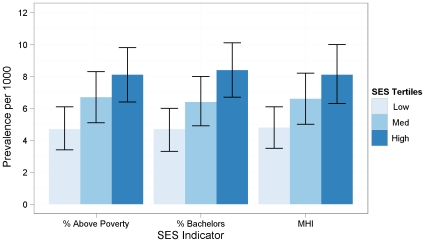
BACKGROUND: This study was designed to evaluate the hypothesis that the prevalence of autism spectrum disorder (ASD) among children in the United States is positively associated with socioeconomic status (SES). METHODS: A cross-sectional study was implemented with data from the Autism and Developmental Disabilities Monitoring Network, a multiple source surveillance system that incorporates data from educational and health care sources to determine the number of 8-year-old children with ASD among defined populations. For the years 2002 and 2004, there were 3,680 children with ASD among a population of 557,689 8-year-old children. Area-level census SES indicators were used to compute ASD prevalence by SES tertiles of the population. RESULTS: Prevalence increased with increasing SES in a dose-response manner, with prevalence ratios relative to medium SES of 0.70 (95% confidence interval [CI] 0.64, 0.76) for low SES, and of 1.25 (95% CI 1.16, 1.35) for high SES, (P<0.001). Significant SES gradients were observed for children with and without a pre-existing ASD diagnosis, and in analyses stratified by gender, race/ethnicity, and surveillance data source. The SES gradient was significantly stronger in children with a pre-existing diagnosis than in those meeting criteria for ASD but with no previous record of an ASD diagnosis (p<0.001), and was not present in children with co-occurring ASD and intellectual disability. CONCLUSIONS: The stronger SES gradient in ASD prevalence in children with versus without a pre-existing ASD diagnosis points to potential ascertainment or diagnostic bias and to the possibility of SES disparity in access to services for children with autism. Further research is needed to confirm and understand the sources of this disparity so that policy implications can be drawn. Consideration should also be given to the possibility that there may be causal mechanisms or confounding factors associated with both high SES and vulnerability to ASD.
Overview
The claims and statistics of this paper haven’t been checked yet.
Free: it reads the open-access text and checks the first 5 claims that cite a source we can check. Create a free account to check every claim.
Integrity signals
Registry
Cites
Statistics
Figures
Verification
Claims the paper makes
The claims and statistics of this paper haven’t been checked yet.
Free: it reads the open-access text and checks the first 5 claims that cite a source we can check. Create a free account to check every claim.
Self-check
Percentages, sums and reported differences re-computed from the paper’s own numbers.
The self-check needs the paper’s full text.
Citations
Cites
(1943) · The Nervous child · Cited by 8,870
Autistic disturbances of affective contact.
Kanner, L. (1968) · PubMed · Cited by 3,140
Easy SAS Calculations for Risk or Prevalence Ratios and Differences
Spiegelman, D. (2005) · American Journal of Epidemiology · doi:10.1093/aje/kwi188 · Cited by 1,738 · cited 1×
“We computed x(2) tests and 95% confidence intervals based on a Poisson distribution and log-link function [37].”
MethodEpidemiological Surveys of Autism and Other Pervasive Developmental Disorders: An Update
Fombonne, E. (2003) · Journal of Autism and Developmental Disorders · doi:10.1023/a:1025054610557 · Cited by 1,505 · cited 1×
“A number of investigators and recent reviews of the epidemiology of autism have concluded that any association observed between autism risk and SES has been due to such bias [26,27,30,31].”
BackgroundThe Epidemiology of Autism Spectrum Disorders
Newschaffer, C. J., Croen, L. A., Daniels, J., Giarelli, E., Grether, J. K., Levy, S. E., Mandell, D. S., Miller, L. A., Pinto-Martin, J., Reaven, J., et al. (2007) · Annual Review of Public Health · doi:10.1146/annurev.publhealth.28.021406.144007 · Cited by 1,228 · cited 1×
“A number of investigators and recent reviews of the epidemiology of autism have concluded that any association observed between autism risk and SES has been due to such bias [26,27,30,31].”
BackgroundSelf-citationRacial/Ethnic Disparities in the Identification of Children With Autism Spectrum Disorders
Mandell, D. S., Wiggins, L. D., Carpenter, L. A., Daniels, J., DiGuiseppi, C., Durkin, M. S., Giarelli, E., Morrier, M. J., Nicholas, J. S., Pinto-Martin, J. A., et al. (2009) · American Journal of Public Health · doi:10.2105/ajph.2007.131243 · Cited by 946 · cited 1×
“In a previous analysis of ADDM Network data for children identified by the surveillance system as meeting diagnostic criteria for ASD, Mandell and colleagues found nonHispanic white and Asian children to be more likely than nonHispanic black and Hispanic children to have a pre-existing ASD diagnosis [39].”
MethodSelf-citationApplying an equity lens to child health and mortality: more of the same is not enough
Victora, C. G., Wagstaff, A., Schellenberg, J. A., Gwatkin, D., Claeson, M., & Habicht, J.-P. (2003) · The Lancet · doi:10.1016/s0140-6736(03)13917-7 · Cited by 820
Epidemiology of autistic conditions in young children: 1. Prevalence
Lotter, V. (1966) · Social Psychiatry · doi:10.1007/bf00584048 · Cited by 780
Risk Factors for Autism: Perinatal Factors, Parental Psychiatric History, and Socioeconomic Status
Larsson, H. J., Eaton, W. W., Madsen, K. M., Vestergaard, M., Olesen, A. V., Agerbo, E., Schendel, D., Thorsen, P., & Mortensen, P. B. (2005) · American Journal of Epidemiology · doi:10.1093/aje/kwi123 · Cited by 727 · cited 1×
“However, a nearly equivalent number of studies, both clinical [19–23] and epidemiological [24–28], have failed to find associations between SES and ASD, and one casecontrol study found lower educational attainment of mothers of children with autism compared to controls [29].”
Result
Research works printed but not linked: 3
- Susser MW Hopper K Watson W 1985 Sociology in medicine, third edition. New York Oxford University Press 603
- Durkin MS Schupf N Stein ZA Susser MW 2007 Childhood cognitive disability. Wallace RB Hightstown, NJ McGraw-Hill 1173 1184 Public health and preventive medicine, fifteenth edition
- American Psychiatric Association 2000 Diagnostic and Statistical Manual of Mental Disorders (DSM-IV-TR) Edition 4, Text Revision. Arlington, VA American Psychiatric Association
Cited by
Items 101–200 of 549
Mahdi, S., Viljoen, M., Yee, T., Selb, M., Singhal, N., Almodayfer, O., Granlund, M., de Vries, P. J., Zwaigenbaum, L., & Bölte, S. (2018) · Autism Research · doi:10.1002/aur.1905 · Cited by 58
“…linkable to ICF categories, a large number of personal factors, such as age, education level, living situation, were identified in this study, further attesting to the link between personal background experiences and the lived experiences of ASD [Delobel-Ayoub et al., 2015; Durkin et al., 2010].”
BackgroundAdvancing parental age and autism: multifactorial pathways
Lee, B. K., & McGrath, J. J. (2015) · Trends in Molecular Medicine · doi:10.1016/j.molmed.2014.11.005 · Cited by 76
BACB Certification Trends: State of the States (1999 to 2014)
Deochand, N., & Fuqua, R. W. (2016) · Behavior Analysis in Practice · doi:10.1007/s40617-016-0118-z · Cited by 62
Rivard, M., Millau, M., Magnan, C., Mello, C., & Boulé, M. (2019) · Journal of Developmental and Physical Disabilities · doi:10.1007/s10882-018-9653-6 · Cited by 68
“…the prevalence rate for ASD, presently estimated at 1 child in 59 (Baio et al. 2018), is regarded as relatively homogeneous across the globe (Durkin et al. 2010), there remain ethnic and cultural disparities (Emerson et al. 2008; Fombonne 2003; Gardiner and French 2011; IASSID SIRG 2012;…”
BackgroundPillay, S., Duncan, M., & de Vries, P. J. (2020) · Autism · doi:10.1177/1362361320978042 · Cited by 68
“However, the pattern of under-representation in our findings is also in line with reports from the United States where White children were 30% more likely to be identified with ASD than Black children (CDC, 2014; Durkin et al., 2010; Imm et al., 2019).”
ResultGao, Y., Yu, Y., Xiao, J., Luo, J., Zhang, Y., Tian, Y., Zhang, J., Olsen, J., Li, J., & Liew, Z. (2020) · JAMA Network Open · doi:10.1001/jamanetworkopen.2020.2868 · Cited by 64
Nowell, K. P., Brewton, C. M., Allain, E., & Mire, S. S. (2015) · Review Journal of Autism and Developmental Disorders · doi:10.1007/s40489-015-0053-x · Cited by 66
“tween race, ethnicity, and timeliness of ASD diagnosis (Durkin et al. 2010; Liptak et al. 2008; Mandell et al. 2009; Thomas, et al. 2012), suggesting that parental knowledge of”
BackgroundMethodResultInfluentialSun, X., Allison, C., Auyeung, B., Baron-Cohen, S., & Brayne, C. (2014) · Research in Developmental Disabilities · doi:10.1016/j.ridd.2014.07.037 · Cited by 54
Kurzius‐Spencer, M., Pettygrove, S. D., Christensen, D., Pedersen, A. L., Cunniff, C. M., Meaney, F. J., Soke, G. N., Harrington, R. A., Durkin, M. S., & Rice, S. A. (2018) · Research in Autism · doi:10.1016/j.rasd.2018.09.002 · Cited by 63
Self-citationBerger, N. I., Wainer, A., Kuhn, J., Bearss, K. E., Attar, S. M., Carter, A. S., Ibañez, L. V., Ingersoll, B. R., Neiderman, H., Scott, S., et al. (2021) · Journal of Autism and Developmental Disorders · doi:10.1007/s10803-021-04911-2 · Cited by 61
Pham, C., Symeonides, C., O’Hely, M., Sly, P. D., Knibbs, L. D., Thomson, S. M., Vuillermin, P., Saffery, R., Ponsonby, A., & the Barwon Infant Study Investigator Group (2022) · Autism · doi:10.1177/13623613211068223 · Cited by 61
“On the contrary, numerous epidemiological studies, mainly from the United States, have reported that ASD is more common among relatively affluent participants (Bhasin & Schendel, 2007; Croen et al., 2002; Delobel-Ayoub et al., 2015; Durkin et al., 2010; Fountain et al., 2011; Windham et al., 2011).”
BackgroundSchieve, L. A., Boulet, S. L., Blumberg, S. J., Kogan, M. D., Yeargin-Allsopp, M., Boyle, C. A., Visser, S. N., & Rice, C. (2012) · Disability and Health Journal · doi:10.1016/j.dhjo.2011.09.001 · Cited by 55
Self-citationDiGuiseppi, C. G., Daniels, J. L., Fallin, D. M., Rosenberg, S. A., Schieve, L. A., Thomas, K. C., Windham, G. C., Goss, C. W., Soke, G. N., Currie, D. W., et al. (2016) · Disability and Health Journal · doi:10.1016/j.dhjo.2016.01.005 · Cited by 54
Self-citationMahdi, S., Albertowski, K., Almodayfer, O., Arsenopoulou, V., Carucci, S., Dias, J. C., Khalil, M., Knüppel, A., Langmann, A., Lauritsen, M. B., et al. (2018) · Journal of Autism and Developmental Disorders · doi:10.1007/s10803-018-3482-4 · Cited by 61
“Furthermore, environmental factors such as higher socio-economic background, parental commitment, and provision of evidence-based treatments, have found to facilitate the functional outcome of individuals with ASD regarding social relationships as well as school and vocational achievement (Delobel-Ayoub et al. 2015; D…”
BackgroundIn utero Exposure to β-2-Adrenergic Receptor Agonist Drugs and Risk for Autism Spectrum Disorders
Gidaya, N. B., Lee, B. K., Burstyn, I., Michael, Y., Newschaffer, C. J., & Mortensen, E. L. (2016) · PEDIATRICS · doi:10.1542/peds.2015-1316 · Cited by 63
Sakai, C., Mulé, C. M., LeClair, A. M., Chang, F., Sliwinski, S. K., Yau, Y., & Freund, K. M. (2019) · Journal of Developmental & Behavioral Pediatrics · doi:10.1097/dbp.0000000000000660 · Cited by 54
Robertson, R. E., Sobeck, E. E., Wynkoop, K. S., & Schwartz, R. J. (2017) · Remedial and Special Education · doi:10.1177/0741932516685407 · Cited by 51
“Because previous research has been mixed on whether rates of ASD differ across these demographics (Durkin et al., 2010; Dyches et al., 2004; Mandell, Novak, & Zubritsky, 2005; Mandell et al., 2009; Yeargin-Allsopp et al., 2003), the general population of U.S. families was considered an acceptable…”
BackgroundResultInfluentialStainbrook, J. A., Weitlauf, A. S., Juárez, A. O. R., Taylor, J. L., Hine, J. F., Broderick, N. A., Nicholson, A. G., & Warren, Z. E. (2018) · Autism · doi:10.1177/1362361318787797 · Cited by 51
“…of 1 in 59 (Baio et al., 2018), demand for diagnostic expertise has grown exponentially, with ongoing disparities regarding geographic, socioeconomic, and racial/ethnic factors (Christensen et al., 2016; Durkin et al., 2010; Fountain et al., 2011; Liptak et al., 2008; Zuckerman et al., 2013).”
BackgroundSociodemographic differences in parental satisfaction with an autism spectrum disorder diagnosis
Hidalgo, N. J., McIntyre, L. L., & McWhirter, E. H. (2015) · Journal of Intellectual & Developmental Disability · doi:10.3109/13668250.2014.994171 · Cited by 54
“Recent epidemiological studies suggest an increased risk for ASD among lower SES groups (e.g., Harris, 2012), yet individuals from higher SES backgrounds are more often identified than their lower income counterparts (Durkin et al., 2010).”
Miller, L. L., Scharf, J. M., Mathews, C. A., & Ben‐Shlomo, Y. (2013) · Developmental Medicine & Child Neurology · doi:10.1111/dmcn.12318 · Cited by 49
“40) when comparing children without a pre-existing diagnosis.(22) This elegantly demonstrates the same issue of ascertainment bias that is likely to occur in the Tourette syndrome/chronic tics literature.”
BackgroundHrdlička, M., Vacova, M., Ošlejšková, H., Gondžová, V., Vadlejchova, I., Kocourková, J., Koutek, J., & Dudová, I. (2016) · Neuropsychiatric Disease and Treatment · doi:10.2147/ndt.s107239 · Cited by 56
Blood Lead Concentrations in Jamaican Children with and without Autism Spectrum Disorder
Rahbar, M. H., Samms‐Vaughan, M. E., Dickerson, A. S., Loveland, K. A., Hessabi, M., Bressler, J., Shakespeare‐Pellington, S., Grove, M. L., Pearson, D. A., & Boerwinkle, E. (2014) · International Journal of Environmental Research and Public Health · doi:10.3390/ijerph120100083 · Cited by 49
“Additionally, previous studies have reported a lower rate of ASD diagnosis and prevalence in groups with lower income [77,82,84].”
BackgroundIs genetic liability to ADHD and ASD causally linked to educational attainment?
Dardani, C., Riglin, L., Leppert, B., Sanderson, E. C. M., Rai, D., Howe, L. D., Smith, G. D., Tilling, K. M., Thapar, A., Davies, N. M., et al. (2021) · International Journal of Epidemiology · doi:10.1093/ije/dyab107 · Cited by 48
Luelmo, P., & Kasari, C. L. (2021) · Autism · doi:10.1177/1362361321998561 · Cited by 48
“At the same time, disparities persist in early identification of autism and access to services for lowincome families, racial/ethnic minorities, and families where English is not the primary language (Christensen et al., 2016; Durkin et al., 2010; Harris et al., 2020; Magaña et al., 2013).”
BackgroundLogan, S. L., Carpenter, L. A., Leslie, R. S., Garrett-Mayer, E. S., Hunt, K. J., Charles, J. M., & Nicholas, J. S. (2015) · Journal of Child and Adolescent Psychopharmacology · doi:10.1089/cap.2013.0119 · Cited by 49
“…et al. 2008; Nicholas et al. 2008; Van Naarden Braun 2008; Yeargin-Allsopp 2008; Bilder et al 2009; Mandell 2009; Nicholas et al., 2009; Shattuck et al 2009; Pinborough-Zimmerman et al. 2009; Wiggins and Baio 2009; Durkin et al. 2010; Kalkbrenner et al. 2010; Levy et al. 2010; Powell et al 2010).”
Self-citationConti, E., Mazzotti, S., Calderoni, S., Saviozzi, I., & Guzzetta, A. (2013) · Human Reproduction · doi:10.1093/humrep/det380 · Cited by 43
Çalışan, R., Özbaran, B., Inal-Kaleli, I., Köse, S., Bildik, T., & Ghaziuddin, M. (2023) · Psychiatric Quarterly · doi:10.1007/s11126-023-10063-6 · Cited by 47
“The effects of socioeconomic and education levels of the parents on autism diagnosis are inconsistent with an increased risk of ASD diagnoses reported with both high [33, 34] and low socio-economic status of the parents’ [35, 36] and some studies reporting no association at all [37].”
Concerns and considerations among caregivers of a child with autism in Qatar
Kheir, N. M., Ghoneim, O. M., Sandridge, A. L., Hayder, S., Al-Ismail, M. S., & Al-Rawi, F. (2012) · BMC Research Notes · doi:10.1186/1756-0500-5-290 · Cited by 48
“In addition, physical health issues which are recently becoming recognized in the literature and the volume of hours spent looking after a child with autism can also contribute to caregiver burden [2-4].”
BackgroundTravers, J. C., Krezmien, M. P., Mulcahy, C., & Tincani, M. (2014) · The Journal of Special Education · doi:10.1177/0022466912454014 · Cited by 39
“Durkin et al. (2010) found that prevalence rates were directly related to SES, with lower prevalence among children from low SES and higher prevalence among children with high SES.”
BackgroundShould all young children be screened for autism spectrum disorder?
Mandell, D. S., & Mandy, W. (2015) · Autism · doi:10.1177/1362361315608323 · Cited by 42
“1177/1362361315608323AutismMandell and Mandy research-article2015 Editorial 896 Autism 19(8) or not at all (Daniels and Mandell, 2014; Durkin et al., 2010).”
BackgroundIncreasing autism prevalence in metropolitan New Jersey
Zahorodny, W., Shenouda, J., Howell, S., Rosato, N. S., Peng, B., & Mehta, U. (2014) · Autism · doi:10.1177/1362361312463977 · Cited by 38
“Regardless, further consideration of demographic influences on ASD prevalence is indicated, especially to understand disparities in ASD identification and diagnosis (Durkin et al., 2010; Levy et al., 2011; Mandell et al., 2009; Thomas et al., 2011).”
BackgroundAbbas, H., Garberson, F., Glover, E., & Wall, D. P. (2017) · IEEE International Conference on Big Data (BigData) · doi:10.1109/bigdata.2017.8258346 · Cited by 46
“Diagnosis within the first few years of life dramatically improves the outlook of children with autism, as it allows for treatment while the child’s brain is still rapidly developing [1], [2].”
BackgroundDillon, E. F., Kanne, S. M., Landa, R. J., Annett, R. D., Bernier, R., Bradley, C. C., Carpenter, L. A., Kim, S. H., Parish‐Morris, J., Schultz, R. T., et al. (2021) · Journal of Autism and Developmental Disorders · doi:10.1007/s10803-021-05385-y · Cited by 47
Geetha, B., Sukumar, C., Dhivyadeepa, E., Reddy, J. K., & Vellingiri, B. (2018) · Acta Neurologica Belgica · doi:10.1007/s13760-018-01057-4 · Cited by 45
Trends in concept and nosology of autism spectrum disorder: A review
Gyawali, S., & Patra, B. N. (2019) · Asian Journal of Psychiatry · doi:10.1016/j.ajp.2019.01.021 · Cited by 47
Guyatt, A. L., Heron, J., Knight, B. L. C., Golding, J., & Rai, D. (2015) · BMJ Open · doi:10.1136/bmjopen-2014-007433 · Cited by 35
Neonatal EEG linked to individual differences in socioemotional outcomes and autism risk in toddlers
Brito, N. H., Elliott, A., Isler, J. R., Rodríguez, C., Friedrich, C., Shuffrey, L. C., & Fifer, W. P. (2019) · Developmental Psychobiology · doi:10.1002/dev.21870 · Cited by 44
“…links between ASD and difficulties in learning, attention, and sensory pro‐ cessing (Johnson & Myers, 2007); ASD is reported to occur in all racial, ethnic, and socioeconomic groups (Durkin et al., 2010), but is much more common among boys (1 in 42) than among girls (1 in 189) (Baio, 2014).”
BackgroundBakulski, K. M., Dou, J., Feinberg, J. I., Aung, M. T., Ladd‐Acosta, C., Volk, H. E., Newschaffer, C. J., Croen, L., Hertz‐Picciotto, I., Levy, S. E., et al. (2021) · Frontiers in Molecular Neuroscience · doi:10.3389/fnmol.2021.775390 · Cited by 47
Self-citationKhanna, R., Jariwala, K., & Bentley, J. P. (2013) · Quality of Life Research · doi:10.1007/s11136-013-0423-8 · Cited by 38
Smith, L., Malcolm-Smith, S., & de Vries, P. J. (2017) · Autism · doi:10.1177/1362361316648469 · Cited by 37
“Socioeconomic status (SES) is not a risk factor for ASD (Fombonne, 2003), but may influence clinical diagnosis (Daley, 2002) and access to services (Durkin et al., 2010).”
BackgroundOverview and Introduction to Autism Spectrum Disorder (ASD)
Al-Dewik, N. I. E., Al‐Jurf, R., Styles, M., Tahtamouni, S., Al‐Sharshani, D., Alsharshani, M., Ahmad, A. I., Khattab, A., Rifai, H. A., & Qoronfleh, M. W. (2020) · Advances in neurobiology · doi:10.1007/978-3-030-30402-7_1 · Cited by 45
Sociodemographic risk factors associated with autism spectrum disorders and intellectual disability
Pinborough‐Zimmerman, J., Bilder, D. A., Bakian, A. V., Satterfield, R., Carbone, P. S., Nangle, B. E., Randall, H., & McMahon, W. M. (2011) · Autism Research · doi:10.1002/aur.224 · Cited by 40
Beliefs in vaccine as causes of autism among SPARK cohort caregivers
Fombonne, E. J., Goin‐Kochel, R. P., O’Roak, B. J., Abbeduto, L., Aberbach, G., Acampado, J., Ace, A. J., Albright, C., Alessandri, M., Amaral, D. G., et al. (2020) · Vaccine · doi:10.1016/j.vaccine.2019.12.026 · Cited by 40
“Already, ethnic minority and underserved social groups have well-established decreased access to diagnostic and early intervention services [2,7].”
BackgroundImm, P., White, T., & Durkin, M. S. (2019) · Autism · doi:10.1177/1362361319827510 · Cited by 35
“Furthermore, our previous studies have demonstrated that the racial and ethnic disparities in ASD prevalence may be partially explained by racial and ethnic disparities in socioeconomic status (Durkin et al., 2017; Durkin et al., 2010).”
BackgroundSelf-citationBlacher, J., Stavropoulos, K. K. M., & Bolourian, Y. (2019) · Autism · doi:10.1177/1362361318818327 · Cited by 36
“Previous studies suggested that there may be some demographic differences in autism samples, supported by socioeconomic status (SES) inequality in reported ASD prevalence (Durkin et al., 2010).”
Yu, T., Lien, Y.-J., Liang, F., & Kuo, P. (2020) · American Journal of Epidemiology · doi:10.1093/aje/kwaa241 · Cited by 42
Sagiv, S. K., Kalkbrenner, A. E., & Bellinger, D. C. (2015) · Environmental Health · doi:10.1186/1476-069x-14-8 · Cited by 39
“Children diagnosed with ASD have been shown to differ along these dimensions compared to the underlying population [6].”
Quantitative autistic trait measurements index background genetic risk for ASD in Hispanic families
Page, J., Constantino, J. N., Zambrana, K., Martin, E. R., Tunc, I., Zhang, Y., Abbacchi, A. M., & Messinger, D. S. (2016) · Molecular Autism · doi:10.1186/s13229-016-0100-1 · Cited by 39
“When fewer cases are diagnosed in a population, the diagnosed cases of ASD tend to be more severe [39]; this and inverse associations between SES and language/executive Fig.”
BackgroundFactors that Influence Autism Knowledge in Hispanic Cultures: a Pilot Study
Colbert, A. M., Webber, J., & Graham, R. (2016) · Journal of Racial and Ethnic Health Disparities · doi:10.1007/s40615-016-0213-4 · Cited by 36
Épidémiologie de l’autisme : où en sommes-nous ?
Fombonne, E. J., Myers, J., Chavez, A. E., Hill, A. P., Zuckerman, K. E., & Pry, R. (2019) · Enfance · doi:10.3917/enf2.191.0013 · Cited by 42
Hooker, B. S. (2014) · Translational Neurodegeneration · doi:10.1186/2047-9158-3-16 · Cited by 34
“It should be noted that a recent publication has shown that the prevalence of autism in African Americans is nearly 25% higher than that of whites [15].”
BackgroundRetractedEpidemiological Surveys of Autism Spectrum Disorders
Myers, J., Chavez, A. E., Hill, A. P., Zuckerman, K. E., & Fombonne, E. J. (2019) · Cambridge University Press eBooks · doi:10.1017/9781108297769.003 · Cited by 35
Fujiwara, T. (2013) · Journal of Autism and Developmental Disorders · doi:10.1007/s10803-013-1988-3 · Cited by 35
“2 years old), using Kanner’s diagnostic criteria (Hoshino et al. 1982). This conflicting result may be due to the difference of outcome, i.e., Hoshino et al. (1982) used diagnosed autism, while current study used suspected ASD as outcome.”
ResultFettig, A., Barton, E. E., Carter, A. S., & Eisenhower, A. (2016) · Infants & Young Children · doi:10.1097/iyc.0000000000000058 · Cited by 30
“…communication strategies (e.g., request for help requesting for a turn) from the approach to supporting an EI provider in access to early diagnosis and treatment for ASD (Chiri & Warfield, 2011; Durkin et al., 2010); these disparities fall along lines of race, income, and English learner status.”
Doing Abstraction: Autism, Diagnosis, and Social Theory
Maynard, D. W., & Turowetz, J. J. (2019) · Sociological Theory · doi:10.1177/0735275119830450 · Cited by 35
“In combination with epidemiological studies (Durkin et al. 2010; Durkin et al. 2008), these investigations provide a rich store of knowledge about how meso- and-macro-level processes have resulted in the contemporary autism “epidemic” (Bishop et al. 2008).”
BackgroundCasagrande, K. A., & Ingersoll, B. R. (2020) · Review Journal of Autism and Developmental Disorders · doi:10.1007/s40489-020-00208-9 · Cited by 32
“Given the increased healthcare disparities for this group (e.g., Durkin et al. 2010; Magaña et al. 2013; Parish et al. 2012; Shapiro et al. 2004), it is especially important to understand how the broader research can inform more effective supports for connecting these families to services that can…”
BackgroundLopez, K., Marroquín, J. M., & Gutierrez, C. (2020) · Social Work · doi:10.1093/sw/swaa012 · Cited by 34
US state variation in autism insurance mandates: Balancing access and fairness
Johnson, R., Danis, M., & Hafner-Eaton, C. (2014) · Autism · doi:10.1177/1362361314529191 · Cited by 32
“…demographic variables, research examining individual factors contributing to higher identified prevalence of autism points to higher parental socioeconomic status (Durkin et al., 2010), higher levels of parental education (Kogan et al., 2009), and white, nonHispanic race (Kogan et al., 2009).”
BackgroundA comparison of the ASD experience of low‐SES hispanic and non‐hispanic white parents
Ferguson, A., & Vigil, D. C. (2019) · Autism Research · doi:10.1002/aur.2223 · Cited by 32
“Inequalities in the U.S. healthcare system may contribute to the under-diagnosis of ASD in Hispanic children and children from lower SES backgrounds [Alvarado, 2005; Durkin et al., 2010; Kraermer, 2010].”
BackgroundInfluentialSocioeconomic status and childhood autism: A population-based study in China
He, P., Guo, C., Wang, Z., Gong, C., Li, N., & Zheng, X. (2017) · Psychiatry Research · doi:10.1016/j.psychres.2017.08.046 · Cited by 34
“United States where significant correlation between SES and autism was found in both male and female children (Durkin et al., 2010).”
Strand, S., & Lindorff, A. (2018) · doi:10.13140/rg.2.2.23625.19044 · Cited by 29
Chinawa, J. M., Manyike, P. C., Aniwada, E. C., Chinawa, A. T., Obu, H. A., Odetunde, O. I., Nwokocha, A. R. C., & Ibekwe, R. R. (2017) · African Health Sciences · doi:10.4314/ahs.v16i4.8 · Cited by 28
Janvier, Y. M., Coffield, C. N., Harris, J. F., Mandell, D. S., & Cidav, Z. (2018) · Autism · doi:10.1177/1362361318770430 · Cited by 28
“Diagnosis is even later or missed altogether among children living in poverty and those from racial or ethnic minorities (Durkin et al., 2010, 2017; Fountain et al., 2010; Mandell et al., 2002, 2009).”
BackgroundGaspar, R. S., Rossi, L., Hone, T., & Dornelles, A. Z. (2021) · The Lancet Regional Health - Americas · doi:10.1016/j.lana.2021.100042 · Cited by 37
Shenouda, J., Barrett, E. S., Davidow, A. L., Halperin, W., Silenzio, V., & Zahorodny, W. M. (2021) · Autism Research · doi:10.1002/aur.2628 · Cited by 34
“While multiple studies reported a positive association between SES and ASD prevalence, between 2000 and 2010 (Durkin & Yeargin-Allsopp, 2018; Durkin et al., 2010; Nevison & Parker, 2020; Thomas et al.,) Recent studies suggest that the association may be shifting (Nevison & Parker, 2020; Winter et…”
BackgroundGoldblum, J., McFayden, T. C., Bristol, S. K., Putnam, O. C., Wylie, A. C., & Harrop, C. (2023) · Journal of Autism and Developmental Disorders · doi:10.1007/s10803-023-06104-5 · Cited by 31
Health Utility Assessment Using EQ-5D among Caregivers of Children with Autism
Khanna, R., Jariwala, K., & Bentley, J. P. (2013) · Value in Health · doi:10.1016/j.jval.2013.04.007 · Cited by 29
Yoo, S. M., Kim, K., Kang, S., Kim, H. J., Yun, J., & Lee, J. Y. (2022) · Journal of Korean Medical Science · doi:10.3346/jkms.2022.37.e1 · Cited by 34
Dawson-Squibb, J.-J., & de Vries, P. J. (2019) · Journal of Autism and Developmental Disorders · doi:10.1007/s10803-019-04176-w · Cited by 31
Assessment of Autism Across the Lifespan: A Way Forward
Klaiman, C., Fernàndez‐Carriba, S., Hall, C., & Saulnier, C. A. (2014) · Current Developmental Disorders Reports · doi:10.1007/s40474-014-0031-5 · Cited by 31
The Unmasking of Autism in South Africa and Nigeria
Adams, S. N. (2024) · Neuropsychiatric Disease and Treatment · doi:10.2147/ndt.s461650 · Cited by 33
“17,26,28 Moreover, validation of tools is more than just linguistic adaptations but also the incorporation of cultural and contextual factors that are imperative to understand the population being studied.”
BackgroundHoffman, K., Kalkbrenner, A. E., Vieira, V. M., & Daniels, J. L. (2012) · Environmental Health · doi:10.1186/1476-069x-11-80 · Cited by 27
“In addition, Durkin et al. (2010) reported a differential socioeconomic (SES) gradient in ASD prevalence by the presence or absence of ID; SES acts as a stronger risk factor for ASD-ID compared to ASD+ID [3].”
BackgroundConstantino, J. N., & Marrus, N. M. (2017) · Child and Adolescent Psychiatric Clinics of North America · doi:10.1016/j.chc.2017.02.008 · Cited by 33
Validation of the Developmental Check-In Tool for Low-Literacy Autism Screening
Harris, J. F., Coffield, C. N., Janvier, Y. M., Mandell, D. S., & Cidav, Z. (2021) · PEDIATRICS · doi:10.1542/peds.2019-3659 · Cited by 28
Characterizing Health Disparities in the Age of Autism Diagnosis in a Study of 8-Year-Old Children
Parikh, C., Kurzius‐Spencer, M., Mastergeorge, A. M., & Pettygrove, S. D. (2018) · Journal of Autism and Developmental Disorders · doi:10.1007/s10803-018-3500-6 · Cited by 27
Enhancing Transition Programming for College Students with Autism: A Systematic Literature Review.
Nachman, B. R. (2020) · The Journal of Postsecondary Education and Disability · Cited by 33
Logan, S. L., Carpenter, L. A., Leslie, R. S., Hunt, K. S., Garrett-Mayer, E. S., Charles, J. M., & Nicholas, J. S. (2014) · Journal of Autism and Developmental Disorders · doi:10.1007/s10803-014-2156-0 · Cited by 29
Self-citationSegev, A., Weisskopf, M. G., Levine, H., Pinto, O. Y., & Raz, R. (2019) · Autism Research · doi:10.1002/aur.2185 · Cited by 26
“Much of the literature supports our understanding of these disparities as deriving from variations in awareness and access to resources [Colbert, Webber, & Graham, 2017; Durkin et al., 2010; Isaksen et al., 2013; Jo et al., 2015; Leonard et al., 2010; Thomas et al., 2012].”
BackgroundResultInfluentialSturm, A., Williams, J., & Kasari, C. L. (2021) · Autism Research · doi:10.1002/aur.2517 · Cited by 30
“…with core domains of impairment for ID. ASD and ID can both impact learning and academic achievement (American Psychiatric Association, 2013; Estes et al., 2011; Fleury et al., 2014), social communication, independent living, and gross and fine motor development (Ming et al., 2007; Vuijk et…”
BackgroundSelenium and Autism Spectrum Disorder
Skalny, A. V., Геннадиевна, С. М., Bjørklund, G., Гриценко, В. А., Aaseth, J., & Tinkov, A. A. (2018) · Molecular and integrative toxicology · doi:10.1007/978-3-319-95390-8_10 · Cited by 23
Improving Behavior Challenges and Quality of Life in the Autism Learning Health Network
Anixt, J. S., Murray, D. S., Coury, D. L., Kuhlthau, K. A., Eskra, D., Seide, J., Kelly, A. M., Hess, A., Lipkin, P. H., Law, J. K., et al. (2020) · PEDIATRICS · doi:10.1542/peds.2019-1895e · Cited by 23
“Compared with a nationally representative ASD population, our ALHN sample had a similar sex distribution but less racial diversity.(35) However, a goal of the ALHN is to enroll 75% of all children with ASD who receive care at ALHN sites, reflecting the broader population seen at those sites.”
ResultFreitag, C. M. (2012) · Zeitschrift für Kinder- und Jugendpsychiatrie und Psychotherapie · doi:10.1024/1422-4917/a000164 · Cited by 30
Correlates of adaptive skills in children with autism spectrum disorder
Aishworiya, R., Goh, T. J., Sung, M., & Tay, S. K. H. (2021) · Autism · doi:10.1177/1362361321997287 · Cited by 25
“However, studies from the United States have suggested that a higher family SES is associated with an increased prevalence of ASD diagnosis and greater access to treatment compared with a lower family SES (Durkin et al., 2010; Thomas et al., 2012; Windham et al., 2011).”
BackgroundEpidemiology of Autism Spectrum Disorders
French, L. R., Bertone, A., Hyde, K. L., & Fombonne, E. J. (2012) · Elsevier eBooks · doi:10.1016/b978-0-12-391924-3.00001-6 · Cited by 36
Esler, A., Hall‐Lande, J., & Hewitt, A. S. (2017) · Journal of Autism and Developmental Disorders · doi:10.1007/s10803-017-3232-z · Cited by 24
O’Sharkey, K., Mitra, S., Paik, S.-A., Chow, T., Cockburn, M., & Ritz, B. R. (2024) · Journal of Autism and Developmental Disorders · doi:10.1007/s10803-024-06371-w · Cited by 25
“…ASD, for which we saw a similar transformation over time with higher SES neighborhoods initially exhibiting greater annual ASD cumulative incidence consistent with the literature describing higher diagnosis rates in families with the means to pursue professional evaluations (Durkin et al., 2010 ).”
Kuenzel, E., Séguin, D., Nicolson, R., & Duerden, E. G. (2021) · Autism Research · doi:10.1002/aur.2613 · Cited by 23
“This association may be due to increased access to testing and earlier diagnoses among families with greater financial resources (Durkin et al., 2010).”
BackgroundLehti, V., Hinkka‐Yli‐Salomäki, S., Cheslack‐Postava, K., Gissler, M., Brown, A. S., & Sourander, A. (2015) · Nordic Journal of Psychiatry · doi:10.3109/08039488.2015.1011692 · Cited by 23
An ecological study on childhood autism
St‐Hilaire, S., Ezike, V. O., Stryhn, H., & Thomas, M. A. (2012) · International Journal of Health Geographics · doi:10.1186/1476-072x-11-44 · Cited by 20
“We found a negative association between unemployment rate and autism, which is consistent with other recent studies that have found the prevalence of autism is higher in families that have a higher socioeconomic status (or lower unemployment) [52].”
BackgroundResultLa determinación social del autismo en población infantil ecuatoriana
Chávez, C. L., Castelo, M. D. L. L., Breilh, J., & Muñoz, Y. T. (2020) · Revista Ciencias de la Salud · doi:10.12804/revistas.urosario.edu.co/revsalud/a.8993 · Cited by 27
“Otras investigaciones refieren que en la clase social más alta (mayor ingreso mediano de la familia) el autismo es significativamente mayor; y hay que resaltar que en esta población el autismo no está acompañado de discapacidad intelectual, como en el caso de los niños autistas que pertenecen a una clase social baja (…”
BackgroundPredictors of Ascertainment of Autism Spectrum Disorders Across Nine US Communities
Pettygrove, S. D., Pinborough‐Zimmerman, J., Meaney, F. J., Braun, K. V. N., Nicholas, J. S., Miller, L. A., Miller, J. N., & Rice, C. E. (2012) · Journal of Autism and Developmental Disorders · doi:10.1007/s10803-012-1732-4 · Cited by 20
“Higher income has been associated with higher prevalence of ASD in some studies (Durkin et al. 2010) and it would seem likely that higher income would be associated with a decreased chance of education-only.”
BackgroundSelf-citationAn intelligent multimodal framework for identifying children with autism spectrum disorder
Chen, J., Liao, M., Wang, G., & Chen, C. (2020) · International Journal of Applied Mathematics and Computer Science · doi:10.34768/amcs-2020-0032 · Cited by 22
Dovgan, K. N., & Villanti, K. M. (2021) · The Journal of Genetic Psychology · doi:10.1080/00221325.2021.1904817 · Cited by 22
Avoiding Unintended Bias: Strategies for Providing More Equitable Health Care.
van Ryn, M. (2016) · PubMed · Cited by 25
Schelly, D., González, P. J., & Solís, P. J. (2019) · Health Services Research and Managerial Epidemiology · doi:10.1177/2333392819853058 · Cited by 21
“Autism spectrum disorder (ASD) has long been underdiagnosed in children from minority and low socioeconomic status (SES) families.(1,2) On one hand, some clinics are more likely than others to diagnose ASD or refer children to specialists, and minority and low SES families have inferior access to diagnosing clinics.”
BackgroundPredictors of Autism Enrollment in Public School Systems
Boswell, K., Zablotsky, B., & Smith, C. J. (2014) · Exceptional Children · doi:10.1177/0014402914532230 · Cited by 21
“Such findings may further imply that within counties of higher SES, there are more services available, leading more families of children with ASD to move there, which may be particularly true with respect to schools.”
BackgroundResultInfluentialExtraversion Is a Mediator of Gelotophobia: A Study of Autism Spectrum Disorder and the Big Five
Tsai, M.-N., Wu, C., Tseng, L.-P., An, C.-P., & Chen, H. (2018) · Frontiers in Psychology · doi:10.3389/fpsyg.2018.00150 · Cited by 22
“Past research has indicated that a positive relationship has been observed between socioeconomic status and ASD prevalence (Durkin et al., 2010).”
BackgroundGoodman‐Scott, E., & Carlisle, R. (2014) · Professional School Counseling · doi:10.5330/2156-759x-18.1.158 · Cited by 21
Akhter, S., Shefa, J., Quader, M. A., Talukder, K., Hussain, A. E., Kundu, G. K., Fatema, K., Alam, S. T., Islam, K. A., Rahman, M. S., et al. (2022) · Autism · doi:10.1177/13623613221135297 · Cited by 20
“Our findings (Table 6) agreed with some studies (Durkin et al., 2010; Thomas et al., 2012)and disagreed with others (Rai et al., 2012; Sun et al., 2014).”
ResultHrdlička, M., Urbánek, T., Rotreklova, A., Kultova, A., Valek, O., & Dudová, I. (2023) · European Child & Adolescent Psychiatry · doi:10.1007/s00787-023-02189-6 · Cited by 23
“In contrast to several US studies [33–36] and a meta-analysis of 42 studies by Daniels and Mandell [14], family socioeconomic status was not found to be a significant predictor in our study [it was significant only at the trend level ( p = 0.067)].”
ResultInfluential
Metadata
- Authors
- Durkin, M. S., Maenner, M. J., Meaney, F. J., Levy, S. E., DiGuiseppi, C., Nicholas, J. S., Kirby, R. S., Pinto-Martin, J. A., & Schieve, L. A.
- Affiliations
- University of Wisconsin–Madison (US)
- University of Arizona (US)
- University of Pennsylvania (US)
- Colorado School of Public Health (US)
- Medical University of South Carolina (US)
- University of South Florida (US)
- Centers for Disease Control and Prevention (US)
- Corresponding author
- Durkin, Maureen S.
- ORCID
- Venue
- PLoS ONE
- Publisher
- Public Library of Science (PLoS)
- Published
- 2010-07-12
- Volume
- 5
- Issue
- 7
- Pages
- e11551
- ISSN
- 1932-6203 (ISSN-L)
- PMC
- PMC2902521
- OpenAlex
- W2158452837
- Semantic Scholar
- ebd9777ee15fcbb04421b4123da8c17d267be1e1
- Cited by
- 509
- References
- 41
- Citations by year
- 2026: 87 · 2025: 20 · 2024: 26 · 2023: 31 · 2022: 25 · 2021: 39 · 2020: 34 · 2019: 36 · 2018: 34 · 2017: 31 · 2016: 23 · 2015: 36 · 2014: 25 · 2013: 19 · 2012: 27
- FWCI
- 11.99
- Type
- journal article
- Language
- en
- Open access
- gold
- doi.org
- Licence
- Locations
- PLoS ONE (publishedVersion, public-domain)
- PubMed Central (publishedVersion, public-domain)
- PubMed (publishedVersion)
- RePEc: Research Papers in Economics (submittedVersion)
- DOAJ (DOAJ: Directory of Open Access Journals) (submittedVersion, cc-by-sa)
- Funders
- Centers for Disease Control and Prevention (UR3/CCU523235, UR3DD000078)
- U.S. Public Health Service (UR3/CCU523235)
- Topics
- Life Sciences › Neuroscience › Cognitive Neuroscience › Autism Spectrum Disorder Research
- Health Sciences › Medicine › Psychiatry and Mental health › Child Nutrition and Feeding Issues
- Social Sciences › Psychology › Clinical Psychology › Family and Disability Support Research
- Keywords
- autism spectrum disorder, socioeconomic status, socioeconomic disparities, autism prevalence, children, diagnostic bias, access to services, intellectual disability, racial and ethnic disparities, gender disparities
- MeSH terms
- Child, Child Development Disorders, Pervasive, Cross-Sectional Studies, Female, Humans, Male, Social Class, United States
About these checks
Registry, retraction, Cites and statistics results are computed, not judged, with one exception: a printed reference that no index lists is read once by a model before it counts as a citation error. Claims are extracted by a model and kept only when their quote appears verbatim in the text; each cited source is then checked, with a model’s help, for whether it says what the claim relies on. Those verdicts can be wrong — read the claim’s quote and the cited source before relying on one.
Statistics and arithmetic are recomputed, not judged.
Confidence bands are shown only for fields calibrated on our annotated test set. None is calibrated yet, so no band is shown.
What counts as a claim ›How we measure confidence ›How we check this ›
Are you an author, or do you see a problem with this page? Request a review
Data sources
Bibliographic data: Semantic Scholar, OpenAlex, Crossref.
Contains information from the Semantic Scholar Academic Graph Datasets, made available under the ODC Attribution License (ODC-BY 1.0).
Semantic Scholar’s data is described in: Kinney, R., et al. (2023). The Semantic Scholar Open Data Platform. arXiv:2301.10140.
