

Socioeconomic Inequality in the Prevalence of Autism Spectrum Disorder: Evidence from a U.S. Cross-Sectional Study
Open accessThe DOI matches its Crossref record; 41 of the 41 references it cites were found in a registry or an index.
Abstract
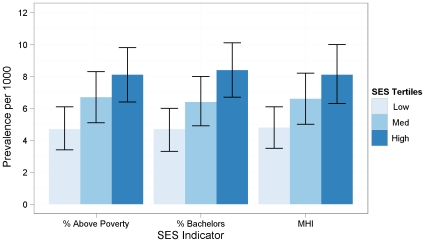
BACKGROUND: This study was designed to evaluate the hypothesis that the prevalence of autism spectrum disorder (ASD) among children in the United States is positively associated with socioeconomic status (SES). METHODS: A cross-sectional study was implemented with data from the Autism and Developmental Disabilities Monitoring Network, a multiple source surveillance system that incorporates data from educational and health care sources to determine the number of 8-year-old children with ASD among defined populations. For the years 2002 and 2004, there were 3,680 children with ASD among a population of 557,689 8-year-old children. Area-level census SES indicators were used to compute ASD prevalence by SES tertiles of the population. RESULTS: Prevalence increased with increasing SES in a dose-response manner, with prevalence ratios relative to medium SES of 0.70 (95% confidence interval [CI] 0.64, 0.76) for low SES, and of 1.25 (95% CI 1.16, 1.35) for high SES, (P<0.001). Significant SES gradients were observed for children with and without a pre-existing ASD diagnosis, and in analyses stratified by gender, race/ethnicity, and surveillance data source. The SES gradient was significantly stronger in children with a pre-existing diagnosis than in those meeting criteria for ASD but with no previous record of an ASD diagnosis (p<0.001), and was not present in children with co-occurring ASD and intellectual disability. CONCLUSIONS: The stronger SES gradient in ASD prevalence in children with versus without a pre-existing ASD diagnosis points to potential ascertainment or diagnostic bias and to the possibility of SES disparity in access to services for children with autism. Further research is needed to confirm and understand the sources of this disparity so that policy implications can be drawn. Consideration should also be given to the possibility that there may be causal mechanisms or confounding factors associated with both high SES and vulnerability to ASD.
Overview
The claims and statistics of this paper haven’t been checked yet.
Free: it reads the open-access text and checks the first 5 claims that cite a source we can check. Create a free account to check every claim.
Integrity signals
Registry
Cites
Statistics
Figures
Verification
Claims the paper makes
The claims and statistics of this paper haven’t been checked yet.
Free: it reads the open-access text and checks the first 5 claims that cite a source we can check. Create a free account to check every claim.
Self-check
Percentages, sums and reported differences re-computed from the paper’s own numbers.
The self-check needs the paper’s full text.
Citations
Cites
(1943) · The Nervous child · Cited by 8,870
Autistic disturbances of affective contact.
Kanner, L. (1968) · PubMed · Cited by 3,140
Easy SAS Calculations for Risk or Prevalence Ratios and Differences
Spiegelman, D. (2005) · American Journal of Epidemiology · doi:10.1093/aje/kwi188 · Cited by 1,738 · cited 1×
“We computed x(2) tests and 95% confidence intervals based on a Poisson distribution and log-link function [37].”
MethodEpidemiological Surveys of Autism and Other Pervasive Developmental Disorders: An Update
Fombonne, E. (2003) · Journal of Autism and Developmental Disorders · doi:10.1023/a:1025054610557 · Cited by 1,505 · cited 1×
“A number of investigators and recent reviews of the epidemiology of autism have concluded that any association observed between autism risk and SES has been due to such bias [26,27,30,31].”
BackgroundThe Epidemiology of Autism Spectrum Disorders
Newschaffer, C. J., Croen, L. A., Daniels, J., Giarelli, E., Grether, J. K., Levy, S. E., Mandell, D. S., Miller, L. A., Pinto-Martin, J., Reaven, J., et al. (2007) · Annual Review of Public Health · doi:10.1146/annurev.publhealth.28.021406.144007 · Cited by 1,228 · cited 1×
“A number of investigators and recent reviews of the epidemiology of autism have concluded that any association observed between autism risk and SES has been due to such bias [26,27,30,31].”
BackgroundSelf-citationRacial/Ethnic Disparities in the Identification of Children With Autism Spectrum Disorders
Mandell, D. S., Wiggins, L. D., Carpenter, L. A., Daniels, J., DiGuiseppi, C., Durkin, M. S., Giarelli, E., Morrier, M. J., Nicholas, J. S., Pinto-Martin, J. A., et al. (2009) · American Journal of Public Health · doi:10.2105/ajph.2007.131243 · Cited by 946 · cited 1×
“In a previous analysis of ADDM Network data for children identified by the surveillance system as meeting diagnostic criteria for ASD, Mandell and colleagues found nonHispanic white and Asian children to be more likely than nonHispanic black and Hispanic children to have a pre-existing ASD diagnosis [39].”
MethodSelf-citationApplying an equity lens to child health and mortality: more of the same is not enough
Victora, C. G., Wagstaff, A., Schellenberg, J. A., Gwatkin, D., Claeson, M., & Habicht, J.-P. (2003) · The Lancet · doi:10.1016/s0140-6736(03)13917-7 · Cited by 820
Epidemiology of autistic conditions in young children: 1. Prevalence
Lotter, V. (1966) · Social Psychiatry · doi:10.1007/bf00584048 · Cited by 780
Risk Factors for Autism: Perinatal Factors, Parental Psychiatric History, and Socioeconomic Status
Larsson, H. J., Eaton, W. W., Madsen, K. M., Vestergaard, M., Olesen, A. V., Agerbo, E., Schendel, D., Thorsen, P., & Mortensen, P. B. (2005) · American Journal of Epidemiology · doi:10.1093/aje/kwi123 · Cited by 727 · cited 1×
“However, a nearly equivalent number of studies, both clinical [19–23] and epidemiological [24–28], have failed to find associations between SES and ASD, and one casecontrol study found lower educational attainment of mothers of children with autism compared to controls [29].”
Result
Research works printed but not linked: 3
- Susser MW Hopper K Watson W 1985 Sociology in medicine, third edition. New York Oxford University Press 603
- Durkin MS Schupf N Stein ZA Susser MW 2007 Childhood cognitive disability. Wallace RB Hightstown, NJ McGraw-Hill 1173 1184 Public health and preventive medicine, fifteenth edition
- American Psychiatric Association 2000 Diagnostic and Statistical Manual of Mental Disorders (DSM-IV-TR) Edition 4, Text Revision. Arlington, VA American Psychiatric Association
Cited by
Items 301–400 of 549
A View of Parents of Children with Autism Spectrum Disorder
Reynolds, J. (2016) · Digital Commons (Liberty University) · Cited by 5
Epidemiology of Cerebellar Disorders
Shooshtari, S., Stoesz, B. M., Rad, P., & Khoeiniha, S. (2017) · Contemporary clinical neuroscience · doi:10.1007/978-3-319-59749-2_21 · Cited by 4
Strengthening Service Access for Children of Color With Autism Spectrum Disorders
Boyd, B. A., Iruka, I. U., & Pierce, N. P. (2018) · International review of research in developmental disabilities · doi:10.1016/bs.irrdd.2018.07.001 · Cited by 7
Brief Report: Regional Variations in Characteristics of ASD Hospitalizations in the U.S.
Zhang, W., & Eshghi, M. (2018) · Journal of Autism and Developmental Disorders · doi:10.1007/s10803-018-3826-0 · Cited by 4
Voelkel, H., LeCroy, C. W., Williams, L. R., & Holschuh, J. (2013) · Best practices in mental health · doi:10.70256/712575aaopge · Cited by 6
Epidemiologic Features of Autism Spectrum Disorders
Kirby, R. S. (2015) · Contemporary clinical neuroscience · doi:10.1007/978-1-4939-2190-4_3 · Cited by 4
Self-citationCDC analysis of ICSI/autism: association is not causation
Barad, D. H., Kushnir, V. A., Albertini, D. F., & Gleicher, N. (2015) · Human Reproduction · doi:10.1093/humrep/dev104 · Cited by 4
Pediatric School Outreach: Clinical Needs of an Urban Student Population
Ng, P. M. L., Cohen-Silver, J., Yang, H., Swaminathan, A., & Wormsbecker, A. E. (2022) · Clinical Pediatrics · doi:10.1177/00099228221101242 · Cited by 3
Martin, A. M., Keehn, B., Paxton, A., Ciccarelli, M. R., & Keehn, R. M. (2024) · Journal of Developmental & Behavioral Pediatrics · doi:10.1097/dbp.0000000000001298 · Cited by 3
“4 Although higher SES background is associated with higher AS prevalence and earlier diagnosis, 13 there is evidence of racial and ethnic AS disparities even when SES is controlled.”
Cruz, V. P. D., Lelis, D. D. F., Andrade, J. M. O., Ribeiro, N. G., Baldo, T. D. O. F., & Baldo, M. P. (2024) · International Journal of Developmental Disabilities · doi:10.1080/20473869.2024.2414133 · Cited by 3
Parental educational levels association with autism risk in offsprings and their autistic phenotypes
Liu, X., Guo, C., Lyu, L., Liu, H., Yu, J., Huang, Z., Li, Y., Wei, W., Huang, J., Liao, C., et al. (2025) · Psychiatry Research · doi:10.1016/j.psychres.2025.116649 · Cited by 4
“Several studies have reported a significant association between high parental education levels and autism risk(Bhasin and Schendel, 2007; Durkin et al., 2010; Yu et al., 2021).”
Collins, E., Al‐Jaishi, A. A., Farrow, A., Amankwah, N., Georgiades, S., Salt, M., Holmes, K., & Edjoc, R. (2025) · BMJ Open · doi:10.1136/bmjopen-2024-096019 · Cited by 3
“21–24 42 43 While some studies from the USA and Australia have reported an opposite trend, suggesting a higher prevalence of autism in households of higher socioeconomic status, this has been attributed to differential access to services and supports from which participants were recruited.”
Complex genotype–phenotype relationships in neurodevelopmental disorders
Dvir, E., Meshorer, E., & Shifman, S. (2026) · Trends in Genetics · doi:10.1016/j.tig.2026.03.005 · Cited by 4
Community-based Screening and Referrals for Autism
Brewer, L. (2019) · Journal of Occupational Therapy Schools & Early Intervention · doi:10.1080/19411243.2019.1700472 · Cited by 3
“…and Mandell (2013) indicates that the mean age of diagnosis has decreased over time, however, children from families of low socioeconomic status and minority groups are less likely to be diagnosed at young ages (Christensen et al., 2015; Durkin et al., 2010; Fountain, King, & Bearman, 2011).”
BackgroundInfluentialKhatun, M. A., Ali, M. A., Ahmed, M. R., Noori, S. R. H., & Sahayadhas, A. (2020) · Advances in intelligent systems and computing · doi:10.1007/978-981-15-5566-4_14 · Cited by 3
Ding, J., Wang, L., Lei, Y., Xue, M., Mei, X., & Wang, X. (2022) · International Conference on Computational Intelligence and Applications (ICCIA) · doi:10.1109/iccia55271.2022.9828431 · Cited by 3
COVID-19 and changes in college student educational expectations and health by disability status
Halpern-Manners, A., McLeod, J. D., Anderson, E. M., & Ekl, E. A. (2022) · SSM - Population Health · doi:10.1016/j.ssmph.2022.101195 · Cited by 5
“consistent with research on gender gaps in college attendance (DiPrete & Buchmann, 2013), and mirror what we know about the epidemiology of autism (Durkin et al., 2010; Lai et al., 2015; Newschaffer et al., 2007).”
Rooney, T., Stern, Y. S., Hampton, L. H., Grauzer, J. M., Hobson, A. N., Levin, A., Jones, M. K., Kaat, A. J., & Roberts, M. Y. (2022) · American Journal of Speech-Language Pathology · doi:10.1044/2022_ajslp-22-00132 · Cited by 3
Dai, Y. G., Tagavi, D. M., Troxel, M., Oosting, D., & Carter, A. S. (2023) · Evidence-Based Practice in Child and Adolescent Mental Health · doi:10.1080/23794925.2023.2253549 · Cited by 4
“Individuals who are minoritized or from lower-CONTACT income households experience even greater challenges accessing timely diagnosis and intervention (Baio et al., 2018; Durkin et al., 2010; Mandell et al., 2009).”
Mourosi, J. T., Anwar, S., Islam, M. T., Vanakker, O. M., & Hosen, M. J. (2025) · International Journal of Developmental Disabilities · doi:10.1080/20473869.2025.2452858 · Cited by 3
Hendrix, R. A. (2011) · ScholarWorks (Walden University) · Cited by 6
Taking off the mask: autistic young women's experiences with social skills in high school
Kofke, M. (2019) · Library, Museums and Press - UDSpace (University of Delaware) · doi:10.58088/67xc-bq57 · Cited by 4
van Schalkwyk, G. I., Beyer, C., & de Vries, P. J. (2021) · Springer eBooks · doi:10.1007/978-3-319-91280-6_102111 · Cited by 3
Brisendine, A. E., O’Kelley, S. E., Sen, B., Preskitt, J. K., & Wingate, M. S. (2022) · Acta Psychologica · doi:10.1016/j.actpsy.2022.103800 · Cited by 2
Health Care Seeking Behavior among the Parents for their Autistic Children
Rahman, A. M., Sharmin, F., Usman, F., Yusuf, M. A., Haque, M., & Khan, K. (2023) · Journal of Current and Advance Medical Research · doi:10.3329/jcamr.v9i2.68000 · Cited by 2
Kokaua, J., Kolose-Pulefolau, B., Ruhe, T., Aldridge, F., Foliaki, S. A., Kokaua, L., Mapusua, T., Dacombe, J., Richards, R., Blakelock, R., et al. (2023) · Autism · doi:10.1177/13623613231217800 · Cited by 5
“…required to obtain an autism diagnosis, it has been hypothesised that family resourcing including socioeconomic status and parents’ education levels may be associated with inequities in the diagnostic process (Dickerson et al., 2017; Durkin et al., 2010; Kelly et al., 2017; Thomas et al., 2012).”
BackgroundResultInfluentialLyall, K., Dickerson, A. S., Green, A. M., Frndak, S., Croen, L., Ames, J., Avalos, L. A., Aschner, J. L., Bush, N. R., Camargo, C. A., et al. (2025) · Autism Research · doi:10.1002/aur.3296 · Cited by 2
“…relationships between sociodemographic factors and autism diagnoses (Christensen et al. 2016; Croen, Grether, and Selvin 2002; Durkin et al. 2017; Durkin et al. 2010; Harrison et al. 2017), as well as specific demographic and clinical factors associated with quantitative trait measures…”
Development of the Observable Behaviors of Autism Spectrum Disorder Scale
Deal, L. S., DeMuro, C., DiBenedetti, D. B., & Lewis, S. (2017) · Therapeutic Innovation & Regulatory Science · doi:10.1177/2168479016680258 · Cited by 2
“3% in Asia.(10-17) Many children with autism are treated with pharmaceutical therapies; however, there is little evidence to support a clinical benefit for most of these treatments.”
BackgroundInfluentialSimpson, J., Robinson, T., & Vale, L. D. (2021) · BMC Health Services Research · doi:10.1186/s12913-021-06280-z · Cited by 2
“Similarly, evidence shows that the risks of experiencing CP and ASD are also pronounced for those from socially disadvantaged backgrounds [27, 28].”
BackgroundLung, F., & Shu, B. (2022) · European Child & Adolescent Psychiatry · doi:10.1007/s00787-022-01945-4 · Cited by 2
“However, the results of our study may subvert the environmental hypothesis and support the awareness hypothesis, in which it is the increased awareness of parents, in addition to access to and availability of healthcare services, that increases the rate of diagnosis in urban areas [7, 12, 22].”
BackgroundResultAkash, N., Santre, M., Panse, S., Rathi, M., & Sonawane, K. (2024) · Industrial Psychiatry Journal · doi:10.4103/ipj.ipj_128_24 · Cited by 2
Wang, F., Du, W., & Iao, L. (2024) · Frontiers in Psychiatry · doi:10.3389/fpsyt.2024.1433823 · Cited by 3
“…indicated that mothers with higher education levels in WEIRD countries tended to engage in a more mutually affective interactions with their children (27) and demonstrated better awareness of their children ’ s autistic traits and obtained autism diagnoses for their children (e.g., 64, 65).”
BackgroundWhat Happens After Autism Screening—Factors That Predict Evaluation Attendance
Wieckowski, A. T., Brown, M., Register, H. M., FEIN, D. A., Stahmer, A. C., McClure, L. A., Dufek, S., & Robins, D. L. (2025) · Journal of Autism and Developmental Disorders · doi:10.1007/s10803-025-07143-w · Cited by 2
Perinatal and maternal factors associated with Autism Spectrum Disorder
Edlund, S., Haglund, N., Bornehag, C., Gennings, C., Kiviranta, H., Kolevzon, A., Lindh, C. H., Rantakokko, P., Reichenberg, A., Swan, S. H., et al. (2026) · PLoS ONE · doi:10.1371/journal.pone.0316968 · Cited by 3
“Social determinants like low socioeconomic status [51] and ethnicity [52] have also been implicated.”
Special Population Consideration in ASD Identification and Treatment
Chavez, A. E., Huang-Storms, L. Y., & Zuckerman, K. E. (2018) · Springer eBooks · doi:10.1007/978-3-030-00503-0_9 · Cited by 2
Ms, A., Begum, B. A., Akhter, S., Nigar, K., Uddin, U. K. M., Akter, S., & Jolly, Y. N. (2019) · Journal of Blood Disorders & Transfusion · doi:10.4172/2155-9864.1000415 · Cited by 4
Hepburn, S. (2019) · International review of research in developmental disabilities · doi:10.1016/bs.irrdd.2019.08.002 · Cited by 2
Low-income parents' perceptions of technology
Munoz, D. (2014) · CHI Conference Extended Abstracts on Human Factors in Computing Systems (CHI EA) · doi:10.1145/2559206.2579420 · Cited by 2
“Children from low SES families, especially African Americans and Hispanics, are more likely to receive a later diagnosis [1, 7], decreasing benefits that come with receiving early treatment and intervention [6].”
BackgroundReynolds, J. (2015) · ProQuest LLC eBooks · Cited by 2
Hegelund, E. R., Flensborg‐Madsen, T., Vassard, D., Rosenblum, L. A., Reinisch, J. M., & Mortensen, E. L. (2018) · Research in Autism · doi:10.1016/j.rasd.2018.08.004 · Cited by 2
Environmental risk factors for autism spectrum disorders
Rai, D. (2013) · Figshare · Cited by 2
Solarsh, H. M. (2016) · CUNY Academic Works (City University of New York) · Cited by 2
Developmental Screening in Community-Based Settings
Shahidullah, J. D., Forman, S. G., Harris, J. H., & Norton, A. M. (2020) · Springer eBooks · doi:10.1007/978-3-030-46295-6_4 · Cited by 1
Modos de Vida de Personas Autistas del Centro Medicina Integral (Cartagena - Colombia)
Meza, A. C. D. (2022) · Areté · doi:10.33881/1657-2513.22209 · Cited by 1
Epidemiology of Cerebellar Disorders
Shooshtari, S., Stoesz, B. M., Kian, P., Kian, S., & Iranpour, R. (2023) · Contemporary clinical neuroscience · doi:10.1007/978-3-031-23104-9_25 · Cited by 2
Tahir, S., Maqbool, S., Farid, A., Ali, A., Ullah, E., & Azhar, H. (2023) · Pakistan Armed Forces Medical Journal · doi:10.51253/pafmj.v73i3.7272 · Cited by 2
Viviani, T., Morin, D., & Greenfield, B. J. (2023) · Advances in Neurodevelopmental Disorders · doi:10.1007/s41252-023-00384-9 · Cited by 1
“For instance, some studies have shown a link between higher SES and higher ASD prevalence (Durkin et al., 2010; Fountain et al., 2011; Thomas et al., 2012; Yu et al, 2021), while others did not demonstrate any association (Larsson et al., 2005; Sun et al., 2014).”
Serum cholesterol in children with ASD
Alyaseen, F. (2024) · Romanian Journal of Pediatrics · doi:10.37897/rjp.2024.3.1 · Cited by 1
“The socioeconomic status revealed a non-significant difference (P = 0.460), concomitant with the finding of Durkin et al. [11], but lower SES backgrounds might hinder interventions, as explained by Barnard-Brak et al. [12].”
ResultInfluentialDy-Hollins, M., & Kirkpatrick, L. A. (2024) · Springer eBooks · doi:10.1007/978-3-031-62727-9_15 · Cited by 1
Mixed Methods Analysis of Caregiver Satisfaction With the Early Autism Evaluation Hub System
Martin, A. M., Huskins, J. C., Paxton, A., Nafiseh, A. A., Ciccarelli, M. R., Keehn, B., & Keehn, R. M. (2024) · Journal of Patient Experience · doi:10.1177/23743735241305531 · Cited by 1
Wagner, L., Foster, T. E., Bonnet, K. R., Spitler, A. K., Schlundt, D., & Warren, Z. E. (2024) · Autism · doi:10.1177/13623613241307078 · Cited by 1
“socioeconomic status, race/ethnicity, primary language, and age (Constantino et al., 2020; Durkin et al., 2010; Fountain et al., 2011; Liptak et al., 2008; Maenner et al., 2020; Zuckerman et al., 2017; Zwaigenbaum et al., 2021).”
Autism Spectrum Disorder in the Cleft Population: Evaluating Occurrence in Non-Syndromic Patients
MacIsaac, M. F., Fritz, A. M., Crenshaw, M., Gardner, L. M., Halsey, J. N., & Rottgers, S. A. (2025) · The Cleft Palate-Craniofacial Journal · doi:10.1177/10556656251368659 · Cited by 2
Singh, R., Shah, A., Jain, N. K., Shah, H., Parekh, B., & Rawal, R. (2026) · Nutritional Psychiatry · doi:10.1016/j.nupsyc.2026.100013 · Cited by 1
Policy Responses to Rising Autism Diagnoses in Childhood: Across the Spectrum
OECD (2026) · OECD eBooks · doi:10.1787/08394255-en · Cited by 1
Kaczor, M. W., Hentz, R. C., Wi, C., & Brumbaugh, J. E. (2026) · The Journal of Pediatrics · doi:10.1016/j.jpeds.2026.115089 · Cited by 2
Disparities in Autism Spectrum Disorder and Perinatal Risk Factors
del Giorgio, F., Driollet, B., Buajitti, E., Ahmed, A., Hutcheon, J. A., Rosella, L. C., & Yang, S. (2026) · JAMA Network Open · doi:10.1001/jamanetworkopen.2026.37174 · Cited by 1
Perinatal Immune Activation and Risk of Autism
Theoharides, T. C., Angelidou, A., Alysandratos, K., Asadi, S., Francis, K., Lykouras, L., & Kalogeromitros, D. C. (2011) · InTech eBooks · doi:10.5772/17436 · Cited by 2
Khanna, R., Jariwala, K., & Bentley, J. P. (2013) · Value in Health · doi:10.1016/j.jval.2013.03.501 · Cited by 1
Childhood Autism and Assortative Mating
Golden, H. (2013) · Cited by 1
Reported Perception and Clinical Diagnosis of Autism Among White and Non-White Groups
Gopaul, P. D., & Little, P. D. (2020) · Open Scholarship Institutional Repository (Washington University in St. Louis) · Cited by 1
Seung, H., Bui, J., & Pham, S. (2022) · Perspectives of the ASHA Special Interest Groups · doi:10.1044/2022_persp-22-00004 · Cited by 1
Rogge, N. (2023) · Journal of Behavioral Decision Making · doi:10.1002/bdm.2317 · Cited by 1
DeVries, L., Dempsey, J. R., & Wilson, R. (2023) · Journal of Developmental & Behavioral Pediatrics · doi:10.1097/dbp.0000000000001190 · Cited by 2
Socio-demographic correlates of autism spectrum disorder: A study in Odisha
Nayak, A., & Khuntia, R. (2024) · Industrial Psychiatry Journal · doi:10.4103/ipj.ipj_57_23 · Cited by 1
Adeogun, A. A., & Faezipour, M. (2023) · International Conference on Computational Science and Computational Intelligence (CSCI) · doi:10.1109/csci62032.2023.00218 · Cited by 1
“The health and development of children are intricately linked to socioeconomic status (SES) indicators in the population, which include factors such as household wealth, income, parental education, and occupation [14].”
BackgroundMathur, M., Li, R., McKay, S., Markham, C. M., Ernest, D. K., & Sharma, S. V. (2025) · Journal of Racial and Ethnic Health Disparities · doi:10.1007/s40615-025-02316-w · Cited by 1
Becerra, T. A. (2013) · eScholarship (California Digital Library) · Cited by 2
Understanding the Stressors of Low Socioeconomic Rural Parents of Autistic Children
Dunham, W. M. (2015) · ScholarWorks (Walden University) · Cited by 1
Preparing Behavioral Interventionists for Individuals with Autism Spectrum Disorder via Telepractice
Neely, L. C. (2015) · OakTrust (Texas A&M University Libraries) · Cited by 2
Durkin, M. S., & Imm, P. (2018) · American Journal of Public Health · doi:10.2105/ajph.2017.304272 · Cited by 1
Self-citationPerceived Barriers to Autism Spectrum Disorder Services
Williams, L. W. (2016) · Louisiana State University · doi:10.31390/gradschool_dissertations.4431 · Cited by 3
“(2010) found that those in the lowest third SES were half as likely to receive an ASD diagnosis as those in the highest third (Durkin et al., 2010).”
BackgroundInfluentialHidalgo, N. J. (2018) · Scholars' Bank (University of Oregon) · Cited by 2
Yazıcı, M. S. (2018) · PEARL (University of Plymouth) · doi:10.24382/726 · Cited by 10
Verhoef, E., Grove, J., Shapland, C. Y., Demontis, D., Burgess, S., Rai, D., Børglum, A. D., & Pourcain, B. S. (2019) · bioRxiv (Cold Spring Harbor Laboratory) · doi:10.1101/580365 · Cited by 1
Enabling autistic sociality: unrealised potentials intwo-sided social interaction
Heasman, B. (2018) · London School of Economics and Political Science Theses Online (London School of Economics and Political Science) · Cited by 14
Menoe, B. M., & Baloyi, L. (2017) · Cited by 1
Cornett, J. A. (2021) · Springer eBooks · doi:10.1007/978-3-319-91280-6_102183 · Cited by 1
Socioeconomic Factors and Comorbid Conditions in Children with Autism Spectrum Disorder
Paris, W. (2021) · ScholarWorks (Walden University) · Cited by 1
The Population Level Impacts of Differential Fertility Behavior of Parents of Children with Autism
Makovi, K., Winter, A. S., Liu, K., & Bearman, P. (2015) · Sociological Science · doi:10.15195/v2.a19
“Based on prior literature (Basin and Schendel 2007; Durkin et al. 2010; King and Bearman 2011), the ascertainment of autism occurs differently in different social groups, by birth cohort, poverty status, gender of the child, and educational level of the parents.”
BackgroundKinder- und jugendpsychiatrische Störungen
Vloet, T. D., & Herpertz‐Dahlmann, B. (2015) · Elsevier eBooks · doi:10.1016/b978-3-437-22107-1.50383-6
Wilford, A. (2012) · ResearchSpace (University of KwaZulu-Natal)
Chi, T., Critchfield, M., & Stahlhut, I. X. (2012) · Dominican Scholar (Dominican University of California) · doi:10.33015/dominican.edu/2012.ot.02
“Socioeconomic status (SES) is one of the most significant factors that influence access to health care for CSHCN. Durkin et al. (2010) found that inconsistency in accessing health care attributed to low SES can cause a decrease in appropriate diagnoses and services in children with autism.”
BackgroundServices And Information Provided To Mothers In El Paso/Juarez Region
Perez, C. Y. (2014) · scholarworks - UTEP (The University of Texas at El Paso)
Eine Übersicht zum aktuellen Forschungsstand und zum verhaltenstherapeutischen Behandlungsvorgehen
Kamp‐Becker, I., & Quaschner, K. (2015) · Cited by 1
Parents and Teachers' Perceptions and Clinical Diagnosis of Autism Among White and Non-White Groups
Gopaul, M. (2017) · ScholarWorks (Walden University) · Cited by 1
Kelly, K. J. T. (2017) · J. Willard Marriott Library · doi:10.26053/0h-y8rs-3vg0 · Cited by 2
Examining the cross-cultural validity of three early autism screening instruments
McDonough, J. D. (2015)
Alteraciones de la percepción socioemocional en adultos con autismo : correlatos psicopatológicos
del Rincón, P. L. N., Villamisar, D. G., & Polaino-Lorente, A. M. (2014) · LA Referencia (Red Federada de Repositorios Institucionales de Publicaciones Científicas) · Cited by 3
Gibson, A. L. (2017) · DigitalCommons@UNMC
Rieske, R. D. (2015) · Louisiana State University · doi:10.31390/gradschool_dissertations.96
Ayanaw, R., & Erika, L. (2017) · ProQuest LLC eBooks
Asperger's Syndrome in African American Children
Bailey, S. (2018) · ScholarWorks (Walden University) · Cited by 3
Coal ash exposure and behavioral impairments among children in Louisville, Kentucky.
Odoh, C. (2018) · ThinkIR: The University of Louisville's Institutional Repository (University of Louisville) · doi:10.18297/etd/3046
“education, and occupation, are strongly correlated with the health and development of children (141).”
BackgroundFamily Experiences: The Impact of Family Structure and Autism Spectrum Disorder on Social Outcomes
Hamre, K. (2016) · University of Minnesota Digital Conservancy (University of Minnesota) · Cited by 1
Is Excessive Prenatal Ultrasonography a Risk Factor for Autism? A Literature ReviewPreprint
Moammar, H., & Sulayman, R. (2019) · Preprints.org · doi:10.20944/preprints201906.0030.v1
Carminatti, G. G., & Carminati, F. (2019) · Psychothérapies · doi:10.3917/psys.193.0161
Jordan, S. (2019) · Digital Commons - DU (University of Denver) · Cited by 2
Early identification in autism: Subtypes based on child, family, and community characteristics
Wallisch, A. M. (2018) · KU ScholarWorks (University of Kansas)
Cornett, J. A. (2017) · Springer eBooks · doi:10.1007/978-1-4614-6435-8_102183-1
Metadata
- Authors
- Durkin, M. S., Maenner, M. J., Meaney, F. J., Levy, S. E., DiGuiseppi, C., Nicholas, J. S., Kirby, R. S., Pinto-Martin, J. A., & Schieve, L. A.
- Affiliations
- University of Wisconsin–Madison (US)
- University of Arizona (US)
- University of Pennsylvania (US)
- Colorado School of Public Health (US)
- Medical University of South Carolina (US)
- University of South Florida (US)
- Centers for Disease Control and Prevention (US)
- Corresponding author
- Durkin, Maureen S.
- ORCID
- Venue
- PLoS ONE
- Publisher
- Public Library of Science (PLoS)
- Published
- 2010-07-12
- Volume
- 5
- Issue
- 7
- Pages
- e11551
- ISSN
- 1932-6203 (ISSN-L)
- PMC
- PMC2902521
- OpenAlex
- W2158452837
- Semantic Scholar
- ebd9777ee15fcbb04421b4123da8c17d267be1e1
- Cited by
- 509
- References
- 41
- Citations by year
- 2026: 87 · 2025: 20 · 2024: 26 · 2023: 31 · 2022: 25 · 2021: 39 · 2020: 34 · 2019: 36 · 2018: 34 · 2017: 31 · 2016: 23 · 2015: 36 · 2014: 25 · 2013: 19 · 2012: 27
- FWCI
- 11.99
- Type
- journal article
- Language
- en
- Open access
- gold
- doi.org
- Licence
- Locations
- PLoS ONE (publishedVersion, public-domain)
- PubMed Central (publishedVersion, public-domain)
- PubMed (publishedVersion)
- RePEc: Research Papers in Economics (submittedVersion)
- DOAJ (DOAJ: Directory of Open Access Journals) (submittedVersion, cc-by-sa)
- Funders
- Centers for Disease Control and Prevention (UR3/CCU523235, UR3DD000078)
- U.S. Public Health Service (UR3/CCU523235)
- Topics
- Life Sciences › Neuroscience › Cognitive Neuroscience › Autism Spectrum Disorder Research
- Health Sciences › Medicine › Psychiatry and Mental health › Child Nutrition and Feeding Issues
- Social Sciences › Psychology › Clinical Psychology › Family and Disability Support Research
- Keywords
- autism spectrum disorder, socioeconomic status, socioeconomic disparities, autism prevalence, children, diagnostic bias, access to services, intellectual disability, racial and ethnic disparities, gender disparities
- MeSH terms
- Child, Child Development Disorders, Pervasive, Cross-Sectional Studies, Female, Humans, Male, Social Class, United States
About these checks
Registry, retraction, Cites and statistics results are computed, not judged, with one exception: a printed reference that no index lists is read once by a model before it counts as a citation error. Claims are extracted by a model and kept only when their quote appears verbatim in the text; each cited source is then checked, with a model’s help, for whether it says what the claim relies on. Those verdicts can be wrong — read the claim’s quote and the cited source before relying on one.
Statistics and arithmetic are recomputed, not judged.
Confidence bands are shown only for fields calibrated on our annotated test set. None is calibrated yet, so no band is shown.
What counts as a claim ›How we measure confidence ›How we check this ›
Are you an author, or do you see a problem with this page? Request a review
Data sources
Bibliographic data: Semantic Scholar, OpenAlex, Crossref.
Contains information from the Semantic Scholar Academic Graph Datasets, made available under the ODC Attribution License (ODC-BY 1.0).
Semantic Scholar’s data is described in: Kinney, R., et al. (2023). The Semantic Scholar Open Data Platform. arXiv:2301.10140.
