

Socioeconomic Inequality in the Prevalence of Autism Spectrum Disorder: Evidence from a U.S. Cross-Sectional Study
Open accessThe DOI matches its Crossref record; 41 of the 41 references it cites were found in a registry or an index.
Abstract
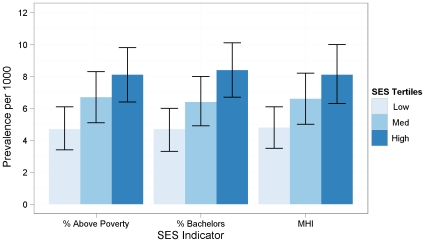
BACKGROUND: This study was designed to evaluate the hypothesis that the prevalence of autism spectrum disorder (ASD) among children in the United States is positively associated with socioeconomic status (SES). METHODS: A cross-sectional study was implemented with data from the Autism and Developmental Disabilities Monitoring Network, a multiple source surveillance system that incorporates data from educational and health care sources to determine the number of 8-year-old children with ASD among defined populations. For the years 2002 and 2004, there were 3,680 children with ASD among a population of 557,689 8-year-old children. Area-level census SES indicators were used to compute ASD prevalence by SES tertiles of the population. RESULTS: Prevalence increased with increasing SES in a dose-response manner, with prevalence ratios relative to medium SES of 0.70 (95% confidence interval [CI] 0.64, 0.76) for low SES, and of 1.25 (95% CI 1.16, 1.35) for high SES, (P<0.001). Significant SES gradients were observed for children with and without a pre-existing ASD diagnosis, and in analyses stratified by gender, race/ethnicity, and surveillance data source. The SES gradient was significantly stronger in children with a pre-existing diagnosis than in those meeting criteria for ASD but with no previous record of an ASD diagnosis (p<0.001), and was not present in children with co-occurring ASD and intellectual disability. CONCLUSIONS: The stronger SES gradient in ASD prevalence in children with versus without a pre-existing ASD diagnosis points to potential ascertainment or diagnostic bias and to the possibility of SES disparity in access to services for children with autism. Further research is needed to confirm and understand the sources of this disparity so that policy implications can be drawn. Consideration should also be given to the possibility that there may be causal mechanisms or confounding factors associated with both high SES and vulnerability to ASD.
Overview
The claims and statistics of this paper haven’t been checked yet.
Free: it reads the open-access text and checks the first 5 claims that cite a source we can check. Create a free account to check every claim.
Integrity signals
Registry
Cites
Statistics
Figures
Verification
Claims the paper makes
The claims and statistics of this paper haven’t been checked yet.
Free: it reads the open-access text and checks the first 5 claims that cite a source we can check. Create a free account to check every claim.
Self-check
Percentages, sums and reported differences re-computed from the paper’s own numbers.
The self-check needs the paper’s full text.
Citations
Cites
(1943) · The Nervous child · Cited by 8,870
Autistic disturbances of affective contact.
Kanner, L. (1968) · PubMed · Cited by 3,140
Easy SAS Calculations for Risk or Prevalence Ratios and Differences
Spiegelman, D. (2005) · American Journal of Epidemiology · doi:10.1093/aje/kwi188 · Cited by 1,738 · cited 1×
“We computed x(2) tests and 95% confidence intervals based on a Poisson distribution and log-link function [37].”
MethodEpidemiological Surveys of Autism and Other Pervasive Developmental Disorders: An Update
Fombonne, E. (2003) · Journal of Autism and Developmental Disorders · doi:10.1023/a:1025054610557 · Cited by 1,505 · cited 1×
“A number of investigators and recent reviews of the epidemiology of autism have concluded that any association observed between autism risk and SES has been due to such bias [26,27,30,31].”
BackgroundThe Epidemiology of Autism Spectrum Disorders
Newschaffer, C. J., Croen, L. A., Daniels, J., Giarelli, E., Grether, J. K., Levy, S. E., Mandell, D. S., Miller, L. A., Pinto-Martin, J., Reaven, J., et al. (2007) · Annual Review of Public Health · doi:10.1146/annurev.publhealth.28.021406.144007 · Cited by 1,228 · cited 1×
“A number of investigators and recent reviews of the epidemiology of autism have concluded that any association observed between autism risk and SES has been due to such bias [26,27,30,31].”
BackgroundSelf-citationRacial/Ethnic Disparities in the Identification of Children With Autism Spectrum Disorders
Mandell, D. S., Wiggins, L. D., Carpenter, L. A., Daniels, J., DiGuiseppi, C., Durkin, M. S., Giarelli, E., Morrier, M. J., Nicholas, J. S., Pinto-Martin, J. A., et al. (2009) · American Journal of Public Health · doi:10.2105/ajph.2007.131243 · Cited by 946 · cited 1×
“In a previous analysis of ADDM Network data for children identified by the surveillance system as meeting diagnostic criteria for ASD, Mandell and colleagues found nonHispanic white and Asian children to be more likely than nonHispanic black and Hispanic children to have a pre-existing ASD diagnosis [39].”
MethodSelf-citationApplying an equity lens to child health and mortality: more of the same is not enough
Victora, C. G., Wagstaff, A., Schellenberg, J. A., Gwatkin, D., Claeson, M., & Habicht, J.-P. (2003) · The Lancet · doi:10.1016/s0140-6736(03)13917-7 · Cited by 820
Epidemiology of autistic conditions in young children: 1. Prevalence
Lotter, V. (1966) · Social Psychiatry · doi:10.1007/bf00584048 · Cited by 780
Risk Factors for Autism: Perinatal Factors, Parental Psychiatric History, and Socioeconomic Status
Larsson, H. J., Eaton, W. W., Madsen, K. M., Vestergaard, M., Olesen, A. V., Agerbo, E., Schendel, D., Thorsen, P., & Mortensen, P. B. (2005) · American Journal of Epidemiology · doi:10.1093/aje/kwi123 · Cited by 727 · cited 1×
“However, a nearly equivalent number of studies, both clinical [19–23] and epidemiological [24–28], have failed to find associations between SES and ASD, and one casecontrol study found lower educational attainment of mothers of children with autism compared to controls [29].”
Result
Research works printed but not linked: 3
- Susser MW Hopper K Watson W 1985 Sociology in medicine, third edition. New York Oxford University Press 603
- Durkin MS Schupf N Stein ZA Susser MW 2007 Childhood cognitive disability. Wallace RB Hightstown, NJ McGraw-Hill 1173 1184 Public health and preventive medicine, fifteenth edition
- American Psychiatric Association 2000 Diagnostic and Statistical Manual of Mental Disorders (DSM-IV-TR) Edition 4, Text Revision. Arlington, VA American Psychiatric Association
Cited by
Items 401–500 of 549
The Role of Demographics in the Age of Autism Diagnosis
Koller, J. (2020) · Springer eBooks · doi:10.1007/978-1-4614-6435-8_102442-1
DeMayo, M. M. (2020) · The Sydney eScholarship Repository (The University of Sydney)
Young, K. (2020) · University of Minnesota Digital Conservancy (University of Minnesota)
Carminati, G. G., & Carminati, F. (2021) · Psychology · doi:10.4236/psych.2021.121003
“Severe autism affects around 0.1% of the general population (Durkin et al., 2008, 2010; Fombonne, 2009; Grether et al., 2009, King & Bearman, 2009; Rice, 2013; Rice et al., 2013; Schieve et al., 2011; Wing & Potter, 2002) and requires intensive psycho-educational care and an expensive human and…”
BackgroundInfluentialMacKenzie, K. T. (2021) · D-Scholarship@Pitt (University of Pittsburgh)
Early adversity and positive parenting: Predicting executive functioning in children with ASD
Kuenzel, E. (2021) · Scholarship@Western (Western University)
Montrenes, J. J. (2021) · Louisiana State University · doi:10.31390/gradschool_theses.5336
“Due to type of concern and age of diagnosis having both been shown to be influenced by child gender (Durkin et al., 2010; Giarelli et al., 2010; Little et al., 2017), lower age of concern having been shown to be associated with”
BackgroundDeZelar, S. (2018) · University of Minnesota Digital Conservancy (University of Minnesota) · Cited by 2
A Scoping Review of Excessive Prenatal Ultrasonography as a Potential Risk Factor for Autism
Moammar, H., Desch, L. W., & Sulayman, R. (2021) · American Journal of Pediatrics · doi:10.11648/j.ajp.20210704.12
“[52] Recent research has shown that more developed countries [58] and higher socioeconomic populations [59] have a greater prevalence of ASD.”
Wang, X., & Lee, N. (2018) · iDEA - Drexel University Institutional Repository · doi:10.17918/5g8c-th49
Immigrant Status (Epidemiological Studies)
Rice, C. E. (2012) · Springer eBooks · doi:10.1007/978-1-4419-1698-3_7
Hooper, S. R., Burgin, S., Christian, R., & Shattuck, K. (2021) · Springer eBooks · doi:10.1007/978-3-319-91280-6_938
Kinder- und jugendpsychiatrische Störungen
Vloet, T. D., & Herpertz-Dahlmann, B. (2018) · Elsevier eBooks · doi:10.1016/b978-3-437-24950-1.00102-5
Hooper, S. R., Burgin, S., Christian, R., & Shattuck, K. (2018) · Springer eBooks · doi:10.1007/978-1-4614-6435-8_938-3
Immigrant Status (Epidemiological Studies)
Rice, C. E. (2021) · Springer eBooks · doi:10.1007/978-3-319-91280-6_7
(2018) · مجلة دراسات الطفولة · doi:10.21608/jsc.2018.92956
Demographics and the Age of Autism Diagnosis
Koller, J. (2021) · Springer eBooks · doi:10.1007/978-3-319-91280-6_102442
Transtorno do Espectro do Autismo: Um estudo epidemiológico no Norte de Minas Gerais
Maia, F. A., Silveira, M. F., & Araújo, S. L. N. O. (2022) · Stricto Sensu Editora eBooks · doi:10.35170/ss.ed.9786586283709 · Cited by 1
Screening of ASD in At-Risk Young Children and Initiation of the Diagnostic Process
Weir, P. A., Tevis, C. M., & Matson, J. L. (2022) · Journal of Developmental and Physical Disabilities · doi:10.1007/s10882-022-09850-z
“Furthermore, low socio-economic status has been attributed to this racial/ethnic disparity, as minority groups have limited access to ASD screenings for early identification (Durkin et al., 2010).”
BackgroundAlvarez, I. D. (2022) · MOspace Institutional Repository (University of Missouri) · doi:10.32469/10355/91548
Rukmini, R., Sholikhah, H., Tumaji, & Laksono, A. (2022) · International conference on public health · doi:10.17501/24246735.2022.7116
GENETIC RISK FACTORS OF AUTISM SPECTRUM DISORDER
Mkhitaryan, M. (2023) · MEDICINE SCIENCE AND EDUCATION · doi:10.56936/18291775-2023.35-22
Neurodevelopmental disorders in people with intellectual disability across cultures
Shankar, R., Barrett, M., Kommu, J. V. S., & Biswas, A. B. (2023) · Oxford University Press eBooks · doi:10.1093/med/9780198857600.003.0003 · Cited by 1
Prenatal Risk and Later Intellectual and Developmental Disabilities
Bick, J. R., Rutter, T. M., Holland, C. M., Mueller, I., Mahmoodi, V., Manessis, A. G., Merrill, L. C., Camacho, M. C., Inala, S., Ortiz‐Jimenez, A., et al. (2024) · Contemporary clinical neuroscience · doi:10.1007/978-3-031-66932-3_8
Myers, S. M., & Challman, T. D. (2024) · Elsevier eBooks · doi:10.1016/b978-0-12-824060-1.00038-9
Ongono, J. S. (2021) · theses.fr (ABES) · doi:10.70675/6fe1cde6z9c86z4636zbdfez3ca0d60d01d7 · Cited by 1
Zhagüi-Tenesaca, V., Quintanilla-Martínez, J., Bermeo, J. P., & Guerrero-Vásquez, L. F. (2025) · World Congress on Medical Physics and Biomedical Engineering, September 7 - 12, 2009, Munich, Germany · doi:10.1007/978-3-031-89514-2_7 · Cited by 1
Early diagnosis and intervention for young children with autism spectrum disorder in New York State
Korompis, G. E. C. (2017) · Scholars Archive - University at Albany (University at Albany, State University of New York) · doi:10.54014/30rf-2x8z
Bobadilla, T., & Espinoza, J. (2025) · Journal of Ethnic & Cultural Diversity in Social Work · doi:10.1080/15313204.2025.2524348
“Research by Durkin et al. (2010) emphasizes the importance of culturally sensitive support services that recognize and address the unique needs of Latino families.”
InfluentialRacial and Socioeconomic Disparities in Autism Providers’ ACEs Inquiries
Walker, K. L., Gates, J. A., Boateng, S., Gerber, A. S., Gurba, A. N., Moskowitz, L. J., & Lerner, M. D. (2025) · Journal of Autism and Developmental Disorders · doi:10.1007/s10803-025-06948-z
Chettri, S., Chettri, M. N., Gurung, R., & Kondaveety, J. (2025) · Indian Journal of Otolaryngology and Head & Neck Surgery · doi:10.1007/s12070-025-05958-8
Delayed Diagnosis of Autism Spectrum Disorder in Adolescent Boys
Pardalou, G., Panagouli, E. D., Tzila, E., & Τσίτσικα, Ά. (2025) · Advances in experimental medicine and biology · doi:10.1007/978-3-032-03394-9_31
Straiton, D., & Ingersoll, B. R. (2025) · Autism · doi:10.1177/13623613251392495
Response to Autism: An Assessment of Services for Students with Autism in Kentucky's Public Schools
Roden, L. A. (2011) · TopSCHOLAR (Western Kentucky University) · Cited by 1
Simpson, J., Robinson, T., & Vale, L. (2021) · Figshare · doi:10.6084/m9.figshare.14253836
Shahrokhi, H., Ghiasi, A., Gholipour, K., Fanid, L. M., Shamekhi, H. R., & Iezadi, S. (2021) · Figshare · doi:10.6084/m9.figshare.13634517
Shahrokhi, H., Ghiasi, A., Gholipour, K., Fanid, L. M., Shamekhi, H. R., & Iezadi, S. (2021) · Figshare · doi:10.6084/m9.figshare.13634511
Simpson, J., Robinson, T., & Vale, L. (2021) · Figshare · doi:10.6084/m9.figshare.14253833
Salter, J., & Blainey, S. H. (2024) · Figshare · doi:10.6084/m9.figshare.25940112
Reimagining Autism in the School Years: An ICF-CY Core Set for Interdisciplinary Services
Balsa, F. (2023) · Carolina Digital Repository (University of North Carolina at Chapel Hill) · doi:10.17615/0qm5-0342
Smith-Young, J. (2024) · Memorial University Research Repository (Memorial University) · doi:10.48336/5jb7-x457
Shahrokhi, H., Ghiasi, A., Gholipour, K., Fanid, L. M., Shamekhi, H. R., & Iezadi, S. (2021) · Figshare · doi:10.6084/m9.figshare.13634514
Robert, G. (2024) · Corpus Université Laval (Université Laval)
Ayanaw, E. L. (2017) · IRL - University of Missouri, St. Louis (University of Missouri–St. Louis)
A district level population-based study of structural inequalities in autism pathways
Smith, D. L. (2023) · White Rose eTheses Online (University of Leeds, The University of Sheffield, University of York) · Cited by 3
Gopaul, M. (2016) · ScholarWorks (Walden University)
Inner Strength In Mothers Of Children With Autism Spectrum Disorders: Oral Histories
Steinberg, J. W. (2017) · UND Scholarly Commons (University of North Dakota)
Maternal Folate Status and Risk Factors for Autism Spectrum Disorders
Haniff, M. M. (2023) · ScholarWorks (Walden University)
Telehealth Autism Spectrum Disorder Evaluations: Efficacy and Caregiver Perceptions
Heyman, M. (2023) · eScholarship (California Digital Library)
Resilience of a caregiver of a child with autism spectrum disorder in resource-constrained contexts
(2020) · UpSpace Institutional Repository (University of Pretoria) · Cited by 1
Els trastorns del neurodesenvolupament com predictors del baix rendiment acadèmic
Munso, R. B. (2022) · Tesis Doctorals en Xarxa (Consorci de Serveis Universitaris de Catalunya)
Autismo en el cantón Cañar, 2022: un análisis desde el enfoque relacional
García Lima, J. B. (2023) · UASB-DIGITAL Categories (Universidad Andina Simón Bolívar)
Pulli, E. P. (2023) · UTUPub (University of Turku)
The Full Spectrum: Hispanic Understanding of Autism in Southern Arizona
Voelkel, H. (2012) · Arizona State University Library Digital Repository (Arizona State University) · Cited by 1
Chambers, K. (2025) · Nottingham ePrints (University of Nottingham)
Poreddy, K. K. R., Sahu, A. K., Mukherjee, S., & Basavaraju, B. K. (2025) · Research Square · doi:10.21203/rs.3.rs-8399277/v1
Pathways to an Autism Diagnosis: Insights from Parents of Females
Russell, A. (2025) · Carolina Digital Repository (University of North Carolina at Chapel Hill) · doi:10.17615/s5qn-w839
Crispim, M. G. A. (2024) · LA Referencia (Red Federada de Repositorios Institucionales de Publicaciones Científicas)
Professional Perspectives on the Barriers to Autistic Adult Mental Health in Ottawa, Canada
van Rensburg, M. J. (2025) · Carleton University's Institutional Repository (MacOdrum Library, Carleton University) · doi:10.22215/etd/2025-16694
Tohit, N. F. M., Fakuradzi, W. F. S. W. A., Minhat, H. S., & Haque, M. (2026) · Bangladesh Journal of Medical Science · doi:10.3329/bjms.v25i1.86400
“The findings of this review carry significant implications for policymakers, healthcare administrators, and practitioners working within ASEAN countries and Malaysia to improve outcomes for individuals with autism and their families 6,10,27,36 .”
InfluentialAutism Awareness Among Physical Therapists: Insights from Two Lower-Middle-Income Countries
Balogun, J. A., Mbada, C. E., Oyeyemi, A. Y., Bello, A. I., & Akande, M. A. (2026) · Springer eBooks · doi:10.1007/978-3-031-86558-9_14
Bowden, N., Anns, F., Clendon, S. A., Dacombe, J., Meehan, L. A., Vu, H. T. V., Woodford, E. C., & McLay, L. (2026) · International Journal for Population Data Science · doi:10.23889/ijpds.v10i2.3362
“Internationally, children from higher socioeconomic backgrounds are often more likely to be diagnosed, particularly without ID [62, 63].”
Desjardins, J.-P. (2025) · Le dépôt institutionnel (Université du Québec à Trois-Rivières)
Etude épidémiologique, génétique et métabolomique des Troubles du Spectre Autistique au Liban
Bitar, T. (2018) · theses.fr (ABES) · doi:10.70675/44700042z0e35z49f0z9d21zd00543f6df1c · Cited by 1
Kim, S. (2026) · American journal of student research. · doi:10.70251/hyjr2348.42307312
Haïda, O. (2018) · theses.fr (ABES) · doi:10.70675/ff06b994z1a54z464cz8830z6a3a9363bee7
“Ces différences peuvent être expliquées selon la rigueur des méthodes employées lors de l’étude, l’origine ethnique des patients qui semble être un facteur (Christensen, 2016) et leur niveau socio-économique (Durkin et al., 2010).”
Gender differences in autism prevalence: origins of bias and its current scientific relevance
Peña-Casquero, P., Wojcik, D. Z., & Canal‐Bedia, R. (2026) · Frontiers in Psychiatry · doi:10.3389/fpsyt.2026.1739570
“This structural lack of visibility reinforces historical inequalities and underscores the urgent need to rethink diagnostic frameworks from a critical, inclusive, and grounded perspective — one that recognizes the complexity of identities social contexts (36, 68, 69).”
Individual and In-Session Strategies
Rodrigues, S. (2026) · Oxford University Press eBooks · doi:10.1093/9780197843413.003.0046
Reimagining Family Engagement Through a Neurodiversity Lens
Rodrigues, S. (2026) · Oxford University Press eBooks · doi:10.1093/9780197843413.003.0044
Rodrigues, S. (2026) · Oxford University Press eBooks · doi:10.1093/9780197843413.002.0008
Restorative Practices and Regulation-Informed Discipline
Rodrigues, S. (2026) · Oxford University Press eBooks · doi:10.1093/9780197843413.003.0043
Neurodivergence and Socioeconomic Class
Rodrigues, S. (2026) · Oxford University Press eBooks · doi:10.1093/9780197843413.003.0020
Performative Inclusion and the Burden of Adaptation
Rodrigues, S. (2026) · Oxford University Press eBooks · doi:10.1093/9780197843413.003.0038
Reorienting the System: Unpacking Bias
Rodrigues, S. (2026) · Oxford University Press eBooks · doi:10.1093/9780197843413.003.0024
Designing Accessible and Inclusive Social Emotional Learning
Rodrigues, S. (2026) · Oxford University Press eBooks · doi:10.1093/9780197843413.003.0031
The Ethical Imperative of Action
Rodrigues, S. (2026) · Oxford University Press eBooks · doi:10.1093/9780197843413.003.0058
Rodrigues, S. (2026) · Oxford University Press eBooks · doi:10.1093/9780197843413.003.0001
Sustaining the Work: Burnout, Compassion Fatigue, and Systemic Support
Rodrigues, S. (2026) · Oxford University Press eBooks · doi:10.1093/9780197843413.003.0034
Rodrigues, S. (2026) · Oxford University Press eBooks · doi:10.1093/9780197843413.003.0053
Rodrigues, S. (2026) · Oxford University Press eBooks · doi:10.1093/9780197843413.003.0049
Rodrigues, S. (2026) · Oxford University Press eBooks · doi:10.1093/9780197843413.005.0002
Glossary of Key Terms and Concepts
Rodrigues, S. (2026) · Oxford University Press eBooks · doi:10.1093/9780197843413.005.0001
Transformative Social Emotional Learning
Rodrigues, S. (2026) · Oxford University Press eBooks · doi:10.1093/9780197843413.003.0032
Rodrigues, S. (2026) · Oxford University Press eBooks · doi:10.1093/9780197843413.003.0050
Applying the Person-In-Environment Framework
Rodrigues, S. (2026) · Oxford University Press eBooks · doi:10.1093/9780197843413.003.0008
Cultural Humility in Neurodiversity Affirming Practice
Rodrigues, S. (2026) · Oxford University Press eBooks · doi:10.1093/9780197843413.003.0009
Rodrigues, S. (2026) · Oxford University Press eBooks · doi:10.1093/9780197843413.003.0036
Peer Relationships and Dedicated Interests
Rodrigues, S. (2026) · Oxford University Press eBooks · doi:10.1093/9780197843413.003.0040
Rodrigues, S. (2026) · Oxford University Press eBooks · doi:10.1093/9780197843413.002.0002
Communication Justice as a Social Work Imperative
Rodrigues, S. (2026) · Oxford University Press eBooks · doi:10.1093/9780197843413.003.0011
Rodrigues, S. (2026) · Oxford University Press eBooks · doi:10.1093/9780197843413.003.0051
Rodrigues, S. (2026) · Oxford University Press eBooks · doi:10.1093/9780197843413.003.0002
Rodrigues, S. (2026) · Oxford University Press eBooks · doi:10.1093/9780197843413.003.0042
School Social Workers as Policy Advocates
Rodrigues, S. (2026) · Oxford University Press eBooks · doi:10.1093/9780197843413.003.0055
Rodrigues, S. (2026) · Oxford University Press eBooks · doi:10.1093/9780197843413.003.0035
Narrative Theory and the Reclamation of Neurodivergent Identity
Rodrigues, S. (2026) · Oxford University Press eBooks · doi:10.1093/9780197843413.003.0016
Advocacy in a Shifting Political Landscape
Rodrigues, S. (2026) · Oxford University Press eBooks · doi:10.1093/9780197843413.003.0057
Rodrigues, S. (2026) · Oxford University Press eBooks · doi:10.1093/9780197843413.005.0006
Metadata
- Authors
- Durkin, M. S., Maenner, M. J., Meaney, F. J., Levy, S. E., DiGuiseppi, C., Nicholas, J. S., Kirby, R. S., Pinto-Martin, J. A., & Schieve, L. A.
- Affiliations
- University of Wisconsin–Madison (US)
- University of Arizona (US)
- University of Pennsylvania (US)
- Colorado School of Public Health (US)
- Medical University of South Carolina (US)
- University of South Florida (US)
- Centers for Disease Control and Prevention (US)
- Corresponding author
- Durkin, Maureen S.
- ORCID
- Venue
- PLoS ONE
- Publisher
- Public Library of Science (PLoS)
- Published
- 2010-07-12
- Volume
- 5
- Issue
- 7
- Pages
- e11551
- ISSN
- 1932-6203 (ISSN-L)
- PMC
- PMC2902521
- OpenAlex
- W2158452837
- Semantic Scholar
- ebd9777ee15fcbb04421b4123da8c17d267be1e1
- Cited by
- 509
- References
- 41
- Citations by year
- 2026: 87 · 2025: 20 · 2024: 26 · 2023: 31 · 2022: 25 · 2021: 39 · 2020: 34 · 2019: 36 · 2018: 34 · 2017: 31 · 2016: 23 · 2015: 36 · 2014: 25 · 2013: 19 · 2012: 27
- FWCI
- 11.99
- Type
- journal article
- Language
- en
- Open access
- gold
- doi.org
- Licence
- Locations
- PLoS ONE (publishedVersion, public-domain)
- PubMed Central (publishedVersion, public-domain)
- PubMed (publishedVersion)
- RePEc: Research Papers in Economics (submittedVersion)
- DOAJ (DOAJ: Directory of Open Access Journals) (submittedVersion, cc-by-sa)
- Funders
- Centers for Disease Control and Prevention (UR3/CCU523235, UR3DD000078)
- U.S. Public Health Service (UR3/CCU523235)
- Topics
- Life Sciences › Neuroscience › Cognitive Neuroscience › Autism Spectrum Disorder Research
- Health Sciences › Medicine › Psychiatry and Mental health › Child Nutrition and Feeding Issues
- Social Sciences › Psychology › Clinical Psychology › Family and Disability Support Research
- Keywords
- autism spectrum disorder, socioeconomic status, socioeconomic disparities, autism prevalence, children, diagnostic bias, access to services, intellectual disability, racial and ethnic disparities, gender disparities
- MeSH terms
- Child, Child Development Disorders, Pervasive, Cross-Sectional Studies, Female, Humans, Male, Social Class, United States
About these checks
Registry, retraction, Cites and statistics results are computed, not judged, with one exception: a printed reference that no index lists is read once by a model before it counts as a citation error. Claims are extracted by a model and kept only when their quote appears verbatim in the text; each cited source is then checked, with a model’s help, for whether it says what the claim relies on. Those verdicts can be wrong — read the claim’s quote and the cited source before relying on one.
Statistics and arithmetic are recomputed, not judged.
Confidence bands are shown only for fields calibrated on our annotated test set. None is calibrated yet, so no band is shown.
What counts as a claim ›How we measure confidence ›How we check this ›
Are you an author, or do you see a problem with this page? Request a review
Data sources
Bibliographic data: Semantic Scholar, OpenAlex, Crossref.
Contains information from the Semantic Scholar Academic Graph Datasets, made available under the ODC Attribution License (ODC-BY 1.0).
Semantic Scholar’s data is described in: Kinney, R., et al. (2023). The Semantic Scholar Open Data Platform. arXiv:2301.10140.
