

Socioeconomic Inequality in the Prevalence of Autism Spectrum Disorder: Evidence from a U.S. Cross-Sectional Study
Open accessThe DOI matches its Crossref record; 41 of the 41 references it cites were found in a registry or an index.
Abstract
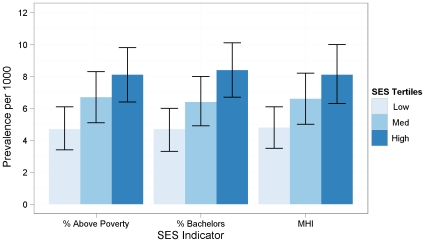
BACKGROUND: This study was designed to evaluate the hypothesis that the prevalence of autism spectrum disorder (ASD) among children in the United States is positively associated with socioeconomic status (SES). METHODS: A cross-sectional study was implemented with data from the Autism and Developmental Disabilities Monitoring Network, a multiple source surveillance system that incorporates data from educational and health care sources to determine the number of 8-year-old children with ASD among defined populations. For the years 2002 and 2004, there were 3,680 children with ASD among a population of 557,689 8-year-old children. Area-level census SES indicators were used to compute ASD prevalence by SES tertiles of the population. RESULTS: Prevalence increased with increasing SES in a dose-response manner, with prevalence ratios relative to medium SES of 0.70 (95% confidence interval [CI] 0.64, 0.76) for low SES, and of 1.25 (95% CI 1.16, 1.35) for high SES, (P<0.001). Significant SES gradients were observed for children with and without a pre-existing ASD diagnosis, and in analyses stratified by gender, race/ethnicity, and surveillance data source. The SES gradient was significantly stronger in children with a pre-existing diagnosis than in those meeting criteria for ASD but with no previous record of an ASD diagnosis (p<0.001), and was not present in children with co-occurring ASD and intellectual disability. CONCLUSIONS: The stronger SES gradient in ASD prevalence in children with versus without a pre-existing ASD diagnosis points to potential ascertainment or diagnostic bias and to the possibility of SES disparity in access to services for children with autism. Further research is needed to confirm and understand the sources of this disparity so that policy implications can be drawn. Consideration should also be given to the possibility that there may be causal mechanisms or confounding factors associated with both high SES and vulnerability to ASD.
Overview
The claims and statistics of this paper haven’t been checked yet.
Free: it reads the open-access text and checks the first 5 claims that cite a source we can check. Create a free account to check every claim.
Integrity signals
Registry
Cites
Statistics
Figures
Verification
Claims the paper makes
The claims and statistics of this paper haven’t been checked yet.
Free: it reads the open-access text and checks the first 5 claims that cite a source we can check. Create a free account to check every claim.
Self-check
Percentages, sums and reported differences re-computed from the paper’s own numbers.
The self-check needs the paper’s full text.
Citations
Cites
(1943) · The Nervous child · Cited by 8,870
Autistic disturbances of affective contact.
Kanner, L. (1968) · PubMed · Cited by 3,140
Easy SAS Calculations for Risk or Prevalence Ratios and Differences
Spiegelman, D. (2005) · American Journal of Epidemiology · doi:10.1093/aje/kwi188 · Cited by 1,738 · cited 1×
“We computed x(2) tests and 95% confidence intervals based on a Poisson distribution and log-link function [37].”
MethodEpidemiological Surveys of Autism and Other Pervasive Developmental Disorders: An Update
Fombonne, E. (2003) · Journal of Autism and Developmental Disorders · doi:10.1023/a:1025054610557 · Cited by 1,505 · cited 1×
“A number of investigators and recent reviews of the epidemiology of autism have concluded that any association observed between autism risk and SES has been due to such bias [26,27,30,31].”
BackgroundThe Epidemiology of Autism Spectrum Disorders
Newschaffer, C. J., Croen, L. A., Daniels, J., Giarelli, E., Grether, J. K., Levy, S. E., Mandell, D. S., Miller, L. A., Pinto-Martin, J., Reaven, J., et al. (2007) · Annual Review of Public Health · doi:10.1146/annurev.publhealth.28.021406.144007 · Cited by 1,228 · cited 1×
“A number of investigators and recent reviews of the epidemiology of autism have concluded that any association observed between autism risk and SES has been due to such bias [26,27,30,31].”
BackgroundSelf-citationRacial/Ethnic Disparities in the Identification of Children With Autism Spectrum Disorders
Mandell, D. S., Wiggins, L. D., Carpenter, L. A., Daniels, J., DiGuiseppi, C., Durkin, M. S., Giarelli, E., Morrier, M. J., Nicholas, J. S., Pinto-Martin, J. A., et al. (2009) · American Journal of Public Health · doi:10.2105/ajph.2007.131243 · Cited by 946 · cited 1×
“In a previous analysis of ADDM Network data for children identified by the surveillance system as meeting diagnostic criteria for ASD, Mandell and colleagues found nonHispanic white and Asian children to be more likely than nonHispanic black and Hispanic children to have a pre-existing ASD diagnosis [39].”
MethodSelf-citationApplying an equity lens to child health and mortality: more of the same is not enough
Victora, C. G., Wagstaff, A., Schellenberg, J. A., Gwatkin, D., Claeson, M., & Habicht, J.-P. (2003) · The Lancet · doi:10.1016/s0140-6736(03)13917-7 · Cited by 820
Epidemiology of autistic conditions in young children: 1. Prevalence
Lotter, V. (1966) · Social Psychiatry · doi:10.1007/bf00584048 · Cited by 780
Risk Factors for Autism: Perinatal Factors, Parental Psychiatric History, and Socioeconomic Status
Larsson, H. J., Eaton, W. W., Madsen, K. M., Vestergaard, M., Olesen, A. V., Agerbo, E., Schendel, D., Thorsen, P., & Mortensen, P. B. (2005) · American Journal of Epidemiology · doi:10.1093/aje/kwi123 · Cited by 727 · cited 1×
“However, a nearly equivalent number of studies, both clinical [19–23] and epidemiological [24–28], have failed to find associations between SES and ASD, and one casecontrol study found lower educational attainment of mothers of children with autism compared to controls [29].”
Result
Research works printed but not linked: 3
- Susser MW Hopper K Watson W 1985 Sociology in medicine, third edition. New York Oxford University Press 603
- Durkin MS Schupf N Stein ZA Susser MW 2007 Childhood cognitive disability. Wallace RB Hightstown, NJ McGraw-Hill 1173 1184 Public health and preventive medicine, fifteenth edition
- American Psychiatric Association 2000 Diagnostic and Statistical Manual of Mental Disorders (DSM-IV-TR) Edition 4, Text Revision. Arlington, VA American Psychiatric Association
Cited by
Items 501–549 of 549
Rethinking Social Intelligence
Rodrigues, S. (2026) · Oxford University Press eBooks · doi:10.1093/9780197843413.003.0027
Rodrigues, S. (2026) · Oxford University Press eBooks · doi:10.1093/9780197843413.003.0048
Rodrigues, S. (2026) · Oxford University Press eBooks · doi:10.1093/9780197843413.003.0004
Culturally Responsive and Sustaining Practice
Rodrigues, S. (2026) · Oxford University Press eBooks · doi:10.1093/9780197843413.003.0030
Neurodivergent Cultural Communication at the Intersection of Race
Rodrigues, S. (2026) · Oxford University Press eBooks · doi:10.1093/9780197843413.003.0021
Applying Critical Disability Studies in Practice
Rodrigues, S. (2026) · Oxford University Press eBooks · doi:10.1093/9780197843413.003.0014
Intersectionality as Praxis in Inclusive Social Work
Rodrigues, S. (2026) · Oxford University Press eBooks · doi:10.1093/9780197843413.003.0018
Building Coalitions and Cross-System Partnerships
Rodrigues, S. (2026) · Oxford University Press eBooks · doi:10.1093/9780197843413.003.0056
Rodrigues, S. (2026) · Oxford University Press eBooks · doi:10.1093/9780197843413.002.0005
Spotlighting Communication Diversity as a Strategy
Rodrigues, S. (2026) · Oxford University Press eBooks · doi:10.1093/9780197843413.003.0047
Rodrigues, S. (2026) · Oxford University Press eBooks · doi:10.1093/9780197843413.003.0025
Modeling Youth-Adult Relationships
Rodrigues, S. (2026) · Oxford University Press eBooks · doi:10.1093/9780197843413.003.0028
Bridging Individual Work to Systemic Change
Rodrigues, S. (2026) · Oxford University Press eBooks · doi:10.1093/9780197843413.003.0054
Crisis Intervention through a Neurodiversity-Affirming Lens
Rodrigues, S. (2026) · Oxford University Press eBooks · doi:10.1093/9780197843413.003.0052
Rodrigues, S. (2026) · Oxford University Press eBooks · doi:10.1093/9780197843413.002.0007
Rodrigues, S. (2026) · Oxford University Press eBooks · doi:10.1093/9780197843413.003.0013
Rodrigues, S. (2026) · Oxford University Press eBooks · doi:10.1093/9780197843413.003.0037
Revisiting the Theory of Mind Narrative
Rodrigues, S. (2026) · Oxford University Press eBooks · doi:10.1093/9780197843413.003.0006
Rodrigues, S. (2026) · Oxford University Press eBooks · doi:10.1093/9780197843413.003.0039
Cultural Humility and Reflexivity in Practice
Rodrigues, S. (2026) · Oxford University Press eBooks · doi:10.1093/9780197843413.003.0022
Centering Dignity, Strength, and Self-Determination
Rodrigues, S. (2026) · Oxford University Press eBooks · doi:10.1093/9780197843413.003.0007
Reimagining Behavior Support in Schools
Rodrigues, S. (2026) · Oxford University Press eBooks · doi:10.1093/9780197843413.003.0026
Rodrigues, S. (2026) · Oxford University Press eBooks · doi:10.1093/9780197843413.003.0003
Environmental Fit and the Ecology of Inclusion
Rodrigues, S. (2026) · Oxford University Press eBooks · doi:10.1093/9780197843413.003.0015
Rodrigues, S. (2026) · Oxford University Press eBooks · doi:10.1093/9780197843413.003.0012
Rodrigues, S. (2026) · Oxford University Press eBooks · doi:10.1093/9780197843413.005.0007
Rodrigues, S. (2026) · Oxford University Press eBooks · doi:10.1093/9780197843413.005.0005
Gender, Masking, and the Performance of Acceptability
Rodrigues, S. (2026) · Oxford University Press eBooks · doi:10.1093/9780197843413.003.0019
Recognizing Strengths and Challenges Across Neurodivergent Profiles
Rodrigues, S. (2026) · Oxford University Press eBooks · doi:10.1093/9780197843413.003.0005
Centering Sensory Inclusivity and Student Voice in Neurodiversity-Affirming SEL
Rodrigues, S. (2026) · Oxford University Press eBooks · doi:10.1093/9780197843413.003.0033
Advocacy in Special Education Systems
Rodrigues, S. (2026) · Oxford University Press eBooks · doi:10.1093/9780197843413.003.0023
Rodrigues, S. (2026) · Oxford University Press eBooks · doi:10.1093/9780197843413.005.0003
Supporting Neurodivergent Caregivers
Rodrigues, S. (2026) · Oxford University Press eBooks · doi:10.1093/9780197843413.003.0045
Accessible Design for Learning
Rodrigues, S. (2026) · Oxford University Press eBooks · doi:10.1093/9780197843413.003.0029
Rodrigues, S. (2026) · Oxford University Press eBooks · doi:10.1093/9780197843413.005.0004
Rodrigues, S. (2026) · Oxford University Press eBooks · doi:10.1093/9780197843413.003.0017
Honoring Dedicated Interests as Pathways to Learning and Connection
Rodrigues, S. (2026) · Oxford University Press eBooks · doi:10.1093/9780197843413.003.0041
Accessible Design for Learning
Rodrigues, S. (2026) · Oxford University Press eBooks · doi:10.1093/9780197843413.003.0010
Rodrigues, S. (2026) · Oxford University Press eBooks · doi:10.1093/9780197843413.002.0006
Pini, N., Shuffrey, L. C., Sparks, K. C. O., Marin, A. T., D'Amato, C., Dambreville, R., Hu, Y., Siegel, R. N., Brown, H. R., Azad, G. F., et al. (2026) · Pediatric Research · doi:10.1038/s41390-026-05204-z
Pant, S., Gehlot, A., Singh, N., & Singh, R. (2026) · International Journal for Global Academic & Scientific Research · doi:10.55938/ijgasr.v5i3.405
“Its frequency is rising globally, with gender disparities and substantial socioeconomic disparities, underlining the need for early intervention, timely diagnosis and enhanced continuous healthcare support [11–14] .”
Lee, H.-Y., Chang, Y.-C., Chen, C., Ko, S.-H., Huang, Y.-L., Shen, S., Hsu, Y., Lee, W.-Y., & Lin, H.-C. (2026) · Pharmaceutics · doi:10.3390/pharmaceutics18091088
Doka, G., Gega, V., Alicka, Y., Belicari, E., Saraci, J., & Berdufi, A. (2026) · Malque Health · doi:10.31893/health.2027003
“…research should also include children who do not reach rehabilitation services and should examine whether access differs by residence, parental education, and socioeconomic resources (Durkin et al., 2010; Sapiets et al., 2021; Scherer et al., 2026; Smythe et al., 2021; Vameghi et al., 2015).”
Laplante, J. (2025) · Brock University Digital Repository (Brock University)
Han, A., & Lee, N. (2026) · Cureus · doi:10.7759/cureus.116117
“Of these, child age, sex, ASD severity, parent education, and Medicaid coverage were selected a priori for the adjusted regression model based on prior literature demonstrating their associations with ASD diagnosis, severity, and access to care, and their potential role as confounders [4,5,12,13].”
Uçar, Ö. T., & Eyüboğlu, M. (2026) · Autism Research · doi:10.1002/aur.70363
Lee, I., Wolstencroft, J., Housby, H., van den Bree, M. B. M., Chawner, S. J. R. A., Hall, J., Owen, M. J., & Skuse, D. (2026) · JCPP Advances · doi:10.1002/jcv2.70180
“IDD is more prevalent in families with lower household income, reliance on welfare, and poorer housing conditions (Durkin et al., 2007, 2010; Emerson, 2012; Victora et al., 2003) and in those circumstances is linked with poorer general and mental health and educational outcomes (Emerson & Hatton,…”
Wang, H., Zhao, H., Du, Y., Mao, Z.-H., Chen, W.-J., Ding, L., Zhao, A.-F., Wang, C.-W., Zou, C., & Li, H. F. (2026) · Research Square · doi:10.21203/rs.3.rs-11256671/v1
Landau, E. B., & Wodka, E. L. (2026) · Journal of Autism and Developmental Disorders · doi:10.1007/s10803-026-07579-8 · Cited by 1
Metadata
- Authors
- Durkin, M. S., Maenner, M. J., Meaney, F. J., Levy, S. E., DiGuiseppi, C., Nicholas, J. S., Kirby, R. S., Pinto-Martin, J. A., & Schieve, L. A.
- Affiliations
- University of Wisconsin–Madison (US)
- University of Arizona (US)
- University of Pennsylvania (US)
- Colorado School of Public Health (US)
- Medical University of South Carolina (US)
- University of South Florida (US)
- Centers for Disease Control and Prevention (US)
- Corresponding author
- Durkin, Maureen S.
- ORCID
- Venue
- PLoS ONE
- Publisher
- Public Library of Science (PLoS)
- Published
- 2010-07-12
- Volume
- 5
- Issue
- 7
- Pages
- e11551
- ISSN
- 1932-6203 (ISSN-L)
- PMC
- PMC2902521
- OpenAlex
- W2158452837
- Semantic Scholar
- ebd9777ee15fcbb04421b4123da8c17d267be1e1
- Cited by
- 509
- References
- 41
- Citations by year
- 2026: 87 · 2025: 20 · 2024: 26 · 2023: 31 · 2022: 25 · 2021: 39 · 2020: 34 · 2019: 36 · 2018: 34 · 2017: 31 · 2016: 23 · 2015: 36 · 2014: 25 · 2013: 19 · 2012: 27
- FWCI
- 11.99
- Type
- journal article
- Language
- en
- Open access
- gold
- doi.org
- Licence
- Locations
- PLoS ONE (publishedVersion, public-domain)
- PubMed Central (publishedVersion, public-domain)
- PubMed (publishedVersion)
- RePEc: Research Papers in Economics (submittedVersion)
- DOAJ (DOAJ: Directory of Open Access Journals) (submittedVersion, cc-by-sa)
- Funders
- Centers for Disease Control and Prevention (UR3/CCU523235, UR3DD000078)
- U.S. Public Health Service (UR3/CCU523235)
- Topics
- Life Sciences › Neuroscience › Cognitive Neuroscience › Autism Spectrum Disorder Research
- Health Sciences › Medicine › Psychiatry and Mental health › Child Nutrition and Feeding Issues
- Social Sciences › Psychology › Clinical Psychology › Family and Disability Support Research
- Keywords
- autism spectrum disorder, socioeconomic status, socioeconomic disparities, autism prevalence, children, diagnostic bias, access to services, intellectual disability, racial and ethnic disparities, gender disparities
- MeSH terms
- Child, Child Development Disorders, Pervasive, Cross-Sectional Studies, Female, Humans, Male, Social Class, United States
About these checks
Registry, retraction, Cites and statistics results are computed, not judged, with one exception: a printed reference that no index lists is read once by a model before it counts as a citation error. Claims are extracted by a model and kept only when their quote appears verbatim in the text; each cited source is then checked, with a model’s help, for whether it says what the claim relies on. Those verdicts can be wrong — read the claim’s quote and the cited source before relying on one.
Statistics and arithmetic are recomputed, not judged.
Confidence bands are shown only for fields calibrated on our annotated test set. None is calibrated yet, so no band is shown.
What counts as a claim ›How we measure confidence ›How we check this ›
Are you an author, or do you see a problem with this page? Request a review
Data sources
Bibliographic data: Semantic Scholar, OpenAlex, Crossref.
Contains information from the Semantic Scholar Academic Graph Datasets, made available under the ODC Attribution License (ODC-BY 1.0).
Semantic Scholar’s data is described in: Kinney, R., et al. (2023). The Semantic Scholar Open Data Platform. arXiv:2301.10140.
