

The DOI matches its Crossref record; 42 of the 42 references it cites were found in a registry or an index.
Deficient Liver Biosynthesis of Docosahexaenoic Acid Correlates with Cognitive Impairment in Alzheimer's Disease
Open accessAbstract
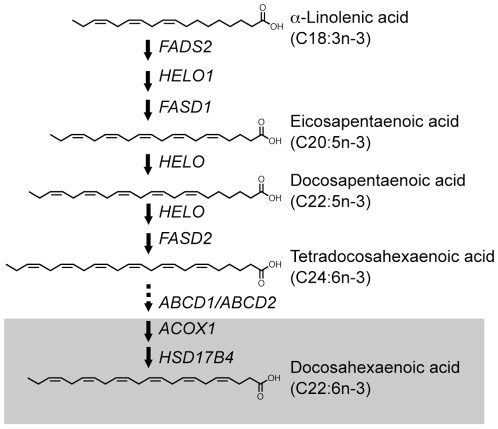
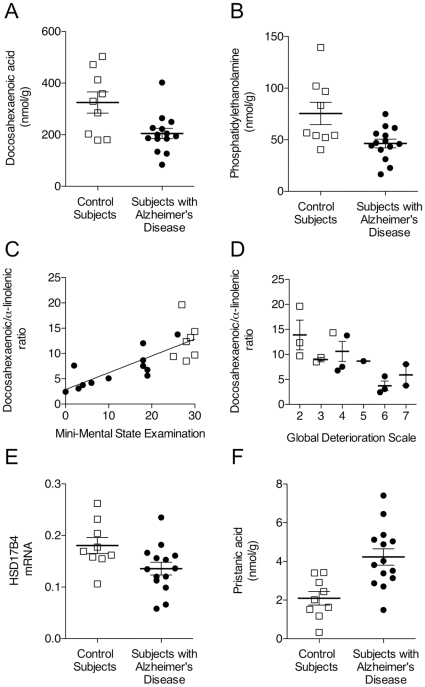
Reduced brain levels of docosahexaenoic acid (C22:6n-3), a neurotrophic and neuroprotective fatty acid, may contribute to cognitive decline in Alzheimer's disease. Here, we investigated whether the liver enzyme system that provides docosahexaenoic acid to the brain is dysfunctional in this disease. Docosahexaenoic acid levels were reduced in temporal cortex, mid-frontal cortex and cerebellum of subjects with Alzheimer's disease, compared to control subjects (P = 0.007). Mini Mental State Examination (MMSE) scores positively correlated with docosahexaenoic/α-linolenic ratios in temporal cortex (P = 0.005) and mid-frontal cortex (P = 0.018), but not cerebellum. Similarly, liver docosahexaenoic acid content was lower in Alzheimer's disease patients than control subjects (P = 0.011). Liver docosahexaenoic/α-linolenic ratios correlated positively with MMSE scores (r = 0.78; P<0.0001), and negatively with global deterioration scale grades (P = 0.013). Docosahexaenoic acid precursors, including tetracosahexaenoic acid (C24:6n-3), were elevated in liver of Alzheimer's disease patients (P = 0.041), whereas expression of peroxisomal d-bifunctional protein, which catalyzes the conversion of tetracosahexaenoic acid into docosahexaenoic acid, was reduced (P = 0.048). Other genes involved in docosahexaenoic acid metabolism were not affected. The results indicate that a deficit in d-bifunctional protein activity impairs docosahexaenoic acid biosynthesis in liver of Alzheimer's disease patients, lessening the flux of this neuroprotective fatty acid to the brain.
Overview
The claims and statistics of this paper haven’t been checked yet.
Run the check — free, no account needed. It reads the open-access text and checks the sources it cites.
Integrity signals
Registry
Cites
Statistics
Figures
Verification
Claims the paper makes
The claims and statistics of this paper haven’t been checked yet.
Run the check — free, no account needed. It reads the open-access text and checks the sources it cites.
Claims other papers make about this one
Each is checked against this paper’s own text: does it say what the citing paper says it does?
The source backs part of the claim, not all of it — or backs it for a different population, condition or comparison.
In the citing paper
“Despite variability introduced by diet and comorbid conditions, metabolomic biomarkers such as reduced docosahexaenoic acid (DHA) and elevated homocysteine have demonstrated clinical utility133,194, 195, 196, 197, 198, 199.”
From Artificial intelligence-driven multi-omics approaches in Alzheimer's disease: Progress, challenges, and future directions (2025) · cites this paper as [133]
Experimental — accuracy not yet measured
Self-check
Percentages, sums and reported differences re-computed from the paper’s own numbers.
The self-check needs the paper’s full text.
Citations
Cites
A heteroskedasticity-consistent covariance matrix estimator and a direct test for heteroskedasticity
White, H. (1980) · Econometrica · doi:10.2307/1912934 · Cited by 25,861
Longitudinal data analysis using generalized linear models
LIANG, K.-Y., & ZEGER, S. L. (1986) · Biometrika · doi:10.1093/biomet/73.1.13 · Cited by 18,550
Origins and evolution of the Western diet: health implications for the 21st century1,2
Cordain, L., Eaton, S. B., Sebastian, A., Mann, N., Lindeberg, S., Watkins, B. A., O’Keefe, J. H., & Brand-Miller, J. (2005) · The American Journal of Clinical Nutrition · doi:10.1093/ajcn.81.2.341 · Cited by 2,397
Intracellular amyloid-β in Alzheimer's disease
LaFerla, F. M., Green, K. N., & Oddo, S. (2007) · Nature Reviews Neuroscience · doi:10.1038/nrn2168 · Cited by 1,942
Cummings, J. L. (2004) · New England Journal of Medicine · doi:10.1056/nejmra040223 · Cited by 1,152
Conversion of α -linolenic acid to longer-chain polyunsaturated fatty acids in human adults
Burdge, G. C., & Calder, P. C. (2005) · Reproduction Nutrition Development · doi:10.1051/rnd:2005047 · Cited by 939
Lukiw, W. J. (2005) · Journal of Clinical Investigation · doi:10.1172/jci25420 · Cited by 897
Mukherjee, P. K., Marcheselli, V. L., Serhan, C. N., & Bazan, N. G. (2004) · Proceedings of the National Academy of Sciences · doi:10.1073/pnas.0402531101 · Cited by 753 · cited 1×
“The polyunsaturated lipid, docosahexaenoic acid (C22:6n-3), is an essential component of neuronal membranes [4,5] and a precursor for potent neuroprotective mediators [6–8].”
Docosahexaenoic acid protects from dendritic pathology in an Alzheimer's disease mouse model
Calon, F., Lim, G. P., Yang, F., Morihara, T., Teter, B., Ubeda, O., Rostaing, P., Triller, A., Salem, N., Ashe, K. H., et al. (2004) · Neuron · doi:10.1016/j.neuron.2004.08.013 · Cited by 707
Dietary omega 3 fatty acids and the developing brain
Innis, S. M. (2008) · Brain Research · doi:10.1016/j.brainres.2008.08.078 · Cited by 699
Cited by
Sorted by citations
Items 201–218 of 218
Componentes bioativos de alimentos funcionais
Sgarbieri, V. C., Pacheco, M. T. B., Gibrim, N. F., de Oliveira, D. A. G., & Caetano‐Silva, M. E. (2021) · Editora da Unicamp eBooks · doi:10.7476/9788526815353.0009
Emre, C., Khanh, V., Jun, B., Hjorth, E., Alcalde, S. G., Kautzmann, M.-A. I., Gordon, W. C., Nilsson, P., Bazan, N. G., & Schultzberg, M. (2021) · Figshare · doi:10.6084/m9.figshare.14880548
Emre, C., Khanh, V., Jun, B., Hjorth, E., Alcalde, S. G., Kautzmann, M.-A. I., Gordon, W. C., Nilsson, P., Bazan, N. G., & Schultzberg, M. (2021) · Figshare · doi:10.6084/m9.figshare.14880545
Semikasev, E., Ahlemeyer, B., Acker, T., Schänzer, A., & Baumgart‐Vogt, E. (2024) · Figshare · doi:10.6084/m9.figshare.26588847
Semikasev, E., Ahlemeyer, B., Acker, T., Schänzer, A., & Baumgart‐Vogt, E. (2024) · Figshare · doi:10.6084/m9.figshare.26588850
Emre, C., Khanh, V., Jun, B., Hjorth, E., Alcalde, S. G., Kautzmann, M.-A. I., Gordon, W. C., Nilsson, P., Bazan, N. G., & Schultzberg, M. (2021) · Figshare · doi:10.6084/m9.figshare.14880560
Semikasev, E., Ahlemeyer, B., Acker, T., Schänzer, A., & Baumgart‐Vogt, E. (2024) · Figshare · doi:10.6084/m9.figshare.26588841
Yamasaki, M., Makino, T., Khor, S.-S., Toyoda, H., Miyagawa, T., Liu, X., Kuwabara, H., Kano, Y., Shimada, T., Sugiyama, T., et al. (2020) · Figshare · doi:10.6084/m9.figshare.12045759
Emre, C., Khanh, V., Jun, B., Hjorth, E., Alcalde, S. G., Kautzmann, M.-A. I., Gordon, W. C., Nilsson, P., Ng, B., & Schultzberg, M. (2021) · Figshare · doi:10.6084/m9.figshare.14880551
Semikasev, E., Ahlemeyer, B., Acker, T., Schänzer, A., & Baumgart‐Vogt, E. (2024) · Figshare · doi:10.6084/m9.figshare.26588829
Semikasev, E., Ahlemeyer, B., Acker, T., Schänzer, A., & Baumgart‐Vogt, E. (2024) · Figshare · doi:10.6084/m9.figshare.26588853
Semikasev, E., Ahlemeyer, B., Acker, T., Schänzer, A., & Baumgart‐Vogt, E. (2024) · Figshare · doi:10.6084/m9.figshare.26588844
Semikasev, E., Ahlemeyer, B., Acker, T., Schänzer, A., & Baumgart‐Vogt, E. (2024) · Figshare · doi:10.6084/m9.figshare.26588832
Kharrassi, Y. E. (2015) · theses.fr (ABES) · doi:10.70675/b4faa240z73eez450bz8332z946a77b3f157
Benhaiem-Henry, K. (2017) · theses.fr (ABES) · doi:10.70675/f94a3540zfcb5z4b66zb175zde59b39e41c4
Luo, Z., Lin, F., Xu, H., Huang, Z., Weng, X., Liu, L., Chen, Y., & Qu, J. (2026) · Analytical Chemistry · doi:10.1021/acs.analchem.6c01421
Mathematical mapping of circadian genes in Alzheimer’s disease
Venkatesh, S., Venkadeswaran, K., Raja, R., & Reshma, A. (2026) · Chronobiology International · doi:10.1080/07420528.2026.2705386
Gomes‐Bispo, A., Dias, B., Gomes, R., Cardoso, C. L., Afonso, C. M., Lopes, P. A., Prates, J. A. M., & Bandarra, N. M. (2026) · Biochimie · doi:10.1016/j.biochi.2026.08.009
Metadata
- Authors
- Astarita, G., Jung, K.-M., Berchtold, N. C., Nguyen, V. Q., Gillen, D. L., Head, E., Cotman, C. W., & Piomelli, D.
- Affiliations
- University of Rome Tor Vergata (IT)
- University of California, Irvine (US)
- University of Kentucky (US)
- Corresponding author
- Piomelli, Daniele
- ORCID
- Venue
- PLoS ONE
- Publisher
- Public Library of Science (PLoS)
- Published
- 2010-09-08
- Volume
- 5
- Issue
- 9
- Pages
- e12538
- ISSN
- 1932-6203 (ISSN-L)
- PMC
- PMC2935886
- OpenAlex
- W1993630867
- Cited by
- 218
- References
- 42
- Citations by year
- 2026: 3 · 2025: 6 · 2024: 17 · 2023: 9 · 2022: 15 · 2021: 19 · 2020: 16 · 2019: 15 · 2018: 9 · 2017: 18 · 2016: 19 · 2015: 21 · 2014: 14 · 2013: 14 · 2012: 11
- FWCI
- 11.23
- Type
- journal article
- Language
- en
- Open access
- gold
- doi.org
- Locations
- PLoS ONE (publishedVersion, cc-by)
- PubMed Central (publishedVersion, cc-by)
- PubMed (publishedVersion)
- UKnowledge (University of Kentucky) (submittedVersion, cc-by)
- RePEc: Research Papers in Economics (submittedVersion)
- DOAJ (DOAJ: Directory of Open Access Journals) (submittedVersion, cc-by-sa)
- eScholarship (California Digital Library) (submittedVersion, cc-by)
- Figshare (submittedVersion, cc-by)
- Funders
- Michael J. Fox Foundation for Parkinson's Research (05-901, 211002, P30 AG19610)
- Agilent Foundation
- Arizona Department of Health Services (P30 AG19610, P50 AG016573, 05-901, 211002, Contract 211002)
- Arizona Biomedical Research Commission (P30 AG19610, 05–901, 211002)
- University of California, Irvine (P50AG016573)
- National Institute on Aging (211002, P01AG000538, P30-AG-19610, AG-016573, P01 AG00538, AG-19610, AG 00538, P50AG016573, P30AG019610, 05-901)
- National Institute on Drug Abuse (R01DA012447)
- Topics
- Health Sciences › Nursing › Nutrition and Dietetics › Fatty Acid Research and Health
- Life Sciences › Neuroscience › Cellular and Molecular Neuroscience › Alzheimer's disease research and treatments
- Health Sciences › Medicine › Psychiatry and Mental health › Dementia and Cognitive Impairment Research
- Keywords
- docosahexaenoic acid, Alzheimer's disease, cognitive impairment, omega-3 fatty acids, temporal cortex, cerebellum
- MeSH terms
- Aged, Aged, 80 and over, Alzheimer Disease, Brain, Cognition, Docosahexaenoic Acids, Female, Humans, Liver, Male, Neuropsychological Tests, Case-Control Studies
About these checks
Registry, retraction, Cites and statistics results are computed, not judged, with one exception: a printed reference that no index lists is read once by a model before it counts as a citation error. Claims are extracted by a model and kept only when their quote appears verbatim in the text; each cited source is then checked, with a model’s help, for whether it says what the claim relies on. Those verdicts can be wrong — read the claim’s quote and the cited source before relying on one.
Statistics and arithmetic are recomputed, not judged.
Confidence bands are shown only for fields calibrated on our annotated test set. None is calibrated yet, so no band is shown.
What counts as a claim ›How we measure confidence ›How we check this ›
Are you an author, or do you see a problem with this page? Request a review
