

The DOI matches its Crossref record; 42 of the 42 references it cites were found in a registry or an index.
Deficient Liver Biosynthesis of Docosahexaenoic Acid Correlates with Cognitive Impairment in Alzheimer's Disease
Open accessAbstract
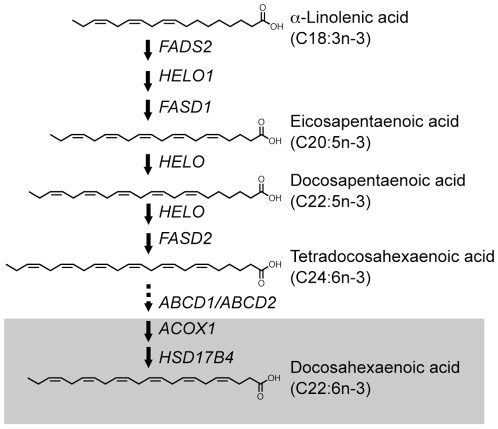
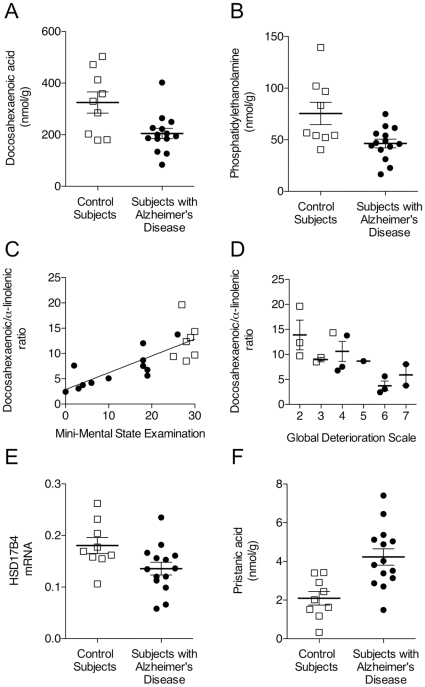
Reduced brain levels of docosahexaenoic acid (C22:6n-3), a neurotrophic and neuroprotective fatty acid, may contribute to cognitive decline in Alzheimer's disease. Here, we investigated whether the liver enzyme system that provides docosahexaenoic acid to the brain is dysfunctional in this disease. Docosahexaenoic acid levels were reduced in temporal cortex, mid-frontal cortex and cerebellum of subjects with Alzheimer's disease, compared to control subjects (P = 0.007). Mini Mental State Examination (MMSE) scores positively correlated with docosahexaenoic/α-linolenic ratios in temporal cortex (P = 0.005) and mid-frontal cortex (P = 0.018), but not cerebellum. Similarly, liver docosahexaenoic acid content was lower in Alzheimer's disease patients than control subjects (P = 0.011). Liver docosahexaenoic/α-linolenic ratios correlated positively with MMSE scores (r = 0.78; P<0.0001), and negatively with global deterioration scale grades (P = 0.013). Docosahexaenoic acid precursors, including tetracosahexaenoic acid (C24:6n-3), were elevated in liver of Alzheimer's disease patients (P = 0.041), whereas expression of peroxisomal d-bifunctional protein, which catalyzes the conversion of tetracosahexaenoic acid into docosahexaenoic acid, was reduced (P = 0.048). Other genes involved in docosahexaenoic acid metabolism were not affected. The results indicate that a deficit in d-bifunctional protein activity impairs docosahexaenoic acid biosynthesis in liver of Alzheimer's disease patients, lessening the flux of this neuroprotective fatty acid to the brain.
Overview
The claims and statistics of this paper haven’t been checked yet.
Run the check — free, no account needed. It reads the open-access text and checks the sources it cites.
Integrity signals
Registry
Cites
Statistics
Figures
Verification
Claims the paper makes
The claims and statistics of this paper haven’t been checked yet.
Run the check — free, no account needed. It reads the open-access text and checks the sources it cites.
Claims other papers make about this one
Each is checked against this paper’s own text: does it say what the citing paper says it does?
The source backs part of the claim, not all of it — or backs it for a different population, condition or comparison.
In the citing paper
“Despite variability introduced by diet and comorbid conditions, metabolomic biomarkers such as reduced docosahexaenoic acid (DHA) and elevated homocysteine have demonstrated clinical utility133,194, 195, 196, 197, 198, 199.”
From Artificial intelligence-driven multi-omics approaches in Alzheimer's disease: Progress, challenges, and future directions (2025) · cites this paper as [133]
Experimental — accuracy not yet measured
Self-check
Percentages, sums and reported differences re-computed from the paper’s own numbers.
The self-check needs the paper’s full text.
Citations
Cites
A heteroskedasticity-consistent covariance matrix estimator and a direct test for heteroskedasticity
White, H. (1980) · Econometrica · doi:10.2307/1912934 · Cited by 25,861
Longitudinal data analysis using generalized linear models
LIANG, K.-Y., & ZEGER, S. L. (1986) · Biometrika · doi:10.1093/biomet/73.1.13 · Cited by 18,550
Origins and evolution of the Western diet: health implications for the 21st century1,2
Cordain, L., Eaton, S. B., Sebastian, A., Mann, N., Lindeberg, S., Watkins, B. A., O’Keefe, J. H., & Brand-Miller, J. (2005) · The American Journal of Clinical Nutrition · doi:10.1093/ajcn.81.2.341 · Cited by 2,397
Intracellular amyloid-β in Alzheimer's disease
LaFerla, F. M., Green, K. N., & Oddo, S. (2007) · Nature Reviews Neuroscience · doi:10.1038/nrn2168 · Cited by 1,942
Cummings, J. L. (2004) · New England Journal of Medicine · doi:10.1056/nejmra040223 · Cited by 1,152
Conversion of α -linolenic acid to longer-chain polyunsaturated fatty acids in human adults
Burdge, G. C., & Calder, P. C. (2005) · Reproduction Nutrition Development · doi:10.1051/rnd:2005047 · Cited by 939
Lukiw, W. J. (2005) · Journal of Clinical Investigation · doi:10.1172/jci25420 · Cited by 897
Mukherjee, P. K., Marcheselli, V. L., Serhan, C. N., & Bazan, N. G. (2004) · Proceedings of the National Academy of Sciences · doi:10.1073/pnas.0402531101 · Cited by 753 · cited 1×
“The polyunsaturated lipid, docosahexaenoic acid (C22:6n-3), is an essential component of neuronal membranes [4,5] and a precursor for potent neuroprotective mediators [6–8].”
Docosahexaenoic acid protects from dendritic pathology in an Alzheimer's disease mouse model
Calon, F., Lim, G. P., Yang, F., Morihara, T., Teter, B., Ubeda, O., Rostaing, P., Triller, A., Salem, N., Ashe, K. H., et al. (2004) · Neuron · doi:10.1016/j.neuron.2004.08.013 · Cited by 707
Dietary omega 3 fatty acids and the developing brain
Innis, S. M. (2008) · Brain Research · doi:10.1016/j.brainres.2008.08.078 · Cited by 699
Cited by
Sorted by citations
Functions of plasmalogen lipids in health and disease
Braverman, N. E., & Moser, A. B. (2012) · Biochimica et Biophysica Acta (BBA) - Molecular Basis of Disease · doi:10.1016/j.bbadis.2012.05.008 · Cited by 1,082
Dyall, S. C. (2015) · Frontiers in Aging Neuroscience · doi:10.3389/fnagi.2015.00052 · Cited by 943
DHA Effects in Brain Development and Function
Lauritzen, L., Brambilla, P., Mazzocchi, A., Harsløf, L. B. S., Ciappolino, V., & Agostoni, C. V. (2016) · Nutrients · doi:10.3390/nu8010006 · Cited by 566
Significance of long chain polyunsaturated fatty acids in human health
Zárate, R., el Jaber-Vazdekis, N., Tejera, N., Pérez, J. A., & Rodríguez, C. (2017) · Clinical and Translational Medicine · doi:10.1186/s40169-017-0153-6 · Cited by 573
Homocysteine, B Vitamins, and Cognitive Impairment
Smith, A. D., & Refsum, H. (2016) · Annual Review of Nutrition · doi:10.1146/annurev-nutr-071715-050947 · Cited by 526
Lipids and Alzheimer’s Disease
Kao, Y.-C., Ho, P.-C., Tu, Y.-K., Jou, I.-M., & Tsai, K.-J. (2020) · International Journal of Molecular Sciences · doi:10.3390/ijms21041505 · Cited by 485
Arizona Study of Aging and Neurodegenerative Disorders and Brain and Body Donation Program
Beach, T. G., Adler, C. H., Sue, L. I., Serrano, G., Shill, H. A., Walker, D. G., Lue, L., Roher, A. E., Dugger, B. N., Maarouf, C., et al. (2015) · Neuropathology · doi:10.1111/neup.12189 · Cited by 460
Bazan, N. G., Molina, M. F., & Gordon, W. C. (2011) · Annual Review of Nutrition · doi:10.1146/annurev.nutr.012809.104635 · Cited by 441
Docosahexaenoic Acid and Cognition throughout the Lifespan
Weiser, M., Butt, C., & Mohajeri, M. (2016) · Nutrients · doi:10.3390/nu8020099 · Cited by 400
Plasma nutrient status of patients with Alzheimer's disease: Systematic review and meta‐analysis
da Silva, S. L., Vellas, B. J., Elemans, S., Luchsinger, J. A., Kamphuis, P. J. G. H., Yaffe, K. S., Sijben, J., Groenendijk, M., & Stijnen, T. (2013) · Alzheimer s & Dementia · doi:10.1016/j.jalz.2013.05.1771 · Cited by 313
Xu, M., Zhang, D., Luo, R., Wu, Y., Zhou, H., Kong, L., Bi, R., & Yao, Y. (2017) · Alzheimer s & Dementia · doi:10.1016/j.jalz.2017.08.012 · Cited by 296
Mitochondria-associated ER membranes in Alzheimer disease
Schon, E. A., & Area-Gomez, E. (2013) · Molecular and Cellular Neuroscience · doi:10.1016/j.mcn.2012.07.011 · Cited by 261
Zhao, Y., Calon, F., Julien, C., Winkler, J. W., Petasis, N. A., Lukiw, W. J., & Bazan, N. G. (2011) · PLoS ONE · doi:10.1371/journal.pone.0015816 · Cited by 243
ER stress and impaired autophagy flux in neuronal degeneration and brain injury
Yin, Y., Sun, G., Li, E., Kiselyov, K. I., & Sun, D. (2016) · Ageing Research Reviews · doi:10.1016/j.arr.2016.08.008 · Cited by 218
Brain docosahexaenoic acid uptake and metabolism
Lacombe, R. J. S., Chouinard‐Watkins, R., & Bazinet, R. P. (2018) · Molecular Aspects of Medicine · doi:10.1016/j.mam.2017.12.004 · Cited by 225
Li, R.-Y., Qin, Q., Yang, H.-C., Wang, Y.-Y., Mi, Y.-X., Yin, Y.-S., Wang, M., Yu, C.-J., & Tang, Y. (2022) · Molecular Neurodegeneration · doi:10.1186/s13024-022-00542-y · Cited by 204
Pro-Resolving Lipid Mediators Improve Neuronal Survival and Increase Aβ42 Phagocytosis
Zhu, M., Wang, X., Hjorth, E., Colas, R. A., Schroeder, L., Granholm, A.-C., Serhan, C. N., & Schultzberg, M. (2016) · Molecular Neurobiology · doi:10.1007/s12035-015-9544-0 · Cited by 204
Metabolite profiling for the identification of altered metabolic pathways in Alzheimer's disease
González‐Domínguez, R., García‐Barrera, T., & Gómez‐Ariza, J. L. (2014) · Journal of Pharmaceutical and Biomedical Analysis · doi:10.1016/j.jpba.2014.10.010 · Cited by 205
Lipidomics of Human Brain Aging and Alzheimer's Disease Pathology
Naudí, A., Cabré, R., Jové, M., Ayala, V., Gonzalo‐Benito, H., Portero‐Otín, M., Ferrer, I., & Pamplona, R. (2015) · International review of neurobiology · doi:10.1016/bs.irn.2015.05.008 · Cited by 214
Rojas-Gutierrez, E., Muñoz‐Arenas, G., Treviño, S., Espinosa, B., Chávez, R., Rojas, K., Flores, G., Díaz, A., & Guevara, J. (2017) · Synapse · doi:10.1002/syn.21990 · Cited by 205
Peroxisomes in brain development and function
Berger, J., Dorninger, F., Forss-Petter, S., & Kunze, M. (2016) · Biochimica et Biophysica Acta (BBA) - Molecular Cell Research · doi:10.1016/j.bbamcr.2015.12.005 · Cited by 194
“Also, a decrease inDHA,whose endogenous de novo production requires peroxisomes, in brain and liver [276] and a regional decrease in catalase activity in the temporal lobe [277] were reported.”
BackgroundPlasmalogens and Alzheimer’s disease: A review
Su, X. Q., Wang, J., & Sinclair, A. J. (2019) · Lipids in Health and Disease · doi:10.1186/s12944-019-1044-1 · Cited by 172
Lipidomics of Alzheimer's disease: current status
Wood, P. L. (2012) · Alzheimer's Research & Therapy · doi:10.1186/alzrt103 · Cited by 167
Elevated stearoyl-CoA desaturase in brains of patients with Alzheimer’s disease
Astarita, G., Jung, K.-M., Vasilevko, V., DiPatrizio, N. V., Martin, S. K., Cribbs, D. H., Head, E., Cotman, C. W., & Piomelli, D. (2011) · PLoS ONE · doi:10.1371/journal.pone.0024777 · Cited by 146
Self-citationNeuroglialpharmacology: Myelination as a shared mechanism of action of psychotropic treatments
Bartzokis, G. (2012) · Neuropharmacology · doi:10.1016/j.neuropharm.2012.01.015 · Cited by 142
Lower brain and blood nutrient status in Alzheimer's disease: Results from meta‐analyses
de Wilde, M. C., Vellas, B. J., Girault, E. M., Cetinyurek‐Yavuz, A., & Sijben, J. (2017) · Alzheimer s & Dementia Translational Research & Clinical Interventions · doi:10.1016/j.trci.2017.06.002 · Cited by 144
Paglia, G., Stocchero, M., Cacciatore, S., Lai, S., Angel, P. M., Alam, M. T., Keller, M. A., Ralser, M., & Astarita, G. (2015) · Journal of Proteome Research · doi:10.1021/acs.jproteome.5b01020 · Cited by 136
Self-citationPeroxisome quality control and dysregulated lipid metabolism in neurodegenerative diseases
Jo, D. S., Park, N. Y., & Cho, D. (2020) · Experimental & Molecular Medicine · doi:10.1038/s12276-020-00503-9 · Cited by 143
Jung, K., Astarita, G., Yaşar, S., Vasilevko, V., Cribbs, D. H., Head, E., Cotman, C. W., & Piomelli, D. (2011) · Neurobiology of Aging · doi:10.1016/j.neurobiolaging.2011.03.012 · Cited by 136
Self-citationvan Wijk, N., Broersen, L. M., de Wilde, M. C., Hageman, R. J. J., Groenendijk, M., Sijben, J. W. C., & Kamphuis, P. J. G. H. (2013) · Journal of Alzheimer s Disease · doi:10.3233/jad-130998 · Cited by 128
Role of docosahexaenoic acid in the modulation of glial cells in Alzheimer’s disease
Heras-Sandoval, D., Pedraza‐Chaverrí, J., & Pérez‐Rojas, J. M. (2016) · Journal of Neuroinflammation · doi:10.1186/s12974-016-0525-7 · Cited by 126
A Blood-Based, 7-Metabolite Signature for the Early Diagnosis of Alzheimer's Disease
Olazarán, J., Gil‐de‐Gómez, L., Rodríguez‐Martín, A., Valentí, M., Payo, B. F., Marín-Muñoz, J., Antúnez, C., Frank, A., Acedo, C., Gracia, L. M., et al. (2015) · Journal of Alzheimer s Disease · doi:10.3233/jad-142925 · Cited by 120
Grimm, M. O. W., Michaelson, D. M., & Hartmann, T. (2017) · Journal of Lipid Research · doi:10.1194/jlr.r076331 · Cited by 114
An Emerging Role for Metabolomics in Nutrition Science
Astarita, G., & Langridge, J. (2013) · Lifestyle Genomics · doi:10.1159/000354403 · Cited by 110
Self-citationKitson, A. P., Metherel, A. H., Chen, C. T., Domenichiello, A. F., Trépanier, M., Berger, A., & Bazinet, R. P. (2016) · The Journal of Nutritional Biochemistry · doi:10.1016/j.jnutbio.2016.02.009 · Cited by 112
Trompier, D., Véjux, A., Zarrouk, A., Gondcaille, C., Geillon, F., Nury, T., Savary, S., & Lizard, G. (2013) · Biochimie · doi:10.1016/j.biochi.2013.09.009 · Cited by 106
Ren, F., Wei, J., Chen, Q., Hu, M., Yu, L., Mi, J., Zhou, X., Qin, D., Wu, J., & Wu, A. (2025) · Acta Pharmaceutica Sinica B · doi:10.1016/j.apsb.2025.07.030 · Cited by 97
Asatryan, A., & Bazan, N. G. (2017) · Journal of Biological Chemistry · doi:10.1074/jbc.r117.783076 · Cited by 99
Wood, P. L. (2013) · Neuropsychopharmacology · doi:10.1038/npp.2013.167 · Cited by 95
Dietary Docosahexaenoic Acid Supplementation in Children With Autism
Voigt, R. G., Mellon, M. W., Katusic, S. K., Weaver, A. L., Matern, D., Mellon, B., Jensen, C. L., & Barbaresi, W. J. (2013) · Journal of Pediatric Gastroenterology and Nutrition · doi:10.1097/mpg.0000000000000260 · Cited by 94
Cunnane, S. C., Chouinard‐Watkins, R., Castellano, C., & Barberger‐Gateau, P. (2012) · Prostaglandins Leukotrienes and Essential Fatty Acids · doi:10.1016/j.plefa.2012.04.006 · Cited by 99
Curcumin boosts DHA in the brain: Implications for the prevention of anxiety disorders
Wu, A., Noble, E. E., Tyagi, E., Ying, Z., Zhuang, Y., & Gómez‐Pinilla, F. (2014) · Biochimica et Biophysica Acta (BBA) - Molecular Basis of Disease · doi:10.1016/j.bbadis.2014.12.005 · Cited by 92
Nutritional approaches in the risk reduction and management of Alzheimer's disease
Mi, W., van Wijk, N., Cansev, M., Sijben, J., & Kamphuis, P. J. G. H. (2013) · Nutrition · doi:10.1016/j.nut.2013.01.024 · Cited by 91
Rikkert, M. G. M. O., Verhey, F. R. J., Sijben, J., Bouwman, F. H., DAUTZENBERG, P. L. J., Lansink, M., Sipers, W. M. W. H., van Asselt, D. Z. B., van Hees, A. M. J., Stevens, M., et al. (2014) · Journal of Alzheimer s Disease · doi:10.3233/jad-131892 · Cited by 88
Bennett, S. A. L., Valenzuela, N., Xu, H., Franko, B., Fai, S., & Figeys, D. (2013) · Frontiers in Physiology · doi:10.3389/fphys.2013.00168 · Cited by 89
Alzheimer’s Disease: Pathogenesis and Therapeutic Interventions
Ogbodo, J. O., Agbo, C. P., Njoku, U. O., Ogugofor, M. O., Egba, S. I., Ihim, S. A., Echezona, A. C., Brendan, K. C., Upaganlawar, A. B., & Upasani, C. D. (2021) · Current Aging Science · doi:10.2174/1874609814666210302085232 · Cited by 86
Cao, M., Li, H., Zhao, J., Cui, J., & Hu, G. (2019) · Neurobiology of Aging · doi:10.1016/j.neurobiolaging.2019.05.023 · Cited by 81
Alteration of Metabolic Profile and Potential Biomarkers in the Plasma of Alzheimer’s Disease
Shao, Y., Ouyang, Y., Li, T., Liu, X., Xu, X., Li, S., Xu, G., & Le, W. (2020) · Aging and Disease · doi:10.14336/ad.2020.0217 · Cited by 79
Ochiai, Y., Uchida, Y., Ohtsuki, S., Tachikawa, M., Aizawa, S., & Terasaki, T. (2016) · Journal of Neurochemistry · doi:10.1111/jnc.13943 · Cited by 74
Emre, C., Do, K. V., Jun, B., Hjorth, E., Alcalde, S. G., Kautzmann, M.-A. I., Gordon, W. C., Nilsson, P., Bazan, N. G., & Schultzberg, M. (2021) · Acta Neuropathologica Communications · doi:10.1186/s40478-021-01216-4 · Cited by 75
Toledo, A. P., Reyna‐Jeldes, M., Ortega, L., Coddou, C., & Yévenes, G. E. (2022) · International Journal of Molecular Sciences · doi:10.3390/ijms23105390 · Cited by 74
Wen, M., Ding, L., Zhang, L., Zhou, M., Xu, J., Wang, J., Wang, Y., & Xue, C. (2016) · Journal of Functional Foods · doi:10.1016/j.jff.2016.02.004 · Cited by 71
Lipids in Pathophysiology and Development of the Membrane Lipid Therapy: New Bioactive Lipids
Torres, M., Parets, S., Fernández-Díaz, J., Beteta-Göbel, R., Rodríguez-Lorca, R., Román, R., Lladó, V., Rosselló, C. A., Fernández‐García, P., & Escribá, P. V. (2021) · Membranes · doi:10.3390/membranes11120919 · Cited by 80
Exercise facilitates the action of dietary DHA on functional recovery after brain trauma
Wu, A. D., Ying, Z., & Gómez‐Pinilla, F. (2013) · Neuroscience · doi:10.1016/j.neuroscience.2013.06.041 · Cited by 72
Relationship between central and peripheral fatty acids in humans
Guest, J., Garg, M. L., BILGIN, A. A. B., & Grant, R. (2013) · Lipids in Health and Disease · doi:10.1186/1476-511x-12-79 · Cited by 69
Lipidomics applications in health, disease and nutrition research
MURPHY, S. A., & Nicolaou, A. (2013) · Molecular Nutrition & Food Research · doi:10.1002/mnfr.201200863 · Cited by 74
New Perspectives on Alzheimer’s Disease and Nutrition
Gustafson, D., Morris, M. C., Scarmeas, N., Shah, R. C., Sijben, J., Yaffe, K. S., & Zhu, X. (2015) · Journal of Alzheimer s Disease · doi:10.3233/jad-150084 · Cited by 71
A nutrient combination that can affect synapse formation
Wurtman, R. (2014) · Nutrients · doi:10.3390/nu6041701 · Cited by 68
Lipidomics of Bioactive Lipids in Alzheimer’s and Parkinson’s Diseases: Where Are We?
Chiurchiù, V., Tiberi, M., Matteocci, A., Fazio, F., Siffeti, H., Saracini, S., Mercuri, N. B., & Sancesario, G. (2022) · International Journal of Molecular Sciences · doi:10.3390/ijms23116235 · Cited by 73
Torres, M., Price, S. L., Fiol-deRoque, M. A., Marcilla-Etxenike, A., Ahyayauch, H., Barceló‐Coblijn, G., Terés, S., Katsouri, L., Ordinas, M., López, D. J., et al. (2014) · Biochimica et Biophysica Acta (BBA) - Biomembranes · doi:10.1016/j.bbamem.2013.12.016 · Cited by 68
Chouinard‐Watkins, R., & Plourde, M. (2014) · Nutrients · doi:10.3390/nu6104452 · Cited by 73
Peroxisomal Stress Response and Inter-Organelle Communication in Cellular Homeostasis and Aging
Kim, J., & Bai, H. (2022) · Antioxidants · doi:10.3390/antiox11020192 · Cited by 64
Peroxisomal dysfunction in neurodegenerative diseases
Jo, D. S., & Cho, D. (2019) · Archives of Pharmacal Research · doi:10.1007/s12272-019-01131-2 · Cited by 66
Targeted Metabolomic Analysis in Alzheimer’s Disease Plasma and Brain Tissue in Non-Hispanic Whites
Kalecký, K., German, D. C., Montillo, A., & Bottiglieri, T. (2022) · Journal of Alzheimer s Disease · doi:10.3233/jad-215448 · Cited by 65
Hachem, M., Belkouch, M., Van, A. L., Picq, M., Bernoud‐Hubac, N., & Lagarde, M. (2020) · Biochimie · doi:10.1016/j.biochi.2020.01.013 · Cited by 61
Troesch, B., Weber, P., & Mohajeri, M. H. (2016) · Nutrients · doi:10.3390/nu8120803 · Cited by 63
Wood, P. L., Locke, V. A., Herling, P., Passaro, A., Vigna, G. B., Volpato, S., Valacchi, G., Cervellati, C., & Zuliani, G. (2015) · BBA Clinical · doi:10.1016/j.bbacli.2015.11.004 · Cited by 61
Yamashita, S., Kiko, T., Fujiwara, H., Hashimoto, M., Nakagawa, K., Kinoshita, M., Furukawa, K., Arai, H., & Miyazawa, T. (2016) · Journal of Alzheimer s Disease · doi:10.3233/jad-150640 · Cited by 60
Zhou, M., Ding, L., Wen, M., Che, H., Huang, J., Zhang, T., Xue, C., Mao, X., & Wang, Y.-M. (2018) · The Journal of Nutritional Biochemistry · doi:10.1016/j.jnutbio.2018.05.009 · Cited by 60
Llano, D. A., Initiative, A. D. N., & Devanarayan, V. (2021) · Journal of Alzheimer s Disease · doi:10.3233/jad-201420 · Cited by 58
Sex difference in CHI3L1 expression levels in human brain aging and in Alzheimer’s disease
Sanfilippo, C., Castrogiovanni, P., Imbesi, R., Kazakowa, M., Musumeci, G., Blennow, K., Zetterberg, H., & Rosa, M. D. (2019) · Brain Research · doi:10.1016/j.brainres.2019.146305 · Cited by 57
Fatty Acids: From Membrane Ingredients to Signaling Molecules
Hashimoto, M., & Hossain, S. (2018) · IntechOpen eBooks · doi:10.5772/intechopen.80430 · Cited by 51
Targeting Alzheimer’s Disease: The Critical Crosstalk between the Liver and Brain
Huang, Z., Lin, H. W. (., Zhang, Q., & Zong, X. (2022) · Nutrients · doi:10.3390/nu14204298 · Cited by 50
Bazan, N. G. (2012) · Prostaglandins Leukotrienes and Essential Fatty Acids · doi:10.1016/j.plefa.2012.08.008 · Cited by 54
Stark, D. T., & Bazan, N. G. (2011) · Molecular Neurobiology · doi:10.1007/s12035-011-8174-4 · Cited by 49
Liu, J., Sahin, C., Ahmad, S., Magomedova, L., Zhang, M., Jia, Z., Metherel, A. H., Orellana, A. J., Poda, G. I., Bazinet, R. P., et al. (2022) · Science Signaling · doi:10.1126/scisignal.abo1857 · Cited by 48
Pinçon, A., de Montgolfier, O., Akkoyunlu, N., Daneault, C., Pouliot, P., Villeneuve, L. R., Lesage, F., Levy, B. I., Thorin‐Trescases, N., Thorin, É., et al. (2019) · Metabolites · doi:10.3390/metabo9050104 · Cited by 47
Bottero, V., & Potashkin, J. A. (2019) · International Journal of Molecular Sciences · doi:10.3390/ijms20215403 · Cited by 47
Rijpma, A., Meulenbroek, O., van Hees, A. M. J., Sijben, J., Vellas, B. J., Shah, R. C., Bennett, D. A., Scheltens, P., & Rikkert, M. G. M. O. (2015) · Alzheimer s Research & Therapy · doi:10.1186/s13195-015-0134-1 · Cited by 44
Towards a whole-body systems [multi-organ] lipidomics in Alzheimer’s disease
Astarita, G., & Piomelli, D. (2011) · Prostaglandins Leukotrienes and Essential Fatty Acids · doi:10.1016/j.plefa.2011.04.021 · Cited by 45
Self-citationOoi, K.-L. M., Vacy, K., & Boon, W. C. (2021) · Neurochemistry International · doi:10.1016/j.neuint.2021.105143 · Cited by 42
Ageing and apoE change DHA homeostasis: relevance to age-related cognitive decline
Hennebelle, M., Plourde, M., Chouinard‐Watkins, R., Castellano, C., Barberger‐Gateau, P., & Cunnane, S. C. (2013) · Proceedings of The Nutrition Society · doi:10.1017/s0029665113003625 · Cited by 42
Filho, A. J. M. C., Braniff, O., Angelova, A., Deng, Y., & Tremblay, M. (2023) · Brain Research Bulletin · doi:10.1016/j.brainresbull.2023.110702 · Cited by 41
Hancock, S. E., Friedrich, M. G., Mitchell, T. W., Truscott, R. J. W., & Else, P. L. (2017) · GeroScience · doi:10.1007/s11357-017-9961-2 · Cited by 41
Wood, P. L., Smith, T. M., Lane, N., Khan, M. A., Ehrmantraut, G., & Goodenowe, D. B. (2011) · Lipids in Health and Disease · doi:10.1186/1476-511x-10-227 · Cited by 41
Lipids and brain inflammation in APOE4-associated dementia
Duro, M. V. V., Ebright, B., & Yassine, H. N. (2021) · Current Opinion in Lipidology · doi:10.1097/mol.0000000000000801 · Cited by 39
Kling, M. A., Goodenowe, D. B., Senanayake, V. K., MahmoudianDehkordi, S., Arnold, M., Massaro, T., Baillie, R., Han, X., Leung, Y. Y., Saykin, A. J., et al. (2020) · Alzheimer s & Dementia · doi:10.1002/alz.12110 · Cited by 37
The Pathological Effects of Circulating Hydrophobic Bile Acids in Alzheimer’s Disease
Ehtezazi, T., Rahman, K., Davies, R., & Leach, A. G. (2023) · Journal of Alzheimer s Disease Reports · doi:10.3233/adr-220071 · Cited by 37
Chen, S., & Subbaiah, P. V. (2013) · Lipids · doi:10.1007/s11745-013-3791-5 · Cited by 35
Docosahexaenoic fatty acid (DHA) in the regulation of colon cell growth and cell death: A review
Skender, B., Vaculová, A. H., & Hofmanová, J. (2012) · Biomedical Papers · doi:10.5507/bp.2012.093 · Cited by 35
High throughput multiorgan metabolomics in the APP/PS1 mouse model of Alzheimer's disease
González‐Domínguez, R., García‐Barrera, T., Vitórica, J., & Gómez‐Ariza, J. L. (2015) · Electrophoresis · doi:10.1002/elps.201400544 · Cited by 35
Torres, M., Rosselló, C. A., Fernández‐García, P., Lladó, V., Kakhlon, O., & Escribá, P. V. (2020) · International Journal of Molecular Sciences · doi:10.3390/ijms21072322 · Cited by 35
Serum cholesterol and variant in cholesterol-related gene CETP predict white matter microstructure
Warstadt, N. M., Dennis, E. L., Jahanshad, N., Omid Kohannim, A., Nir, T. M., McMahon, K. L., de Zubicaray, G. I., Montgomery, G. W., Henders, A. K., Martin, N. G., et al. (2014) · Neurobiology of Aging · doi:10.1016/j.neurobiolaging.2014.05.024 · Cited by 34
Bowman, G. L., Dodge, H. H., Guyonnet, S., Zhou, N., Donohue, J., Bichsel, A., Schmitt, J. A. J., Hooper, C., Bartfai, T., Andrieu, S., et al. (2019) · Alzheimer s & Dementia Translational Research & Clinical Interventions · doi:10.1016/j.trci.2019.11.004 · Cited by 35
The essential nature of dietary omega-3 fatty acids in dogs
Bauer, J. E. (2016) · Journal of the American Veterinary Medical Association · doi:10.2460/javma.249.11.1267 · Cited by 36
Modulations of bioactive lipids and their receptors in postmortem Alzheimer’s disease brains
Kurano, M., Saito, Y., Uranbileg, B., Saigusa, D., Kano, K., Aoki, J., & Yatomi, Y. (2022) · Frontiers in Aging Neuroscience · doi:10.3389/fnagi.2022.1066578 · Cited by 30
Pan, Y., Omori, K., Ali, I., Tachikawa, M., Terasaki, T., Brouwer, K. L. R., & Nicolazzo, J. A. (2018) · Molecular Pharmaceutics · doi:10.1021/acs.molpharmaceut.8b00500 · Cited by 30
van Wijk, N., Slot, R. E. R., Duits, F. H., Strik, M., Biesheuvel, E., Sijben, J., Blankenstein, M. A., Bierau, J., van der Flier, W. M., Scheltens, P., et al. (2017) · Alzheimer s & Dementia Diagnosis Assessment & Disease Monitoring · doi:10.1016/j.dadm.2017.04.005 · Cited by 29
Puris, E., Auriola, S. O. K., Petralla, S., Hartman, R., Gynther, M., de Lange, E. C. M., & Fricker, G. (2022) · Neurobiology of Disease · doi:10.1016/j.nbd.2022.105741 · Cited by 30
Healthy brain ageing and cognition: Nutritional factors
Vandewoude, M. F. J., Barberger‐Gateau, P., Cederholm, T., Mecocci, P., Salvà, A., Sergi, G., Topinková, E., & van Asselt, D. (2016) · European Geriatric Medicine · doi:10.1016/j.eurger.2015.12.005 · Cited by 31
Metadata
- Authors
- Astarita, G., Jung, K.-M., Berchtold, N. C., Nguyen, V. Q., Gillen, D. L., Head, E., Cotman, C. W., & Piomelli, D.
- Affiliations
- University of Rome Tor Vergata (IT)
- University of California, Irvine (US)
- University of Kentucky (US)
- Corresponding author
- Piomelli, Daniele
- ORCID
- Venue
- PLoS ONE
- Publisher
- Public Library of Science (PLoS)
- Published
- 2010-09-08
- Volume
- 5
- Issue
- 9
- Pages
- e12538
- ISSN
- 1932-6203 (ISSN-L)
- PMC
- PMC2935886
- OpenAlex
- W1993630867
- Cited by
- 218
- References
- 42
- Citations by year
- 2026: 3 · 2025: 6 · 2024: 17 · 2023: 9 · 2022: 15 · 2021: 19 · 2020: 16 · 2019: 15 · 2018: 9 · 2017: 18 · 2016: 19 · 2015: 21 · 2014: 14 · 2013: 14 · 2012: 11
- FWCI
- 11.23
- Type
- journal article
- Language
- en
- Open access
- gold
- doi.org
- Locations
- PLoS ONE (publishedVersion, cc-by)
- PubMed Central (publishedVersion, cc-by)
- PubMed (publishedVersion)
- UKnowledge (University of Kentucky) (submittedVersion, cc-by)
- RePEc: Research Papers in Economics (submittedVersion)
- DOAJ (DOAJ: Directory of Open Access Journals) (submittedVersion, cc-by-sa)
- eScholarship (California Digital Library) (submittedVersion, cc-by)
- Figshare (submittedVersion, cc-by)
- Funders
- Michael J. Fox Foundation for Parkinson's Research (05-901, 211002, P30 AG19610)
- Agilent Foundation
- Arizona Department of Health Services (P30 AG19610, P50 AG016573, 05-901, 211002, Contract 211002)
- Arizona Biomedical Research Commission (P30 AG19610, 05–901, 211002)
- University of California, Irvine (P50AG016573)
- National Institute on Aging (211002, P01AG000538, P30-AG-19610, AG-016573, P01 AG00538, AG-19610, AG 00538, P50AG016573, P30AG019610, 05-901)
- National Institute on Drug Abuse (R01DA012447)
- Topics
- Health Sciences › Nursing › Nutrition and Dietetics › Fatty Acid Research and Health
- Life Sciences › Neuroscience › Cellular and Molecular Neuroscience › Alzheimer's disease research and treatments
- Health Sciences › Medicine › Psychiatry and Mental health › Dementia and Cognitive Impairment Research
- Keywords
- docosahexaenoic acid, Alzheimer's disease, cognitive impairment, omega-3 fatty acids, temporal cortex, cerebellum
- MeSH terms
- Aged, Aged, 80 and over, Alzheimer Disease, Brain, Cognition, Docosahexaenoic Acids, Female, Humans, Liver, Male, Neuropsychological Tests, Case-Control Studies
About these checks
Registry, retraction, Cites and statistics results are computed, not judged, with one exception: a printed reference that no index lists is read once by a model before it counts as a citation error. Claims are extracted by a model and kept only when their quote appears verbatim in the text; each cited source is then checked, with a model’s help, for whether it says what the claim relies on. Those verdicts can be wrong — read the claim’s quote and the cited source before relying on one.
Statistics and arithmetic are recomputed, not judged.
Confidence bands are shown only for fields calibrated on our annotated test set. None is calibrated yet, so no band is shown.
What counts as a claim ›How we measure confidence ›How we check this ›
Are you an author, or do you see a problem with this page? Request a review
