

The DOI matches its Crossref record; 27 of the 28 references it cites were found in a registry or an index.
Behavioral Priming: It’s all in the Mind, but whose Mind?
Open accessAbstract
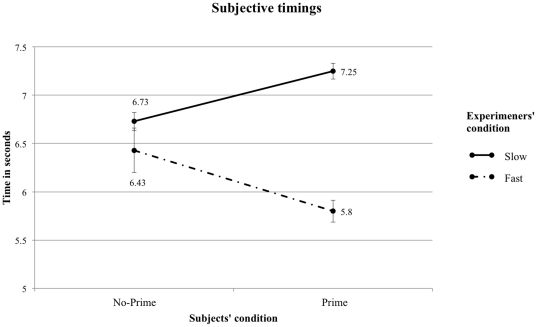
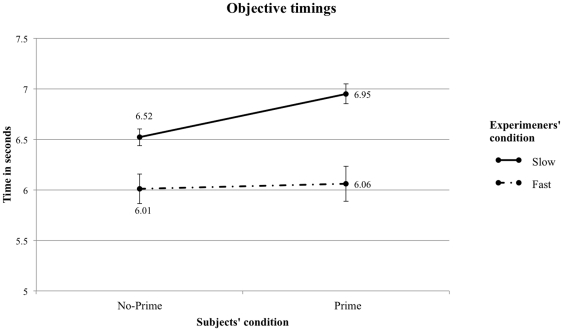
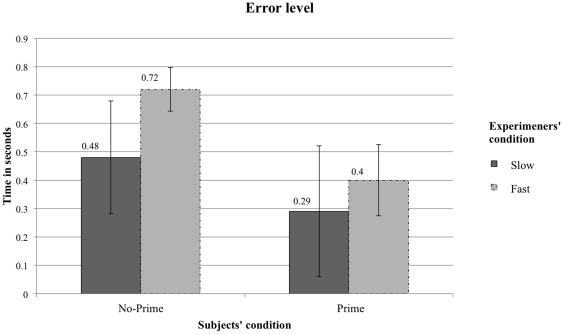
The perspective that behavior is often driven by unconscious determinants has become widespread in social psychology. Bargh, Chen, and Burrows' (1996) famous study, in which participants unwittingly exposed to the stereotype of age walked slower when exiting the laboratory, was instrumental in defining this perspective. Here, we present two experiments aimed at replicating the original study. Despite the use of automated timing methods and a larger sample, our first experiment failed to show priming. Our second experiment was aimed at manipulating the beliefs of the experimenters: Half were led to think that participants would walk slower when primed congruently, and the other half was led to expect the opposite. Strikingly, we obtained a walking speed effect, but only when experimenters believed participants would indeed walk slower. This suggests that both priming and experimenters' expectations are instrumental in explaining the walking speed effect. Further, debriefing was suggestive of awareness of the primes. We conclude that unconscious behavioral priming is real, while real, involves mechanisms different from those typically assumed to cause the effect.
Overview
The claims and statistics of this paper haven’t been checked yet.
Run the check — free, no account needed. It reads the open-access text and checks the sources it cites.
Integrity signals
Registry
Cites
Statistics
Figures
Verification
Claims the paper makes
The claims and statistics of this paper haven’t been checked yet.
Run the check — free, no account needed. It reads the open-access text and checks the sources it cites.
Claims other papers make about this one
Each is checked against this paper’s own text: does it say what the citing paper says it does?
The source backs part of the claim, not all of it — or backs it for a different population, condition or comparison.
In the citing paper
“When Doyen and colleagues49 attempted to replicate a previous experiment suggesting that priming participants with age-related stereotypes had an effect on walking speed50, they failed to find any significant results when using a double-blind procedure (prior studies were not blinded).”
From The limited prosocial effects of meditation: A systematic review and meta-analysis (2018) · cites this paper as [49]
Experimental — accuracy not yet measuredThe cited source says what the claim attributes to it.
In the citing paper
“As demonstrated by Doyen et al. [25] the experimenter who knows the participants’ condition may unintentionally act differently so that participants’ behavior may be altered to confirm the researcher’s hypothesis.”
From Failed Replication of Oxytocin Effects on Trust: The Envelope Task Case (2015) · cites this paper as [25]
The cited source says what the claim attributes to it.
In the citing paper
“The use of single blind studies, where the subject is blind to the treatment condition but the experimenter is not, introduces the risk that the experimenter might unconsciously influence the subjects (37).”
From Is there a Publication Bias in Behavioural Intranasal Oxytocin Research on Humans? Opening the File Drawer of One Laboratory (2016) · cites this paper as [37]
The cited source says what the claim attributes to it.
In the citing paper
“They further showed that when making some experimenters believe that priming participants with age-related stereotypes would slow them down, this indeed had a significant effect, but only in those experimenters that were made to believe in the stereotypes.”
From The limited prosocial effects of meditation: A systematic review and meta-analysis (2018) · cites this paper as [49]
The cited source says what the claim attributes to it.
In the citing paper
“Recent work indicates that experimenter biases are not a thing of the past.”
From The limited prosocial effects of meditation: A systematic review and meta-analysis (2018) · cites this paper as [49]
Self-check
Percentages, sums and reported differences re-computed from the paper’s own numbers.
The self-check needs the paper’s full text.
Citations
Cites
Telling more than we can know: Verbal reports on mental processes.
Nisbett, R. E., & Wilson, T. D. (1977) · Psychological Review · doi:10.1037/0033-295x.84.3.231 · Cited by 11,317 · cited 1×
“As Nisbett and Wilson [20] famously pointed out, participants can remain (1) unaware of the stimulus, (2) unaware of their response, or (3) unaware of the fact that the stimulus importantly influenced the response.”
BackgroundThe unbearable automaticity of being
Bargh, J. A., & Chartrand, T. L. (1999) · American Psychologist · doi:10.1037/0003-066x.54.7.462 · Cited by 3,699 · cited 1×
“Studies [22] on automatic behavior have suggested that participants tend to mimic the experimenter’s behavior.”
BackgroundThe chameleon effect: the perception–behavior link and social interaction
Chartrand, T. L., & Bargh, J. A. (1999) · Journal of Personality and Social Psychology · doi:10.1037/0022-3514.76.6.893 · Cited by 3,674
Bargh, J. A., Chen, M., & Burrows, L. (1996) · Journal of Personality and Social Psychology · doi:10.1037/0022-3514.71.2.230 · Cited by 2,736
Bargh, J. A., Chen, M. I.-C., & Burrows, L. (1996) · Journal of Personality and Social Psychology · doi:10.1037//0022-3514.71.2.230 · Cited by 2,646
Towards a cognitive neuroscience of consciousness: basic evidence and a workspace framework
Dehaene, S. (2001) · Cognition · doi:10.1016/s0010-0277(00)00123-2 · Cited by 2,498 · cited 1×
“For instance, several authors [9,10,11] suggest that two factors are necessary to produce the large patterns of neural activation in higher association cortices that are essential for semantic priming to occur: Top-down attention to the prime and bottom-up stimulus strength (e.”
BackgroundConscious, preconscious, and subliminal processing: a testable taxonomy
Dehaene, S., Changeux, J.-P., Naccache, L., Sackur, J., & Sergent, C. (2006) · Trends in Cognitive Sciences · doi:10.1016/j.tics.2006.03.007 · Cited by 2,067
The automated will: nonconscious activation and pursuit of behavioral goals.
Bargh, J. A., Gollwitzer, P. M., Lee-Chai, A., Barndollar, K., & Trötschel, R. (2001) · Journal of Personality and Social Psychology · doi:10.1037/0022-3514.81.6.1014 · Cited by 1,865
Srull, T. K., & Wyer, R. S. (1979) · Journal of Personality and Social Psychology · doi:10.1037/0022-3514.37.10.1660 · Cited by 1,529
Cerebral mechanisms of word masking and unconscious repetition priming
Dehaene, S., Naccache, L., Cohen, L., Bihan, D. L., Mangin, J.-F., Poline, J.-B., & Rivière, D. (2001) · Nature Neuroscience · doi:10.1038/89551 · Cited by 1,305
Cited by
Sorted by citations
Items 201–300 of 674
Unearned Preferential Treatment
Zhang, L., & Hanks, L. (2015) · Cornell Hospitality Quarterly · doi:10.1177/1938965515575422 · Cited by 29
Wine and music (III): so what if music influences the taste of the wine?
Spence, C. J., & Wang, Q. J. (2015) · Flavour · doi:10.1186/s13411-015-0046-9 · Cited by 27
Concept and Method in Cross-Cultural and Cultural Psychology
Poortinga, Y. H. (2021) · Cambridge University Press eBooks · doi:10.1017/9781108908320 · Cited by 28
Political Bias in the Social Sciences: A Critical, Theoretical, and Empirical Review
Honeycutt, N., & Jussim, L. J. (2023) · Springer eBooks · doi:10.1007/978-3-031-29148-7_5 · Cited by 27
A Radical Reassessment of the Body in Social Cognition
Lindblom, J. (2020) · Frontiers in Psychology · doi:10.3389/fpsyg.2020.00987 · Cited by 31
Psychology Exceptionalism and the Multiple Discovery of the Replication Crisis
Nelson, N. C., Chung, J., Ichikawa, K., & Malik, M. M. (2021) · Review of General Psychology · doi:10.1177/10892680211046508 · Cited by 27
van Steenbergen, H., & Bocanegra, B. R. (2015) · Behavior Research Methods · doi:10.3758/s13428-015-0677-x · Cited by 27
A Three-Site Reproduction of the Joint Simon Effect with the NAO Robot
Strait, M. K., Lier, F., Bernotat, J., Wachsmuth, S., Eyssel, F., Goldstone, R. L., & Šabanović, S. (2020) · ACM/IEEE International Conference on Human-Robot Interaction (HRI) · doi:10.1145/3319502.3374783 · Cited by 26
The problem of demand effects in power studies: Moving beyond power priming
Khademi, M., Mast, M. S., Zehnder, C., & Priest, O. D. S. (2021) · The Leadership Quarterly · doi:10.1016/j.leaqua.2021.101496 · Cited by 26
Assessing and Improving Robustness of Psychological Research Findings in Four Steps
Nuijten, M. B. (2022) · Springer eBooks · doi:10.1007/978-3-031-04968-2_17 · Cited by 26
Augustinova, M., & Ferrand, L. (2014) · Cognition · doi:10.1016/j.cognition.2013.11.014 · Cited by 25
Effects of subtle cognitive manipulations on placebo analgesia – An implicit priming study
Rosén, A., Yi, J., Kirsch, I., Kaptchuk, T. J., Ingvar, M., & Jensen, K. B. (2016) · European Journal of Pain · doi:10.1002/ejp.961 · Cited by 24
Corneille, O., & Lush, P. (2021) · doi:10.31234/osf.io/jqyvx · Cited by 25
de Jong, D. C., & Cook, C. (2021) · Archives of Sexual Behavior · doi:10.1007/s10508-020-01878-6 · Cited by 26
A meta-analytic cognitive framework of nudge and sludge
Luo, Y., Li, A., Soman, D., & Zhao, J. (2023) · Royal Society Open Science · doi:10.1098/rsos.230053 · Cited by 32
Encouraging pro-environmental behaviors through children-based appeals: a kin selection perspective
Palomo-Vélez, G., Buczny, J., & Van Vugt, M. (2020) · Sustainability · doi:10.3390/su12020748 · Cited by 23
Does Doing Media Violence Research Make One Aggressive?
Elson, M., & Ferguson, C. J. (2013) · European Psychologist · doi:10.1027/1016-9040/a000185 · Cited by 29
Can creative role models prime creativity in soccer players?
Furley, P., & Memmert, D. (2018) · Psychology of sport and exercise · doi:10.1016/j.psychsport.2018.03.007 · Cited by 28
Embracing Open Science and Transparency in Health Psychology
Hagger, M. S. (2019) · Health Psychology Review · doi:10.1080/17437199.2019.1605614 · Cited by 22
Linguistic Experiments and Ordinary Language Philosophy
Hansen, N., & Chemla, E. (2015) · Ratio · doi:10.1111/rati.12112 · Cited by 22
Latham, G. P. (2016) · Current Opinion in Psychology · doi:10.1016/j.copsyc.2016.07.005 · Cited by 22
Self‐control: Information, priorities, and resources
Laran, J. (2019) · Consumer Psychology Review · doi:10.1002/arcp.1058 · Cited by 22
A New Replication Norm for Psychology
LeBel, E. P. (2015) · Collabra · doi:10.1525/collabra.23 · Cited by 27
Genschow, O., Westfal, M., Crusius, J., Bartosch, L., Feikes, K. I., Pallasch, N., & Wozniak, M. (2020) · Journal of Personality and Social Psychology · doi:10.1037/pspa0000261 · Cited by 24
Behavioral Priming 2.0: Enter a Dynamical Systems Perspective
Krpan, D. (2017) · Frontiers in Psychology · doi:10.3389/fpsyg.2017.01204 · Cited by 23
EPS Prize Lecture: Cognitive underpinnings of social interaction
Hamilton, A. F. D. C. (2014) · Quarterly Journal of Experimental Psychology · doi:10.1080/17470218.2014.973424 · Cited by 25
Advancing the Cognitive Science of Religion through Replication and Open Science
Hoogeveen, S., & van Elk, M. (2020) · Journal for the Cognitive Science of Religion · doi:10.1558/jcsr.39039 · Cited by 21
Manipulating belief in free will and its downstream consequences: A meta-analysisPreprint
Genschow, O., Cracco, E., Schneider, J., Protzko, J., Wisniewski, D., Braß, M., & Schooler, J. W. (2021) · doi:10.31234/osf.io/quwgr · Cited by 21
Noggle, R. (2025) · doi:10.1093/9780198924920.001.0001 · Cited by 22
Efendić, E., & van Zyl, L. E. (2019) · SA Journal of Industrial Psychology · doi:10.4102/sajip.v45i0.1607 · Cited by 26
Tallapragada, M., Hardy, B. W., Lybrand, E., & Hallman, W. K. (2020) · Risk Analysis · doi:10.1111/risa.13591 · Cited by 20
Unconscious integration: Current evidence for integrative processing under subliminal conditions
Zher‐Wen, & Yu, R. (2023) · British Journal of Psychology · doi:10.1111/bjop.12631 · Cited by 26
Pech, G. P., & Caspar, É. A. (2023) · Frontiers in Psychology · doi:10.3389/fpsyg.2023.1255835 · Cited by 25
Unconscious Motives and Actions – Agency, Freedom and Responsibility
Lumer, C. (2019) · Frontiers in Psychology · doi:10.3389/fpsyg.2018.02777 · Cited by 20
Have psychologists increased reporting of outliers in response to the reproducibility crisis?
Valentine, K. D., Buchanan, E. M., Cunningham, A., Hopke, T. G., Wikowsky, A., & Wilson, H. (2021) · Social and Personality Psychology Compass · doi:10.1111/spc3.12591 · Cited by 22
Self-control and normativity: Theories in social psychology revisited
Horstkötter, D. (2014) · Theory & Psychology · doi:10.1177/0959354314561487 · Cited by 23
Schooler, J. W., Mrazek, M. D., Baird, B., & Winkielman, P. (2014) · American Psychological Association eBooks · doi:10.1037/14341-005 · Cited by 24
Optimization of Cellular ELISA for Assay of Surface Antigens on Human Synoviocytes
Smith, D. D., Cohick, C. B., & Lindsley, H. B. (1997) · BioTechniques · doi:10.2144/97225rr03 · Cited by 21
Tunç, D. U., & Tunç, M. N. (2020) · doi:10.31234/osf.io/pdm7y · Cited by 20
Just What Is It That Makes Travis’s Examples So Different, So Appealing?
Hansen, N. (2018) · Oxford University Press eBooks · doi:10.1093/oso/9780198783916.003.0006 · Cited by 19
Minas, R. K., Poor, M., Dennis, A. R., & Bartelt, V. L. (2016) · Appetite · doi:10.1016/j.appet.2016.05.022 · Cited by 19
The focus of virtue: Attention broadening in empirically informed accounts of virtue cultivation
Waggoner, M. (2021) · Philosophical Psychology · doi:10.1080/09515089.2021.1959027 · Cited by 19
How sweet odors affect healthy food choice: An eye-tracking study
Yang, X., Zandstra, E. H., & Boesveldt, S. (2023) · Food Quality and Preference · doi:10.1016/j.foodqual.2023.104922 · Cited by 19
Can the Unconscious Boost Lie-Detection Accuracy?
Street, C. N. H., & Vadillo, M. A. (2016) · Current Directions in Psychological Science · doi:10.1177/0963721416656348 · Cited by 37
Koganemaru, S., Mikami, Y., Maezawa, H., Matsuhashi, M., Ikeda, S., Ikoma, K., & Mima, T. (2018) · PLoS ONE · doi:10.1371/journal.pone.0208691 · Cited by 21
Replication and the Establishment of Scientific Truth
Iso‐Ahola, S. E. (2020) · Frontiers in Psychology · doi:10.3389/fpsyg.2020.02183 · Cited by 25
Watanabe, S., & Laurent, S. M. (2020) · Journal for the Cognitive Science of Religion · doi:10.1558/jcsr.38411 · Cited by 19
Does achievement motivation mediate the semantic achievement priming effect?
Engeser, S., & Baumann, N. (2014) · Journal of Experimental Psychology General · doi:10.1037/a0036864 · Cited by 19
A Flexible Impact of Affective Feelings on Priming Effects
Huntsinger, J. R. (2013) · Personality and Social Psychology Bulletin · doi:10.1177/0146167213514279 · Cited by 16
Real and imagined power poses: is the physical experience necessary after all?
Bombari, D., Mast, M. S., & Pulfrey, C. (2017) · Comprehensive Results in Social Psychology · doi:10.1080/23743603.2017.1341183 · Cited by 18
Albarracín, D., Sunderrajan, A., & Dai, W. (2018) · Nebraska Symposium on Motivation/The Nebraska symposium on motivation · doi:10.1007/978-3-319-96920-6_3 · Cited by 13
The Influence of Exposure to Religious Symbols on Out-Group Stereotypes
Razpurker‐Apfeld, I., & Shamoa‐Nir, L. (2015) · Psychology · doi:10.2139/ssrn.4077694 · Cited by 18
Behavioral Ethics Meets Behavioral Law and Economics
Feldman, Y. (2014) · Oxford University Press eBooks · doi:10.1093/oxfordhb/9780199945474.013.0009 · Cited by 19
Demand characteristics in human–computer experiments
Iarygina, O., Hornbæk, K., & Mottelson, A. (2024) · International Journal of Human-Computer Studies · doi:10.1016/j.ijhcs.2024.103379 · Cited by 27
Assessing the replication landscape in experimental linguistics
Kobrock, K., & Roettger, T. B. (2023) · Glossa Psycholinguistics · doi:10.5070/g6011135 · Cited by 18
Albert, L., Potheegadoo, J., Herbelin, B., Bernasconi, F., & Blanke, O. (2024) · Nature Communications · doi:10.1038/s41467-024-45912-w · Cited by 19
The rationality wars: a personal reflection
Gigerenzer, G. (2024) · Behavioural Public Policy · doi:10.1017/bpp.2024.51 · Cited by 17
Priming as a way of understanding children’s mental representations of the social world
Stupica, B., & Cassidy, J. A. (2014) · Developmental Review · doi:10.1016/j.dr.2013.12.003 · Cited by 19
Hodgkinson, G. P., Sund, K. J., & Galavan, R. (2017) · Emerald Group Publishing Limited eBooks · doi:10.1108/s2397-52102017002 · Cited by 17
Automatic Antecedents of Discrimination
Roth, J., Deutsch, R., & Sherman, J. W. (2018) · European Psychologist · doi:10.1027/1016-9040/a000321 · Cited by 20
Ethics in Statistical Practice and Communication: Five Recommendations
Gelman, A. (2018) · Significance · doi:10.1111/j.1740-9713.2018.01193.x · Cited by 17
The effect of haptic and ambient temperature experience on prosocial behavior.
Lynott, D., Corker, K. S., Connell, L., & O’Brien, K. (2017) · Archives of Scientific Psychology · doi:10.1037/arc0000031 · Cited by 19
Experimental Design and the Reliability of Priming Effects: Reconsidering the "Train Wreck"Preprint
Rivers, A. M., & Sherman, J. W. (2018) · doi:10.31234/osf.io/r7pd3 · Cited by 17
Mindfulness or expectancy? The label of mindfulness leads to expectancy effects
Ghanbari Noshari, M., Kempton, H. M., & Kreplin, U. (2023) · Counselling and Psychotherapy Research · doi:10.1002/capr.12589 · Cited by 16
One Decade Into the Replication Crisis, How Have Psychological Results Changed?
Bogdan, P. C. (2025) · Advances in Methods and Practices in Psychological Science · doi:10.1177/25152459251323480 · Cited by 17
Franěk, M., & Režný, L. (2017) · Frontiers in Psychology · doi:10.3389/fpsyg.2017.00073 · Cited by 16
Rea, D. J., & Young, J. E. (2018) · ACM/IEEE International Conference on Human-Robot Interaction (HRI) · doi:10.1145/3171221.3171259 · Cited by 16
Belletier, C., Normand, A., Camos, V., Barrouillet, P., & Huguet, P. (2019) · Cognition · doi:10.1016/j.cognition.2019.03.018 · Cited by 17
The neuroscience of free will: implications for psychiatry
Pierre, J. M. (2013) · Psychological Medicine · doi:10.1017/s0033291713002985 · Cited by 16
Schoolbook Texts: Behavioral Achievement Priming in Math and Language
Engeser, S., Baumann, N., & Baum, I. R. (2016) · PLoS ONE · doi:10.1371/journal.pone.0150497 · Cited by 16
A direct replication: Unconscious arithmetic processing
Karpinski, A., Briggs, J. C., & Yale, M. (2018) · European Journal of Social Psychology · doi:10.1002/ejsp.2390 · Cited by 16
Optimizing Expectations via Mobile Apps: A New Approach for Examining and Enhancing Placebo Effects
Gruszka, P., Burger, C., & Jensen, M. P. (2019) · Frontiers in Psychiatry · doi:10.3389/fpsyt.2019.00365 · Cited by 15
Boissicat, N., Fayant, M., Nurra, C., & Müller, D. (2021) · British Journal of Educational Psychology · doi:10.1111/bjep.12466 · Cited by 18
Solo Dance or Pas de Deux? The Sector Stereotype Matters in Coproduction
Yang, F., & Li, Y. (2023) · Public Performance & Management Review · doi:10.1080/15309576.2023.2258115 · Cited by 15
Priming Effects on Commitment to Help and on Real Helping Behavior
Abbate, C. S., Boca, S., Spadaro, G., & Romano, A. (2014) · Basic and Applied Social Psychology · doi:10.1080/01973533.2014.922089 · Cited by 14
Social Media and the Politics of Small Data: Post Publication Peer Review and Academic Value
Blackman, L. M. (2015) · Theory Culture & Society · doi:10.1177/0263276415590002 · Cited by 15
Craig, D. P. A., & Abramson, C. I. (2018) · International Journal of Comparative Psychology · doi:10.46867/ijcp.2018.31.01.10 · Cited by 15
Ameli, R., Skeath, P. R., Abraham, P. A., Panahi, S., Kazman, J. B., Foote, F. O., Deuster, P. A., Ahmad, N., & Berger, A. M. (2021) · PeerJ · doi:10.7717/peerj.10519 · Cited by 16
Publication Bias Might Make Us Untrustworthy, But the Solutions May Be Worse
Leavitt, K. (2013) · Industrial and Organizational Psychology · doi:10.1111/iops.12052 · Cited by 15
Social Priming Improves Cognitive Control in Elderly Adults—Evidence from the Simon Task
Aisenberg-Shafran, D., Cohen, N., Pick, H., Tressman, I., Rappaport, M., Shenberg, T., & Henik, A. (2015) · PLoS ONE · doi:10.1371/journal.pone.0117151 · Cited by 15
When Tex and Tess Carpenter Build Houses in Texas: Moderators of Implicit Egotism
Pelham, B. W., & Carvallo, M. (2015) · Self and Identity · doi:10.1080/15298868.2015.1070745 · Cited by 16
Keulen, M. H. F., Teunis, T., Vagner, G. A., Ring, D., & Reichel, L. M. (2018) · The Journal Of Hand Surgery · doi:10.1016/j.jhsa.2018.04.020 · Cited by 15
Lakens, D. (2017) · doi:10.31234/osf.io/3m5y9 · Cited by 15
Priming autonomous and controlling motivation and effects on persistence
Murphy, S. L., & Taylor, I. M. (2020) · Current Psychology · doi:10.1007/s12144-020-00921-y · Cited by 16
Exposure to the American flag polarizes democratic‐republican ideologies
Chan, E. Y. (2017) · British Journal of Social Psychology · doi:10.1111/bjso.12197 · Cited by 14
The problem of false positives and false negatives in violent video game experiments
Ferguson, C. J. (2017) · International Journal of Law and Psychiatry · doi:10.1016/j.ijlp.2017.11.001 · Cited by 18
Forwood, S., Ahern, A. L., Hollands, G. J., Fletcher, P. C., & Marteau, T. M. (2013) · PLoS ONE · doi:10.1371/journal.pone.0071475 · Cited by 16
Bakker, M., Cramer, A. O. J., Matzke, D., Kievit, R., van der Maas, H. L. J., Wagenmakers, E., & Borsboom, D. (2013) · European Journal of Personality · doi:10.1002/per.1920 · Cited by 13
What Is Minimally Required to Elicit Placebo Effects?
Jensen, K. B. (2018) · International review of neurobiology · doi:10.1016/bs.irn.2018.01.008 · Cited by 13
Ngoye, B., Sierra, V., Ysa, T., & Awan, S. (2018) · International Public Management Journal · doi:10.1080/10967494.2018.1495672 · Cited by 14
Replicator Degrees of Freedom Allow Publication of Misleading 'Failures to Replicate'Preprint
Bryan, C. J., Yeager, D. S., & O’Brien, J. (2019) · SSRN Electronic Journal · doi:10.2139/ssrn.3408200 · Cited by 13
Tincani, M., Gilroy, S. P., & Dowdy, A. (2024) · Journal of Applied Behavior Analysis · doi:10.1002/jaba.2909 · Cited by 15
Structural alignment and its prosocial effects in first and second languages
Abrahams, L., Hartsuiker, R. J., Fruyt, F. D., & Bajo, M. T. (2019) · Acta Psychologica · doi:10.1016/j.actpsy.2019.102906 · Cited by 13
Vartapetiance, A., & Gillam, L. (2012) · Cited by 13
Replicability and the Psychology of Science
Clark, C. J., Honeycutt, N., & Jussim, L. J. (2022) · Springer eBooks · doi:10.1007/978-3-031-04968-2_3 · Cited by 13
Does Religious Priming Induce Greater Prejudice? A Meta-Analytic Review
Snell, A., Zuckerman, M., & Le, B. M. (2022) · Personality and Social Psychology Bulletin · doi:10.1177/01461672221135956 · Cited by 13
Be’ery, G., & Bloom, P. B. (2015) · PLoS ONE · doi:10.1371/journal.pone.0128858 · Cited by 14
Introducing New Open Science Practices at EJPA
Greiff, S., van der Westhuizen, L., Mund, M., Rauthmann, J. F., & Wetzel, E. (2020) · European Journal of Psychological Assessment · doi:10.1027/1015-5759/a000628 · Cited by 14
A meta-analytic cognitive framework of nudge and sludgePreprint
Luo, Y., Li, A., Soman, D., & Zhao, J. (2021) · PsyArXiv (OSF Preprints) · doi:10.31234/osf.io/dbmu3 · Cited by 16
Bruhn, M., Gröppel‐Klein, A., & Kirchgeorg, M. (2023) · Journal of Business Economics · doi:10.1007/s11573-023-01141-z · Cited by 19
Metadata
- Authors
- Doyen, S., Klein, O., Pichon, C.-L., & Cleeremans, A.
- Affiliations
- Université Libre de Bruxelles (BE)
- Corresponding author
- Doyen, Stéphane
- Venue
- PLoS ONE
- Publisher
- Public Library of Science (PLoS)
- Published
- 2012-01-18
- Volume
- 7
- Issue
- 1
- Pages
- e29081
- ISSN
- 1932-6203 (ISSN-L)
- PMC
- PMC3261136
- OpenAlex
- W2047874726
- Cited by
- 670
- References
- 28
- Citations by year
- 2026: 32 · 2025: 45 · 2024: 32 · 2023: 64 · 2022: 40 · 2021: 48 · 2020: 49 · 2019: 51 · 2018: 50 · 2017: 43 · 2016: 44 · 2015: 60 · 2014: 56 · 2013: 43 · 2012: 10
- FWCI
- 179.33
- Type
- journal article
- Language
- en
- Open access
- gold
- doi.org
- Locations
- PLoS ONE (publishedVersion, cc-by)
- PubMed Central (publishedVersion, cc-by)
- PubMed (publishedVersion)
- Dépôt institutionnel de l'Université libre de Bruxelles (Université Libre de Bruxelles) (submittedVersion, other-oa)
- DOAJ (DOAJ: Directory of Open Access Journals) (submittedVersion, cc-by-sa)
- Figshare (submittedVersion, cc-by)
- Topics
- Social Sciences › Sociology and Political Science › Social and Intergroup Psychology
- Social Sciences › Psychology › Social Psychology › Psychology of Social Influence
- Social Sciences › Psychology › Social Psychology › Death Anxiety and Social Exclusion
- Keywords
- behavioral priming, unconscious priming, replication failure, walking speed, age stereotypes, expectancy effects, debriefing
- MeSH terms
- Adolescent, Adult, Awareness, Behavior, Humans, Psychology, Social, Psychomotor Performance, Unconscious, Psychology, Word Association Tests, Walking, Young Adult
About these checks
Registry, retraction, Cites and statistics results are computed, not judged, with one exception: a printed reference that no index lists is read once by a model before it counts as a citation error. Claims are extracted by a model and kept only when their quote appears verbatim in the text; each cited source is then checked, with a model’s help, for whether it says what the claim relies on. Those verdicts can be wrong — read the claim’s quote and the cited source before relying on one.
Statistics and arithmetic are recomputed, not judged.
Confidence bands are shown only for fields calibrated on our annotated test set. None is calibrated yet, so no band is shown.
What counts as a claim ›How we measure confidence ›How we check this ›
Are you an author, or do you see a problem with this page? Request a review
