

The DOI matches its Crossref record; 27 of the 28 references it cites were found in a registry or an index.
Behavioral Priming: It’s all in the Mind, but whose Mind?
Open accessAbstract
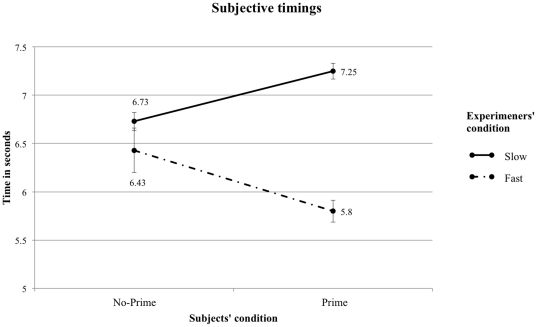
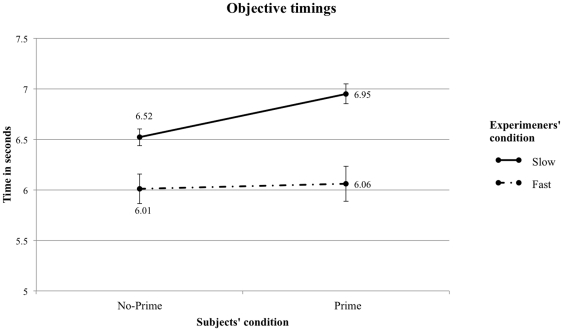
The perspective that behavior is often driven by unconscious determinants has become widespread in social psychology. Bargh, Chen, and Burrows' (1996) famous study, in which participants unwittingly exposed to the stereotype of age walked slower when exiting the laboratory, was instrumental in defining this perspective. Here, we present two experiments aimed at replicating the original study. Despite the use of automated timing methods and a larger sample, our first experiment failed to show priming. Our second experiment was aimed at manipulating the beliefs of the experimenters: Half were led to think that participants would walk slower when primed congruently, and the other half was led to expect the opposite. Strikingly, we obtained a walking speed effect, but only when experimenters believed participants would indeed walk slower. This suggests that both priming and experimenters' expectations are instrumental in explaining the walking speed effect. Further, debriefing was suggestive of awareness of the primes. We conclude that unconscious behavioral priming is real, while real, involves mechanisms different from those typically assumed to cause the effect.
Overview
The claims and statistics of this paper haven’t been checked yet.
Run the check — free, no account needed. It reads the open-access text and checks the sources it cites.
Integrity signals
Registry
Cites
Statistics
Figures
Verification
Claims the paper makes
The claims and statistics of this paper haven’t been checked yet.
Run the check — free, no account needed. It reads the open-access text and checks the sources it cites.
Claims other papers make about this one
Each is checked against this paper’s own text: does it say what the citing paper says it does?
The source backs part of the claim, not all of it — or backs it for a different population, condition or comparison.
In the citing paper
“When Doyen and colleagues49 attempted to replicate a previous experiment suggesting that priming participants with age-related stereotypes had an effect on walking speed50, they failed to find any significant results when using a double-blind procedure (prior studies were not blinded).”
From The limited prosocial effects of meditation: A systematic review and meta-analysis (2018) · cites this paper as [49]
Experimental — accuracy not yet measuredThe cited source says what the claim attributes to it.
In the citing paper
“As demonstrated by Doyen et al. [25] the experimenter who knows the participants’ condition may unintentionally act differently so that participants’ behavior may be altered to confirm the researcher’s hypothesis.”
From Failed Replication of Oxytocin Effects on Trust: The Envelope Task Case (2015) · cites this paper as [25]
The cited source says what the claim attributes to it.
In the citing paper
“The use of single blind studies, where the subject is blind to the treatment condition but the experimenter is not, introduces the risk that the experimenter might unconsciously influence the subjects (37).”
From Is there a Publication Bias in Behavioural Intranasal Oxytocin Research on Humans? Opening the File Drawer of One Laboratory (2016) · cites this paper as [37]
The cited source says what the claim attributes to it.
In the citing paper
“They further showed that when making some experimenters believe that priming participants with age-related stereotypes would slow them down, this indeed had a significant effect, but only in those experimenters that were made to believe in the stereotypes.”
From The limited prosocial effects of meditation: A systematic review and meta-analysis (2018) · cites this paper as [49]
The cited source says what the claim attributes to it.
In the citing paper
“Recent work indicates that experimenter biases are not a thing of the past.”
From The limited prosocial effects of meditation: A systematic review and meta-analysis (2018) · cites this paper as [49]
Self-check
Percentages, sums and reported differences re-computed from the paper’s own numbers.
The self-check needs the paper’s full text.
Citations
Cites
Telling more than we can know: Verbal reports on mental processes.
Nisbett, R. E., & Wilson, T. D. (1977) · Psychological Review · doi:10.1037/0033-295x.84.3.231 · Cited by 11,317 · cited 1×
“As Nisbett and Wilson [20] famously pointed out, participants can remain (1) unaware of the stimulus, (2) unaware of their response, or (3) unaware of the fact that the stimulus importantly influenced the response.”
BackgroundThe unbearable automaticity of being
Bargh, J. A., & Chartrand, T. L. (1999) · American Psychologist · doi:10.1037/0003-066x.54.7.462 · Cited by 3,699 · cited 1×
“Studies [22] on automatic behavior have suggested that participants tend to mimic the experimenter’s behavior.”
BackgroundThe chameleon effect: the perception–behavior link and social interaction
Chartrand, T. L., & Bargh, J. A. (1999) · Journal of Personality and Social Psychology · doi:10.1037/0022-3514.76.6.893 · Cited by 3,674
Bargh, J. A., Chen, M., & Burrows, L. (1996) · Journal of Personality and Social Psychology · doi:10.1037/0022-3514.71.2.230 · Cited by 2,736
Bargh, J. A., Chen, M. I.-C., & Burrows, L. (1996) · Journal of Personality and Social Psychology · doi:10.1037//0022-3514.71.2.230 · Cited by 2,646
Towards a cognitive neuroscience of consciousness: basic evidence and a workspace framework
Dehaene, S. (2001) · Cognition · doi:10.1016/s0010-0277(00)00123-2 · Cited by 2,498 · cited 1×
“For instance, several authors [9,10,11] suggest that two factors are necessary to produce the large patterns of neural activation in higher association cortices that are essential for semantic priming to occur: Top-down attention to the prime and bottom-up stimulus strength (e.”
BackgroundConscious, preconscious, and subliminal processing: a testable taxonomy
Dehaene, S., Changeux, J.-P., Naccache, L., Sackur, J., & Sergent, C. (2006) · Trends in Cognitive Sciences · doi:10.1016/j.tics.2006.03.007 · Cited by 2,067
The automated will: nonconscious activation and pursuit of behavioral goals.
Bargh, J. A., Gollwitzer, P. M., Lee-Chai, A., Barndollar, K., & Trötschel, R. (2001) · Journal of Personality and Social Psychology · doi:10.1037/0022-3514.81.6.1014 · Cited by 1,865
Srull, T. K., & Wyer, R. S. (1979) · Journal of Personality and Social Psychology · doi:10.1037/0022-3514.37.10.1660 · Cited by 1,529
Cerebral mechanisms of word masking and unconscious repetition priming
Dehaene, S., Naccache, L., Cohen, L., Bihan, D. L., Mangin, J.-F., Poline, J.-B., & Rivière, D. (2001) · Nature Neuroscience · doi:10.1038/89551 · Cited by 1,305
Cited by
Sorted by citations
Items 401–500 of 674
Socio-Motor Improvisation in Schizophrenia: A Case-Control Study in a Sample of Stable Patients
Salesse, R. N., Casties, J.-F., Capdevielle, D., & Raffard, S. (2021) · Frontiers in Human Neuroscience · doi:10.3389/fnhum.2021.676242 · Cited by 5
Predicting group benefits in joint multiple object tracking
Wahn, B., Peter König, B., & Kingstone, A. F. (2023) · Attention Perception & Psychophysics · doi:10.3758/s13414-023-02693-6 · Cited by 5
Stereotypes in Social Psychology
Klein, O., & Bernard, P. (2015) · Elsevier eBooks · doi:10.1016/b978-0-08-097086-8.24097-x · Cited by 7
Self-citationThe (Partial but) Real Crisis in Social Psychology
Pratkanis, A. R. (2017) · Wiley eBooks · doi:10.1002/9781119095910.ch9 · Cited by 5
Neequaye, D. A. (2018) · Gothenburg University Publications Electronic Archive (Gothenburg University) · Cited by 5
Anchoring Effects: Resolving the Contradictions of Personality Moderator Research
Röseler, L. (2021) · doi:10.20378/irb-49951 · Cited by 5
Religious Belief, Evolution of
Geertz, A. W. (2015) · Elsevier eBooks · doi:10.1016/b978-0-08-097086-8.81055-7 · Cited by 5
A Train Wreck by Any Other Name
Harris, C., Rohrer, D., & Pashler, H. (2021) · Psychological Inquiry · doi:10.1080/1047840x.2021.1889317 · Cited by 4
Yu, X., Barnehl, H.-M., & Wojcieszak, M. (2025) · Information Communication & Society · doi:10.1080/1369118x.2025.2565333 · Cited by 4
Teymoori, A., & Trappes, R. (2026) · Review of General Psychology · doi:10.1177/10892680261421875 · Cited by 7
Concerns About Replicability Across Two Crises in Social Psychology
Lakens, D. (2025) · International Review of Social Psychology · doi:10.5334/irsp.1036 · Cited by 7
Strack, F., & Schwarz, N. (2021) · Psychological Inquiry · doi:10.1080/1047840x.2021.1889328 · Cited by 4
Do reminders of God increase willingness to take risks?
White, C., Dean, C., & Laurin, K. (2023) · Journal of Experimental Social Psychology · doi:10.1016/j.jesp.2023.104539 · Cited by 5
Croucher, C., Powell, W. A., Stevens, B., Dicks, M., Powell, V., Wiltshire, T. J., & Spronck, P. H. M. (2023) · IEEE Transactions on Visualization and Computer Graphics · doi:10.1109/tvcg.2023.3313439 · Cited by 5
Li, H. (2023) · International Journal for the Psychology of Religion · doi:10.1080/10508619.2023.2280411 · Cited by 4
Crediting or blaming theories or auxiliary assumptions for empirical victories or defeats
Trafimow, D., Quinton, T. S., & Weber, M. (2024) · Theory & Psychology · doi:10.1177/09593543241253548 · Cited by 4
Frugality and food waste avoidance: Does a prime work as much as the trait?
Iorfa, S. K., Stafford, L. D., Bowyer, C. J., & Jack, L. (2025) · Food Quality and Preference · doi:10.1016/j.foodqual.2025.105656 · Cited by 5
Deception detection: dependable or defective?
Vartapetiance, A., & Gillam, L. (2014) · Social Network Analysis and Mining · doi:10.1007/s13278-014-0166-8 · Cited by 4
Fisk, G. D., & Haase, S. J. (2013) · Consciousness and Cognition · doi:10.1016/j.concog.2013.09.006 · Cited by 4
Replication to assess statistical adequacy
Owen, P. D. (2018) · Economics · doi:10.5018/economics-ejournal.ja.2018-60 · Cited by 3
The Influence of Affective Priming on the Affective Response During Exercise: A Replication Study
Timme, S., Hutchinson, J., Regorius, A., & Brand, R. (2022) · Journal of Sport and Exercise Psychology · doi:10.1123/jsep.2022-0025 · Cited by 4
Phaf, R. H. (2023) · New Ideas in Psychology · doi:10.1016/j.newideapsych.2023.101026 · Cited by 4
Open Psychology: transparency and reproducibility
Derksen, M. (2019) · Psicología Conocimiento y Sociedad · doi:10.26864/pcs.v9.n2.13 · Cited by 4
(2016) · Bloomsbury Academic eBooks · doi:10.5040/9781501306549.0018 · Cited by 4
Greenaway, K. H., Fisk, K., & Branscombe, N. R. (2017) · Journal of Applied Social Psychology · doi:10.1111/jasp.12482 · Cited by 4
The Impact of Changing Norms on Creativity in Psychological Science
Wai, J., & Halpern, D. F. (2018) · Perspectives on Psychological Science · doi:10.1177/1745691618773326 · Cited by 4
The Cultural Brain Hypothesis and the transmission and evolution of culture
Muthukrishna, M. (2015) · cIRcle (University of British Columbia) · doi:10.14288/1.0166517 · Cited by 3
Conscious vs. Unconscious Determinants of Behavior
Vrabel, J. K., & Zeigler‐Hill, V. (2016) · Springer eBooks · doi:10.1007/978-3-319-28099-8_1124-1 · Cited by 4
The Moral Psychology of Loyalty
Hildreth, J. A. D. (2016) · eScholarship (California Digital Library) · Cited by 4
Compensatory Control and Belief in God: A Registered Replication Report Across Two CountriesPreprint
Hoogeveen, S., Wagenmakers, E., Kay, A. C., & van Elk, M. (2019) · doi:10.31234/osf.io/vqu2x · Cited by 4
Post-Publication Peer Review for RealPreprint
Ikeda, K., Yamada, Y., & Takahashi, K. (2020) · doi:10.31234/osf.io/sp3j5 · Cited by 4
Assessing the replication landscape in experimental linguisticsPreprint
Kobrock, K., & Roettger, T. B. (2022) · doi:10.31234/osf.io/fzngs · Cited by 4
Conscious Versus Unconscious Determinants of Behavior
Vrabel, J. K., & Zeigler‐Hill, V. (2020) · Springer eBooks · doi:10.1007/978-3-319-24612-3_1124 · Cited by 4
Conscious and Unconscious Mental States
Dienes, Z. P., & Seth, A. K. (2022) · Oxford University Press eBooks · doi:10.1093/acrefore/9780190236557.013.804 · Cited by 5
Does she still love and feel hungry? Afterlife continuity beliefs and religion across 24 countriesPreprint
Hoogeveen, S., Altay, S., Bendixen, T., Berniûnas, R., Bulbulia, J. A., Cheshin, A., Gentili, C., Georgescu, R., Haaf, J. M., Hagel, K., et al. (2023) · doi:10.31234/osf.io/tvycp · Cited by 4
Rea, D. J., & Young, J. E. (2023) · Frontiers in Robotics and AI · doi:10.3389/frobt.2023.1271337 · Cited by 3
Creativity Booster: How Time versus Money Impacts Creative Performances
Gong, H., Zhou, H., & Zhang, X. (2019) · The Journal of Creative Behavior · doi:10.1002/jocb.399 · Cited by 3
Evaluating Experimental Research
Roediger, H. L., III, & Yamashiro, J. K. (2019) · Cambridge University Press eBooks · doi:10.1017/9781108684354.012 · Cited by 5
Human Unconscious Processes In Situ
Bargh, J. A., & Hassin, R. R. (2022) · Oxford University Press eBooks · doi:10.1093/oso/9780197501573.003.0010 · Cited by 3
Tanton, T. (2023) · Oxford University Press eBooks · doi:10.1093/oso/9780192884589.003.0003 · Cited by 6
Phaf, R. H., & Rotteveel, M. (2023) · Psychological Reports · doi:10.1177/00332941231153975 · Cited by 5
Influence of Economic Scarcity on Race Perception
Antunes, R. D. A., Gonçalves, E. D. S., Bernardino, L. G., Casalecchi, J. G. S., Grebot, I. B. D. F., & de Moraes, R. (2023) · Psychological Reports · doi:10.1177/00332941231169666 · Cited by 3
Conceptual replication study of fifteen JDM effects: Insights from the Polish sample
Sobków, A., Sobczak, A., Latacz, K., Gambuś, P., Tyc, A., Goryczka, K., Barcik, K., Janosz, A., Hetmańczuk, W., Gonczar, T., et al. (2022) · Polish Psychological Bulletin · doi:10.24425/ppb.2022.141862 · Cited by 5
The Surprising Effect of Priming on SNOT-22 Results
Mohammad, I., Stack, T., Norris, M., Kim, S., Lamb, M., Thorp, B. D., Klatt‐Cromwell, C. N., Ebert, C. S., Kimple, A. J., & Senior, B. A. (2024) · American Journal of Rhinology and Allergy · doi:10.1177/19458924241229160 · Cited by 3
Being an older person: modulation of walking speed with geriatric walking motion avatars
Koseki, Y., & Amemiya, T. (2024) · Frontiers in Virtual Reality · doi:10.3389/frvir.2024.1363043 · Cited by 3
Motivation Effect of Social Media Posts about Well-being and Healthy Living
Spiliotopoulos, D., Antonakaki, D., Ioannidis, S., & Fragopoulou, P. (2016) · International Conference on PErvasive Technologies Related to Assistive Environments (PETRA) · doi:10.1145/2910674.2910688 · Cited by 3
Testing the effect of cooperative/competitive priming on the Prisoner’s Dilemma. A replication study
Belaus, A., Reyna, C., & Freidín, E. (2018) · PLoS ONE · doi:10.1371/journal.pone.0209263 · Cited by 4
Marhenke, T., & Imhoff, R. (2019) · The Journal of General Psychology · doi:10.1080/00221309.2019.1665489 · Cited by 3
La crisis en la psicología social contemporánea: el fenómeno del priming
Santos, D. (2013) · Poiésis · doi:10.21501/16920945.636 · Cited by 3
The historian's craft and economics
Hansen, B. A., & Hansen, M. E. (2015) · Journal of Institutional Economics · doi:10.1017/s1744137415000363 · Cited by 3
The effect of information bias on the formation of impressions: courtroom implications
León, F. G., Mestas, L., Martínez, J. M. A., Nieto, M. Á. P., Córdova, E. A. E., Pérez, R. M. L., & Fernández, F. P. (2017) · Journal of Criminal Psychology · doi:10.1108/jcp-09-2016-0029 · Cited by 3
Működési zavarok és megújulási törekvések a tudományos pszichológiában, a 21. század elején
Szokolszky, Á. (2018) · Magyar Pszichológiai Szemle · doi:10.1556/0016.2018.73.4.3 · Cited by 3
Why Science Succeeds, and Sometimes Doesn’t
Baron, J. A. (2019) · Cambridge University Press eBooks · doi:10.1017/9781108684354.004 · Cited by 3
Primed Goals and Primed Actions: A Commentary from an Action Theory Point of View
Fresé, M. (2020) · Applied Psychology · doi:10.1111/apps.12271 · Cited by 3
Les pratiques de recherche ouvertes en psychologie
Lantian, A. (2020) · Psychologie Française · doi:10.1016/j.psfr.2020.09.001 · Cited by 6
How Trust in Social Dilemmas Evolves with Age
Kocher, M. G. (2017) · Oxford University Press eBooks · doi:10.1093/oso/9780190630782.003.0006 · Cited by 3
Editorial Decisions May Perpetuate Belief in Invalid Research Findings
Eriksson, K., & Simpson, B. (2013) · PLoS ONE · doi:10.1371/journal.pone.0073364 · Cited by 3
Open Science at Liberal Arts CollegesPreprint
Lane, K. A., Le, B., Woodzicka, J. A., Detweiler-Bedell, J. B., & Detweiler-Bedell, B. T. (2020) · doi:10.31234/osf.io/437c8 · Cited by 3
Digital-robotic markers for hallucinations in Parkinson’s diseasePreprint
Albert, L., Potheegadoo, J., Herbelin, B., Bernasconi, F., & Blanke, O. (2023) · bioRxiv (Cold Spring Harbor Laboratory) · doi:10.1101/2023.06.14.544929 · Cited by 3
Voice activated : exploring the effects of voices on behaviours.
MacFarlane, A. E. (2014) · UC Research Repository (University of Canterbury) · doi:10.26021/6186 · Cited by 3
Fletcher, D., Houghton, R. J., & Spence, A. (2024) · PLoS ONE · doi:10.1371/journal.pone.0301781 · Cited by 2
Should Hostile Design Be Used To Prevent Begging, Loitering, and Rough Sleeping?
Holmen, S. J. (2025) · Res Publica · doi:10.1007/s11158-025-09731-0 · Cited by 2
Holmberg, P. M., & Kelly, V. G. (2025) · International Journal of Sports Physiology and Performance · doi:10.1123/ijspp.2025-0105 · Cited by 2
Einführung in die Sozialpsychologie
Stroebe, W., Hewstone, M., & Jonas, K. (2007) · Springer eBooks · doi:10.1007/978-3-540-71633-4_1 · Cited by 2
A Heterophenomenological Framework for Analyzing User Experiences with Affordances
Ha, T., & Lee, S. (2021) · International Journal of Human-Computer Interaction · doi:10.1080/10447318.2021.1917841 · Cited by 2
Prosocial priming and bystander effect in an online context
Abbate, C. S., Misuraca, R., Vaccaro, C., Roccella, M., Vetri, L., & Miceli, S. (2022) · Frontiers in Psychology · doi:10.3389/fpsyg.2022.945630 · Cited by 4
Cognitively Accessible Words Associated with God as Effective Lexical Primes
Kitchens, M. B., Lang, I. M., Petrasic, S. E., Remper, B. C., & Wilson, B. M. (2022) · Journal for the Cognitive Science of Religion · doi:10.1558/jcsr.22679 · Cited by 2
Effects of Priming Different I-Positions on Motor Behavior
Suszek, H., Gabińska, A., & Kopera, M. (2023) · Journal of Constructivist Psychology · doi:10.1080/10720537.2023.2194692 · Cited by 2
Deutsch, R., & Roth, J. (2023) · Springer eBooks · doi:10.1007/978-3-662-65297-8_4 · Cited by 2
Thériault, R., & Dandeneau, S. (2023) · Mindfulness · doi:10.1007/s12671-023-02246-w · Cited by 5
Rea, A. L., Corbit, L. H., & Shu, L. H. (2023) · Journal of Mechanical Design · doi:10.1115/1.4064100 · Cited by 2
The Virtues of Lab Experiments
Charness, G. B., Cox, J. C., Eckel, C. C., Holt, C. A., & Jabarian, B. (2026) · Journal of Economic Behavior & Organization · doi:10.1016/j.jebo.2026.107595 · Cited by 2
Data avatars: A theory-guided design and assessment for multidimensional data visualization
Pflughoeft, K. A., Zahedi, F. M., & Chen, Y. (2023) · Information & Management · doi:10.1016/j.im.2023.103911 · Cited by 2
Ahluwalia‐McMeddes, A., Moore, A., Marr, C., & Kunders, Z. (2024) · British Journal of Social Psychology · doi:10.1111/bjso.12781 · Cited by 3
Registered Replication Report: Study 3 From Trafimow and Hughes (2012)
Rife, S. C., Lambert, Q. S., Calin-Jageman, R. J., Adamkovic, M., Baník, G., Barberia, I., Beaudry, J. L., Bernauer, H., Calvillo, D. P., Chopik, W. J., et al. (2025) · Advances in Methods and Practices in Psychological Science · doi:10.1177/25152459251328334 · Cited by 2
The Middleman Effect: The ethical consequences of paying others to act on one's behalf
MacDonald, C. (2020) · Open Science Journal · doi:10.23954/osj.v5i1.2377 · Cited by 2
Lacking control, Pattern Perception, and Symptom Overendorsement
Banning, L. C. P. (2014) · Cited by 2
What Explains Consciousness? Or...What Consciousness Explains?
Dulany, D. E. (2014) · Mens Sana monographs · doi:10.4103/0973-1229.130283 · Cited by 2
Empirically Supported Treatments and Efficacy Trials: What Steps Do We Still Need to Take?
Nasser, J. D. (2013) · Journal of Contemporary Psychotherapy · doi:10.1007/s10879-013-9236-x · Cited by 2
Doing what others see: visuomotor conversion to informational social influence.
Skewes, J., Skewes, L., Roepstorff, A., & Frith, C. (2013) · Journal of Experimental Psychology: Human Perception and Performance · doi:10.1037/a0031572 · Cited by 5
Falikman, M. V. (2014) · Cambridge University Press eBooks · doi:10.1017/cbo9781139028097.026 · Cited by 2
When Manipulation Gets Personal
Sridharan, V. (2015) · Australasian Journal of Philosophy · doi:10.1080/00048402.2015.1104367 · Cited by 2
Magid, K. S., Sarkol, V., & Mesoudi, A. (2017) · Royal Society Open Science · doi:10.1098/rsos.161025 · Cited by 3
Huxster, J. K., Hopkins, M., Bresticker, J. E., Leddington, J. P., & Slater, M. H. (2017) · Philosophical Psychology · doi:10.1080/09515089.2017.1359245 · Cited by 3
McCarthy, K. S., & Taylor, A. P. (2017) · Journal of Psychotherapy Integration · doi:10.1037/int0000065 · Cited by 2
Wahrnehmung und Interpretation von Informationen
Kindermann, H. (2020) · Springer eBooks · doi:10.1007/978-3-658-28161-8_5 · Cited by 2
Die Replikationskrise in der Psychologie
Spitzer, M., & Spitzer, M. (2020) · Nervenheilkunde · doi:10.1055/a-1095-0144 · Cited by 2
Murphy, S. L., & Steel, R. P. (2021) · Motivation and Emotion · doi:10.1007/s11031-021-09919-w · Cited by 2
Agencia y control: el rol subcortical en las buenas decisiones
Churchland, P. S., & Suhler, C. L. (2022) · Revista de Humanidades de Valparaíso · doi:10.22370/rhv2022iss20pp231-250 · Cited by 2
The Evolutionary Approach to Political Psychology
Petersen, M. B. (2023) · Oxford University Press eBooks · doi:10.1093/oxfordhb/9780197541302.013.6 · Cited by 2
Avatars, disconnecting agents: exploring the nuances of the avatar effect in online discourse
MacDonald, C. (2020) · Open Science Journal · doi:10.23954/osj.v5i2.2385 · Cited by 2
Two Questions to Foster Critical Thinking in the Field of Psychology
Holtz, P. (2020) · Meta-Psychology · doi:10.15626/mp.2018.984 · Cited by 3
Bejanyan, K. (2015) · Brunel University Research Archive (BURA) (Brunel University London) · Cited by 2
Cultural differences in scene perception
Alotaibi, A. T. (2016) · Nottingham ePrints (University of Nottingham) · Cited by 2
Opinions on the value of direct replication: A survey of 2,000 psychologistsPreprint
Buttliere, B., & Wicherts, J. M. (2018) · PsyArXiv (OSF Preprints) · doi:10.31234/osf.io/z9kx6 · Cited by 3
The statistical crisis in science: How is it relevant to clinical neuropsychology?Preprint
Gelman, A. (2016) · doi:10.31235/osf.io/cp8fz · Cited by 2
Cunningham, S. J. (2013) · Oxford University Press eBooks · doi:10.1093/obo/9780199828340-0136 · Cited by 3
Designing for Preregistration in Practice: Multiple Norms and PurposesPreprint
Pu, X., Zhu, L., Kay, M., & Conrad, F. G. (2019) · OSF Preprints (OSF Preprints) · doi:10.31219/osf.io/w5ked · Cited by 3
The Effect of Haptic and Ambient Temperature Experience on Prosocial BehaviorPreprint
Lynott, D., Corker, K. S., Connell, L., & O’Brien, K. (2017) · PsyArXiv (OSF Preprints) · doi:10.31234/osf.io/jk967 · Cited by 2
Implicit Knowledge in Unawareness StructuresPreprint
Belardinelli, G., & Schipper, B. C. (2023) · SSRN Electronic Journal · doi:10.2139/ssrn.4625080 · Cited by 2
Metadata
- Authors
- Doyen, S., Klein, O., Pichon, C.-L., & Cleeremans, A.
- Affiliations
- Université Libre de Bruxelles (BE)
- Corresponding author
- Doyen, Stéphane
- Venue
- PLoS ONE
- Publisher
- Public Library of Science (PLoS)
- Published
- 2012-01-18
- Volume
- 7
- Issue
- 1
- Pages
- e29081
- ISSN
- 1932-6203 (ISSN-L)
- PMC
- PMC3261136
- OpenAlex
- W2047874726
- Cited by
- 670
- References
- 28
- Citations by year
- 2026: 32 · 2025: 45 · 2024: 32 · 2023: 64 · 2022: 40 · 2021: 48 · 2020: 49 · 2019: 51 · 2018: 50 · 2017: 43 · 2016: 44 · 2015: 60 · 2014: 56 · 2013: 43 · 2012: 10
- FWCI
- 179.33
- Type
- journal article
- Language
- en
- Open access
- gold
- doi.org
- Locations
- PLoS ONE (publishedVersion, cc-by)
- PubMed Central (publishedVersion, cc-by)
- PubMed (publishedVersion)
- Dépôt institutionnel de l'Université libre de Bruxelles (Université Libre de Bruxelles) (submittedVersion, other-oa)
- DOAJ (DOAJ: Directory of Open Access Journals) (submittedVersion, cc-by-sa)
- Figshare (submittedVersion, cc-by)
- Topics
- Social Sciences › Sociology and Political Science › Social and Intergroup Psychology
- Social Sciences › Psychology › Social Psychology › Psychology of Social Influence
- Social Sciences › Psychology › Social Psychology › Death Anxiety and Social Exclusion
- Keywords
- behavioral priming, unconscious priming, replication failure, walking speed, age stereotypes, expectancy effects, debriefing
- MeSH terms
- Adolescent, Adult, Awareness, Behavior, Humans, Psychology, Social, Psychomotor Performance, Unconscious, Psychology, Word Association Tests, Walking, Young Adult
About these checks
Registry, retraction, Cites and statistics results are computed, not judged, with one exception: a printed reference that no index lists is read once by a model before it counts as a citation error. Claims are extracted by a model and kept only when their quote appears verbatim in the text; each cited source is then checked, with a model’s help, for whether it says what the claim relies on. Those verdicts can be wrong — read the claim’s quote and the cited source before relying on one.
Statistics and arithmetic are recomputed, not judged.
Confidence bands are shown only for fields calibrated on our annotated test set. None is calibrated yet, so no band is shown.
What counts as a claim ›How we measure confidence ›How we check this ›
Are you an author, or do you see a problem with this page? Request a review
