

The DOI matches its Crossref record; 75 of the 75 references it cites were found in a registry or an index; none of the 50 sources its claims cite is checked for support yet.
How to Boost Positive Interpretations? A Meta-Analysis of the Effectiveness of Cognitive Bias Modification for Interpretation
Open accessAbstract
The current meta-analysis explores the strength of effects of cognitive bias modification training for interpretation bias (CBM-I) on positive (i.e., adaptive) interpretations and mood as well as the training and sample characteristics influencing these effects. Data-bases were searched with the key words "interpret* bias AND training" and "interpret* bias AND modif*". Reference lists of identified articles were checked and authors of identified articles were contacted for further relevant articles and unpublished data. Studies were reviewed for inclusion with eligibility criteria being that the study (a) aimed to target interpretation biases through any kind of training, (b) assessed mood and/or interpretation bias as outcome measures, (c) allocated individuals to training conditions at random, and (d) recruited adult samples. A meta-analytic multilevel mixed-effects model was employed to assess standardized mean changes in interpretation bias, negative mood, and emotional reactivity. In addition, several training and sample characteristics were explored for their potential to enhance benign training effectiveness. On average, benign CBM-I resulted in an increase in positive interpretation bias (p<.01) and a decrease in negative mood state (p<.001), but did not affect emotional reactivity. These effects were not consistently different from control conditions with no or neutral training. However, within benign training conditions imagery instructions and more training sessions were related to larger cognitive and mood effects, whereas feedback about training performance and inclusion of non-benign training items (instead of including benign items only) boosted cognitive effects only. Finally, training was more effective in women (cognitive and mood effects) and presumably samples with symptomatic emotional dysregulation (cognitive effects). Although the effects of emotional dysregulation and number of training sessions could not well be distinguished, there is an indication that when used with imagery instructions and more training sessions, benign CBM-I can be employed as a useful complementary treatment to usual psychotherapies.
Overview
AI snapshot
Written from the paper’s full text.
TL;DR
This meta-analysis of 42 articles (59 studies, 125 samples, 2,526 individuals) found that benign cognitive bias modification for interpretation (CBM-I) increased positive interpretation bias and decreased negative mood, but effects were not consistently different from neutral or no-training controls. Imagery instructions and more training sessions were the most consistent moderators of larger cognitive and mood effects.
Key findings
- Benign CBM-I produced a large post-training difference favoring positive over negative interpretations (ES = 1.33, 95% CI 1.11–1.55, p < .001), significantly larger than neutral (ES = 0.49), negative (ES = −0.05), and no-training (ES = 0.28) conditions (all pairwise p < .001).
- Pre- to post-training positive interpretation bias increased significantly only in benign training (ES = 0.43, 95% CI 0.17–0.69, p < .01), differing significantly only from negative training (ES = −0.22; pairwise ES = 0.65, p < .05).
- Negative mood decreased significantly pre- to post-training in benign training (ES = 0.25, 95% CI 0.14–0.36, p < .001), but this did not differ significantly from neutral (ES = 0.22) or no-training (ES = −0.03) conditions; it did differ from negative training (ES = −0.20; pairwise ES = 0.44, p < .001).
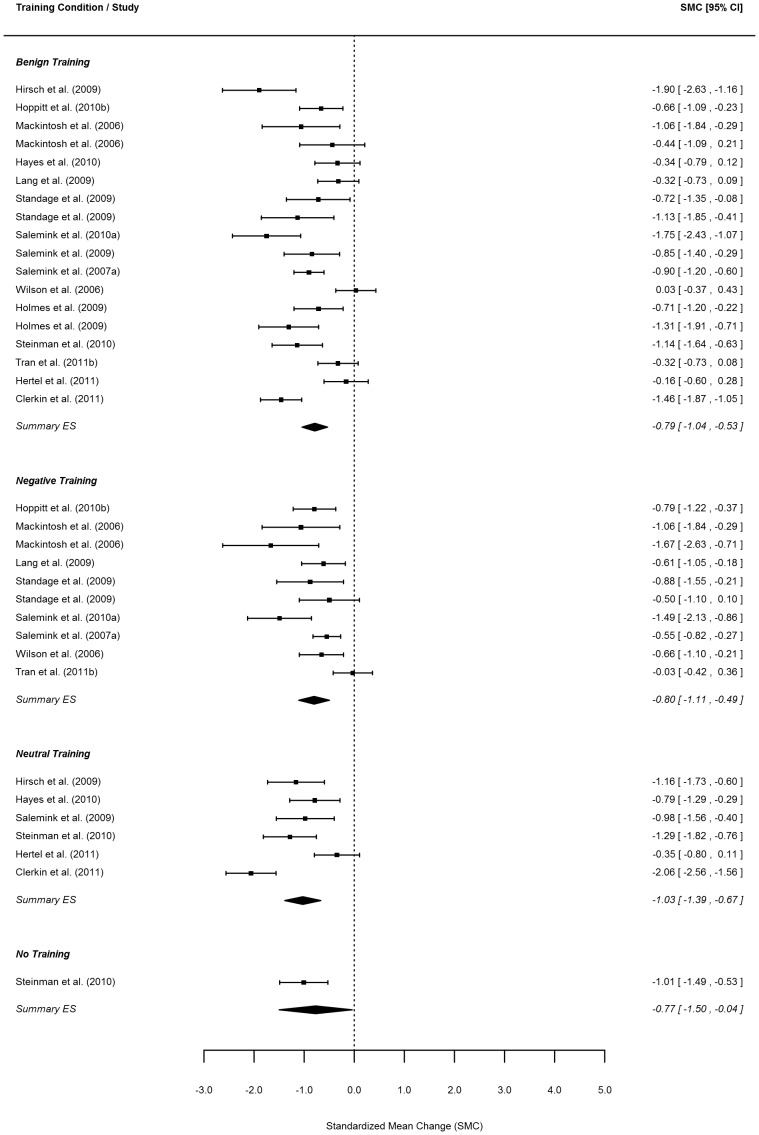
- Benign CBM-I did not attenuate negative mood reactivity after an emotional challenge: negative mood increased in all conditions (benign ES = −0.79, negative ES = −0.80, neutral ES = −1.03, no training ES = −0.77), with no significant pairwise differences.
- Moderators: imagery instructions increased post-training positive-vs-negative bias from ES = 0.54 to 1.59 and pre-post positive bias by ES = 0.50; each additional session increased positive bias by ES = 0.08 and mood improvement by ES = 0.07; feedback increased pre-post positive bias by ES = 0.46; non-benign training items (ratio < 1) boosted cognitive effects; effects were larger in women and, for cognitive change, in symptomatic samples.
Methods
- Systematic review and meta-analysis following PRISMA; databases searched through June 2013 with terms “interpret* bias AND training” and “interpret* bias AND modif*,” plus reference checks and author contacts.
- Inclusion criteria: studies targeting interpretation bias through training, random allocation for multi-condition studies, interpretation bias and/or mood as outcomes, adult samples (healthy, subclinical/high-trait, or clinical anxiety/depression), and publication in English, German, or Dutch.
- Multilevel mixed-effects meta-analytic models estimated standardized mean changes/differences for four contrasts: post-training positive vs negative interpretations, pre-post positive interpretation bias, pre-post negative mood, and pre-post emotional challenge negative mood; moderators were tested separately for benign training.
Limitations
- The paper states that unpublished data and publication bias were addressed, with no indication of publication bias (funnel-plot asymmetry p-values = .72, .79, .46, .89), but it acknowledges that unpublished studies could still matter.
- The paper states that it focused only on mood state, not the full symptom spectrum; effects on low mood were small, and effects on guilt, rumination, or other symptoms cannot be answered.
- The paper states that moderators were tested separately, so their combined effects are unknown; repeated training sessions and symptomatic status were strongly associated (r = .73) and could not be well distinguished for pre-post positive interpretation bias.
- Evident from the text: paradigm and imagery instructions were almost perfectly confounded (all AS paradigms used imagery; only one homograph paradigm did), so it is impossible to tell whether paradigm or imagery drove those effects; ratio < 1 was based on only three samples; neutral and no-training comparisons had much smaller sample counts than benign training, reducing power.
Model-written summary. Check it against the paper before relying on it.
Integrity signals
Registry
Cites
Statistics
Figures
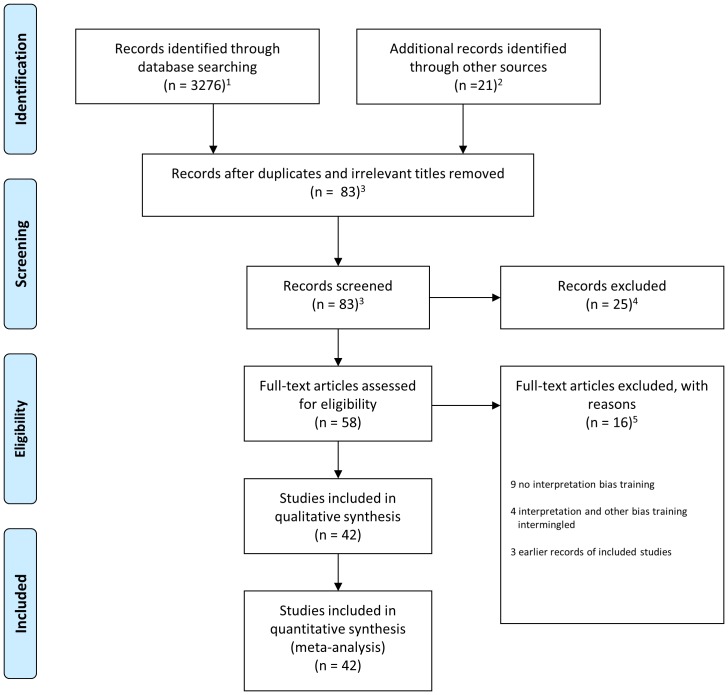
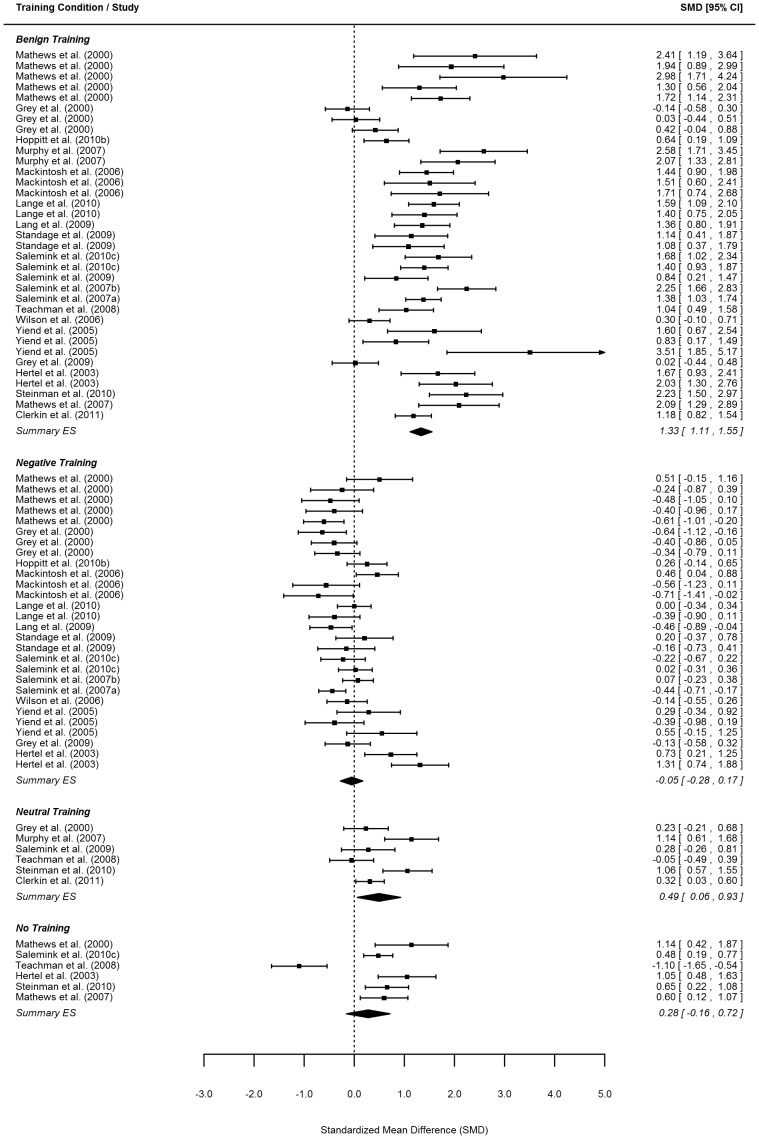
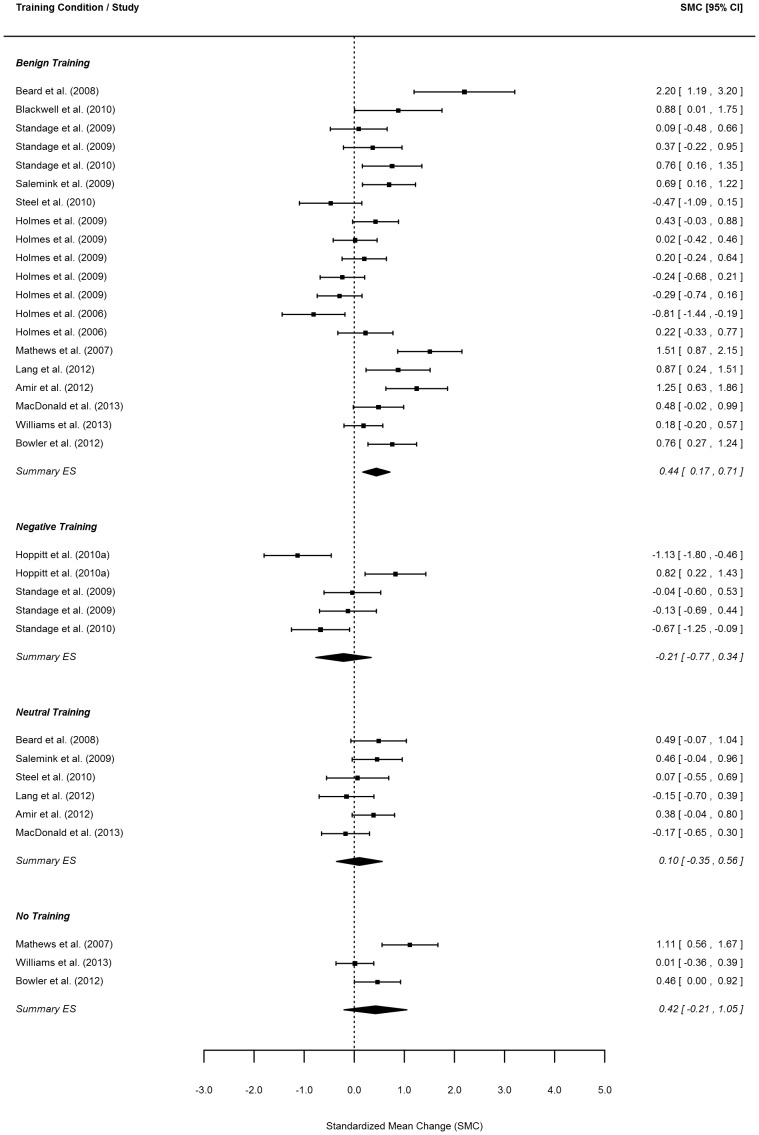
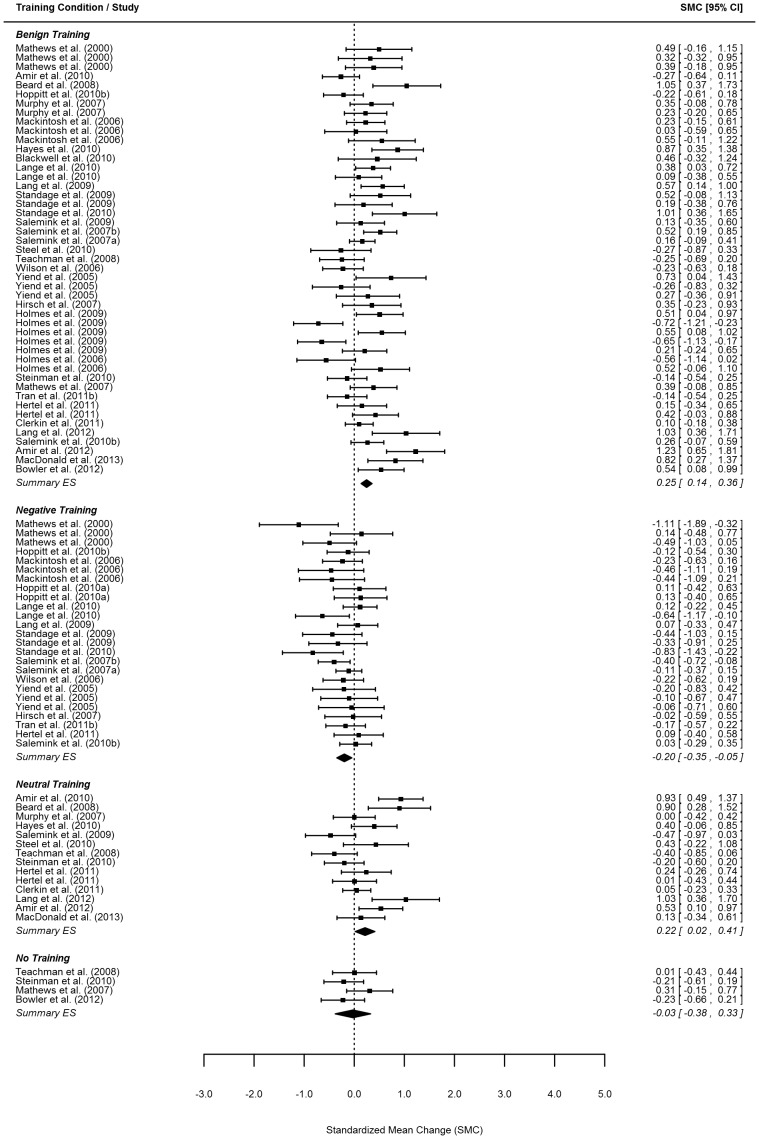
Verification
Claims the paper makes
109 Own result · 39 Not checked yet · 29 Own interpretation · 25 Own method · 15 No basis given
A result the paper reports from its own data — it cites no other source for it, so there is none to check. The quote shows it is in the paper.
In the paper
“within benign training conditions imagery instructions and more training sessions were related to larger cognitive and mood effects”
§ How to Boost Positive Interpretations? A Meta-Analysis of the Effectiveness of Cognitive Bias Modification for Interpretation > Abstract
plaincorrelational- Asserted: passes — The authors put it forward as true.
- Checkable: passes — It can be checked against evidence.
- Load-bearing: passes — The paper’s conclusions depend on it.
- Based: passes — The paper gives a reason why it holds.
A result the paper reports from its own data — it cites no other source for it, so there is none to check. The quote shows it is in the paper.
In the paper
“feedback about training performance and inclusion of non-benign training items (instead of including benign items only) boosted cognitive effects only.”
§ How to Boost Positive Interpretations? A Meta-Analysis of the Effectiveness of Cognitive Bias Modification for Interpretation > Abstract
plaindirect- Asserted: passes — The authors put it forward as true.
- Checkable: passes — It can be checked against evidence.
- Load-bearing: passes — The paper’s conclusions depend on it.
- Based: passes — The paper gives a reason why it holds.
A result the paper reports from its own data — it cites no other source for it, so there is none to check. The quote shows it is in the paper.
In the paper
“On average, benign CBM-I resulted in an increase in positive interpretation bias (p<.01) and a decrease in negative mood state (p<.001), but did not affect emotional reactivity.”
§ How to Boost Positive Interpretations? A Meta-Analysis of the Effectiveness of Cognitive Bias Modification for Interpretation > Abstract
plain- Asserted: passes — The authors put it forward as true.
- Checkable: passes — It can be checked against evidence.
- Load-bearing: passes — The paper’s conclusions depend on it.
- Based: passes — The paper gives a reason why it holds.
A result the paper reports from its own data — it cites no other source for it, so there is none to check. The quote shows it is in the paper.
In the paper
“feedback about training performance and inclusion of non-benign training items (instead of including benign items only) boosted cognitive effects only.”
§ How to Boost Positive Interpretations? A Meta-Analysis of the Effectiveness of Cognitive Bias Modification for Interpretation > Abstract
plaindirect- Asserted: passes — The authors put it forward as true.
- Checkable: passes — It can be checked against evidence.
- Load-bearing: passes — The paper’s conclusions depend on it.
- Based: passes — The paper gives a reason why it holds.
A result the paper reports from its own data — it cites no other source for it, so there is none to check. The quote shows it is in the paper.
In the paper
“On average, benign CBM-I resulted in an increase in positive interpretation bias (p<.01) and a decrease in negative mood state (p<.001), but did not affect emotional reactivity.”
§ How to Boost Positive Interpretations? A Meta-Analysis of the Effectiveness of Cognitive Bias Modification for Interpretation > Abstract
plaindirect- Asserted: passes — The authors put it forward as true.
- Checkable: passes — It can be checked against evidence.
- Load-bearing: passes — The paper’s conclusions depend on it.
- Based: passes — The paper gives a reason why it holds.
A result the paper reports from its own data — it cites no other source for it, so there is none to check. The quote shows it is in the paper.
In the paper
“within benign training conditions imagery instructions and more training sessions were related to larger cognitive and mood effects”
§ How to Boost Positive Interpretations? A Meta-Analysis of the Effectiveness of Cognitive Bias Modification for Interpretation > Abstract
plaincorrelational- Asserted: passes — The authors put it forward as true.
- Checkable: passes — It can be checked against evidence.
- Load-bearing: passes — The paper’s conclusions depend on it.
- Based: passes — The paper gives a reason why it holds.
A result the paper reports from its own data — it cites no other source for it, so there is none to check. The quote shows it is in the paper.
In the paper
“On average, benign CBM-I resulted in an increase in positive interpretation bias (p<.01) and a decrease in negative mood state (p<.001), but did not affect emotional reactivity.”
§ How to Boost Positive Interpretations? A Meta-Analysis of the Effectiveness of Cognitive Bias Modification for Interpretation > Abstract
plaindirect- Asserted: passes — The authors put it forward as true.
- Checkable: passes — It can be checked against evidence.
- Load-bearing: passes — The paper’s conclusions depend on it.
- Based: passes — The paper gives a reason why it holds.
A result the paper reports from its own data — it cites no other source for it, so there is none to check. The quote shows it is in the paper.
In the paper
“and presumably samples with symptomatic emotional dysregulation (cognitive effects)”
§ How to Boost Positive Interpretations? A Meta-Analysis of the Effectiveness of Cognitive Bias Modification for Interpretation > Abstract
hedgeddirect- Asserted: passes — The authors put it forward as true.
- Checkable: passes — It can be checked against evidence.
- Load-bearing: passes — The paper’s conclusions depend on it.
- Based: passes — The paper gives a reason why it holds.
A result the paper reports from its own data — it cites no other source for it, so there is none to check. The quote shows it is in the paper.
In the paper
“training was more effective in women (cognitive and mood effects)”
§ How to Boost Positive Interpretations? A Meta-Analysis of the Effectiveness of Cognitive Bias Modification for Interpretation > Abstract
plaindirect- Asserted: passes — The authors put it forward as true.
- Checkable: passes — It can be checked against evidence.
- Load-bearing: passes — The paper’s conclusions depend on it.
- Based: passes — The paper gives a reason why it holds.
A result the paper reports from its own data — it cites no other source for it, so there is none to check. The quote shows it is in the paper.
In the paper
“| difference between positive and negativeinterpretation bias after training1 | 75 | 35 | Benign | 1.33 | 1.11; 1.55 | <.001 |”
§ How to Boost Positive Interpretations? A Meta-Analysis of the Effectiveness of Cognitive Bias Modification for Interpretation > Results > Synthesis of results I: Does benign CBM-I training alter interpretational styles and mood states?
plaindirect- Asserted: passes — The authors put it forward as true.
- Checkable: passes — It can be checked against evidence.
- Load-bearing: passes — The paper’s conclusions depend on it.
- Based: passes — The paper gives a reason why it holds.
- It may state two separate claims as one. 77
- Probably not a substantial claim. 36
- The quote only partly states this claim. 1
A result the paper reports from its own data — it cites no other source for it, so there is none to check. The quote shows it is in the paper.
In the paper
“These effects were not consistently different from control conditions with no or neutral training.”
§ How to Boost Positive Interpretations? A Meta-Analysis of the Effectiveness of Cognitive Bias Modification for Interpretation > Abstract
plain- Asserted: passes — The authors put it forward as true.
- Checkable: passes — It can be checked against evidence.
- Load-bearing: passes — The paper’s conclusions depend on it.
- Based: passes — The paper gives a reason why it holds.
It may state two separate claims as one.
A result the paper reports from its own data — it cites no other source for it, so there is none to check. The quote shows it is in the paper.
In the paper
“| | | 1 | No training | −0.77 | −1.49; −0.05 | .04 |”
§ How to Boost Positive Interpretations? A Meta-Analysis of the Effectiveness of Cognitive Bias Modification for Interpretation > Results > Synthesis of results I: Does benign CBM-I training alter interpretational styles and mood states?
plain- Asserted: passes — The authors put it forward as true.
- Checkable: passes — It can be checked against evidence.
- Load-bearing: fails — The paper’s conclusions may not depend on it.
- Based: passes — The paper gives a reason why it holds.
Probably not a substantial claim. The paper’s conclusions may not depend on it.
A result the paper reports from its own data — it cites no other source for it, so there is none to check. The quote shows it is in the paper.
In the paper
“Both the study level variance component and the effect size level variance component did reach statistical significance (p = .002 and p<.001, respectively – not depicted in table 2).”
§ How to Boost Positive Interpretations? A Meta-Analysis of the Effectiveness of Cognitive Bias Modification for Interpretation > Results > Synthesis of results I: Does benign CBM-I training alter interpretational styles and mood states?
plain- Asserted: passes — The authors put it forward as true.
- Checkable: passes — It can be checked against evidence.
- Load-bearing: passes — The paper’s conclusions depend on it.
- Based: passes — The paper gives a reason why it holds.
It may state two separate claims as one.
A result the paper reports from its own data — it cites no other source for it, so there is none to check. The quote shows it is in the paper.
In the paper
“For the same difference in the neutral condition this effect was also significant but considerably smaller (i.e., 0.49, 95% CI 0.06–0.93).”
§ How to Boost Positive Interpretations? A Meta-Analysis of the Effectiveness of Cognitive Bias Modification for Interpretation > Results > Synthesis of results I: Does benign CBM-I training alter interpretational styles and mood states?
plaindirectn = 75- Asserted: passes — The authors put it forward as true.
- Checkable: passes — It can be checked against evidence.
- Load-bearing: unclear — It is unclear whether the paper’s conclusions depend on it.
- Based: passes — The paper gives a reason why it holds.
It may state two separate claims as one.
A result the paper reports from its own data — it cites no other source for it, so there is none to check. The quote shows it is in the paper.
In the paper
“Overall negative mood decreased significantly (p<.001) in the benign training condition (a small effect size of 0.25 with 95% CI 0.14–0.36; table 2) indicating that, on average, 60% of individuals showed reductions in negative mood in the benign condition.”
§ How to Boost Positive Interpretations? A Meta-Analysis of the Effectiveness of Cognitive Bias Modification for Interpretation > Results > Synthesis of results I: Does benign CBM-I training alter interpretational styles and mood states?
hedgeddirectn = 90 ·- Asserted: passes — The authors put it forward as true.
- Checkable: passes — It can be checked against evidence.
- Load-bearing: passes — The paper’s conclusions depend on it.
- Based: passes — The paper gives a reason why it holds.
It may state two separate claims as one.
A result the paper reports from its own data — it cites no other source for it, so there is none to check. The quote shows it is in the paper.
In the paper
“In contrast, negative mood increased significantly (p<.01) for those receiving negative training (a small effect size of −0.20 with 95% CI −0.35– −0.05; table 2), indicating that, on average, 58% of individuals showed increases in negative mood after negative training”
§ How to Boost Positive Interpretations? A Meta-Analysis of the Effectiveness of Cognitive Bias Modification for Interpretation > Results > Synthesis of results I: Does benign CBM-I training alter interpretational styles and mood states?
hedgeddirectn = 90 ·- Asserted: passes — The authors put it forward as true.
- Checkable: passes — It can be checked against evidence.
- Load-bearing: passes — The paper’s conclusions depend on it.
- Based: passes — The paper gives a reason why it holds.
It may state two separate claims as one.
A result the paper reports from its own data — it cites no other source for it, so there is none to check. The quote shows it is in the paper.
In the paper
“As shown in Table 2, across 75 independent samples (k = 75) (distributed over a total of 34 studies), benign and neutral training demonstrated a significant difference between endorsement of positive and negative interpretations after training. The effect size of this difference for the benign training was substantial (i.e., 1.33 with 95% CI 1.11–1.55).”
§ How to Boost Positive Interpretations? A Meta-Analysis of the Effectiveness of Cognitive Bias Modification for Interpretation > Results > Synthesis of results I: Does benign CBM-I training alter interpretational styles and mood states?
plaindirectn = 75- Asserted: passes — The authors put it forward as true.
- Checkable: passes — It can be checked against evidence.
- Load-bearing: passes — The paper’s conclusions depend on it.
- Based: passes — The paper gives a reason why it holds.
It may state two separate claims as one.
A result the paper reports from its own data — it cites no other source for it, so there is none to check. The quote shows it is in the paper.
In the paper
“While the effect size level variance component was significantly larger than zero (p<.001), we did not find significant study-level heterogeneity (p = .58) for this outcome”
§ How to Boost Positive Interpretations? A Meta-Analysis of the Effectiveness of Cognitive Bias Modification for Interpretation > Results > Synthesis of results I: Does benign CBM-I training alter interpretational styles and mood states?
plainn = 34 ·- Asserted: passes — The authors put it forward as true.
- Checkable: passes — It can be checked against evidence.
- Load-bearing: unclear — It is unclear whether the paper’s conclusions depend on it.
- Based: passes — The paper gives a reason why it holds.
It may state two separate claims as one.
A result the paper reports from its own data — it cites no other source for it, so there is none to check. The quote shows it is in the paper.
In the paper
“Again, only heterogeneity at the effect size level (p<.001) and not the study level (p = .86) was found”
§ How to Boost Positive Interpretations? A Meta-Analysis of the Effectiveness of Cognitive Bias Modification for Interpretation > Results > Synthesis of results I: Does benign CBM-I training alter interpretational styles and mood states?
plainn = 90 ·- Asserted: passes — The authors put it forward as true.
- Checkable: passes — It can be checked against evidence.
- Load-bearing: unclear — It is unclear whether the paper’s conclusions depend on it.
- Based: passes — The paper gives a reason why it holds.
It may state two separate claims as one.
A result the paper reports from its own data — it cites no other source for it, so there is none to check. The quote shows it is in the paper.
In the paper
“In contrast to the earlier outcomes, we found significant heterogeneity at the study (p<.01), but not at the effect size level (p = .18).”
§ How to Boost Positive Interpretations? A Meta-Analysis of the Effectiveness of Cognitive Bias Modification for Interpretation > Results > Synthesis of results I: Does benign CBM-I training alter interpretational styles and mood states?
plainn = 35 ·- Asserted: passes — The authors put it forward as true.
- Checkable: passes — It can be checked against evidence.
- Load-bearing: unclear — It is unclear whether the paper’s conclusions depend on it.
- Based: passes — The paper gives a reason why it holds.
It may state two separate claims as one.
A result the paper reports from its own data — it cites no other source for it, so there is none to check. The quote shows it is in the paper.
In the paper
“Moreover, while the change in the negative training condition varied significantly from the change in the neutral condition (p<.01; table 3), there was no significant difference in the amount of change in mood state between the benign and neutral or no-training conditions (both p’s >.05)”
§ How to Boost Positive Interpretations? A Meta-Analysis of the Effectiveness of Cognitive Bias Modification for Interpretation > Results > Synthesis of results I: Does benign CBM-I training alter interpretational styles and mood states?
plainn = 90 ·- Asserted: passes — The authors put it forward as true.
- Checkable: passes — It can be checked against evidence.
- Load-bearing: passes — The paper’s conclusions depend on it.
- Based: passes — The paper gives a reason why it holds.
It may state two separate claims as one.
A result the paper reports from its own data — it cites no other source for it, so there is none to check. The quote shows it is in the paper.
In the paper
“The paradigm employed significantly impacted on the post-training difference between positive and negative interpretation bias in that the AS paradigm (k = 26) was significantly more effective (Table 4).”
§ How to Boost Positive Interpretations? A Meta-Analysis of the Effectiveness of Cognitive Bias Modification for Interpretation > Results > Synthesis of results II: Do training- and sample characteristics enhance the effects of benign training?
plaindirect- Asserted: passes — The authors put it forward as true.
- Checkable: passes — It can be checked against evidence.
- Load-bearing: passes — The paper’s conclusions depend on it.
- Based: passes — The paper gives a reason why it holds.
It may state two separate claims as one.
A result the paper reports from its own data — it cites no other source for it, so there is none to check. The quote shows it is in the paper.
In the paper
“Additionally, while no use of feedback (k = 12) yielded a non-significant small effect (ES = .01, p = .96, corresponding to a 54% chance for an increase in positive interpretations), the use of feedback (k = 8) increased this effect significantly by ES = .46 (p<.05). This results in a total effect of feedback administration of ES = .46 (68% absolute chance and 26% higher chance of increase in”
§ How to Boost Positive Interpretations? A Meta-Analysis of the Effectiveness of Cognitive Bias Modification for Interpretation > Results > Synthesis of results II: Do training- and sample characteristics enhance the effects of benign training?
plaindirect- Asserted: passes — The authors put it forward as true.
- Checkable: passes — It can be checked against evidence.
- Load-bearing: passes — The paper’s conclusions depend on it.
- Based: passes — The paper gives a reason why it holds.
It may state two separate claims as one.
The paper states this without a source or data behind it here, so there is nothing to check it against. The quote shows it is in the paper.
In the paper
“In absolute terms, that is a 94%−75% = 19% percentage points difference. Relative, that is 94/75 = 1.25, that is a 25% higher chance of endorsing positive interpretations more strongly than negative interpretations.”
§ How to Boost Positive Interpretations? A Meta-Analysis of the Effectiveness of Cognitive Bias Modification for Interpretation > Results > Synthesis of results II: Do training- and sample characteristics enhance the effects of benign training?
plaincorrelational- Asserted: passes — The authors put it forward as true.
- Checkable: passes — It can be checked against evidence.
- Load-bearing: passes — The paper’s conclusions depend on it.
- Based: passes — The paper gives a reason why it holds.
It may state two separate claims as one.
A result the paper reports from its own data — it cites no other source for it, so there is none to check. The quote shows it is in the paper.
In the paper
“For the change in positive interpretation bias from pre- to post-training, again paradigm, imagery instructions, and sex emerged as significant moderators.”
§ How to Boost Positive Interpretations? A Meta-Analysis of the Effectiveness of Cognitive Bias Modification for Interpretation > Results > Synthesis of results II: Do training- and sample characteristics enhance the effects of benign training?
plaincorrelational- Asserted: passes — The authors put it forward as true.
- Checkable: passes — It can be checked against evidence.
- Load-bearing: passes — The paper’s conclusions depend on it.
- Based: passes — The paper gives a reason why it holds.
It may state two separate claims as one.
A result the paper reports from its own data — it cites no other source for it, so there is none to check. The quote shows it is in the paper.
In the paper
“No use of imagery instructions (k = 8) resulted in an effect size of.54 (p<.01) indicating a chance of about 71% for endorsing more positive than negative interpretations.”
§ How to Boost Positive Interpretations? A Meta-Analysis of the Effectiveness of Cognitive Bias Modification for Interpretation > Results > Synthesis of results II: Do training- and sample characteristics enhance the effects of benign training?
hedged- Asserted: passes — The authors put it forward as true.
- Checkable: passes — It can be checked against evidence.
- Load-bearing: passes — The paper’s conclusions depend on it.
- Based: passes — The paper gives a reason why it holds.
It may state two separate claims as one.
A result the paper reports from its own data — it cites no other source for it, so there is none to check. The quote shows it is in the paper.
In the paper
“However, it needs to be noted that paradigm and imagery-use were almost perfectly confounded; all AS-paradigms employed imagery instructions, whereas only one of the nine homograph paradigms did.”
§ How to Boost Positive Interpretations? A Meta-Analysis of the Effectiveness of Cognitive Bias Modification for Interpretation > Results > Synthesis of results II: Do training- and sample characteristics enhance the effects of benign training?
plaincorrelational- Asserted: passes — The authors put it forward as true.
- Checkable: passes — It can be checked against evidence.
- Load-bearing: passes — The paper’s conclusions depend on it.
- Based: passes — The paper gives a reason why it holds.
It may state two separate claims as one.
A result the paper reports from its own data — it cites no other source for it, so there is none to check. The quote shows it is in the paper.
In the paper
“This effect increased by ES = 1.05 (p<.001), when imagery instructions were employed (k = 27)(see Table 4), resulting in an overall ES of 1.59 indicating a chance of almost 94% of endorsing more positive than negative interpretations, that is a 33% higher chance than when no imagery instructions were employed.”
§ How to Boost Positive Interpretations? A Meta-Analysis of the Effectiveness of Cognitive Bias Modification for Interpretation > Results > Synthesis of results II: Do training- and sample characteristics enhance the effects of benign training?
plaindirect- Asserted: passes — The authors put it forward as true.
- Checkable: passes — It can be checked against evidence.
- Load-bearing: passes — The paper’s conclusions depend on it.
- Based: passes — The paper gives a reason why it holds.
It may state two separate claims as one.
A result the paper reports from its own data — it cites no other source for it, so there is none to check. The quote shows it is in the paper.
In the paper
“Finally, while in all-female samples the difference between positive and negative interpretation biases was large and significant (ES = 2.03, p<.001, 98% chance of endorsing more positive than negative interpretations after training), this difference decreased by ES = −.02 (p<.05) per percentage point more males in the sample (see table 4).”
§ How to Boost Positive Interpretations? A Meta-Analysis of the Effectiveness of Cognitive Bias Modification for Interpretation > Results > Synthesis of results II: Do training- and sample characteristics enhance the effects of benign training?
plaincorrelational- Asserted: passes — The authors put it forward as true.
- Checkable: passes — It can be checked against evidence.
- Load-bearing: unclear — It is unclear whether the paper’s conclusions depend on it.
- Based: passes — The paper gives a reason why it holds.
It may state two separate claims as one.
A result the paper reports from its own data — it cites no other source for it, so there is none to check. The quote shows it is in the paper.
In the paper
“This effect was then, however, significantly increased by ES = .95, p<.001) when ‘other’ paradigms (k = 6; 1 homograph; 3 WSAT, and 2 other paradigms) were employed. This results in an overall ES = 1.08 corresponding to a 54% higher chance of an increase in positive interpretation bias.”
§ How to Boost Positive Interpretations? A Meta-Analysis of the Effectiveness of Cognitive Bias Modification for Interpretation > Results > Synthesis of results II: Do training- and sample characteristics enhance the effects of benign training?
plaindirect- Asserted: passes — The authors put it forward as true.
- Checkable: passes — It can be checked against evidence.
- Load-bearing: passes — The paper’s conclusions depend on it.
- Based: passes — The paper gives a reason why it holds.
It may state two separate claims as one.
A result the paper reports from its own data — it cites no other source for it, so there is none to check. The quote shows it is in the paper.
In the paper
“For the endorsement of positive versus negative interpretations after training, the use of imagery instructions and male sex within the sample correlated by r = −.60 indicating that samples including fewer male participants were more often instructed to use imagery.”
§ How to Boost Positive Interpretations? A Meta-Analysis of the Effectiveness of Cognitive Bias Modification for Interpretation > Results > Synthesis of results II: Do training- and sample characteristics enhance the effects of benign training?
hedgedcorrelational- Asserted: passes — The authors put it forward as true.
- Checkable: passes — It can be checked against evidence.
- Load-bearing: unclear — It is unclear whether the paper’s conclusions depend on it.
- Based: passes — The paper gives a reason why it holds.
It may state two separate claims as one.
A result the paper reports from its own data — it cites no other source for it, so there is none to check. The quote shows it is in the paper.
In the paper
“All other paradigms combined (k = 9) yielded a significant effect size of.69 (p<.001), indicating that there is a 75% chance (on average) for endorsing positive interpretations more strongly than negative interpretations.”
§ How to Boost Positive Interpretations? A Meta-Analysis of the Effectiveness of Cognitive Bias Modification for Interpretation > Results > Synthesis of results II: Do training- and sample characteristics enhance the effects of benign training?
hedgedcorrelational- Asserted: passes — The authors put it forward as true.
- Checkable: passes — It can be checked against evidence.
- Load-bearing: passes — The paper’s conclusions depend on it.
- Based: passes — The paper gives a reason why it holds.
It may state two separate claims as one.
The paper states this without a source or data behind it here, so there is nothing to check it against. The quote shows it is in the paper.
In the paper
“For AS-paradigms this effect increased by ES = .90 (see table 4), yielding an overall effect of.69+.90 = 1.59, which corresponds to a 94% chance for endorsing positive interpretations more strongly than negative interpretations.”
§ How to Boost Positive Interpretations? A Meta-Analysis of the Effectiveness of Cognitive Bias Modification for Interpretation > Results > Synthesis of results II: Do training- and sample characteristics enhance the effects of benign training?
plaindirect- Asserted: passes — The authors put it forward as true.
- Checkable: passes — It can be checked against evidence.
- Load-bearing: passes — The paper’s conclusions depend on it.
- Based: passes — The paper gives a reason why it holds.
It may state two separate claims as one.
A result the paper reports from its own data — it cites no other source for it, so there is none to check. The quote shows it is in the paper.
In the paper
“Whereas no use of imagery instructions (k = 6) did not yield a significant effect (ES = −.20, p = .21, 42% chance of increase in positive interpretation bias), this effect was significantly enhanced by ES = .50 (p<.01) when imagery instructions were employed (k = 12). This results in a net-effect of imagery instructions of ES = .30 (62% absolute chance and 48% higher chance of increase in positive”
§ How to Boost Positive Interpretations? A Meta-Analysis of the Effectiveness of Cognitive Bias Modification for Interpretation > Results > Synthesis of results II: Do training- and sample characteristics enhance the effects of benign training?
plaindirect- Asserted: passes — The authors put it forward as true.
- Checkable: passes — It can be checked against evidence.
- Load-bearing: passes — The paper’s conclusions depend on it.
- Based: passes — The paper gives a reason why it holds.
It may state two separate claims as one.
The paper states this without a source or data behind it here, so there is nothing to check it against. The quote shows it is in the paper.
In the paper
“Thus, in a sample with for example 40% males this converges to a total effect of 1.28, corresponding to an absolute chance of 90%, which is a 9% decreased chance of endorsing more positive than negative interpretations after training.”
§ How to Boost Positive Interpretations? A Meta-Analysis of the Effectiveness of Cognitive Bias Modification for Interpretation > Results > Synthesis of results II: Do training- and sample characteristics enhance the effects of benign training?
plaindirect- Asserted: passes — The authors put it forward as true.
- Checkable: passes — It can be checked against evidence.
- Load-bearing: unclear — It is unclear whether the paper’s conclusions depend on it.
- Based: passes — The paper gives a reason why it holds.
It may state two separate claims as one.
A result the paper reports from its own data — it cites no other source for it, so there is none to check. The quote shows it is in the paper.
In the paper
“However, it is important to mention that more than one training session was only administered to individuals with symptoms whereas one training session was administered to both healthy and symptomatic samples (also see table 1)”
§ How to Boost Positive Interpretations? A Meta-Analysis of the Effectiveness of Cognitive Bias Modification for Interpretation > Results > Synthesis of results II: Do training- and sample characteristics enhance the effects of benign training?
plain- Asserted: passes — The authors put it forward as true.
- Checkable: passes — It can be checked against evidence.
- Load-bearing: passes — The paper’s conclusions depend on it.
- Based: passes — The paper gives a reason why it holds.
It may state two separate claims as one.
A result the paper reports from its own data — it cites no other source for it, so there is none to check. The quote shows it is in the paper.
In the paper
“Adding one session (k one session = 40; k four sessions = 2; k six sessions = 1; k seven sessions = 2; k eight sessions = 2; k twelve sessions = 1) resulted in a significant larger decrease in negative mood by increasing the effect by ES = .07, p<.05, resulting in a total ES = .16, which corresponds to a 56% absolute and 4% higher chance of decrease in negative mood when administering for example”
§ How to Boost Positive Interpretations? A Meta-Analysis of the Effectiveness of Cognitive Bias Modification for Interpretation > Results > Synthesis of results II: Do training- and sample characteristics enhance the effects of benign training?
plaindirect- Asserted: passes — The authors put it forward as true.
- Checkable: passes — It can be checked against evidence.
- Load-bearing: passes — The paper’s conclusions depend on it.
- Based: passes — The paper gives a reason why it holds.
It may state two separate claims as one.
The paper states this without a source or data behind it here, so there is nothing to check it against. The quote shows it is in the paper.
In the paper
“Although this may seem a very small effect, the effect of 10 sessions of training would already result in an ES = .80, with a higher chance of approximately 49%.”
§ How to Boost Positive Interpretations? A Meta-Analysis of the Effectiveness of Cognitive Bias Modification for Interpretation > Results > Synthesis of results II: Do training- and sample characteristics enhance the effects of benign training?
hedgeddirect- Asserted: passes — The authors put it forward as true.
- Checkable: passes — It can be checked against evidence.
- Load-bearing: unclear — It is unclear whether the paper’s conclusions depend on it.
- Based: passes — The paper gives a reason why it holds.
It may state two separate claims as one.
A result the paper reports from its own data — it cites no other source for it, so there is none to check. The quote shows it is in the paper.
In the paper
“Conform above results, while all-female samples showed a large and significant effect (ES = 1.30, p<.001, 90% chance of increase), this effect was significantly reduced by ES = .03 (p<.01) per percentage point males in the sample. Thus, a sample with for example 40% males, the chance for an increase in positive interpretation bias would be lowered by 61%.”
§ How to Boost Positive Interpretations? A Meta-Analysis of the Effectiveness of Cognitive Bias Modification for Interpretation > Results > Synthesis of results II: Do training- and sample characteristics enhance the effects of benign training?
plaindirect- Asserted: passes — The authors put it forward as true.
- Checkable: passes — It can be checked against evidence.
- Load-bearing: unclear — It is unclear whether the paper’s conclusions depend on it.
- Based: passes — The paper gives a reason why it holds.
It may state two separate claims as one.
A result the paper reports from its own data — it cites no other source for it, so there is none to check. The quote shows it is in the paper.
In the paper
“Also, the ratio of benign training items versus all training items (ratio 0.69 (k = 2), 0.80 (k = 1), 1.00 (k = 17)) showed a significant effect. While the ratio of.69 yielded a large effect (ES = 0.94, corresponding to a 83% chance of an increase in interpretation bias) this effect was significantly reduced when the ratio became 1.00 (p<.01). This results in an absolute effect of ES = .07 (53%”
§ How to Boost Positive Interpretations? A Meta-Analysis of the Effectiveness of Cognitive Bias Modification for Interpretation > Results > Synthesis of results II: Do training- and sample characteristics enhance the effects of benign training?
plaindirectn = 3 ·- Asserted: passes — The authors put it forward as true.
- Checkable: passes — It can be checked against evidence.
- Load-bearing: passes — The paper’s conclusions depend on it.
- Based: passes — The paper gives a reason why it holds.
It may state two separate claims as one.
A result the paper reports from its own data — it cites no other source for it, so there is none to check. The quote shows it is in the paper.
In the paper
“The use of no imagery instructions resulted in a non-significant effect (k = 11; ES = −0.25, p = .083, 40% chance of decrease in negative mood). However, adding imagery instructions (k = 33) increased this effect significantly by ES = .50 (p<.01), resulting in a total ES = .25, which corresponds to a 60% absolute and 50% higher chance of decrease in negative mood.”
§ How to Boost Positive Interpretations? A Meta-Analysis of the Effectiveness of Cognitive Bias Modification for Interpretation > Results > Synthesis of results II: Do training- and sample characteristics enhance the effects of benign training?
plaindirect- Asserted: passes — The authors put it forward as true.
- Checkable: passes — It can be checked against evidence.
- Load-bearing: passes — The paper’s conclusions depend on it.
- Based: passes — The paper gives a reason why it holds.
It may state two separate claims as one.
A result the paper reports from its own data — it cites no other source for it, so there is none to check. The quote shows it is in the paper.
In the paper
“Finally, adding one training session significantly increased the effect of training by ES = .08 (k one session = 12; k four sessions = 2; k six sessions = 1; k seven sessions = 2; k eight sessions = 2; k twelve sessions = 1, p<.01; total ES = .01; absolute chance of 51% and higher chance of 6%).”
§ How to Boost Positive Interpretations? A Meta-Analysis of the Effectiveness of Cognitive Bias Modification for Interpretation > Results > Synthesis of results II: Do training- and sample characteristics enhance the effects of benign training?
plaindirect- Asserted: passes — The authors put it forward as true.
- Checkable: passes — It can be checked against evidence.
- Load-bearing: passes — The paper’s conclusions depend on it.
- Based: passes — The paper gives a reason why it holds.
It may state two separate claims as one.
A result the paper reports from its own data — it cites no other source for it, so there is none to check. The quote shows it is in the paper.
In the paper
“None of the moderators demonstrating a significant effect correlated strongly with another (all r’s ≤.50), except for the number of training sessions and health status of individuals (r = .73) (also see Table S3).”
§ How to Boost Positive Interpretations? A Meta-Analysis of the Effectiveness of Cognitive Bias Modification for Interpretation > Results > Synthesis of results II: Do training- and sample characteristics enhance the effects of benign training?
plaincorrelational- Asserted: passes — The authors put it forward as true.
- Checkable: passes — It can be checked against evidence.
- Load-bearing: unclear — It is unclear whether the paper’s conclusions depend on it.
- Based: passes — The paper gives a reason why it holds.
It may state two separate claims as one.
A result the paper reports from its own data — it cites no other source for it, so there is none to check. The quote shows it is in the paper.
In the paper
“Post-hoc analyses including both ‘number of training sessions’ and ‘health status’ revealed the following effects: ES = .09, p<.05 for ‘number of sessions’ and ES = −.01, p = .99, for ‘health status’”
§ How to Boost Positive Interpretations? A Meta-Analysis of the Effectiveness of Cognitive Bias Modification for Interpretation > Results > Synthesis of results II: Do training- and sample characteristics enhance the effects of benign training?
plaincorrelational- Asserted: passes — The authors put it forward as true.
- Checkable: passes — It can be checked against evidence.
- Load-bearing: passes — The paper’s conclusions depend on it.
- Based: passes — The paper gives a reason why it holds.
It may state two separate claims as one.
A result the paper reports from its own data — it cites no other source for it, so there is none to check. The quote shows it is in the paper.
In the paper
“This effect was significantly increased by ES = .29 (p = .05) when other paradigms were employed (k = 10). The total effect when other paradigms were employed therefore was ES = .48, with an absolute chance of 68% and a higher chance of 17% of decrease in negative mood.”
§ How to Boost Positive Interpretations? A Meta-Analysis of the Effectiveness of Cognitive Bias Modification for Interpretation > Results > Synthesis of results II: Do training- and sample characteristics enhance the effects of benign training?
plaindirect- Asserted: passes — The authors put it forward as true.
- Checkable: passes — It can be checked against evidence.
- Load-bearing: passes — The paper’s conclusions depend on it.
- Based: passes — The paper gives a reason why it holds.
It may state two separate claims as one.
A result the paper reports from its own data — it cites no other source for it, so there is none to check. The quote shows it is in the paper.
In the paper
“The correlations between the significant moderators here were small (all r’s <.36) (also see Table S3).”
§ How to Boost Positive Interpretations? A Meta-Analysis of the Effectiveness of Cognitive Bias Modification for Interpretation > Results > Synthesis of results II: Do training- and sample characteristics enhance the effects of benign training?
plaincorrelational- Asserted: passes — The authors put it forward as true.
- Checkable: passes — It can be checked against evidence.
- Load-bearing: unclear — It is unclear whether the paper’s conclusions depend on it.
- Based: passes — The paper gives a reason why it holds.
The quote only partly states this claim.
A result the paper reports from its own data — it cites no other source for it, so there is none to check. The quote shows it is in the paper.
In the paper
“There was no significant correlation between the endorsement of positive versus negative bias after training or the change in positive bias from before to after training and the increase in negative mood in response to an emotional challenge (r = −.0001, CI −0.41–0.41, k = 23 and r = −.15, CI −0.77–0.62, k = 8, respectively).”
§ How to Boost Positive Interpretations? A Meta-Analysis of the Effectiveness of Cognitive Bias Modification for Interpretation > Results > Additional analyses I: Do training effects on interpretation bias and on mood state correlate?
plain- Asserted: passes — The authors put it forward as true.
- Checkable: passes — It can be checked against evidence.
- Load-bearing: unclear — It is unclear whether the paper’s conclusions depend on it.
- Based: passes — The paper gives a reason why it holds.
It may state two separate claims as one.
A result the paper reports from its own data — it cites no other source for it, so there is none to check. The quote shows it is in the paper.
In the paper
“(see Figure S1 for some additional analyses possibly hinting at some asymmetry in the pre-training versus post-training endorsements of positive interpretations outcome).”
§ How to Boost Positive Interpretations? A Meta-Analysis of the Effectiveness of Cognitive Bias Modification for Interpretation > Results > Risk of bias across studies
hedged- Asserted: passes — The authors put it forward as true.
- Checkable: passes — It can be checked against evidence.
- Load-bearing: fails — The paper’s conclusions may not depend on it.
- Based: passes — The paper gives a reason why it holds.
Probably not a substantial claim. The paper’s conclusions may not depend on it.
A result the paper reports from its own data — it cites no other source for it, so there is none to check. The quote shows it is in the paper.
In the paper
“While these benign training effects differed reliably from negative training effects, the difference relative to neutral or no-training conditions remained insignificant for the change in positive bias and mood.”
§ How to Boost Positive Interpretations? A Meta-Analysis of the Effectiveness of Cognitive Bias Modification for Interpretation > Discussion > Does benign CBM-I boost positive interpretations with improvements in negative mood?
plain- Asserted: passes — The authors put it forward as true.
- Checkable: passes — It can be checked against evidence.
- Load-bearing: passes — The paper’s conclusions depend on it.
- Based: passes — The paper gives a reason why it holds.
It may state two separate claims as one.
A result the paper reports from its own data — it cites no other source for it, so there is none to check. The quote shows it is in the paper.
In the paper
“In the current analyses, benign CBM-I resulted in large post-training endorsements of positive relative to negative interpretations, in small to medium changes in positive interpretational style from pre- to post training, and small decreases in negative mood states from pre- to post training.”
§ How to Boost Positive Interpretations? A Meta-Analysis of the Effectiveness of Cognitive Bias Modification for Interpretation > Discussion > Does benign CBM-I boost positive interpretations with improvements in negative mood?
plaindirect- Asserted: passes — The authors put it forward as true.
- Checkable: passes — It can be checked against evidence.
- Load-bearing: passes — The paper’s conclusions depend on it.
- Based: passes — The paper gives a reason why it holds.
It may state two separate claims as one.
A result the paper reports from its own data — it cites no other source for it, so there is none to check. The quote shows it is in the paper.
In the paper
“Benign CBM-I training resulted in significant, but small decreases in negative mood, which significantly differed from changes in the opposite direction in the negative condition, but not from changes in neutral and no-training conditions.”
§ How to Boost Positive Interpretations? A Meta-Analysis of the Effectiveness of Cognitive Bias Modification for Interpretation > Discussion > Does benign CBM-I boost positive interpretations with improvements in negative mood?
plaindirect- Asserted: passes — The authors put it forward as true.
- Checkable: passes — It can be checked against evidence.
- Load-bearing: passes — The paper’s conclusions depend on it.
- Based: passes — The paper gives a reason why it holds.
It may state two separate claims as one.
A result the paper reports from its own data — it cites no other source for it, so there is none to check. The quote shows it is in the paper.
In the paper
“The benign condition showed significant but small changes, which differed from negative training only.”
§ How to Boost Positive Interpretations? A Meta-Analysis of the Effectiveness of Cognitive Bias Modification for Interpretation > Discussion > Does benign CBM-I boost positive interpretations with improvements in negative mood?
plaindirect- Asserted: passes — The authors put it forward as true.
- Checkable: passes — It can be checked against evidence.
- Load-bearing: passes — The paper’s conclusions depend on it.
- Based: passes — The paper gives a reason why it holds.
It may state two separate claims as one.
A result the paper reports from its own data — it cites no other source for it, so there is none to check. The quote shows it is in the paper.
In the paper
“Whereas benign CBM-I seems to be the only condition to significantly affect interpretational biases, mood was affected in all but the no-training condition.”
§ How to Boost Positive Interpretations? A Meta-Analysis of the Effectiveness of Cognitive Bias Modification for Interpretation > Discussion > Does benign CBM-I boost positive interpretations with improvements in negative mood?
hedgeddirect- Asserted: passes — The authors put it forward as true.
- Checkable: passes — It can be checked against evidence.
- Load-bearing: passes — The paper’s conclusions depend on it.
- Based: passes — The paper gives a reason why it holds.
It may state two separate claims as one.
A result the paper reports from its own data — it cites no other source for it, so there is none to check. The quote shows it is in the paper.
In the paper
“Benign CBM-I resulted in a large post-training difference between positive and negative interpretation bias, which was also significantly larger than in any comparison condition.”
§ How to Boost Positive Interpretations? A Meta-Analysis of the Effectiveness of Cognitive Bias Modification for Interpretation > Discussion > Does benign CBM-I boost positive interpretations with improvements in negative mood?
plaindirect- Asserted: passes — The authors put it forward as true.
- Checkable: passes — It can be checked against evidence.
- Load-bearing: passes — The paper’s conclusions depend on it.
- Based: passes — The paper gives a reason why it holds.
It may state two separate claims as one.
A result the paper reports from its own data — it cites no other source for it, so there is none to check. The quote shows it is in the paper.
In the paper
“Most convincingly, imagery instructions were able to significantly boost improvements in both positive interpretation bias and negative mood.”
§ How to Boost Positive Interpretations? A Meta-Analysis of the Effectiveness of Cognitive Bias Modification for Interpretation > Discussion > How can we boost benign CBM-I’s effectiveness?
boosteddirect- Asserted: passes — The authors put it forward as true.
- Checkable: passes — It can be checked against evidence.
- Load-bearing: passes — The paper’s conclusions depend on it.
- Based: passes — The paper gives a reason why it holds.
It may state two separate claims as one.
A result the paper reports from its own data — it cites no other source for it, so there is none to check. The quote shows it is in the paper.
In the paper
“repeated training sessions were most often employed in samples with mood-symptoms (with the latter also showing significant influence on the increase in positive interpretation bias)”
§ How to Boost Positive Interpretations? A Meta-Analysis of the Effectiveness of Cognitive Bias Modification for Interpretation > Discussion > How can we boost benign CBM-I’s effectiveness?
plaincorrelational- Asserted: passes — The authors put it forward as true.
- Checkable: passes — It can be checked against evidence.
- Load-bearing: passes — The paper’s conclusions depend on it.
- Based: passes — The paper gives a reason why it holds.
It may state two separate claims as one.
A result the paper reports from its own data — it cites no other source for it, so there is none to check. The quote shows it is in the paper.
In the paper
“Although the effect sizes were small (.08 for increase in positive interpretation bias and.07 for decrease in negative mood)”
§ How to Boost Positive Interpretations? A Meta-Analysis of the Effectiveness of Cognitive Bias Modification for Interpretation > Discussion > How can we boost benign CBM-I’s effectiveness?
plaindirect- Asserted: passes — The authors put it forward as true.
- Checkable: passes — It can be checked against evidence.
- Load-bearing: passes — The paper’s conclusions depend on it.
- Based: passes — The paper gives a reason why it holds.
It may state two separate claims as one.
A result the paper reports from its own data — it cites no other source for it, so there is none to check. The quote shows it is in the paper.
In the paper
“However, both sex and imagery yielded significant effects for each of the other outcome measures as well (where only very weak correlations were observable) supporting the robustness of the imaging effect.”
§ How to Boost Positive Interpretations? A Meta-Analysis of the Effectiveness of Cognitive Bias Modification for Interpretation > Discussion > How can we boost benign CBM-I’s effectiveness?
plaincorrelational- Asserted: passes — The authors put it forward as true.
- Checkable: passes — It can be checked against evidence.
- Load-bearing: passes — The paper’s conclusions depend on it.
- Based: passes — The paper gives a reason why it holds.
It may state two separate claims as one.
The paper states this without a source or data behind it here, so there is nothing to check it against. The quote shows it is in the paper.
In the paper
“The increase in positive interpretation bias from pre- to post-training was particularly prominent in samples with anxiety and mood symptoms/diagnoses as compared to healthy (non-symptomatic) controls (showing a non-significant change).”
§ How to Boost Positive Interpretations? A Meta-Analysis of the Effectiveness of Cognitive Bias Modification for Interpretation > Discussion > Do people who are most vulnerable actually respond to CBM-I?
plaincorrelational- Asserted: passes — The authors put it forward as true.
- Checkable: passes — It can be checked against evidence.
- Load-bearing: passes — The paper’s conclusions depend on it.
- Based: passes — The paper gives a reason why it holds.
It may state two separate claims as one.
A result the paper reports from its own data — it cites no other source for it, so there is none to check. The quote shows it is in the paper.
In the paper
“Our findings indicated that particularly women (who are more vulnerable to develop mood symptoms) tend to benefit more from benign CBM-I, both cognitively (interpretation bias) and emotionally (mood) with significant and large effect sizes.”
§ How to Boost Positive Interpretations? A Meta-Analysis of the Effectiveness of Cognitive Bias Modification for Interpretation > Discussion > Do people who are most vulnerable actually respond to CBM-I?
hedgeddirect- Asserted: passes — The authors put it forward as true.
- Checkable: passes — It can be checked against evidence.
- Load-bearing: passes — The paper’s conclusions depend on it.
- Based: passes — The paper gives a reason why it holds.
It may state two separate claims as one.
- Rests on an assumption: Women are more vulnerable to develop mood symptoms.
The paper states this without a source or data behind it here, so there is nothing to check it against. The quote shows it is in the paper.
In the paper
“While not influencing any of the other outcome measures, administering feedback about response accuracy and having a moderate ratio of benign training items and total items within the training was further related to a larger increase in positive interpretation bias with moderate (feedback) to large (ratio) effect sizes.”
§ How to Boost Positive Interpretations? A Meta-Analysis of the Effectiveness of Cognitive Bias Modification for Interpretation > Discussion > How can we boost benign CBM-I’s effectiveness?
plaincorrelational- Asserted: passes — The authors put it forward as true.
- Checkable: passes — It can be checked against evidence.
- Load-bearing: passes — The paper’s conclusions depend on it.
- Based: passes — The paper gives a reason why it holds.
It may state two separate claims as one.
The paper states this without a source or data behind it here, so there is nothing to check it against. The quote shows it is in the paper.
In the paper
“Although post-hoc analyses did not support the influence of emotional symptoms, it is important to notice that all studies administering more than one training session were conducted in symptomatic samples, possibly suggesting that repeated sessions are of added value within symptomatic samples.”
§ How to Boost Positive Interpretations? A Meta-Analysis of the Effectiveness of Cognitive Bias Modification for Interpretation > Discussion > Do people who are most vulnerable actually respond to CBM-I?
hedgedconditional- Asserted: passes — The authors put it forward as true.
- Checkable: passes — It can be checked against evidence.
- Load-bearing: passes — The paper’s conclusions depend on it.
- Based: passes — The paper gives a reason why it holds.
It may state two separate claims as one.
A result the paper reports from its own data — it cites no other source for it, so there is none to check. The quote shows it is in the paper.
In the paper
“It was associated with an increase in positive interpretation bias and a decrease in negative mood.”
§ How to Boost Positive Interpretations? A Meta-Analysis of the Effectiveness of Cognitive Bias Modification for Interpretation > Discussion > Conclusions
plaincorrelational- Asserted: passes — The authors put it forward as true.
- Checkable: passes — It can be checked against evidence.
- Load-bearing: passes — The paper’s conclusions depend on it.
- Based: passes — The paper gives a reason why it holds.
It may state two separate claims as one.
A result the paper reports from its own data — it cites no other source for it, so there is none to check. The quote shows it is in the paper.
In the paper
“employing imagery instructions in particular and to a lesser extent repeated training sessions, a moderate ratio of benign training items and total items, and administering feedback during training can significantly increase these effects.”
§ How to Boost Positive Interpretations? A Meta-Analysis of the Effectiveness of Cognitive Bias Modification for Interpretation > Discussion > Conclusions
plaindirect- Asserted: passes — The authors put it forward as true.
- Checkable: passes — It can be checked against evidence.
- Load-bearing: passes — The paper’s conclusions depend on it.
- Based: passes — The paper gives a reason why it holds.
It may state two separate claims as one.
A result the paper reports from its own data — it cites no other source for it, so there is none to check. The quote shows it is in the paper.
In the paper
“These effects (i.e., increase in positive interpretation bias and decrease in negative mood) were significantly correlated indicating that an improvement in cognitive style goes hand in hand with immediate improvements in mood.”
§ How to Boost Positive Interpretations? A Meta-Analysis of the Effectiveness of Cognitive Bias Modification for Interpretation > Discussion > Conclusions
hedgedcorrelational- Asserted: passes — The authors put it forward as true.
- Checkable: passes — It can be checked against evidence.
- Load-bearing: passes — The paper’s conclusions depend on it.
- Based: passes — The paper gives a reason why it holds.
It may state two separate claims as one.
In the paper
“The protocol for reviewing the articles was developed by the first author based on the suggested strategy by Lipsey and Wilson [22] and adhered to the PRISMA guidelines (Table S1).”
§ How to Boost Positive Interpretations? A Meta-Analysis of the Effectiveness of Cognitive Bias Modification for Interpretation > Methods > Protocol
What the sources say
- Not checked yetcites [22] MW Eysenck, 1991, Bias in interpretation of ambiguous sentences related to threat in anxiety, Journal of Abnormal Psychology source
plain- Asserted: passes — The authors put it forward as true.
- Checkable: passes — It can be checked against evidence.
- Load-bearing: fails — The paper’s conclusions may not depend on it.
- Based: passes — The paper gives a reason why it holds.
Probably not a substantial claim. The paper’s conclusions may not depend on it.
What the paper did — it cites no source for this, so there is none to check. The quote shows it is in the paper.
In the paper
“The whole screening procedure was conducted independently by two researchers (CML and PH for the first two searches, and CML and SH for the last search).”
§ How to Boost Positive Interpretations? A Meta-Analysis of the Effectiveness of Cognitive Bias Modification for Interpretation > Methods > Study selection
plain- Asserted: passes — The authors put it forward as true.
- Checkable: passes — It can be checked against evidence.
- Load-bearing: fails — The paper’s conclusions may not depend on it.
- Based: passes — The paper gives a reason why it holds.
Probably not a substantial claim. The paper’s conclusions may not depend on it.
In the paper
“women present more often with emotional problems than men, e.g. see [21]”
§ How to Boost Positive Interpretations? A Meta-Analysis of the Effectiveness of Cognitive Bias Modification for Interpretation > Introduction
What the sources say
- Not checked yetcites [21] MM Husky, 2009, Past depression and gender interact to influence emotional reactivity to daily life stress, Cognitive Therapy and Research source
plaincorrelational- Asserted: passes — The authors put it forward as true.
- Checkable: passes — It can be checked against evidence.
- Load-bearing: passes — The paper’s conclusions depend on it.
- Based: passes — The paper gives a reason why it holds.
Probably not a substantial claim.
What the paper did — it cites no source for this, so there is none to check. The quote shows it is in the paper.
In the paper
“for studies with more than one training group, allocation to training groups was done at random to prevent confounding of the data by any third variables such as personal preference.”
§ How to Boost Positive Interpretations? A Meta-Analysis of the Effectiveness of Cognitive Bias Modification for Interpretation > Methods > Eligibility criteria
plain- Asserted: passes — The authors put it forward as true.
- Checkable: passes — It can be checked against evidence.
- Load-bearing: passes — The paper’s conclusions depend on it.
- Based: passes — The paper gives a reason why it holds.
Probably not a substantial claim.
What the paper did — it cites no source for this, so there is none to check. The quote shows it is in the paper.
In the paper
“Risk of bias in individual studies was attempted to be kept at a minimum by making randomization to training condition an inclusion criteria for those reports including more than one training condition.”
§ How to Boost Positive Interpretations? A Meta-Analysis of the Effectiveness of Cognitive Bias Modification for Interpretation > Methods > Risk of bias in individual studies
hedgeddirect- Asserted: passes — The authors put it forward as true.
- Checkable: passes — It can be checked against evidence.
- Load-bearing: passes — The paper’s conclusions depend on it.
- Based: passes — The paper gives a reason why it holds.
Probably not a substantial claim.
What the paper did — it cites no source for this, so there is none to check. The quote shows it is in the paper.
In the paper
“For those studies that administered training across several sessions, attrition (percentage of drop-out) within each training condition was coded as a proxy for risk of selected attrition in the benign condition.”
§ How to Boost Positive Interpretations? A Meta-Analysis of the Effectiveness of Cognitive Bias Modification for Interpretation > Methods > Risk of bias in individual studies
plaincorrelational- Asserted: passes — The authors put it forward as true.
- Checkable: passes — It can be checked against evidence.
- Load-bearing: fails — The paper’s conclusions may not depend on it.
- Based: passes — The paper gives a reason why it holds.
Probably not a substantial claim. The paper’s conclusions may not depend on it.
What the paper did — it cites no source for this, so there is none to check. The quote shows it is in the paper.
In the paper
“All included articles were independently coded by at least two researchers (CML, PH, ZK, and SH) using a standardized coding protocol and appropriate forms (available upon request from the first author; also see ‘protocol’).”
§ How to Boost Positive Interpretations? A Meta-Analysis of the Effectiveness of Cognitive Bias Modification for Interpretation > Methods > Data collection process
plain- Asserted: passes — The authors put it forward as true.
- Checkable: passes — It can be checked against evidence.
- Load-bearing: passes — The paper’s conclusions depend on it.
- Based: passes — The paper gives a reason why it holds.
Probably not a substantial claim.
What the paper did — it cites no source for this, so there is none to check. The quote shows it is in the paper.
In the paper
“All missing data were requested from authors via e-mail. As most primary articles report between-group differences at post-training rather than within-group comparisons, almost all authors were contacted. All but five out of 35 of those contacted responded positively (response rate = 86%).”
§ How to Boost Positive Interpretations? A Meta-Analysis of the Effectiveness of Cognitive Bias Modification for Interpretation > Methods > Data collection process
plain- Asserted: passes — The authors put it forward as true.
- Checkable: passes — It can be checked against evidence.
- Load-bearing: fails — The paper’s conclusions may not depend on it.
- Based: passes — The paper gives a reason why it holds.
Probably not a substantial claim. The paper’s conclusions may not depend on it. It may state two separate claims as one.
In the paper
“To avoid the problem of non-independent effect size estimates in these samples, we selected only one measure based on an a priori established preference list [26].”
§ How to Boost Positive Interpretations? A Meta-Analysis of the Effectiveness of Cognitive Bias Modification for Interpretation > Methods > Summary measures
What the sources say
- Not checked yetcites [26] Cooper H (2010) Research synthesis and meta-analysis: A step-by-step approach. Thousands Oaks, CA: Sage.
plaindirect- Asserted: passes — The authors put it forward as true.
- Checkable: passes — It can be checked against evidence.
- Load-bearing: passes — The paper’s conclusions depend on it.
- Based: passes — The paper gives a reason why it holds.
Probably not a substantial claim.
What the paper did — it cites no source for this, so there is none to check. The quote shows it is in the paper.
In the paper
“The summary statistics necessary to compute the effect sizes (see below) were retrieved from the articles by at least two independent coders (CML, PH, ZK, and SH), compared, and if necessary adapted.”
§ How to Boost Positive Interpretations? A Meta-Analysis of the Effectiveness of Cognitive Bias Modification for Interpretation > Methods > Data collection process
plain- Asserted: passes — The authors put it forward as true.
- Checkable: passes — It can be checked against evidence.
- Load-bearing: passes — The paper’s conclusions depend on it.
- Based: passes — The paper gives a reason why it holds.
Probably not a substantial claim. It may state two separate claims as one.
What the paper did — it cites no source for this, so there is none to check. The quote shows it is in the paper.
In the paper
“if the same group of subjects underwent more than one training (whether it be a different training condition or a variation of the same training condition) we only computed d for the first training condition the group was exposed to.”
§ How to Boost Positive Interpretations? A Meta-Analysis of the Effectiveness of Cognitive Bias Modification for Interpretation > Methods > Summary measures
plain- Asserted: passes — The authors put it forward as true.
- Checkable: passes — It can be checked against evidence.
- Load-bearing: passes — The paper’s conclusions depend on it.
- Based: passes — The paper gives a reason why it holds.
Probably not a substantial claim.
What the paper did — it cites no source for this, so there is none to check. The quote shows it is in the paper.
In the paper
“For studies where r was unknown and SDdiff had to be computed in order to obtain d, the mean correlation was employed to impute r (this was done separately for each of the four training conditions per contrast).”
§ How to Boost Positive Interpretations? A Meta-Analysis of the Effectiveness of Cognitive Bias Modification for Interpretation > Methods > Summary measures
plain- Asserted: passes — The authors put it forward as true.
- Checkable: passes — It can be checked against evidence.
- Load-bearing: passes — The paper’s conclusions depend on it.
- Based: passes — The paper gives a reason why it holds.
Probably not a substantial claim.
What the paper did — it cites no source for this, so there is none to check. The quote shows it is in the paper.
In the paper
“To address the question whether random assignment and attrition affects results these variables were coded for each study.”
§ How to Boost Positive Interpretations? A Meta-Analysis of the Effectiveness of Cognitive Bias Modification for Interpretation > Results > Risk of bias within studies
plain- Asserted: passes — The authors put it forward as true.
- Checkable: passes — It can be checked against evidence.
- Load-bearing: passes — The paper’s conclusions depend on it.
- Based: passes — The paper gives a reason why it holds.
Probably not a substantial claim.
What the paper did — it cites no source for this, so there is none to check. The quote shows it is in the paper.
In the paper
“To address the potential risk of bias within studies, the main analyses were repeated excluding studies with only one training condition and therefore no random assignment to training condition and excluding conditions that had an attrition rate of >15%.”
§ How to Boost Positive Interpretations? A Meta-Analysis of the Effectiveness of Cognitive Bias Modification for Interpretation > Methods > Additional analyses
plain- Asserted: passes — The authors put it forward as true.
- Checkable: passes — It can be checked against evidence.
- Load-bearing: fails — The paper’s conclusions may not depend on it.
- Based: passes — The paper gives a reason why it holds.
Probably not a substantial claim. The paper’s conclusions may not depend on it. It may state two separate claims as one.
In the paper
“Articles were retrieved according to the PRISMA guidelines [24].”
§ How to Boost Positive Interpretations? A Meta-Analysis of the Effectiveness of Cognitive Bias Modification for Interpretation > Results > Study selection
What the sources say
- Not checked yetcites [24] D Moher, 2009, Preferred Reporting Items for Systematic Reviews and Meta-Analyses: The PRISMA Statement, PLoS Med source
plain- Asserted: passes — The authors put it forward as true.
- Checkable: passes — It can be checked against evidence.
- Load-bearing: fails — The paper’s conclusions may not depend on it.
- Based: passes — The paper gives a reason why it holds.
Probably not a substantial claim. The paper’s conclusions may not depend on it.
In the paper
“We also examined the presence of publication biases visually (by inspecting the presence of asymmetry in funnel plots) and by including and testing the inverse of the sample size as a potential covariate in the models [30].”
§ How to Boost Positive Interpretations? A Meta-Analysis of the Effectiveness of Cognitive Bias Modification for Interpretation > Methods > Risk of bias across studies
What the sources say
- Not checked yetcites [30] JL Peters, 2006, Comparison of two methods to detect publication bias in meta-analysis, Journal of the American Medical Association source
plain- Asserted: passes — The authors put it forward as true.
- Checkable: passes — It can be checked against evidence.
- Load-bearing: fails — The paper’s conclusions may not depend on it.
- Based: passes — The paper gives a reason why it holds.
Probably not a substantial claim. The paper’s conclusions may not depend on it. It may state two separate claims as one.
In the paper
“For an effect size of 0.2 (a “small” effect), the positive interpretation bias is expected to increase (and negative mood is expected to decrease) for φ(0.2) = .58 (i.e., 58%) of individuals.”
§ How to Boost Positive Interpretations? A Meta-Analysis of the Effectiveness of Cognitive Bias Modification for Interpretation > Methods > Interpretation of Effect Sizes
What the sources say
- Not checked yetcites [31] SB Morris, 2002, Combining effect size estimates in meta-analysis with repeated measures and independent-group desings, Psychological Methods source
plaindirect- Asserted: passes — The authors put it forward as true.
- Checkable: passes — It can be checked against evidence.
- Load-bearing: fails — The paper’s conclusions may not depend on it.
- Based: passes — The paper gives a reason why it holds.
Probably not a substantial claim. The paper’s conclusions may not depend on it. It may state two separate claims as one.
In the paper
“Effect sizes of 0.5 (a “medium” effect) and 0.8 (a “large” effect) correspond to an increase in positive interpretation bias (and a decrease in negative mood) in 69% and 79% of individuals, respectively [31].”
§ How to Boost Positive Interpretations? A Meta-Analysis of the Effectiveness of Cognitive Bias Modification for Interpretation > Methods > Interpretation of Effect Sizes
What the sources say
- Not checked yetcites [31] SB Morris, 2002, Combining effect size estimates in meta-analysis with repeated measures and independent-group desings, Psychological Methods source
plaindirect- Asserted: passes — The authors put it forward as true.
- Checkable: passes — It can be checked against evidence.
- Load-bearing: unclear — It is unclear whether the paper’s conclusions depend on it.
- Based: passes — The paper gives a reason why it holds.
It may state two separate claims as one.
In the paper
“A significant relationship between the inverse of the sample size and the observed d-values may be suggestive of publication bias.”
§ How to Boost Positive Interpretations? A Meta-Analysis of the Effectiveness of Cognitive Bias Modification for Interpretation > Methods > Risk of bias across studies
What the sources say
- Not checked yetcites [30] JL Peters, 2006, Comparison of two methods to detect publication bias in meta-analysis, Journal of the American Medical Association source
hedgedcorrelational- Asserted: passes — The authors put it forward as true.
- Checkable: passes — It can be checked against evidence.
- Load-bearing: fails — The paper’s conclusions may not depend on it.
- Based: passes — The paper gives a reason why it holds.
Probably not a substantial claim. The paper’s conclusions may not depend on it.
What the paper did — it cites no source for this, so there is none to check. The quote shows it is in the paper.
In the paper
“Each of the moderators was added to the meta-regression separately (we were unable to enter the moderators simultaneously as the majority of data would be lost due to missing values (also see table 1), which would have drastically reduced the power to find any relationships).”
§ How to Boost Positive Interpretations? A Meta-Analysis of the Effectiveness of Cognitive Bias Modification for Interpretation > Methods > Synthesis of results
plaindirect- Asserted: passes — The authors put it forward as true.
- Checkable: passes — It can be checked against evidence.
- Load-bearing: passes — The paper’s conclusions depend on it.
- Based: passes — The paper gives a reason why it holds.
Probably not a substantial claim.
In the paper
“Letting φ() denote the cumulative density function of a standard normal distribution, the interpretation of the standardized mean change can also be facilitated by noting that φ(d) estimates the proportion of individuals for which the difference or change scores reflect a preferable outcome [31].”
§ How to Boost Positive Interpretations? A Meta-Analysis of the Effectiveness of Cognitive Bias Modification for Interpretation > Methods > Interpretation of Effect Sizes
What the sources say
- Not checked yetcites [31] SB Morris, 2002, Combining effect size estimates in meta-analysis with repeated measures and independent-group desings, Psychological Methods source
hedgedcorrelational- Asserted: passes — The authors put it forward as true.
- Checkable: passes — It can be checked against evidence.
- Load-bearing: fails — The paper’s conclusions may not depend on it.
- Based: passes — The paper gives a reason why it holds.
Probably not a substantial claim. The paper’s conclusions may not depend on it.
What the paper did — it cites no source for this, so there is none to check. The quote shows it is in the paper.
In the paper
“However, since training paradigm (AS, homograph, and WSAT) is a rather complex variable possibly differentially influencing the effect of other training characteristics, we controlled for type of paradigm (whenever training paradigm resulted in a significant moderating effect) when analyzing the more specific training characteristics.”
§ How to Boost Positive Interpretations? A Meta-Analysis of the Effectiveness of Cognitive Bias Modification for Interpretation > Methods > Synthesis of results
plain- Asserted: passes — The authors put it forward as true.
- Checkable: passes — It can be checked against evidence.
- Load-bearing: passes — The paper’s conclusions depend on it.
- Based: passes — The paper gives a reason why it holds.
Probably not a substantial claim.
A conclusion the paper draws from its own results — it cites no other source for it, so there is none to check. The quote shows it is in the paper.
In the paper
“As before, the pooled effects reflect averages across studies.”
§ How to Boost Positive Interpretations? A Meta-Analysis of the Effectiveness of Cognitive Bias Modification for Interpretation > Results > Synthesis of results I: Does benign CBM-I training alter interpretational styles and mood states?
plainn = 35- Asserted: passes — The authors put it forward as true.
- Checkable: passes — It can be checked against evidence.
- Load-bearing: fails — The paper’s conclusions may not depend on it.
- Based: passes — The paper gives a reason why it holds.
Probably not a substantial claim. The paper’s conclusions may not depend on it.
A conclusion the paper draws from its own results — it cites no other source for it, so there is none to check. The quote shows it is in the paper.
In the paper
“Although most correlations between the significant moderators were far from perfect (≤.5), the effects of repeated number of training sessions and mood symptoms for the increase in positive interpretation bias were strongly associated and therefore need to be viewed with caution.”
§ How to Boost Positive Interpretations? A Meta-Analysis of the Effectiveness of Cognitive Bias Modification for Interpretation > Results > Synthesis of results II: Do training- and sample characteristics enhance the effects of benign training?
boostedcorrelational- Asserted: passes — The authors put it forward as true.
- Checkable: passes — It can be checked against evidence.
- Load-bearing: passes — The paper’s conclusions depend on it.
- Based: passes — The paper gives a reason why it holds.
It may state two separate claims as one.
In the paper
“Cognitive bias modification training for interpretation bias (CBM-I) has recently been considered a promising clinical tool, e.g., see [33] with potential for boosting positive thoughts (i.e., positive or benign interpretations of ambiguous situations) and thereby improving emotional symptoms.”
§ How to Boost Positive Interpretations? A Meta-Analysis of the Effectiveness of Cognitive Bias Modification for Interpretation > Discussion
What the sources say
- Not checked yetcites [33] SE Blackwell, 2010, Modifying interpretation and imagination in clinical depression: a single case series using cognitive bias modification, Applied Cognitive Psychology source
hedgedconditional- Asserted: passes — The authors put it forward as true.
- Checkable: passes — It can be checked against evidence.
- Load-bearing: passes — The paper’s conclusions depend on it.
- Based: passes — The paper gives a reason why it holds.
Probably not a substantial claim. It may state two separate claims as one.
A conclusion the paper draws from its own results — it cites no other source for it, so there is none to check. The quote shows it is in the paper.
In the paper
“To sum up, training paradigm, imagery instructions, the number of training sessions, and sex moderated the impact of benign training on at least two different outcome measures.”
§ How to Boost Positive Interpretations? A Meta-Analysis of the Effectiveness of Cognitive Bias Modification for Interpretation > Results > Synthesis of results II: Do training- and sample characteristics enhance the effects of benign training?
plaincorrelational- Asserted: passes — The authors put it forward as true.
- Checkable: passes — It can be checked against evidence.
- Load-bearing: passes — The paper’s conclusions depend on it.
- Based: passes — The paper gives a reason why it holds.
It may state two separate claims as one.
In the paper
“These findings partly support but also extend results from the earlier meta-analysis which combined assessment of CBM-I effects with another training program, CBM-A [11].”
§ How to Boost Positive Interpretations? A Meta-Analysis of the Effectiveness of Cognitive Bias Modification for Interpretation > Discussion > Does benign CBM-I boost positive interpretations with improvements in negative mood?
What the sources say
- Not checked yetcites [11] LS Hallion, 2011, A meta-analysis of the effect of cognitive bias modification on anxiety and depression, Psychological Bulletin source
hedgedcorrelational- Asserted: passes — The authors put it forward as true.
- Checkable: passes — It can be checked against evidence.
- Load-bearing: unclear — It is unclear whether the paper’s conclusions depend on it.
- Based: passes — The paper gives a reason why it holds.
It may state two separate claims as one.
What the paper did — it cites no source for this, so there is none to check. The quote shows it is in the paper.
In the paper
“However, it also needs to be taken into account that compared to the benign training no-training and neutral training were administered less frequently (three and six samples as compared to 20 samples), hence power for these comparisons might have been reduced.”
§ How to Boost Positive Interpretations? A Meta-Analysis of the Effectiveness of Cognitive Bias Modification for Interpretation > Discussion > Does benign CBM-I boost positive interpretations with improvements in negative mood?
hedgedconditionaln = 20- Asserted: passes — The authors put it forward as true.
- Checkable: passes — It can be checked against evidence.
- Load-bearing: unclear — It is unclear whether the paper’s conclusions depend on it.
- Based: passes — The paper gives a reason why it holds.
It may state two separate claims as one.
A conclusion the paper draws from its own results — it cites no other source for it, so there is none to check. The quote shows it is in the paper.
In the paper
“Yet, it is still notable that only benign training showed a significant change in interpretational style, indicating its potential as an interventive tool.”
§ How to Boost Positive Interpretations? A Meta-Analysis of the Effectiveness of Cognitive Bias Modification for Interpretation > Discussion > Does benign CBM-I boost positive interpretations with improvements in negative mood?
hedgedconditionaln = 20 ·- Asserted: passes — The authors put it forward as true.
- Checkable: passes — It can be checked against evidence.
- Load-bearing: passes — The paper’s conclusions depend on it.
- Based: passes — The paper gives a reason why it holds.
It may state two separate claims as one.
None of the sources cited for this claim have been checked yet.
In the paper
“For example, watching stressful videos [39], trying to solve an unsolvable anagram task under time pressure ‘knowing’ that ‘most people have no problems solving it in time’, e.g., see [9] or giving a speech, e.g. see [55] should be stressful for most individuals.”
§ How to Boost Positive Interpretations? A Meta-Analysis of the Effectiveness of Cognitive Bias Modification for Interpretation > Discussion > Does benign CBM-I boost positive interpretations with improvements in negative mood?
What the sources say
- Not checked yetcites [39] Hertel PT, Vasquez E, Benbow A, Hughes M (2011) Recollection is impaired by the modification of interpretation bias. Journal of Abnormal Psychology Advance online publication. doi:10.1037/a0023974. source
- Not checked yetcites [9] E Salemink, 2009, Effects of positive interpretive bias modification in highly anxious individuals, Journal of Anxiety Disorders source
- Not checked yetcites [55] H Standage, 2009, Comparing visual and auditory presentation for the modification of interpretation bias, Journal of Behavior Therapy and Experimental Psychiatry source
plaindirect- Asserted: passes — The authors put it forward as true.
- Checkable: passes — It can be checked against evidence.
- Load-bearing: passes — The paper’s conclusions depend on it.
- Based: passes — The paper gives a reason why it holds.
It may state two separate claims as one.
What the paper did — it cites no source for this, so there is none to check. The quote shows it is in the paper.
In the paper
“From the current results it impossible to tell whether the AS-paradigm would still be superior to the homograph paradigm if no imagery instructions had been employed.”
§ How to Boost Positive Interpretations? A Meta-Analysis of the Effectiveness of Cognitive Bias Modification for Interpretation > Discussion > How can we boost benign CBM-I’s effectiveness?
plain- Asserted: passes — The authors put it forward as true.
- Checkable: passes — It can be checked against evidence.
- Load-bearing: fails — The paper’s conclusions may not depend on it.
- Based: passes — The paper gives a reason why it holds.
Probably not a substantial claim. The paper’s conclusions may not depend on it.
In the paper
“Overall, the AS-paradigm was developed to increase stimuli realism [7], [64] and is a task with high face validity.”
§ How to Boost Positive Interpretations? A Meta-Analysis of the Effectiveness of Cognitive Bias Modification for Interpretation > Discussion > How can we boost benign CBM-I’s effectiveness?
What the sources say
- Not checked yetcites [7], [64]
plaindirect- Asserted: passes — The authors put it forward as true.
- Checkable: passes — It can be checked against evidence.
- Load-bearing: fails — The paper’s conclusions may not depend on it.
- Based: passes — The paper gives a reason why it holds.
Probably not a substantial claim. The paper’s conclusions may not depend on it. It may state two separate claims as one.
A conclusion the paper draws from its own results — it cites no other source for it, so there is none to check. The quote shows it is in the paper.
In the paper
“assuming that individuals are confronted with ambiguous situations repeatedly in their daily lives, the cumulative effect of benignly interpreting these situations might result in clinically significant improvements in the long run”
§ How to Boost Positive Interpretations? A Meta-Analysis of the Effectiveness of Cognitive Bias Modification for Interpretation > Discussion > Does benign CBM-I boost positive interpretations with improvements in negative mood?
hedgedconditional- Asserted: passes — The authors put it forward as true.
- Checkable: fails — It may be too vague to check against evidence.
- Load-bearing: passes — The paper’s conclusions depend on it.
- Based: fails — The paper may give no reason why it holds.
Probably not a substantial claim. It may be too vague to check against evidence. The paper may give no reason why it holds.
- The authors state this as an assumption: Individuals are confronted with ambiguous situations repeatedly in their daily lives.
A conclusion the paper draws from its own results — it cites no other source for it, so there is none to check. The quote shows it is in the paper.
In the paper
“So, perhaps training effects are more visible when training and test are of increased similarity.”
§ How to Boost Positive Interpretations? A Meta-Analysis of the Effectiveness of Cognitive Bias Modification for Interpretation > Discussion > How can we boost benign CBM-I’s effectiveness?
hedgedcorrelational- Asserted: passes — The authors put it forward as true.
- Checkable: passes — It can be checked against evidence.
- Load-bearing: passes — The paper’s conclusions depend on it.
- Based: passes — The paper gives a reason why it holds.
Probably not a substantial claim.
A conclusion the paper draws from its own results — it cites no other source for it, so there is none to check. The quote shows it is in the paper.
In the paper
“Alternatively, the findings for the post-training endorsement of positive versus negative bias may have been solely driven by the use of imagery instructions which were (almost) only employed in studies with the AS-paradigm.”
§ How to Boost Positive Interpretations? A Meta-Analysis of the Effectiveness of Cognitive Bias Modification for Interpretation > Discussion > How can we boost benign CBM-I’s effectiveness?
hedgedconditional- Asserted: passes — The authors put it forward as true.
- Checkable: passes — It can be checked against evidence.
- Load-bearing: passes — The paper’s conclusions depend on it.
- Based: passes — The paper gives a reason why it holds.
Probably not a substantial claim.
In the paper
“previous research has shown that, while the endorsement of positive versus negative interpretation style after training showed significant training effects with the AS-paradigm, other interpretation bias assessment tools did not [53]”
§ How to Boost Positive Interpretations? A Meta-Analysis of the Effectiveness of Cognitive Bias Modification for Interpretation > Discussion > How can we boost benign CBM-I’s effectiveness?
What the sources say
- Not checked yetcites [53] E Salemink, 2007, Trained interpretive bias: Validity and effects on anxiety, Journal of Behavior Therapy and Experimental Psychiatry source
plaindirect- Asserted: passes — The authors put it forward as true.
- Checkable: passes — It can be checked against evidence.
- Load-bearing: passes — The paper’s conclusions depend on it.
- Based: passes — The paper gives a reason why it holds.
It may state two separate claims as one.
In the paper
“Imagery has long been assumed to have a special link with emotions [18].”
§ How to Boost Positive Interpretations? A Meta-Analysis of the Effectiveness of Cognitive Bias Modification for Interpretation > Discussion > How can we boost benign CBM-I’s effectiveness?
What the sources say
- Not checked yetcites [18] EA Holmes, 2006, Positive Interpretation Training: Effects of Mental Imagery Versus Verbal Training on Positive Mood, Behavior Therapy source
plaincorrelational- Asserted: passes — The authors put it forward as true.
- Checkable: passes — It can be checked against evidence.
- Load-bearing: fails — The paper’s conclusions may not depend on it.
- Based: passes — The paper gives a reason why it holds.
Probably not a substantial claim. The paper’s conclusions may not depend on it.
In the paper
“The use of imagery in CBM-I has been proposed to increase training effects and primary studies have supported this idea [10], [18].”
§ How to Boost Positive Interpretations? A Meta-Analysis of the Effectiveness of Cognitive Bias Modification for Interpretation > Discussion > How can we boost benign CBM-I’s effectiveness?
What the sources say
- Not checked yetcites [10], [18]
plaindirect- Asserted: passes — The authors put it forward as true.
- Checkable: passes — It can be checked against evidence.
- Load-bearing: passes — The paper’s conclusions depend on it.
- Based: passes — The paper gives a reason why it holds.
It may state two separate claims as one.
A conclusion the paper draws from its own results — it cites no other source for it, so there is none to check. The quote shows it is in the paper.
In the paper
“This may indicate that the effect of imagery for this particular outcome is partly attributable to the effect of sex and vice versa.”
§ How to Boost Positive Interpretations? A Meta-Analysis of the Effectiveness of Cognitive Bias Modification for Interpretation > Discussion > How can we boost benign CBM-I’s effectiveness?
hedgedconditional- Asserted: passes — The authors put it forward as true.
- Checkable: passes — It can be checked against evidence.
- Load-bearing: unclear — It is unclear whether the paper’s conclusions depend on it.
- Based: passes — The paper gives a reason why it holds.
It may state two separate claims as one.
What the paper did — it cites no source for this, so there is none to check. The quote shows it is in the paper.
In the paper
“This makes it difficult to determine which of the two moderators drove this effect although post-hoc analyses including both factors simultaneously supported the robustness of the influence of more training sessions.”
§ How to Boost Positive Interpretations? A Meta-Analysis of the Effectiveness of Cognitive Bias Modification for Interpretation > Discussion > How can we boost benign CBM-I’s effectiveness?
plaindirect- Asserted: passes — The authors put it forward as true.
- Checkable: passes — It can be checked against evidence.
- Load-bearing: passes — The paper’s conclusions depend on it.
- Based: passes — The paper gives a reason why it holds.
It may state two separate claims as one.
In the paper
“One pioneering study [34] already demonstrated the feasibility and effectiveness of a multi-session internet-based CBM-I.”
§ How to Boost Positive Interpretations? A Meta-Analysis of the Effectiveness of Cognitive Bias Modification for Interpretation > Discussion > How can we boost benign CBM-I’s effectiveness?
What the sources say
- Not checked yetcites [34] JO Bowler, 2012, A comparison of cognitive bias modification for interpretation and computerized cognitive behavior therapy: effects on anxiety, depression, attentional control, and interpretive bias, Journal of Consulting and Clinical Psychology source
boosteddirect- Asserted: passes — The authors put it forward as true.
- Checkable: passes — It can be checked against evidence.
- Load-bearing: unclear — It is unclear whether the paper’s conclusions depend on it.
- Based: passes — The paper gives a reason why it holds.
It may state two separate claims as one.
In the paper
“as there was no indication for publication bias [31], we cautiously suggest that even had there been other unpublished data, these would not have changed the results.”
§ How to Boost Positive Interpretations? A Meta-Analysis of the Effectiveness of Cognitive Bias Modification for Interpretation > Discussion > Limitations and future directions
What the sources say
- Not checked yetcites [31] SB Morris, 2002, Combining effect size estimates in meta-analysis with repeated measures and independent-group desings, Psychological Methods source
hedged- Asserted: passes — The authors put it forward as true.
- Checkable: passes — It can be checked against evidence.
- Load-bearing: passes — The paper’s conclusions depend on it.
- Based: passes — The paper gives a reason why it holds.
It may state two separate claims as one.
A conclusion the paper draws from its own results — it cites no other source for it, so there is none to check. The quote shows it is in the paper.
In the paper
“Exposure to one or more sessions of benign CBM-I may result in only moderate changes in healthy populations as they already possess a substantial positive interpretation bias to begin with, resulting in a ceiling effect.”
§ How to Boost Positive Interpretations? A Meta-Analysis of the Effectiveness of Cognitive Bias Modification for Interpretation > Discussion > Do people who are most vulnerable actually respond to CBM-I?
hedgedconditional- Asserted: passes — The authors put it forward as true.
- Checkable: passes — It can be checked against evidence.
- Load-bearing: passes — The paper’s conclusions depend on it.
- Based: passes — The paper gives a reason why it holds.
It may state two separate claims as one.
- Rests on an assumption: Healthy populations already possess a substantial positive interpretation bias to begin with.
None of the sources cited for this claim have been checked yet.
In the paper
“Second, interpretation biases represent only one potential bias in information processing [64], which, in turn, represents only one possible cause of emotional disturbance [11].”
§ How to Boost Positive Interpretations? A Meta-Analysis of the Effectiveness of Cognitive Bias Modification for Interpretation > Discussion > Limitations and future directions
What the sources say
plain- Asserted: passes — The authors put it forward as true.
- Checkable: passes — It can be checked against evidence.
- Load-bearing: fails — The paper’s conclusions may not depend on it.
- Based: passes — The paper gives a reason why it holds.
Probably not a substantial claim. The paper’s conclusions may not depend on it. It may state two separate claims as one.
In the paper
“Low mood is a common symptom of mood- and anxiety disorders [15].”
§ How to Boost Positive Interpretations? A Meta-Analysis of the Effectiveness of Cognitive Bias Modification for Interpretation > Discussion > Limitations and future directions
What the sources say
- Not checked yetcites [15] APA (2000) Quick reference to the diagnostic criteria from DSM-IV-TR. Arlington, VA: American Psychiatric Association.
plaincorrelational- Asserted: passes — The authors put it forward as true.
- Checkable: passes — It can be checked against evidence.
- Load-bearing: fails — The paper’s conclusions may not depend on it.
- Based: passes — The paper gives a reason why it holds.
Probably not a substantial claim. The paper’s conclusions may not depend on it.
What the paper did — it cites no source for this, so there is none to check. The quote shows it is in the paper.
In the paper
“whether other symptoms like feelings of guilt or rumination can also be influenced cannot be answered.”
§ How to Boost Positive Interpretations? A Meta-Analysis of the Effectiveness of Cognitive Bias Modification for Interpretation > Discussion > Limitations and future directions
plain- Asserted: passes — The authors put it forward as true.
- Checkable: passes — It can be checked against evidence.
- Load-bearing: fails — The paper’s conclusions may not depend on it.
- Based: passes — The paper gives a reason why it holds.
Probably not a substantial claim. The paper’s conclusions may not depend on it.
What the paper did — it cites no source for this, so there is none to check. The quote shows it is in the paper.
In the paper
“Most of the correlations between the moderators were small to moderate reducing the likelihood that the results were confounded by collinearity.”
§ How to Boost Positive Interpretations? A Meta-Analysis of the Effectiveness of Cognitive Bias Modification for Interpretation > Discussion > Limitations and future directions
hedgeddirect- Asserted: passes — The authors put it forward as true.
- Checkable: passes — It can be checked against evidence.
- Load-bearing: unclear — It is unclear whether the paper’s conclusions depend on it.
- Based: passes — The paper gives a reason why it holds.
It may state two separate claims as one.
None of the sources cited for this claim have been checked yet.
In the paper
“Studies are currently emerging showing that training more than one benign cognitive bias (e.g., interpretation and attention bias) [68], [69] and repeated training sessions of CBM-I [20], [34] result in clinical relevant improvements.”
§ How to Boost Positive Interpretations? A Meta-Analysis of the Effectiveness of Cognitive Bias Modification for Interpretation > Discussion > Limitations and future directions
What the sources say
- Not checked yetcites [68], [69]
- Not checked yetcites [20], [34]
hedgeddirect- Asserted: passes — The authors put it forward as true.
- Checkable: passes — It can be checked against evidence.
- Load-bearing: fails — The paper’s conclusions may not depend on it.
- Based: passes — The paper gives a reason why it holds.
Probably not a substantial claim. The paper’s conclusions may not depend on it. It may state two separate claims as one.
In the paper
“as adolescents are particularly vulnerable to emotional disturbance [70]”
§ How to Boost Positive Interpretations? A Meta-Analysis of the Effectiveness of Cognitive Bias Modification for Interpretation > Discussion > Limitations and future directions
What the sources say
- Not checked yetcites [70] Lewinsohn PM, Hops H, Roberts RE, Seeley JR, Andrews JA (1993) Adolescent psychopathology: I. Prevalence and incidence of depression and other DSM-III-R disorders in high school students. Journal of Abnormal Psychology 102.
plain- Asserted: passes — The authors put it forward as true.
- Checkable: passes — It can be checked against evidence.
- Load-bearing: fails — The paper’s conclusions may not depend on it.
- Based: passes — The paper gives a reason why it holds.
Probably not a substantial claim. The paper’s conclusions may not depend on it.
What the paper did — it cites no source for this, so there is none to check. The quote shows it is in the paper.
In the paper
“Therefore, the current results depict the effects of the moderators above and beyond the effect of paradigm but not above and beyond the presence of any other moderators.”
§ How to Boost Positive Interpretations? A Meta-Analysis of the Effectiveness of Cognitive Bias Modification for Interpretation > Discussion > Limitations and future directions
plain- Asserted: passes — The authors put it forward as true.
- Checkable: passes — It can be checked against evidence.
- Load-bearing: passes — The paper’s conclusions depend on it.
- Based: passes — The paper gives a reason why it holds.
It may state two separate claims as one.
The paper relies on this without support.
CBM-I was first introduced in 2000.
“To the authors’ knowledge, CBM-I was first introduced in 2000; additional searches for the years 1992 through 1999 were conducted to ensure that no earlier and possibly less popular accounts were missed.”
The paper relies on this without support.
It is currently unclear whether one of the various CBM-I paradigms used is more effective than others.
“It is currently unclear whether one of the various CBM-I paradigms used (i.e., homograph, AS, and WSAT) is more effective than others.”
The paper relies on this without support.
The administration of feedback about response accuracy has not yet been systematically tested.
“However, to the best of the authors’ knowledge, this has not yet been systematically tested.”
The paper relies on this without support.
Additional training characteristics such as mode of stimuli presentation and ratio of training items have not yet been systematically investigated.
“Additional training characteristics, such as the mode of stimuli presentation (visual or auditory), and the ratio of training items in the benign training direction to the total number of presented items (i.e., does the fraction of benign items matter?) also frequently vary between CBM-I studies but have not yet been systematically investigated.”
The paper relies on this without support.
Questions remain on the degree to which CBM can actually ‘correct’ biases and reduce symptomatology.
“While recent individual studies appear promising, questions remain on the degree to which CBM can actually ‘correct’ biases and reduce symptomatology.”
The paper relies on this without support.
The emotional challenges used in the included studies were universally stressful and not under the direct influence of interpretation biases.
“For example, watching stressful videos [39], trying to solve an unsolvable anagram task under time pressure ‘knowing’ that ‘most people have no problems solving it in time’, e.g., see [9] or giving a speech, e.g. see [55] should be stressful for most individuals.”
The authors state this as an assumption.
Individuals are confronted with ambiguous situations repeatedly in their daily lives.
“assuming that individuals are confronted with ambiguous situations repeatedly in their daily lives”
The paper relies on this without support.
Interpretation biases only start to play a role in reducing mood when people are confronted with ambiguous situations in their own life.
“First, interpretation biases only start to play a role in reducing mood when people are confronted with ambiguous situations in their own life.”
The paper relies on this without support.
Women are more vulnerable to develop mood symptoms.
“particularly women (who are more vulnerable to develop mood symptoms)”
The paper relies on this without support.
Healthy populations already possess a substantial positive interpretation bias to begin with.
“as they already possess a substantial positive interpretation bias to begin with”
Claims other papers make about this one
Each is checked against this paper’s own text: does it say what the citing paper says it does?
The source backs part of the claim, not all of it — or backs it for a different population, condition or comparison.
In the citing paper
“While the effect on social anxiety symptoms has not always been greater than control conditions, a greater number of training sessions and instructions for participants to imagine themselves in the social scenarios have been shown to produce larger effects on social anxiety disorder symptoms (Menne-Lothmann et al., 2014).”
From Acceptability and Co-Development of an Online Cognitive Bias Modification Intervention for Emerging Adults With Hazardous Alcohol Use and Social Anxiety: A Mixed Methods Study (2020) · cites this paper as Menne-Lothmann et al., 2014
Experimental — accuracy not yet measuredThe source backs part of the claim, not all of it — or backs it for a different population, condition or comparison.
In the citing paper
“Research evidence has demonstrated the efficacy of CBM-I in reducing pathological beliefs and symptoms within the affective disorder spectrum [10].”
From A qualitative study of the acceptability of cognitive bias modification for paranoia (CBM-pa) in patients with psychosis (2019) · cites this paper as [10]
Experimental — accuracy not yet measuredIn the citing paper
“Metaanalytic findings suggest that IBM training has a small effect on reducing negative mood (Cristea, Kok et al., 2015;Hallion & Ruscio, 2011;Menne-Lothmann et al., 2014).”
From Anxiety and attention to threat: cognitive mechanisms and treatment with attention bias modification (2016) · cites this paper as Menne-Lothmann et al., 2014
Self-check
Percentages, sums and reported differences re-computed from the paper’s own numbers.
Rated minor: it would not touch a result — a value no result rests on, a p-value that stays on the same side of the significance level, or a conflict that is clerical, resolved elsewhere in the paper, or outside its own findings.
In the paper
“| | | 6 | No training | 0.28 | −0.16; 0.86 | .72 |”
§ How to Boost Positive Interpretations? A Meta-Analysis of the Effectiveness of Cognitive Bias Modification for Interpretation > Results > Synthesis of results I: Does benign CBM-I training alter interpretational styles and mood states?
Reported 0.28 · recomputed 0.35
Rated minor: it would not touch a result — a value no result rests on, a p-value that stays on the same side of the significance level, or a conflict that is clerical, resolved elsewhere in the paper, or outside its own findings.
In the paper
“Adding one session (k one session = 40; k four sessions = 2; k six sessions = 1; k seven sessions = 2; k eight sessions = 2; k twelve sessions = 1)”
§ How to Boost Positive Interpretations? A Meta-Analysis of the Effectiveness of Cognitive Bias Modification for Interpretation > Results > Synthesis of results II: Do training- and sample characteristics enhance the effects of benign training?
Reported 47 · recomputed 48
Citations
Cites
Preferred Reporting Items for Systematic Reviews and Meta-Analyses: the PRISMA statement
Moher, D., Liberati, A., Tetzlaff, J., Altman, D. G., & for the PRISMA Group (2009) · BMJ · doi:10.1136/bmj.b2535 · Cited by 83,823
Preferred Reporting Items for Systematic Reviews and Meta-Analyses: The PRISMA Statement
Moher, D., Liberati, A., Tetzlaff, J., Altman, D. G., & The PRISMA Group (2009) · PLoS Medicine · doi:10.1371/journal.pmed.1000097 · Cited by 64,042
Preferred reporting items for systematic reviews and meta-analyses: the PRISMA Statement.
(2009) · PubMed Central · Cited by 44,859
Hamilton, M. (1960) · Journal of Neurology, Neurosurgery & Psychiatry · doi:10.1136/jnnp.23.1.56 · Cited by 32,817
Conducting Meta-Analyses in R with the metafor Package
Viechtbauer, W. (2010) · Journal of Statistical Software · doi:10.18637/jss.v036.i03 · Cited by 20,464
Self-citationPsychometric properties of the Beck Depression Inventory: Twenty-five years of evaluation
Beck, A. T., Steer, R. A., & Carbin, M. G. (1988) · Clinical Psychology Review · doi:10.1016/0272-7358(88)90050-5 · Cited by 11,696
Mixed-Effects Models in Sand S-PLUS
Pinheiro, J. C., & Bates, D. M. (2000) · Statistics and Computing · doi:10.1007/978-1-4419-0318-1 · Cited by 11,187
Mixed-Effects Models in S and S-PLUS
(2001) · Technometrics · doi:10.1198/tech.2001.s574 · Cited by 9,278
Validity and reliability of the Experience-Sampling Method
CSIKSZENTMIHALYI, M., & LARSON, R. (1987) · The Journal of Nervous and Mental Disease · doi:10.1097/00005053-198709000-00004 · Cited by 2,544
Morris, S. B., & DeShon, R. P. (2002) · Psychological Methods · doi:10.1037/1082-989x.7.1.105 · Cited by 2,502
Cited by
Sorted by citations
Items 201–235 of 235
de Haan, E., Wolters, L. H., & Salemink, E. (2016) · Bohn Stafleu van Loghum eBooks · doi:10.1007/978-90-368-1495-9_8
Nieto, I., & Vázquez, C. (2020) · PsyArXiv (OSF Preprints) · doi:10.31234/osf.io/auhm6
Examining the role of cognitive bias in emotion regulation
Usyatynsky, A. (2021) · doi:10.32920/ryerson.14654418.v1
Persson, R. S. (2022) · International Journal for Talent Development and Creativity · doi:10.7202/1091471ar · Cited by 1
Siwiec, S. G., Bodhy, S., Lotfi, S., & Lee, H. (2023) · Journal of Obsessive-Compulsive and Related Disorders · doi:10.1016/j.jocrd.2023.100787
Cornelissen, P. L., Mokros, L., Glombitza, E., Arhinfull, J., Holtmann, M. H., Tovée, M. J., & Legenbauer, T. (2023) · doi:10.31219/osf.io/t9j8u
Wie, M. V. (2022) · MOspace Institutional Repository (University of Missouri) · doi:10.32469/10355/94194
Grunewald, K., Andrews, J. L., Minihan, S., Songco, A., Werner‐Seidler, A., Blakemore, S., Fox, E., Goodyer, I. M., Raffe, W. L., & Schweizer, S. (2023) · PsyArXiv (OSF Preprints) · doi:10.31234/osf.io/rpvh9 · Cited by 1
Hsu, C.-W., & Akuhata-Huntington, Z. (2023) · Research Square · doi:10.21203/rs.3.rs-3257949/v1
Zhang, F., Xu, H., Liu, Q., Sun, Y., Yan, W., Ouyang, H., & Liu, W. (2024) · BMJ Mental Health · doi:10.1136/bmjment-2023-300871 · Cited by 1
Kim, T., Yoon, H., & Kim, S. H. (2025) · Frontiers in Psychiatry · doi:10.3389/fpsyt.2025.1530532
Evia, Á. F. V. D. L. G., Eberle, J. W., Baee, S., Wolfe, E. C., Boukhechba, M., Funk, D. H., Teachman, B. A., & Barnes, L. E. (2025) · PLOS Digital Health · doi:10.1371/journal.pdig.0000945
Cognitive bias modification for interpretation mitigates nocebo hyperalgesia
Rooney, T., Sharpe, L., Todd, J., & Colagiuri, B. (2025) · Journal of Pain · doi:10.1016/j.jpain.2025.105646
Frommelt, T., Traykova, M., Platt, B., & Wittekind, C. E. (2023) · Figshare · doi:10.6084/m9.figshare.23983332
Frommelt, T., Traykova, M., Platt, B., & Wittekind, C. E. (2023) · Figshare · doi:10.6084/m9.figshare.23983317
Frommelt, T., Traykova, M., Platt, B., & Wittekind, C. E. (2023) · Figshare · doi:10.6084/m9.figshare.23983320
Frommelt, T., Traykova, M., Platt, B., & Wittekind, C. E. (2023) · Figshare · doi:10.6084/m9.figshare.23983329
Frommelt, T., Traykova, M., Platt, B., & Wittekind, C. E. (2023) · Figshare · doi:10.6084/m9.figshare.23983323
Frommelt, T., Traykova, M., Platt, B., & Wittekind, C. E. (2023) · Figshare · doi:10.6084/m9.figshare.23983326
Minihan, S., Kwok, C., & Schweizer, S. (2024) · Figshare · doi:10.6084/m9.figshare.26561707
Vrinzen, S., Everaert, J., & Salemink, E. (2026) · Behavior Therapy · doi:10.1016/j.beth.2026.01.004
Lin, C. C., Manathungage, O., & Hsu, C.-W. (2026) · Journal of Affective Disorders · doi:10.1016/j.jad.2026.121493
Ladis, I., & Teachman, B. A. (2026) · Behaviour Research and Therapy · doi:10.1016/j.brat.2026.105007
Karamanlı, K. A., Yiend, J., Al-Jaboby, S., Ceachir, I., Fialho, C., Jia, Z., John, J., Markham, S., Moloney, H., Ricci, T., et al. (2026) · Trials · doi:10.1186/s13063-026-09668-6
Pasanisi, E., White, R., Bowles, C., Wahl, K., & Hirsch, C. R. (2026) · Journal of Obsessive-Compulsive and Related Disorders · doi:10.1016/j.jocrd.2026.101018
Du, X., Wang, B., Jia, J., Shi, C., Yu, X., & Ren, Z. (2026) · Behavior Therapy · doi:10.1016/j.beth.2026.07.004
A Self-Determination Theory-Based Gamified Cognitive Bias Modification Training for AI Anxiety
Liu, M., & Yin, R. (2026) · International Conference on Intelligent Engineering and Next-Gen Healthcare Systems (IEHNS) · doi:10.1109/iehns68708.2026.11607145
Li, Y., Jean Daunizeau, A., Geurts, S., Karremans, J. C., & Hasselman, F. (2026) · British Journal of Social Psychology · doi:10.1111/bjso.70123
Examining Moderators of Outcomes in a Smartphone-Delivered Interpretation Bias Intervention
Shin, D. E., Silverman, A. L., Rotta, G. K., Ferguson, I., Tuck, A. B., & Beard, C. (2026) · The Behavior Therapist · doi:10.1016/j.beth.2026.08.002
Barroso, C., Yi, X., & Wang, Z. (2026) · Annals of the New York Academy of Sciences · doi:10.1111/nyas.70405
Lopes, M. P., Monssen, D., Grycuk, L., Gordon, G., Gaughran, F., Campbell, I. C., & Schmidt, U. H. (2026) · Early Intervention in Psychiatry · doi:10.1111/eip.70275
Metadata
- Authors
- Menne-Lothmann, C., Viechtbauer, W., Höhn, P., Kasanova, Z., Haller, S. P., Drukker, M., van Os, J., Wichers, M., & Lau, J. Y. F.
- Affiliations
- Maastricht University (NL)
- University of Oxford (GB)
- King's College London (GB)
- ORCID
- Venue
- PLoS ONE
- Publisher
- Public Library of Science (PLoS)
- Published
- 2014-06-26
- Volume
- 9
- Issue
- 6
- Pages
- e100925
- ISSN
- 1932-6203 (ISSN-L)
- PMC
- PMC4072710
- OpenAlex
- W2036630076
- Semantic Scholar
- 15404a3bbb3ea3729574533942385823a36d63c1
- Cited by
- 235
- References
- 75
- Citations by year
- 2026: 14 · 2025: 10 · 2024: 13 · 2023: 26 · 2022: 14 · 2021: 30 · 2020: 27 · 2019: 24 · 2018: 16 · 2017: 19 · 2016: 16 · 2015: 21 · 2014: 5
- FWCI
- 2.75
- Type
- journal article
- Language
- en
- Open access
- gold
- doi.org
- Locations
- PLoS ONE (publishedVersion, cc-by)
- PubMed Central (publishedVersion, cc-by)
- PubMed (publishedVersion)
- Research Publications (Maastricht University) (publishedVersion, cc-by)
- RePEc: Research Papers in Economics (submittedVersion)
- DOAJ (DOAJ: Directory of Open Access Journals) (submittedVersion)
- Figshare (submittedVersion, cc-by)
- Research Portal (King's College London) (submittedVersion, cc-by)
- Research Publications (Maastricht University) (submittedVersion, other-oa)
- Funders
- Universiteit Maastricht
- Topics
- Social Sciences › Psychology › Experimental and Cognitive Psychology › Anxiety, Depression, Psychometrics, Treatment, Cognitive Processes
- Social Sciences › Psychology › Clinical Psychology › Psychological Treatments and Assessments
- Social Sciences › Psychology › Clinical Psychology › Psychotherapy Techniques and Applications
- Keywords
- cognitive bias modification for interpretation, interpretation bias, negative mood, emotional reactivity, imagery instructions, gender differences, emotional dysregulation
- MeSH terms
- Affect, Humans, Cognitive Behavioral Therapy, Outcome Assessment, Health Care
About these checks
Registry, retraction, Cites and statistics results are computed, not judged, with one exception: a printed reference that no index lists is read once by a model before it counts as a citation error. Claims are extracted by a model and kept only when their quote appears verbatim in the text; each cited source is then checked, with a model’s help, for whether it says what the claim relies on. Those verdicts can be wrong — read the claim’s quote and the cited source before relying on one.
A language model drew the claims from the paper on 2026-10-09, under version 3 of the claim definition (model deepseek-v4.1-flash, prompt extract-v3).
A second model labelled each claim on 2026-10-09 (model jev-1.13-20260917, definition revision gold-guideline-v0.2).
Statistics and arithmetic are recomputed, not judged.
Confidence bands are shown only for fields calibrated on our annotated test set. None is calibrated yet, so no band is shown.
What counts as a claim ›How we measure confidence ›How we check this ›
Are you an author, or do you see a problem with this page? Request a review
