

The Precision-Recall Plot Is More Informative than the ROC Plot When Evaluating Binary Classifiers on Imbalanced Datasets
Open accessThe DOI matches its Crossref record; 55 of the 56 references it cites were found in a registry or an index.
Abstract
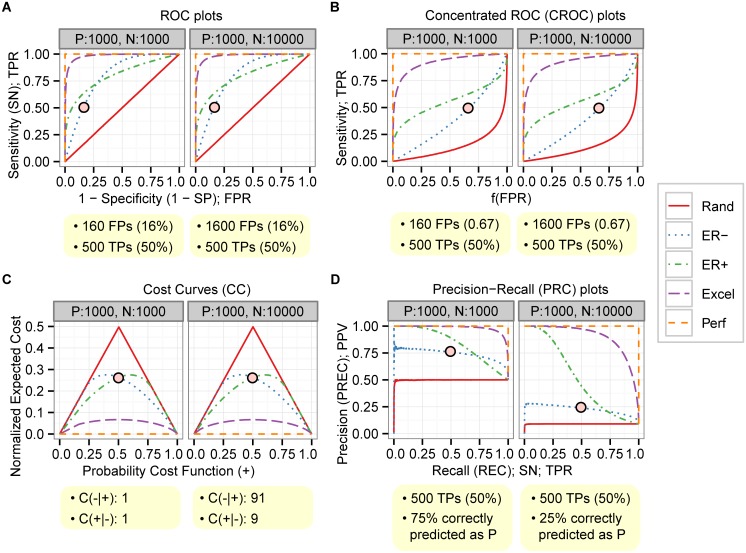
Binary classifiers are routinely evaluated with performance measures such as sensitivity and specificity, and performance is frequently illustrated with Receiver Operating Characteristics (ROC) plots. Alternative measures such as positive predictive value (PPV) and the associated Precision/Recall (PRC) plots are used less frequently. Many bioinformatics studies develop and evaluate classifiers that are to be applied to strongly imbalanced datasets in which the number of negatives outweighs the number of positives significantly. While ROC plots are visually appealing and provide an overview of a classifier's performance across a wide range of specificities, one can ask whether ROC plots could be misleading when applied in imbalanced classification scenarios. We show here that the visual interpretability of ROC plots in the context of imbalanced datasets can be deceptive with respect to conclusions about the reliability of classification performance, owing to an intuitive but wrong interpretation of specificity. PRC plots, on the other hand, can provide the viewer with an accurate prediction of future classification performance due to the fact that they evaluate the fraction of true positives among positive predictions. Our findings have potential implications for the interpretation of a large number of studies that use ROC plots on imbalanced datasets.
Overview
The claims and statistics of this paper haven’t been checked yet.
Free: it reads the open-access text and checks the first 5 claims that cite a source we can check. Create a free account to check every claim.
Integrity signals
Registry
Cites
Statistics
Figures

Verification
Claims the paper makes
The claims and statistics of this paper haven’t been checked yet.
Free: it reads the open-access text and checks the first 5 claims that cite a source we can check. Create a free account to check every claim.
Claims other papers make about this one
Each is checked against this paper’s own text: does it say what the citing paper says it does?
The cited source says what the claim attributes to it.
In the citing paper
“which is a more informative measure than ROC analysis in imbalanced scenarios59.”
From K-STAMM: a knowledge-enhanced spatial - temporal attention model with multimodal fusion for pneumonia prediction (2026) · cites this paper as [59]
The cited source says what the claim attributes to it.
In the citing paper
“When dealing with highly imbalanced data as is the case with fraud detection, AUC (and ROC curves) may be too optimistic and the Area under the Precision-Recall Curve (AUPRC) gives a more informative picture of a classifier's performance (Davis and Goadrich, 2006; Saito and Rehmsmeier, 2015; Fern´ andez et al., 2018).”
From Data engineering for fraud detection (2021) · cites this paper as Saito and Rehmsmeier, 2015
The cited source says what the claim attributes to it.
In the citing paper
“Because extreme prediction is by definition an imbalanced classification problem, we base our analysis on precision-recall plots which are well-suited for this case [42].”
From Learning skillful medium-range global weather forecasting (2023) · cites this paper as [42]
In the citing paper
“Furthermore, careful consideration should be given when selecting evaluation metrics, as the precision-recall curve is more informative for imbalanced datasets than the most commonly used receiver-operating characteristic curve (true positive rate vs. false positive rate) (Fig. 5C).115”
From Use of artificial intelligence for liver diseases: A survey from the EASL congress 2024 (2024) · cites this paper as [115]
1 more claim about this paper
Create a free account to see every claim other papers make about this one.
Self-check
Percentages, sums and reported differences re-computed from the paper’s own numbers.
The self-check needs the paper’s full text.
Citations
Cites
LIBSVM: A library for support vector machines
Chang, C.-C., & Lin, C.-J. (2011) · ACM Transactions on Intelligent Systems and Technology · doi:10.1145/1961189.1961199 · Cited by 40,918
Bartel (2004) · doi:10.1016/s0092-8674(04)00045-5 · Cited by 34,714
SMOTE synthetic minority over-sampling technique
Chawla, N. V., Bowyer, K. W., Hall, L. O., & Kegelmeyer, W. P. (2002) · Journal of Artificial Intelligence Research · doi:10.1613/jair.953 · Cited by 32,865
An introduction to ROC analysis
Fawcett, T. (2006) · Pattern Recognition Letters · doi:10.1016/j.patrec.2005.10.010 · Cited by 21,879 · cited 3×
“Here, we review the theoretical background of commonly used evaluation measures, specifically ROC [24, 25], PRC [26], concentrated ROC (CROC) [27], and Cost Curves (CC) [28].”
BackgroundMethodThe meaning and use of the area under a receiver operating characteristic (ROC) curve.
Hanley, J. A., & McNeil, B. J. (1982) · Radiology · doi:10.1148/radiology.143.1.7063747 · Cited by 21,856
The WEKA data mining software: an update
Hall, M., Frank, E., Holmes, G., Pfahringer, B., Reutemann, P., & Witten, I. H. (2009) · ACM SIGKDD Explorations Newsletter · doi:10.1145/1656274.1656278 · Cited by 17,750
Bioconductor: open software development for computational biology and bioinformatics
Gentleman, R. C., Carey, V. J., Bates, D. M., Bolstad, B., Dettling, M., Dudoit, S., Ellis, B., Gautier, L., Ge, Y., Gentry, J., et al. (2004) · Genome Biology · doi:10.1186/gb-2004-5-10-r80 · Cited by 12,172 · cited 1×
“Several integrated machine learning and bioinformatics platforms such as WEKA [34] and Bioconductor [42, 43] also have basic functions or libraries for making ROC and PRC plots.”
MethodA training algorithm for optimal margin classifiers
Boser, B. E., Guyon, I. M., & Vapnik, V. N. (1992) · Proceedings of the fifth annual workshop on Computational learning theory · doi:10.1145/130385.130401 · Cited by 11,992
R: A Language for Data Analysis and Graphics
Ihaka, R., & Gentleman, R. (1996) · Journal of Computational and Graphical Statistics · doi:10.1080/10618600.1996.10474713 · Cited by 11,220
He, H., & Garcia, E. A. (2009) · IEEE Transactions on Knowledge and Data Engineering · doi:10.1109/tkde.2008.239 · Cited by 10,359
Cited by
Items 801–900 of 1,023
Abromavičius, V., Plonis, D., Tarasevičius, D., & Serackis, A. (2020) · Electronics · doi:10.3390/electronics9071133 · Cited by 32
Parghi, N., Chennapragada, L., Barzilay, S., Newkirk, S., Ahmedani, B., Lok, B., & Galynker, I. (2021) · International Journal of Methods in Psychiatric Research · doi:10.1002/mpr.1863 · Cited by 30
Multi-Label Classification Neural Networks with Hard Logical Constraints
Giunchiglia, E., & Lukasiewicz, T. (2021) · Journal of Artificial Intelligence Research · doi:10.1613/jair.1.12850 · Cited by 77
Foroushani, H. M., Hamzehloo, A., Kumar, A., Chen, Y., Heitsch, L., Słowik, A., Strbian, D., Lee, J., Marcus, D. S., & Dhar, R. (2021) · Neurocritical Care · doi:10.1007/s12028-021-01325-x · Cited by 39
TiWS-iForest: Isolation forest in weakly supervised and tiny ML scenarios
Barbariol, T., & Susto, G. A. (2022) · Information Sciences · doi:10.1016/j.ins.2022.07.129 · Cited by 34
Chakraborty, R., & Pramanik, A. (2022) · Medical & Biological Engineering & Computing · doi:10.1007/s11517-022-02542-y · Cited by 31
NAG: neural feature aggregation framework for credit card fraud detection
Dastidar, K. G., Jurgovsky, J., Siblini, W., & Granitzer, M. (2022) · Knowledge and Information Systems · doi:10.1007/s10115-022-01653-0 · Cited by 42
Discriminating abilities of threshold-free evaluation metrics in link prediction
Zhou, T. (2023) · Physica A Statistical Mechanics and its Applications · doi:10.1016/j.physa.2023.128529 · Cited by 34
Changing perspectives: Using graph metrics to predict purchase probabilities
Baumann, A., Haupt, J., Gebert, F., & Lessmann, S. (2017) · Expert Systems with Applications · doi:10.1016/j.eswa.2017.10.046 · Cited by 35
Integrative analysis of DNA methylation and gene expression in papillary renal cell carcinoma
Singh, N., & Vinod, P. K. U. (2020) · Molecular Genetics and Genomics · doi:10.1007/s00438-020-01664-y · Cited by 32
ChaperISM: improved chaperone binding prediction using position-independent scoring matrices
Gutierres, M. B. B., Bonorino, C. B. C., & Rigo, M. M. (2020) · Bioinformatics · doi:10.1093/bioinformatics/btz670 · Cited by 29
Predicting hypertension onset from longitudinal electronic health records with deep learning
Datta, S., Sasso, A. M., Kiwit, N., Bose, S., Nadkarni, G. N., Miotto, R., & Böttinger, E. P. (2022) · JAMIA Open · doi:10.1093/jamiaopen/ooac097 · Cited by 39
Machine Learning in CNC Machining: Best Practices
von Hahn, T., & Mechefske, C. K. (2022) · Machines · doi:10.3390/machines10121233 · Cited by 38
A stacking ensemble machine learning method for early identification of students at risk of dropout
Talamás-Carvajal, J. A., & Ceballos, H. G. (2023) · Education and Information Technologies · doi:10.1007/s10639-023-11682-z · Cited by 37
Machine learning-based prediction of sand and dust storm sources in arid Central Asia
Wang, W., Samat, A., Abuduwaili, J., Maeyer, P. D., & de Voorde, T. V. (2023) · International Journal of Digital Earth · doi:10.1080/17538947.2023.2202421 · Cited by 33
A primer on the use of machine learning to distil knowledge from data in biological psychiatry
Quinn, T. P., Hess, J., Marshe, V. S., Barnett, M. M., Hauschild, A.-C., Maciukiewicz, M., Elsheikh, S. S. M., Men, X., Schwarz, E., Trakadis, Y. J., et al. (2024) · Molecular Psychiatry · doi:10.1038/s41380-023-02334-2 · Cited by 43
El-Menyar, A. A., Naduvilekandy, M., Asim, M., Rizoli, S. B., & Al-Thani, H. A. S. (2024) · Computers in Biology and Medicine · doi:10.1016/j.compbiomed.2024.108880 · Cited by 37
Inconsistency among evaluation metrics in link prediction
Bi, Y., Jiao, X., Lee, Y.-L., & Zhou, T. (2024) · PNAS Nexus · doi:10.1093/pnasnexus/pgae498 · Cited by 30
Özsarı, Ş., Kumru, E., Ekinci, F., Akata, İ., Güzel, M. S., Açıcı, K., Özcan, E. S., & Aşuroğlu, T. (2024) · Sensors · doi:10.3390/s24227189 · Cited by 41
An Efficient Deep Learning Approach for Malaria Parasite Detection in Microscopic Images
Boit, S., & Patil, R. (2024) · Diagnostics · doi:10.3390/diagnostics14232738 · Cited by 45
Martin, B., Bennett, T. D., DeWitt, P. E., Russell, S., & Sanchez-Pinto, L. N. (2025) · Pediatric Critical Care Medicine · doi:10.1097/pcc.0000000000003752 · Cited by 42
Objective over Architecture: Fraud Detection Under Extreme Imbalance in Bank Account Opening
Sun, W., Shen, Q., Gao, Y., Mao, Q., Qi, T., & Xu, S. (2025) · Computation · doi:10.3390/computation13120290 · Cited by 49
Lymphoma images analysis using morphological and non-morphological descriptors for classification
do Nascimento, M. Z., Martins, A. S., Tosta, T. A. A., & Neves, L. A. (2018) · Computer Methods and Programs in Biomedicine · doi:10.1016/j.cmpb.2018.05.035 · Cited by 35
The trauma severity model: An ensemble machine learning approach to risk prediction
Gorczyca, M. T., Toscano, N. C., & Cheng, J. D. (2019) · Computers in Biology and Medicine · doi:10.1016/j.compbiomed.2019.02.025 · Cited by 30
Meneghetti, L., Susto, G. A., & Favero, S. D. (2019) · Journal of Diabetes Science and Technology · doi:10.1177/1932296819881452 · Cited by 29
Cone-beam computed tomography-based radiomics in prostate cancer: a mono-institutional study
Bosetti, D. G., Ruinelli, L., Piliero, M. A., van der Gaag, L. C., Pesce, G. A., Valli, M., Bosetti, M., Presilla, S., Richetti, A., & Deantonio, L. (2020) · Strahlentherapie und Onkologie · doi:10.1007/s00066-020-01677-x · Cited by 31
Scale–Space Data Augmentation for Deep Transfer Learning of Crack Damage from Small Sized Datasets
Tang, S., & Chen, Z. (2020) · Journal of Nondestructive Evaluation · doi:10.1007/s10921-020-00715-z · Cited by 30
Robust Deep Neural Networks for Road Extraction From Remote Sensing Images
Li, P., He, X., Qiao, M., Cheng, X., Li, Z., Luo, H., Song, D., Li, D., Hu, S., Li, R., et al. (2020) · IEEE Transactions on Geoscience and Remote Sensing · doi:10.1109/tgrs.2020.3023112 · Cited by 32
Decision Tree based Electricity Theft Detection in Smart Grid
Tehrani, S. O., Yaghmaee, M. H., & Asadi, M. (2020) · International Conference on Smart Cities, Internet of Things and Applications (SCIoT) · doi:10.1109/sciot50840.2020.9250194 · Cited by 29
SSBC 2020: Sclera Segmentation Benchmarking Competition in the Mobile Environment
Vitek, M., Das, A., Pourcenoux, Y., Missler, A., Paumier, C., Das, S., Ghosh, I. D., Lucio, D. R., Junior, L. A. Z., Menotti, D., et al. (2020) · IEEE International Joint Conference on Biometrics (IJCB) · doi:10.1109/ijcb48548.2020.9304881 · Cited by 47
Park, S. J., Cho, K.-J., Kwon, O., Park, H., Lee, Y., Shim, W. H., Park, C. R., & Jhang, W. K. (2021) · Biomedical Journal · doi:10.1016/j.bj.2021.01.003 · Cited by 37
Udriștoiu, Ș., Stefanescu, D., Gruionu, G., Gruionu, L. G., Iacob, A. V., Karstensen, J. G., Vilman, P., & Săftoiu, A. (2021) · Journal of Gastrointestinal and Liver Diseases · doi:10.15403/jgld-3212 · Cited by 35
Nugroho, H., Utama, N. P., & Surendro, K. (2021) · Journal Of Big Data · doi:10.1186/s40537-021-00518-7 · Cited by 38
KBoost: a new method to infer gene regulatory networks from gene expression data
Iglesias-Martinez, L. F., Kegel, B. D., & Kölch, W. (2021) · Scientific Reports · doi:10.1038/s41598-021-94919-6 · Cited by 29
Bellin, N., Calzolari, M., Callegari, E., Bonilauri, P., Grisendi, A., Dottori, M., & Rossi, V. (2021) · Infection Genetics and Evolution · doi:10.1016/j.meegid.2021.105034 · Cited by 35
Choe, S., Park, E., Shin, W., Koo, B., Shin, D. J., Jung, C.-W., Lee, H., & Kim, J. (2021) · JMIR Medical Informatics · doi:10.2196/31311 · Cited by 41
InterPepRank: Assessment of Docked Peptide Conformations by a Deep Graph Network
Johansson-Åkhe, I., Mirabello, C., & Wallner, B. (2021) · Frontiers in Bioinformatics · doi:10.3389/fbinf.2021.763102 · Cited by 30
miRe2e: a full end-to-end deep model based on transformers for prediction of pre-miRNAs
Raad, J., Bugnon, L. A., Milone, D. H., & Stegmayer, G. S. (2021) · Bioinformatics · doi:10.1093/bioinformatics/btab823 · Cited by 34
Multiscale structural mapping of Alzheimer’s disease neurodegeneration
Jang, I., Li, B., Riphagen, J. M., Dickerson, B. C., & Salat, D. H. (2022) · NeuroImage Clinical · doi:10.1016/j.nicl.2022.102948 · Cited by 29
Deep Learning to Predict Traumatic Brain Injury Outcomes in the Low-Resource Setting
Adil, S. M., Elahi, C., Patel, D. N., Seas, A., Warman, P. I., Fuller, A. T., Haglund, M. M., & Dunn, T. (2022) · World Neurosurgery · doi:10.1016/j.wneu.2022.02.097 · Cited by 34
Cole, E. D., Valikodath, N. G., Al-Khaled, T., Bajimaya, S., Sagun, K. C., Chuluunbat, T., Munkhuu, B., Jonas, K. E., Chuluunkhuu, C., MacKeen, L. D., et al. (2022) · Ophthalmology Science · doi:10.1016/j.xops.2022.100165 · Cited by 29
Predicting exclusive breastfeeding in maternity wards using machine learning techniques
Oliver‐Roig, A., Rico-Juan, J. R., Richart‐Martínez, M., & Cabrero‐García, J. (2022) · Computer Methods and Programs in Biomedicine · doi:10.1016/j.cmpb.2022.106837 · Cited by 34
Fine-grained address segmentation for attention-based variable-degree prefetching
Zhang, P., Srivastava, A., Nori, A., Kannan, R., & Prasanna, V. K. (2022) · ACM International Conference on Computing Frontiers (CF) · doi:10.1145/3528416.3530236 · Cited by 34
Prediction of the Lotus Effect on Solid Surfaces by Machine Learning
He, X. D., Zhang, K., Xiong, X., Li, Y., Wan, X., Chen, Z., Wang, Y., Xu, X.-T., Liu, M., Jiang, Y. L., et al. (2022) · Small · doi:10.1002/smll.202203264 · Cited by 30
Brand, Y. E., Schwartz, D., Gazit, E., Buchman, A. S., Gilad-Bachrach, R., & Hausdorff, J. M. (2022) · Sensors · doi:10.3390/s22187094 · Cited by 35
Dynamic behaviour restructuring mediates dopamine-dependent credit assignment
Tang, J. C. Y., Paixão, V., Carvalho, F., Silva, A., Klaus, A., da Silva, J. A., & Costa, R. M. (2023) · Nature · doi:10.1038/s41586-023-06941-5 · Cited by 38
We Need No Pixels: Video Manipulation Detection Using Stream Descriptors
Güera, D., Baireddy, S., Bestagini, P., Tubaro, S., & Delp, E. J. (2019) · arXiv (Cornell University) · doi:10.48550/arxiv.1906.08743 · Cited by 29
Seq-InSite: sequence supersedes structure for protein interaction site prediction
Hosseini, S., Golding, G. B., & Ilie, L. (2024) · Bioinformatics · doi:10.1093/bioinformatics/btad738 · Cited by 26
Optimal selection of resampling methods for imbalanced data with high complexity
Kim, A., & Jung, I. (2023) · PLOS ONE · doi:10.1371/journal.pone.0288540 · Cited by 28
Bej, S., Galow, A.-M., David, R., Wolfien, M., & Wolkenhauer, O. (2021) · BMC Bioinformatics · doi:10.1186/s12859-021-04469-x · Cited by 35
Wei, Y., Huang, W., Jian, C.-Y., Hsu, C. H., Hsu, C., Lin, C., Cheng, C., Chen, Y.-L., Wei, H., & Chen, K. (2022) · NeuroImage Clinical · doi:10.1016/j.nicl.2022.103044 · Cited by 32
Recent Context-Aware LSTM for Clinical Event Time-Series Prediction
Lee, J. M., & Hauskrecht, M. (2019) · Lecture notes in computer science · doi:10.1007/978-3-030-21642-9_3 · Cited by 33
Scalable Causal Graph Learning through a Deep Neural Network
Xu, C., Huang, H., & Yoo, S. (2019) · ACM International Conference on Information and Knowledge Management (CIKM) · doi:10.1145/3357384.3357864 · Cited by 45
Influence of intensity measure selection on simulation‐based regional seismic risk assessment
Du, A., Padgett, J. E., & Shafieezadeh, A. (2020) · Earthquake Spectra · doi:10.1177/8755293019891717 · Cited by 28
Bhandari, M., Nallabasannagari, A. R., Reddiboina, M., PORTER, J. R., Jeong, W., Mottrie, A., Dasgupta, P., Challacombe, B. J., Abaza, R. M. D., Rha, K. H., et al. (2020) · British Journal of Urology · doi:10.1111/bju.15087 · Cited by 30
Foroushani, H. M., Hamzehloo, A., Kumar, A., Chen, Y., Heitsch, L., Słowik, A., Strbian, D., Lee, J., Marcus, D. S., & Dhar, R. (2020) · Neurocritical Care · doi:10.1007/s12028-020-01056-5 · Cited by 40
Ferrario, A., Demiray, B., Yordanova, K., Luo, M., & Martin, M. (2020) · Journal of Medical Internet Research · doi:10.2196/19133 · Cited by 34
Papacharalampopoulos, A., Tzimanis, K., Sabatakakis, K., & Stavropoulos, P. G. (2020) · Sensors · doi:10.3390/s20195481 · Cited by 30
Machine Learning Applications in the Neuro ICU: A Solution to Big Data Mayhem?
Chaudhry, F., Hunt, R., Hariharan, P., Anand, S. K., Sanjay, S., Kjoller, E. E., Bartlett, C. M., Johnson, K. W., Levy, P. D., Noushmehr, H., et al. (2020) · Frontiers in Neurology · doi:10.3389/fneur.2020.554633 · Cited by 32
Barot, M., Gligorijević, V., Cho, K., & Bonneau, R. (2021) · Bioinformatics · doi:10.1093/bioinformatics/btab098 · Cited by 33
Real-Time Hierarchical Classification of Time Series Data for Locomotion Mode Detection
Narayan, A., Reyes, F. A., Ren, M., & Yu, H. (2021) · IEEE Journal of Biomedical and Health Informatics · doi:10.1109/jbhi.2021.3106110 · Cited by 30
Nguyen, M., Corbin, C. K., Eulalio, T. Y., Ostberg, N. P., Machiraju, G., Marafino, B. J., Baiocchi, M., Rose, C. C., & Chen, J. H. (2021) · Journal of the American Medical Informatics Association · doi:10.1093/jamia/ocab118 · Cited by 34
Automated Anomaly Detection via Curiosity-Guided Search and Self-Imitation Learning
Li, Y., Chen, Z., Zha, D., Zhou, K., Jin, H., Chen, H., & Hu, X. (2021) · IEEE Transactions on Neural Networks and Learning Systems · doi:10.1109/tnnls.2021.3105636 · Cited by 52
Taxonomy-aware, sequence similarity ranking reliably predicts phage–host relationships
Zieleziński, A., Barylski, J., & Karlowski, W. M. (2021) · BMC Biology · doi:10.1186/s12915-021-01146-6 · Cited by 33
Predicting the binding of small molecules to nuclear receptors using machine learning
Ramaprasad, A. S. E., Smith, M. T., McCoy, D., Hubbard, A., Merrill, M. A. L., & Durkin, K. A. (2022) · Briefings in Bioinformatics · doi:10.1093/bib/bbac114 · Cited by 29
Predicting protein stability changes upon mutation using a simple orientational potential
Hernández, I. M., Dehouck, Y., Bastolla, U., López‐Blanco, J. R., & Chacón, P. (2023) · Bioinformatics · doi:10.1093/bioinformatics/btad011 · Cited by 38
Singh, A., Chhetri, N. K., ., N., Gupta, S. K., & Shukla, D. P. (2023) · Bulletin of Engineering Geology and the Environment · doi:10.1007/s10064-023-03333-x · Cited by 29
Etaiwi, W., Biltawi, M. M., & Al‐Naymat, G. (2017) · Procedia Computer Science · doi:10.1016/j.procs.2017.08.280 · Cited by 28
Rarity of microbial species: In search of reliable associations
Cougoul, A., Bailly, X., Vourc’h, G., & Gasqui, P. (2019) · PLoS ONE · doi:10.1371/journal.pone.0200458 · Cited by 32
Yan, H., Hu, Z., Thomas, G. W. C., Edwards, S. V., Sackton, T. B., & Liu, J. S. (2023) · Molecular Biology and Evolution · doi:10.1093/molbev/msad195 · Cited by 28
Student Performance Prediction on Primary and Secondary Schools-A Systematic Literature Review
Rodrigues, L. S., dos Santos, M., Costa, I. P. D. A., & Moreira, M. Â. L. (2022) · Procedia Computer Science · doi:10.1016/j.procs.2022.11.229 · Cited by 35
Seo, E.-Y., Yang, J., Lee, J.-E., & So, G. (2024) · Heliyon · doi:10.1016/j.heliyon.2024.e30960 · Cited by 56
Tian, Q., Zhang, P., Zhai, Y., Wang, Y., & Zou, Q. (2024) · Genome Biology and Evolution · doi:10.1093/gbe/evae102 · Cited by 28
Interpretation of Artificial Intelligence Models in Healthcare: A Pictorial Guide for Clinicians
Ardakani, A. A., Airom, O., Khorshidi, H., Bureau, N. J., Salvi, M., Molinari, F., & Acharya, U. R. (2024) · Journal of Ultrasound in Medicine · doi:10.1002/jum.16524 · Cited by 37
Lost in UNet: Improving Infrared Small Target Detection by Underappreciated Local Features
Quan, W., Zhao, W., Wang, W., Xie, H., Wang, F. L., & Wei, M. (2024) · IEEE Transactions on Geoscience and Remote Sensing · doi:10.1109/tgrs.2024.3504594 · Cited by 31
Yulvina, R., Putra, S. A., Rizkinia, M., Pujitresnani, A., Tenda, E. D., Yunus, R. E., Djumaryo, D. H., Yusuf, P. A., & Valindria, V. V. (2024) · Computers · doi:10.3390/computers13120343 · Cited by 44
Mușat, F., Păduraru, D. N., Bolocan, A., Palcău, A. C., Copăceanu, A.-M., Daniel, I., Jinga, V., & Andronic, O. (2024) · Biomedicines · doi:10.3390/biomedicines12122892 · Cited by 41
Li, X., Jiang, F., Guo, Y., Jin, Z., & Wang, Y. (2019) · International Journal of Computer Assisted Radiology and Surgery · doi:10.1007/s11548-019-01993-3 · Cited by 27
Zhu, Y., Chiu, Y., Villar, S. S., Brand, J., Patteril, M., Morrice, D. J., Clayton, J. J., & Mackay, J. H. (2020) · Resuscitation · doi:10.1016/j.resuscitation.2020.10.037 · Cited by 34
Singla, S., Gong, M., Riley, C. M., Sciurba, F. C., & Batmanghelich, K. N. (2020) · Medical Physics · doi:10.1002/mp.14673 · Cited by 31
2 Years in the anti-phishing group of a large company
Gallo, L., Maiello, A., Botta, A., & Ventre, G. (2021) · Computers & Security · doi:10.1016/j.cose.2021.102259 · Cited by 33
Velásquez‐Zapata, V., Elmore, J. M., Banerjee, S., Dorman, K. S., & Wise, R. P. (2021) · PLoS Computational Biology · doi:10.1371/journal.pcbi.1008890 · Cited by 32
Bennett, S., Szczypiński, F., Turcani, L., Briggs, M. E., Greenaway, R. L., & Jelfs, K. E. (2021) · Journal of Chemical Information and Modeling · doi:10.1021/acs.jcim.1c00375 · Cited by 26
Naseer, S., Ali, R. F., Fati, S. M., & Muneer, A. (2021) · IEEE Access · doi:10.1109/access.2021.3080041 · Cited by 27
Li, K.-Y., Burnside, N. G., de Lima, R. S., Villoslada, M., Sepp, K., Pinheiro, V. H. C., de Lima, B. R. C. A., Yang, M., Vain, A., & Sepp, K. (2021) · Remote Sensing · doi:10.3390/rs13163190 · Cited by 32
Lin, S., Wu, Y., & Fang, Y. (2022) · Frontiers in Psychiatry · doi:10.3389/fpsyt.2021.764806 · Cited by 31
IoT information theft prediction using ensemble feature selection
Leevy, J. L., Hancock, J., Khoshgoftaar, T. M., & Peterson, J. M. (2022) · Journal Of Big Data · doi:10.1186/s40537-021-00558-z · Cited by 29
Mouret, F., Albughdadi, M., Duthoit, S., Kouamé, D., Rieu, G., & Tourneret, J. (2022) · Computers and Electronics in Agriculture · doi:10.1016/j.compag.2022.106983 · Cited by 30
Karri, R., Chen, Y. P., & Drummond, K. J. (2022) · PLoS ONE · doi:10.1371/journal.pone.0267931 · Cited by 29
Natural Language Processing of Radiology Reports to Detect Complications of Ischemic Stroke
Miller, M. I., Orfanoudaki, A., Cronin, M., Sağlam, H., Kim, I. S. Y., Balogun, O. O., Tzalidi, M., Vasilopoulos, K., Fanaropoulou, G., Fanaropoulou, N. M., et al. (2022) · Neurocritical Care · doi:10.1007/s12028-022-01513-3 · Cited by 29
Predicting 3D chromatin interactions from DNA sequence using Deep Learning
Piecyk, R. S., Schlegel, L., & Johannes, F. M. (2022) · Computational and Structural Biotechnology Journal · doi:10.1016/j.csbj.2022.06.047 · Cited by 33
Wunderlich, T., Wilken, D., Majchczack, B. S., Segschneider, M., & Rabbel, W. (2022) · Remote Sensing · doi:10.3390/rs14153665 · Cited by 29
Guidelines for the prediction of species interactions through binary classification
Poisot, T. (2023) · Methods in Ecology and Evolution · doi:10.1111/2041-210x.14071 · Cited by 30
Gagliano, A. T., Contardo, G., Foreman-Mackey, D. T., Malz, A. I., & Aleo, P. (2023) · The Astrophysical Journal · doi:10.3847/1538-4357/ace326 · Cited by 39
The Effectiveness of Multitask Learning for Phenotyping with Electronic Health Records Data
Ding, D. Y., Simpson, C., Pfohl, S., Kale, D. C., Jung, K., & Shah, N. H. (2018) · Biocomputing 2019 · doi:10.1142/9789813279827_0003 · Cited by 27
A novel method of gene regulatory network structure inference from gene knock-out expression data
Chen, X. '., Li, M., Zheng, R., Zhao, S., Wu, F., Li, Y., & Wang, J. (2019) · Tsinghua Science & Technology · doi:10.26599/tst.2018.9010097 · Cited by 29
Stabellini, N., Nazha, A., Agrawal, N., Huhn, M., Shanahan, J., Hamerschlak, N., Waite, K. A., Barnholtz‐Sloan, J. S., & Montero, A. J. (2023) · JCO Clinical Cancer Informatics · doi:10.1200/cci.22.00143 · Cited by 34
Classification of Guava Leaf Disease using Deep Learning
Doutoum, A. S., Eryiğit, R., & Tuğrul, B. (2023) · WSEAS Transactions on Information Science and Applications archive · doi:10.37394/23209.2023.20.38 · Cited by 26
Deep learning prediction of hospital readmissions for asthma and COPD
Lopez, K., Li, H., Lipkin-Moore, Z., Kay, S., Rajeevan, H., Davis, J. L., Wilson, F. P., Rochester, C. L., & Gómez, J. L. (2023) · Respiratory Research · doi:10.1186/s12931-023-02628-7 · Cited by 31
Acharya, V., Choi, D., Yener, B., & Beamer, G. (2024) · IEEE Access · doi:10.1109/access.2024.3359989 · Cited by 27
Metadata
- Authors
- Saito, T., & Rehmsmeier, M.
- Affiliations
- University of Bergen (NO)
- Corresponding author
- Saito, Takaya
- Rehmsmeier, Marc
- Venue
- PLOS ONE
- Publisher
- Public Library of Science (PLoS)
- Published
- 2015-03-04
- Volume
- 10
- Issue
- 3
- Pages
- e0118432
- ISSN
- 1932-6203 (ISSN-L)
- PMC
- PMC4349800
- OpenAlex
- W1966716734
- Cited by
- 5,309
- References
- 56
- Citations by year
- 2026: 1482 · 2025: 762 · 2024: 528 · 2023: 505 · 2022: 551 · 2021: 563 · 2020: 402 · 2019: 283 · 2018: 133 · 2017: 64 · 2016: 27 · 2015: 3
- FWCI
- 74.84
- Type
- journal article
- Language
- en
- Open access
- gold
- doi.org
- Licence
- Locations
- PLoS ONE (publishedVersion, cc-by)
- Europe PMC (PubMed Central) (publishedVersion, cc-by)
- PubMed Central (publishedVersion, cc-by)
- PubMed (publishedVersion)
- RePEc: Research Papers in Economics (submittedVersion)
- DOAJ (DOAJ: Directory of Open Access Journals) (submittedVersion, cc-by-sa)
- Funders
- Universitetet i Bergen
- Topics
- Physical Sciences › Computer Science › Artificial Intelligence › Imbalanced Data Classification Techniques
- Physical Sciences › Computer Science › Artificial Intelligence › Machine Learning and Data Classification
- Physical Sciences › Mathematics › Statistics and Probability › Statistical Methods in Epidemiology
- Keywords
- class imbalance, binary classification, classifier evaluation, specificity, positive predictive value, sensitivity, bioinformatics classification, visual interpretability
- MeSH terms
- Classification, ROC Curve, Datasets as Topic
About these checks
Registry, retraction, Cites and statistics results are computed, not judged, with one exception: a printed reference that no index lists is read once by a model before it counts as a citation error. Claims are extracted by a model and kept only when their quote appears verbatim in the text; each cited source is then checked, with a model’s help, for whether it says what the claim relies on. Those verdicts can be wrong — read the claim’s quote and the cited source before relying on one.
Statistics and arithmetic are recomputed, not judged.
Confidence bands are shown only for fields calibrated on our annotated test set. None is calibrated yet, so no band is shown.
What counts as a claim ›How we measure confidence ›How we check this ›
Are you an author, or do you see a problem with this page? Request a review
Data sources
Bibliographic data: Semantic Scholar, OpenAlex, Crossref.
Contains information from the Semantic Scholar Academic Graph Datasets, made available under the ODC Attribution License (ODC-BY 1.0).
Semantic Scholar’s data is described in: Kinney, R., et al. (2023). The Semantic Scholar Open Data Platform. arXiv:2301.10140.
