

The Precision-Recall Plot Is More Informative than the ROC Plot When Evaluating Binary Classifiers on Imbalanced Datasets
Open accessThe DOI matches its Crossref record; 55 of the 56 references it cites were found in a registry or an index.
Abstract
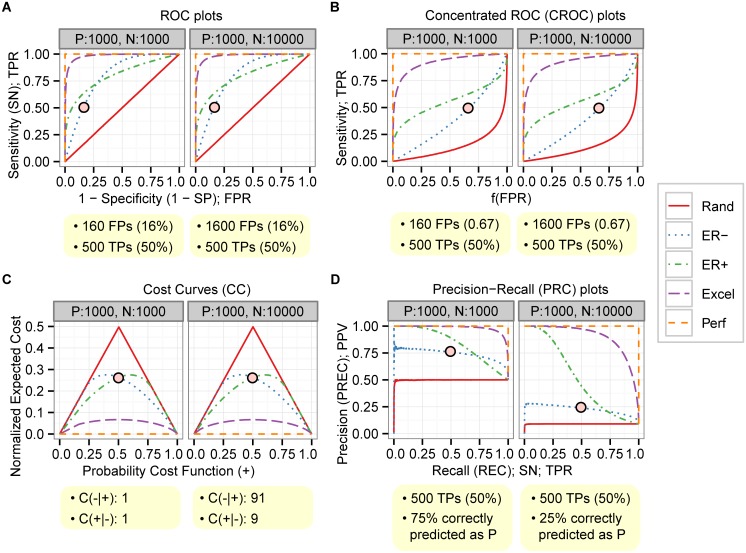
Binary classifiers are routinely evaluated with performance measures such as sensitivity and specificity, and performance is frequently illustrated with Receiver Operating Characteristics (ROC) plots. Alternative measures such as positive predictive value (PPV) and the associated Precision/Recall (PRC) plots are used less frequently. Many bioinformatics studies develop and evaluate classifiers that are to be applied to strongly imbalanced datasets in which the number of negatives outweighs the number of positives significantly. While ROC plots are visually appealing and provide an overview of a classifier's performance across a wide range of specificities, one can ask whether ROC plots could be misleading when applied in imbalanced classification scenarios. We show here that the visual interpretability of ROC plots in the context of imbalanced datasets can be deceptive with respect to conclusions about the reliability of classification performance, owing to an intuitive but wrong interpretation of specificity. PRC plots, on the other hand, can provide the viewer with an accurate prediction of future classification performance due to the fact that they evaluate the fraction of true positives among positive predictions. Our findings have potential implications for the interpretation of a large number of studies that use ROC plots on imbalanced datasets.
Overview
The claims and statistics of this paper haven’t been checked yet.
Free: it reads the open-access text and checks the first 5 claims that cite a source we can check. Create a free account to check every claim.
Integrity signals
Registry
Cites
Statistics
Figures

Verification
Claims the paper makes
The claims and statistics of this paper haven’t been checked yet.
Free: it reads the open-access text and checks the first 5 claims that cite a source we can check. Create a free account to check every claim.
Claims other papers make about this one
Each is checked against this paper’s own text: does it say what the citing paper says it does?
The cited source says what the claim attributes to it.
In the citing paper
“which is a more informative measure than ROC analysis in imbalanced scenarios59.”
From K-STAMM: a knowledge-enhanced spatial - temporal attention model with multimodal fusion for pneumonia prediction (2026) · cites this paper as [59]
The cited source says what the claim attributes to it.
In the citing paper
“When dealing with highly imbalanced data as is the case with fraud detection, AUC (and ROC curves) may be too optimistic and the Area under the Precision-Recall Curve (AUPRC) gives a more informative picture of a classifier's performance (Davis and Goadrich, 2006; Saito and Rehmsmeier, 2015; Fern´ andez et al., 2018).”
From Data engineering for fraud detection (2021) · cites this paper as Saito and Rehmsmeier, 2015
The cited source says what the claim attributes to it.
In the citing paper
“Because extreme prediction is by definition an imbalanced classification problem, we base our analysis on precision-recall plots which are well-suited for this case [42].”
From Learning skillful medium-range global weather forecasting (2023) · cites this paper as [42]
In the citing paper
“Furthermore, careful consideration should be given when selecting evaluation metrics, as the precision-recall curve is more informative for imbalanced datasets than the most commonly used receiver-operating characteristic curve (true positive rate vs. false positive rate) (Fig. 5C).115”
From Use of artificial intelligence for liver diseases: A survey from the EASL congress 2024 (2024) · cites this paper as [115]
1 more claim about this paper
Create a free account to see every claim other papers make about this one.
Self-check
Percentages, sums and reported differences re-computed from the paper’s own numbers.
The self-check needs the paper’s full text.
Citations
Cites
LIBSVM: A library for support vector machines
Chang, C.-C., & Lin, C.-J. (2011) · ACM Transactions on Intelligent Systems and Technology · doi:10.1145/1961189.1961199 · Cited by 40,918
Bartel (2004) · doi:10.1016/s0092-8674(04)00045-5 · Cited by 34,714
SMOTE synthetic minority over-sampling technique
Chawla, N. V., Bowyer, K. W., Hall, L. O., & Kegelmeyer, W. P. (2002) · Journal of Artificial Intelligence Research · doi:10.1613/jair.953 · Cited by 32,865
An introduction to ROC analysis
Fawcett, T. (2006) · Pattern Recognition Letters · doi:10.1016/j.patrec.2005.10.010 · Cited by 21,879 · cited 3×
“Here, we review the theoretical background of commonly used evaluation measures, specifically ROC [24, 25], PRC [26], concentrated ROC (CROC) [27], and Cost Curves (CC) [28].”
BackgroundMethodThe meaning and use of the area under a receiver operating characteristic (ROC) curve.
Hanley, J. A., & McNeil, B. J. (1982) · Radiology · doi:10.1148/radiology.143.1.7063747 · Cited by 21,856
The WEKA data mining software: an update
Hall, M., Frank, E., Holmes, G., Pfahringer, B., Reutemann, P., & Witten, I. H. (2009) · ACM SIGKDD Explorations Newsletter · doi:10.1145/1656274.1656278 · Cited by 17,750
Bioconductor: open software development for computational biology and bioinformatics
Gentleman, R. C., Carey, V. J., Bates, D. M., Bolstad, B., Dettling, M., Dudoit, S., Ellis, B., Gautier, L., Ge, Y., Gentry, J., et al. (2004) · Genome Biology · doi:10.1186/gb-2004-5-10-r80 · Cited by 12,172 · cited 1×
“Several integrated machine learning and bioinformatics platforms such as WEKA [34] and Bioconductor [42, 43] also have basic functions or libraries for making ROC and PRC plots.”
MethodA training algorithm for optimal margin classifiers
Boser, B. E., Guyon, I. M., & Vapnik, V. N. (1992) · Proceedings of the fifth annual workshop on Computational learning theory · doi:10.1145/130385.130401 · Cited by 11,992
R: A Language for Data Analysis and Graphics
Ihaka, R., & Gentleman, R. (1996) · Journal of Computational and Graphical Statistics · doi:10.1080/10618600.1996.10474713 · Cited by 11,220
He, H., & Garcia, E. A. (2009) · IEEE Transactions on Knowledge and Data Engineering · doi:10.1109/tkde.2008.239 · Cited by 10,359
Cited by
Items 101–200 of 1,023
Tamim Kashifi, M., Jamal, A., Samim Kashefi, M., Almoshaogeh, M., & Masiur Rahman, S. (2022) · Travel Behaviour and Society · doi:10.1016/j.tbs.2022.07.003 · Cited by 168
Chavez-Badiola, A., Flores-Saiffe-Farías, A., Mendizabal-Ruiz, G., Drakeley, A. J., & Cohen, J. (2020) · Reproductive BioMedicine Online · doi:10.1016/j.rbmo.2020.07.003 · Cited by 168
LoRAS: an oversampling approach for imbalanced datasets
Bej, S., Davtyan, N., Wolfien, M., Nassar, M., & Wolkenhauer, O. (2021) · Machine Learning · doi:10.1007/s10994-020-05913-4 · Cited by 167
Improving peptide-protein docking with AlphaFold-Multimer using forced sampling
Johansson-Åkhe, I., & Wallner, B. (2022) · Frontiers in Bioinformatics · doi:10.3389/fbinf.2022.959160 · Cited by 162
Li, G., Iyer, B., Prasath, V. B. S., Ni, Y., & Salomonis, N. (2021) · Briefings in Bioinformatics · doi:10.1093/bib/bbab160 · Cited by 168
“auPR is more informative than auROC in an imbalanced scenario due to the incorrect interpretation of specificity [23].”
Kipnis, P., Turk, B. J., Wulf, D. A., LaGuardia, J. C., Liu, V., Churpek, M. M., Romero-Brufau, S., & Escobar, G. J. (2016) · Journal of Biomedical Informatics · doi:10.1016/j.jbi.2016.09.013 · Cited by 167
Machine‐learning scoring functions for structure‐based virtual screening
Li, H., Sze, K., Lu, G., & Ballester, P. J. (2021) · WIREs Computational Molecular Science · doi:10.1002/wcms.1478 · Cited by 163
Data engineering for fraud detection
Baesens, B., Höppner, S., & Verdonck, T. (2021) · Decision Support Systems · doi:10.1016/j.dss.2021.113492 · Cited by 170
Misbehaviour prediction for autonomous driving systems
Stocco, A., Weiss, M., Calzana, M., & Tonella, P. (2020) · Proceedings of the ACM/IEEE 42nd International Conference on Software Engineering · doi:10.1145/3377811.3380353 · Cited by 139
Rodríguez-Hernández, C. F., Musso, M., Kyndt, E., & Cascallar, E. (2021) · Computers and Education: Artificial Intelligence · doi:10.1016/j.caeai.2021.100018 · Cited by 165
Deepred-Mt: Deep representation learning for predicting C-to-U RNA editing in plant mitochondria
Edera, A. A., Small, I., Milone, D. H., & Sanchez-Puerta, M. V. (2021) · Computers in Biology and Medicine · doi:10.1016/j.compbiomed.2021.104682 · Cited by 161
A graph representation of molecular ensembles for polymer property prediction
Aldeghi, M., & Coley, C. W. (2022) · Chemical Science · doi:10.1039/d2sc02839e · Cited by 165
“A RF model trained only on mole fractions achieved a PRC of 0.69 ± 0.01 (Figure S3), and 0.71 ± 0.01 when using solely volume fractions, both of which are better than the wD-MPNN.”
InfluentialCARLA: Self-supervised contrastive representation learning for time series anomaly detection
Darban, Z. Z., Webb, G. I., Pan, S., Aggarwal, C. C., & Salehi, M. (2024) · Pattern Recognition · doi:10.1016/j.patcog.2024.110874 · Cited by 229
Lee, S., & Chung, J. Y. (2019) · Applied Sciences · doi:10.3390/app9153093 · Cited by 161
Applicability of machine learning in spam and phishing email filtering: review and approaches
Gangavarapu, T., Jaidhar, C. D., & Chanduka, B. (2020) · Artificial Intelligence Review · doi:10.1007/s10462-020-09814-9 · Cited by 163
DELPHI: accurate deep ensemble model for protein interaction sites prediction
Li, Y., Golding, G. B., & Ilie, L. (2021) · Bioinformatics · doi:10.1093/bioinformatics/btaa750 · Cited by 162
Lee, H., Park, J., & Hwang, J. Y. (2020) · IEEE Transactions on Ultrasonics, Ferroelectrics, and Frequency Control · doi:10.1109/tuffc.2020.2972573 · Cited by 160
Explainable machine learning model for liquefaction potential assessment of soils using XGBoost-SHAP
Jas, K., & Dodagoudar, G. R. (2022) · Soil Dynamics and Earthquake Engineering · doi:10.1016/j.soildyn.2022.107662 · Cited by 177
Yang, Z., Mitra, A., Liu, W., Berlowitz, D., & Yu, H. (2023) · Nature Communications · doi:10.1038/s41467-023-43715-z · Cited by 158
“AUPRC is the area under PPV and sensitivity curve, and it has shown to be an effective measure for highly imbalanced binary classi fi cation problems, which include self-harm prediction 35,36 .”
Carrington, A. M., Fieguth, P. W., Qazi, H., Holzinger, A., Chen, H. H., Mayr, F., & Manuel, D. G. (2020) · BMC Medical Informatics and Decision Making · doi:10.1186/s12911-019-1014-6 · Cited by 157
Machine learning based methods for software fault prediction: A survey
Pandey, S. K., Mishra, R. B., & Tripathi, A. K. (2021) · Expert Systems with Applications · doi:10.1016/j.eswa.2021.114595 · Cited by 158
Nock, M. K., Millner, A. J., Ross, E. L., Kennedy, C. J., Al-Suwaidi, M., Barak-Corren, Y., Castro, V. M., Castro-Ramirez, F., Lauricella, T., Murman, N., et al. (2022) · JAMA Network Open · doi:10.1001/jamanetworkopen.2021.44373 · Cited by 157
Le, H., & Viviani, J. (2017) · Research in International Business and Finance · doi:10.1016/j.ribaf.2017.07.104 · Cited by 199
From real-world electronic health record data to real-world results using artificial intelligence
Knevel, R., & Liao, K. P. (2023) · Annals of the Rheumatic Diseases · doi:10.1136/ard-2022-222626 · Cited by 154
Nicholls, H. L., John, C. R., Watson, D. S., Munroe, P. B., Barnes, M. R., & Cabrera, C. P. (2020) · Frontiers in Genetics · doi:10.3389/fgene.2020.00350 · Cited by 155
Peng, J., Jury, E. C., Dönnes, P., & Ciurtin, C. (2021) · Frontiers in Pharmacology · doi:10.3389/fphar.2021.720694 · Cited by 229
Olsen, C. R., Mentz, R. J., Anstrom, K. J., Page, D. I., & Patel, P. A. (2020) · American Heart Journal · doi:10.1016/j.ahj.2020.07.009 · Cited by 189
Chatzimparmpas, A., Martins, R. M., Kucher, K., & Kerren, A. (2021) · IEEE Transactions on Visualization and Computer Graphics · doi:10.1109/tvcg.2020.3030352 · Cited by 152
SMOTE-ENC: A Novel SMOTE-Based Method to Generate Synthetic Data for Nominal and Continuous Features
Mukherjee, M., & Khushi, M. (2021) · Applied System Innovation · doi:10.3390/asi4010018 · Cited by 150
Chiew, C. J., Liu, N., Wong, T. H., Sim, Y. E., & Abdullah, H. R. (2020) · Annals of Surgery · doi:10.1097/sla.0000000000003297 · Cited by 151
“We also used F1 score and AUPRC as our main evaluation 18 binary classifiers, they can be misleading and deceptive with respect to conclusions about classifier performance in the context of imbalanced datasets, as evidenced by our results.”
MethodFlexible and scalable diagnostic filtering of genomic variants using G2P with Ensembl VEP
Thormann, A., Halachev, M., McLaren, W., Moore, D. J., Svinti, V., Campbell, A., Kerr, S. M., Tischkowitz, M., Hunt, S. E., Dunlop, M. G., et al. (2019) · Nature Communications · doi:10.1038/s41467-019-10016-3 · Cited by 151
Predicting drug-target interaction network using deep learning model
You, J., McLeod, R. D., & Hu, P. (2019) · Computational Biology and Chemistry · doi:10.1016/j.compbiolchem.2019.03.016 · Cited by 150
Severe aortic stenosis detection by deep learning applied to echocardiography
Holste, G., Oikonomou, E. K., Mortazavi, B. J., Coppi, A., Faridi, K. F., Miller, E. J., Forrest, J. K., McNamara, R. L., Ohno-Machado, L., Yuan, N., et al. (2023) · European Heart Journal · doi:10.1093/eurheartj/ehad456 · Cited by 147
Lee, M. C. H., Braet, J., & Springael, J. (2024) · Applied Sciences · doi:10.3390/app14219863 · Cited by 251
Driver fatigue detection through multiple entropy fusion analysis in an EEG-based system
Min, J., Wang, P., & Hu, J. (2017) · PLoS ONE · doi:10.1371/journal.pone.0188756 · Cited by 168
The Fishyscapes Benchmark: Measuring Blind Spots in Semantic Segmentation
Blum, H., Sarlin, P.-E., Nieto, J. I., Siegwart, R., & Cadena, C. (2021) · International Journal of Computer Vision · doi:10.1007/s11263-021-01511-6 · Cited by 217
A review on machine learning methods for in silico toxicity prediction
Idakwo, G., Luttrell, J., Chen, M., Hong, H., Zhou, Z., Gong, P., & Zhang, C. (2018) · Journal of Environmental Science and Health Part C · doi:10.1080/10590501.2018.1537118 · Cited by 165
Machine learning approaches in microbiome research: challenges and best practices
Παπουτσόγλου, Γ., Tarazona, S., Lopes, M. B., Klammsteiner, T., Ibrahimi, E., Eckenberger, J., Novielli, P., Tonda, A. P., Mihajlović, A., Shigdel, R., et al. (2023) · Frontiers in Microbiology · doi:10.3389/fmicb.2023.1261889 · Cited by 175
Evaluation of deep learning in non-coding RNA classification
Amin, N., McGrath, A., & Chen, Y. P. (2019) · Nature Machine Intelligence · doi:10.1038/s42256-019-0051-2 · Cited by 158
Deep Spoken Keyword Spotting: An Overview
López‐Espejo, I., Tan, Z., Hansen, J. H. L., & Jensen, J. (2021) · IEEE Access · doi:10.1109/access.2021.3139508 · Cited by 204
Zhou, S., Canchila, C., & Song, W. (2022) · Automation in Construction · doi:10.1016/j.autcon.2022.104678 · Cited by 170
Brajer, N., Cozzi, B., Gao, M., Nichols, M., Revoir, M., Balu, S., Futoma, J., Bae, J., Setji, N., Hernandez, A., et al. (2020) · JAMA Network Open · doi:10.1001/jamanetworkopen.2019.20733 · Cited by 138
Morphology and gene expression profiling provide complementary information for mapping cell state
Way, G. P., Natoli, T. E., Adeboye, A., Litichevskiy, L., Yang, A. X., Lü, X., Caicedo, J. C., Cimini, B. A., Karhohs, K. W., Logan, D. J., et al. (2022) · Cell Systems · doi:10.1016/j.cels.2022.10.001 · Cited by 178
When to consult precision-recall curves
Cook, J., & Ramadas, V. (2020) · The Stata Journal: Promoting communications on statistics and Stata · doi:10.1177/1536867x20909693 · Cited by 137
Drew, K., Wallingford, J. B., & Marcotte, E. M. (2021) · Molecular Systems Biology · doi:10.15252/msb.202010016 · Cited by 134
AlphaFold2-aware protein–DNA binding site prediction using graph transformer
Yuan, Q., Chen, S., Rao, J., Zheng, S., Zhao, H., & Yang, Y. (2022) · Briefings in Bioinformatics · doi:10.1093/bib/bbab564 · Cited by 137
“We used AUPR for the above hyperparameter selection as it is more sensitive and it emphasizes more on the minority class in imbalanced two-class classification tasks [58].”
MethodPrediction of anti-inflammatory proteins/peptides: an insilico approach
Gupta, S., Sharma, A. K., Shastri, V., Madhu, M. K., & Sharma, V. K. (2017) · Journal of Translational Medicine · doi:10.1186/s12967-016-1103-6 · Cited by 135
A Simple Representation of Three-Dimensional Molecular Structure
Axen, S. D., Huang, X.-P., Cáceres, E. L., Gendelev, L., Roth, B. L., & Keiser, M. J. (2017) · Journal of Medicinal Chemistry · doi:10.1021/acs.jmedchem.7b00696 · Cited by 131
Developing a 670k genotyping array to tag ~2M SNPs across 24 horse breeds
Schaefer, R., Schubert, M., Bailey, E., Bannasch, D. L., Barrey, É., Bar‐Gal, G. K., Brem, G., Brooks, S. A., Distl, O., Fries, R., et al. (2017) · BMC Genomics · doi:10.1186/s12864-017-3943-8 · Cited by 144
Olczak, J., Pavlopoulos, J., Prijs, J., Ijpma, F. F. A., Doornberg, J. N., Lundström, C., Hedlund, J., & Gordon, M. (2021) · Acta Orthopaedica · doi:10.1080/17453674.2021.1918389 · Cited by 127
Alvarez-Montoya, J., Carvajal-Castrillón, A., & Sierra-Pérez, J. (2019) · Mechanical Systems and Signal Processing · doi:10.1016/j.ymssp.2019.106526 · Cited by 146
Machine learning-based predictive maintenance: A cost-oriented model for implementation
Florian, E., Sgarbossa, F., & Zennaro, I. (2021) · International Journal of Production Economics · doi:10.1016/j.ijpe.2021.108114 · Cited by 152
Using Clinical Notes and Natural Language Processing for Automated HIV Risk Assessment
Feller, D. J., Zucker, J., Yin, M. T., Gordon, P., & Elhadad, N. (2018) · JAIDS Journal of Acquired Immune Deficiency Syndromes · doi:10.1097/qai.0000000000001580 · Cited by 130
Automated Machine Learning for Healthcare and Clinical Notes Analysis
Mustafa, A., & Rahimi Azghadi, M. (2021) · Computers · doi:10.3390/computers10020024 · Cited by 129
Batunacun, Wieland, R., Lakes, T., & Nendel, C. (2021) · Geoscientific model development · doi:10.5194/gmd-14-1493-2021 · Cited by 141
Hughes, J. W., Olgin, J. E., Avram, R., Abreau, S. A., Sittler, T., Radia, K., Hsia, H., Walters, T., Lee, B., Gonzalez, J. E., et al. (2021) · JAMA Cardiology · doi:10.1001/jamacardio.2021.2746 · Cited by 127
Davies, D. R., Redfield, M. M., Scott, C. G., Minamisawa, M., Grogan, M. A., Dispenzieri, A. A., Chareonthaitawee, P., Shah, A. M., Shah, S. J., Wehbe, R. M., et al. (2022) · JAMA Cardiology · doi:10.1001/jamacardio.2022.1781 · Cited by 141
Wong, A., Plasek, J. M., Montecalvo, S. P., & Zhou, L. (2018) · Pharmacotherapy: The Journal of Human Pharmacology and Drug Therapy · doi:10.1002/phar.2151 · Cited by 127
Progresses and challenges in link prediction
Zhou, T. (2021) · iScience · doi:10.1016/j.isci.2021.103217 · Cited by 148
Chen, M. L., Doddi, A., Royer, J., Freschi, L., Schito, M., Ezewudo, M., Kohane, I. S., Beam, A., & Farhat, M. (2019) · EBioMedicine · doi:10.1016/j.ebiom.2019.04.016 · Cited by 123
CHASMplus Reveals the Scope of Somatic Missense Mutations Driving Human Cancers
Tokheim, C., & Karchin, R. (2019) · Cell Systems · doi:10.1016/j.cels.2019.05.005 · Cited by 124
A tongue features fusion approach to predicting prediabetes and diabetes with machine learning
Li, J., Yuan, P., Hu, X., Huang, J.-B., Cui, L., Cui, J. W., Ma, X., Jiang, T., Yao, X., Li, J., et al. (2021) · Journal of Biomedical Informatics · doi:10.1016/j.jbi.2021.103693 · Cited by 138
Diagnostic evaluation of a deep learning model for optical diagnosis of colorectal cancer
Zhou, D., Tian, F., Tian, X., Sun, L., Huang, X., Zhao, F., Zhou, N., Chen, Z., Zhang, Q., Yang, M., et al. (2020) · Nature Communications · doi:10.1038/s41467-020-16777-6 · Cited by 123
Leckey, C., van Dyk, N., Doherty, C., Lawlor, A., & Delahunt, E. (2024) · British Journal of Sports Medicine · doi:10.1136/bjsports-2024-108576 · Cited by 198
Machine learning can identify newly diagnosed patients with CLL at high risk of infection
Agius, R., Brieghel, C., Andersen, M. A., Pearson, A. T., Ledergerber, B., Cozzi-Lepri, A., Louzoun, Y., Andersen, C. L., Bergstedt, J., von Stemann, J. H., et al. (2020) · Nature Communications · doi:10.1038/s41467-019-14225-8 · Cited by 121
Deroliya, P., Ghosh, M., Mohanty, M. P., Ghosh, S., Rao, K. H. V. D., & Karmakar, S. (2022) · The Science of The Total Environment · doi:10.1016/j.scitotenv.2022.158002 · Cited by 132
Marafino, B. J., Park, M., Davies, J. M., Thombley, R., Luft, H. S., Sing, D. C., Kazi, D. S., DeJong, C., Boscardin, W. J., Dean, M. L., et al. (2018) · JAMA Network Open · doi:10.1001/jamanetworkopen.2018.5097 · Cited by 118
Zhou, J., Huang, S., Zhou, T., Armaghani, D. J., & Qiu, Y. (2022) · Artificial Intelligence Review · doi:10.1007/s10462-022-10140-5 · Cited by 127
Rengasamy, D., Jafari, M., Rothwell, B., Chen, X., & Figueredo, G. P. (2020) · Sensors · doi:10.3390/s20030723 · Cited by 118
“A PR curve is employed here as opposed to a receiver operating characteristic curve as the latter can be easily misinterpreted in highly imbalanced dataset [34].”
MethodChen, R., Jankovic, F., Marinsek, N., Foschini, L., Kourtis, L., Signorini, A., Pugh, M., Shen, J., Yaari, R., Maljkovic, V., et al. (2019) · Proceedings of the 25th ACM SIGKDD International Conference on Knowledge Discovery & Data Mining · doi:10.1145/3292500.3330690 · Cited by 114
Deep Representation Learning With Full Center Loss for Credit Card Fraud Detection
Li, Z., Liu, G., & Jiang, C. (2020) · IEEE Transactions on Computational Social Systems · doi:10.1109/tcss.2020.2970805 · Cited by 144
Sánchez‐Franco, M. J., García, A. N., & Cataluña, F. J. R. (2018) · Journal of Business Research · doi:10.1016/j.jbusres.2018.12.051 · Cited by 142
Brovelli, M. A., Sun, Y., & Yordanov, V. (2020) · ISPRS International Journal of Geo-Information · doi:10.3390/ijgi9100580 · Cited by 219
Disease diagnostics using machine learning of B cell and T cell receptor sequences
Zaslavsky, M., Craig, E., Michuda, J., Sehgal, N., Ram-Mohan, N., Lee, J.-Y., Nguyen, K. D., Hoh, R. A., Pham, T. D., Röltgen, K., et al. (2025) · Science · doi:10.1126/science.adp2407 · Cited by 136
A deep learning algorithm to detect anaemia with ECGs: a retrospective, multicentre study
Kwon, J.-M., Cho, Y., Jeon, K.-H., Cho, S., Kim, K.-H., Baek, S. D., Jeung, S., Park, J., & Oh, B.-H. (2020) · The Lancet Digital Health · doi:10.1016/s2589-7500(20)30108-4 · Cited by 116
Promises and perils of artificial intelligence in dentistry
Pethani, F. (2021) · Australian Dental Journal · doi:10.1111/adj.12812 · Cited by 112
Jiao, Z., Choi, J. W., Halsey, K., Tran, T. M. L., Hsieh, B., Wang, D., Eweje, F., Wang, R., Chang, K., Wu, J., et al. (2021) · The Lancet Digital Health · doi:10.1016/s2589-7500(21)00039-x · Cited by 116
Asif, D., Bibi, M., Arif, M. S., & Mukheimer, A. A. (2023) · Algorithms · doi:10.3390/a16060308 · Cited by 169
FissureNet: A Deep Learning Approach For Pulmonary Fissure Detection in CT Images
Gerard, S. E., Patton, T. J., Christensen, G. E., Bayouth, J. E., & Reinhardt, J. M. (2018) · IEEE Transactions on Medical Imaging · doi:10.1109/tmi.2018.2858202 · Cited by 128
Jammal, A. A., Thompson, A. C., Mariottoni, E. B., Berchuck, S. I., Urata, C. N., Estrela, T., Wakil, S. M., Costa, V. P., & Medeiros, F. A. (2019) · American Journal of Ophthalmology · doi:10.1016/j.ajo.2019.11.006 · Cited by 125
Zhou, J., Huang, S., Wang, M., & Qiu, Y. (2021) · Engineering With Computers · doi:10.1007/s00366-021-01418-3 · Cited by 123
Sujon, K. M., hassan, R. B., Choi, K., & Samad, M. A. (2025) · Journal Of Big Data · doi:10.1186/s40537-025-01313-4 · Cited by 240
“Metrics like precision, recall, and MCC are better suited to these scenarios but are underutilized in business data mining applications [2].”
Delmastro, F., Martino, F. D., & Dolciotti, C. (2020) · IEEE Access · doi:10.1109/access.2020.2985301 · Cited by 112
Accurate prediction of cell type-specific transcription factor binding
Keilwagen, J., Posch, S., & Grau, J. (2019) · Genome Biology · doi:10.1186/s13059-018-1614-y · Cited by 112
Wang, J., Bai, Y., & Xia, B. (2020) · IEEE Journal of Biomedical and Health Informatics · doi:10.1109/jbhi.2020.3012547 · Cited by 123
Wang, Y., Yuan, M., Lv, H., Peng, J., Wilson, I. A., & Wu, N. C. (2022) · Immunity · doi:10.1016/j.immuni.2022.03.019 · Cited by 109
Jentzer, J. C., Lawler, P. R., van Diepen, S., Henry, T. D., Menon, V., Baran, D. A., Džavík, V., Barsness, G. W., Holmes, D. R., & KASHANI, K. B. (2020) · Circulation Cardiovascular Quality and Outcomes · doi:10.1161/circoutcomes.120.006956 · Cited by 117
Tomašev, N., Harris, N., Baur, S., Mottram, A., Glorot, X., Rae, J. W., Zielinski, M., Askham, H., Saraiva, A., Magliulo, V., et al. (2021) · Nature Protocols · doi:10.1038/s41596-021-00513-5 · Cited by 131
Choi, J. W., Cho, Y. J., Lee, S., Lee, J. S., Lee, S., Choi, Y. H., Cheon, J., & Ha, J. Y. (2019) · Investigative Radiology · doi:10.1097/rli.0000000000000615 · Cited by 119
Ranchon, F., Chanoine, S., Lambert-Lacroix, S., Bosson, J.-L., Moreau-Gaudry, A., & Bedouch, P. (2023) · International Journal of Medical Informatics · doi:10.1016/j.ijmedinf.2022.104983 · Cited by 106
Lu, Y., Yu, Q., Gao, Y., Zhou, Y., Liu, G., Dong, Q., Ma, J., Ding, L., Yao, H., Zhang, Z., et al. (2018) · Cancer Research · doi:10.1158/0008-5472.can-18-0494 · Cited by 118
Evaluating Merging Strategies for Sampling-based Uncertainty Techniques in Object Detection
Miller, D., Dayoub, F., Milford, M. J., & Sünderhauf, N. (2019) · Proceedings - IEEE International Conference on Robotics and Automation/Proceedings · doi:10.1109/icra.2019.8793821 · Cited by 137
Artificial intelligence for early prediction of pulmonary hypertension using electrocardiography
Kwon, J.-M., Kim, K.-H., Medina-Inojosa, J., Jeon, K.-H., Park, J., & Oh, B.-H. (2020) · The Journal of Heart and Lung Transplantation · doi:10.1016/j.healun.2020.04.009 · Cited by 108
Adjusting eye aspect ratio for strong eye blink detection based on facial landmarks
Dewi, C., Chen, R.-C., Jiang, X., & Yu, H. L. (2022) · PeerJ Computer Science · doi:10.7717/peerj-cs.943 · Cited by 130
Johnson, K. A., & Krishnan, A. (2022) · Genome Biology · doi:10.1186/s13059-021-02568-9 · Cited by 108
Evaluating classifier performance with highly imbalanced Big Data
Hancock, J., Khoshgoftaar, T. M., & Johnson, J. M. (2023) · Journal Of Big Data · doi:10.1186/s40537-023-00724-5 · Cited by 159
Hill, B. L., Brown, R., Gabel, E., Rakocz, N., Lee, C., Cannesson, M., Baldi, P., Olde Loohuis, L., Johnson, R., Jew, B., et al. (2019) · British Journal of Anaesthesia · doi:10.1016/j.bja.2019.07.030 · Cited by 103
Nhu, V., Janizadeh, S., Avand, M., Chen, W., Farzin, M., Omidvar, E., Shirzadi, A., Shahabi, H., Clague, J. J., Jaafari, A., et al. (2020) · Applied Sciences · doi:10.3390/app10062039 · Cited by 109
DeVries, Z., Locke, E., Hoda, M., Moravek, D., Phan, K., Stratton, A. C., Kingwell, S. P., Wai, E. K., & Phan, P. (2021) · The Spine Journal · doi:10.1016/j.spinee.2021.02.007 · Cited by 122
Maxwell, A. E., Warner, T. A., & Guillén, L. A. (2021) · Remote Sensing · doi:10.3390/rs13132591 · Cited by 138
Metadata
- Authors
- Saito, T., & Rehmsmeier, M.
- Affiliations
- University of Bergen (NO)
- Corresponding author
- Saito, Takaya
- Rehmsmeier, Marc
- Venue
- PLOS ONE
- Publisher
- Public Library of Science (PLoS)
- Published
- 2015-03-04
- Volume
- 10
- Issue
- 3
- Pages
- e0118432
- ISSN
- 1932-6203 (ISSN-L)
- PMC
- PMC4349800
- OpenAlex
- W1966716734
- Cited by
- 5,309
- References
- 56
- Citations by year
- 2026: 1482 · 2025: 762 · 2024: 528 · 2023: 505 · 2022: 551 · 2021: 563 · 2020: 402 · 2019: 283 · 2018: 133 · 2017: 64 · 2016: 27 · 2015: 3
- FWCI
- 74.84
- Type
- journal article
- Language
- en
- Open access
- gold
- doi.org
- Licence
- Locations
- PLoS ONE (publishedVersion, cc-by)
- Europe PMC (PubMed Central) (publishedVersion, cc-by)
- PubMed Central (publishedVersion, cc-by)
- PubMed (publishedVersion)
- RePEc: Research Papers in Economics (submittedVersion)
- DOAJ (DOAJ: Directory of Open Access Journals) (submittedVersion, cc-by-sa)
- Funders
- Universitetet i Bergen
- Topics
- Physical Sciences › Computer Science › Artificial Intelligence › Imbalanced Data Classification Techniques
- Physical Sciences › Computer Science › Artificial Intelligence › Machine Learning and Data Classification
- Physical Sciences › Mathematics › Statistics and Probability › Statistical Methods in Epidemiology
- Keywords
- class imbalance, binary classification, classifier evaluation, specificity, positive predictive value, sensitivity, bioinformatics classification, visual interpretability
- MeSH terms
- Classification, ROC Curve, Datasets as Topic
About these checks
Registry, retraction, Cites and statistics results are computed, not judged, with one exception: a printed reference that no index lists is read once by a model before it counts as a citation error. Claims are extracted by a model and kept only when their quote appears verbatim in the text; each cited source is then checked, with a model’s help, for whether it says what the claim relies on. Those verdicts can be wrong — read the claim’s quote and the cited source before relying on one.
Statistics and arithmetic are recomputed, not judged.
Confidence bands are shown only for fields calibrated on our annotated test set. None is calibrated yet, so no band is shown.
What counts as a claim ›How we measure confidence ›How we check this ›
Are you an author, or do you see a problem with this page? Request a review
Data sources
Bibliographic data: Semantic Scholar, OpenAlex, Crossref.
Contains information from the Semantic Scholar Academic Graph Datasets, made available under the ODC Attribution License (ODC-BY 1.0).
Semantic Scholar’s data is described in: Kinney, R., et al. (2023). The Semantic Scholar Open Data Platform. arXiv:2301.10140.
