

The DOI matches its Crossref record; 48 of the 51 references it cites were found in a registry or an index, and 1 are not checked yet.
The “majority illusion” in social networks
Open accessAbstract
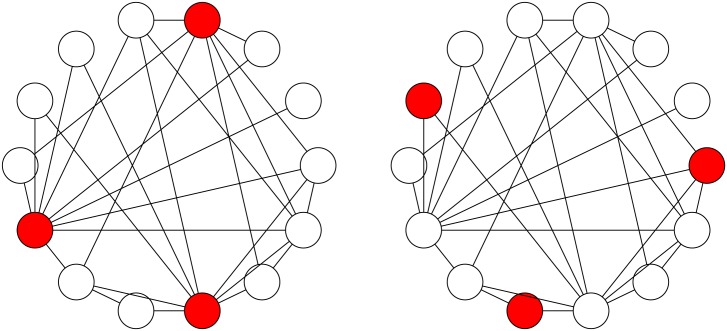
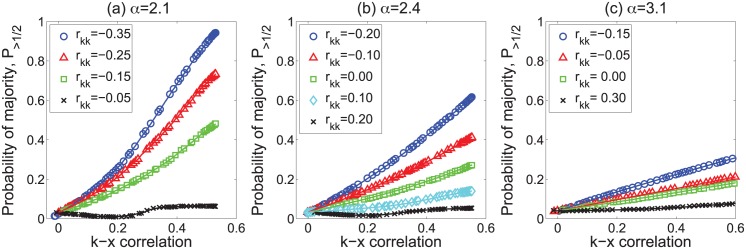
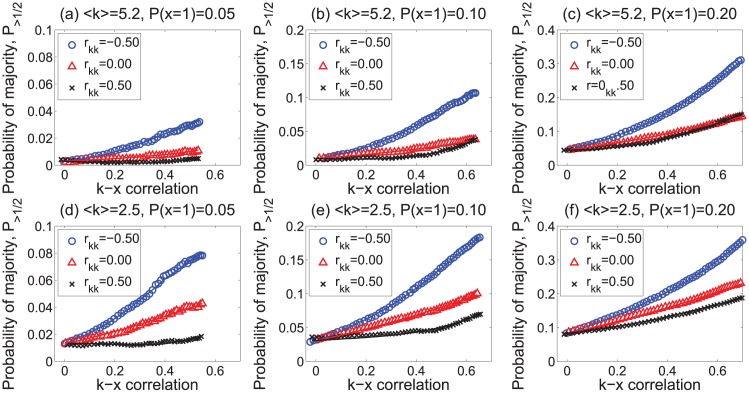
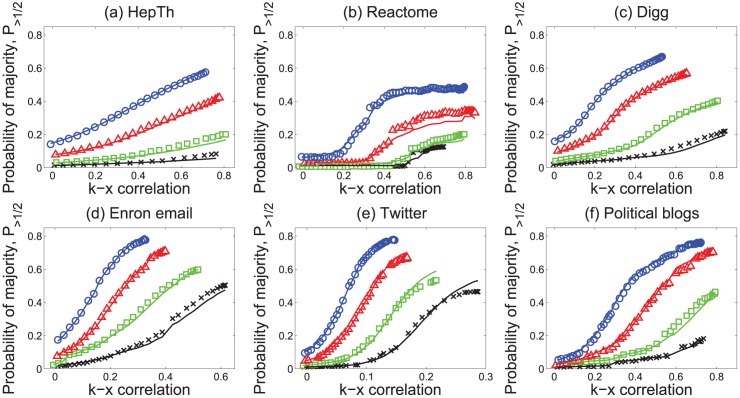
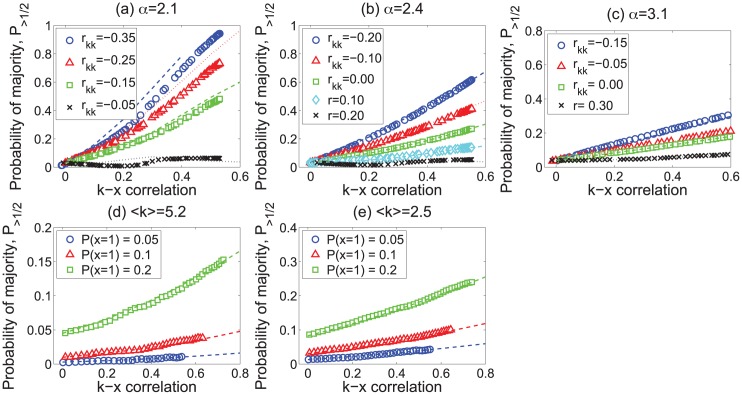
Individual's decisions, from what product to buy to whether to engage in risky behavior, often depend on the choices, behaviors, or states of other people. People, however, rarely have global knowledge of the states of others, but must estimate them from the local observations of their social contacts. Network structure can significantly distort individual's local observations. Under some conditions, a state that is globally rare in a network may be dramatically over-represented in the local neighborhoods of many individuals. This effect, which we call the "majority illusion," leads individuals to systematically overestimate the prevalence of that state, which may accelerate the spread of social contagions. We develop a statistical model that quantifies this effect and validate it with measurements in synthetic and real-world networks. We show that the illusion is exacerbated in networks with a heterogeneous degree distribution and disassortative structure.
Overview
The claims and statistics of this paper haven’t been checked yet.
Run the check — free, no account needed. It reads the open-access text and checks the sources it cites.
Integrity signals
Registry
Cites
Statistics
Figures
Verification
Claims the paper makes
The claims and statistics of this paper haven’t been checked yet.
Run the check — free, no account needed. It reads the open-access text and checks the sources it cites.
Claims other papers make about this one
Each is checked against this paper’s own text: does it say what the citing paper says it does?
The source backs part of the claim, not all of it — or backs it for a different population, condition or comparison.
In the citing paper
“homophily—the tendency of similar people to interact and connect (McPherson et al., 2001)—can systematically bias the perceptions of networked users, resulting in under- or over-estimations of the prevalence of user attributes within a population”
From Social Data: Biases, Methodological Pitfalls, and Ethical Boundaries (2019) · cites this paper as Lerman et al., 2016
Experimental — accuracy not yet measuredThe cited source says what the claim attributes to it.
In the citing paper
“On social platforms, they may also result in systematically biased perceptions about users or content”
From Social Data: Biases, Methodological Pitfalls, and Ethical Boundaries (2019) · cites this paper as Lerman et al., 2016
Self-check
Percentages, sums and reported differences re-computed from the paper’s own numbers.
The self-check needs the paper’s full text.
Citations
Cites
Birds of a Feather: Homophily in Social Networks
McPherson, M., Smith-Lovin, L., & Cook, J. M. (2001) · Annual Review of Sociology · doi:10.1146/annurev.soc.27.1.415 · Cited by 18,567
Availability: A heuristic for judging frequency and probability
Tversky, A., & Kahneman, D. (1973) · Cognitive Psychology · doi:10.1016/0010-0285(73)90033-9 · Cited by 9,984 · cited 1×
“For example, when making social inferences, individuals may use themselves as examples for estimating the states of others (using the “ availability ” heuristic [45]).”
Maximizing the spread of influence through a social network
Kempe, D., Kleinberg, J. M., & Eva Tardos, D. (2003) · ACM SIGKDD Conference on Knowledge Discovery and Data Mining (KDD) · doi:10.1145/956750.956769 · Cited by 7,541
Threshold models of collective behavior
Granovetter, M. (1978) · American Journal of Sociology · doi:10.1086/226707 · Cited by 6,072
Assortative Mixing in Networks
Newman, M. E. J. (2002) · Physical Review Letters · doi:10.1103/physrevlett.89.208701 · Cited by 5,034
The spread of behavior in an online social network experiment
Centola, D. (2010) · Science · doi:10.1126/science.1185231 · Cited by 2,692
A simple model of global cascades on random networks
Watts, D. J. (2002) · Proceedings of the National Academy of Sciences · doi:10.1073/pnas.082090499 · Cited by 2,673
The political blogosphere and the 2004 U.S. election: divided they blog
Adamic, L. A., & Glance, N. (2005) · Proceedings of the 3rd international workshop on Link discovery · doi:10.1145/1134271.1134277 · Cited by 2,619
Superspreading and the effect of individual variation on disease emergence
Lloyd-Smith, J. O., Schreiber, S. J., Kopp, P. E., & Getz, W. M. (2005) · Nature · doi:10.1038/nature04153 · Cited by 2,514
Leskovec, J., Kleinberg, J. M., & Faloutsos, C. (2007) · ACM Transactions on Knowledge Discovery from Data · doi:10.1145/1217299.1217301 · Cited by 2,494
A critical point for random graphs with a given degree sequence
Molloy, M. S. O., & Reed, B. A. (1995) · Random Structures and Algorithms · doi:10.1002/rsa.3240060204 · Cited by 2,267
Experimental Study of Inequality and Unpredictability in an Artificial Cultural Market
Salganik, M. J., Dodds, P. S., & Watts, D. J. (2006) · Science · doi:10.1126/science.1121066 · Cited by 2,231
Diffusion of Innovations, 5th Edition
Rogers, E. M., Simon, 。., & Schuster (2003) · Cited by 2,049
Reactome: a knowledgebase of biological pathways
Joshi-Tope, G. (2004) · Nucleic Acids Research · doi:10.1093/nar/gki072 · Cited by 1,291
Availability: A heuristic for judging frequency and probability
Tversky, A., & Kahneman, D. J. (1982) · Cambridge University Press eBooks · doi:10.1017/cbo9780511809477.012 · Cited by 1,251
The Enron Corpus: A New Dataset for Email Classification Research
Klimt, B., & Yang, Y. (2004) · Lecture notes in computer science · doi:10.1007/978-3-540-30115-8_22 · Cited by 1,238
Efficient Immunization Strategies for Computer Networks and Populations
Reuven Cohen, C., Havlin, S., & ben‐Avraham, D. (2003) · Physical Review Letters · doi:10.1103/physrevlett.91.247901 · Cited by 1,175
Ten years of research on the false-consensus effect: An empirical and theoretical review.
Marks, G. N., & Miller, N. (1987) · Psychological Bulletin · doi:10.1037/0033-2909.102.1.72 · Cited by 1,099
Pluralistic ignorance and alcohol use on campus: Some consequences of misperceiving the social norm.
Prentice, D. A., & Miller, D. T. (1993) · Journal of Personality and Social Psychology · doi:10.1037/0022-3514.64.2.243 · Cited by 1,075
The asymptotic number of labeled graphs with given degree sequences
Bender, E. A., & Canfield, E. R. (1978) · Journal of Combinatorial Theory Series A · doi:10.1016/0097-3165(78)90059-6 · Cited by 924
Biases in the perception of drinking norms among college students.
Baer, J. S., Stacy, A., & Larimer, M. (1991) · Journal of Studies on Alcohol · doi:10.15288/jsa.1991.52.580 · Cited by 688
Why Your Friends Have More Friends Than You Do
Feld, S. L. (1991) · American Journal of Sociology · doi:10.1086/229693 · Cited by 559
Social Network Sensors for Early Detection of Contagious Outbreaks
Christakis, N. A., & Fowler, J. H. (2010) · PLoS ONE · doi:10.1371/journal.pone.0012948 · Cited by 535
Hockey Helmets, Concealed Weapons, and Daylight Saving
Schelling, T. C. (1973) · Journal of Conflict Resolution · doi:10.1177/002200277301700302 · Cited by 502
The power of a good idea: Quantitative modeling of the spread of ideas from epidemiological models
Bettencourt, L. M. A., Cintrón-Arias, A., Kaiser, D. I., & Castillo‐Chávez, C. (2005) · Physica A Statistical Mechanics and its Applications · doi:10.1016/j.physa.2005.08.083 · Cited by 466
The Emperor’s Dilemma: A Computational Model of Self‐Enforcing Norms
Centola, D. M., Willer, R., & Macy, M. W. (2005) · American Journal of Sociology · doi:10.1086/427321 · Cited by 372
Cascade dynamics of complex propagation
Centola, D. M., Eguı́luz, V. M., & Macy, M. W. (2006) · Physica A Statistical Mechanics and its Applications · doi:10.1016/j.physa.2006.06.018 · Cited by 352
Kim, D. A., Hwong, A. R., Stafford, D., Hughes, D. A., O'Malley, A. J., Fowler, J. H., & Christakis, N. A. (2015) · The Lancet · doi:10.1016/s0140-6736(15)60095-2 · Cited by 350
The dynamics of social innovation
Young, H. P. (2011) · Proceedings of the National Academy of Sciences · doi:10.1073/pnas.1100973108 · Cited by 289
The spontaneous emergence of conventions: An experimental study of cultural evolution
Centola, D., & Baronchelli, A. (2015) · Proceedings of the National Academy of Sciences · doi:10.1073/pnas.1418838112 · Cited by 282
Collective Errors and Errors about the Collective
Miller, D. T., & Prentice, D. A. (1994) · Personality and Social Psychology Bulletin · doi:10.1177/0146167294205011 · Cited by 217
On the bias of traceroute sampling
Achlioptas, D., Clauset, A. J., Kempe, D., & Moore, C. (2005) · ACM Symposium on Theory of Computing (STOC) · doi:10.1145/1060590.1060693 · Cited by 164
Hogg, T., & Lerman, K. (2012) · EPJ Data Science · doi:10.1140/epjds5 · Cited by 151
Self-citationKitts, J. A. (2003) · Social Psychology Quarterly · doi:10.2307/1519823 · Cited by 115
Generalized friendship paradox in complex networks: The case of scientific collaboration
Eom, Y.-H., & Jo, H.-H. (2014) · Scientific Reports · doi:10.1038/srep04603 · Cited by 102
Friendship Paradox Redux: Your Friends Are More Interesting Than You
Hodas, N. O., Kooti, F., & Lerman, K. (2021) · Proceedings of the International AAAI Conference on Web and Social Media · doi:10.1609/icwsm.v7i1.14440 · Cited by 101
Self-citationUsing Friends as Sensors to Detect Global-Scale Contagious Outbreaks
García–Herranz, M., Moro, E., Cebrián, M., Christakis, N. A., & Fowler, J. H. (2014) · PLoS ONE · doi:10.1371/journal.pone.0092413 · Cited by 97
Using friends as sensors to detect planetary-scale contagious outbreaks
Cebrián, M. (2012) · doi:10.1145/2390034.2390041 · Cited by 83
The game of contacts: Estimating the social visibility of groups
Salganik, M., Mello, M. B., Abdo, A. H., Bertoni, N., Dimitri Fazito, D., & Bastos, F. I. (2010) · Social Networks · doi:10.1016/j.socnet.2010.10.006 · Cited by 71
The Role of Social Media in the Discussion of Controversial Topics
Smith, L. M., Zhu, L., Lerman, K., & Kozareva, Z. (2013) · International Conference on Social Computing · doi:10.1109/socialcom.2013.41 · Cited by 71
Self-citationModeling the Forming of Public Opinion: An approach from Sociophysics
Galam, S. (2013) · Global Economics and Management Review · doi:10.1016/s2340-1540(13)70002-1 · Cited by 32
Casual Contraception in Casual Sex: Life-Cycle Change in Undergraduates’ Sexual Behavior in Hookups
Bearak, J. (2014) · Social Forces · doi:10.1093/sf/sou091 · Cited by 31
Latané, B., & Darley, J. M. (1969) · PubMed · Cited by 30
Variation in class size, the class size paradox, and some consequences for students
Feld, S. L., & Grofman, B. (1977) · Research in Higher Education · doi:10.1007/bf00991287 · Cited by 27
Network Weirdness: Exploring the Origins of Network Paradoxes
Kooti, F., Hodas, N. O., & Lerman, K. (2014) · Proceedings of the International AAAI Conference on Web and Social Media · doi:10.1609/icwsm.v8i1.14543 · Cited by 26
Self-citationGeneralized friendship paradox in networks with tunable degree-attribute correlation
Jo, H.-H., & Eom, Y.-H. (2014) · Physical Review E · doi:10.1103/physreve.90.022809 · Cited by 22
Han, B., Li, J., & Srinivasan, A. (2013) · IEEE/ACM Transactions on Networking · doi:10.1109/tnet.2013.2280436 · Cited by 22
Structural Properties of Ego Networks
Gupta, S., Yan, X., & Lerman, K. (2015) · Lecture notes in computer science · doi:10.1007/978-3-319-16268-3_6 · Cited by 19
Self-citationNetwork Weirdness: Exploring the Origins of Network ParadoxesPreprint
Kooti, F., Hodas, N. O., & Lerman, K. (2014) · arXiv (Cornell University) · doi:10.48550/arxiv.1403.7242 · Cited by 19
Self-citation
Research works printed but not linked: 2
- AD Berkowitz, 2005, An overview of the social norms approach, Changing the culture of college drinking: A socially situated health communication campaign, 193
- B Latané, 1969, Bystander ‘Apathy’, American Scientist, 57, 244
Cited by
Sorted by citations
Science audiences, misinformation, and fake news
Scheufele, D. A., & Krause, N. M. (2019) · Proceedings of the National Academy of Sciences · doi:10.1073/pnas.1805871115 · Cited by 878
Social Data: Biases, Methodological Pitfalls, and Ethical Boundaries
Olteanu, A., Castillo, C., Diaz, F., & Kıcıman, E. (2019) · Frontiers in Big Data · doi:10.3389/fdata.2019.00013 · Cited by 763
“On social platforms, they may also result in systematically biased perceptions about users or content (Lerman et al., 2016).”
BackgroundCitizens Versus the Internet: Confronting Digital Challenges With Cognitive Tools
Kozyreva, A., Lewandowsky, S., & Hertwig, R. (2020) · Psychological Science in the Public Interest · doi:10.1177/1529100620946707 · Cited by 479
Jiang, Y., Zevenbergen, C., & Ma, Y. (2017) · Environmental Science & Policy · doi:10.1016/j.envsci.2017.11.016 · Cited by 484
Yarchi, M., Baden, C., & Kligler-Vilenchik, N. (2021) · Political Communication · doi:10.1080/10584609.2020.1785067 · Cited by 437
Metadata
- Authors
- Lerman, K., Yan, X., & Wu, X.-Z.
- Affiliations
- University of Southern California (US)
- Corresponding author
- Lerman, Kristina
- Venue
- PLOS ONE
- Publisher
- Public Library of Science (PLoS)
- Published
- 2016-02-17
- Volume
- 11
- Issue
- 2
- Pages
- e0147617
- ISSN
- 1932-6203 (ISSN-L)
- PMC
- PMC4757419
- OpenAlex
- W1552468722
- Cited by
- 669
- References
- 51
- Citations by year
- 2026: 11 · 2025: 13 · 2024: 15 · 2023: 26 · 2022: 22 · 2021: 135 · 2020: 123 · 2019: 119 · 2018: 94 · 2017: 78 · 2016: 30
- FWCI
- 60.61
- Type
- journal article
- Language
- en
- Open access
- gold
- doi.org
- Licence
- Locations
- PLoS ONE (publishedVersion, cc-by)
- Europe PMC (PubMed Central) (publishedVersion, cc-by)
- PubMed Central (publishedVersion, cc-by)
- PubMed (publishedVersion)
- arXiv (Cornell University) (submittedVersion)
- RePEc: Research Papers in Economics (submittedVersion)
- DOAJ (DOAJ: Directory of Open Access Journals) (submittedVersion, cc-by-sa)
- Figshare (submittedVersion, cc-by)
- arXiv (Cornell University)
- Funders
- National Science Foundation (1217605)
- Defense Advanced Research Projects Agency (W911NF- 12-1-0034)
- Advanced Research Projects Agency
- Air Force Office of Scientific Research (FA9550-, FA9550-10-1-, FA9550-10-1-0569)
- Topics
- Physical Sciences › Physics and Astronomy › Statistical and Nonlinear Physics › Complex Network Analysis Techniques
- Physical Sciences › Physics and Astronomy › Statistical and Nonlinear Physics › Opinion Dynamics and Social Influence
- Social Sciences › Economics, Econometrics and Finance › Economics and Econometrics › Complex Systems and Time Series Analysis
- Keywords
- social networks, prevalence estimation, social contagion, network structure, degree heterogeneity, disassortative mixing, statistical models
- MeSH terms
- Humans, Illusions, Normal Distribution, Social Networking
About these checks
Registry, retraction, Cites and statistics results are computed, not judged, with one exception: a printed reference that no index lists is read once by a model before it counts as a citation error. Claims are extracted by a model and kept only when their quote appears verbatim in the text; each cited source is then checked, with a model’s help, for whether it says what the claim relies on. Those verdicts can be wrong — read the claim’s quote and the cited source before relying on one.
Statistics and arithmetic are recomputed, not judged.
Confidence bands are shown only for fields calibrated on our annotated test set. None is calibrated yet, so no band is shown.
What counts as a claim ›How we measure confidence ›How we check this ›
Are you an author, or do you see a problem with this page? Request a review
