

Oxygenation Threshold Derived from Near-Infrared Spectroscopy: Reliability and Its Relationship with the First Ventilatory Threshold
Open accessThe DOI matches its Crossref record; 52 of the 53 references it cites were found in a registry or an index; 7 of the 49 sources its claims cite were checked for support.
Abstract
BACKGROUND: Near-infrared spectroscopy (NIRS) measurements of oxygenation reflect O2 delivery and utilization in exercising muscle and may improve detection of a critical exercise threshold. PURPOSE: First, to detect an oxygenation breakpoint (Δ[O2HbMb-HHbMb]-BP) and compare this breakpoint to ventilatory thresholds during a maximal incremental test across sexes and training status. Second, to assess reproducibility of NIRS signals and exercise thresholds and investigate confounding effects of adipose tissue thickness on NIRS measurements. METHODS: Forty subjects (10 trained male cyclists, 10 trained female cyclists, 11 endurance trained males and 9 recreationally trained males) performed maximal incremental cycling exercise to determine Δ[O2HbMb-HHbMb]-BP and ventilatory thresholds (VT1 and VT2). Muscle haemoglobin and myoglobin O2 oxygenation ([HHbMb], [O2HbMb], SmO2) was determined in m. vastus lateralis. Δ[O2HbMb-HHbMb]-BP was determined by double linear regression. Trained cyclists performed the maximal incremental test twice to assess reproducibility. Adipose tissue thickness (ATT) was determined by skinfold measurements. RESULTS: Δ[O2HbMb-HHbMb]-BP was not different from VT1, but only moderately related (r = 0.58-0.63, p<0.001). VT1 was different across sexes and training status, whereas Δ[O2HbMb-HHbMb]-BP differed only across sexes. Reproducibility was high for SmO2 (ICC = 0.69-0.97), Δ[O2HbMb-HHbMb]-BP (ICC = 0.80-0.88) and ventilatory thresholds (ICC = 0.96-0.99). SmO2 at peak exercise and at occlusion were strongly related to adipose tissue thickness (r2 = 0.81, p<0.001; r2 = 0.79, p<0.001). Moreover, ATT was related to asymmetric changes in Δ[HHbMb] and Δ[O2HbMb] during incremental exercise (r = -0.64, p<0.001) and during occlusion (r = -0.50, p<0.05). CONCLUSION: Although the oxygenation threshold is reproducible and potentially a suitable exercise threshold, VT1 discriminates better across sexes and training status during maximal stepwise incremental exercise. Continuous-wave NIRS measurements are reproducible, but strongly affected by adipose tissue thickness.
Overview
CoChat Summary
TL;DR
In 40 trained and recreationally trained cyclists/endurance athletes, the NIRS-derived Δ[O2HbMb-HHbMb] oxygenation breakpoint was reproducible and not different from VT1 overall, but only moderately related to ventilatory thresholds. VT1 discriminated better across sex and training status, and continuous-wave NIRS SmO2 was strongly confounded by adipose tissue thickness.
Key findings
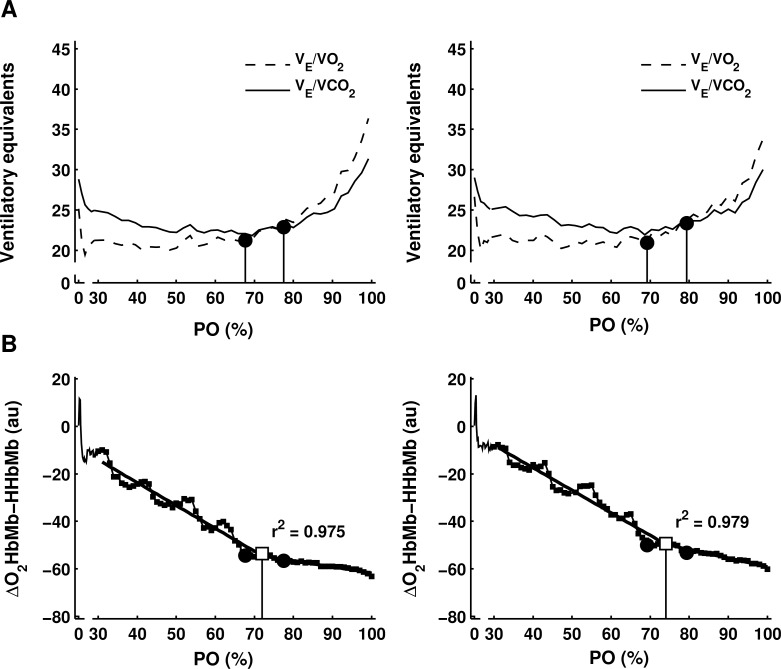
- Δ[O2HbMb-HHbMb]-BP did not differ from VT1 overall (VO2: -0.155±0.509 L/min; PO: -12.1±44.2 W), but was significantly lower than VT2 (VO2: -0.624±0.521 L/min; PO: -56.8±44.2 W, p<0.001). In subgroup analyses, Δ[O2HbMb-HHbMb]-BP was not different from VT1 in CM, CF, and RM, but was significantly smaller than VT1 in EM (p<0.05).
- Δ[O2HbMb-HHbMb]-BP was only moderately related to VT1 (VO2: r=0.63; PO: r=0.58; p<0.001) and VT2 (VO2: r=0.68; PO: r=0.62; p<0.001). Relationships were better in trained cyclists (r=0.68–0.84, p<0.05) than in endurance and recreationally trained males (r=0.48–0.50, p<0.05).
- Reproducibility was high for SmO2 (ICC=0.69–0.97), Δ[O2HbMb-HHbMb]-BP (ICC=0.80–0.88), and ventilatory thresholds (ICC=0.96–0.99).
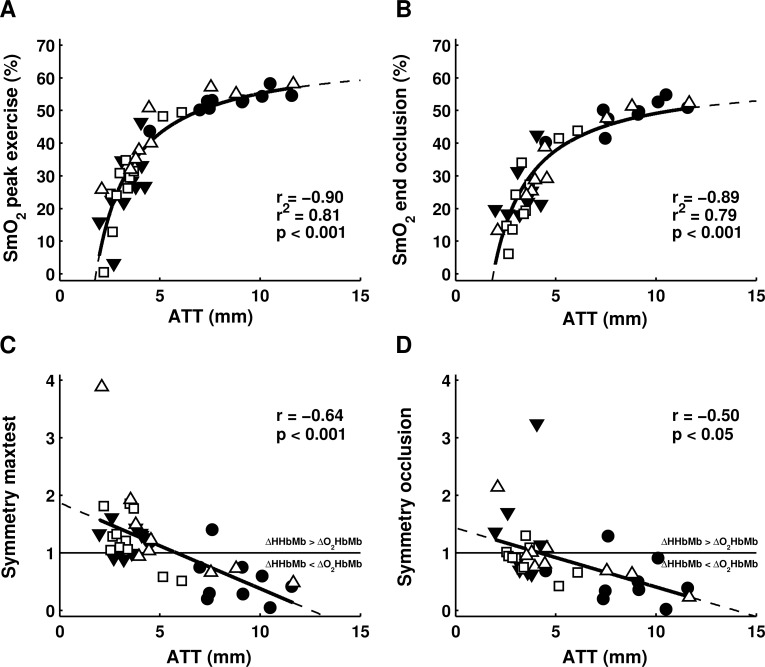
- Adipose tissue thickness explained ~80% of SmO2 variance at peak exercise (r²=0.81, p<0.001) and at occlusion (r²=0.79, p<0.001), and was related to asymmetric changes in Δ[HHbMb] and Δ[O2HbMb] during incremental exercise (r=-0.64, p<0.001) and occlusion (r=-0.50, p<0.05). VT1 differed across sexes and training status, whereas Δ[O2HbMb-HHbMb]-BP differed only across sexes.
Methods
- Forty subjects participated: 10 trained male cyclists, 10 trained female cyclists, 11 endurance trained males, and 9 recreationally trained males. They performed maximal incremental step cycling to exhaustion (start 1.5 W·kg⁻¹, increased 0.5 W·kg⁻¹ every 3 min); NIRS was measured at m. vastus lateralis, arterial occlusion was performed, and adipose tissue thickness was determined by skinfold. Trained cyclists performed the maximal incremental test twice to assess reproducibility.
- Data were converted to 1 Hz, filtered, and analyzed using 30-s moving averages. VT1 was derived using the V-slope method and ventilatory equivalents; VT2 was derived using minute ventilation versus graph and ventilatory equivalents. Δ[O2HbMb-HHbMb]-BP was determined by double linear regression. Statistics included paired t-tests, Pearson correlations, one-way ANOVAs, ICC(3,1), within-subject CV after logarithmic transformation, and hyperbolic/linear regressions.
Limitations
- Stated: step increments (30–50 W) were larger than in previous studies (30 W), possibly affecting Δ[O2HbMb-HHbMb]-BP goodness of fit; measurement errors from visual inspection of ventilatory thresholds and from Δ[O2HbMb-HHbMb]-BP detection (double linear regression, motion artefacts, adipose tissue) may increase unexplained variance. The heterogeneous subject group may have increased inter-individual variation in NIRS patterns.
- Stated: in EM, the smaller Δ[O2HbMb-HHbMb]-BP versus VT1 may be due to the 4 non-cyclists; physiological differences in training status between male groups may have been too small and/or Δ[O2HbMb-HHbMb]-BP measurements not sensitive enough. Correcting Δ[O2HbMb-HHbMb]-BP for ATT is difficult because it remains to be established how ATT affects O2HbMb and HHbMb absorbance at the measured wavelengths.
- Evident: reproducibility was assessed only in trained cyclists (CM and CF), and participants with adipose tissue thickness above 12.5 mm were excluded, so findings may not generalize to other groups or to thicker adipose tissue. Group sizes were small (n=9–11 per group).
Model-written summary. Check it against the paper before relying on it.
Integrity signals
Registry
Cites
Statistics
Figures

Verification
Claims the paper makes
5 Valid · 0 Not valid · 13 Not checked · 63 Own results and interpretations
Every source the paper cites for this claim was checked and supports it.
In the paper
“Only in a single study with sedentary subjects, reproducibility of breakpoints in [O2HbMb] has been determined (r = 0.67–0.85) [23].”
§ Oxygenation Threshold Derived from Near-Infrared Spectroscopy: Reliability and Its Relationship with the First Ventilatory Threshold > Introduction
What the sources say
- Supportedcites [23] Miura T, Takeuchi T, Sato H, Nishioka N, Terakado S, Fujieda Y, et al Skeletal Muscle Deoxygenation During Exercise Assessed by Near-Infrared Spectroscopy and its Relation to Expired Gas Analysis Parameters. Jpn Circ J. 1998; 62: 649– 657. 10.1253/jcj.62.649 9766702 source
The Ramp Protocol Exercise section reports repeat-test correlations of r=0.847 for the first oxy-Hb inflection point (P1) and r=0.667 for the second (P2) in 12 sedentary normal subjects. The paper also says that reproducibility of these NIR spectroscopy parameters had not previously been assessed. The reported correlations concern oxygen uptake at the identified breakpoints. (LLM, conf=0.91)
plainstates an association- Asserted: passes — The authors put it forward as true.
- Checkable: passes — It can be checked against evidence.
- Load-bearing: passes — The paper’s conclusions depend on it.
- Based: passes — The paper gives a reason why it holds.
- Supported
A result the paper reports from its own data — it cites no other source for it, so there is none to check. The quote shows it is in the paper.
In the paper
“Δ[O2HbMb-HHbMb]-BP was not different from VT1, but only moderately related (r = 0.58–0.63, p<0.001).”
- Also stated in: § Critical exercise threshold · plain
“Δ[O2HbMb-HHbMb]-BP was only moderately related to VT1 (: r = 0.63; PO: r = 0.58; p<0.001; Fig 2)”
§ Oxygenation Threshold Derived from Near-Infrared Spectroscopy: Reliability and Its Relationship with the First Ventilatory Threshold > Abstract > Results
plainstates an association- Asserted: passes — The authors put it forward as true.
- Checkable: passes — It can be checked against evidence.
- Load-bearing: passes — The paper’s conclusions depend on it.
- Based: passes — The paper gives a reason why it holds.
- Also stated in: § Critical exercise threshold · plain
A result the paper reports from its own data — it cites no other source for it, so there is none to check. The quote shows it is in the paper.
In the paper
“Reproducibility was high for SmO2 (ICC = 0.69–0.97), Δ[O2HbMb-HHbMb]-BP (ICC = 0.80–0.88) and ventilatory thresholds (ICC = 0.96–0.99).”
- Also stated in: § Reproducibility · plain
“Moreover, reproducibility of and PO values was high at Δ[O2HbMb-HHbMb]-BP (ICC = 0.80–0.88) and excellent at VT1 and VT2 (ICC = 0.96–0.99; Table 3).”
§ Oxygenation Threshold Derived from Near-Infrared Spectroscopy: Reliability and Its Relationship with the First Ventilatory Threshold > Abstract > Results
plain- Asserted: passes — The authors put it forward as true.
- Checkable: passes — It can be checked against evidence.
- Load-bearing: passes — The paper’s conclusions depend on it.
- Based: passes — The paper gives a reason why it holds.
- Also stated in: § Reproducibility · plain
A result the paper reports from its own data — it cites no other source for it, so there is none to check. The quote shows it is in the paper.
In the paper
“Although relative PO was not different between groups at Δ[O2HbMb-HHbMb]-BP, relative PO at VT1 was significantly lower in recreational males compared to other groups (RM< CM~EM~CF, p<0.05).”
§ Oxygenation Threshold Derived from Near-Infrared Spectroscopy: Reliability and Its Relationship with the First Ventilatory Threshold > Results > Critical exercise threshold
plain- Asserted: passes — The authors put it forward as true.
- Checkable: passes — It can be checked against evidence.
- Load-bearing: unclear — It is unclear whether the paper’s conclusions depend on it.
- Based: passes — The paper gives a reason why it holds.
47 more claims
Create a free account to see all 81 claims and to verify the 3 references still open.
- Probably not a substantial claim. 17
- It may state two separate claims as one. 20
Claims other papers make about this one
Each is checked against this paper’s own text: does it say what the citing paper says it does?
The cited source doesn’t support the claim as written.
In the citing paper
“In line with previous studies (Solleiro Pons et al., 2024; van der Zwaard et al., 2016), no significant sex differences or effects of adipose tissue thickness on SmO2 measurements were observed within our sample.”
From Agreement between muscle saturation breakpoints and lactate thresholds: Muscles comparison and sex difference in world‐class Nordic skiers (2026) · cites this paper as van der Zwaard et al., 2016
Checked by a reasoning model — may be wrong.
Experimental — accuracy not yet measuredThe source backs part of the claim, not all of it — or backs it for a different population, condition or comparison.
In the citing paper
“The studies of Feldmann et al.16 and Van der Zwaard et al.42 compared the VT1 and LT1 with MOT1 in cycling and found ICC values (ICC = 0.56–0.65).”
From Reliability of threshold determination using portable muscle oxygenation monitors during exercise testing: a systematic review and meta-analysis (2023) · cites this paper as [42]
Experimental — accuracy not yet measuredThe source backs part of the claim, not all of it — or backs it for a different population, condition or comparison.
In the citing paper
“The remaining studies also compared gas exchange with muscle oxygenation in the second threshold in cycling16,39,42,43 and running16,40.”
From Reliability of threshold determination using portable muscle oxygenation monitors during exercise testing: a systematic review and meta-analysis (2023) · cites this paper as [42]
Experimental — accuracy not yet measuredThe source backs part of the claim, not all of it — or backs it for a different population, condition or comparison.
In the citing paper
“However, previous studies showed good correlations (r = 0.63) between gas exchange and SmO2 data at the first threshold in cycling during step tests (van der Zwaard et al., 2016).”
From A comparative analysis of mathematical methods for detecting lactate thresholds using muscle oxygenation data during a graded cycling test (2023) · cites this paper as van der Zwaard et al., 2016
Experimental — accuracy not yet measuredThe source backs part of the claim, not all of it — or backs it for a different population, condition or comparison.
In the citing paper
“During incremental cycling exercise, SmO2 measured at the vastus lateralis (VL) typically desaturates as a function of increasing exercise intensity, generally following a sigmoidal or segmented linear profile (16–20).”
From Comparing the reliability of muscle oxygen saturation with common performance and physiological markers across cycling exercise intensity (2023) · cites this paper as [16]
Experimental — accuracy not yet measured
7 more claims about this paper
Create a free account to see every claim other papers make about this one.
Self-check
Percentages, sums and reported differences re-computed from the paper’s own numbers.
Each contradiction between two passages listed here was confirmed by an independent check.
Rated minor: it would not touch a result — a value no result rests on, a p-value that stays on the same side of the significance level, or a conflict that is clerical, resolved elsewhere in the paper, or outside its own findings.
In the paper
“| (L/min) | Δ(O2HbMb–HHbMb)-BP | Δ(O2HbMb–HHbMb)-BP | 3.01±0.71 | 3.09±0.70 | -0.09±0.32 | 8.4 | 0.88 |”
§ Oxygenation Threshold Derived from Near-Infrared Spectroscopy: Reliability and Its Relationship with the First Ventilatory Threshold > Results > Reproducibility
Reported -0.09 · recomputed 0.08
Rated minor: it would not touch a result — a value no result rests on, a p-value that stays on the same side of the significance level, or a conflict that is clerical, resolved elsewhere in the paper, or outside its own findings.
In the paper
§ Oxygenation Threshold Derived from Near-Infrared Spectroscopy: Reliability and Its Relationship with the First Ventilatory Threshold > Results > Critical exercise threshold
“Therefore, ventilatory thresholds differed across sexes and training status, whereas Δ[O2Hb-HHb]-BP differed only across sexes.”
§ Oxygenation Threshold Derived from Near-Infrared Spectroscopy: Reliability and Its Relationship with the First Ventilatory Threshold > Results > Critical exercise threshold
“| Δ[O2HbMb-HHbMb]-BP (W) | 230±50 b,d | 156±31 a,c | 208±46 b | 177±32 a |”
Citations
Cites
A new method for detecting anaerobic threshold by gas exchange
Beaver, W. L., Wasserman, K., & Whipp, B. J. (1986) · Journal of Applied Physiology · doi:10.1152/jappl.1986.60.6.2020 · Cited by 4,103 · cited 1×
“VT1 was derived from respiratory exchange measurements using the Vslope method and ventilatory equivalents [35] and VT2 was derived using the minute ventilation versus _ VCO2 graph and ventilatory equivalents [3].”
MethodStraightforward Statistics for the Behavioral Sciences.
Wuensch, K. L., & Evans, J. D. (1996) · Journal of the American Statistical Association · doi:10.2307/2291607 · Cited by 2,409 · cited 1×
“Qualification of correlation coefficientswas performed according to Evans [36].”
MethodFerrari, M., & Quaresima, V. (2012) · NeuroImage · doi:10.1016/j.neuroimage.2012.03.049 · Cited by 2,274
Effects of aging, sex, and physical training on cardiovascular responses to exercise.
Ogawa, T., Spina, R. J., Martin, W. H., Kohrt, W. M., Schechtman, K. B., Holloszy, J. O., & Ehsani, A. A. (1992) · Circulation · doi:10.1161/01.cir.86.2.494 · Cited by 701
Guidelines to classify subject groups in sport-science research
Pauw, K. D., Roelands, B., Cheung, S. S., de Geus, B., Rietjens, G., & Meeusen, R. (2013) · International Journal of Sports Physiology and Performance · doi:10.1123/ijspp.8.2.111 · Cited by 680 · cited 8×
“At this [O2HbMb-HHbMb] breakpoint, the fractional oxygen extraction supposedly has not _ _ _ _ PLOSONE | DOI:10.1371/journal.pone.0162914 September 15, 2016 2 / 16 Abbreviations: Δ[O2HbMb-HHbMb]-BP, oxygenation breakpoint, obtained from subtracting concentration changes in deoxygenated haemoglobinand myoglobin from th…”
MethodInfluentialValidation of near-infrared spectroscopy in humans
Mancini, D. M., Bolinger, L., Li, H., Kendrick, K., Chance, B., & Wilson, J. R. (1994) · Journal of Applied Physiology · doi:10.1152/jappl.1994.77.6.2740 · Cited by 669
Myoglobin O2 desaturation during exercise. Evidence of limited O2 transport.
Richardson, R. S., Noyszewski, E. A., Kendrick, K. F., Leigh, J. S., & Wagner, P. D. (1995) · Journal of Clinical Investigation · doi:10.1172/jci118237 · Cited by 647
Seiler, K. S., & Kjerland, G. Ø. (2006) · Scandinavian Journal of Medicine & Science in Sports · doi:10.1111/j.1600-0838.2004.00418.x · Cited by 643 · cited 4×
“Above LT1 and VT1, blood lactate concentration is elevated [1] and CO2 production exceeds oxygen uptake due to anaerobic energy production in the muscle cells as bicarbonate buffers the produced lactic acid [2].”
BackgroundInfluentialFerrari, M., Muthalib, M., & Quaresima, V. (2011) · Philosophical Transactions of the Royal Society A: Mathematical, Physical and Engineering Sciences · doi:10.1098/rsta.2011.0230 · Cited by 450 · cited 2×
“Near-infrared spectroscopy (NIRS) provides non-invasive measures of the balance between oxygen delivery and consumption in the muscle [7], and thereby NIRS is potentially a very suitable technique to detect a critical exercise threshold directly in the exercising muscle.”
BackgroundAdipose tissue thickness affects in vivo quantitative near-IR spectroscopy in human skeletal muscle
VAN BEEKVELT, M. C. P., BORGHUIS, M. S., VAN ENGELEN, B. G. M., WEVERS, R. A., & COLIER, W. N. J. M. (2001) · Clinical Science · doi:10.1042/cs1010021 · Cited by 369 · cited 2×
“Adipose tissue thickness was calculated by dividing skinfold thickness by two [25], resembling subcutaneous fat and skin.”
Method
Research works printed but not linked: 2
- McCully KK, Hamaoka T. Near-infrared spectroscopy: what can it tell us about oxygen saturation in skeletal muscle? Exerc Sport Sci Rev. 2000; 28: 123– 127. 10916704
- McArdle WD, Katch VL. Exercise Physiology: Energy, Nutrition, and Human Performance 6th Revised edition edition. Philadelphia: Lippincott Williams and Wilkins; 2006.
Cited by
The Importance of ‘Durability’ in the Physiological Profiling of Endurance Athletes
Maunder, E., Seiler, S., Mildenhall, M. J., Kilding, A. E., & Plews, D. J. (2021) · Sports Medicine · doi:10.1007/s40279-021-01459-0 · Cited by 205
Farzam, P., Starkweather, Z., & Franceschini, M. A. (2018) · Physiological Reports · doi:10.14814/phy2.13664 · Cited by 107
Under the Hood: Skeletal Muscle Determinants of Endurance Performance
van der Zwaard, S., Brocherie, F., & Jaspers, R. T. (2021) · Frontiers in Sports and Active Living · doi:10.3389/fspor.2021.719434 · Cited by 89
Self-citationRomero‐Moraleda, B., González‐García, J., Cuéllar-Rayo, Á., Balsalobre‐Fernández, C., Muñoz‐García, D., & Morencos, E. (2019) · Europe PMC (PubMed Central) · Cited by 122
van der Zwaard, S., van der Laarse, W. J., Weide, G., Bloemers, F. W., Hofmijster, M. J., Levels, K., Noordhof, D. A., de Koning, J. J., de Ruiter, C. J., & Jaspers, R. T. (2018) · The FASEB Journal · doi:10.1096/fj.201700827r · Cited by 93
Self-citationNiemeijer, V. M., Jansen, J. P., van Dijk, T., Spee, R. F., Meijer, E. J., Kemps, H. M. C., & Wijn, P. F. F. (2017) · Physiological Measurement · doi:10.1088/1361-6579/aa5dd5 · Cited by 61
“…al 2009, Cooper et al 2010, Grieger et al 2013), reducing optical density (Homma et al 1996, Lin et al 2000), and decreasing sensitivity for deoxygenation with greater ATT (Niwayama et al 2000, Feng et al 2001, van Beekvelt et al 2001, Koga et al 2011, Ohmae et al 2014, van der Zwaard et al 2016).”
Sendra-Pérez, C., Sanchez-Jimenez, J. L., Marzano-Felisatti, J. M., Encarnación-Martínez, A., Salvador-Palmer, R., & Priego-Quesada, J. I. (2023) · Scientific Reports · doi:10.1038/s41598-023-39651-z · Cited by 52
Yogev, A., Arnold, J., Nelson, H., Clarke, D. C., Guenette, J. A., Sporer, B. C., & Koehle, M. S. (2023) · Frontiers in Sports and Active Living · doi:10.3389/fspor.2023.1143393 · Cited by 49
Yogev, A., Arnold, J., Clarke, D., Guenette, J. A., Sporer, B. C., & Koehle, M. S. (2022) · Frontiers in Physiology · doi:10.3389/fphys.2022.818733 · Cited by 35
Muscle Oxygen Saturation Breakpoints Reflect Ventilatory Thresholds in Both Cycling and Running
Feldmann, A., Ammann, L., Gächter, F., Zibung, M., & Erlacher, D. (2022) · Journal of Human Kinetics · doi:10.2478/hukin-2022-0054 · Cited by 41
“Numerous papers have identified BP to correspond with VT1 and or with lactate thresholds (Bhambhani et al., 1997; Grassi et al., 1999; Raleigh et al., 2018; van der Zwaard et al., 2016), whereas others indicated greater similarities between BP and VT2 (Fontana et al., 2015; Inglis et al., 2017).”
ResultBaláš, J., Kodejška, J., Krupková, D., Hannsmann, J., & Fryer, S. M. (2017) · The Journal of Strength and Conditioning Research · doi:10.1519/jsc.0000000000002341 · Cited by 33
“Previously, cw-NIRS–derived parameters during exercise have been shown to be a valid tool for determination of local muscle oxygen consumption, oxygenation threshold, tissue deoxygenation, and O2 recovery rate (3,27,29).”
Hierarchical framework to improve individualised exercise prescription in adults: a critical review
Lehtonen, E., Gagnon, D. D., Eklund, D., Kaseva, K., & Peltonen, J. E. (2022) · BMJ Open Sport & Exercise Medicine · doi:10.1136/bmjsem-2022-001339 · Cited by 40
Determination of Second Lactate Threshold Using Near-infrared Spectroscopy in Elite Cyclists
Salas-Montoro, J.-A., Mateo-March, M., Sánchez-Muñoz, C., & Zabala, M. (2022) · International Journal of Sports Medicine · doi:10.1055/a-1738-0252 · Cited by 27
“Nevertheless, adipose tissue thickness may alter the measured absorption spectrum from the NIRS and SmO2 values can be strongly affected [16,45], so it would be necessary to control this parameter with another less homogeneous sample.”
BackgroundMethodHuman Stress and StO2: Database, Features, and Classification of Emotional and Physical Stress
Liu, X., Shan, Y., Peng, M., Chen, H., & Chen, T. (2020) · Entropy · doi:10.3390/e22090962 · Cited by 28
“StO2 may vary individually, it is influenced by adipose tissue thickness and gender [37].”
BackgroundBaláš, J., Gajdošík, J., Giles, D., Fryer, S. M., Krupková, D., Brtník, T., & Feldmann, A. (2021) · European Journal of Applied Physiology · doi:10.1007/s00421-021-04595-7 · Cited by 35
Time-Trial Performance in Elite Speed Skaters After Remote Ischemic Preconditioning
Richard, P., & Billaut, F. (2018) · International Journal of Sports Physiology and Performance · doi:10.1123/ijspp.2018-0111 · Cited by 40
Vasquez Bonilla, A., González-Custodio, A., Timón, R., Cardenosa, A., Camacho-Cardenosa, M., & Olcina, G. (2023) · Biology of Sport · doi:10.5114/biolsport.2023.114288 · Cited by 22
“…highlight in this study is that the greatest observable changes in SmO 2 occur in the transition from VT1 to VT2, in line with two previous studies [37, 38] showing that the greatest differ - ences in muscle oxygenation could be found when the VO 2 values are between VT1 and VT2 (VO 2 values > 40…”
Lin, C.-W., Huang, C.-F., Wang, J.-S., Fu, L.-L., & Mao, T.-Y. (2020) · Saudi Journal of Biological Sciences · doi:10.1016/j.sjbs.2020.03.005 · Cited by 20
“…+ Mb] and total hemoglobin [Hb + Mb]) (Boone et al., 2015), muscle oxygenation (O2Hb) (Legrand et al., 2007; Racinais et al., 2014), the difference between muscle oxygenation and deoxygenation (D[O2HbMb-HHbMb]) (van der Zwaard et al., 2016), and respiratory muscle oxygenation (Moalla et al., 2005).”
BackgroundMethodResultInfluentialSendra‐Pérez, C., Priego‐Quesada, J. I., Palmer, R. S., Murias, J. M., & Martínez, A. E. (2023) · Journal of Applied Physiology · doi:10.1152/japplphysiol.00420.2023 · Cited by 24
Raleigh, C. J., Donne, B., & Fleming, N. (2018) · International Journal of Exercise Science · doi:10.70252/buct5185 · Cited by 19
“(19) concluded that during incremental exercise the oxygenation threshold was reproducible and coincided with VT1.”
MethodResultSendra-Pérez, C., Encarnacion-Martinez, A., Salvador-Palmer, R., Murias, J. M., & Priego-Quesada, J. I. (2025) · European Journal of Applied Physiology · doi:10.1007/s00421-024-05593-1 · Cited by 16
“This may be related to the type and characteristing of the incremental test (i.e., slow vs. fast step or ramp protocols) (Caen et al. 2021; Iannetta et al. 2019), the method for determining the MOT, or the population evaluated (Jamnick et al. 2020; Van Der Zwaard et al. 2016).”
The effect of severe intensity bouts on muscle oxygen saturation responses in trained cyclists
Yogev, A., Arnold, J. I., Nelson, H., Clarke, D. C., Guenette, J. A., Sporer, B. C., & Koehle, M. S. (2023) · Frontiers in Sports and Active Living · doi:10.3389/fspor.2023.1086227 · Cited by 19
Zhao, F., Tomita, M., & Dutta, A. (2023) · Brain Sciences · doi:10.3390/brainsci13071099 · Cited by 15
Richard, P., & Billaut, F. (2018) · Frontiers in Physiology · doi:10.3389/fphys.2018.01036 · Cited by 18
Giminiani, R. D., Lancia, S., Ferrari, M., Quaresima, V., Vistisen, H. T., Kliltgaard, A., Heick, R. A., Oestergard, K., Soerensen, K. Y., & Cardinale, M. (2018) · IEEE International Symposium on Medical Measurements and Applications (MeMeA) · doi:10.1109/memea.2018.8438785 · Cited by 14
“The integrated use of bio-signals might improve the ability to detect the anaerobic threshold and improve training prescription as compared to the previous studies using EMG [18] or NIRS [19] alone.”
Stuer, L., Teso, M., Colosio, A. L., Loi, M., Mucci, P., Pogliaghi, S., Boone, J., & Caen, K. (2024) · European Journal of Applied Physiology · doi:10.1007/s00421-024-05654-5 · Cited by 13
“%) which is in agreement with previous evidence (Niemeijer et al. 2017; van Hooff et al. 2022; van der Zwaard et al. 2016; Lucero et al. 2018; Thiel et al. 2011; Shoemaker et al. 2023).”
Piucco, T., Soares, R. N., Diefenthaeler, F., Millet, G. Y., & Murias, J. M. (2017) · International Journal of Sports Physiology and Performance · doi:10.1123/ijspp.2017-0440 · Cited by 13
Maliszewski, K., Feldmann, A., McCully, K. K., & Julian, R. (2024) · BMC Sports Science Medicine and Rehabilitation · doi:10.1186/s13102-024-00809-5 · Cited by 13
“Overall, mitochondrial function [15, 16] and a higher oxidative capacity [17–20] are associated with enhanced performance, from patients with chronic illness to endurance athletes.”
BackgroundTutt, A., Persson, H., Andersson, E. P., Ainegren, M., Stenfors, N., & Hanstock, H. G. (2021) · European Journal of Applied Physiology · doi:10.1007/s00421-021-04666-9 · Cited by 10
Yoon, S., Bailey, C. A., Cohen, N., & Côté, J. N. (2021) · Journal of Electromyography and Kinesiology · doi:10.1016/j.jelekin.2021.102564 · Cited by 13
Sendra-Pérez, C., Encarnación-Martínez, A., Oficial-Casado, F., Salvador-Palmer, R., & Priego-Quesada, J. I. (2023) · Physiological Measurement · doi:10.1088/1361-6579/ad1457 · Cited by 9
Miyamoto, T., Watanabe, K., Fukuda, K., & Moritani, T. (2020) · Physical Therapy Research · doi:10.1298/ptr.e9984 · Cited by 9
Whyte, E., Thomas, S. G., & Marzolini, S. (2021) · Journal of Stroke and Cerebrovascular Diseases · doi:10.1016/j.jstrokecerebrovasdis.2021.106265 · Cited by 9
Reinpõld, K., Rannama, I., & Port, K. (2024) · Sports · doi:10.3390/sports12020040 · Cited by 8
“The main biological characteristic that is directly associated with NIRS measurements is ATT, and generally, higher ATT values are related to higher SmO 2 values at any level of exercise intensity [13].”
BackgroundMethodInfluentialEvaluation of leg symmetry in muscle oxygen saturation during submaximal to maximal cycling exercise
Sendra‐Pérez, C., Priego‐Quesada, J. I., Murias, J. M., Carpes, F. P., Palmer, R. S., & Martínez, A. E. (2024) · European Journal of Sport Science · doi:10.1002/ejsc.12230 · Cited by 12
Muscle Oxygenation During Hypoxic Exercise in Children and Adults
Ušaj, A., Mekjavić, I. B., Kapus, J., McDonnell, A. C., Mekjavič, P. J., & Debevec, T. (2019) · Frontiers in Physiology · doi:10.3389/fphys.2019.01385 · Cited by 10
A Review of Factors Associated with Voice Problems in the Fitness Instructor Population
Venkatraman, A., Fujiki, R. B., & Sivasankar, M. P. (2021) · Journal of Voice · doi:10.1016/j.jvoice.2021.05.001 · Cited by 12
Quadriceps muscle oxygenation during a maximum stress test in middle-aged athletes
University of Murcia, U. I. F. R. I. A., Paredes-Ruiz, M.-J., Jodar-Reverte, M., University of Murcia, U. I. F. R. I. A., Ferrer-Lopez, V., University of Murcia, U. I. F. R. I. A., Martínez- González-Moro, I., & University of Murcia, U. I. F. R. I. A. (2020) · Montenegrin Journal of Sports Science and Medicine · doi:10.26773/mjssm.200908 · Cited by 8
Borghi‐Silva, A., Goulart, C. D. L., Carrascosa, C. R., Oliveira, C. C., Berton, D. C., Almeida, D. R., Nery, L. E., Arena, R. A., & Neder, J. A. (2021) · Frontiers in Physiology · doi:10.3389/fphys.2021.685274 · Cited by 8
“The skinfold was 12.5 mm in all patients to ensure that the amount of fat between the muscle probe did not interfere with the signals (van der Zwaard et al., 2016).”
BackgroundInfluentialOsmani, F., Lago-Fuentes, C., Alemany-Iturriaga, J., & Barcala-Furelos, M. (2023) · Frontiers in Physiology · doi:10.3389/fphys.2023.1155037 · Cited by 8
Examining work-to-rest ratios to optimize upper body sprint interval training
Monica, M. B. L., Fukuda, D. H., Starling‐Smith, T. M., Clark, N. W., Morales, J., Hoffman, J. R., & Stout, J. R. (2019) · Respiratory Physiology & Neurobiology · doi:10.1016/j.resp.2019.01.005 · Cited by 7
Brochhagen, J., Barroso, M. T. C., Baumgart, C., Freiwald, J., & Hoppe, M. W. (2020) · BMC Cardiovascular Disorders · doi:10.1186/s12872-020-01661-4 · Cited by 5
Peikon, E., Corso, J. L., Otic, N., Kierul, O. S., Franceschini, M. A., & Robinson, M. B. (2025) · Bioengineering · doi:10.3390/bioengineering12111153 · Cited by 5
Iskra, S., & Paravlic, A. H. (2025) · Scientific Reports · doi:10.1038/s41598-025-14920-1 · Cited by 6
“Various studies have investigated the use of NIRS in both symptomatic and healthy populations with good reproducibility 8,9 .”
Sieciński, S., Kostka, P., & Tkacz, E. (2022) · IEEE Mediterranean Electrotechnical Conference (MELECON) · doi:10.1109/melecon53508.2022.9842972 · Cited by 5
Ušaj, A., Sotiridis, A., & Debevec, T. (2023) · Biology · doi:10.3390/biology12030457 · Cited by 5
Arnet, J., Knaier, R., Schoch, R., D’Hulst, G., Bruggisser, F., Feldmann, A., Leuenberger, R., Westerhuis, E., Infanger, D., Schmidt‐Trucksäss, A., et al. (2025) · International Journal of Sports Physiology and Performance · doi:10.1123/ijspp.2024-0265 · Cited by 5
Vos, L., Vergeer, R. N., Goulding, R. P., Weide, G., de Koning, J. J., Jaspers, R. T., & van der Zwaard, S. (2025) · Applied Artificial Intelligence · doi:10.1080/08839514.2025.2565167 · Cited by 7
“The measurement protocol has been described in detail elsewhere (van der Zwaard et al. 2016).”
Self-citationWhyte, E., Thomas, S. G., & Marzolini, S. (2022) · PM&R · doi:10.1002/pmrj.12927 · Cited by 5
“32,33 Adipose tissue thickness has been shown to affect the NIRS signal because light penetration into the muscle is limited.”
BackgroundMethodInfluentialVasquez-Bonilla, A. A., Camacho-Cardeñosa, A., Camacho-Cardeñosa, M., Martínez‐Guardado, I., Timón, R., & Olcina, G. J. (2016) · RICYDE Revista Internacional de Ciencias del Deporte · doi:10.5232/ricyde2017.04705 · Cited by 2
Sendra‐Pérez, C., Marzano‐Felisatti, J. M., da Silva, W., Pérez‐Soriano, P., Carpes, F. P., & Priego‐Quesada, J. I. (2025) · Physiological Reports · doi:10.14814/phy2.70680 · Cited by 2
“First, NIRS technology was used with participants having different adipose tissue thick-nesses, although all had skinfolds of less than 25 mm (van der Zwaard et al., 2016).”
Beyer, K. S., Stout, J. R., Redd, M. J., Baker, K. M., Bergstrom, H. C., Hoffman, J. R., & Fukuda, D. H. (2018) · Pediatric Exercise Science · doi:10.1123/pes.2017-0250 · Cited by 2
Yang, C.-C., Yang, P.-C., Chen, J.-J. J., Lai, Y.-H., Hu, C.-H., Chang, Y., Tu, S. J., & Guo, L.-Y. (2020) · Sensors · doi:10.3390/s20082197 · Cited by 2
“Only the halfdeoxygenation time of oxygen saturation (StO2), which means the flection time taken to reach 50% of the maximal oxygen consumption during the contraction phase [53] in patients with nonspecific neck pain is shorter than asymptomatic individuals (10.”
BackgroundMethodTilp, M., Mosser, N., Schappacher-Tilp, G., Kruse, A., Birnbaumer, P., & Tschakert, G. (2025) · Frontiers in Physiology · doi:10.3389/fphys.2025.1465344 · Cited by 2
Muscle Oxygen Saturation to Determine Lactate Thresholds in Spinal Cord Injury Population
Sánchez‐Jiménez, J. L., Sendra‐Pérez, C., de Anda, R. M. C.-O., Vazquez-Fariñas, M., Priego‐Quesada, J. I., & Aparicio, I. (2025) · International Journal of Sports Medicine · doi:10.1055/a-2637-7212 · Cited by 1
Romarate, A., Jauregi, A. P., Feldmann, A., Viribay, A., & Santos‐Concejero, J. (2025) · European Journal of Sport Science · doi:10.1002/ejsc.70025 · Cited by 2
“…provides a noninvasive measurement of the balance between oxygen delivery and consumption in active tissue (Ferrari et al. 2011) and thereby, provides an interesting and practical technique to detect critical exercise thresholds directly in the exercising muscle (van der Zwaard et al. 2016).”
InfluentialLesmana, H. S., Schroeder, B., Marume, K., Rodrigues, P., & Lawley, J. S. (2025) · Experimental Physiology · doi:10.1113/ep092908 · Cited by 1
Forot, J., Schorderet, F., Burdet, C., Brocherie, F., & Millet, G. P. (2026) · Experimental Physiology · doi:10.1113/ep093311 · Cited by 1
“However, these studies used different approaches to detect S mO 2 -derivedbreakpoints(BP1andBP2);thatis,throughdoublelinear regression (van der Zwaard et al., 2016), visual identification of a prolonged S mO 2 decrease (Salas-Montoro et al., 2022), detection of a plateau in oxyhaemoglobin increase…”
InfluentialLu, Y.-J., Chen, S., Lai, Y.-C., Chaiyawat, P., Chao, Y.-H., Chuang, L., Shih, T. T., & Wang, H. (2022) · Metabolic Syndrome and Related Disorders · doi:10.1089/met.2021.0101 · Cited by 3
The importance of monitoring saturated oxygen values in hemoglobin in the sports diagnostics
Međedović, B., & Plećaš, J. (2021) · TIMS Acta · doi:10.5937/timsact15-32840 · Cited by 1
“…i dezoksihemoglobina može da se koristi kao pokazatelj opterećenja koje predstavlja prvi anaerobni prag, stanje u kojem radni mišići još uvek nisu dostigli gornji prag korišćenja kiseonika iz krvi, ali ograničenja u dostupnosti kiseonika dovode do pojave laktane acidoze (Zwaard et al., 2016).”
BackgroundChroboczek, M., Jakubowska, M., Kujach, S., Łuszczak, M., & Laskowski, R. (2017) · Baltic Journal of Health and Physical Activity · doi:10.29359/bjhpa.09.3.06
“The muscle tissue oxygenation measurement is limited to a number of external factors (temperature, sunshine, thickness of the fat tissue) [20].”
BackgroundBeyer, K. S. (2017) · STARS (University of Central Florida)
Saturación de oxígeno y test de lactato en ciclistas
Martínez, D. L., Borsani, J. M. C., & Carrasco, C. R. (2021) · MLS Sport Research · doi:10.54716/mlssr.v1i2.673 · Cited by 1
Cesanelli, L., Ylaitė, B., Leite, N. M. C., & Calleja-González, J. (2021) · Journal Of Science & Cycling · doi:10.28985/1221.jsc.02
“This discrepancy might be attributed to methodological differences such as thresholds determination or the utilization of a ramp protocol (Racinais, Buchheit and Girard, 2014) vs. an incremental step protocol (Zwaard et al., 2016).”
BackgroundResultChanges in $$SmO_2$$ Levels During the March on a Treadmill and Rest in Healthy Subjects
Sieciński, S., Kostka, P., & Tkacz, E. (2022) · Lecture notes in networks and systems · doi:10.1007/978-3-030-96293-7_10
Maliszewski, K., Feldmann, A., McCully, K. K., & Julian, R. (2023) · Research Square · doi:10.21203/rs.3.rs-3033672/v1
Blokland, I. J. (2023) · doi:10.5463/thesis.340
Self-citationHasegawa, J. S., Azevedo, R. D. A., Silveira, A. C., Lima‐Silva, A. E., & Bertuzzi, R. (2024) · Brazilian Journal of Medical and Biological Research · doi:10.1590/1414-431x2024e13102 · Cited by 1
“However, while there are a large number of studies showing the reliability and sensitivity of NIRS (13,14), data showing the reliability and sensitivity of wearable NIRS devices (wNIRS) are lacking (15,16).”
BackgroundPredicting physical performance after training: insights from machine learning using small samplesPreprint
Vos, L., Vergeer, R. N., Goulding, R. P., Weide, G., de Koning, J. J., Jaspers, R. T., & van der Zwaard, S. (2024) · Research Square · doi:10.21203/rs.3.rs-4707433/v1
Self-citationSnell, E. R., Succi, P. J., Mitchinson, C. J., Benitez, B., Kwak, M., Kuhn, A. N., & Bergstrom, H. C. (2025) · Journal of Functional Morphology and Kinesiology · doi:10.3390/jfmk10040448
“The results of van der Zwaard et al. [19] similarly demonstrated “excellent” reliability (R = 0.97) of the VT 1 expressed in absolute terms of .”
InfluentialBlunderfield, B., de SANTANA, J. S., Majumdar, R., Herath, I. S., Blouw, M., Ramsey, C., Olafson, K., Sousa, M. L. D. A., Boyd, J. G., Rozenberg, D., et al. (2026) · doi:10.2196/preprints.92346
Lesmana, H. S., Rodrigues, P., Simpson, L. L., Marume, K., Perkins, D. R., & Lawley, J. S. (2026) · Sensors · doi:10.3390/s26103167
“Sensor placement is known to affect the NIRS signal, and the depth of infrared penetration can affect absolute NIRS units [21], particularly given the known variability in thigh adiposity [36].”
Sendra‐Pérez, C., Carrión‐González, C., Wessling-Intriago, P., Marzano‐Felisatti, J. M., Priego‐Quesada, J. I., & Aparicio, I. (2026) · Applied Sciences · doi:10.3390/app16105009
Blunderfield, B., de Santana, J. L., Majumdar, R., Herath, I. S., Blouw, M., Ramsey, C., Olafson, K., Sousa, M. L. D. A., Boyd, J. G., Rozenberg, D., et al. (2026) · JMIR Research Protocols · doi:10.2196/92346
Feldmann, A., Quaresima, V., Perrey, S., & Ferrari, M. (2026) · Sports Medicine - Open · doi:10.1186/s40798-026-01033-w · Cited by 2
“Van der Zwaard et al. [28] noted that although CW SRS NIRS is reliable, it is significantly affected by ATT, which determined asymmetric changes in NIRS signals.”
da Silva, W., Sendra‐Pérez, C., Marzano‐Felisatti, J. M., Aparicio, I., Carpes, F. P., & Priego‐Quesada, J. I. (2026) · PLoS ONE · doi:10.1371/journal.pone.0349644
Single-O 2 ligation of hemoglobin links aerobic and anaerobic metabolism
Burchert, H. H., Stringer, W. W., & Dash, R. K. (2026) · Journal of Applied Physiology · doi:10.1152/japplphysiol.00454.2026
Pyon, Y.-H., Kang, J., Kim, J.-J., Jung, S., Won, J., & Bang, H. (2026) · Journal of Biophotonics · doi:10.1002/jbio.70309
“Subcutaneous fat measurement typically uses skinfold calipers [14–16] or ultrasound [17–20], and research results using computed tomography [21, 22] have been published.”
Machine Learning-Enhanced High Density Near-Infrared Spectroscopy for Exercise Intensity Evaluation
Jinchen, L., Jones, S. H., Jamieson, A., Chen, J., Alghamdi, L., Ella, C., Nazarpour, K., Cooper, R. J., & Zhao, H. (2025) · International IEEE/EMBS Conference on Neural Engineering · doi:10.1109/ner61569.2025.11588963
Fernández-Jarillo, I., Montraveta, J., Iglesias, X., McManus, C., Skotzke, P., & Chaverri, D. (2026) · European Journal of Applied Physiology · doi:10.1007/s00421-026-06357-9
Metadata
- Authors
- van der Zwaard, S., Jaspers, R. T., Blokland, I. J., Achterberg, C., Visser, J. M., den Uil, A. R., Hofmijster, M. J., Levels, K., Noordhof, D. A., de Haan, A., de Koning, J. J., van der Laarse, W. J., & de Ruiter, C. J.
- Affiliations
- Amsterdam Movement Sciences (NL)
- Amsterdam UMC Location Vrije Universiteit Amsterdam (NL)
- Corresponding author
- van der Zwaard, Stephan
- ORCID
- Venue
- PLOS ONE
- Publisher
- Public Library of Science (PLoS)
- Published
- 2016-09-15
- Volume
- 11
- Issue
- 9
- Pages
- e0162914
- ISSN
- 1932-6203 (ISSN-L)
- PMC
- PMC5025121
- OpenAlex
- W2519402594
- Cited by
- 95
- References
- 53
- Citations by year
- 2026: 12 · 2025: 15 · 2024: 6 · 2023: 15 · 2022: 10 · 2021: 12 · 2020: 7 · 2019: 4 · 2018: 7 · 2017: 6 · 2016: 1
- FWCI
- 3.69
- Type
- journal article
- Language
- en
- Open access
- gold
- doi.org
- Licence
- Locations
- PLoS ONE (publishedVersion, cc-by)
- PubMed (publishedVersion)
- PubMed Central (publishedVersion, cc-by)
- Amsterdam UMC (VU Amsterdam) - Institutional Repository (publishedVersion)
- VU Research Portal (publishedVersion, other-oa)
- Data Archiving and Networked Services (DANS) (submittedVersion, other-oa)
- RePEc: Research Papers in Economics (submittedVersion)
- DOAJ (DOAJ: Directory of Open Access Journals) (submittedVersion, cc-by-sa)
- Data Archiving and Networked Services (DANS) (submittedVersion)
- Funders
- Stichting voor de Technische Wetenschappen (NL) (12891)
- Topics
- Health Sciences › Medicine › Physiology (medical) › Cardiovascular and exercise physiology
- Health Sciences › Medicine › Orthopedics and Sports Medicine › Sports Performance and Training
- Health Sciences › Medicine › Radiology, Nuclear Medicine and Imaging › Optical Imaging and Spectroscopy Techniques
- Keywords
- near-infrared spectroscopy, muscle oxygenation, myoglobin, adipose tissue thickness, reproducibility, sex differences, training status, incremental exercise test, vastus lateralis, occlusion, cyclists, endurance training, VO2max
- MeSH terms
- Adipose Tissue, Female, Humans, Male, Oxygen, Reproducibility of Results, Spectroscopy, Near-Infrared
About these checks
Registry, retraction, Cites and statistics results are computed, not judged, with one exception: a printed reference that no index lists is read once by a model before it counts as a citation error. Claims are extracted by a model and kept only when their quote appears verbatim in the text; each cited source is then checked, with a model’s help, for whether it says what the claim relies on. Those verdicts can be wrong — read the claim’s quote and the cited source before relying on one.
The claim verdicts this report counts are experimental: their accuracy is not yet measured.
A language model drew the claims from the paper on 2026-10-13, under version 3 of the claim definition (model deepseek-v4.1-flash, prompt extract-v3).
A second model labelled each claim on 2026-10-13 (model jev-1.13-20260917, definition revision gold-guideline-v0.2).
Cited sources are checked with a language model’s help (gpt-6-sol).
Statistics and arithmetic are recomputed, not judged.
Confidence bands are shown only for fields calibrated on our annotated test set. None is calibrated yet, so no band is shown.
What counts as a claim ›How we measure confidence ›How we check this ›
Are you an author, or do you see a problem with this page? Request a review
Data sources
Bibliographic data: Semantic Scholar, OpenAlex, Crossref.
Contains information from the Semantic Scholar Academic Graph Datasets, made available under the ODC Attribution License (ODC-BY 1.0).
Semantic Scholar’s data is described in: Kinney, R., et al. (2023). The Semantic Scholar Open Data Platform. arXiv:2301.10140.
