

Psychological impacts of “screen time” and “green time” for children and adolescents: A systematic scoping review
Open accessThe DOI matches its Crossref record; 265 of the 270 references it cites were found in a registry or an index; 36 of the 108 sources its claims cite were checked for support.
Abstract
Technological developments in recent decades have increased young people's engagement with screen-based technologies. This systematic scoping review included 186 eligible studies and found that high levels of screen time appeared to be associated with unfavourable psychological outcomes.
Overview
CoChat Summary
## TL;DR
This scoping review identified 186 studies on children and adolescents and found that higher screen time was generally associated with unfavourable psychological outcomes, while green time was generally associated with favourable ones. The evidence is highly heterogeneous and mostly cross-sectional, so the paper argues that stronger longitudinal and intervention studies are needed.
## Key findings
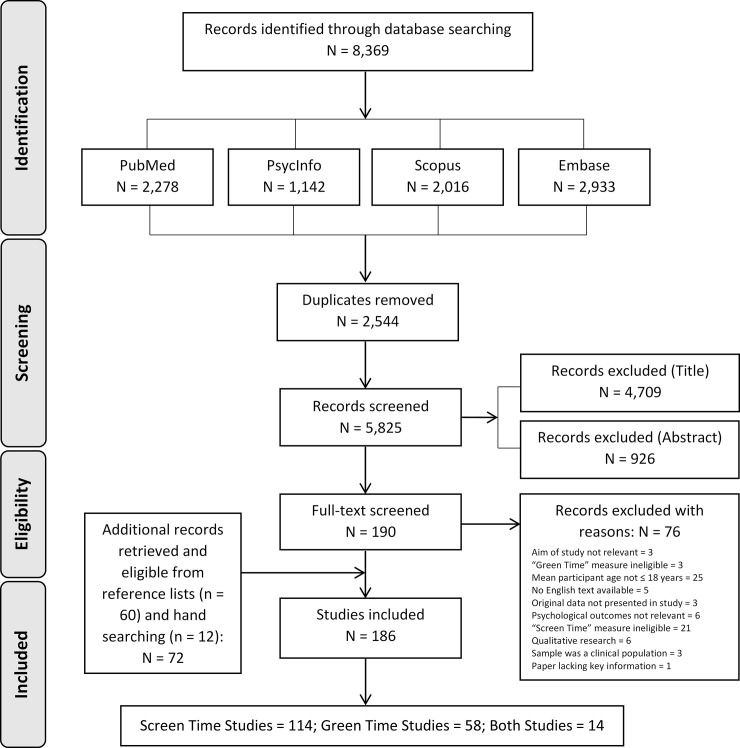
- The review included 186 studies: 114 on screen time (ST), 58 on green time (GT), and 14 on both.
- Across age groups, higher ST was generally linked to unfavourable psychological outcomes, while greater GT was generally linked to favourable psychological outcomes.
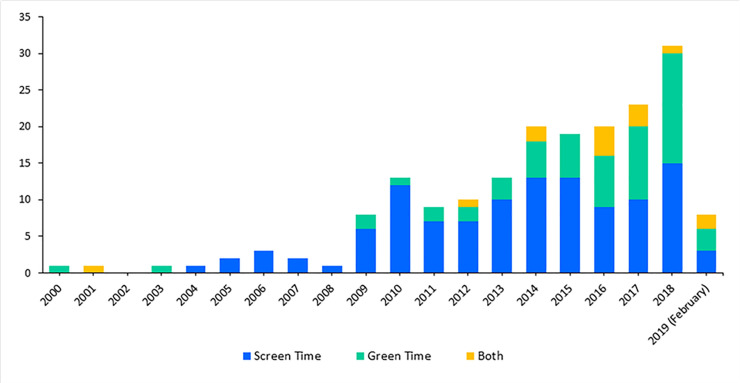
- In the included literature, cross-sectional designs dominated: 74% of ST studies, 42% of GT studies, and 57% of studies of both exposures.
- Sample sizes ranged from 11 to 388,275 participants, with a median of 969.
## Methods
- Design: Systematic scoping review using PRISMA Scoping Review Checklist and Arksey & O’Malley’s framework; no formal quality appraisal or meta-analysis.
- Data/sample: Searches of PubMed, PsycINFO, Embase, and Scopus from inception to 18 February 2019; included peer-reviewed English quantitative studies of children and adolescents aged ≤18 years.
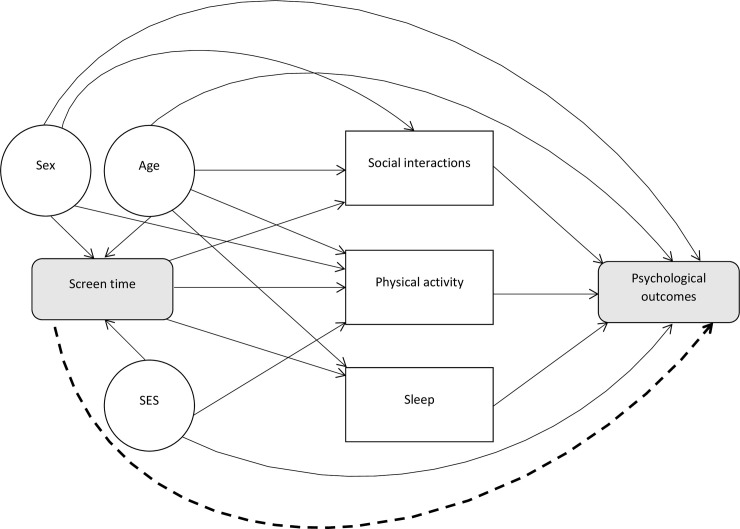
- Main analysis: Studies were charted descriptively and organized by age group, exposure (ST/GT), psychological outcome category, SES, and whether designs allowed some inference about causality.
## Limitations
- The paper states that heterogeneity across studies made it impossible to fully synthesize findings and perform a systematic appraisal or estimate effect sizes.
- The review was limited to English-language articles, which may have missed relevant studies.
- It focused on ST duration rather than content, making it hard to compare recreational vs educational or passive vs interactive screen use.
- Evident from the text: the evidence base is mostly cross-sectional, and studies often used inconsistent exposure/outcome measures, which weakens causal inference and comparability.
Model-written summary. Check it against the paper before relying on it.
Integrity signals
Registry
Cites
Statistics
Figures
Verification
Claims the paper makes
22 Valid · 5 Not valid · 124 Not checked · 106 Own results and interpretations
The cited sources support only part of this claim — read each source’s verdict below.
In the paper
“Experiences of depressive and anxiety symptoms in childhood and adolescence are associated with an elevated risk of poor mental health in adulthood [8–12]”
§ Psychological impacts of “screen time” and “green time” for children and adolescents: A systematic scoping review > 1 Introduction > 1.1 Background
What the sources say
- Not checked — no full text of the sourcecites [8] Baxter A, Vos T, M Scott K, Ferrari A, Whiteford H. The global burden of anxiety disorders in 2010. Psychological Medicine. 2014; 44: 2363– 74. 10.1017/S0033291713003243 24451993 source
- Partly supportedcites [9] Patton GC, Sawyer SM, Santelli JS, Ross DA, Afifi R, Allen NB, et al Our future: a Lancet commission on adolescent health and wellbeing. The Lancet. 2016; 387(10036): 2423– 78. PMC5832967 27174304 sourceExperimental — accuracy not yet measured
In ‘The global health profile of adolescents and young adults’ (page not available), the paper says mental disorders often begin in late childhood or adolescence and many persist into adulthood. It does not establish the claimed adult risk specifically for childhood and adolescent depressive and anxiety symptoms; the ‘Mental disorders’ section also notes that not all adolescent mental health problems persist, particularly brief episodes. (LLM, conf=0.83)
- Not checked — no full text of the sourcecites [10] Pine D, Cohen E, Cohen P, Brook J. Adolescent Depressive Symptoms as Predictors of Adult Depression: Moodiness or Mood Disorder? The American Journal of Psychiatry. 1999; 156: 133– 5. 10.1176/ajp.156.1.133 9892310 source
- Partly supportedcites [11] Copeland WE, Angold A, Shanahan L, Costello EJ. Longitudinal Patterns of Anxiety From Childhood to Adulthood: The Great Smoky Mountains Study. Journal of the American Academy of Child & Adolescent Psychiatry. 2014; 53(1): 21– 33. 24342383 PMC3939681 sourceExperimental — accuracy not yet measured
The Discussion reports links between childhood anxiety status and adult psychiatric outcomes, while the Results link childhood anxiety disorders to adverse functioning in young adulthood. The paper does not establish the claimed association for childhood depressive symptoms; its analyses concern anxiety disorders rather than depressive and anxiety symptoms together. (LLM, conf=0.86)
- Not checked — no full text of the sourcecites [12] Hofstra MB, Van der Ende JAN, Verhulst FC. Continuity and Change of Psychopathology From Childhood Into Adulthood: A 14-Year Follow-up Study. Journal of the American Academy of Child & Adolescent Psychiatry. 2000; 39(7): 850– 8. 10892226 source
plainstates an association- Asserted: passes — The authors put it forward as true.
- Checkable: passes — It can be checked against evidence.
- Load-bearing: passes — The paper’s conclusions depend on it.
- Based: passes — The paper gives a reason why it holds.
The cited sources support only part of this claim — read each source’s verdict below.
In the paper
“However, research investigating the psychological impacts of ST or GT typically considers ST and GT in isolation and fails to delineate the reciprocal effects of high technology use and low contact with nature on mental health and cognitive outcomes [53].”
§ Psychological impacts of “screen time” and “green time” for children and adolescents: A systematic scoping review > 1 Introduction > 1.1 Background
What the sources say
- Partly supportedcites [53] Atchley RA, Strayer DL, Atchley P. Creativity in the Wild: Improving Creative Reasoning through Immersion in Natural Settings. PLoS ONE. 2012; 7(12): e51474 10.1371/journal.pone.0051474 23251547 PMC3520840 sourceExperimental — accuracy not yet measured
Split into 2 atoms — 0 confirmed, 2 partially supported, 0 disputed, 0 misattributed, 0 unverifiable. Expand the claim to see per-atom verdicts.
plain- Asserted: passes — The authors put it forward as true.
- Checkable: passes — It can be checked against evidence.
- Load-bearing: passes — The paper’s conclusions depend on it.
- Based: passes — The paper gives a reason why it holds.
- Partly supported
The cited sources support only part of this claim — read each source’s verdict below.
In the paper
“However, from a developmental neurobiology perspective, excessive ST may be detrimental to young people as ST stimulates neurobiological systems such as the hypothalamic-pituitary-adrenal (HPA) axis [24] and dopaminergic circuitries [25].”
§ Psychological impacts of “screen time” and “green time” for children and adolescents: A systematic scoping review > 1 Introduction > 1.1 Background
What the sources say
- Not checked — no full text of the sourcecites [24] Brunetti VC, O'Loughlin EK, O'Loughlin J, Constantin E, Pigeon É. Screen and nonscreen sedentary behavior and sleep in adolescents. Sleep Health. 2016; 2(4): 335– 40. 10.1016/j.sleh.2016.09.004 29073392 source
- Partly supportedcites [25] Giedd JN. The Digital Revolution and Adolescent Brain Evolution. Journal of Adolescent Health. 2012; 51(2): 101– 5. 10.1016/j.jadohealth.2012.06.002 22824439 PMC3432415 sourceExperimental — accuracy not yet measured
The Entertainment section says video games stimulate reward circuitry involving dopamine, and Attention Economy raises a possible downside of sustained dopamine stimulation. The citation [25] is attached to the dopaminergic-circuitry claim, not the HPA-axis claim. The source discusses video games and poses the detrimental effect as a question; it does not establish that screen time generally has that effect. (LLM, conf=0.86)
hedgedstates a possible cause- Asserted: passes — The authors put it forward as true.
- Checkable: passes — It can be checked against evidence.
- Load-bearing: unclear — It is unclear whether the paper’s conclusions depend on it.
- Based: passes — The paper gives a reason why it holds.
The cited sources support only part of this claim — read each source’s verdict below.
In the paper
“Children in high-income countries are now experiencing significantly lower levels of contact with nature, or GT, than previous generations [35, 36].”
§ Psychological impacts of “screen time” and “green time” for children and adolescents: A systematic scoping review > 1 Introduction > 1.1 Background
What the sources say
- Partly supportedcites [35] Bratman GN, Hamilton JP, Hahn KS, Daily GC, Gross JJ. Nature experience reduces rumination and subgenual prefrontal cortex activation. Proc Natl Acad Sci USA. 2015; 112(28): 8567– 72. 10.1073/pnas.1510459112 26124129 PMC4507237 sourceExperimental — accuracy not yet measured
The paper’s introductory passages say that urbanization corresponds to decreased nature experience and that a larger share of humanity is removed from nature than ever before (page unavailable). They do not establish the claim specifically for children in high-income countries or quantify a significant difference from previous generations. (LLM, conf=0.86)
- Not checked — no full text of the sourcecites [36] Soga M, Gaston KJ. Extinction of experience: the loss of human–nature interactions. Frontiers in Ecology and the Environment. 2016; 14(2): 94– 101. source
plain- Asserted: passes — The authors put it forward as true.
- Checkable: passes — It can be checked against evidence.
- Load-bearing: passes — The paper’s conclusions depend on it.
- Based: passes — The paper gives a reason why it holds.
- Partly supported
The sources with a verdict support this claim; the rest weren’t checked yet, have no full text we could read, or their verdicts aren’t rated yet.
In the paper
“Moderate ST can be beneficial for young people in a connected world [22] as it may afford them with opportunities to enhance existing relationships, forge new connections, engage in safe identity exploration, aid in academic pursuits, and provide access to information about the world beyond their immediate surroundings [23].”
§ Psychological impacts of “screen time” and “green time” for children and adolescents: A systematic scoping review > 1 Introduction > 1.1 Background
What the sources say
- Supportedcites [22] Przybylski AK, Weinstein N. A Large-Scale Test of the Goldilocks Hypothesis: Quantifying the Relations Between Digital-Screen Use and the Mental Well-Being of Adolescents. Psychological Science. 2017; 28(2): 204– 15. 10.1177/0956797616678438 28085574 source
The Avenues for future work section (p. 11) says moderate digital engagement may have positive correlates with well-being and may afford advantages to adolescents. The Confirmatory analyses (p. 8) report positive or flat associations below the study’s screen-time thresholds, with an exception for weekend smartphone use. The claim’s 'can be beneficial' wording reflects that qualified possibility. (LLM, conf=0.91)
- Not checked — no full text of the sourcecites [23] Uhls YT, Ellison NB, Subrahmanyam K. Benefits and Costs of Social Media in Adolescence. Pediatrics. 2017; 140(Suppl 2): S67– s70. 10.1542/peds.2016-1758E 29093035 source
plainstates a possible cause- Asserted: passes — The authors put it forward as true.
- Checkable: passes — It can be checked against evidence.
- Load-bearing: unclear — It is unclear whether the paper’s conclusions depend on it.
- Based: passes — The paper gives a reason why it holds.
- Supported
111 more claims · 2 with their cited sources checked
Create a free account to see all 257 claims and to verify the 5 references still open.
- Probably not a substantial claim. 55
- It may state two separate claims as one. 107
- The quote only partly states this claim. 4
Claims other papers make about this one
Each is checked against this paper’s own text: does it say what the citing paper says it does?
The check wasn’t confident either way, so it gives no verdict — never disputed.
In the citing paper
“Additionally, parents often raise concerns about privacy, misinformation, and content appropriateness [10, 37, 58]”
From SET-PAiREd: Designing for Parental Involvement in Learning with an AI-Assisted Educational Robot (2025) · cites this paper as [58]
Experimental — accuracy not yet measuredIn the citing paper
“On the negative side, technology introduces risks such as excessive screen time, exposure to inappropriate content, and misinformation, which necessitate parental intervention [37, 58].”
From SET-PAiREd: Designing for Parental Involvement in Learning with an AI-Assisted Educational Robot (2025) · cites this paper as [58]
In the citing paper
“it has been posited that youth from low SES backgrounds may disproportionally impacted by psychological problems linked to high screen time [24].”
Citations
Cites
PRISMA Extension for Scoping Reviews (PRISMA-ScR): Checklist and Explanation
Tricco, A. C., Lillie, E., Zarin, W., O'Brien, K. K., Colquhoun, H., Levac, D., Moher, D., Peters, M. D. J., Horsley, T., Weeks, L., et al. (2018) · Annals of Internal Medicine · doi:10.7326/m18-0850 · Cited by 43,565
Scoping studies: towards a methodological framework
Arksey, H., & O'Malley, L. (2005) · International Journal of Social Research Methodology · doi:10.1080/1364557032000119616 · Cited by 36,742 · cited 6×
“While a formal risk of bias assessment was not performed (not required in scoping reviews [58]), a preliminary assessment of each study’s ability to permit examination of causal linkages, based on two key design features, was conducted.”
BackgroundMethodInfluentialThe future of employment: How susceptible are jobs to computerisation?
Frey, C. B., & Osborne, M. A. (2017) · Technological Forecasting and Social Change · doi:10.1016/j.techfore.2016.08.019 · Cited by 8,727
The restorative benefits of nature: toward an integrative framework
Kaplan, S. (1995) · Journal of Environmental Psychology · doi:10.1016/0272-4944(95)90001-2 · Cited by 6,923 · cited 5×
“, provide a feeling of ‘getting away’), may be more important for early-to-late adolescents because they provide opportunities for respite and mind-wandering [46].”
BackgroundInfluentialEffects of stress throughout the lifespan on the brain, behaviour and cognition
Lupien, S. J., McEwen, B. S., Gunnar, M. R., & Heim, C. (2009) · Nature Reviews Neuroscience · doi:10.1038/nrn2639 · Cited by 6,256
Stress recovery during exposure to natural and urban environments
Ulrich, R. S., Simons, R. F., Losito, B. D., Fiorito, E., Miles, M. A., & Zelson, M. (1991) · Journal of Environmental Psychology · doi:10.1016/s0272-4944(05)80184-7 · Cited by 5,990 · cited 3×
“Similarly, Stress Reduction Theory contends that due to extensive human evolution in natural environments, modern humans may have a biologically prepared readiness to quickly and readily acquire restoration from stress in natural settings, but have no such preparedness for highly stimulating technological environments…”
BackgroundOur future: a Lancet commission on adolescent health and wellbeing
Patton, G. C., Sawyer, S. M., Santelli, J. S., Ross, D. A., Afifi, R., Allen, N. B., Arora, M., Azzopardi, P., Baldwin, W., Bonell, C., et al. (2016) · The Lancet · doi:10.1016/s0140-6736(16)00579-1 · Cited by 3,785
Hartig, T., Mitchell, R., de Vries, S., & Frumkin, H. (2014) · Annual Review of Public Health · doi:10.1146/annurev-publhealth-032013-182443 · Cited by 3,638 · cited 2×
“Natural areas also tend to be less crowded, with reduced air and noise pollution, which is beneficial for overall health [41].”
BackgroundMental health of young people: A global public-health challenge
Patel, V., Flisher, A. J., Hetrick, S., & McGorry, P. (2007) · The Lancet · doi:10.1016/s0140-6736(07)60368-7 · Cited by 3,126
Why do many psychiatric disorders emerge during adolescence?
Paus, T., Keshavan, M., & Giedd, J. N. (2008) · Nature Reviews Neuroscience · doi:10.1038/nrn2513 · Cited by 3,123
Research works printed but not linked: 5
- Moss S. Natural Childhood. UK: National Trust; 2012. 28 p.
- Planet Ark. Climbing Trees: Getting Aussie Kids Back Outdoors Australia. Australia: Planet Ark; 2011. 11 p.
- Plitponkarnpim A, Srikaew C, Puranitee P, Vallibhakara SAO. Ict exposure in children younger than 2 years: Rates, associated factors, and health outcomes. Journal of the Medical Association of Thailand. 2018; 101(3): 345– 9.
- de Haan J, Huysmans F. IT/Media Use and Psychological Development Among Dutch Youth. IT&SOCIETY. 2004; 1(6): 44– 58.
- Stainbrook E. Human needs and the natural environment. Man and Nature in the City. 1968: 1– 9.
Cited by
Items 201–300 of 367
Análisis de la fatiga digital en estudiantes: estrategias para reducir el agotamiento
Rodríguez, I., Intriago, M. J. R., Castillo, R. E. A., Cárdenas, M. C. R., Zambrano, E. E. V., & Santander, M. D. C. M. (2024) · South Florida Journal of Development · doi:10.46932/sfjdv5n12-004 · Cited by 2
Suárez-Manzano, S., Solas-Martínez, J. L., Loureiro, V., & Rusillo-Magdaleno, A. (2023) · Retos · doi:10.47197/retos.v51.101337 · Cited by 10
Liu, H., Yi, S., Li, Y.-W., Sun, J., Xiao, W., Bai, Y., & Chen, Y. (2025) · BMC Public Health · doi:10.1186/s12889-025-25050-8 · Cited by 6
“Some studies have indicated that high-quality screen usage, which includes watching educational programs and co-viewing with caregivers, showed a positive correlation with children’s language skills [7–10].”
Transformative Technologies for Children: Going beyond ‘Good’
Fitton, D., Read, J. C., Eriksson, E. W., Bonsignore, E., Iivari, N., Hartikainen, H., & Dick, R. A. (2024) · CHI Conference Extended Abstracts on Human Factors in Computing Systems (CHI EA) · doi:10.1145/3613905.3636317 · Cited by 2
“There are many prevailing negative factors that link closely with technology usage such as increasing childhood loneliness (e.g. [ 27]), problematic impacts from social media use (e.g. [1 ]), and impacts from increasing screen time (e.g. [ 16]).”
Yang, Y., Vaughan, L., & Carmona, M. (2025) · Land · doi:10.3390/land14122340 · Cited by 4
“For individuals, reduced outdoor activities is linked to physical health issues like obesity [6] and myopia [7], and mental health conditions [8] including anxiety and depression [9].”
Pereira, D. R., Clementino, M. T. R., da Silveira, E. A. A., & Moura, W. M. (2022) · Ciência Cuidado e Saúde · doi:10.4025/ciencuidsaude.v21i0.58427 · Cited by 2
Social-Ecological Perspectives and Their Influence on Climate Distress in Young People
Crandon, T., Thomas, H. J., & Scott, J. G. (2024) · Cambridge University Press eBooks · doi:10.1017/9781009252904.017 · Cited by 3
Lemberg, G. M., Kull, M., Mäestu, J., Riso, E., Mägi, K., & Mäestu, E. (2024) · Frontiers in Sports and Active Living · doi:10.3389/fspor.2024.1433801 · Cited by 2
Dias, P. H. G., Franscisquini, M. C. J., Silva, T. M. D. S., dos Santos, G. C., Barbosa, R. D. O., da Silva, J. M., & Neto, A. S. (2025) · International Journal of Environmental Research and Public Health · doi:10.3390/ijerph22060969 · Cited by 4
Jeux vidéo à l’adolescence : paradoxes en temps de pandémie
Lesimple, P., Verley, J.-B., Laplace, B., & Olliac, B. (2021) · Neuropsychiatrie de l Enfance et de l Adolescence · doi:10.1016/j.neurenf.2021.10.002 · Cited by 2
Screen Use and Emotional, Behavioral, and Social Development in Children
McQuaid, F., Skafida, V., McQuillan, R., & Lee, B. (2026) · JAMA Network Open · doi:10.1001/jamanetworkopen.2026.26804 · Cited by 1
Just give them childcare: The COVID-19 pandemic as a natural experiment in parenting practicesPreprint
Hartshorne, J. K. (2021) · PsyArXiv (OSF Preprints) · doi:10.31234/osf.io/r64hf · Cited by 1
Frei, E., Filiz, T. T., Frei, O., et al. (2025) · medRxiv · doi:10.1101/2025.01.07.25320110 · Cited by 1
Doğan, G., & Ayhan, N. Y. (2024) · Hacettepe Üniversitesi Sağlık Bilimleri Fakültesi Dergisi · doi:10.21020/husbfd.1333302 · Cited by 1
Influência das mídias sociais no comportamento sexual de adolescentes: insights da Indonésia
Saud, M., Mas’udah, S., Raguindin, P. Z. J., Ramya, S., Falahat, M., Ashfaq, A., & Ibrahim, A. (2025) · Saúde e Sociedade · doi:10.1590/s0104-12902025240732pt · Cited by 3
Positive Youth Development at Sea: A Case Study of the Shenandoah Model
Blum, C., Tucker, A. R., Levran, M., Holmes, L., & Walsh, H. (2024) · Journal of Experiential Education · doi:10.1177/10538259241275051 · Cited by 2
“In line with data from other adventure programs, this unplugged experience is thought to have positive outcomes for students (Megret, 2023; Oswald et al., 2020; Tucker et al., 2023).”
Technology Utilization and Physical Engagement Among Children with Disabilities in Nepal
Acharya, Y. (2023) · Journal of Health Promotion · doi:10.3126/jhp.v11i1.61207 · Cited by 1
“Because, using technology disrupts children's regular activities and eventually leads to decreased physical exercise (Oswald et al., 2020).”
BackgroundDauda, R. B., & Abdulkadir, A. O. (2025) · Fenomena · doi:10.35719/fenomena.v24i2.255 · Cited by 1
“Furthermore, a growing body of evidence links excessive technology and social media use to increased stress and feelings of isolation, creating a new dimension of risk for student well-being (Mundy et al., 2021; Oswald et al., 2020).”
Chen, X., & Kühner, S. (2025) · Journal of Children and Media · doi:10.1080/17482798.2025.2583149 · Cited by 2
“In contrast, children from lower-SES backgrounds typically face limited access to enriching digital activities and may be more vulnerable to the negative consequences of excessive screen time (Oswald et al., 2020).”
Safeguarding Tomorrow - Fortifying Child Safety in Digital Landscape
Nair, S. S., Lakshmikanthan, G., Kendyala, S. H., & Dhaduvai, V. S. (2024) · International Conference on Computing, Sciences and Communications (ICCSC) · doi:10.1109/iccsc62048.2024.10830389 · Cited by 2
Screen Use Measurement Tools: A Mapping of Instruments, Gaps, and Future Directions
Shaleha, R. R. A., Roque, N. A., Andrews, H. J., Calfee, K., & Lee, S. (2026) · Cyberpsychology Behavior and Social Networking · doi:10.1177/21522715261417288 · Cited by 3
“, 59 it remains debated due to the diversity of screen-based behaviors and their various contexts (e.g., exercise apps, online learning, or remote socialization, which may themselves be enriching).”
Ryynanen, J., MacLennan, K., Witten, E., Tipp, C., Wisdom, S., & Chan, S. W. Y. (2023) · Wellcome Open Research · doi:10.12688/wellcomeopenres.19584.1 · Cited by 3
Screen Use and Its Association with ADHD Symptoms among Children: A Systematic Review
Pan, Y., Li, X., & Yu, Y. (2023) · MEDS Public Health and Preventive Medicine · doi:10.23977/phpm.2023.030301 · Cited by 1
“As a result of this, people with ADHD tend to have frequent and screen time on social media, television, games and more as it helps them experience intense feelings of pleasure and satisfaction ([20]).”
BackgroundUrroz, J., & Christiana, R. W. (2024) · Ecopsychology · doi:10.1089/eco.2023.0072 · Cited by 1
“Unfortunately, technological advancements in recent years have increased the amount of time children spend using screen-based technologies, resulting in the concurrent reduction in the amount of time children spend connected to nature (Oswald et al., 2020).”
Influence of social media on teenagers sexual behaviors; insights from Indonesia
Saud, M., Mas’udah, S., Raguindin, P. Z. J., Ramya, S., Falahat, M., Ashfaq, A., & Ibrahim, A. (2025) · Saúde e Sociedade · doi:10.1590/s0104-12902025240732in · Cited by 6
Exposure to nature scenes mitigates the adverse effects of adolescents’ social ostracism
Moll, A., Collado, S., Ratcliffe, E., Sorrel, M. Á., & Corraliza, J. A. (2025) · Journal of Environmental Psychology · doi:10.1016/j.jenvp.2025.102790 · Cited by 2
Screen time and physical activity in schoolchildren
Molina, S. F., García-Ceberino, J. M., la Cruz, M. L.-D., & Pérez, M. L. (2026) · Cogent Education · doi:10.1080/2331186x.2026.2682595 · Cited by 1
Nyberg, S. (2022) · Linköping studies in behavioural science · doi:10.3384/9789179295202 · Cited by 1
Freijo, E. B. A., Barreto‐Zarza, F., de la Hidalga, A. M., Llerena, C. T., Macía, P., Garcia‐Elburgo, S., & Sánchez‐Pinedo, S. (2024) · Family Relations · doi:10.1111/fare.13112 · Cited by 3
Social media exposure and appearance anxiety: A chain mediation model moderated by physical activity
Ren, W., Tian, Y., Liu, D., Chen, Z., & Yang, S. (2026) · Acta Psychologica · doi:10.1016/j.actpsy.2026.106594 · Cited by 4
Gagliardi, J. A., & O’Brien, K. H. (2025) · Journal of Family Social Work · doi:10.1080/10522158.2025.2537648 · Cited by 6
“A recent systematic review examined the psychological impacts of increased screen time for children and adolescents, with screen time defined as time spent engaging with screen-based technologies such as computers, tablets, smartphones, televisions, and video game systems (Oswald et al., 2020).”
Analysis of Parental Restrictions on Smartphone Use for Early Childhood
Yuniarni, D., Surjaningrum, E. R., & Dewi, T. K. (2024) · JTP - Jurnal Teknologi Pendidikan · doi:10.21009/jtp.v26i3.52007 · Cited by 1
“Psychosocial impacts include causing aggression (Oswald et al., 2020) and impacting on interactions between children and parents (Matthes et al., 2021).”
MacLennan, K., Byrne, P., Allan, S., Gambier-Ross, K., Jain, P., & Chan, S. W. Y. (2024) · Wellcome Open Research · doi:10.12688/wellcomeopenres.20933.1 · Cited by 1
“These images primarily depicted images of nature, aligning with research that has established a link between exposure to nature and wellbeing (Li et al. , 2018; Oswald et al. , 2020).”
BackgroundKong, X., Deng, M., Xiong, S., Zeng, C., Zhang, Z., He, C., & Zhang, B. (2025) · BMC Psychology · doi:10.1186/s40359-025-03805-7 · Cited by 3
“Additionally, the use of devices like mobile phones has increased screen time for students [56].”
Media consumption by preschool children: The risk of autism and developmental disorders
Kamp‐Becker, I., & Poustka, L. (2025) · Deutsches Ärzteblatt international · doi:10.3238/arztebl.m2025.0087 · Cited by 3
Rich-Degeneve, S., & Reiss, M. J. (2025) · Journal of Biological Education · doi:10.1080/00219266.2025.2605035 · Cited by 2
Oshchepkova, E. S., Shatskaya, A. N., Makarevskaya, Y. E., & Tvardovskaya, A. A. (2025) · Psychological Science and Education · doi:10.17759/pse.2025300202 · Cited by 4
Health behaviours among adolescents with depression
Campisi, S. C., Burns, S., & Korczak, D. J. (2025) · Journal of Psychiatric Research · doi:10.1016/j.jpsychires.2025.12.004 · Cited by 3
Chowdhury, A., Wang, T., Anik, M. A. I., & Bunt, A. (2025) · Proceedings of the ACM on Human-Computer Interaction · doi:10.1145/3757674 · Cited by 2
“Scoping reviews aim to identify and map available evidence on a topic, synthesize knowledge, clarify key concepts, and highlight gaps in the literature, helping define the research landscape of a given field [7,17,42,52,59].”
Navarrete, F. C., Arriagada-Hernández, C., Fuentes-Vilugrón, G., Guzmán‐Guzmán, I. P., Jara-Tomckowiack, L., Jerez‐Mayorga, D., del‐Cuerpo, I., Contreras-Díaz, G., Hernández-Mosqueira, C., Vargas, C. A., et al. (2025) · Healthcare · doi:10.3390/healthcare13161950 · Cited by 2
da Silva, N. S., Campos, L. B., da Rocha, M. M., Teixeira, M. C. T. V., & Carreiro, L. R. R. (2024) · Psico · doi:10.15448/1980-8623.2024.1.42362 · Cited by 2
Mattsson, M., Dettweiler, U., Winje, Ø., Truelsen, S. L. B., Løhaugen, G. C. C., & Fernee, C. R. (2026) · Journal of Environmental Psychology · doi:10.1016/j.jenvp.2026.103013 · Cited by 2
Gül, H., Lelonek-Kuleta, B., & Männikkö, N. (2022) · Frontiers in Education · doi:10.3389/feduc.2022.978589 · Cited by 5
“Screen time (ST) refers to time spent on the internet and social media, or communicating via text message, playing videogames, or watching movies and TV programmes (Oswald et al., 2020).”
BackgroundMental health and meaning in modern life among young adults in Norway
Mandelkow, L., & Hillesund, O. K. (2025) · Discover Mental Health · doi:10.1007/s44192-025-00317-z · Cited by 4
“Oswald, Rumbold et al. [63], for example, reviewed studies showing that while screen time increases anxiety and stress, green time is associated with improved mood and lower physiological arousal.”
Türkiye’ de Sağlık Hizmetlerinin Kurumsal Gelişimi
Siner, E., Han, M. T., & Gülbahçe, Ö. (2023) · Özgür Yayınları eBooks · doi:10.58830/ozgur.pub406.c1809 · Cited by 4
Pakpour, A. H., Huus, K., Ahorsu, D. K., Björling, G., Broström, A., Bengtsson, S., Jakobsson, M., & Eriksson, M. (2026) · Addictive Behaviors Reports · doi:10.1016/j.abrep.2026.100672 · Cited by 2
“…television, video games, video clips, social media, and streamed films but excludes school-related screen use programs or apps serving as aids for individuals with functional difficulties (Council on Communications and Media et al., 2013; Oswald et al., 2020; Public Health Agency of Sweden, 2024).”
TƏHSİLALANLARIN SAĞLAMLIQ VƏZİYYƏTİNƏ VƏ HƏYAT TƏRZİNƏ KOMPÜTER TEXNOLOGİYALARININ TƏSİRİ
Balayeva, Ş. M., Gabulov, G. G., Сулейман-заде, Н. Г., Гасанова, С. А., & Исмаилова, З. Г. (2023) · Azerbajdžanskij medicinskij žurnal · doi:10.34921/amj.2023.2.018 · Cited by 1
Kuzmanović, D., & Tošković, O. (2023) · Sociologija · doi:10.2298/soc2303356k · Cited by 1
Exploring the Paradox of Using Digital Technologies in Nature
Perera, P., Webber, S. E., & Smith, W. (2026) · CHI Conference on Human Factors in Computing Systems · doi:10.1145/3772318.3790708
“…recognising these nuances can help to understand the mixed findings with respect to impacts of digital devices on nature’s health benefits [66] and guide further research and targeted design that accounts for the varied motivations, contexts and behaviours involved in nature experiences…”
Imai, S., Close, A., Jones, T., & Jones, K. T. (2025) · Healthcare · doi:10.3390/healthcare13222833 · Cited by 3
“Some research suggests that physical activity [25,26], participation in extracurricular activities [27] or having “green time” [28] may offer protective benefits, while poor body image associated with social media use has been linked to depressive symptoms [29,30].”
Impact on Youth Mental Health by Analyzing App Usage with UEWA Approach
Vandana, B. S., & Sindhu, S. (2025) · International Conference on Networks, Multimedia and Information Technology (NMITCON) · doi:10.1109/nmitcon65824.2025.11188358
“To address this issue, we have proposed a method that offers a comprehensive analysis of screen time while also incorporating mental stress assessment [1].”
How COVID-19 Transformed the Grief Process
Rivera, R. M., & Carballea, D. (2021) · Eye on Psi Chi Magazine · doi:10.24839/2164-9812.eye26.1.31
Molner, B., Spencer-Cavaliere, N., Storey, K., & Nykiforuk, C. I. J. (2026) · Journal of Adventure Education & Outdoor Learning · doi:10.1080/14729679.2026.2716032
Babu, M. A., Mohapatra, S. K., Ahmmed, M. M., Arif, A. S., Sarker, M. M., & Mohanty, J. (2023) · International Conference on Computing, Communication and Networking Technologies (ICCCNT) · doi:10.1109/icccnt56998.2023.10307889
“Excessive usage of digital device lessens their physical and recreational activities as well [17].”
BackgroundGünaydın, N., Cengiz, M. A., Şekerci, Y., & Dünder, E. (2026) · Frontiers in Psychology · doi:10.3389/fpsyg.2026.1775425 · Cited by 1
“Recent findings show that continuously storing information on digital devices may result in less effective long-term memory encoding and greater susceptibility to forgetting (Marciano et al., 2021; Yousef et al., 2025; Oswald et al., 2020).”
What Skills Do Employers Seek? Four Perspectives
Hettich, P. I. (2021) · Eye on Psi Chi Magazine · doi:10.24839/2164-9812.eye26.1.20 · Cited by 1
Multi-Experience Framing: The Mere Perception of Experiencing Multiple Stimuli Increases Enjoyment
Sahin, C., Stuppy, A., & Smith, R. W. (2026) · Journal of Consumer Research · doi:10.1093/jcr/ucag017
Despair: Passivity in the Face of Predictive Power
Thiele, L. P. (2025) · Springer eBooks · doi:10.1007/978-3-031-82086-1_6
Zheng, A., Pahlen, S., Vo, T., et al. (2024) · SSRN Electronic Journal · doi:10.2139/ssrn.4791132
Puteri, L. F. N., Ariani, A., & Novita, H. D. (2022) · Jurnal Ilmu Kedokteran Keluarga · doi:10.56674/altera.v1i1.4
Demir-Kassem, S., Deeks, R., & Mccabe, C. (2026) · Mental Health & Prevention · doi:10.1016/j.mhp.2026.200504 · Cited by 1
Cabrera-Medina, I., Carcelén‐Fraile, M. D. C., Vigil-Torres, N., & Cecic-Mladinic, D. (2026) · Frontiers in Education · doi:10.3389/feduc.2026.1934325
The associations between screen time and mental health in children aged 0-12: A systematic review
Santos, R. M. S., Ventura, S. D. A., Gonçalves, M. E. O. D. A., Nogueira, Y. J. D. A., Mendes, C. G., de Miranda, D. M., & Romano‐Silva, M. A. (2026) · Journal of Child and Adolescent Mental Health · doi:10.2989/17280583.2026.2661687 · Cited by 1
“The technological landscape is constantly changing, and previous systematic reviews on the influence of screen time on mental health may not reflect the latest context for children (Ferguson et al., 2022; Oswald et al., 2020; Santos et al., 2023; Tang et al., 2021).”
Torjinski, M., Anglim, J., Cliff, D. P., & Horwood, S. (2026) · Family Relations · doi:10.1111/fare.70285
Patterns of Youtube Interaction Among Emirati Children: A Study of Media Engagement and InfluencePreprint
Simsar, A., Alhajji, R., Almansoori, A., et al. (2023) · SSRN Electronic Journal · doi:10.2139/ssrn.4643058
Bragagnolo, L. V. P., & Correia‐Zanini, M. R. G. (2026) · Avances en Psicología Latinoamericana · doi:10.12804/revistas.urosario.edu.co/apl/a.15984
“…(2022) demonstraram que o tempo prolongado de exposição a telas pode comprome-ter processos relacionados à atenção e às funções executivas, enquanto Oswald et al. (2020) destacam que o excesso de tempo de tela, associado à baixa interação com ambientes naturais, está correlacio-nado com sintomas…”
Parents’ Role: How Full-Time Workers’ Parents Manage Early Childhood’s Screen Time
Lestari, C. S., & Rahmadani, N. K. A. (2024) · Jurnal Pendidikan Anak Usia Dini Undiksha · doi:10.23887/paud.v12i3.79514
Okul Öncesi Eğitim Programlarında Çocuk Oyunları Üzerine Çalışmalar
Bayram, E. (2023) · Özgür Yayınları eBooks · doi:10.58830/ozgur.pub406.c1801 · Cited by 2
Molner, B., Storey, K., Spencer-Cavaliere, N., & Nykiforuk, C. I. J. (2026) · Journal of Adventure Education & Outdoor Learning · doi:10.1080/14729679.2026.2629257
Tempo de tela e a influência na saúde mental de crianças e adolescentes
Faria, A. P. R. D. C., Bruce, C. R., Zany, G. V. R. D. S., do Nascimento, J. A. L., Avinte, R. K. P., Coêlho, P. D. L. P., dos Santos, M. L. F., & dos Santos, E. B. (2024) · Caderno Pedagógico · doi:10.54033/cadpedv21n6-254 · Cited by 4
Project Research on Improving Citizens' Health Level in the Comprehensive Base of Rural Tourism
Guo, K. (2023) · Frontiers in Sustainable Development · doi:10.54691/fsd.v3i1.3525
Exposição digital às telas e suas consequências para a criança
Diniz, Y. C. D. S., Rafael, E. C. D., de Andrade, J. P. P., Sousa, L. A., & de Sousa, M. N. A. (2023) · Revista Brasileira de Filosofia e História · doi:10.18378/rbfh.v12i3.9955 · Cited by 1
The digital child and adolescent: a systematic review of digital screens and mental health outcomes
Amaad, H., & Mughal, H. (2026) · The Educational and Developmental Psychologist · doi:10.1080/20590776.2026.2662572
“Even younger children, aged 8 to 12, average nearly five hours daily, a figure that excludes screen use for academic purposes (Oswald et al., 2020).”
From Screens to Green Spaces: Lifestyle Influences on Mental Health among UniKL RCMP Students
Yee, K. T., Nwe, T. M., Lwin, S., Mg, T. M., Nwet, M., Aye, W. M., Than, T., Thwin, M. M., Khaing, M. M., & Yi, M. S. (2026) · Research Journal of Pharmacy and Technology · doi:10.52711/0974-360x.2026.00387
Galvan, E. A., & Roman, J. (2026) · Psychology and Education A Multidisciplinary Journal · doi:10.70838/pemj.630505
Oparcik, A., Baranowska, A., Cieślak, M., Kurczoba, L., Orłowa, A., Pakuła, A., Patrzykąt, K. M., Pawłowska, J., Szyszka, K., & Turlej, K. (2025) · International Journal of Innovative Technologies in Social Science · doi:10.31435/ijitss.4(48).2025.4467 · Cited by 2
Yiyun, C. (2026) · Acta Psychologica · doi:10.1016/j.actpsy.2026.106438 · Cited by 6
The Importance of Understanding Smartphone Addiction
James, R., & Hitcham, L. (2026) · Palgrave Studies in Cyberpsychology. · doi:10.1007/978-3-031-96188-5_1
Yaşar, R. (2023) · Özgür Yayınları eBooks · doi:10.58830/ozgur.pub406.c1803
Aman, A. A. A., Biswas, P., Sardar, C., Mukherjee, P. D., Mukherjee, J., Yadav, M. K., & Thakur, N. (2026) · Discover Education · doi:10.1007/s44217-026-01759-5
“At the same time, some studies caution that excessive or unregulated ICT use may lead to negative academic and psychological outcomes, highlighting the importance of balanced and guided adoption [22, 79].”
Investigating the Detrimental Implications of Screen Exposure on Young Adults: A Research Survey
Dwivedi, N., Gupta, R., Manocha, U., Munjal, B., & Vidushi (2025) · International Conference on Advanced Computing and Emerging Technologies (ACET) · doi:10.1109/acet67282.2025.11430262
“Oswald et al. [18] analyzed 186 studies on the relationships between screen time, green time, and psychological outcomes in children and adolescents.”
Lim, H., & Lee, E. (2026) · Journal of Physical Activity and Health · doi:10.1123/jpah.2026-0045
Lin, Y., Jian, J., Luo, Z., Wang, Q., Zou, F., Alias, H., Wong, L. P., & Hu, Z. (2026) · Frontiers in Psychology · doi:10.3389/fpsyg.2026.1686399
Spor Organizasyonları ve Yaygı Etkisi
Gündoğdu, Y. (2023) · Özgür Yayınları eBooks · doi:10.58830/ozgur.pub406.c1804 · Cited by 1
Sporda Beslenme ve Fizyolojik Etkileri
Çintımar, S., & Erciş, S. (2023) · Özgür Yayınları eBooks · doi:10.58830/ozgur.pub406.c1807
Transfer of Learning as a Design Rationale for Engagement with DbcisPreprint
Meija, C. V., Boffo, M., Engels, R. C. M. E., & Remmerswaal, D. (2024) · SSRN Electronic Journal · doi:10.2139/ssrn.4889379 · Cited by 1
Adamčák, Š., Izáková, A., Marko, M., Bartík, P., & Hůlka, K. (2025) · Health sport rehabilitation · doi:10.58962/hsr.2025.11.3.6-16
(2020) · BJPsych International · doi:10.1192/bji.2020.47
Scott, S., Charlton, J., & Wilkinson, R. (2026) · Springer eBooks · doi:10.1007/978-981-95-5275-7_21 · Cited by 2
Demirceylan, H., Tozoğlu, E., & Gülbahçe, Ö. (2023) · Özgür Yayınları eBooks · doi:10.58830/ozgur.pub406.c1808
Investigation and Analysis of Daily Health-Related Behaviors of Senior High School Students
Yan, Z. (2024) · Advances in Physical Education · doi:10.4236/ape.2024.143005
Nabi, R. L. (2024) · The Conversation · doi:10.64628/aai.dgwcs6cja
Glued To the Screen? Parents’ Perspectives and Experiences on School-Aged Child’s Digital Media Use
Pastor, R. C., Truax, F. N., Roberts, L., & Mamier, I. (2026) · Journal of Child and Family Studies · doi:10.1007/s10826-025-03253-2 · Cited by 1
“…problems (Demirayak et al., 2022 ; Hariharan & Gudgel, 2024; Lanca & Saw, 2020 ; Mohan et al., 2021 ), mental and behavioral issues (i.e., anxi - ety, depression, irritability, inattention, hyperactivity) (Car - doso-Leite et al., 2021 ; Hmidan et al., 2023; Li et al., 2021 ; Oswald et al., 2020).”
Sporda Bilimsel Yaklaşımlar ve Lisans Üstü Öğrenci Araştırmaları
Han, M. T., Kan, E., Tozoğlu, E., Bayram, E., Alaeddinoğlu, V., Sivrikaya, M. H., Biricik, Y. S., Yaşar, R., Gündoğdu, Y., Kandil, N., et al. (2023) · Özgür Yayınları eBooks · doi:10.58830/ozgur.pub406 · Cited by 1
Sonkur, A., & Kaygas, Y. (2026) · Batı anadolu eğitim bilimleri dergisi · doi:10.51460/baebd.1628209
Lazsádi, C. (2023) · Research and Education · doi:10.56177/red.9.2023.art.6
UNVEILING THE DIGITAL DILEMMA: DELVING INTO THE LINK BETWEEN SCREEN TIME AND CHILD DEVELOPMENT
Tariq, A. (2024) · Northwest journal of medical sciences. · doi:10.69723/njms.03.03.0399
Eğitsel Oyunlar ve Çocuklarda Gelişim
Alaeddinoğlu, V., Sivrikaya, M. H., & Biricik, Y. S. (2023) · Özgür Yayınları eBooks · doi:10.58830/ozgur.pub406.c1802 · Cited by 2
Associations Between Nature Exposure, Screen Use, and Parent-Child Relations: A Scoping ReviewPreprint
Torjinski, M., Cliff, D. P., & Horwood, S. (2023) · Research Square · doi:10.21203/rs.3.rs-3147553/v1
Metadata
- Authors
- Oswald, T. K., Rumbold, A. R., Kedzior, S. G. E., & Moore, V. M.
- Affiliations
- The University of Adelaide (AU)
- South Australian Health and Medical Research Institute (AU)
- Corresponding author
- Oswald, Tassia K.
- Venue
- PLoS ONE
- Publisher
- Public Library of Science (PLoS)
- Published
- 2020-09-04
- Volume
- 15
- Issue
- 9
- Pages
- e0237725
- ISSN
- 1932-6203 (ISSN-L)
- PMC
- PMC7473739
- OpenAlex
- W3083446787
- Cited by
- 367
- References
- 270
- Citations by year
- 2026: 56 · 2025: 77 · 2024: 86 · 2023: 58 · 2022: 49 · 2021: 39 · 2020: 2
- FWCI
- 3.20
- Type
- journal article
- Language
- en
- Open access
- gold
- doi.org
- Licence
- Locations
- PLoS ONE (publishedVersion, cc-by)
- PubMed Central (publishedVersion, cc-by)
- PubMed (publishedVersion)
- HRB National Drugs Library (Health Research Board) (submittedVersion)
- DOAJ (DOAJ: Directory of Open Access Journals) (submittedVersion, cc-by-sa)
- Funders
- Australian Government
- Topics
- Social Sciences › Urban Studies › Urban Green Space and Health
- Social Sciences › Education › Child Development and Digital Technology
- Social Sciences › Sociology and Political Science › Impact of Technology on Adolescents
- Keywords
- screen time, green time, nature exposure, children and adolescents, youth mental health, psychological well-being, cognitive function, academic performance, socioeconomic disparities
- MeSH terms
- Screen Time, Adolescent, Child, Geography, Humans, Language, Psychology, Publications, Socioeconomic Factors, Nature
About these checks
Registry, retraction, Cites and statistics results are computed, not judged, with one exception: a printed reference that no index lists is read once by a model before it counts as a citation error. Claims are extracted by a model and kept only when their quote appears verbatim in the text; each cited source is then checked, with a model’s help, for whether it says what the claim relies on. Those verdicts can be wrong — read the claim’s quote and the cited source before relying on one.
The claim verdicts this report counts are experimental: their accuracy is not yet measured.
A language model drew the claims from the paper on 2026-10-10, under version 3 of the claim definition (model deepseek-v4.1-flash, prompt extract-v3).
A second model labelled each claim on 2026-10-10 (model jev-1.13-20260917, definition revision gold-guideline-v0.2).
Cited sources are checked with a language model’s help (gpt-6-sol).
Statistics and arithmetic are recomputed, not judged.
Confidence bands are shown only for fields calibrated on our annotated test set. None is calibrated yet, so no band is shown.
What counts as a claim ›How we measure confidence ›How we check this ›
Are you an author, or do you see a problem with this page? Request a review
Data sources
Bibliographic data: Semantic Scholar, OpenAlex, Crossref.
Contains information from the Semantic Scholar Academic Graph Datasets, made available under the ODC Attribution License (ODC-BY 1.0).
Semantic Scholar’s data is described in: Kinney, R., et al. (2023). The Semantic Scholar Open Data Platform. arXiv:2301.10140.
