

The DOI matches its Crossref record; 78 of the 78 references it cites were found in a registry or an index; 28 of the 53 sources its claims cite were checked for support.
Constructive episodic simulation in dreams
Open accessAbstract
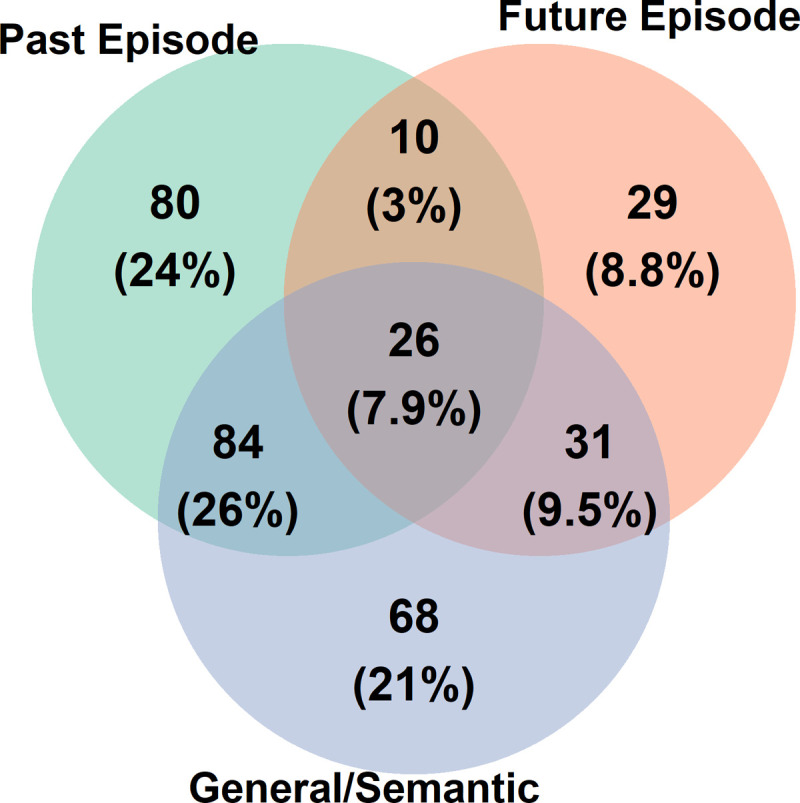
Memories of the past help us adaptively respond to similar situations in the future. Originally described by Schacter & Addis in 2007, the “constructive episodic simulation” hypothesis proposes that waking thought combines fragments of various past episodes into imagined simulations of events that may occur in the future. This same framework may be useful for understanding the function of dreaming. N = 48 college students were asked to identify waking life sources for a total of N = 469 dreams. Participants frequently traced dreams to at least one past or future episodic source (53.5% and 25.7% of dreams, respectively). Individual dreams were very often traced to multiple waking sources (43.9% of all dreams with content), with fragments of past memory incorporated into scenarios that anticipated future events. Waking-life dream sources are described in terms of their phenomenology and distribution across time and sleep stage, providing new evidence that dreams not only reflect the past, but also utilize memory in simulating potential futures.
Overview
CoChat Summary
TL;DR
Dream reports from 48 college students were often traced to past and future waking-life sources, supporting the idea that dreaming combines episodic memory fragments into simulations of possible futures. Over half of content-filled dreams had a past episodic source and about a quarter had a future episodic source, often with multiple sources per dream.
Key findings
- Of 374 content-filled dream reports, 328 (87.7%) had at least one waking source; 200 (53.48%) were linked to a specific past episode and 96 (25.67%) to a specific anticipated future episode.
- Many dreams combined sources: 164 of 328 reports with a waking source (50%) were traced to multiple sources, and 36 of 96 future-episodic dreams (37.5%) also had a past episodic source.
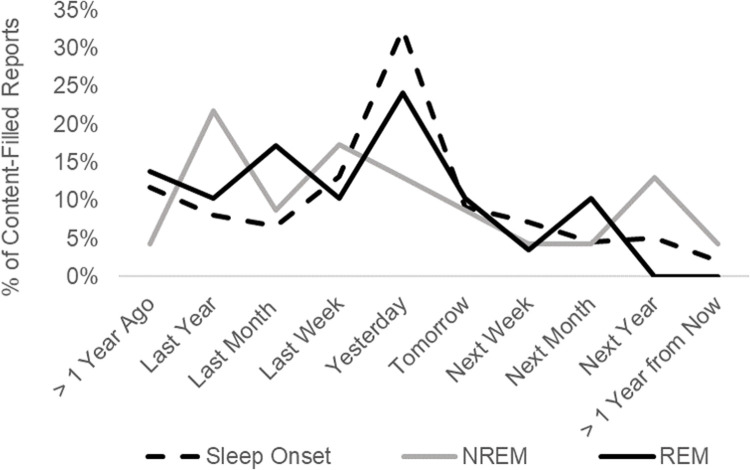
- Dreams were more often associated with past than future episodes (Wald χ²(1, N = 689) = 27.47, p < 0.00001), and past episodic sources were most commonly from <1 day ago (37.0%), as were future sources (24.0%).
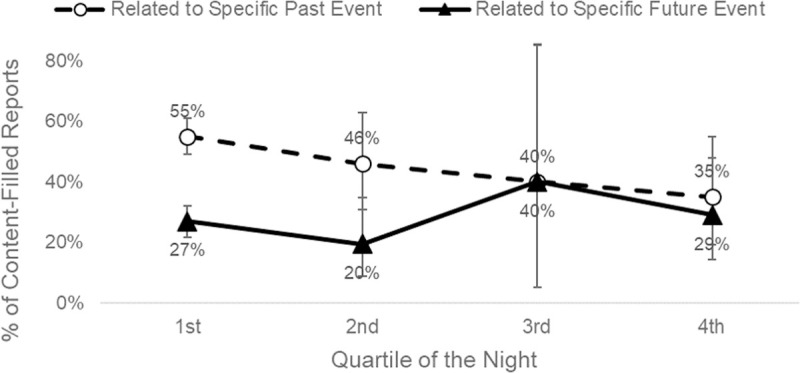
- Future-oriented dreams showed a non-significant trend to become proportionally more common later in the night: 1st-quartile dreams were 55.16% past vs 26.69% future, while 4th-quartile dreams were 35.48% past vs 29.03% future (interaction p = 0.08).
Methods
- Laboratory sleep study with N = 48 undergraduate students aged 18–25 (mean 20.3 ± 1.4 SD; 60% female), recruited from Furman University (n = 39) and Boston College (n = 9).
- Participants underwent polysomnography and were awakened for up to 13 dream reports across a full night; 469 reports were collected, and the next morning participants listened to recordings and identified potential past/future episodic and general/semantic sources.
- Analyses used R, Clopper–Pearson exact binomial confidence intervals, and mixed-effect models grouped by participant, including logistic regression for categorical outcomes and linear mixed models for continuous outcomes.
Limitations
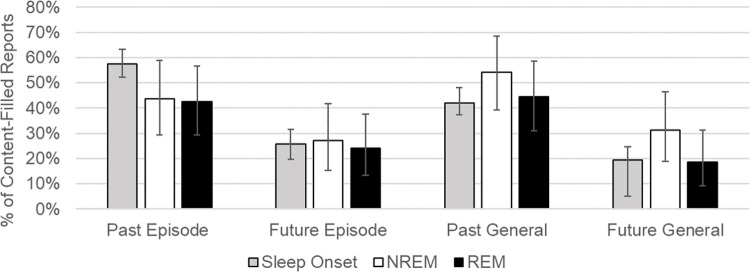
- Stated: participants may not reliably distinguish episodic from semantic sources; probing may introduce demand characteristics; the study cannot determine whether future-oriented dreams are caused purely by upcoming events or by past experiences of thinking/talking about those events; most dreams came from short-latency sleep onset awakenings, with only 10% from REM, possibly limiting sleep-stage conclusions.
- Evident: source identification relied on subjective participant ratings without independent verification, and the sample was a convenience sample of undergraduates, limiting generalizability.
Model-written summary. Check it against the paper before relying on it.
Integrity signals
Registry
Cites
Statistics
Figures
Verification
Claims the paper makes
18 Valid · 0 Not valid · 4 Not checked · 91 Own results and interpretations
Every source the paper cites for this claim was checked and supports it.
In the paper
“But again, these learning-related dreams include only fragments of content drawn from the learning experience, rather than replaying the experience in full.”
§ Constructive episodic simulation in dreams > Episodic future simulation in dreams
What the sources say
- Supportedcites [30] EJ Wamsley, 2010, Cognitive replay of visuomotor learning at sleep onset: temporal dynamics and relationship to task performance., Sleep source
The Discussion describes Alpine Racer dream imagery as fragments of the learning experience interleaved with other material, rather than an isolated, veridical reproduction. It also reports that imagery became less veridical and more abstract as sleep progressed. (LLM, conf=0.93)
plainSingle case- Asserted: passes — The authors put it forward as true.
- Checkable: passes — It can be checked against evidence.
- Load-bearing: passes — The paper’s conclusions depend on it.
- Based: passes — The paper gives a reason why it holds.
- Supported
The cited sources support only part of this claim — read each source’s verdict below.
In the paper
“Importantly, when recent experiences appear in dreams, even in fragmentary form, subsequent memory for those experiences is improved.”
§ Constructive episodic simulation in dreams > Episodic future simulation in dreams
What the sources say
- Partly supportedcites [34] J Plailly, 2019, Incorporation of fragmented visuo-olfactory episodic memory into dreams and its association with memory performance., Scientific reports. sourceExperimental — accuracy not yet measured
The Results (Memory performance; page not available) report better post-sleep visuo-spatial memory among participants with learning-related dreams, but no significant improvement in odor recognition or odor-evoked episodic memory. The Discussion describes an association between dream content and memory performance, not evidence that the dreams caused the improvement; the claim is therefore broader than the finding. (LLM, conf=0.88)
- Partly supportedcites [35] SF Schoch, 2019, The effect of dream report collection and dream incorporation on memory consolidation during sleep, Journal of Sleep Research sourceExperimental — accuracy not yet measured
The Results section ('Relationship between dream incorporation and retention performance'; page unavailable) reports better overnight memory retention when task-related picture categories appeared in NREM dreams, after correcting for chance incorporations. The Methods section ('Sleep and dream analysis'; page unavailable) shows that incorporation could be a broad category rather than a complete replay of an experience. The claim overgeneralizes the finding: the association was not significant for REM dreams, and the study does not establish that dreaming of an experience causes improved memory for that particular experience. (LLM, conf=0.88)
- Supportedcites [36] EJ Wamsley, 2010, Dreaming and offline memory processing, Curr Biol source
In “The Offline Reactivation of Memory during Sleep and Quiet Wakefulness” (page unavailable), the paper reports that participants who dreamed about a recently learned maze showed enhanced memory for it at retest. It also describes recent experiences appearing as fragments in dreams. The reported relationship is an association, not a claim that dreaming causes the improvement. (LLM, conf=0.88)
- Supportedcites [37] EJ Wamsley, 2018, Dreaming of a learning task is associated with enhanced memory consolidation: Replication in an overnight sleep study, Journal of Sleep Research source
The Results section reports greater overnight improvement on the maze task among participants whose dreams directly incorporated it. The Discussion explains that even these task-related dreams rarely replayed the experience exactly; their details often differed. The paper presents this as an association between dreaming and later performance, not proof that dreaming caused the improvement. (LLM, conf=0.86)
plainstates a cause- Asserted: passes — The authors put it forward as true.
- Checkable: passes — It can be checked against evidence.
- Load-bearing: passes — The paper’s conclusions depend on it.
- Based: passes — The paper gives a reason why it holds.
- Partly supported
The cited sources support only part of this claim — read each source’s verdict below.
In the paper
“To the contrary, the activation of weak associations may be a critical component of creative, flexible, and divergent thinking [61–63].”
§ Constructive episodic simulation in dreams > Discussion
What the sources say
- Not checked — no full text of the sourcecites [61] S. Mednick, 1962, The associative basis of the creative process., Psychological review. source
- Partly supportedcites [62] C Mills, 2021, Out of the blue: understanding abrupt and wayward transitions in thought using probability and predictive processing, Philosophical Transactions of the Royal Society B sourceExperimental — accuracy not yet measured
In “Surprising thoughts: a glitch or a feature?” (page unavailable), the paper suggests that wayward transitions broaden mental search to include thoughts with low baseline probability. This supports the idea that otherwise neglected thoughts can be useful, but it does not specifically connect activation of weak associations to creative, flexible, or divergent thinking. (LLM, conf=0.78)
- Supportedcites [63] C Mohr, 2001, Loose but Normal: A Semantic Association Study., J Psycholinguist Res. source
The Abstract describes linking uncommon, nonobvious percepts as a possible prerequisite of creative thinking. The Discussion likewise says that moderate loosening of associations can lead to creative insights and that facilitated access to multiple word meanings may underlie creative reasoning. This supports the citing sentence’s hedged claim. (LLM, conf=0.88)
hedgedstates a possible cause- Asserted: passes — The authors put it forward as true.
- Checkable: passes — It can be checked against evidence.
- Load-bearing: unclear — It is unclear whether the paper’s conclusions depend on it.
- Based: passes — The paper gives a reason why it holds.
Every source the paper cites for this claim was checked and supports it.
In the paper
“As a result, participant-ratings of dream sources are more sensitive, better able to capture remote past and mundane, seemingly insignificant details as a source of dream content [75].”
§ Constructive episodic simulation in dreams > Discussion > Limitations
What the sources say
- Supportedcites [75] R Vallat, 2017, Characteristics of the memory sources of dreams: A new version of the content-matching paradigm to take mundane and remote memories into account., PLOS ONE. source
The Discussion says that asking participants to identify waking-life elements immediately on awakening enabled the study, unlike most previous studies, to consider memories from across the lifespan and mundane experiences. The Introduction explains that earlier diary-matching methods could miss mundane experiences. These passages support the claim’s comparative sense of greater sensitivity, though they do not report a formal sensitivity measurement. (LLM, conf=0.88)
plainstates a cause- Asserted: passes — The authors put it forward as true.
- Checkable: passes — It can be checked against evidence.
- Load-bearing: unclear — It is unclear whether the paper’s conclusions depend on it.
- Based: passes — The paper gives a reason why it holds.
- Supported
The sources with a verdict support this claim; the rest weren’t checked yet, have no full text we could read, or their verdicts aren’t rated yet.
In the paper
“Across diverse forms memory, sleep following encoding results in improved memory performance after a delay [13, 14].”
§ Constructive episodic simulation in dreams > Episodic future simulation in dreams
What the sources say
- Not checked — no full text of the sourcecites [13] S Diekelmann, 2010, The memory function of sleep, Nature Reviews Neuroscience source
- Supportedcites [14] R Stickgold, 2013, Sleep-dependent memory triage: evolving generalization through selective processing, Nat Neurosci source
The section “Sleep-dependent consolidation: A process of discriminatory selection” (page unavailable) reports enhanced post-sleep recall in episodic item, spatial, and procedural skill memory tests. It also describes superior retention after sleep rather than an equivalent period awake, supporting the broad claim of improved delayed performance across diverse forms of memory. (LLM, conf=0.88)
plainstates a cause- Asserted: passes — The authors put it forward as true.
- Checkable: passes — It can be checked against evidence.
- Load-bearing: passes — The paper’s conclusions depend on it.
- Based: passes — The paper gives a reason why it holds.
71 more claims · 7 with their cited sources checked
Create a free account to see all 113 claims and to verify the 2 references still open.
- It may state two separate claims as one. 18
- Probably not a substantial claim. 24
Claims other papers make about this one
Each is checked against this paper’s own text: does it say what the citing paper says it does?
The cited source says what the claim attributes to it.
In the citing paper
“In humans, recent evidence shows that mental time travel and dreaming may be generated through similar networks in the brain [194,195], share parallels in their (re)constructive processes [196–199] as well as deficits owing to injury and disease [200,201].”
From Is episodic-like memory like episodic memory? (2024) · cites this paper as [198]
The check wasn’t confident either way, so it gives no verdict — never disputed.
In the citing paper
“During imagery, compared to perception, the flow of activation seems to reverse, going from high- to low-level areas297,298.”
From Consciousness and sleep (2024) · cites this paper as [298]
Experimental — accuracy not yet measuredIn the citing paper
“while the replay of complete episodic memories is rare during dreaming [197], dream imagery and content is made up of fragmentations and transformations of episodic stimuli [196–198].”
From Is episodic-like memory like episodic memory? (2024) · cites this paper as [198]
Statistics that don’t add up
Each reported p-value recomputed from its test statistic and degrees of freedom.
Rated major: it would touch a result — a value a result rests on, reported and recomputed p-values on opposite sides of the significance level, two passages that conflict with no sign which is right, or a cited work retracted before this paper was published.
In the paper
“χ2(1, N = 248) = 4.77, p = 0.09”
§ Constructive episodic simulation in dreams > Results > Effect of sleep onset report latency (30s vs 60s vs 90s)
Reported p = .09 · recomputed p = .029
Rated major: it would touch a result — a value a result rests on, reported and recomputed p-values on opposite sides of the significance level, two passages that conflict with no sign which is right, or a cited work retracted before this paper was published.
In the paper
“χ2(1, N = 247) = 4.55, p = 0.10”
§ Constructive episodic simulation in dreams > Results > Effect of sleep onset report latency (30s vs 60s vs 90s)
Reported p = .1 · recomputed p = .033
Rated minor: it would not touch a result — a value no result rests on, a p-value that stays on the same side of the significance level, or a conflict that is clerical, resolved elsewhere in the paper, or outside its own findings.
In the paper
“χ2(1, N = 345) = 6.17, p = 0.046”
§ Constructive episodic simulation in dreams > Results > Effect of sleep onset report latency (30s vs 60s vs 90s)
Reported p = .046 · recomputed p = .013
Rated minor: it would not touch a result — a value no result rests on, a p-value that stays on the same side of the significance level, or a conflict that is clerical, resolved elsewhere in the paper, or outside its own findings.
In the paper
“χ2(1, N = 247) = 0.76, p = 0.68”
§ Constructive episodic simulation in dreams > Results > Effect of sleep onset report latency (30s vs 60s vs 90s)
Reported p = .68 · recomputed p = .383
Rated minor: it would not touch a result — a value no result rests on, a p-value that stays on the same side of the significance level, or a conflict that is clerical, resolved elsewhere in the paper, or outside its own findings.
In the paper
“χ2(1, N = 247) = 6.24, p = 0.04”
§ Constructive episodic simulation in dreams > Results > Effect of sleep onset report latency (30s vs 60s vs 90s)
Reported p = .04 · recomputed p = .012
Statistics recomputed
Every reported test result, recomputed from its test statistic and degrees of freedom. A result shows as not adding up only once an independent check has confirmed it.
- Doesn’t add upχ²(1) = 4.55reported p = .1 · recomputed p = .033The two fall on opposite sides of .05
“χ2(1, N = 247) = 4.55, p = .10”
- Doesn’t add upχ²(1) = 4.77reported p = .09 · recomputed p = .029The two fall on opposite sides of .05
“χ2(1, N = 248) = 4.77, p = .09”
- Doesn’t add upχ²(1) = 6.24reported p = .04 · recomputed p = .012
“χ2(1, N = 247) = 6.24, p = .04”
- Doesn’t add upχ²(1) = 0.76reported p = .68 · recomputed p = .383
“χ2(1, N = 247) = 0.76, p = .68”
- Doesn’t add upχ²(1) = 6.17reported p = .046 · recomputed p = .013
“χ2(1, N = 345) = 6.17, p = .046”
6 more recomputed tests
Create a free account to see every test the Stats check recomputed.
Self-check
Percentages, sums and reported differences re-computed from the paper’s own numbers.
Each contradiction between two passages listed here was confirmed by an independent check.
Rated minor: it would not touch a result — a value no result rests on, a p-value that stays on the same side of the significance level, or a conflict that is clerical, resolved elsewhere in the paper, or outside its own findings.
In the paper
§ Constructive episodic simulation in dreams > Results > Prevalence of past and future waking sources
“23.96%, 95% CI [15.83%, 44.09%] of identified sources, respectively”
§ Constructive episodic simulation in dreams > Results > Prevalence of past and future waking sources
“| <1 Day | 74 | 37.0% | [30.3%, | 44.0%] | 23 | 24.0% | [15.8%, | 34.0%] |”
Citations
Cites
R: A Language and Environment for Statistical Computing
R Core Team (2025) · doi:10.32614/r.manuals · Cited by 352,181
Fitting Linear Mixed-Effects Models Using lme4
Bates, D., Mächler, M., Bolker, B., & Walker, S. (2015) · Journal of Statistical Software · doi:10.18637/jss.v067.i01 · Cited by 86,835
lmerTest Package: Tests in Linear Mixed Effects Models
Kuznetsova, A., Brockhoff, P. B., & Christensen, R. H. B. (2017) · Journal of Statistical Software · doi:10.18637/jss.v082.i13 · Cited by 24,346 · cited 1×
“Where outcome variables were continuous, mixed effect models were conducted using the lme4 and lmerTest packages for R [54].”
MethodA New Method for Measuring Daytime Sleepiness: The Epworth Sleepiness Scale
Johns, M. W. (1991) · Sleep · doi:10.1093/sleep/14.6.540 · Cited by 17,364
The Brain's Default Network: Anatomy, Function, and Relevance to Disease
Buckner, R. L., Andrews‐Hanna, J. R., & Schacter, D. L. (2008) · Annals of the New York Academy of Sciences · doi:10.1196/annals.1440.011 · Cited by 9,761
McClelland, J. L., McNaughton, B. L., & O'Reilly, R. C. (1995) · Psychological Review · doi:10.1037/0033-295x.102.3.419 · Cited by 5,256 · cited 1×
“McClelland, McNaughton & O’Reilly first speculated this decades ago, proposing that sleep may “permit both new and old information to be played back in closely interleaved fashion” [60].”
BackgroundThe associative basis of the creative process.
Mednick, S. (1962) · Psychological Review · doi:10.1037/h0048850 · Cited by 4,140
Diekelmann, S., & Born, J. (2010) · Nature Reviews Neuroscience · doi:10.1038/nrn2762 · Cited by 3,760 · cited 1×
“Across diverse forms memory, sleep following encoding results in improved memory performance after a delay [13, 14].”
BackgroundFitting Linear Mixed-Effects Models Using lme4
Bates, D. M., Maechler, M., Bolker, B. M., & Walker, S. (2014) · arXiv (Cornell University) · doi:10.3929/ethz-b-000105397 · Cited by 2,541
Quantification of Sleepiness: A New Approach
Hoddes, E., Zarcone, V., Smythe, H., Phillips, R., & Dement, W. C. (1973) · Psychophysiology · doi:10.1111/j.1469-8986.1973.tb00801.x · Cited by 2,538 · cited 1×
“Upon arrival at the laboratory, participants provided written informed consent prior to completing a series of questionnaires inquiring about demographic information and sleep history, the Epworth Sleepiness Scale (a measure of trait sleepiness [46]), and the Stanford Sleepiness Scale (a measure of state sleepiness [4…”
Method
Research works printed but not linked: 1
- C Iber, 2007, The AASM Manual for the Scoring of Sleep and Associated Events: Rules, Terminology, and Technical Specifications.
Cited by
Tononi, G., Boly, M., & Cirelli, C. (2024) · Neuron · doi:10.1016/j.neuron.2024.04.011 · Cited by 70
The memory sources of dreams: serial awakenings across sleep stages and time of night
Picard‐Deland, C., Konkoly, K. R., Raider, R., Paller, K. A., Nielsen, T., Pigeon, W. R., & Carr, M. (2022) · SLEEP · doi:10.1093/sleep/zsac292 · Cited by 45
“Memory sources were identified for 87.2% of all dreams, which is similar to what has been found in studies by Wamsley [2] and Vallat et al. [1], i.e. 87.7% and 83.8% respectively.”
InfluentialIs episodic-like memory like episodic memory?
Davies, J. R., & Clayton, N. S. (2024) · Philosophical Transactions of the Royal Society B: Biological Sciences · doi:10.1098/rstb.2023.0397 · Cited by 27
Sleep and dreaming in the light of reactive and predictive homeostasis
Simor, P., Peigneux, P., & Bódizs, R. (2023) · Neuroscience & Biobehavioral Reviews · doi:10.1016/j.neubiorev.2023.105104 · Cited by 36
“In another study, past-related memory sources were less common in dreams reported in the last quartile of the night compared to dreams in the first quartile (Wamsley, 2022).”
BackgroundResultMemory reactivations during sleep: a neural basis of dream experiences?
Picard‐Deland, C., Bernardi, G., Genzel, L., Dresler, M., & Schoch, S. F. (2023) · Trends in Cognitive Sciences · doi:10.1016/j.tics.2023.02.006 · Cited by 40
Metadata
- Authors
- Wamsley, E. J.
- Affiliations
- Furman University (US)
- Corresponding author
- Wamsley, Erin J.
- ORCID
- Wamsley, Erin J.
- Venue
- PLOS ONE
- Publisher
- Public Library of Science (PLoS)
- Published
- 2022-03-22
- Volume
- 17
- Issue
- 3
- Pages
- e0264574
- ISSN
- 1932-6203 (ISSN-L)
- PMC
- PMC8939783
- OpenAlex
- W4220811759
- Semantic Scholar
- 4670472afb167f691f7b84c9c77f098ae605fb32
- Cited by
- 22
- References
- 75
- Citations by year
- 2026: 2 · 2025: 5 · 2024: 6 · 2023: 6 · 2022: 3
- FWCI
- 2.58
- Type
- journal article
- Language
- en
- Open access
- gold
- doi.org
- Licence
- Locations
- PLoS ONE (publishedVersion, cc-by)
- PubMed Central (publishedVersion, cc-by)
- PubMed (publishedVersion)
- DOAJ (DOAJ: Directory of Open Access Journals) (submittedVersion)
- OSF Preprints (OSF Preprints) (submittedVersion, cc-by)
- OSF Preprints (OSF Preprints) (submittedVersion)
- Funders
- Fundação Bial (83/12)
- Topics
- Life Sciences › Neuroscience › Cognitive Neuroscience › Sleep and Wakefulness Research
- Life Sciences › Neuroscience › Cognitive Neuroscience › Memory Processes and Influences
- Social Sciences › Psychology › Experimental and Cognitive Psychology › Sleep and related disorders
- Keywords
- dreams, episodic memory, memory simulation, future events, dream content, sleep stages
- MeSH terms
- Computer Simulation, Dreams, Humans, Sleep Stages
About these checks
Registry, retraction, Cites and statistics results are computed, not judged, with one exception: a printed reference that no index lists is read once by a model before it counts as a citation error. Claims are extracted by a model and kept only when their quote appears verbatim in the text; each cited source is then checked, with a model’s help, for whether it says what the claim relies on. Those verdicts can be wrong — read the claim’s quote and the cited source before relying on one.
The claim verdicts this report counts are experimental: their accuracy is not yet measured.
A language model drew the claims from the paper on 2026-10-10, under version 3 of the claim definition (model deepseek-v4.1-flash, prompt extract-v3).
A second model labelled each claim on 2026-10-10 (model jev-1.13-20260917, definition revision gold-guideline-v0.2).
Cited sources are checked with a language model’s help (gpt-6-sol).
Statistics and arithmetic are recomputed, not judged.
Confidence bands are shown only for fields calibrated on our annotated test set. None is calibrated yet, so no band is shown.
What counts as a claim ›How we measure confidence ›How we check this ›
Are you an author, or do you see a problem with this page? Request a review
How to cite
Cite CoChat for the checks on this page, and the paper for its own findings.
- This page
- CoChat. (2026). Citation check: Constructive episodic simulation in dreams. https://app.cochat.ai/papers/10.1371/journal.pone.0264574
- The paper
- Wamsley, E. J. (2022). Constructive episodic simulation in dreams. PLOS ONE. https://doi.org/10.1371/journal.pone.0264574
Data sources
Bibliographic data: Semantic Scholar, OpenAlex, Crossref.
Contains information from the Semantic Scholar Academic Graph Datasets, made available under the ODC Attribution License (ODC-BY 1.0).
Semantic Scholar’s data is described in: Kinney, R., et al. (2023). The Semantic Scholar Open Data Platform. arXiv:2301.10140.
