

The DOI matches its Crossref record; 6 of the 6 references it cites were found in a registry or an index.
Testing a first online intervention to reduce conformity to cyber aggression in messaging apps
Abstract
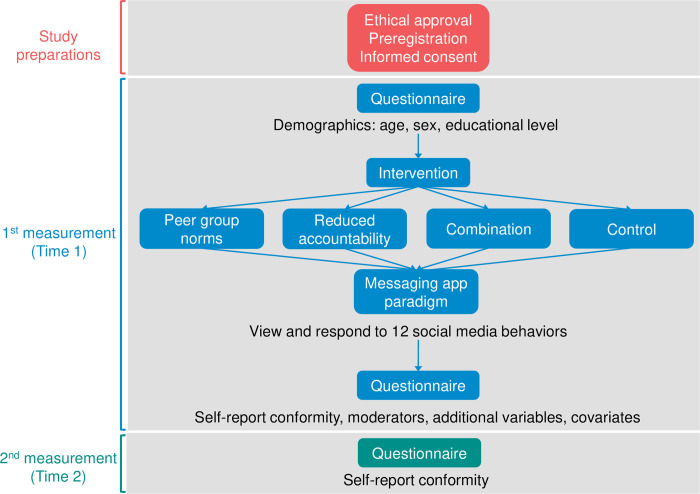
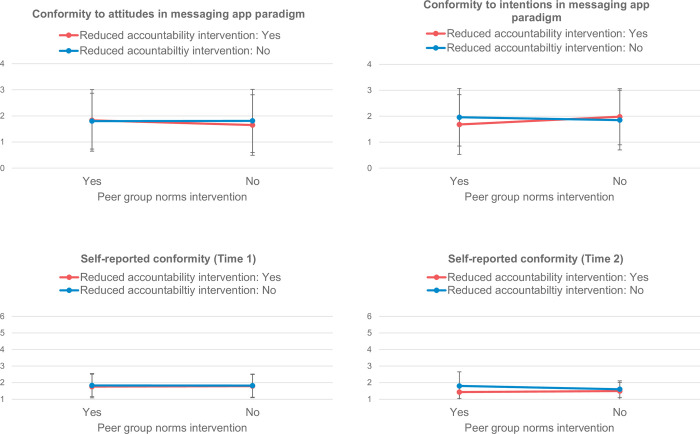
Early adolescents frequently use mobile messaging apps to communicate with peers. The popularity of such messaging apps has a critical drawback because it increases conformity to cyber aggression. Cyber aggression includes aggressive peer behaviors such as nasty comments, nonconsensual image sharing, and social exclusion, to which adolescents subsequently conform. Recent empirical research points to peer group norms and reduced accountability as two essential determinants of conformity to cyber aggression. Therefore, the current study aimed to counteract these two determinants in a 2 (peer group norms counteracted: yes, no) x 2 (reduced accountability counteracted: yes, no) design. We created four intervention conditions that addressed adolescents’ deficits in information, motivation, and behavioral skills. Depending on the condition (peer group norms, reduced accountability, combination, or control), we first informed participants about the influence of the relevant determinant (e.g., peer group norms). Subsequently, participants performed a self-persuasion task and formulated implementation-intentions to increase their motivation and behavioral skills not to conform to cyber aggression. Effectiveness was tested with a messaging app paradigm and self-report among a sample of 377 adolescents (Mage= 12.99,SDage= 0.84; 53.6% boys). Factorial ANCOVAs revealed that none of the intervention conditions reduced conformity to cyber aggression. Moreover, individual differences in susceptibility to peer pressure or inhibitory control among adolescents did not moderate the expected relations. Therefore, there is no evidence that our intervention effectively reduces conformity to cyber aggression. The findings from this first intervention effort point to the complex relationship between theory and practice. Our findings warrant future research to develop potential intervention tools that could effectively reduce conformity to cyber aggression.
Overview
The claims and statistics of this paper haven’t been checked yet.
Run the check — free, no account needed. It reads the open-access text and checks the sources it cites.
Integrity signals
Registry
Cites
Statistics
Figures
Verification
Claims the paper makes
The claims and statistics of this paper haven’t been checked yet.
Run the check — free, no account needed. It reads the open-access text and checks the sources it cites.
Claims other papers make about this one
Each is checked against this paper’s own text: does it say what the citing paper says it does?
The cited source says what the claim attributes to it.
In the citing paper
“Only two studies in this meta‐analysis targeted interpersonal challenges (Bleize et al., 2022; Mauduy et al., 2023), although peer relations, changes in family dynamics and social identity become increasingly important during early adolescence (Steinberg & Morris, 2001).”
From The effectiveness of implementation intentions in children: A systematic review and meta‐analysis (2026) · cites this paper as Bleize et al., 2022
Self-check
Percentages, sums and reported differences re-computed from the paper’s own numbers.
The self-check needs the paper’s full text.
Citations
Cites
A meta-analysis of computer-tailored interventions for health behavior change
Krebs, P., Prochaska, J. O., & Rossi, J. S. (2010) · Preventive Medicine · doi:10.1016/j.ypmed.2010.06.004 · Cited by 854
Norms of online expressions of emotion: Comparing Facebook, Twitter, Instagram, and WhatsApp
Waterloo, S. F., Baumgartner, S. E., Peter, J., & Valkenburg, P. M. (2018) · New Media & Society · doi:10.1177/1461444817707349 · Cited by 549
Cyberbullying definition among adolescents: A comparison across six European countries
Menesini, E., Nocentini, A., Palladino, B. E., Frisén, A., Berne, S., Ortega-Ruiz, R., Calmaestra, J., Scheithauer, H., Schultze-Krumbholz, A., Luik, P., et al. (2012) · Cyberpsychology Behavior and Social Networking · doi:10.1089/cyber.2012.0040 · Cited by 344
Barlińska, J., Szuster, A., & Winiewski, M. (2013) · Journal of Community & Applied Social Psychology · doi:10.1002/casp.2137 · Cited by 296 · cited 1×
“Adolescents who feel unaccountable to others typically perceive little risk of potential adult intervention or punishment for their behaviors [2, 43].”
BackgroundBeing a cybervictim and a cyberbully – The duality of cyberbullying: A meta-analysis
Lozano-Blasco, R., Cortés-Pascual, A., & Latorre-Martínez, M. P. (2020) · Computers in Human Behavior · doi:10.1016/j.chb.2020.106444 · Cited by 142
Jacobs, N. C., Völlink, T., Dehue, F., & Lechner, L. (2014) · BMC Public Health · doi:10.1186/1471-2458-14-396 · Cited by 75
Research works printed but not linked: 71
- II van Driel, 2019, Posten, scrollen, appen en snappen: Jongeren (14–15 jaar) en social media in 2019
- D. Aizenkot, 2020, Cyberbullying experiences in classmates‘ WhatsApp discourse, across public and private contexts., Child Youth Serv Rev, 110, 104814, 10.1016/j.childyouth.2020.104814 · DOI
- D Aizenkot, 2018, Cyberbullying in WhatsApp classmates’ groups: Evaluation of an intervention program implemented in Israeli elementary and middle schools., New Media Soc., 20, 4709, 10.1177/1461444818782702 · DOI
- S Hinduja, 2019, 2019 Cyberbullying data
- V Piccoli, 2020, Cyberbullying through the lens of social influence: Predicting cyberbullying perpetration from perceived peer-norm, cyberspace regulations and ingroup processes., Comput Human Behav, 102, 260, 10.1016/j.chb.2019.09.001 · DOI · Paper page
- R. Cohen-Almagor, 2018, Social responsibility on the internet: Addressing the challenge of cyberbullying, Aggress Violent Behav, 39, 42, 10.1016/j.avb.2018.01.001 · DOI · Paper page
- K Runions, 2015, Online moral disengagement, cyberbullying, and cyber-aggression., Cyberpsychology, Behav Soc Netw., 18, 400, 10.1089/cyber.2014.0670 · DOI · Paper page
- K Runions, 2016, Cyber aggression., 10.1007/978-3-319-32132-5_780-1 · DOI
- R Ling, 2016, Microcoordination 2.0: Social coordination in the age of smartphones and messaging apps., J Commun., 66, 834, 10.1111/jcom.12251 · DOI
- JH Gardella, 2017, A systematic review and meta-analysis of cyber-victimization and educational outcomes for adolescents., Rev Educ Res, 87, 283, 10.3102/0034654316689136 · DOI · Paper page
- S Skilbred-Fjeld, 2020, Cyberbullying involvement and mental health problems among late adolescents., Cyberpsychology., 14, 10.5817/CP2020-1-5 · DOI
- GW Giumetti, 2022, Cyberbullying via social media and well-being., Curr Opin Psychol, 45, 101314, 10.1016/j.copsyc.2022.101314 · DOI · Paper page
- HTL Nguyen, 2020, Relationships among cyberbullying, parental attitudes, self-harm and suicidal behavior among adolescents: Results from a school-based survey in Vietnam., BMC Public Health, 20, 1
- J Bryce, 2013, “It’s common sense that it’s wrong”: Young people’s perceptions and experiences of cyberbullying., Cyberpsychol Behav Soc Netw, 16, 783, 10.1089/cyber.2012.0275 · DOI
- RB Cialdini, 2004, Social influence: Compliance and conformity., Annu Rev Psychol, 55, 591, 10.1146/annurev.psych.55.090902.142015 · DOI · Paper page
- WA Brechwald, 2011, Beyond homophily: A decade of advances in understanding peer influence processes., J Res Adolesc, 21, 166, 10.1111/j.1532-7795.2010.00721.x · DOI
- T Olthof, 2008, Bullying and the need to belong: Early adolescents’ bullying-related behavior and the acceptance they desire and receive from particular classmates., Soc Dev., 17, 24, 10.1111/j.1467-9507.2007.00413.x · DOI
- M Tarrant, 2006, Friendship group identification, multidimensional self-concept, and experience of developmental tasks in adolescence., J Adolesc, 29, 627, 10.1016/j.adolescence.2005.08.012 · DOI
- L Steinberg, 2007, Age differences in resistance to peer influence., Dev Psychol, 43, 1531, 10.1037/0012-1649.43.6.1531 · DOI
- D Wegge, 2016, Popularity through online harm: The longitudinal associations between cyberbullying and sociometric status in early adolescence., J Early Adolesc, 36, 86, 10.1177/0272431614556351 · DOI
- OL Steer, 2020, “I feel like everyone does it”- adolescents’ perceptions and awareness of the association between humour, banter, and cyberbullying., Comput Human Behav, 108, 106297, 10.1016/j.chb.2020.106297 · DOI
- M Huizinga, 2011, Age-related changes in executive function: A normative study with the dutch version of the Behavior Rating Inventory of Executive Function (BRIEF)., Child Neuropsychol, 17, 51, 10.1080/09297049.2010.509715 · DOI
- S Erreygers, 2016, Helping behavior among adolescent bystanders of cyberbullying: The role of impulsivity., Learn Individ Differ., 48, 61, 10.1016/j.lindif.2016.03.003 · DOI
- P Valkenburg, 2017, Plugged in: How media attract and affect youth., 10.12987/yale/9780300218879.001.0001 · DOI · Paper page
- M Naezer, 2021, Only sluts love sexting: Youth, sexual norms and non-consensual sharing of digital sexual images., J Gend Stud, 30, 79, 10.1080/09589236.2020.1799767 · DOI · Paper page
- D Cross, 2016, Longitudinal impact of the Cyber Friendly Schools program on adolescents’ cyberbullying behavior., Aggress Behav, 42, 166, 10.1002/ab.21609 · DOI
- D Aizenkot, 2020, The effectiveness of safe surfing intervention program in reducing WhatsApp cyberbullying and improving classroom climate and student sense of class belonging in elementary school., J Early Adolesc, 41, 550, 10.1177/0272431620931203 · DOI
- JD Fisher, 1992, Changing AIDS-risk behavior., Psychol Bull., 111, 455, 10.1037/0033-2909.111.3.455 · DOI · Paper page
- WA Fisher, 2009, The Information‐Motivation‐Behavioral Skills Model: A general social psychological approach to understanding and promoting health behavior, 82
- AL Duffy, 2009, Peer groups, social identity, and children’s bullying behavior., Soc Dev, 18, 121, 10.1111/j.1467-9507.2008.00484.x · DOI
- S Bastiaensens, 2016, From normative influence to social pressure: How relevant others affect whether bystanders join in cyberbullying., Soc Dev, 25, 193, 10.1111/sode.12134 · DOI · Paper page
- B Laursen, 2021, Toward understanding the functions of peer influence: A summary and synthesis of recent empirical research., J Res Adolesc, 31, 889, 10.1111/jora.12606 · DOI
- M Giletta, 2021, A meta-analysis of longitudinal peer influence effects in childhood and adolescence., Psychol Bull., 147, 719, 10.1037/bul0000329 · DOI
- SR Sumter, 2008, The developmental pattern of resistance to peer influence in adolescence: Will the teenager ever be able to resist?, J Adolesc., 32, 1009, 10.1016/j.adolescence.2008.08.010 · DOI
- S Bastiaensens, 2014, Cyberbullying on social network sites. An experimental study into bystanders’ behavioural intentions to help the victim or reinforce the bully., Comput Human Behav., 31, 259, 10.1016/j.chb.2013.10.036 · DOI
- I Oh, 2009, Contributions of personal and situational factors to bystanders’ reactions to school bullying., Sch Psychol Int, 30, 291, 10.1177/0143034309106499 · DOI
- D Cross, 2015, A social–ecological framework for understanding and reducing cyberbullying behaviours., Aggress Violent Behav, 23, 109, 10.1016/j.avb.2015.05.016 · DOI
- KL Mason, 2008, Cyberbullying: A preliminary assessment for school personnel., Psychol Sch, 45, 323, 10.1002/pits.20301 · DOI
- L McGuire, 2015, Peer group norms and accountability moderate the effect of school norms on children’s intergroup attitudes., Child Dev, 86, 1290, 10.1111/cdev.12388 · DOI
- K Rudnicki, 2022, Systematic review of determinants and consequences of bystander interventions in online hate and cyberbullying among adults., Behav Inf Technol., 1, 10.1080/0144929X.2022.2027013 · DOI
- DNM Bleize, 2021, The effects of group centrality and accountability on conformity to cyber aggressive norms on WhatsApp: Two messaging app experiments., Comput Human Behav, 120, 106754, 10.1016/j.chb.2021.106754 · DOI
- M Popovac, 2018, An intervention using the Information-Motivation-Behavioral Skills Model: Tackling cyberaggression and cyberbullying in South African adolescents, 225
- E. Aronson, 1999, The power of self-persuasion., Am Psychol, 54, 875, 10.1037/h0088188 · DOI
- P Briñol, 2012, Self-generated persuasion: Effects of the target and direction of arguments., J Pers Soc Psychol, 102, 925, 10.1037/a0027231 · DOI
- PM Gollwitzer, 1999, Implementation intentions: Strong effects of simple plans., Am Psychol, 54, 493, 10.1037/0003-066X.54.7.493 · DOI · Paper page
- AL Duckworth, 2011, Self-regulation strategies improve self-discipline in adolescents: Benefits of mental contrasting and implementation intentions., Educ Psychol., 31, 17, 10.1080/01443410.2010.506003 · DOI
- ER Mutter, 2019, An online randomised controlled trial of mental contrasting with implementation intentions as a smoking behaviour change intervention, Psychol Heal, 35, 318, 10.1080/08870446.2019.1634200 · DOI
- BB Brown, 1986, Early adolescents’ perceptions of peer pressure., J Early Adolesc, 6, 139, 10.1177/0272431686062005 · DOI
- M Koutamanis, 2015, Adolescents’ comments in social media: Why do adolescents receive negative feedback and who is most at risk?, Comput Human Behav, 53, 486, 10.1016/j.chb.2015.07.016 · DOI
- A DeSmet, 2018, The efficacy of the Friendly Attac serious digital game to promote prosocial bystander behavior in cyberbullying among young adolescents: A cluster-randomized controlled trial., Comput Human Behav, 78, 336, 10.1016/j.chb.2017.10.011 · DOI
- AG Greenwald, 1968, Acceptance and recall of improvised arguments., J Pers Soc Psychol, 8, 31, 10.1037/h0021237 · DOI
- T Mussweiler, 2000, Sources of mental contamination: Comparing the effects of self-generated versus externally provided primes., J Exp Soc Psychol, 36, 194, 10.1006/jesp.1999.1415 · DOI
- JGB Loman, 2018, Self-persuasion on facebook increases alcohol risk perception, Cyberpsychology, Behav Soc Netw., 21, 672, 10.1089/cyber.2018.0235 · DOI
- S Wittleder, 2019, Mental contrasting with implementation intentions reduces drinking when drinking is hazardous: An online self-regulation intervention., Heal Educ Behav, 46, 666, 10.1177/1090198119826284 · DOI · Paper page
- D Álvarez-García, 2017, Validation of the Cybervictimization Questionnaire (CYVIC) for adolescents., Comput Human Behav., 70, 270, 10.1016/j.chb.2017.01.007 · DOI
- D Santor, 2000, Measuring peer pressure, popularity, and conformity in adolescent boys and girls: Predicting school performance, sexual attitudes, and substance abuse., J Youth Adolesc, 29, 163, 10.1023/A:1005152515264 · DOI · Paper page
- GA Gioia, 2000, Behavior Rating Inventory of Executive Function
- RM Ryan, 2017, Self-determination theory: Basic psychological needs in motivation, development, and wellness., 10.1521/978.14625/28806 · DOI · Paper page
- R Schwarzer, 2013, Perceived self-efficacy and its relationship to resilience, 139
- M Walrave, 2011, Cyberbullying: Predicting victimisation and perpetration., Child Soc, 25, 59, 10.1111/j.1099-0860.2009.00260.x · DOI
- CR Müller, 2018, Does media use lead to cyberbullying or vice versa? Testing longitudinal associations using a latent cross-lagged panel design., Comput Human Behav, 81, 93, 10.1016/j.chb.2017.12.007 · DOI
- RM Kowalski, 2014, Bullying in the digital age: A critical review and meta-analysis of cyberbullying research among youth., Psychol Bull., 140, 1073, 10.1037/a0035618 · DOI · Paper page
- A Field, 2012, Discovering Statistics Using R
- R Slonje, 2013, The nature of cyberbullying, and strategies for prevention., Comput Human Behav., 29, 26, 10.1016/j.chb.2012.05.024 · DOI · Paper page
- A Schnauber-Stockmann, 2019, The process of forming a mobile media habit: Results of a longitudinal study in a real-world setting., Media Psychol., 22, 714, 10.1080/15213269.2018.1513850 · DOI
- CP Barlett, 2014, Cross-cultural differences in cyberbullying behavior: A short-term longitudinal study., J Cross Cult Psychol, 45, 300, 10.1177/0022022113504622 · DOI
- ANM Leung, 2019, Testing the effectiveness of an e-course to combat cyberbullying., Cyberpsychology, Behav Soc Netw., 22, 569, 10.1089/cyber.2018.0609 · DOI
- R Kowalski, 2019, A developmental approach to cyberbullying: Prevalence and protective factors., Aggress Violent Behav, 45, 20, 10.1016/j.avb.2018.02.009 · DOI · Paper page
- CP Barlett, 2021, Cross-cultural similarities and differences in the theoretical predictors of cyberbullying perpetration: Results from a seven-country study., Aggress Behav., 47, 111, 10.1002/ab.21923 · DOI · Paper page
- MF Wright, 2015, Indian adolescents’ cyber aggression involvement and cultural values: The moderation of peer attachment., Sch Psychol Int., 36, 410, 10.1177/0143034315584696 · DOI
- JD Shapka, 2013, Does one size fit all? Ethnic differences in parenting behaviors and motivations for adolescent engagement in cyberbullying., J Youth Adolesc., 42, 723, 10.1007/s10964-013-9928-2 · DOI
Cited by
Sorted by citations
The effectiveness of implementation intentions in children: A systematic review and meta‐analysis
Breitwieser, J., & Reinelt, T. (2026) · British Journal of Psychology · doi:10.1111/bjop.70065 · Cited by 1
Metadata
- Authors
- Bleize, D. N. M., Anschütz, D. J., Tanis, M., & Buijzen, M.
- Venue
- PLOS ONE
- Publisher
- Public Library of Science (PLoS)
- Published
- 2022-08-09
- Volume
- 17
- Issue
- 8
- Pages
- e0272615
- ISSN
- 1932-6203
- PMC
- PMC9362912
- Cited by
- 7
- References
- 6
- Language
- en
About these checks
Registry, retraction, Cites and statistics results are computed, not judged, with one exception: a printed reference that no index lists is read once by a model before it counts as a citation error. Claims are extracted by a model and kept only when their quote appears verbatim in the text; each cited source is then checked, with a model’s help, for whether it says what the claim relies on. Those verdicts can be wrong — read the claim’s quote and the cited source before relying on one.
Statistics and arithmetic are recomputed, not judged.
Confidence bands are shown only for fields calibrated on our annotated test set. None is calibrated yet, so no band is shown.
What counts as a claim ›How we measure confidence ›How we check this ›
Are you an author, or do you see a problem with this page? Request a review
