

Low-Volume Toolbox for the Discovery of Immunosuppressive Fungal Secondary Metabolites
Open accessThe DOI matches its Crossref record; 36 of the 37 references it cites were found in a registry or an index.
Abstract
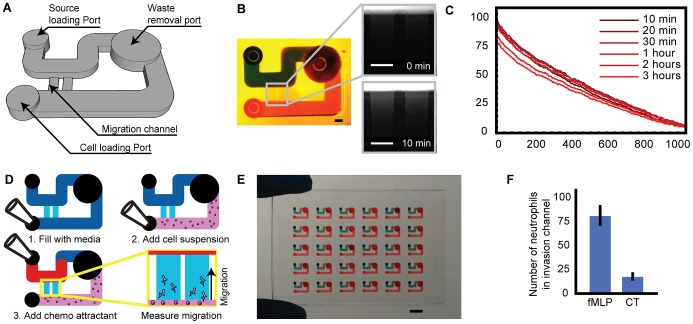
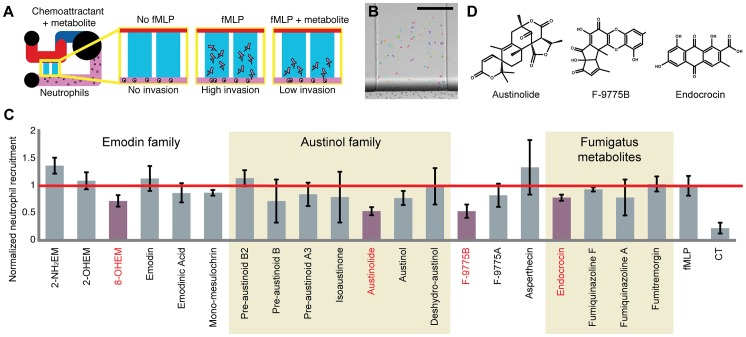
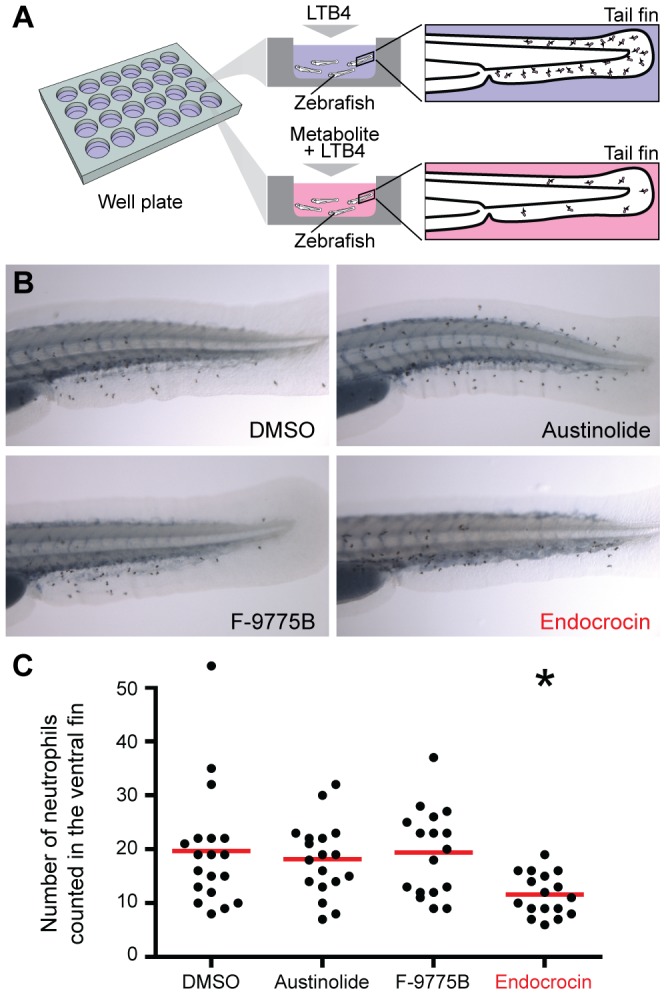
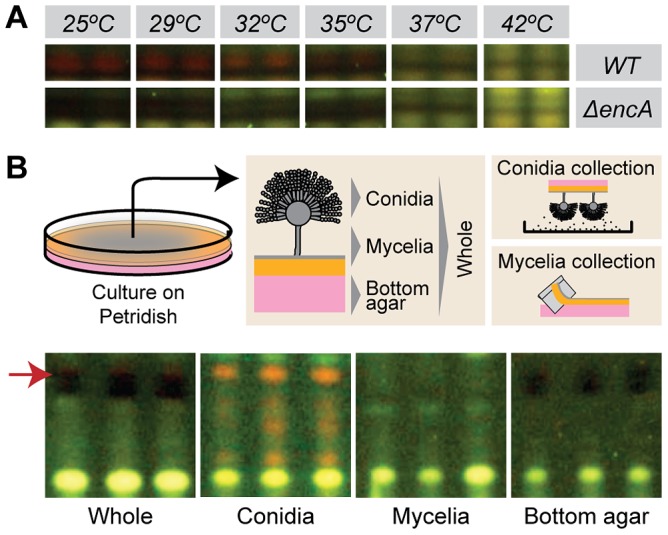
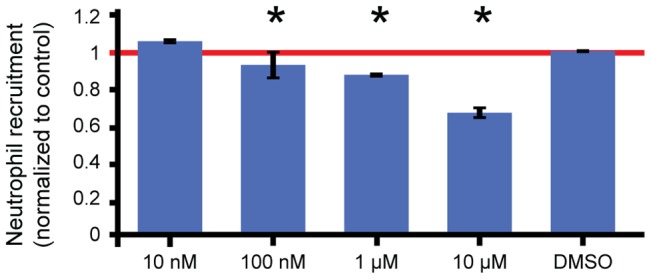
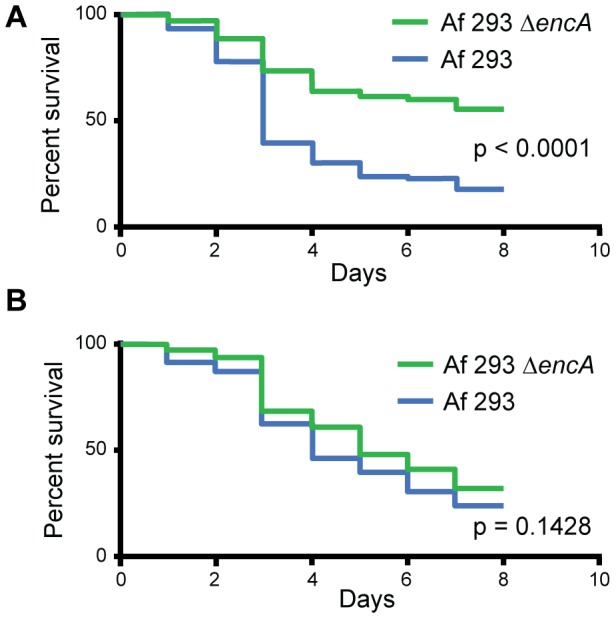
The secondary metabolome provides pathogenic fungi with a plethoric and versatile panel of molecules that can be deployed during host ingress. While powerful genetic and analytical chemistry methods have been developed to identify fungal secondary metabolites (SMs), discovering the biological activity of SMs remains an elusive yet critical task. Here, we describe a process for identifying the immunosuppressive properties of Aspergillus SMs developed by coupling a cost-effective microfluidic neutrophil chemotaxis assay with an in vivo zebrafish assay. The microfluidic platform allows the identification of metabolites inhibiting neutrophil recruitment with as little as several nano-grams of compound in microliters of fluid. The zebrafish assay demonstrates a simple and accessible approach for performing in vivo studies without requiring any manipulation of the fish. Using this methodology we identify the immunosuppressive properties of a fungal SM, endocrocin. We find that endocrocin is localized in Aspergillus fumigatus spores and its biosynthesis is temperature-dependent. Finally, using the Drosophila toll deficient model, we find that deletion of encA, encoding the polyketide synthase required for endocrocin production, yields a less pathogenic strain of A. fumigatus when spores are harvested from endocrocin permissive but not when harvested from endocrocin restrictive conditions. The tools developed here will open new "function-omic" avenues downstream of the metabolomics, identification, and purification phases.
Overview
The claims and statistics of this paper haven’t been checked yet.
Free: it reads the open-access text and checks the first 5 claims that cite a source we can check. Create a free account to check every claim.
Integrity signals
Registry
Cites
Statistics
Figures
Verification
Claims the paper makes
The claims and statistics of this paper haven’t been checked yet.
Free: it reads the open-access text and checks the first 5 claims that cite a source we can check. Create a free account to check every claim.
Claims other papers make about this one
Each is checked against this paper’s own text: does it say what the citing paper says it does?
The source backs part of the claim, not all of it — or backs it for a different population, condition or comparison.
In the citing paper
“Toxic secondary metabolites produced by A. fumigatus (fumigaclavin, trypacidin, helvolic acid, gliotoxin, fumitremorgin, fumagillin, and pseurotin) do impact host cells (433, 440–443).”
From Aspergillus fumigatus and Aspergillosis in 2019 (2019) · cites this paper as [442]
Experimental — accuracy not yet measured
Self-check
Percentages, sums and reported differences re-computed from the paper’s own numbers.
The self-check needs the paper’s full text.
Citations
Cites
Lemaitre, B., Nicolas, E., Michaut, L., Reichhart, J.-M., & Hoffmann, J. A. (1996) · Cell · doi:10.1016/s0092-8674(00)80172-5 · Cited by 4,043
Aspergillus fumigatus and Aspergillosis
Latgé, J.-P. (1999) · Clinical Microbiology Reviews · doi:10.1128/cmr.12.2.310 · Cited by 2,307 · cited 1×
“nidulans whose SMs are assessed in this study [6,7].”
BackgroundMicrofluidic Large-Scale Integration
Thorsen, T., Maerkl, S. J., & Quake, S. R. (2002) · Science · doi:10.1126/science.1076996 · Cited by 2,222
Fungal secondary metabolism — from biochemistry to genomics
Keller, N. P., Turner, G., & Bennett, J. W. (2005) · Nature Reviews Microbiology · doi:10.1038/nrmicro1286 · Cited by 1,731
Self-citationPathogenesis of Aspergillus fumigatus in Invasive Aspergillosis
Dagenais, T. R. T., & Keller, N. P. (2009) · Clinical Microbiology Reviews · doi:10.1128/cmr.00055-08 · Cited by 993 · cited 1×
“More relevant models such as the murine model are logistically challenging, require excessive amounts of purified SMs, and are still fraught with deficiencies in visualization of innate cell response [25].”
BackgroundSelf-citationFungal secondary metabolites – Strategies to activate silent gene clusters
Brakhage, A. A., & Schroeckh, V. (2011) · Fungal Genetics and Biology · doi:10.1016/j.fgb.2010.04.004 · Cited by 729
Regulation of Secondary Metabolism in Filamentous Fungi
Yu, J.-H., & Keller, N. (2005) · Annual Review of Phytopathology · doi:10.1146/annurev.phyto.43.040204.140214 · Cited by 562
Self-citationda Silva Ferreira, M. E., Kress, M. R. V. Z., Savoldi, M., Goldman, M. H. S., Härtl, A., Heinekamp, T., Brakhage, A. A., & Goldman, G. H. (2006) · Eukaryotic Cell · doi:10.1128/ec.5.1.207-211.2006 · Cited by 403 · cited 1×
“SM from different developmental parts of the fungus were obtained as follows: conidia was obtained by gently tapping the fungal culture with the petri dish lid side down as described previously [35], The remaining conidia and conidiophores were removed by gently scraping the surface of the fungal culture with 0.”
MethodChromatin-level regulation of biosynthetic gene clusters
Bok, J. W., Chiang, Y.-M., Szewczyk, E., Reyes-Dominguez, Y., Davidson, A. D., Sanchez, J. F., Lo, H.-C., Watanabe, K., Strauss, J., Oakley, B. R., et al. (2009) · Nature Chemical Biology · doi:10.1038/nchembio.177 · Cited by 381
Self-citationGenomic Mining for Aspergillus Natural Products
Bok, J. W., Hoffmeister, D., Maggio-Hall, L. A., Murillo, R., Glasner, J. D., & Keller, N. P. (2006) · Chemistry & Biology · doi:10.1016/j.chembiol.2005.10.008 · Cited by 354
Self-citationLaeA, a Regulator of Morphogenetic Fungal Virulence Factors
Bok, J. W., Balajee, S. A., Marr, K. A., Andes, D., Nielsen, K. F., Frisvad, J. C., & Keller, N. P. (2005) · Eukaryotic Cell · doi:10.1128/ec.4.9.1574-1582.2005 · Cited by 283 · cited 1×
“fumigatus implicated unidentified SMs in development of invasive aspergillosis [10,11].”
BackgroundSelf-citationWiemann, P., Brown, D. W., Kleigrewe, K., Bok, J. W., Keller, N. P., Humpf, H., & Tudzynski, B. (2010) · Molecular Microbiology · doi:10.1111/j.1365-2958.2010.07263.x · Cited by 283
Self-citationFlow rate analysis of a surface tension driven passive micropump
Berthier, E., & Beebe, D. J. (2007) · Lab on a Chip · doi:10.1039/b707637a · Cited by 191
Self-citationLópez‐Berges, M. S., Hera, C., Sulyok, M., Schäfer, K., Capilla, J., Guarro, J., & Di Pietro, A. (2013) · Molecular Microbiology · doi:10.1111/mmi.12082 · Cited by 176
Automated cell culture in high density tubeless microfluidic device arrays
Meyvantsson, I., Warrick, J. W., Hayes, S., Skoien, A., & Beebe, D. J. (2008) · Lab on a Chip · doi:10.1039/b715375a · Cited by 172
Self-citationDistinct Roles for VeA and LaeA in Development and Pathogenesis of Aspergillus flavus
Amaike, S., & Keller, N. P. (2009) · Eukaryotic Cell · doi:10.1128/ec.00088-09 · Cited by 172
Self-citationWu, D. L., Oide, S., Zhang, N., Choi, M. Y., & Turgeon, B. G. (2012) · PLoS Pathogens · doi:10.1371/journal.ppat.1002542 · Cited by 161
Live imaging of neutrophil motility in a zebrafish model of WHIM syndrome
Walters, K. B., Green, J. M., Surfus, J. C., Yoo, S. K., & Huttenlocher, A. (2010) · Blood · doi:10.1182/blood-2010-03-276972 · Cited by 155
Self-citationMarine Natural Product Libraries for High-Throughput Screening and Rapid Drug Discovery
Bugni, T. S., Richards, B. T., Bhoite, L., Cimbora, D. M., Harper, M. K., & Ireland, C. M. (2008) · Journal of Natural Products · doi:10.1021/np800184g · Cited by 141
Ben‐Ami, R., Lewis, R. E., & Kontoyiannis, D. P. (2010) · British Journal of Haematology · doi:10.1111/j.1365-2141.2010.08283.x · Cited by 133
Self-citationBen-Ami, R., Lewis, R. E., Leventakos, K., & Kontoyiannis, D. P. (2009) · Blood · doi:10.1182/blood-2009-07-231209 · Cited by 120
Self-citationAspergillus nidulans and Chronic Granulomatous Disease: A Unique Host–Pathogen Interaction
Henriet, S. S. V., Verweij, P. E., & Warris, A. (2012) · The Journal of Infectious Diseases · doi:10.1093/infdis/jis473 · Cited by 99
Zebrafish: A See-Through Host and a Fluorescent Toolbox to Probe Host–Pathogen Interaction
Tobin, D. M., May, R. C., & Wheeler, R. T. (2012) · PLoS Pathogens · doi:10.1371/journal.ppat.1002349 · Cited by 97
Galleria mellonella as a Model for Fungal Pathogenicity Testing
Fallon, J., Kelly, J., & Kavanagh, K. (2012) · Methods in Molecular Biology · doi:10.1007/978-1-61779-539-8_33 · Cited by 91
Unraveling polyketide synthesis in members of the genus Aspergillus
Chiang, Y., Oakley, B. R., Keller, N. P., & Wang, C. C. C. (2010) · Applied Microbiology and Biotechnology · doi:10.1007/s00253-010-2525-3 · Cited by 91
Self-citationLionakis, M. S., Lewis, R. E., May, G. S., Wiederhold, N. P., Albert, N. D., Halder, G., & Kontoyiannis, D. P. (2005) · The Journal of Infectious Diseases · doi:10.1086/428587 · Cited by 90
Self-citationGenome-Based Cluster Deletion Reveals an Endocrocin Biosynthetic Pathway in Aspergillus fumigatus
Lim, F. Y., Hou, Y., Chen, Y., Oh, J.-H., Lee, I., Bugni, T. S., & Keller, N. P. (2012) · Applied and Environmental Microbiology · doi:10.1128/aem.07710-11 · Cited by 85
Self-citationKhoufache, K., Puel, O., Loiseau, N., Delaforge, M., Rivollet, D., Coste, A., Cordonnier, C., Escudier, E., Botterel, F., & Bretagne, S. (2007) · BMC Microbiology · doi:10.1186/1471-2180-7-5 · Cited by 79
Phagocytosis of Aspergillus fumigatus conidia by primary nasal epithelial cells in vitro
Botterel, F., Gross, K., Ibrahim-Granet, O., Khoufache, K., Escabasse, V., Coste, A., Cordonnier, C., Escudier, E., & Bretagne, S. (2008) · BMC Microbiology · doi:10.1186/1471-2180-8-97 · Cited by 70
An arrayed high-content chemotaxis assay for patient diagnosis
Berthier, E., Surfus, J., Verbsky, J., Huttenlocher, A., & Beebe, D. (2010) · Integrative Biology · doi:10.1039/c0ib00030b · Cited by 68
Self-citationIsogenic auxotrophic mutant strains in the Aspergillus fumigatus genome reference strain AF293
Xue, T., Nguyen, C. K., Romans, A., Kontoyiannis, D. P., & May, G. S. (2004) · Archives of Microbiology · doi:10.1007/s00203-004-0707-z · Cited by 66
Self-citationMurayama, T., Amitani, R., Ikegami, Y., Nawada, R., Lee, W., & Kuze, F. (1996) · European Respiratory Journal · doi:10.1183/09031936.96.09020293 · Cited by 63
Immunosuppressive substances in Aspergillus fumigatus culture filtrate
Watanabe, A., Kuriyama, T., Kamei, K., Nishimura, K., Miyaji, M., Sekine, T., & Waku, M. (2003) · Journal of Infection and Chemotherapy · doi:10.1007/s10156-002-0227-1 · Cited by 50
Lionakis, M. S., & Kontoyiannis, D. P. (2010) · Virulence · doi:10.4161/viru.1.6.13311 · Cited by 43
Self-citationIkegami, Y., Amitani, R., Murayama, T., Nawada, R., Lee, W., Kawanami, R., & Kuze, F. (1998) · European Respiratory Journal · doi:10.1183/09031936.98.12030607 · Cited by 19
Image-based analysis of primary human neutrophil chemotaxis in an automated direct-viewing assay
Meyvantsson, I., Vu, E., Lamers, C., Echeverria, D., Worzella, T. J., Echeverria, V., Skoien, A., & Hayes, S. A. (2011) · Journal of Immunological Methods · doi:10.1016/j.jim.2010.12.017 · Cited by 14
Cited by
The re-emergence of natural products for drug discovery in the genomics era
Harvey, A. L., Edrada-Ebel, R., & Quinn, R. J. (2015) · Nature Reviews Drug Discovery · doi:10.1038/nrd4510 · Cited by 2,572
Aspergillus fumigatus and Aspergillosis in 2019
Latgé, J.-P., & Chamilos, G. (2019) · Clinical Microbiology Reviews · doi:10.1128/cmr.00140-18 · Cited by 1,400
Fungal secondary metabolism: regulation, function and drug discovery
Keller, N. P. (2019) · Nature Reviews Microbiology · doi:10.1038/s41579-018-0121-1 · Cited by 1,390
Self-citationNeutrophil migration in infection and wound repair: going forward in reverse
de Oliveira, S., Rosowski, E. E., & Huttenlocher, A. (2016) · Nature Reviews Immunology · doi:10.1038/nri.2016.49 · Cited by 1,058
Self-citationRegulation and Role of Fungal Secondary Metabolites
Macheleidt, J., Mattern, D. J., Fischer, J., Netzker, T., Weber, J., Schroeckh, V., Valiante, V., & Brakhage, A. A. (2016) · Annual Review of Genetics · doi:10.1146/annurev-genet-120215-035203 · Cited by 433
Metadata
- Authors
- Berthier, E., Lim, F. Y., Deng, Q., Guo, C.-J., Kontoyiannis, D. P., Wang, C. C. C., Rindy, J., Beebe, D. J., Huttenlocher, A., & Keller, N. P.
- Affiliations
- University of Wisconsin–Madison (US)
- University of Southern California (US)
- The University of Texas MD Anderson Cancer Center (US)
- Corresponding author
- Keller, Nancy P.
- ORCID
- Venue
- PLoS Pathogens
- Publisher
- Public Library of Science (PLoS)
- Published
- 2013-04-11
- Volume
- 9
- Issue
- 4
- Pages
- e1003289
- ISSN
- 1553-7366 (ISSN-L)
- 1553-7374
- PMC
- PMC3623715
- OpenAlex
- W2069889363
- Cited by
- 63
- References
- 37
- Citations by year
- 2026: 1 · 2025: 2 · 2024: 2 · 2023: 4 · 2022: 3 · 2021: 1 · 2020: 5 · 2019: 6 · 2018: 5 · 2017: 7 · 2016: 8 · 2015: 7 · 2014: 11 · 2013: 1
- FWCI
- 6.61
- Type
- journal article
- Language
- en
- Open access
- gold
- doi.org
- Locations
- PLoS Pathogens (publishedVersion, cc-by)
- Europe PMC (PubMed Central) (publishedVersion, cc-by)
- PubMed Central (publishedVersion, cc-by)
- PubMed (publishedVersion)
- DOAJ (DOAJ: Directory of Open Access Journals) (submittedVersion, cc-by-sa)
- Figshare (submittedVersion, cc-by)
- Funders
- National Science Foundation
- Division of Emerging Frontiers in Research and Innovation
- Topics
- Life Sciences › Immunology and Microbiology › Applied Microbiology and Biotechnology › Microbial Natural Products and Biosynthesis
- Health Sciences › Medicine › Infectious Diseases › Antifungal resistance and susceptibility
- Life Sciences › Agricultural and Biological Sciences › Plant Science › Mycotoxins in Agriculture and Food
- Keywords
- fungal secondary metabolites, immunosuppression, Aspergillus fumigatus, neutrophil chemotaxis, microfluidic assay, zebrafish infection model, polyketide synthase, fungal pathogenicity
- MeSH terms
- Animals, Anthracenes, Aspergillus fumigatus, Drosophila, Immunosuppression Therapy, Neutrophils, Zebrafish, Microfluidics, Polyketide Synthases, Metabolome, Secondary Metabolism
About these checks
Registry, retraction, Cites and statistics results are computed, not judged, with one exception: a printed reference that no index lists is read once by a model before it counts as a citation error. Claims are extracted by a model and kept only when their quote appears verbatim in the text; each cited source is then checked, with a model’s help, for whether it says what the claim relies on. Those verdicts can be wrong — read the claim’s quote and the cited source before relying on one.
Statistics and arithmetic are recomputed, not judged.
Confidence bands are shown only for fields calibrated on our annotated test set. None is calibrated yet, so no band is shown.
What counts as a claim ›How we measure confidence ›How we check this ›
Are you an author, or do you see a problem with this page? Request a review
Data sources
Bibliographic data: Semantic Scholar, OpenAlex, Crossref.
Contains information from the Semantic Scholar Academic Graph Datasets, made available under the ODC Attribution License (ODC-BY 1.0).
Semantic Scholar’s data is described in: Kinney, R., et al. (2023). The Semantic Scholar Open Data Platform. arXiv:2301.10140.
