

Experimental and Simulative Analysis of Magnetic Nanoparticle Accumulation Using Various Halbach Arrays
Open accessThe DOI matches its Crossref record; 14 of the 14 references it cites were found in a registry or an index; 3 of the 12 sources its claims cite were checked for support.
Abstract
Abstract One of the major challenges in using magnetic nanoparticles in biomedical applications is still the accurate steering and trapping of these particles at a desired location, like at a tumor. Halbach arrays are well-established here as they generate the strongest magnetic force. However, these arrays are mechanically unstable, and thus, their potential to attract magnetic particles is often investigated fully numerically. Hence, this paper provides instructions on how to easily produce Halbach arrays using permanent magnets and metal glue. In total, three Halbach arrays of five, seven, and nine magnets were produced and analyzed regarding their potential for capturing magnetic particles in a background flow, numerically using COMSOL Multiphysics and in measurements. Furthermore, the Halbach arrays are compared with two other array configurations with all magnetizations in the same directions and alternating once. Overall, the simulation results were in good agreement with the measurement results. The amount of captured particles was significantly higher in measurements for the Halbach arrays with 8.2 %, compared to the array with alternating magnetization direction with 6.6% captured particles. Therefore, using Halbach arrays to capture or steer magnetic nanoparticles in a background flow is strongly recommended.
Overview
CoChat Summary
TL;DR
The paper produces linear Halbach arrays of five, seven, and nine permanent magnets and compares their ability to capture SPIONs in a background flow using COMSOL simulations and measurements. It reports good agreement between simulation and measurement and recommends Halbach arrays for capturing or steering magnetic nanoparticles.
Key findings
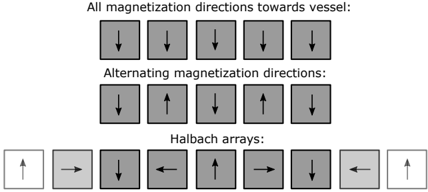
- In measurements, the five-magnet Halbach array captured 8.2% of SPIONs, compared with 6.6% for the alternating-magnetization array and 1.0% for the array with all magnetizations toward the tube; the no-magnet reference captured 0%.
- Longer Halbach arrays captured more particles: the seven-magnet array measured 10.5% (simulated 9.0%), and the nine-magnet array measured 11.5% (simulated 10.8%).
- Simulation results overall agreed with measurements: the five-magnet Halbach array simulated 6.2%, the alternating array 6.0%, the all-toward-tube array 3.8%, and the reference 0%.
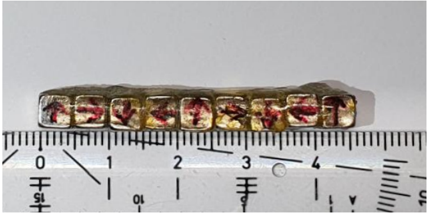
- The paper provides a low-cost production method for linear Halbach arrays using permanent magnets, metal glue, and optional epoxy resin encapsulation of approximately 2 mm thickness, not applied to the strong side.
Methods
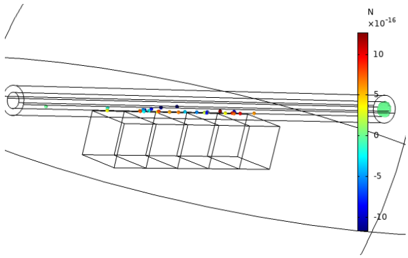
- Numerical: COMSOL Multiphysics 5.4 3D model with an 80 mm tube filled with deionized water, no-slip boundary condition, NdFeB magnets, one SPION pulse released at t = 0 s, and a time-dependent study for 100 s with 0.1 s time steps; captured SPIONs at the vessel wall were extracted, and particle-particle interactions were neglected. Six scenarios were simulated: reference, five magnets toward tube, five magnets alternating, and Halbach arrays with five, seven, and nine magnets.
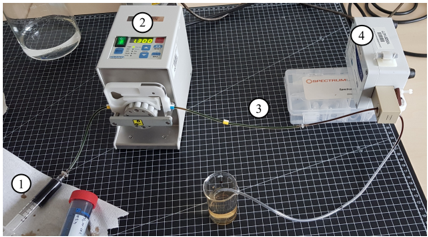
- Experimental: for each of the six scenarios, five measurements were conducted and mean and standard deviation derived; an Ismatec Tygon ST tube with inner radius 0.76 mm and wall thickness 0.86 mm was used with a peristaltic pump and deionized water; SPIONs were injected continuously, and a Barington MS3 susceptometer measured maximum susceptibility, which was normalized to the no-magnet reference to derive captured SPIONs.
- SPIONs: synthesized by SEON at the University Hospital Erlangen, consisting of magnetite (Fe3O4) clusters with approximately 66 SPIONs per cluster and approximately 6.77 × 10^13 clusters per milliliter; hydrodynamic cluster diameter 50 nm, iron-oxide particle diameter 9.5 nm, Fe concentration 7.5 mg/ml, and magnetite density 5.2 g/ml.
Limitations
- The paper states that the simulation neglected particle-particle interactions and retroaction of the particles on the magnetic field, and that previous research showed retroaction has a significant impact; only 500 particles were considered in simulations, whereas measurements had approximately 6.77 × 10^13 particle clusters per milliliter.
- The paper states that the measurement setup and evaluation were rather simple: SPIONs were injected continuously, only the decrease in maximum susceptibility was evaluated, SPIONs remaining in the tube (e.g., due to gravitation) were neglected, and reproducibility needs to be confirmed.
- The paper states future improvements will include sending multiple pulses and considering pulse width in measurements, and moving the simulation from individual particles to an inhomogeneous medium with magnetic properties; the text also makes evident that simulation and measurement deviations occurred, with Nc,meas < Nc,sim for the all-toward-tube array and Nc,meas > Nc,sim for all other arrays.
Model-written summary. Check it against the paper before relying on it.
Integrity signals
Registry
Cites
Statistics
Figures
Verification
Claims the paper makes
3 Valid · 1 Not valid · 5 Not checked · 17 Own results and interpretations
Every source the paper cites for this claim was checked and supports it.
In the paper
“In our previous research [14], we have shown that especially the retroaction has a significant impact on the magnetic force”
§ Magnetic Nanoparticle Accumulation Using Various Halbach Arrays > 4.3 Comparison of Simulation and Measurement Results
What the sources say
- Supportedcites [14] 14. Thalmayer AS, et al. Reduced Steering Performance in Mag- netic Drug Targeting Induced by Shielding Arising from Ac- cumulation of Particles. Current Directions in Biomedical Engineering 2022;8(2):560-563. source
The Abstract reports that retroaction of the particle accumulation profile affected the magnetic field and reduced the magnetic force by up to 50% as the profile accumulated. The Limitations and Conclusions section (p. 562) likewise describes changes in the field gradient and force. This finding is from a numerical model of particle accumulation, particularly at high effective susceptibility. (LLM, conf=0.93)
boostedstates a cause- Asserted: passes — The authors put it forward as true.
- Checkable: passes — It can be checked against evidence.
- Load-bearing: unclear — It is unclear whether the paper’s conclusions depend on it.
- Based: passes — The paper gives a reason why it holds.
- Supported
The cited sources support only part of this claim — read each source’s verdict below.
In the paper
“Moreover, SPIONs are biocompatible [2,6].”
§ Magnetic Nanoparticle Accumulation Using Various Halbach Arrays > 2.2 Magnetic Nanoparticles
What the sources say
- Partly supportedcites [2] 2. Zschiesche L, et al. Biocompatibility of Dextran-Coated 30 nm and 80 nm Sized SPIONs towards Monocytes, Dendritic Cells and Lymphocytes. Nanomaterials 2022;13(1):14. sourceExperimental — accuracy not yet measured
The Discussion concludes that the tested dextran-coated SPIONs are highly biocompatible at doses relevant for MRI. The citing sentence extends that finding to SPIONs generally, regardless of coating or dose, which this study does not establish. (LLM, conf=0.88)
- Not checked — no full text of the sourcecites [6] 6. Tietze R, et al. Efficient Drug-Delivery Using Magnetic Nanoparticles-Biodistribution and Therapeutic Effects in Tumour Bearing Rabbits. Nanomedicine: Nanotechnology, Biology, and Medicine 2013;9:961-971. source
plain- Asserted: passes — The authors put it forward as true.
- Checkable: passes — It can be checked against evidence.
- Load-bearing: passes — The paper’s conclusions depend on it.
- Based: passes — The paper gives a reason why it holds.
- Partly supported
The cited sources support only part of this claim — read each source’s verdict below.
In the paper
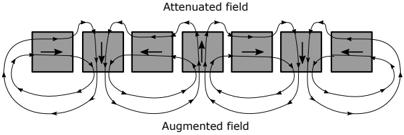
“In the literature, so-called Halbach arrays have proven to be particularly suitable for particle steering, as they generate the strongest magnetic force over a large distance [7][8][9].”
- Also stated in: § 2.1 Linear Halbach Arrays · plain
“This structure maximizes the magnetic force on the nanoparticles, which is crucial for effective particle steering or capturing [5,7,9,12].”
§ Magnetic Nanoparticle Accumulation Using Various Halbach Arrays > 1 Introduction
What the sources say
- Not matchedcites [7][8][9]
A range of references, not one source.
- Not matchedcites [5] 5. Thalmayer A, Götz K, Fischer G. How the Magnetization Angle of a Linear Halbach Array Influences Particle Steering in Magnetic Drug Targeting-A Systematic Evaluation and Optimization. Symmetry 2024;16:148.
More than one paper fits this citation.
- Partly supportedcites [7] 7. Thalmayer AS, et al. Towards Steering Magnetic Nanopar- ticles in Drug Targeting Using a Linear Halbach Array. Ad- vances in Radio Science 2023;20:93-104. sourceExperimental — accuracy not yet measured
Section 2.1 reports stronger magnetic force from a linear Halbach array than from an alternating-magnetization array. Section 3.3 says the gradient on its strong side remains high over a larger distance, but does not establish that Halbach arrays generate the strongest magnetic force over a large distance compared with other configurations. Page numbers are unavailable in our copy. (LLM, conf=0.84)
- Not checked — no full text of the sourcecites [9] 9. Sakuma H, Nakagawara T. Optimization of Rotation Patterns of a Mangle-Type Magnetic Field Source Using Covariance Matrix Adaptation Evolution Strategy. Journal of Magnetism and Magnetic Materials 2021;527:167752. source
- Not checked — no full text of the sourcecites [12] 12. Kang JH, et al. Application of a Halbach Magnetic Array for Long-Range Cell and Particle Separations in Biological Sam- ples. Applied Physics Letters 2016;108:213702. source
boostedstates a cause- Asserted: passes — The authors put it forward as true.
- Checkable: passes — It can be checked against evidence.
- Load-bearing: passes — The paper’s conclusions depend on it.
- Based: passes — The paper gives a reason why it holds.
- Also stated in: § 2.1 Linear Halbach Arrays · plain
A result the paper reports from its own data — it cites no other source for it, so there is none to check. The quote shows it is in the paper.
In the paper
“For the alternating magnetization directions, 6 % of the SPIONs get captured”
§ Magnetic Nanoparticle Accumulation Using Various Halbach Arrays > 4.1 Simulation Results
plain- Asserted: passes — The authors put it forward as true.
- Checkable: passes — It can be checked against evidence.
- Load-bearing: passes — The paper’s conclusions depend on it.
- Based: passes — The paper gives a reason why it holds.
A result the paper reports from its own data — it cites no other source for it, so there is none to check. The quote shows it is in the paper.
In the paper
“Overall, the simulation results were in good agreement with the measurement results.”
- Also stated in: § 4.3 Comparison of Simulation and Measurement Results · plain
“By comparing the simulation and measurement results in Table 3, overall, a good agreement was achieved.”
§ Magnetic Nanoparticle Accumulation Using Various Halbach Arrays > Abstract
plainstates an association- Asserted: passes — The authors put it forward as true.
- Checkable: passes — It can be checked against evidence.
- Load-bearing: passes — The paper’s conclusions depend on it.
- Based: passes — The paper gives a reason why it holds.
- Also stated in: § 4.3 Comparison of Simulation and Measurement Results · plain
12 more claims
Create a free account to see all 26 claims and every source verdict.
- Borderline: one of the tests for a substantial claim is unclear. 1
- It may state two separate claims as one. 7
- Probably not a substantial claim. 2
Citations
Cites
The publisher hasn’t deposited this paper’s reference list.
Cited by
Steering Magnetic Nanoparticles with Moving Magnetic Fields – A Feasibility Study
Thalmayer, A. S., Xiao, K., Huber, C. M., Hageroth, L., Fink, L., Wolff, P., Touijer, O., Lyer, S., Fischer, G., & Lübke, M. (2026) · Current Directions in Biomedical Engineering · doi:10.1515/cdbme-2026-0244
“A Hal-bach array generates the strongest magnetic force on nanoparticles [11].”
Self-citation
Metadata
- Authors
- Thalmayer, A. S., Götz, K., Lübke, M., & Fischer, G.
- Affiliations
- Friedrich-Alexander-Universität Erlangen-Nürnberg (DE)
- Corresponding author
- Thalmayer, Angelika S.
- Venue
- Current Directions in Biomedical Engineering
- Publisher
- Walter de Gruyter GmbH
- Published
- 2024-12-01
- Volume
- 10
- Issue
- 4
- Pages
- 649-652
- ISSN
- 2364-5504 (ISSN-L)
- OpenAlex
- W4405555228
- Cited by
- 0
- References
- 0
- FWCI
- 0.00
- Type
- journal article
- Language
- en
- Open access
- diamond
- doi.org
- Locations
- Current Directions in Biomedical Engineering (publishedVersion, cc-by)
- DOAJ (DOAJ: Directory of Open Access Journals) (submittedVersion)
- Funders
- Deutsche Forschungsgemeinschaft (509922606, GRK 2950)
- Topics
- Physical Sciences › Engineering › Biomedical Engineering › Characterization and Applications of Magnetic Nanoparticles
- Physical Sciences › Physics and Astronomy › Condensed Matter Physics › Micro and Nano Robotics
- Physical Sciences › Engineering › Biomedical Engineering › Microfluidic and Bio-sensing Technologies
- Keywords
- Halbach array, magnetic nanoparticles, magnetic trapping, magnetic steering, permanent magnets, magnetization direction, magnetic field modeling, biomedical applications, tumor targeting
About these checks
Registry, retraction, Cites and statistics results are computed, not judged, with one exception: a printed reference that no index lists is read once by a model before it counts as a citation error. Claims are extracted by a model and kept only when their quote appears verbatim in the text; each cited source is then checked, with a model’s help, for whether it says what the claim relies on. Those verdicts can be wrong — read the claim’s quote and the cited source before relying on one.
The claim verdicts this report counts are experimental: their accuracy is not yet measured.
A language model drew the claims from the paper on 2026-10-08, under version 3 of the claim definition (model deepseek-v4.1-flash, prompt extract-v3).
A second model labelled each claim on 2026-10-08 (model jev-1.13-20260917, definition revision gold-guideline-v0.2).
Cited sources are checked with a language model’s help (gpt-6-sol).
Statistics and arithmetic are recomputed, not judged.
Confidence bands are shown only for fields calibrated on our annotated test set. None is calibrated yet, so no band is shown.
What counts as a claim ›How we measure confidence ›How we check this ›
Are you an author, or do you see a problem with this page? Request a review
Data sources
Bibliographic data: Semantic Scholar, OpenAlex, Crossref.
Contains information from the Semantic Scholar Academic Graph Datasets, made available under the ODC Attribution License (ODC-BY 1.0).
Semantic Scholar’s data is described in: Kinney, R., et al. (2023). The Semantic Scholar Open Data Platform. arXiv:2301.10140.
