

L2 fluency across tasks: disentangling demands on conceptualisation and formulation in speech production
Open accessThe DOI matches its Crossref record; 62 of the 62 references it cites were found in a registry or an index; none of the 116 sources its claims cite is checked for support yet.
Abstract
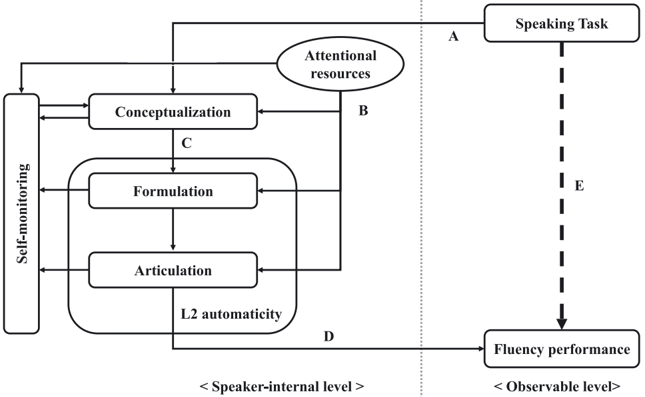
Second language (L2) speaking research has highlighted intra-speaker variability of fluency performance across tasks. To better understand such task effects on fluency, the framework of speech processing demands has been proposed as a systematic approach to relating task characteristics to L2 speech production mechanisms and the limited capacity of attentional resources (Skehan 2009. Modelling second language performance: Integrating complexity, accuracy, fluency, and lexis. Applied Linguistics 30(4). 510–532, 2014. Limited attentional capacity, second language performance, and task-based pedagogy. In Peter Skehan (ed.), Processing perspectives on task performance, 211–260. Amsterdam: John Benjamins). However, the framework has been tested on a limited range of task types, using carefully designed experimental tasks. For the sake of the ecological validity of findings, the current study thus further explores how L2 learners’ fluency varies across four spontaneous speaking tasks differing in their processing demands. A total of 128 Japanese learners of English completed four speaking tasks: Argumentative task, Picture narrative task, Reading-to-Speaking task, and Reading-while-listening-to-speaking task. Their speech was analysed in terms of speed, breakdown, and repair fluency and was compared across tasks. The results of Generalised Linear Mixed-effects Modelling showed that conceptualising demands were reflected in the frequency of filled pauses, while formulation demands were associated with the articulation rate, mid-clause pause ratio, and mid-clause pause duration. These findings unveil the interrelationship between task characteristics, fluency measures, and how learners approach tasks.
Overview
CoChat Summary
TL;DR
This study compared L2 fluency across four spontaneous speaking tasks differing in conceptualisation and formulation demands in 128 Japanese learners of English. It found that conceptualisation demands were mainly reflected in filled pause frequency, while formulation demands were associated with articulation rate and mid-clause pause measures.
Key findings
- For conceptualisation (argumentative vs. picture narrative), the argumentative task showed faster articulation rate, fewer mid- and end-clause silent pauses, more filled pauses, and fewer self-repetitions and self-corrections; post-speaking questionnaire responses mentioned conceptualisation 12 vs. 8 times (Arg vs. PicN) out of 111 total coded responses.
- For lexical activation (picture narrative vs. reading-to-speaking), the reading-to-speaking task showed slower articulation rate, more mid-clause pauses, fewer but longer end-clause pauses, more filled pauses, fewer repetitions, and more false starts.
- For phonological activation (reading-to-speaking vs. reading-while-listening-to-speaking), only mid-clause pause duration differed significantly: pauses were longer in the reading-while-listening-to-speaking task; there were no significant differences in speed fluency or pause ratio measures between these two tasks.
- Overall, conceptualising demands were reflected in filled pause frequency, while formulation demands were associated with articulation rate, mid-clause pause ratio, and mid-clause pause duration.
Methods
- 128 Japanese learners of English at a private university in Japan (73 female, 55 male; age 18–27, M = 20.43, SD = 1.81; mostly B1–B2 CEFR) completed four speaking tasks: Argumentative, Picture narrative, Reading-to-speaking, and Reading-while-listening-to-speaking. Three minutes of pre-task planning were provided in all tasks, note-taking was not allowed, and no speaking time limit was set; task order was counterbalanced. Forty participants completed a post-speaking questionnaire.
- Speech was analysed for speed, breakdown, and repair fluency; silent pauses were defined as silences longer than 250 ms. Syllable counts used the sylcount package in R 4.0.2, and Praat was used for temporal annotation. Generalised Linear Mixed-effects Models used a log link, Gaussian distribution for articulation rate and Gamma distribution for other fluency measures, with task type as a fixed effect, participant random intercepts, and forward difference contrast coding for three predetermined contrasts. Questionnaire responses were analysed deductively.
Limitations
- Stated: the constant 3-min pre-task planning across tasks may interact with task characteristics, so replication with varied pre-task and on-line planning is needed; content generation and discourse organisation may not fully control preverbal message complexity and subsequent linguistic demands, and separating conceptualisation from formulation may be virtually impossible; the four common task types may differ in genre, topic difficulty, and other aspects beyond speech processing demands.
- Evident: the sample comes from one private Japanese university and is mostly B1–B2, limiting generalisability; only 40 of 128 participants completed the post-speaking questionnaire, so qualitative cross-validation is limited. Also, some participants (n = 104) completed two argumentative tasks, and random slopes were not included because task type was within-subject.
Model-written summary. Check it against the paper before relying on it.
Integrity signals
Registry
Cites
Statistics
Figures
Verification
Claims the paper makes
0 Valid · 0 Not valid · 81 Not checked · 101 Own results and interpretations
A result the paper reports from its own data — it cites no other source for it, so there is none to check. The quote shows it is in the paper.
In the paper
“formulation demands were associated with the articulation rate, mid-clause pause ratio, and mid-clause pause duration”
§ Shungo Suzuki* and Judit Kormos L2 fluency across tasks: disentangling demands on conceptualisation and formulation in speech production > Abstract
plainstates an association- Asserted: passes — The authors put it forward as true.
- Checkable: passes — It can be checked against evidence.
- Load-bearing: passes — The paper’s conclusions depend on it.
- Based: passes — The paper gives a reason why it holds.
A result the paper reports from its own data — it cites no other source for it, so there is none to check. The quote shows it is in the paper.
In the paper
“conceptualising demands were reflected in the frequency of filled pauses”
§ Shungo Suzuki* and Judit Kormos L2 fluency across tasks: disentangling demands on conceptualisation and formulation in speech production > Abstract
plainstates an association- Asserted: passes — The authors put it forward as true.
- Checkable: passes — It can be checked against evidence.
- Load-bearing: passes — The paper’s conclusions depend on it.
- Based: passes — The paper gives a reason why it holds.
A result the paper reports from its own data — it cites no other source for it, so there is none to check. The quote shows it is in the paper.
In the paper
“Although the content of speech is largely predefined in both the PicN task and the RtoS task, the frequency of filled pauses was higher in the RtoS task.”
- Also stated in: § Additional information · plain
“PicN < RtoS”
§ Shungo Suzuki* and Judit Kormos L2 fluency across tasks: disentangling demands on conceptualisation and formulation in speech production > 6.2 Speech processing demands on formulation
plainstates an association- Asserted: passes — The authors put it forward as true.
- Checkable: passes — It can be checked against evidence.
- Load-bearing: passes — The paper’s conclusions depend on it.
- Based: passes — The paper gives a reason why it holds.
- Also stated in: § Additional information · plain
A result the paper reports from its own data — it cites no other source for it, so there is none to check. The quote shows it is in the paper.
In the paper
“Meanwhile, they produced fewer mid-clause pauses but more end-clause pauses in the PicN task than in the RtoS task.”
§ Shungo Suzuki* and Judit Kormos L2 fluency across tasks: disentangling demands on conceptualisation and formulation in speech production > 5.1 Task effects on fluency
plainstates an association- Asserted: passes — The authors put it forward as true.
- Checkable: passes — It can be checked against evidence.
- Load-bearing: passes — The paper’s conclusions depend on it.
- Based: passes — The paper gives a reason why it holds.
A result the paper reports from its own data — it cites no other source for it, so there is none to check. The quote shows it is in the paper.
In the paper
“Unlike in the argumentative task, some speakers mentioned that even though the visual prompt of the PicN task helped them to readily specify what to express, they had difficulty with retrieving the corresponding vocabulary items.”
§ Shungo Suzuki* and Judit Kormos L2 fluency across tasks: disentangling demands on conceptualisation and formulation in speech production > 6.1 Speech processing demands on conceptualisation
hedged- Asserted: passes — The authors put it forward as true.
- Checkable: passes — It can be checked against evidence.
- Load-bearing: passes — The paper’s conclusions depend on it.
- Based: passes — The paper gives a reason why it holds.
82 more claims
Create a free account to see all 182 claims and to verify the 80 references still open.
- It may state two separate claims as one. 17
- Probably not a substantial claim. 87
Citations
Cites
Fitting Linear Mixed-Effects Models Using lme4
Bates, D., Mächler, M., Bolker, B., & Walker, S. (2015) · Journal of Statistical Software · doi:10.18637/jss.v067.i01 · Cited by 86,835
Common European framework of reference for languages: learning, teaching, assessment
Council of Europe (2001) · International Linear Collider · Cited by 5,982
Speaking: From Intention to Articulation
Levelt, W. J. M. (1989) · doi:10.7551/mitpress/6393.001.0001 · Cited by 4,804
Dual-Process Theories of Higher Cognition: Advancing the Debate
Evans, J. S. B. T., & Stanovich, K. E. (2013) · Perspectives on Psychological Science · doi:10.1177/1745691612460685 · Cited by 4,271
Cognitive Load Theory and the Format of Instruction
Chandler, P., & Sweller, J. (1991) · Cognition and Instruction · doi:10.1207/s1532690xci0804_2 · Cited by 2,894
Working memory and language: an overview
Baddeley, A. (2003) · Journal of Communication Disorders · doi:10.1016/s0021-9924(03)00019-4 · Cited by 2,309
The spatial and temporal signatures of word production components
Indefrey, P., & Levelt, W. J. M. (2004) · Cognition · doi:10.1016/j.cognition.2002.06.001 · Cited by 2,144
A Framework for the Implementation of Task-based Instruction
SKEHAN, P. (1996) · Applied Linguistics · doi:10.1093/applin/17.1.38 · Cited by 1,547
Modelling Second Language Performance: Integrating Complexity, Accuracy, Fluency, and Lexis
Skehan, P. (2009) · Applied Linguistics · doi:10.1093/applin/amp047 · Cited by 1,161
Measuring spoken language: a unit for all reasons
Foster, P. (2000) · Applied Linguistics · doi:10.1093/applin/21.3.354 · Cited by 976
Individual Differences in Working Memory Capacity and Dual-Process Theories of the Mind.
Barrett, L. F., Tugade, M. M., & Engle, R. W. (2004) · Psychological Bulletin · doi:10.1037/0033-2909.130.4.553 · Cited by 913 · cited 1×
“Students could rely on retrieving readily available linguistic resources from memory (cf. Barrett et al. 2004) rather than advanced lexical items and constructions corresponding to an elaborated message, which are not likely to be fully automatised and requires conscious e ff ort and time to…”
Automated Evaluation of Text and Discourse with Coh-Metrix
McNamara, D. S., Graesser, A. C., McCarthy, P. M., & Cai, Z. (2014) · Cambridge University Press eBooks · doi:10.1017/cbo9780511894664 · Cited by 892
Cognitive Bases of Second Language Fluency
Segalowitz, N. (2010) · doi:10.4324/9780203851357 · Cited by 881
Random effects structure for testing interactions in linear mixed-effects models
Barr, D. J. (2013) · Frontiers in Psychology · doi:10.3389/fpsyg.2013.00328 · Cited by 782
Bock, J. K. (1982) · Psychological Review · doi:10.1037//0033-295x.89.1.1 · Cited by 695
Defining and operationalising L2 complexity
Bulté, B., & Housen, A. (2012) · Language Learning & Language Teaching · doi:10.1075/lllt.32.02bul · Cited by 587 · cited 1×
“Therefore, future studies should seek to further clarify the e ff ects of conceptualising demands on fl uency with valid measurement of the complexity of preverbal messages (cf. Bulté and Housen 2012; Skehan 2009; Vasylets et al. 2017).”
A meta-analysis on the relation between reading and working memory
Peng, P., Barnes, M., Wang, C., Wang, W., Li, S., Swanson, H. L., Dardick, W., & Tao, S. (2018) · Psychological Bulletin · doi:10.1037/bul0000124 · Cited by 521 · cited 1×
“The dual-process theory, which gained strong support in a recent meta-analysis of the relationship between reading task type, fi rst language reading development and working memory conducted by Peng et al. (2018), is compatible with Skehan ’ s (2009) speech processing framework.”
9. Strategic planning, task structure and performance testing
Tavakoli, P., & Skehan, P. (2005) · Language Learning & Language Teaching · doi:10.1075/lllt.11.15tav · Cited by 466
Dimensions of L2 Performance and Proficiency: Complexity, Accuracy and Fluency in SLA
(2012) · Language Learning & Language Teaching · doi:10.1075/lllt.32 · Cited by 452
Luoma, S. (2004) · Cambridge University Press eBooks · doi:10.1017/cbo9780511733017 · Cited by 365
BOT, K. D. (1992) · Applied Linguistics · doi:10.1093/applin/13.1.1 · Cited by 331
Lexical access during the production of idiomatic phrases
SPRENGER, S., LEVELT, W., & KEMPEN, G. (2006) · Journal of Memory and Language · doi:10.1016/j.jml.2005.11.001 · Cited by 323
(2011) · Task-Based Language Teaching · doi:10.1075/tblt.2 · Cited by 319
Fluency in Native and Nonnative English Speech
Götz, S. (2013) · Studies in Corpus Linguistics · doi:10.1075/scl.53 · Cited by 308
What makes speech sound fluent? The contributions of pauses, speed and repairs
Bosker, H. R., Pinget, A.-F., Quené, H., Sanders, T., & de Jong, N. H. (2013) · Language Testing · doi:10.1177/0265532212455394 · Cited by 301
TASK REPETITION AND SECOND LANGUAGE SPEECH PROCESSING
Lambert, C., Kormos, J., & Minn, D. (2017) · Studies in Second Language Acquisition · doi:10.1017/s0272263116000085 · Cited by 281
Self-citationJackson, D. O., & Suethanapornkul, S. (2013) · Language Learning · doi:10.1111/lang.12008 · Cited by 249
Second language fluency and its underlying cognitive and social determinants
Segalowitz, N. (2016) · International Review of Applied Linguistics in Language Teaching · doi:10.1515/iral-2016-9991 · Cited by 243
Ferrand, L., & Grainger, J. (1993) · Bulletin of the Psychonomic Society · doi:10.3758/bf03334157 · Cited by 216
Pausing patterns: differences between L2 learners and native speakers
Tavakoli, P. (2011) · ELT Journal · doi:10.1093/elt/ccq020 · Cited by 187
Foster, P., & Tavakoli, P. (2009) · Language Learning · doi:10.1111/j.1467-9922.2009.00528.x · Cited by 186
Lambert, C., & Kormos, J. (2014) · Applied Linguistics · doi:10.1093/applin/amu047 · Cited by 165
Self-citationUsing Priming Methods in Second Language Research
McDonough, K., & Trofimovich, P. (2011) · Routledge eBooks · doi:10.4324/9780203880944 · Cited by 162
Predicting pauses in L1 and L2 speech: the effects of utterance boundaries and word frequency
de Jong, N. H. (2016) · International Review of Applied Linguistics in Language Teaching · doi:10.1515/iral-2016-9993 · Cited by 151
The Effects of Mode and Task Complexity on Second Language Production
Vasylets, O., Gilabert, R., & Manchón, R. M. (2017) · Language Learning · doi:10.1111/lang.12228 · Cited by 130
The task is not enough: Processing approaches to task-based performance
Skehan, P., Xiaoyue, B., Qian, L., & Wang, Z. (2012) · Language Teaching Research · doi:10.1177/1362168811428414 · Cited by 121 · cited 4×
“This three-dimensional Kormos 2006; Segalowitz 2010; Skehan 2009, 2014; Skehan et al. 2012).”
InfluentialSuzuki, S., & Kormos, J. (2020) · Studies in Second Language Acquisition · doi:10.1017/s0272263119000421 · Cited by 120
Self-citationAspects of Fluency Across Assessed Levels of Speaking Proficiency
TAVAKOLI, P., NAKATSUHARA, F., & HUNTER, A. (2020) · The Modern Language Journal · doi:10.1111/modl.12620 · Cited by 98 · cited 1×
“Among various aspects of second language (L2) oral skills, fl uency has been regarded as one of the important constructs, considering its reliability as an indicator of L2 pro fi ciency (Tavakoli et al. 2020).”
Tavakoli, P., & Hunter, A.-M. (2018) · Language Teaching Research · doi:10.1177/1362168817708462 · Cited by 96 · cited 1×
“While practitioners often hold a broader conceptualisation of fl uency, L2 researchers has consistently followed a very narrower de fi nition, focusing on speed, pausing and repair features of speech (see Tavakoli and Hunter 2018).”
The Relationship Between Utterance and Perceived Fluency: A Meta‐Analysis of Correlational Studies
SUZUKI, S., KORMOS, J., & UCHIHARA, T. (2021) · The Modern Language Journal · doi:10.1111/modl.12706 · Cited by 92
Self-citationTask Design and Second Language Performance: The Effect of Narrative Type on Learner Output
Tavakoli, P., & Foster, P. (2011) · Language Learning · doi:10.1111/j.1467-9922.2011.00642.x · Cited by 83
Préfontaine, Y., & Kormos, J. (2015) · The Modern Language Journal · doi:10.1111/modl.12186 · Cited by 83
Self-citationSuzuki, S., & Kormos, J. (2023) · Studies in Second Language Acquisition · doi:10.1017/s0272263121000899 · Cited by 80
Self-citationChapter 8. Limited attentional capacity, second language performance, and task-based pedagogy
Skehan, P. (2014) · Task-Based Language Teaching · doi:10.1075/tblt.5.08ske · Cited by 77 · cited 15×
“Following previous work on speech processing demands (Skehan 2009, 2014), the current study adopts Kormos ’ (2006) L2 speech production model, which was developed based on L1 speech production models (e.g., Levelt 1989, 1999).”
InfluentialAlice's adventures in um-derland: Psycholinguistic sources of variation in disfluency production
Fraundorf, S. H., & Watson, D. G. (2013) · Language and Cognitive Processes · doi:10.1080/01690965.2013.832785 · Cited by 70
Babuder, M. K., Kormos, J., Ratajczak, M., & Pižorn, K. (2018) · Language Testing · doi:10.1177/0265532218756946 · Cited by 69
Self-citationCoupé, C. (2018) · Frontiers in Psychology · doi:10.3389/fpsyg.2018.00513 · Cited by 56
How conceptualizing influences fluency in first and second language speech production
Felker, E. R., Klockmann, H., & de Jong, N. H. (2018) · Applied Psycholinguistics · doi:10.1017/s0142716418000474 · Cited by 45
Kim, Y., Jung, Y., & Skalicky, S. (2019) · Studies in Second Language Acquisition · doi:10.1017/s0272263119000093 · Cited by 32
Suzuki, S., Yasuda, T., Hanzawa, K., & Kormos, J. (2022) · TESOL Quarterly · doi:10.1002/tesq.3104 · Cited by 27
Self-citationGreene, J. O., & Cappella, J. N. (1986) · Language and Speech · doi:10.1177/002383098602900203 · Cited by 26
The effect of syntactic complexity on fluency: Comparing actives and passives in L1 and L2 speech
Mirdamadi, F. S., & de Jong, N. H. (2014) · Second language Research · doi:10.1177/0267658314554498 · Cited by 26
Research methods for IDs and TBLT: A substantive and methodological review
Bryfonski, L., Ku, Y. (., & Mackey, A. (2024) · Studies in Second Language Acquisition · doi:10.1017/s0272263124000135 · Cited by 25
Christenfeld, N. (1994) · Journal of Language and Social Psychology · doi:10.1177/0261927x94132005 · Cited by 25
Williams, S. A., & Korko, M. (2019) · Applied Psycholinguistics · doi:10.1017/s0142716418000802 · Cited by 25
The role of input modality and vocabulary knowledge in alignment in reading-to-speaking tasks
Kormos, J., Suzuki, S., & Eguchi, M. (2022) · System · doi:10.1016/j.system.2022.102854 · Cited by 24
Self-citationMeasuring Complexity, Accuracy, and Fluency (CAF)
Pallotti, G. (2020) · Routledge eBooks · doi:10.4324/9781351034784-23 · Cited by 20
Temporal cycles in speech production
Roberts, B., & Kirsner, K. (2000) · Language and Cognitive Processes · doi:10.1080/016909600386075 · Cited by 17
Dual‐Modality Input in Repeated Reading for Foreign Language Learners With Different Learning Styles
Liu, Y., & Todd, A. G. (2014) · Foreign Language Annals · doi:10.1111/flan.12113 · Cited by 12
Measuring Speaking and Writing Fluency
Suzuki, S., & Révész, A. (2023) · Practice and Automatization in Second Language Research · doi:10.4324/9781003414643-13 · Cited by 9
Self-citationRévész, A., Jeong, H., Suzuki, S., Cui, H., Matsuura, S., Saito, K., & Sugiura, M. (2024) · Studies in Second Language Acquisition · doi:10.1017/s0272263124000421 · Cited by 6
Self-citation(2013) · Max Planck Digital Library
Research works printed but not linked: 3
- Levelt, W. J. M. 1999. Language production: A blueprint of the speaker. In C. Brown & P. Hagoort (eds.), Neurocognition of language, 83-122. Oxford: Oxford University Press.
- Suzuki, Shungo & Judit Kormos. 2023. The multidimensionality of second language oral fluency: Interfacing cognitive fluency and utterance fluency. Studies in Second Language Acquisition 45(1). 38-64. · DOI · Paper page
- van Dijk, Teun A. & Walter Kintsch. 1983. Strategies of discourse comprehension. New York, NY: Academic Press.
Cited by
The neural correlates of mid- and end-clause silent pauses in L1 and L2 speech
Révész, A., Jeong, H., Suzuki, S., Cui, H., Matsuura, S., Saito, K., & Sugiura, M. (2026) · Bilingualism Language and Cognition · doi:10.1017/s1366728926101011 · Cited by 2
Self-citationLi, Z., Chen, T., & Sun, P. P. (2026) · Studies in Higher Education · doi:10.1080/03075079.2026.2744232 · Cited by 1
Guo, X., & Wang, M. (2026) · Studies in Second Language Learning and Teaching · doi:10.14746/ssllt.40934
Metacognitive Strategy Instruction: Impact on EFL Learners’ Speaking Performance and Motivation
wordofa, Y. J., Duressa, B. T., & Geleto, B. T. (2026) · SAGE Open · doi:10.1177/21582440261494641
Fluency in Second Language Learning: A Conceptual Review of Proficiency and Language Anxiety
Suparia, F. A. A., Raffi, M. S. M., Isa, A. A. M., Nordin, F. N., & Zakaria, M. Z. (2026) · International Journal of Research and Innovation in Social Science · doi:10.47772/ijriss.2026.102100105
Metadata
- Authors
- Suzuki, S., & Kormos, J.
- Affiliations
- Nagoya University (JP)
- Lancaster University (GB)
- Corresponding author
- Suzuki, Shungo
- Venue
- International Review of Applied Linguistics in Language Teaching
- Publisher
- Walter de Gruyter GmbH
- Published
- 2025-06-20
- Volume
- 64
- Issue
- 1
- Pages
- 7-34
- ISSN
- 0019-042X (ISSN-L)
- 1613-4141
- OpenAlex
- W4411457054
- Cited by
- 8
- References
- 62
- Citations by year
- 2026: 8
- FWCI
- 9.03
- Type
- journal article
- Language
- en
- Open access
- hybrid
- doi.org
- Locations
- IRAL - International Review of Applied Linguistics in Language Teaching (publishedVersion, cc-by)
- Lancaster EPrints (Lancaster University) (submittedVersion)
- Funders
- Japan Society for the Promotion of Science (Grant-in-Aid for Early-Career Scientists from Japa)
- Topics
- Social Sciences › Arts and Humanities › Language and Linguistics › EFL/ESL Teaching and Learning
- Social Sciences › Psychology › Developmental and Educational Psychology › Second Language Acquisition and Learning
- Social Sciences › Psychology › Experimental and Cognitive Psychology › Phonetics and Phonology Research
- Keywords
- second language fluency, speech production, Japanese learners of English, filled pauses, articulation rate, attentional capacity
About these checks
Registry, retraction, Cites and statistics results are computed, not judged, with one exception: a printed reference that no index lists is read once by a model before it counts as a citation error. Claims are extracted by a model and kept only when their quote appears verbatim in the text; each cited source is then checked, with a model’s help, for whether it says what the claim relies on. Those verdicts can be wrong — read the claim’s quote and the cited source before relying on one.
A language model drew the claims from the paper on 2026-11-24, under version 3 of the claim definition (model deepseek-v4.1-flash, prompt extract-v3).
A second model labelled each claim on 2026-11-24 (model jev-1.13-20260917, definition revision gold-guideline-v0.2).
Statistics and arithmetic are recomputed, not judged.
Confidence bands are shown only for fields calibrated on our annotated test set. None is calibrated yet, so no band is shown.
What counts as a claim ›How we measure confidence ›How we check this ›
Are you an author, or do you see a problem with this page? Request a review
Data sources
Bibliographic data: Semantic Scholar, OpenAlex, Crossref.
Contains information from the Semantic Scholar Academic Graph Datasets, made available under the ODC Attribution License (ODC-BY 1.0).
Semantic Scholar’s data is described in: Kinney, R., et al. (2023). The Semantic Scholar Open Data Platform. arXiv:2301.10140.
