

The DOI matches its Crossref record; 32 of the 32 references it cites were found in a registry or an index.
Long-term therapeutic silencing of miR-33 increases circulating triglyceride levels and hepatic lipid accumulation in mice
Open accessAbstract
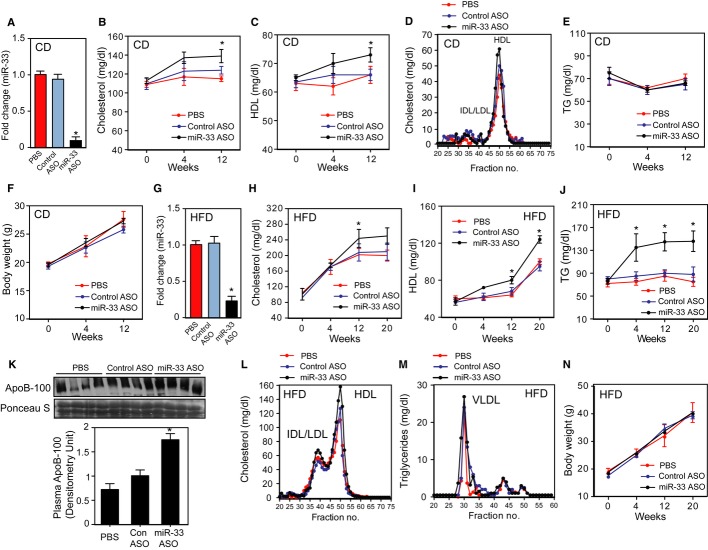
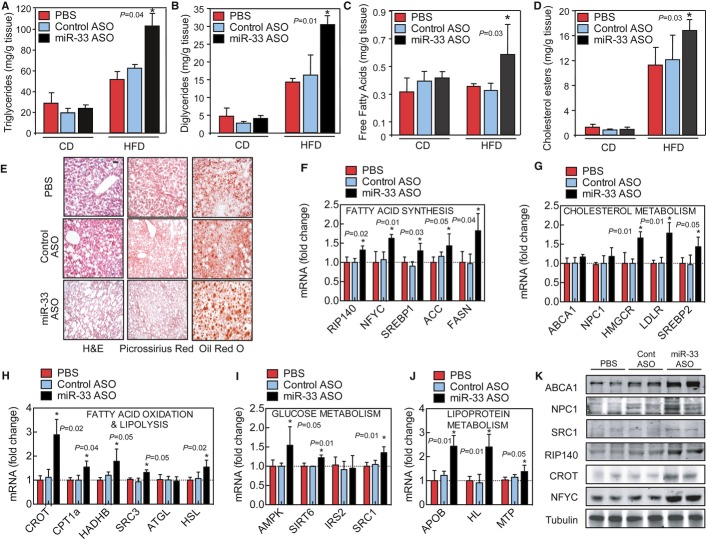
Plasma high‐density lipoprotein (HDL) levels show a strong inverse correlation with atherosclerotic vascular disease. Previous studies have demonstrated that antagonism of miR‐33 in vivo increases circulating HDL and reverse cholesterol transport (RCT), thereby reducing the progression and enhancing the regression of atherosclerosis. While the efficacy of short‐term anti‐miR‐33 treatment has been previously studied, the long‐term effect of miR‐33 antagonism in vivo remains to be elucidated. Here, we show that long‐term therapeutic silencing of miR‐33 increases circulating triglyceride (TG) levels and lipid accumulation in the liver. These adverse effects were only found when mice were fed a high‐fat diet (HFD). Mechanistically, we demonstrate that chronic inhibition of miR‐33 increases the expression of genes involved in fatty acid synthesis such as acetyl‐CoA carboxylase (ACC) and fatty acid synthase (FAS) in the livers of mice treated with miR‐33 antisense oligonucleotides. We also report that anti‐miR‐33 therapy enhances the expression of nuclear transcription Y subunit gamma (NFYC), a transcriptional regulator required for DNA binding and full transcriptional activation of SREBP‐responsive genes, including ACC and FAS. Taken together, these results suggest that persistent inhibition of miR‐33 when mice are fed a high‐fat diet (HFD) might cause deleterious effects such as moderate hepatic steatosis and hypertriglyceridemia. These unexpected findings highlight the importance of assessing the effect of chronic inhibition of miR‐33 in non‐human primates before we can translate this therapy to humans.
Overview
The claims and statistics of this paper haven’t been checked yet.
Run the check — free, no account needed. It reads the open-access text and checks the sources it cites.
Integrity signals
Registry
Cites
Statistics
Figures
Verification
Claims the paper makes
The claims and statistics of this paper haven’t been checked yet.
Run the check — free, no account needed. It reads the open-access text and checks the sources it cites.
Claims other papers make about this one
Each is checked against this paper’s own text: does it say what the citing paper says it does?
The cited source says what the claim attributes to it.
In the citing paper
“Additionally, some studies of long-term anti-miR-33 treatment have reported deleterious effects including increased circulating levels of triglycerides (TAGs) and the development of hepatic steatosis (Allen et al., 2014; Goedeke et al., 2014).”
From Genetic dissection of the impact of miR-33a and miR-33b during the progression of atherosclerosis (2017) · cites this paper as Goedeke et al., 2014
The cited source says what the claim attributes to it.
In the citing paper
“the hypertriglyceridemia and hepatic steatosis observed in some long term anti-miR-33 studies (Allen et al., 2014; Goedeke et al., 2014)”
From Genetic dissection of the impact of miR-33a and miR-33b during the progression of atherosclerosis (2017) · cites this paper as Goedeke et al., 2014
Self-check
Percentages, sums and reported differences re-computed from the paper’s own numbers.
The self-check needs the paper’s full text.
Citations
Cites
Bartel (2004) · doi:10.1016/s0092-8674(04)00045-5 · Cited by 34,714
Huang, D. W., Sherman, B. T., & Lempicki, R. A. (2009) · Nucleic Acids Research · doi:10.1093/nar/gkn923 · Cited by 14,108
The functions of animal microRNAs
Ambros, V. (2004) · Nature · doi:10.1038/nature02871 · Cited by 10,728
(2008) · doi:10.1038/nrg2290 · Cited by 5,199
SREBPs: activators of the complete program of cholesterol and fatty acid synthesis in the liver
Horton, J. D., Goldstein, J. L., & Brown, M. S. (2002) · Journal of Clinical Investigation · doi:10.1172/jci15593 · Cited by 4,794
SREBPs: activators of the complete program of cholesterol and fatty acid synthesis in the liver
Horton, J. D., Goldstein, J. L., & Brown, M. S. (2002) · Journal of Clinical Investigation · doi:10.1172/jci0215593 · Cited by 4,092
Brown, M. S., & Goldstein, J. L. (1997) · Cell · doi:10.1016/s0092-8674(00)80213-5 · Cited by 3,834
Non-coding RNAs and cancer: microRNAs and beyond
Raia, R. M., & Călin, G. A. (2011) · Journal of Nucleic Acids Investigation · doi:10.4081/jnai.2011.e5 · Cited by 3,394
Mechanisms for Insulin Resistance: Common Threads and Missing Links
Samuel, V. T., & Shulman, G. I. (2012) · Cell · doi:10.1016/j.cell.2012.02.017 · Cited by 2,294
MiR-33 Contributes to the Regulation of Cholesterol Homeostasis
Rayner, K. J., Suárez, Y., Dávalos, A., Parathath, S., Fitzgerald, M. L., Tamehiro, N., Fisher, E. A., Moore, K. J., & Fernández-Hernando, C. (2010) · Science · doi:10.1126/science.1189862 · Cited by 1,260
Self-citation
Cited by
Sorted by citations
MicroRNA therapeutics: towards a new era for the management of cancer and other diseases
Rupaimoole, R., & Slack, F. J. (2017) · Nature Reviews Drug Discovery · doi:10.1038/nrd.2016.246 · Cited by 4,741
HDL and Reverse Cholesterol Transport
Ouimet, M. I., Barrett, T. J., & Fisher, E. A. A. (2019) · Circulation Research · doi:10.1161/circresaha.119.312617 · Cited by 816
Self-citationMicroRNA Regulation of Atherosclerosis
Feinberg, M. W., & Moore, K. J. (2016) · Circulation Research · doi:10.1161/circresaha.115.306300 · Cited by 638
Deiuliis, J. A. (2015) · International Journal of Obesity · doi:10.1038/ijo.2015.170 · Cited by 365
MicroRNA-148a regulates LDL receptor and ABCA1 expression to control circulating lipoprotein levels
Goedeke, L., Rotllan, N., Canfrán-Duque, A., Aranda, J. F., Ramírez, C. M., Araldi, E., Lin, C.-S., Anderson, N. N., Wagschal, A., de Cabo, R., et al. (2015) · Nature Medicine · doi:10.1038/nm.3949 · Cited by 238
Self-citation
Metadata
- Authors
- Goedeke, L., Salerno, A., Ramírez, C. M., Guo, L., Allen, R. M., Yin, X., Langley, S. R., Esau, C., Wanschel, A., Fisher, E. A., Suárez, Y., Baldán, A., Mayr, M., & Fernández‐Hernando, C.
- Affiliations
- Yale University (US)
- New York University (US)
- Saint Louis University (US)
- King's College London (GB)
- Regulus Therapeutics (United States) (US)
- ORCID
- Venue
- EMBO Molecular Medicine
- Published
- 2014-07-18
- Volume
- 6
- Issue
- 9
- Pages
- 1133-1141
- ISSN
- 1757-4676 (ISSN-L)
- 1757-4684
- PMC
- PMC4197861
- OpenAlex
- W2142082511
- Cited by
- 145
- References
- 32
- Citations by year
- 2026: 2 · 2025: 12 · 2024: 6 · 2023: 8 · 2022: 10 · 2021: 10 · 2020: 11 · 2019: 12 · 2018: 11 · 2017: 17 · 2016: 23 · 2015: 21 · 2014: 2
- FWCI
- 20.84
- Type
- journal article
- Language
- en
- Open access
- gold
- doi.org
- Locations
- EMBO Molecular Medicine (publishedVersion, other-oa)
- Europe PMC (PubMed Central) (publishedVersion, cc-by)
- PubMed Central (publishedVersion, cc-by)
- PubMed (publishedVersion)
- National University of Singapore (submittedVersion, cc-by)
- DOAJ (DOAJ: Directory of Open Access Journals) (submittedVersion)
- ORCA Online Research @Cardiff (Cardiff University) (submittedVersion)
- Research Portal (King's College London) (submittedVersion, other-oa)
- Funders
- National Institutes of Health (R01HL107953, R01HL107953‐04S1, R01HL106063, 1F31AG043318, R01HL107794)
- Foundation Leducq Transatlantic Network of Excellence in Cardiovascular Research
- Heart Research UK
- Department of Health via the National Institute for Health Research
- Biomedical Research Centre
- NHS Foundation Trust
- King's College London
- King's College Hospital NHS Foundation Trust
- British Heart Foundation
- AHA Predoctoral Fellowship (11PRE7240026)
- Topics
- Life Sciences › Biochemistry, Genetics and Molecular Biology › Biochemistry › Cholesterol and Lipid Metabolism
- Life Sciences › Biochemistry, Genetics and Molecular Biology › Cancer Research › MicroRNA in disease regulation
- Health Sciences › Medicine › Cardiology and Cardiovascular Medicine › Lipid metabolism and disorders
- Keywords
- miR-33, antisense oligonucleotides, hypertriglyceridemia, hepatic steatosis, fatty acid synthesis, acetyl-CoA carboxylase, fatty acid synthase, SREBP, high-fat diet, HDL cholesterol, reverse cholesterol transport, atherosclerosis
- MeSH terms
- Animals, Fatty Liver, Liver, Male, Mice, Inbred C57BL, Triglycerides, Oligonucleotides, Antisense, Gene Silencing, MicroRNAs, Lipid Metabolism, Diet, High-Fat
About these checks
Registry, retraction, Cites and statistics results are computed, not judged, with one exception: a printed reference that no index lists is read once by a model before it counts as a citation error. Claims are extracted by a model and kept only when their quote appears verbatim in the text; each cited source is then checked, with a model’s help, for whether it says what the claim relies on. Those verdicts can be wrong — read the claim’s quote and the cited source before relying on one.
Statistics and arithmetic are recomputed, not judged.
Confidence bands are shown only for fields calibrated on our annotated test set. None is calibrated yet, so no band is shown.
What counts as a claim ›How we measure confidence ›How we check this ›
Are you an author, or do you see a problem with this page? Request a review
