

Parallel reverse genetic screening in mutant human cells using transcriptomics
Open accessThe DOI matches its Crossref record; 37 of the 39 references it cites were found in a registry or an index.
Abstract
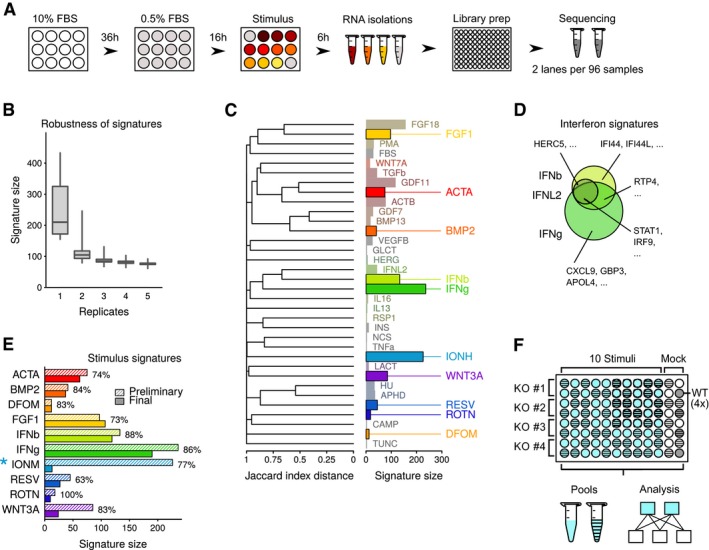
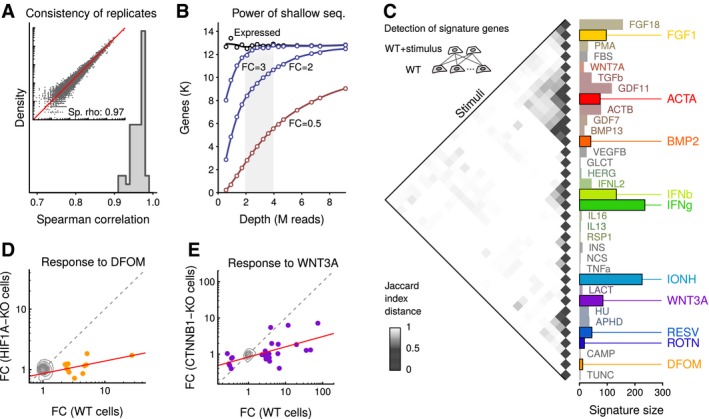
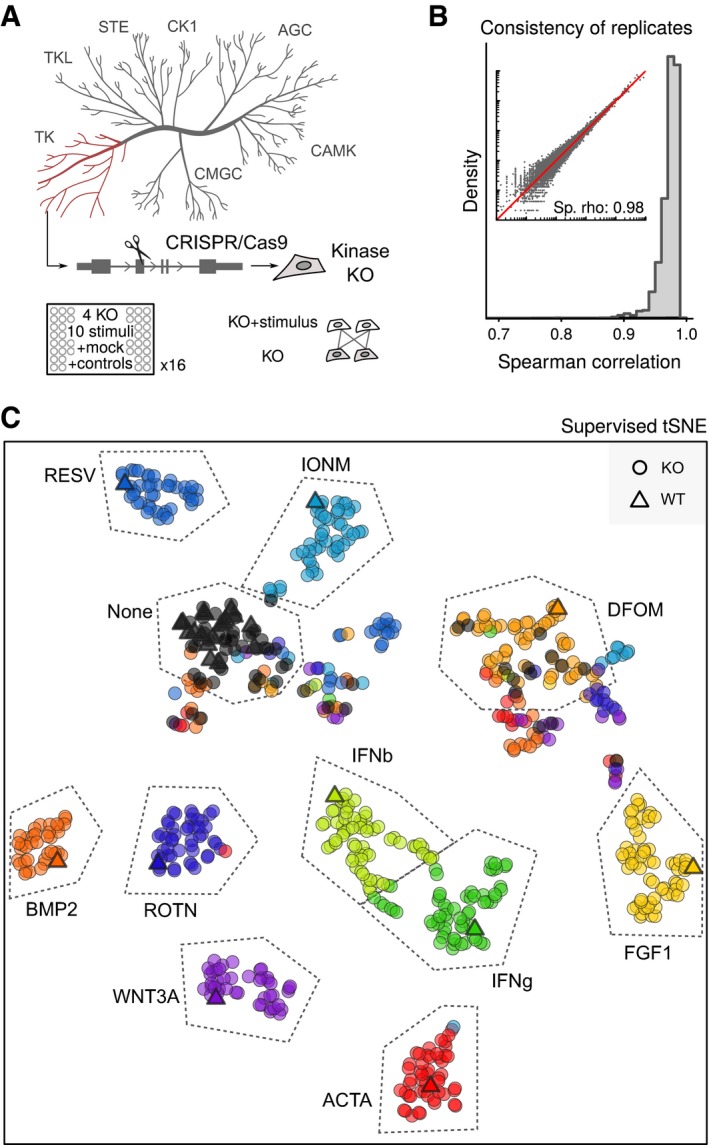
Reverse genetic screens have driven gene annotation and target discovery in model organisms. However, many disease‐relevant genotypes and phenotypes cannot be studied in lower organisms. It is therefore essential to overcome technical hurdles associated with large‐scale reverse genetics in human cells. Here, we establish a reverse genetic approach based on highly robust and sensitive multiplexed RNA sequencing of mutant human cells. We conduct 10 parallel screens using a collection of engineered haploid isogenic cell lines with knockouts covering tyrosine kinases and identify known and unexpected effects on signaling pathways. Our study provides proof of concept for a scalable approach to link genotype to phenotype in human cells, which has broad applications. In particular, it clears the way for systematic phenotyping of still poorly characterized human genes and for systematic study of uncharacterized genomic features associated with human disease.
Overview
The claims and statistics of this paper haven’t been checked yet.
Free: it reads the open-access text and checks the first 5 claims that cite a source we can check. Create a free account to check every claim.
Integrity signals
Registry
Cites
Statistics
Figures
Verification
Claims the paper makes
The claims and statistics of this paper haven’t been checked yet.
Free: it reads the open-access text and checks the first 5 claims that cite a source we can check. Create a free account to check every claim.
Claims other papers make about this one
Each is checked against this paper’s own text: does it say what the citing paper says it does?
The cited source says what the claim attributes to it.
In the citing paper
“Arrayed CRISPR screens, in which only one gene is targeted at a time, make it possible to use RNA-seq as the readout 6 .”
From Pooled CRISPR screening with single-cell transcriptome readout. (2017) · cites this paper as [6]
Self-check
Percentages, sums and reported differences re-computed from the paper’s own numbers.
The self-check needs the paper’s full text.
Citations
Cites
(2008) · Journal of Machine Learning Research · Cited by 33,051
The protein kinase complement of the human genome
Manning, G., Whyte, D. B., Martinez, R., Hunter, T., & Sudarsanam, S. (2002) · Science · doi:10.1126/science.1075762 · Cited by 8,145
Lamb, J., Crawford, E. D., Peck, D., Modell, J. W., Blat, I. C., Wrobel, M. J., Lerner, J., Brunet, J.-P., Subramanian, A., Ross, K. N., et al. (2006) · Science · doi:10.1126/science.1132939 · Cited by 5,257
Exploring the Metabolic and Genetic Control of Gene Expression on a Genomic Scale
DeRisi, J. L., Iyer, V. R., & Brown, P. O. (1997) · Science · doi:10.1126/science.278.5338.680 · Cited by 4,456
Functional profiling of the Saccharomyces cerevisiae genome
Giaever, G., Chu, A. M., Ni, L., Connelly, C., Riles, L., Véronneau, S., Dow, S., Lucau-Danila, A., Anderson, K., André, B., et al. (2002) · Nature · doi:10.1038/nature00935 · Cited by 4,316
Functional Discovery via a Compendium of Expression Profiles
Hughes, T. R., Marton, M. J., Jones, A. R., Roberts, C. J., Stoughton, R., Armour, C. D., Bennett, H. A., Coffey, E., Dai, H., He, Y. D., et al. (2000) · Cell · doi:10.1016/s0092-8674(00)00015-5 · Cited by 2,533
Improved scoring of functional groups from gene expression data by decorrelating GO graph structure
Alexa, A., Rahnenführer, J., & Lengauer, T. (2006) · Bioinformatics · doi:10.1093/bioinformatics/btl140 · Cited by 2,188
Fast and SNP-tolerant detection of complex variants and splicing in short reads
Wu, T. D., & Nacu, S. (2010) · Bioinformatics · doi:10.1093/bioinformatics/btq057 · Cited by 1,894
Dissecting the regulatory circuitry of a eukaryotic genome
Holstege, F. C. P., Jennings, E. G., Wyrick, J. J., Lee, T. I., Hengartner, C. J., Green, M. R., Golub, T. R., Lander, E. S., & Young, R. A. (1998) · Cell · doi:10.1016/s0092-8674(00)81641-4 · Cited by 1,670
Ten years of next-generation sequencing technology
van Dijk, E. L., Auger, H., Jaszczyszyn, Y., & Thermes, C. (2014) · Trends in Genetics · doi:10.1016/j.tig.2014.07.001 · Cited by 1,622
High-throughput functional genomics using CRISPR-Cas9
Shalem, O., Sanjana, N. E., & Zhang, F. (2015) · Nature Reviews Genetics · doi:10.1038/nrg3899 · Cited by 1,233
Loss of the cylindromatosis tumour suppressor inhibits apoptosis by activating NF-κB
Brummelkamp, T. R., Nijman, S. M. B., Dirac, A. M. G., & Bernards, R. (2003) · Nature · doi:10.1038/nature01811 · Cited by 952
Self-citationGene essentiality and synthetic lethality in haploid human cells
Blomen, V. A., Májek, P., Jae, L. T., Bigenzahn, J. W., Nieuwenhuis, J., Staring, J., Sacco, R., van Diemen, F. R., Olk, N., Stukalov, A., et al. (2015) · Science · doi:10.1126/science.aac7557 · Cited by 857
Quantitative assessment of single-cell RNA-sequencing methods
Wu, A. R., Neff, N. F., Kalisky, T., Dalerba, P., Treutlein, B., Rothenberg, M. E., Mburu, F. M., Mantalas, G. L., Sim, S., Clarke, M. F., et al. (2014) · Nature Methods · doi:10.1038/nmeth.2694 · Cited by 696
Paulsen, R. D., Soni, D. V., Wollman, R., Hahn, A. T., Yee, M.-C., Guan, A., Hesley, J. A., Miller, S. C., Cromwell, E. F., Solow-Cordero, D. E., et al. (2009) · Molecular Cell · doi:10.1016/j.molcel.2009.06.021 · Cited by 555
Targeting FGFR Signaling in Cancer
Touat, M., Ileana, E., Postel-Vinay, S., André, F., & Soria, J.-C. (2015) · Clinical Cancer Research · doi:10.1158/1078-0432.ccr-14-2329 · Cited by 524
Genome-wide generation and systematic phenotyping of knockout mice reveals new roles for many genes.
White, J. K., Gerdin, A.-K., Karp, N. A., Ryder, E., Buljan, M., Bussell, J. N., Salisbury, J., Clare, S., Ingham, N. J., Podrini, C., et al. (2013) · Cell · doi:10.1016/j.cell.2013.06.022 · Cited by 509
Janus kinases: components of multiple signaling pathways
Rane, S. G., & Reddy, E. P. (2000) · Oncogene · doi:10.1038/sj.onc.1203925 · Cited by 466
A Genome-wide RNAi Screen for Modifiers of the Circadian Clock in Human Cells
Zhang, E. E., Liu, A. C., Hirota, T., Miraglia, L. J., Welch, G., Pongsawakul, P. Y., Liu, X., Atwood, A., Huss, J. W., Janes, J., et al. (2009) · Cell · doi:10.1016/j.cell.2009.08.031 · Cited by 431
Genetic reconstruction of a functional transcriptional regulatory network
Hu, Z., Killion, P. J., & Iyer, V. R. (2007) · Nature Genetics · doi:10.1038/ng2012 · Cited by 414
Rapid reverse genetic screening using CRISPR in zebrafish
Shah, A. N., Davey, C. F., Whitebirch, A. C., Miller, A. C., & Moens, C. B. (2015) · Nature Methods · doi:10.1038/nmeth.3360 · Cited by 351
RNAi screening comes of age: improved techniques and complementary approaches
Mohr, S. E., Smith, J. A., Shamu, C. E., Neumüller, R. A., & Perrimon, N. (2014) · Nature Reviews Molecular Cell Biology · doi:10.1038/nrm3860 · Cited by 332
The (un)targeted cancer kinome
Fedorov, O., Müller, S., & Knapp, S. (2010) · Nature Chemical Biology · doi:10.1038/nchembio.297 · Cited by 292
Kemmeren, P., Sameith, K., van de Pasch, L. A. L., Benschop, J. J., Lenstra, T. L., Margaritis, T., O’Duibhir, E., Apweiler, E., van Wageningen, S., Ko, C. W., et al. (2014) · Cell · doi:10.1016/j.cell.2014.02.054 · Cited by 277
Megabase-scale deletion using CRISPR/Cas9 to generate a fully haploid human cell line
Essletzbichler, P., Konopka, T., Santoro, F., Chen, D., Gapp, B. V., Kralovics, R., Brummelkamp, T. R., Nijman, S. M. B., & Bürckstümmer, T. (2014) · Genome Research · doi:10.1101/gr.177220.114 · Cited by 277
Self-citationThe Specificity and Topology of Chromatin Interaction Pathways in Yeast
Lenstra, T. L., Benschop, J. J., Kim, T., Schulze, J. M., Brabers, N. A. C. H., Margaritis, T., van de Pasch, L. A. L., van Heesch, S. A. A. C., Brok, M. O., Groot Koerkamp, M. J. A., et al. (2011) · Molecular Cell · doi:10.1016/j.molcel.2011.03.026 · Cited by 238
Genotype to phenotype: lessons from model organisms for human genetics
Lehner, B. (2013) · Nature Reviews Genetics · doi:10.1038/nrg3404 · Cited by 230
Generation of iPSCs from cultured human malignant cells
Carette, J. E., Pruszak, J., Varadarajan, M., Blomen, V. A., Gokhale, S., Camargo, F. D., Wernig, M., Jaenisch, R., & Brummelkamp, T. R. (2010) · Blood · doi:10.1182/blood-2009-07-231845 · Cited by 228
Identifying transcription factor functions and targets by phenotypic activation
Chua, G., Morris, Q. D., Sopko, R., Robinson, M. D., Ryan, O., Chan, E. T., Frey, B. J., Andrews, B. J., Boone, C., & Hughes, T. R. (2006) · Proceedings of the National Academy of Sciences · doi:10.1073/pnas.0605140103 · Cited by 183
Use and Abuse of RNAi to Study Mammalian Gene Function
Kaelin, W. G. (2012) · Science · doi:10.1126/science.1225787 · Cited by 169
Advances in CRISPR-Cas9 genome engineering: lessons learned from RNA interference
Barrangou, R., Birmingham, A., Wiemann, S., Beijersbergen, R. L., Hornung, V., & Smith, A. V. B. (2015) · Nucleic Acids Research · doi:10.1093/nar/gkv226 · Cited by 165
Functional Overlap and Regulatory Links Shape Genetic Interactions between Signaling Pathways
van Wageningen, S., Kemmeren, P., Lijnzaad, P., Margaritis, T., Benschop, J. J., de Castro, I. J., van Leenen, D., Groot Koerkamp, M. J. A., Ko, C. W., Miles, A. J., et al. (2010) · Cell · doi:10.1016/j.cell.2010.11.021 · Cited by 133
A Network Map of FGF-1/FGFR Signaling System
Raju, R., Palapetta, S. M., Sandhya, V. K., Sahu, A., Alipoor, A., Balakrishnan, L., Advani, J., George, B., Kini, K. R., Geetha, N. P., et al. (2014) · Journal of Signal Transduction · doi:10.1155/2014/962962 · Cited by 123
An efficient method for genome-wide polyadenylation site mapping and RNA quantification
Wilkening, S., Pelechano, V., Järvelin, A. I., Tekkedil, M. M., Anders, S., Benes, V., & Steinmetz, L. M. (2013) · Nucleic Acids Research · doi:10.1093/nar/gks1249 · Cited by 101
A synthetic lethal screen identifies FAT1 as an antagonist of caspase-8 in extrinsic apoptosis
Kranz, D., & Boutros, M. (2014) · The EMBO Journal · doi:10.1002/embj.201385686 · Cited by 46
Tiwana, G. S., Prevo, R., Buffa, F. M., Yu, S., Ebner, D. V., Howarth, A., Folkes, L. K., Budwal, B., Chu, K.-Y., Durrant, L., et al. (2015) · Oncotarget · doi:10.18632/oncotarget.3468 · Cited by 39
TriageTools: tools for partitioning and prioritizing analysis of high-throughput sequencing data
Fimereli, D., Detours, V., & Konopka, T. (2013) · Nucleic Acids Research · doi:10.1093/nar/gkt094 · Cited by 11
Self-citation
Cited by
Pooled CRISPR screening with single-cell transcriptome readout.
Datlinger, P., Rendeiro, A. F., Schmidl, C., Krausgruber, T., Traxler, P., Klughammer, J., Schuster, L. C., Kuchler, A., Alpar, D., & Bock, C. (2017) · Nature Methods · doi:10.1038/nmeth.4177 · Cited by 1,096
Self-citationDiscovery of a Highly Selective Cell‐Active Inhibitor of the Histone Lysine Demethylases KDM2/7
Gerken, P. A., Wolstenhulme, J. R., Tumber, A., Hatch, S. B., Zhang, Y., Müller, S., Chandler, S. A., Mair, B., Li, F., Nijman, S. M. B., et al. (2017) · Angewandte Chemie International Edition · doi:10.1002/anie.201706788 · Cited by 49
Self-citationScott, O., Lindsay, K., Erwood, S., Mollica, A., Roifman, C. M., Cohn, R. D., & Ivakine, E. A. (2021) · npj Genomic Medicine · doi:10.1038/s41525-021-00196-7 · Cited by 35
Scrima, N., Bars, R. L., Nevers, Q., Glon, D., Chevreux, G., Civas, A., Blondel, D., Lagaudrière‐Gesbert, C., & Gaudin, Y. (2023) · Cell Reports · doi:10.1016/j.celrep.2022.111949 · Cited by 34
A small cassette enables conditional gene inactivation by CRISPR/Cas9
Guzzardo, P. M., Rashkova, C., dos Santos, R. L., Tehrani, R., Collin, P., & Bürckstümmer, T. (2017) · Scientific Reports · doi:10.1038/s41598-017-16931-z · Cited by 22
Self-citation
Metadata
- Authors
- Gapp, B. V., Konopka, T., Penz, T., Dalal, V., Bürckstümmer, T., Bock, C., & Nijman, S. M.
- Affiliations
- University of Oxford (GB)
- Austrian Academy of Sciences (AT)
- Corresponding author
- Nijman, Sebastian MB
- Venue
- Molecular Systems Biology
- Published
- 2016-08-01
- Volume
- 12
- Issue
- 8
- Pages
- 879-879
- ISSN
- 1744-4292 (ISSN-L)
- PMC
- PMC5119491
- OpenAlex
- W2485369312
- Cited by
- 12
- References
- 39
- Citations by year
- 2024: 1 · 2023: 1 · 2022: 1 · 2021: 1 · 2020: 2 · 2017: 5 · 2016: 1
- FWCI
- 1.61
- Type
- journal article
- Language
- en
- Open access
- gold
- doi.org
- Licence
- cc-by
- creativecommons.org/licenses/by/4.0/ (tdm)
- creativecommons.org/licenses/by/4.0/ (vor)
- Locations
- Molecular Systems Biology (publishedVersion, cc-by)
- PubMed Central (publishedVersion, cc-by)
- PubMed (publishedVersion)
- DOAJ (DOAJ: Directory of Open Access Journals) (submittedVersion)
- Max Planck Digital Library (submittedVersion, other-oa)
- MPG.PuRe (Max Planck Society) (submittedVersion, cc-by)
- Funders
- European Research Council (311166)
- Boehringer Ingelheim Fonds
- Topics
- Life Sciences › Biochemistry, Genetics and Molecular Biology › Genetics › Genomics and Rare Diseases
- Life Sciences › Biochemistry, Genetics and Molecular Biology › Molecular Biology › Bioinformatics and Genomic Networks
- Life Sciences › Biochemistry, Genetics and Molecular Biology › Molecular Biology › CRISPR and Genetic Engineering
- Keywords
- gene knockout, tyrosine kinase, signaling pathways, genotype-phenotype mapping, human disease genes
- MeSH terms
- Cell Line, Genotype, Humans, Phenotype, Protein-Tyrosine Kinases, Sequence Analysis, RNA, Gene Expression Profiling, Gene Knockout Techniques, Molecular Sequence Annotation, Reverse Genetics
About these checks
Registry, retraction, Cites and statistics results are computed, not judged, with one exception: a printed reference that no index lists is read once by a model before it counts as a citation error. Claims are extracted by a model and kept only when their quote appears verbatim in the text; each cited source is then checked, with a model’s help, for whether it says what the claim relies on. Those verdicts can be wrong — read the claim’s quote and the cited source before relying on one.
Statistics and arithmetic are recomputed, not judged.
Confidence bands are shown only for fields calibrated on our annotated test set. None is calibrated yet, so no band is shown.
What counts as a claim ›How we measure confidence ›How we check this ›
Are you an author, or do you see a problem with this page? Request a review
Data sources
Bibliographic data: Semantic Scholar, OpenAlex, Crossref.
Contains information from the Semantic Scholar Academic Graph Datasets, made available under the ODC Attribution License (ODC-BY 1.0).
Semantic Scholar’s data is described in: Kinney, R., et al. (2023). The Semantic Scholar Open Data Platform. arXiv:2301.10140.
