

The DOI matches its Crossref record; 23 of the 23 references it cites were found in a registry or an index; none of the 28 sources its claims cite is checked for support yet.
Early Identification of Autism Spectrum Disorder Among Children Aged 4 Years — Autism and Developmental Disabilities Monitoring Network, 11 Sites, United States, 2020
Open accessAbstract
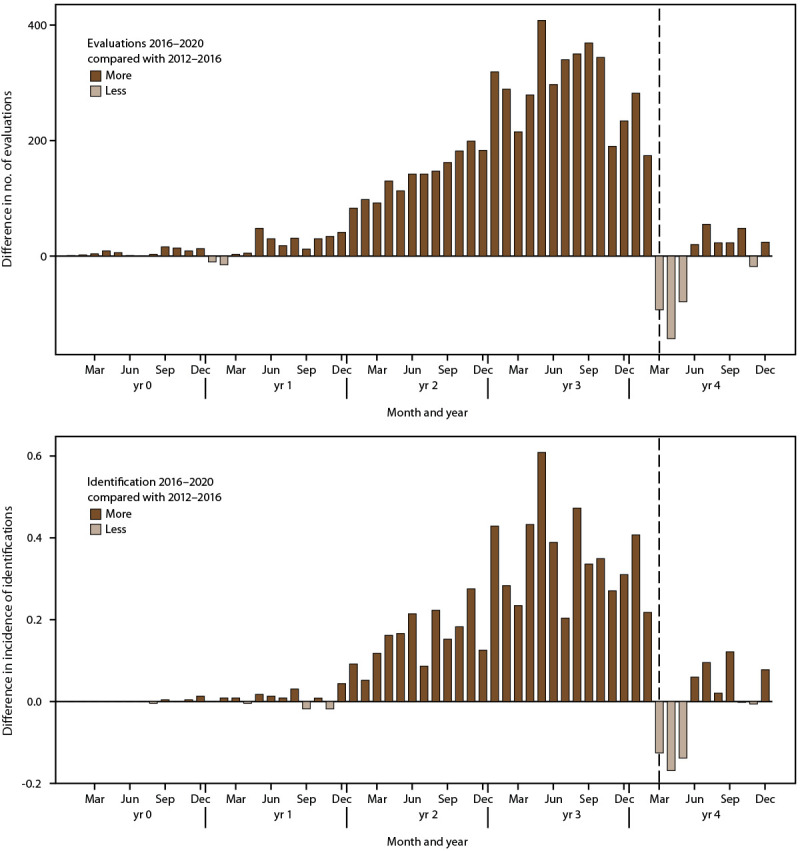
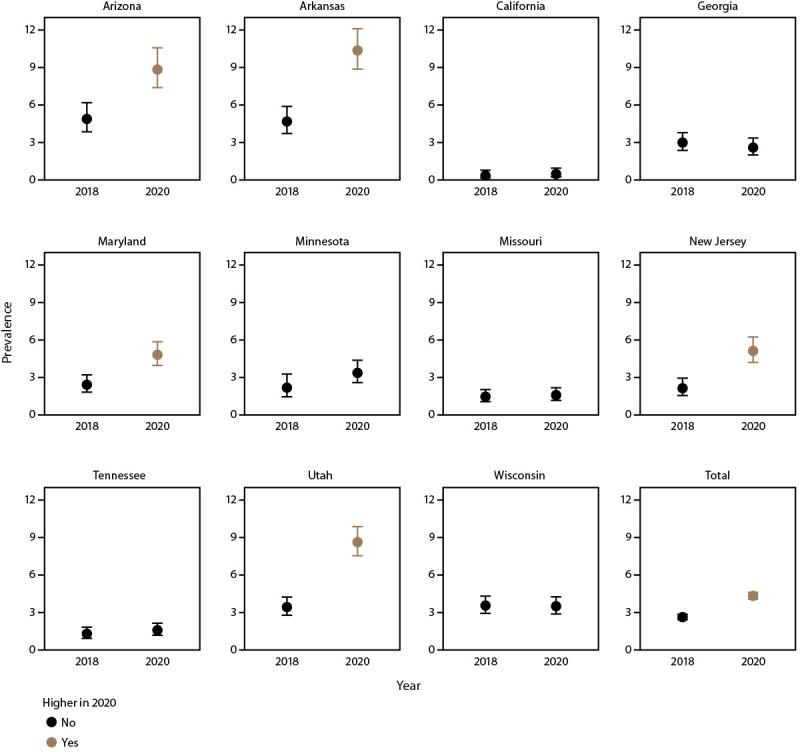
Problem/Condition: Autism spectrum disorder (ASD). Period Covered: 2020. Description of System: The Autism and Developmental Disabilities Monitoring Network is an active surveillance program that estimates prevalence and characteristics of ASD and monitors timing of ASD identification among children aged 4 and 8 years. In 2020, a total of 11 sites (located in Arizona, Arkansas, California, Georgia, Maryland, Minnesota, Missouri, New Jersey, Tennessee, Utah, and Wisconsin) conducted surveillance of ASD among children aged 4 and 8 years and suspected ASD among children aged 4 years. Surveillance included children who lived in the surveillance area at any time during 2020. Children were classified as having ASD if they ever received 1) an ASD diagnostic statement in an evaluation, 2) a special education classification of autism (eligibility), or 3) an ASD International Classification of Diseases (ICD) code (revisions 9 or 10). Children aged 4 years were classified as having suspected ASD if they did not meet the case definition for ASD but had a documented qualified professional's statement indicating a suspicion of ASD. This report focuses on children aged 4 years in 2020 compared with children aged 8 years in 2020. Results: For 2020, ASD prevalence among children aged 4 years varied across sites, from 12.7 per 1,000 children in Utah to 46.4 in California. The overall prevalence was 21.5 and was higher among boys than girls at every site. Compared with non-Hispanic White children, ASD prevalence was 1.8 times as high among Hispanic, 1.6 times as high among non-Hispanic Black, 1.4 times as high among Asian or Pacific Islander, and 1.2 times as high among multiracial children. Among the 58.3% of children aged 4 years with ASD and information on intellectual ability, 48.5% had an IQ score of ≤70 on their most recent IQ test or an examiner's statement of intellectual disability. Among children with a documented developmental evaluation, 78.0% were evaluated by age 36 months. Children aged 4 years had a higher cumulative incidence of ASD diagnosis or eligibility by age 48 months compared with children aged 8 years at all sites; risk ratios ranged from 1.3 in New Jersey and Utah to 2.0 in Tennessee. In the 6 months before the March 2020 COVID-19 pandemic declaration by the World Health Organization, there were 1,593 more evaluations and 1.89 more ASD identifications per 1,000 children aged 4 years than children aged 8 years received 4 years earlier. After the COVID-19 pandemic declaration, this pattern reversed: in the 6 months after pandemic onset, there were 217 fewer evaluations and 0.26 fewer identifications per 1,000 children aged 4 years than children aged 8 years received 4 years earlier. Patterns of evaluation and identification varied among sites, but there was not recovery to pre-COVID-19 pandemic levels by the end of 2020 at most sites or overall. For 2020, prevalence of suspected ASD ranged from 0.5 (California) to 10.4 (Arkansas) per 1,000 children aged 4 years, with an increase from 2018 at five sites (Arizona, Arkansas, Maryland, New Jersey, and Utah). Demographic and cognitive characteristics of children aged 4 years with suspected ASD were similar to children aged 4 years with ASD. Interpretation: A wide range of prevalence of ASD by age 4 years was observed, suggesting differences in early ASD identification practices among communities. At all sites, cumulative incidence of ASD by age 48 months among children aged 4 years was higher compared with children aged 8 years in 2020, indicating improvements in early identification of ASD. Higher numbers of evaluations and rates of identification were evident among children aged 4 years until the COVID-19 pandemic onset in 2020. Sustained lower levels of ASD evaluations and identification seen at a majority of sites after the pandemic onset could indicate disruptions in typical practices in evaluations and identification for health service providers and schools through the end of 2020. Sites with more recovery could indicate successful strategies to mitigate service interruption, such as pivoting to telehealth approaches for evaluation. Public Health Action: From 2016 through February of 2020, ASD evaluation and identification among the cohort of children aged 4 years was outpacing ASD evaluation and identification 4 years earlier (from 2012 until March 2016) among the cohort of children aged 8 years in 2020 . From 2016 to March 2020, ASD evaluation and identification among the cohort of children aged 4 years was outpacing that among children aged 8 years in 2020 from 2012 until March 2016. The disruptions in evaluation that coincided with the start of the COVID-19 pandemic and the increase in prevalence of suspected ASD in 2020 could have led to delays in ASD identification and interventions. Communities could evaluate the impact of these disruptions as children in affected cohorts age and consider strategies to mitigate service disruptions caused by fut
Overview
AI snapshot
Written from the paper’s full text.
TL;DR
In 2020, Autism and Developmental Disabilities Monitoring Network surveillance across 11 U.S. sites estimated ASD prevalence among children aged 4 years at 21.5 per 1,000, with wide site variation and higher prevalence among boys and several racial/ethnic minority groups. Early identification by age 48 months was higher among children aged 4 years than among children aged 8 years, but evaluations and identifications fell after the March 2020 COVID-19 pandemic declaration and had not fully recovered by the end of 2020 at most sites.
Key findings
- Overall ASD prevalence among children aged 4 years was 21.5 per 1,000 (1 in 46), ranging from 12.7 per 1,000 in Utah to 46.4 in California. Prevalence was 32.3 per 1,000 among boys versus 10.4 among girls (male-to-female ratio 3.1).
- By race and ethnicity, prevalence was highest among Hispanic children (28.7 per 1,000), followed by Black (25.3), Asian/Pacific Islander (23.5), multiracial (19.3), White (16.3), and American Indian/Alaska Native children (11.1). Compared with White children, prevalence was 1.8 times as high among Hispanic, 1.6 times as high among Black, 1.4 times as high among Asian/Pacific Islander, and 1.2 times as high among multiracial children.
- Among the 58.3% of children aged 4 years with ASD who had intellectual ability information, 48.5% had an IQ score ≤70 or an examiner’s statement of intellectual disability. Among children with a documented developmental evaluation, 78.0% were evaluated by age 36 months.
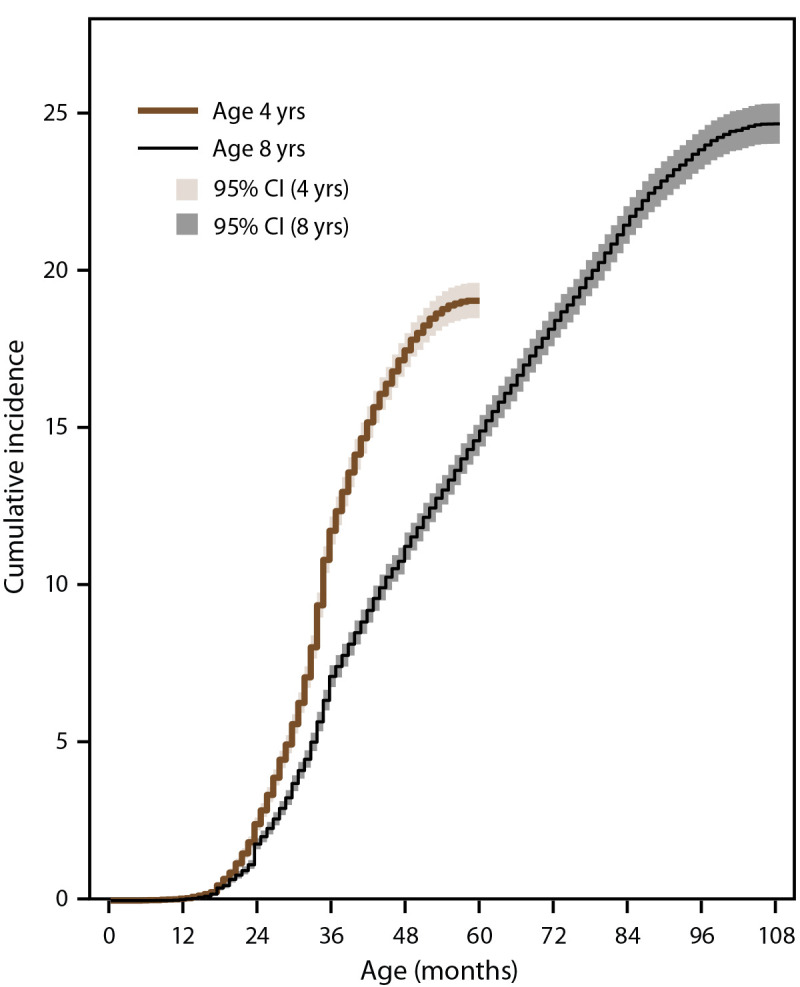
- Cumulative incidence of ASD diagnosis or eligibility by age 48 months was 17.5 per 1,000 among children aged 4 years versus 11.2 among children aged 8 years (1.6 times higher), with site risk ratios from 1.3 in New Jersey and Utah to 2.0 in Tennessee. In the 6 months before the March 2020 pandemic declaration, there were 1,593 more evaluations and 1.89 more ASD identifications per 1,000 children aged 4 years than children aged 8 years had 4 years earlier; in the 6 months after, there were 217 fewer evaluations and 0.26 fewer identifications per 1,000. Suspected ASD prevalence ranged from 0.5 per 1,000 in California to 10.4 in Arkansas and increased from 2018 at five sites.
Methods
- Active surveillance was conducted in 11 sites in Arizona, Arkansas, California, Georgia, Maryland, Minnesota, Missouri, New Jersey, Tennessee, Utah, and Wisconsin among children aged 4 and 8 years in 2020. Children met the ASD case definition if records documented an ASD diagnostic statement, ASD special education eligibility, or an ASD ICD-9/ICD-10 code; suspected ASD was defined as a qualified professional’s statement of suspicion without meeting the ASD case definition.
- Data came from health and education records, with denominators from U.S. Census 2021 county-level postcensal population estimates for 2020, adjusted for subcounty school districts at three sites using public school enrollment counts. Analyses calculated prevalence, prevalence ratios, cumulative incidence, and risk ratios using the Wilson score method for 95% CIs, with Mantel-Haenszel, chi-square, or Fisher tests for selected comparisons; R version 4.2.0 was used.
- To assess COVID-19 impact, monthly counts of evaluations and earliest identification for children aged 4 years in 2016–2020 were compared with the same age windows for children aged 8 years in 2012–2016.
Limitations
- The paper states four limitations: surveillance area populations are not necessarily generalizable to entire states or the United States; data quality depends on availability and completeness of records; sites or study areas could change between study years, complicating comparisons over time; and the surveillance case definition of intellectual disability is not the same as a clinical diagnosis, with IQ measurements in young children potentially unstable.
- Evident from the text: intellectual ability information was available for only 58.3% of children aged 4 years with ASD, so co-occurring intellectual disability estimates are based on a subset. Also, comparisons between children with ASD and suspected ASD were among children seen for a developmental evaluation, so disparities in receiving evaluations could still exist.
Model-written summary. Check it against the paper before relying on it.
Integrity signals
Registry
Cites
Statistics
Figures
Verification
Claims the paper makes
53 Own result · 16 Own interpretation · 14 Not checked yet · 9 Own method · 6 No basis given
A result the paper reports from its own data — it cites no other source for it, so there is none to check. The quote shows it is in the paper.
In the paper
“The overall prevalence was 21.5 and was higher among boys than girls at every site.”
- Also stated in: § Prevalence and Characteristics of Children Aged 4 Years with ASD · plain
“ASD prevalence in the 11 sites combined was 21.5 per 1,000 (one in 46) children aged 4 years.”
§ Early Identification of Autism Spectrum Disorder Among Children Aged 4 Years — Autism and Developmental Disabilities Monitoring Network, 11 Sites, United States, 2020 > Abstract > Results
plainn = 4,896- Asserted: passes — The authors put it forward as true.
- Checkable: passes — It can be checked against evidence.
- Load-bearing: passes — The paper’s conclusions depend on it.
- Based: passes — The paper gives a reason why it holds.
- Also stated in: § Prevalence and Characteristics of Children Aged 4 Years with ASD · plain
A result the paper reports from its own data — it cites no other source for it, so there is none to check. The quote shows it is in the paper.
In the paper
“Compared with non-Hispanic White children, ASD prevalence was 1.8 times as high among Hispanic, 1.6 times as high among non-Hispanic Black, 1.4 times as high among Asian or Pacific Islander, and 1.2 times as high among multiracial children.”
- Also stated in: § Demographics · plain
“Compared with White children, ASD prevalence was higher among Black children at nine sites (overall 1.6 times as high), Hispanic children at seven sites (overall 1.8 times as high), A/PI children at six sites (overall 1.4 times as high), and multiracial children at two sites (overall 1.2 times as high) (Table 3).”
§ Early Identification of Autism Spectrum Disorder Among Children Aged 4 Years — Autism and Developmental Disabilities Monitoring Network, 11 Sites, United States, 2020 > Abstract > Results
plaincorrelational- Asserted: passes — The authors put it forward as true.
- Checkable: passes — It can be checked against evidence.
- Load-bearing: unclear — It is unclear whether the paper’s conclusions depend on it.
- Based: passes — The paper gives a reason why it holds.
- Also stated in: § Demographics · plain
A result the paper reports from its own data — it cites no other source for it, so there is none to check. The quote shows it is in the paper.
In the paper
“Compared with non-Hispanic White children, ASD prevalence was 1.8 times as high among Hispanic, 1.6 times as high among non-Hispanic Black, 1.4 times as high among Asian or Pacific Islander, and 1.2 times as high among multiracial children.”
- Also stated in: § Demographics · plain
“Compared with White children, ASD prevalence was higher among Black children at nine sites (overall 1.6 times as high), Hispanic children at seven sites (overall 1.8 times as high), A/PI children at six sites (overall 1.4 times as high), and multiracial children at two sites (overall 1.2 times as high) (Table 3).”
§ Early Identification of Autism Spectrum Disorder Among Children Aged 4 Years — Autism and Developmental Disabilities Monitoring Network, 11 Sites, United States, 2020 > Abstract > Results
plaincorrelational- Asserted: passes — The authors put it forward as true.
- Checkable: passes — It can be checked against evidence.
- Load-bearing: unclear — It is unclear whether the paper’s conclusions depend on it.
- Based: passes — The paper gives a reason why it holds.
- Also stated in: § Demographics · plain
A result the paper reports from its own data — it cites no other source for it, so there is none to check. The quote shows it is in the paper.
In the paper
“Compared with non-Hispanic White children, ASD prevalence was 1.8 times as high among Hispanic, 1.6 times as high among non-Hispanic Black, 1.4 times as high among Asian or Pacific Islander, and 1.2 times as high among multiracial children.”
- Also stated in: § Demographics · plain
“Compared with White children, ASD prevalence was higher among Black children at nine sites (overall 1.6 times as high), Hispanic children at seven sites (overall 1.8 times as high), A/PI children at six sites (overall 1.4 times as high), and multiracial children at two sites (overall 1.2 times as high) (Table 3).”
§ Early Identification of Autism Spectrum Disorder Among Children Aged 4 Years — Autism and Developmental Disabilities Monitoring Network, 11 Sites, United States, 2020 > Abstract > Results
plaincorrelational- Asserted: passes — The authors put it forward as true.
- Checkable: passes — It can be checked against evidence.
- Load-bearing: unclear — It is unclear whether the paper’s conclusions depend on it.
- Based: passes — The paper gives a reason why it holds.
- Also stated in: § Demographics · plain
A result the paper reports from its own data — it cites no other source for it, so there is none to check. The quote shows it is in the paper.
In the paper
“Among the 58.3% of children aged 4 years with ASD and information on intellectual ability, 48.5% had an IQ score of ≤70 on their most recent IQ test or an examiner’s statement of intellectual disability.”
§ Early Identification of Autism Spectrum Disorder Among Children Aged 4 Years — Autism and Developmental Disabilities Monitoring Network, 11 Sites, United States, 2020 > Abstract > Results
plain- Asserted: passes — The authors put it forward as true.
- Checkable: passes — It can be checked against evidence.
- Load-bearing: unclear — It is unclear whether the paper’s conclusions depend on it.
- Based: passes — The paper gives a reason why it holds.
A result the paper reports from its own data — it cites no other source for it, so there is none to check. The quote shows it is in the paper.
In the paper
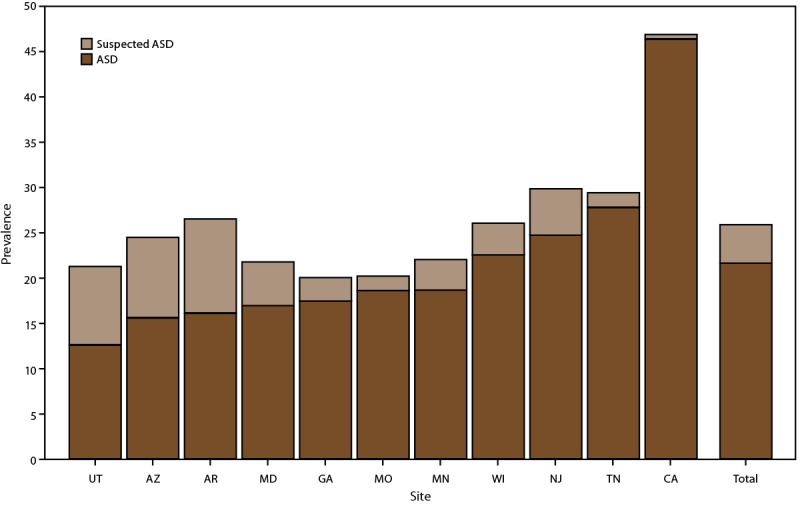
“For 2020, ASD prevalence among children aged 4 years varied across sites, from 12.7 per 1,000 children in Utah to 46.4 in California.”
- Also stated in: § Prevalence and Characteristics of Children Aged 4 Years with ASD · plain
“For 2020, prevalence ranged from 12.7 per 1,000 children aged 4 years in Utah to 46.4 in California (Table 1).”
§ Early Identification of Autism Spectrum Disorder Among Children Aged 4 Years — Autism and Developmental Disabilities Monitoring Network, 11 Sites, United States, 2020 > Abstract > Results
plaincorrelational- Asserted: passes — The authors put it forward as true.
- Checkable: passes — It can be checked against evidence.
- Load-bearing: passes — The paper’s conclusions depend on it.
- Based: passes — The paper gives a reason why it holds.
- Also stated in: § Prevalence and Characteristics of Children Aged 4 Years with ASD · plain
A result the paper reports from its own data — it cites no other source for it, so there is none to check. The quote shows it is in the paper.
In the paper
“The overall prevalence was 21.5 and was higher among boys than girls at every site.”
- Also stated in: § Demographics · plain
“Prevalence was significantly higher among males than females at all sites (95% CI excludes 1.0).”
§ Early Identification of Autism Spectrum Disorder Among Children Aged 4 Years — Autism and Developmental Disabilities Monitoring Network, 11 Sites, United States, 2020 > Abstract > Results
plaincorrelational- Asserted: passes — The authors put it forward as true.
- Checkable: passes — It can be checked against evidence.
- Load-bearing: unclear — It is unclear whether the paper’s conclusions depend on it.
- Based: passes — The paper gives a reason why it holds.
- Also stated in: § Demographics · plain
A result the paper reports from its own data — it cites no other source for it, so there is none to check. The quote shows it is in the paper.
In the paper
“Compared with non-Hispanic White children, ASD prevalence was 1.8 times as high among Hispanic, 1.6 times as high among non-Hispanic Black, 1.4 times as high among Asian or Pacific Islander, and 1.2 times as high among multiracial children.”
- Also stated in: § Demographics · plain
“Compared with White children, ASD prevalence was higher among Black children at nine sites (overall 1.6 times as high), Hispanic children at seven sites (overall 1.8 times as high), A/PI children at six sites (overall 1.4 times as high), and multiracial children at two sites (overall 1.2 times as high) (Table 3).”
§ Early Identification of Autism Spectrum Disorder Among Children Aged 4 Years — Autism and Developmental Disabilities Monitoring Network, 11 Sites, United States, 2020 > Abstract > Results
plaincorrelational- Asserted: passes — The authors put it forward as true.
- Checkable: passes — It can be checked against evidence.
- Load-bearing: unclear — It is unclear whether the paper’s conclusions depend on it.
- Based: passes — The paper gives a reason why it holds.
- Also stated in: § Demographics · plain
A result the paper reports from its own data — it cites no other source for it, so there is none to check. The quote shows it is in the paper.
In the paper
“Among children with a documented developmental evaluation, 78.0% were evaluated by age 36 months.”
§ Early Identification of Autism Spectrum Disorder Among Children Aged 4 Years — Autism and Developmental Disabilities Monitoring Network, 11 Sites, United States, 2020 > Abstract > Results
plain- Asserted: passes — The authors put it forward as true.
- Checkable: passes — It can be checked against evidence.
- Load-bearing: passes — The paper’s conclusions depend on it.
- Based: passes — The paper gives a reason why it holds.
In the paper
“The male-to-female ratio among children aged 4 years was similar across sites, but the ratio was lower than among children aged 8 years (11).”
§ Early Identification of Autism Spectrum Disorder Among Children Aged 4 Years — Autism and Developmental Disabilities Monitoring Network, 11 Sites, United States, 2020 > Results > Demographics
What the sources say
- Not checked yetcites [11] Maenner, 2023, Prevalence and characteristics of autism spectrum disorder among children aged 8 years—Autism and Developmental Disabilities Monitoring Network, 11 sites, United States, 2020., MMWR Surveill Summ source
plain- Asserted: passes — The authors put it forward as true.
- Checkable: passes — It can be checked against evidence.
- Load-bearing: unclear — It is unclear whether the paper’s conclusions depend on it.
- Based: passes — The paper gives a reason why it holds.
- It may state two separate claims as one. 34
- Probably not a substantial claim. 17
A result the paper reports from its own data — it cites no other source for it, so there is none to check. The quote shows it is in the paper.
In the paper
“For 2020, prevalence was 32.3 per 1,000 boys aged 4 years, which was 3.1 times as high as among girls (10.4) (Table 2).”
§ Early Identification of Autism Spectrum Disorder Among Children Aged 4 Years — Autism and Developmental Disabilities Monitoring Network, 11 Sites, United States, 2020 > Results > Demographics
plaincorrelational- Asserted: passes — The authors put it forward as true.
- Checkable: passes — It can be checked against evidence.
- Load-bearing: unclear — It is unclear whether the paper’s conclusions depend on it.
- Based: passes — The paper gives a reason why it holds.
It may state two separate claims as one.
A result the paper reports from its own data — it cites no other source for it, so there is none to check. The quote shows it is in the paper.
In the paper
“Overall, 80.2% of children who met the ADDM Network case definition had a recorded ASD diagnosis (range = 54.1%–98.3%) (Figure 1) (Supplementary Figure 1, https://stacks.cdc.gov/view/cdc/124396), 38.1% had a recorded ASD eligibility (range = 9.3%–75.1%), and 79.4% had a recorded ASD ICD code (range = 22.0%–92.7%).”
§ Early Identification of Autism Spectrum Disorder Among Children Aged 4 Years — Autism and Developmental Disabilities Monitoring Network, 11 Sites, United States, 2020 > Results > Prevalence and Characteristics of Children Aged 4 Years with ASD
plainn = 4,896- Asserted: passes — The authors put it forward as true.
- Checkable: passes — It can be checked against evidence.
- Load-bearing: passes — The paper’s conclusions depend on it.
- Based: passes — The paper gives a reason why it holds.
It may state two separate claims as one.
In the paper
“Prevalence of suspected ASD increased from 2018 at five sites (Arizona, Arkansas, Maryland, New Jersey, and Utah) and was similar between years at other sites (7)”
- Also stated in: § Conclusion · plain
“Identification of children with suspected ASD also increased at certain sites compared with 2018 data.”
§ Early Identification of Autism Spectrum Disorder Among Children Aged 4 Years — Autism and Developmental Disabilities Monitoring Network, 11 Sites, United States, 2020 > Results > Prevalence and Characteristics of Children Aged 4 Years with Suspected ASD
What the sources say
- Not checked yetcites [7] Shaw, 2021, Early identification of autism spectrum disorder among children aged 4 years—Autism and Developmental Disabilities Monitoring Network, 11 sites, United States, 2018., MMWR Surveill Summ source
plain- Asserted: passes — The authors put it forward as true.
- Checkable: passes — It can be checked against evidence.
- Load-bearing: unclear — It is unclear whether the paper’s conclusions depend on it.
- Based: passes — The paper gives a reason why it holds.
It may state two separate claims as one.
- Also stated in: § Conclusion · plain
A result the paper reports from its own data — it cites no other source for it, so there is none to check. The quote shows it is in the paper.
In the paper
“Among race and ethnicity groups, Hispanic children had the highest prevalence of ASD at 28.7 among children aged 4 years, followed by Black children (25.3), A/PI children (23.5), multiracial children (19.3), White children (16.3), and AI/AN children (11.1) (Table 3).”
§ Early Identification of Autism Spectrum Disorder Among Children Aged 4 Years — Autism and Developmental Disabilities Monitoring Network, 11 Sites, United States, 2020 > Results > Demographics
plain- Asserted: passes — The authors put it forward as true.
- Checkable: passes — It can be checked against evidence.
- Load-bearing: unclear — It is unclear whether the paper’s conclusions depend on it.
- Based: passes — The paper gives a reason why it holds.
It may state two separate claims as one.
A result the paper reports from its own data — it cites no other source for it, so there is none to check. The quote shows it is in the paper.
In the paper
“Children with ASD and children with suspected ASD were similar by sex, race and ethnicity, intellectual disability, and evaluation by age 36 months”
§ Early Identification of Autism Spectrum Disorder Among Children Aged 4 Years — Autism and Developmental Disabilities Monitoring Network, 11 Sites, United States, 2020 > Results > Prevalence and Characteristics of Children Aged 4 Years with Suspected ASD
plain- Asserted: passes — The authors put it forward as true.
- Checkable: passes — It can be checked against evidence.
- Load-bearing: unclear — It is unclear whether the paper’s conclusions depend on it.
- Based: passes — The paper gives a reason why it holds.
It may state two separate claims as one.
A result the paper reports from its own data — it cites no other source for it, so there is none to check. The quote shows it is in the paper.
In the paper
“Although every site experienced a period of lower evaluation and identification among children aged 4 years, certain sites showed movement toward recovery to prepandemic levels.”
§ Early Identification of Autism Spectrum Disorder Among Children Aged 4 Years — Autism and Developmental Disabilities Monitoring Network, 11 Sites, United States, 2020 > Discussion
plain- Asserted: passes — The authors put it forward as true.
- Checkable: passes — It can be checked against evidence.
- Load-bearing: unclear — It is unclear whether the paper’s conclusions depend on it.
- Based: passes — The paper gives a reason why it holds.
It may state two separate claims as one.
A result the paper reports from its own data — it cites no other source for it, so there is none to check. The quote shows it is in the paper.
In the paper
“Compared with White children, ASD prevalence was higher among Black children at nine sites (overall 1.6 times as high), Hispanic children at seven sites (overall 1.8 times as high), A/PI children at six sites (overall 1.4 times as high), and multiracial children at two sites (overall 1.2 times as high) (Table 3).”
§ Early Identification of Autism Spectrum Disorder Among Children Aged 4 Years — Autism and Developmental Disabilities Monitoring Network, 11 Sites, United States, 2020 > Results > Demographics
plaincorrelational- Asserted: passes — The authors put it forward as true.
- Checkable: passes — It can be checked against evidence.
- Load-bearing: unclear — It is unclear whether the paper’s conclusions depend on it.
- Based: passes — The paper gives a reason why it holds.
It may state two separate claims as one.
A result the paper reports from its own data — it cites no other source for it, so there is none to check. The quote shows it is in the paper.
In the paper
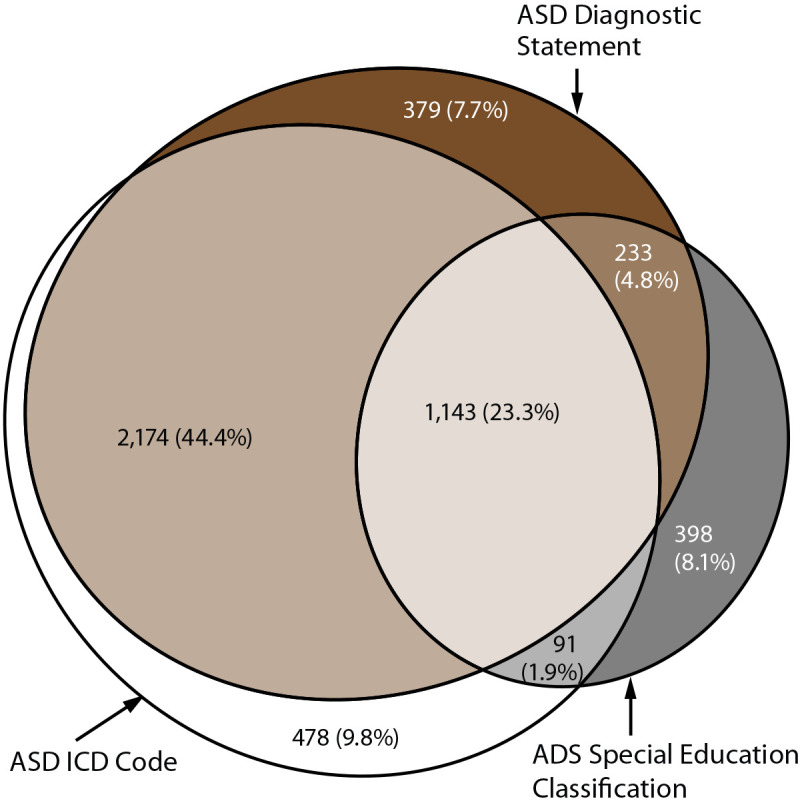
“A majority of children (74.4%) had more than one component of the case definition in their records and 23.3% had all three; 9.8% had an ASD ICD code only (Figure 1).”
§ Early Identification of Autism Spectrum Disorder Among Children Aged 4 Years — Autism and Developmental Disabilities Monitoring Network, 11 Sites, United States, 2020 > Results > Prevalence and Characteristics of Children Aged 4 Years with ASD
plainn = 4,896- Asserted: passes — The authors put it forward as true.
- Checkable: passes — It can be checked against evidence.
- Load-bearing: unclear — It is unclear whether the paper’s conclusions depend on it.
- Based: passes — The paper gives a reason why it holds.
It may state two separate claims as one.
A result the paper reports from its own data — it cites no other source for it, so there is none to check. The quote shows it is in the paper.
In the paper
“Patterns of evaluations and ASD identification after pandemic onset varied by site, with certain sites (e.g., Georgia, Minnesota, and Utah) having sustained declines in evaluation and identification through the end of the year, but other sites (e.g, Missouri and Tennessee) showing resurgences closer to prepandemic levels”
§ Early Identification of Autism Spectrum Disorder Among Children Aged 4 Years — Autism and Developmental Disabilities Monitoring Network, 11 Sites, United States, 2020 > Results > Evaluation and Identification During COVID-19 Pandemic Onset
plaincorrelational- Asserted: passes — The authors put it forward as true.
- Checkable: passes — It can be checked against evidence.
- Load-bearing: passes — The paper’s conclusions depend on it.
- Based: passes — The paper gives a reason why it holds.
It may state two separate claims as one.
A result the paper reports from its own data — it cites no other source for it, so there is none to check. The quote shows it is in the paper.
In the paper
“Among children with data on intellectual ability, 48.5% of children with ASD met the surveillance case definition of having co-occurring intellectual disability (range = 24.7% in California to 67.3% in Arkansas).”
§ Early Identification of Autism Spectrum Disorder Among Children Aged 4 Years — Autism and Developmental Disabilities Monitoring Network, 11 Sites, United States, 2020 > Results > Co-Occurring Intellectual Disability
plain- Asserted: passes — The authors put it forward as true.
- Checkable: passes — It can be checked against evidence.
- Load-bearing: unclear — It is unclear whether the paper’s conclusions depend on it.
- Based: passes — The paper gives a reason why it holds.
It may state two separate claims as one.
A result the paper reports from its own data — it cites no other source for it, so there is none to check. The quote shows it is in the paper.
In the paper
“Overall, 58.3% of children had information on intellectual ability available (range = 38.6% in Wisconsin to 89.8% in Arkansas) (Table 4).”
§ Early Identification of Autism Spectrum Disorder Among Children Aged 4 Years — Autism and Developmental Disabilities Monitoring Network, 11 Sites, United States, 2020 > Results > Co-Occurring Intellectual Disability
plain- Asserted: passes — The authors put it forward as true.
- Checkable: passes — It can be checked against evidence.
- Load-bearing: unclear — It is unclear whether the paper’s conclusions depend on it.
- Based: passes — The paper gives a reason why it holds.
It may state two separate claims as one.
A result the paper reports from its own data — it cites no other source for it, so there is none to check. The quote shows it is in the paper.
In the paper
“Evaluation by age 36 months was similar by sex and by racial and ethnic groups except for being lower among Black (75.9%) compared with Hispanic (79.8%) children.”
§ Early Identification of Autism Spectrum Disorder Among Children Aged 4 Years — Autism and Developmental Disabilities Monitoring Network, 11 Sites, United States, 2020 > Results > First Evaluation
plain- Asserted: passes — The authors put it forward as true.
- Checkable: passes — It can be checked against evidence.
- Load-bearing: unclear — It is unclear whether the paper’s conclusions depend on it.
- Based: passes — The paper gives a reason why it holds.
It may state two separate claims as one.
A result the paper reports from its own data — it cites no other source for it, so there is none to check. The quote shows it is in the paper.
In the paper
“Prevalence among AI/AN children was similar to White children, but Black, Hispanic, A/PI, and multiracial children had an ASD prevalence 2.3, 2.6, 2.1, and 1.7 times as high as AI/AN children, respectively.”
§ Early Identification of Autism Spectrum Disorder Among Children Aged 4 Years — Autism and Developmental Disabilities Monitoring Network, 11 Sites, United States, 2020 > Results > Demographics
plaincorrelational- Asserted: passes — The authors put it forward as true.
- Checkable: passes — It can be checked against evidence.
- Load-bearing: unclear — It is unclear whether the paper’s conclusions depend on it.
- Based: passes — The paper gives a reason why it holds.
It may state two separate claims as one.
A result the paper reports from its own data — it cites no other source for it, so there is none to check. The quote shows it is in the paper.
In the paper
“Patterns of evaluation and identification varied among sites, but there was not recovery to pre-COVID-19 pandemic levels by the end of 2020 at most sites or overall.”
§ Early Identification of Autism Spectrum Disorder Among Children Aged 4 Years — Autism and Developmental Disabilities Monitoring Network, 11 Sites, United States, 2020 > Abstract > Results
plain- Asserted: passes — The authors put it forward as true.
- Checkable: passes — It can be checked against evidence.
- Load-bearing: passes — The paper’s conclusions depend on it.
- Based: passes — The paper gives a reason why it holds.
It may state two separate claims as one.
- Rests on an assumption: The 8-year-old cohort's evaluation and identification patterns 4 years earlier provide a valid counterfactual for what the 4-year-old cohort would have experienced absent the COVID-19 pandemic.
In the paper
“Prevalence in 2020 among children aged 4 years was 24.3% higher among boys and 34.5% higher among girls than prevalence in 2018 (7), but the male-to-female ratios were similar between years.”
§ Early Identification of Autism Spectrum Disorder Among Children Aged 4 Years — Autism and Developmental Disabilities Monitoring Network, 11 Sites, United States, 2020 > Results > Demographics
What the sources say
- Not checked yetcites [7] Shaw, 2021, Early identification of autism spectrum disorder among children aged 4 years—Autism and Developmental Disabilities Monitoring Network, 11 sites, United States, 2018., MMWR Surveill Summ source
plaincorrelational- Asserted: passes — The authors put it forward as true.
- Checkable: passes — It can be checked against evidence.
- Load-bearing: unclear — It is unclear whether the paper’s conclusions depend on it.
- Based: passes — The paper gives a reason why it holds.
It may state two separate claims as one.
A result the paper reports from its own data — it cites no other source for it, so there is none to check. The quote shows it is in the paper.
In the paper
“Overall, 80.2% of children who met the ADDM Network case definition had a recorded ASD diagnosis (range = 54.1%–98.3%) (Figure 1) (Supplementary Figure 1, https://stacks.cdc.gov/view/cdc/124396), 38.1% had a recorded ASD eligibility (range = 9.3%–75.1%), and 79.4% had a recorded ASD ICD code (range = 22.0%–92.7%).”
§ Early Identification of Autism Spectrum Disorder Among Children Aged 4 Years — Autism and Developmental Disabilities Monitoring Network, 11 Sites, United States, 2020 > Results > Prevalence and Characteristics of Children Aged 4 Years with ASD
plainn = 4,896- Asserted: passes — The authors put it forward as true.
- Checkable: passes — It can be checked against evidence.
- Load-bearing: unclear — It is unclear whether the paper’s conclusions depend on it.
- Based: passes — The paper gives a reason why it holds.
It may state two separate claims as one.
In the paper
“California continued to report high levels of early ASD identification, with higher prevalence at age 4 years than 8 years in 2020 (11).”
§ Early Identification of Autism Spectrum Disorder Among Children Aged 4 Years — Autism and Developmental Disabilities Monitoring Network, 11 Sites, United States, 2020 > Discussion
What the sources say
- Not checked yetcites [11] Maenner, 2023, Prevalence and characteristics of autism spectrum disorder among children aged 8 years—Autism and Developmental Disabilities Monitoring Network, 11 sites, United States, 2020., MMWR Surveill Summ source
plaincorrelational- Asserted: passes — The authors put it forward as true.
- Checkable: passes — It can be checked against evidence.
- Load-bearing: unclear — It is unclear whether the paper’s conclusions depend on it.
- Based: passes — The paper gives a reason why it holds.
It may state two separate claims as one.
The paper states this without a source or data behind it here, so there is nothing to check it against. The quote shows it is in the paper.
In the paper
“Findings were similar to 2018 by presence of co-occurring intellectual disability and evaluation by age 36 months.”
§ Early Identification of Autism Spectrum Disorder Among Children Aged 4 Years — Autism and Developmental Disabilities Monitoring Network, 11 Sites, United States, 2020 > Conclusion
plain- Asserted: passes — The authors put it forward as true.
- Checkable: passes — It can be checked against evidence.
- Load-bearing: passes — The paper’s conclusions depend on it.
- Based: passes — The paper gives a reason why it holds.
It may state two separate claims as one.
The paper states this without a source or data behind it here, so there is nothing to check it against. The quote shows it is in the paper.
In the paper
“Suspected ASD was highest in the three states (Utah, Arizona, and Arkansas) with the lowest ASD prevalence, and two of the three states with the highest prevalence (California and Tennessee) had the lowest suspected ASD prevalence.”
§ Early Identification of Autism Spectrum Disorder Among Children Aged 4 Years — Autism and Developmental Disabilities Monitoring Network, 11 Sites, United States, 2020 > Discussion
plaincorrelational- Asserted: passes — The authors put it forward as true.
- Checkable: passes — It can be checked against evidence.
- Load-bearing: unclear — It is unclear whether the paper’s conclusions depend on it.
- Based: passes — The paper gives a reason why it holds.
It may state two separate claims as one.
In the paper
“Prevalence among girls surpassed 10 per 1,000 children aged 4 years for the first time in ADDM Network surveillance (also observed among children aged 8 years for the first time) (11).”
§ Early Identification of Autism Spectrum Disorder Among Children Aged 4 Years — Autism and Developmental Disabilities Monitoring Network, 11 Sites, United States, 2020 > Discussion
What the sources say
- Not checked yetcites [11] Maenner, 2023, Prevalence and characteristics of autism spectrum disorder among children aged 8 years—Autism and Developmental Disabilities Monitoring Network, 11 sites, United States, 2020., MMWR Surveill Summ source
plain- Asserted: passes — The authors put it forward as true.
- Checkable: passes — It can be checked against evidence.
- Load-bearing: unclear — It is unclear whether the paper’s conclusions depend on it.
- Based: passes — The paper gives a reason why it holds.
It may state two separate claims as one.
A result the paper reports from its own data — it cites no other source for it, so there is none to check. The quote shows it is in the paper.
In the paper
“However, prevalence varied widely across sites in 2020, with prevalence 265% higher in California than in Utah, the site with the lowest prevalence.”
§ Early Identification of Autism Spectrum Disorder Among Children Aged 4 Years — Autism and Developmental Disabilities Monitoring Network, 11 Sites, United States, 2020 > Discussion
plaincorrelational- Asserted: passes — The authors put it forward as true.
- Checkable: passes — It can be checked against evidence.
- Load-bearing: unclear — It is unclear whether the paper’s conclusions depend on it.
- Based: passes — The paper gives a reason why it holds.
It may state two separate claims as one.
In the paper
“The higher prevalence of ASD among Black, Hispanic, and A/PI versus White children aged 4 years first reported in 2018 continued in 2020 and also was seen among children aged 8 years (11).”
§ Early Identification of Autism Spectrum Disorder Among Children Aged 4 Years — Autism and Developmental Disabilities Monitoring Network, 11 Sites, United States, 2020 > Discussion
What the sources say
- Not checked yetcites [11] Maenner, 2023, Prevalence and characteristics of autism spectrum disorder among children aged 8 years—Autism and Developmental Disabilities Monitoring Network, 11 sites, United States, 2020., MMWR Surveill Summ source
plaincorrelational- Asserted: passes — The authors put it forward as true.
- Checkable: passes — It can be checked against evidence.
- Load-bearing: unclear — It is unclear whether the paper’s conclusions depend on it.
- Based: passes — The paper gives a reason why it holds.
It may state two separate claims as one.
A result the paper reports from its own data — it cites no other source for it, so there is none to check. The quote shows it is in the paper.
In the paper
“A larger increase in prevalence from 2018 for girls compared with boys was observed; however, the male-to-female ratio was similar across years.”
§ Early Identification of Autism Spectrum Disorder Among Children Aged 4 Years — Autism and Developmental Disabilities Monitoring Network, 11 Sites, United States, 2020 > Discussion
plaincorrelational- Asserted: passes — The authors put it forward as true.
- Checkable: passes — It can be checked against evidence.
- Load-bearing: unclear — It is unclear whether the paper’s conclusions depend on it.
- Based: passes — The paper gives a reason why it holds.
It may state two separate claims as one.
None of the sources cited for this claim have been checked yet.
In the paper
“Surveillance was conducted using the same methods as in 2018 (7,10).”
§ Early Identification of Autism Spectrum Disorder Among Children Aged 4 Years — Autism and Developmental Disabilities Monitoring Network, 11 Sites, United States, 2020 > Methods > Case Ascertainment and Surveillance Case Definition
What the sources say
- Not checked yetcites [7] Shaw, 2021, Early identification of autism spectrum disorder among children aged 4 years—Autism and Developmental Disabilities Monitoring Network, 11 sites, United States, 2018., MMWR Surveill Summ source
- Not checked yetcites [10] Maenner, 2021, Comparison of two case definitions for ascertaining prevalence of autism spectrum disorder among 8-Year-old children., Am J Epidemiol source
plain- Asserted: passes — The authors put it forward as true.
- Checkable: passes — It can be checked against evidence.
- Load-bearing: fails — The paper’s conclusions may not depend on it.
- Based: passes — The paper gives a reason why it holds.
Probably not a substantial claim. The paper’s conclusions may not depend on it.
What the paper did — it cites no source for this, so there is none to check. The quote shows it is in the paper.
In the paper
“Prevalence and risk ratios were considered significant when 95% CIs did not include 1.0.”
§ Early Identification of Autism Spectrum Disorder Among Children Aged 4 Years — Autism and Developmental Disabilities Monitoring Network, 11 Sites, United States, 2020 > Methods > Analytic Methods
plain- Asserted: passes — The authors put it forward as true.
- Checkable: passes — It can be checked against evidence.
- Load-bearing: passes — The paper’s conclusions depend on it.
- Based: passes — The paper gives a reason why it holds.
Probably not a substantial claim.
A conclusion the paper draws from its own results — it cites no other source for it, so there is none to check. The quote shows it is in the paper.
In the paper
“At all sites, cumulative incidence of ASD by age 48 months among children aged 4 years was higher compared with children aged 8 years in 2020, indicating improvements in early identification of ASD.”
§ Early Identification of Autism Spectrum Disorder Among Children Aged 4 Years — Autism and Developmental Disabilities Monitoring Network, 11 Sites, United States, 2020 > Abstract > Interpretation
hedgeddirect- Asserted: passes — The authors put it forward as true.
- Checkable: passes — It can be checked against evidence.
- Load-bearing: passes — The paper’s conclusions depend on it.
- Based: passes — The paper gives a reason why it holds.
It may state two separate claims as one.
- Rests on an assumption: Higher cumulative incidence of ASD by age 48 months among children aged 4 years compared with children aged 8 years in 2020 reflects improvements in early identification rather than other cohort differences.
What the paper did — it cites no source for this, so there is none to check. The quote shows it is in the paper.
In the paper
“All sites functioned as public health authorities under the Health Insurance Portability and Accountability Act of 1996 Privacy Rule and met applicable local institutional review board, privacy, and confidentiality requirements under 45 CFR 46.”
§ Early Identification of Autism Spectrum Disorder Among Children Aged 4 Years — Autism and Developmental Disabilities Monitoring Network, 11 Sites, United States, 2020 > Methods > Surveillance Sites and Procedures
plain- Asserted: passes — The authors put it forward as true.
- Checkable: passes — It can be checked against evidence.
- Load-bearing: fails — The paper’s conclusions may not depend on it.
- Based: passes — The paper gives a reason why it holds.
Probably not a substantial claim. The paper’s conclusions may not depend on it. It may state two separate claims as one.
What the paper did — it cites no source for this, so there is none to check. The quote shows it is in the paper.
In the paper
“Nine sites had data agreements in place with education sources covering 100% of their study areas, Missouri had agreements with education data sources covering 50.3%, and Georgia with education data sources covering 97.6% of its study area.”
§ Early Identification of Autism Spectrum Disorder Among Children Aged 4 Years — Autism and Developmental Disabilities Monitoring Network, 11 Sites, United States, 2020 > Methods > Case Ascertainment and Surveillance Case Definition
plain- Asserted: passes — The authors put it forward as true.
- Checkable: passes — It can be checked against evidence.
- Load-bearing: fails — The paper’s conclusions may not depend on it.
- Based: passes — The paper gives a reason why it holds.
Probably not a substantial claim. The paper’s conclusions may not depend on it. It may state two separate claims as one.
What the paper did — it cites no source for this, so there is none to check. The quote shows it is in the paper.
In the paper
“Prevalence estimates with a relative SE ≥30% were suppressed because of limited statistical precision.”
§ Early Identification of Autism Spectrum Disorder Among Children Aged 4 Years — Autism and Developmental Disabilities Monitoring Network, 11 Sites, United States, 2020 > Methods > Analytic Methods
plaindirect- Asserted: passes — The authors put it forward as true.
- Checkable: passes — It can be checked against evidence.
- Load-bearing: fails — The paper’s conclusions may not depend on it.
- Based: passes — The paper gives a reason why it holds.
Probably not a substantial claim. The paper’s conclusions may not depend on it.
A conclusion the paper draws from its own results — it cites no other source for it, so there is none to check. The quote shows it is in the paper.
In the paper
“A wide range of prevalence of ASD by age 4 years was observed, suggesting differences in early ASD identification practices among communities.”
§ Early Identification of Autism Spectrum Disorder Among Children Aged 4 Years — Autism and Developmental Disabilities Monitoring Network, 11 Sites, United States, 2020 > Abstract > Interpretation
hedgedcorrelational- Asserted: passes — The authors put it forward as true.
- Checkable: passes — It can be checked against evidence.
- Load-bearing: passes — The paper’s conclusions depend on it.
- Based: passes — The paper gives a reason why it holds.
It may state two separate claims as one.
- Rests on an assumption: Differences in ASD prevalence by age 4 years across communities reflect differences in early ASD identification practices rather than differences in the true occurrence of ASD.
None of the sources cited for this claim have been checked yet.
In the paper
“This could reflect increased use of telehealth approaches that enabled remote evaluation and identification of children with ASD (12–16).”
§ Early Identification of Autism Spectrum Disorder Among Children Aged 4 Years — Autism and Developmental Disabilities Monitoring Network, 11 Sites, United States, 2020 > Discussion
What the sources say
- Not checked yetcites [12] Corona L, Hine J, Ncholson A, TELE-ASD-PEDS: a telemedicine-based ASD evaluation tool for toddlers and young children. Nashville, TN: Vanderbilt University Medical Center; 2020. https://vkc.vumc.org/vkc/triad/tele-asd-peds
- Not checked yetcites [13] Wagner, 2021, Use of the TELE-ASD-PEDS for autism evaluations in response to COVID-19: preliminary outcomes and clinician acceptability., J Autism Dev Disord source
- Not checked yetcites [14] Dow, 2022, The brief observation of symptoms of autism (BOSA): development of a new adapted assessment measure for remote telehealth administration through COVID-19 and beyond., J Autism Dev Disord source
- Not checked yetcites [15] Dow, 2017, Psychometric analysis of the Systematic Observation of Red Flags for autism spectrum disorder in toddlers., Autism source
- Not checked yetcites [16] Dow, 2020, Screening for autism spectrum disorder in a naturalistic home setting using the Systematic Observation of Red Flags (SORF) at 18–24 months., Autism Res source
hedgedconditional- Asserted: passes — The authors put it forward as true.
- Checkable: passes — It can be checked against evidence.
- Load-bearing: fails — The paper’s conclusions may not depend on it.
- Based: passes — The paper gives a reason why it holds.
Probably not a substantial claim. The paper’s conclusions may not depend on it.
A conclusion the paper draws from its own results — it cites no other source for it, so there is none to check. The quote shows it is in the paper.
In the paper
“First, surveillance area populations are not necessarily generalizable to the entire state or United States.”
§ Early Identification of Autism Spectrum Disorder Among Children Aged 4 Years — Autism and Developmental Disabilities Monitoring Network, 11 Sites, United States, 2020 > Limitations
hedged- Asserted: passes — The authors put it forward as true.
- Checkable: passes — It can be checked against evidence.
- Load-bearing: fails — The paper’s conclusions may not depend on it.
- Based: passes — The paper gives a reason why it holds.
Probably not a substantial claim. The paper’s conclusions may not depend on it.
A conclusion the paper draws from its own results — it cites no other source for it, so there is none to check. The quote shows it is in the paper.
In the paper
“Variability in state-level procedures for early intervention also could contribute to differences in prevalence among sites.”
§ Early Identification of Autism Spectrum Disorder Among Children Aged 4 Years — Autism and Developmental Disabilities Monitoring Network, 11 Sites, United States, 2020 > Discussion
hedgedconditional- Asserted: passes — The authors put it forward as true.
- Checkable: passes — It can be checked against evidence.
- Load-bearing: fails — The paper’s conclusions may not depend on it.
- Based: passes — The paper gives a reason why it holds.
Probably not a substantial claim. The paper’s conclusions may not depend on it.
In the paper
“For example, Arkansas code required agreement by three professionals in specified categories to receive an ASD diagnosis until the code was revised in 2021 to two “qualified professionals” (17), easing the requirements for identification.”
§ Early Identification of Autism Spectrum Disorder Among Children Aged 4 Years — Autism and Developmental Disabilities Monitoring Network, 11 Sites, United States, 2020 > Discussion
What the sources say
- Not checked yetcites [17] Bill A. State of Arkansas 93rd General Assembly HB1545. 2021 Apr 12;5.
plaindirect- Asserted: passes — The authors put it forward as true.
- Checkable: passes — It can be checked against evidence.
- Load-bearing: unclear — It is unclear whether the paper’s conclusions depend on it.
- Based: passes — The paper gives a reason why it holds.
It may state two separate claims as one.
What the paper did — it cites no source for this, so there is none to check. The quote shows it is in the paper.
In the paper
“The latter is mitigated by comparing ASD identification between children aged 4 and 8 years in the same study area during the surveillance period.”
§ Early Identification of Autism Spectrum Disorder Among Children Aged 4 Years — Autism and Developmental Disabilities Monitoring Network, 11 Sites, United States, 2020 > Limitations
plaindirect- Asserted: passes — The authors put it forward as true.
- Checkable: passes — It can be checked against evidence.
- Load-bearing: fails — The paper’s conclusions may not depend on it.
- Based: passes — The paper gives a reason why it holds.
Probably not a substantial claim. The paper’s conclusions may not depend on it.
A conclusion the paper draws from its own results — it cites no other source for it, so there is none to check. The quote shows it is in the paper.
In the paper
“Sustained decreases also could reflect extended remote learning through the end of 2020 in certain sites such as in Minnesota, where many children are identified in schools (Figure 1).”
§ Early Identification of Autism Spectrum Disorder Among Children Aged 4 Years — Autism and Developmental Disabilities Monitoring Network, 11 Sites, United States, 2020 > Discussion
hedgedconditional- Asserted: passes — The authors put it forward as true.
- Checkable: passes — It can be checked against evidence.
- Load-bearing: fails — The paper’s conclusions may not depend on it.
- Based: passes — The paper gives a reason why it holds.
Probably not a substantial claim. The paper’s conclusions may not depend on it.
What the paper did — it cites no source for this, so there is none to check. The quote shows it is in the paper.
In the paper
“Second, data quality is dependent on data availability and completeness of records at data sources.”
§ Early Identification of Autism Spectrum Disorder Among Children Aged 4 Years — Autism and Developmental Disabilities Monitoring Network, 11 Sites, United States, 2020 > Limitations
plaindirect- Asserted: passes — The authors put it forward as true.
- Checkable: passes — It can be checked against evidence.
- Load-bearing: fails — The paper’s conclusions may not depend on it.
- Based: passes — The paper gives a reason why it holds.
Probably not a substantial claim. The paper’s conclusions may not depend on it.
What the paper did — it cites no source for this, so there is none to check. The quote shows it is in the paper.
In the paper
“For example, demographic characteristics reflect what is documented in records; sex and race and ethnicity estimates could be higher or lower if administrative records are different from individual or family preferences.”
§ Early Identification of Autism Spectrum Disorder Among Children Aged 4 Years — Autism and Developmental Disabilities Monitoring Network, 11 Sites, United States, 2020 > Limitations
hedgedconditional- Asserted: passes — The authors put it forward as true.
- Checkable: passes — It can be checked against evidence.
- Load-bearing: fails — The paper’s conclusions may not depend on it.
- Based: passes — The paper gives a reason why it holds.
Probably not a substantial claim. The paper’s conclusions may not depend on it. It may state two separate claims as one.
None of the sources cited for this claim have been checked yet.
In the paper
“ASD is beginning to be identified more in lower-SES groups than previously (7,11); however, barriers to services still exist for lower-SES families of children with ASD (e.g., transportation, childcare, and job accommodations) (18–26).”
§ Early Identification of Autism Spectrum Disorder Among Children Aged 4 Years — Autism and Developmental Disabilities Monitoring Network, 11 Sites, United States, 2020 > Discussion
What the sources say
- Not checked yetcites [7] Shaw, 2021, Early identification of autism spectrum disorder among children aged 4 years—Autism and Developmental Disabilities Monitoring Network, 11 sites, United States, 2018., MMWR Surveill Summ source
- Not checked yetcites [11] Maenner, 2023, Prevalence and characteristics of autism spectrum disorder among children aged 8 years—Autism and Developmental Disabilities Monitoring Network, 11 sites, United States, 2020., MMWR Surveill Summ source
- Not checked yetcites [18] Smith, 2020, Disparities in service use among children with autism: a systematic review., Pediatrics source
- Not checked yetcites [19] Bilaver, 2021, Understanding racial and ethnic disparities in autism-related service use among Medicaid-enrolled children., J Autism Dev Disord source
- Not checked yetcites [20] Magaña, 2012, Racial and ethnic disparities in quality of health care among children with autism and other developmental disabilities., Intellect Dev Disabil source
- Not checked yetcites [21] Magaña, 2013, Access to diagnosis and treatment services among latino children with autism spectrum disorders., Intellect Dev Disabil source
- Not checked yetcites [22] Flores, 2008, Racial and ethnic disparities in medical and dental health, access to care, and use of services in US children., Pediatrics source
- Not checked yetcites [23] Hodgkinson, 2017, Improving mental health access for low-income children and families in the primary care setting., Pediatrics source
- Not checked yetcites [24] Wieckowski, 2022, Addressing current barriers to autism diagnoses through a tiered diagnostic approach involving pediatric primary care providers., Autism Res source
- Not checked yetcites [25] Drahota, 2020, Service deserts and service oases: Utilizing geographic information systems to evaluate service availability for individuals with autism spectrum disorder., Autism source
plaincorrelational- Asserted: passes — The authors put it forward as true.
- Checkable: passes — It can be checked against evidence.
- Load-bearing: unclear — It is unclear whether the paper’s conclusions depend on it.
- Based: passes — The paper gives a reason why it holds.
It may state two separate claims as one.
A conclusion the paper draws from its own results — it cites no other source for it, so there is none to check. The quote shows it is in the paper.
In the paper
“but these comparisons were among children seen for a developmental evaluation; disparities in receiving evaluations could still exist.”
§ Early Identification of Autism Spectrum Disorder Among Children Aged 4 Years — Autism and Developmental Disabilities Monitoring Network, 11 Sites, United States, 2020 > Discussion
hedged- Asserted: passes — The authors put it forward as true.
- Checkable: passes — It can be checked against evidence.
- Load-bearing: fails — The paper’s conclusions may not depend on it.
- Based: passes — The paper gives a reason why it holds.
Probably not a substantial claim. The paper’s conclusions may not depend on it. It may state two separate claims as one.
What the paper did — it cites no source for this, so there is none to check. The quote shows it is in the paper.
In the paper
“Finally, the surveillance case definition of intellectual disability is not the same as a clinical diagnosis; IQ measurements in young children might lack stability and children might not ultimately receive a diagnosis of intellectual disability.”
§ Early Identification of Autism Spectrum Disorder Among Children Aged 4 Years — Autism and Developmental Disabilities Monitoring Network, 11 Sites, United States, 2020 > Limitations
hedged- Asserted: passes — The authors put it forward as true.
- Checkable: passes — It can be checked against evidence.
- Load-bearing: fails — The paper’s conclusions may not depend on it.
- Based: passes — The paper gives a reason why it holds.
Probably not a substantial claim. The paper’s conclusions may not depend on it. It may state two separate claims as one.
A conclusion the paper draws from its own results — it cites no other source for it, so there is none to check. The quote shows it is in the paper.
In the paper
“The higher occurrence of ASD among these groups possibly suggests higher risk for ASD (e.g., perinatal or environmental factors) in populations that were previously masked by socioeconomic disparities in accessing ASD identification and treatment services.”
§ Early Identification of Autism Spectrum Disorder Among Children Aged 4 Years — Autism and Developmental Disabilities Monitoring Network, 11 Sites, United States, 2020 > Discussion
hedgedconditional- Asserted: passes — The authors put it forward as true.
- Checkable: passes — It can be checked against evidence.
- Load-bearing: fails — The paper’s conclusions may not depend on it.
- Based: passes — The paper gives a reason why it holds.
Probably not a substantial claim. The paper’s conclusions may not depend on it.
A conclusion the paper draws from its own results — it cites no other source for it, so there is none to check. The quote shows it is in the paper.
In the paper
“Higher levels of suspected ASD could reflect community requirements for ASD diagnosis.”
§ Early Identification of Autism Spectrum Disorder Among Children Aged 4 Years — Autism and Developmental Disabilities Monitoring Network, 11 Sites, United States, 2020 > Discussion
hedgedconditional- Asserted: passes — The authors put it forward as true.
- Checkable: passes — It can be checked against evidence.
- Load-bearing: fails — The paper’s conclusions may not depend on it.
- Based: passes — The paper gives a reason why it holds.
Probably not a substantial claim. The paper’s conclusions may not depend on it.
What the paper did — it cites no source for this, so there is none to check. The quote shows it is in the paper.
In the paper
“Third, sites or study areas could change between study years, which could complicate comparisons over time.”
§ Early Identification of Autism Spectrum Disorder Among Children Aged 4 Years — Autism and Developmental Disabilities Monitoring Network, 11 Sites, United States, 2020 > Limitations
hedgedconditional- Asserted: passes — The authors put it forward as true.
- Checkable: passes — It can be checked against evidence.
- Load-bearing: fails — The paper’s conclusions may not depend on it.
- Based: passes — The paper gives a reason why it holds.
Probably not a substantial claim. The paper’s conclusions may not depend on it. It may state two separate claims as one.
In the paper
“Local factors likely contribute to early identification at the California site, such as hundreds of pediatricians participating in the Get SET Early model (27) and a state-funded regional center that provides evaluations and service coordination for persons with disabilities and their families”
§ Early Identification of Autism Spectrum Disorder Among Children Aged 4 Years — Autism and Developmental Disabilities Monitoring Network, 11 Sites, United States, 2020 > Discussion
What the sources say
- Not checked yetcites [27] Pierce, 2021, Get SET early to identify and treatment refer autism spectrum disorder at 1 year and discover factors that influence early diagnosis., J Pediatr source
hedgedconditional- Asserted: passes — The authors put it forward as true.
- Checkable: passes — It can be checked against evidence.
- Load-bearing: unclear — It is unclear whether the paper’s conclusions depend on it.
- Based: passes — The paper gives a reason why it holds.
It may state two separate claims as one.
The paper relies on this without support.
The 8-year-old cohort's evaluation and identification patterns 4 years earlier provide a valid counterfactual for what the 4-year-old cohort would have experienced absent the COVID-19 pandemic.
“To compare the same age windows by calendar month, the numbers of evaluations and incidence of identification from 2012 (year 0) through 2016 (year 4) for children aged 8 years was subtracted from the same months during 2016 (year 0) through 2020 (year 4) for children aged 4 years.”
The paper relies on this without support.
Differences in ASD prevalence by age 4 years across communities reflect differences in early ASD identification practices rather than differences in the true occurrence of ASD.
“A wide range of prevalence of ASD by age 4 years was observed, suggesting differences in early ASD identification practices among communities.”
The paper relies on this without support.
Higher cumulative incidence of ASD by age 48 months among children aged 4 years compared with children aged 8 years in 2020 reflects improvements in early identification rather than other cohort differences.
“At all sites, cumulative incidence of ASD by age 48 months among children aged 4 years was higher compared with children aged 8 years in 2020, indicating improvements in early identification of ASD.”
The paper relies on this without support.
Earlier identification of ASD leads to better outcomes.
“Because earlier identification could lead to better outcomes, follow-up of children suspected but not confirmed of having ASD could help minimize delays in identification and intervention.”
Claims other papers make about this one
Each is checked against this paper’s own text: does it say what the citing paper says it does?
In the citing paper
“Although prevalence has been lower among children aged 4 years than aged 8 years in each reporting year, comparing cumulative incidence of identification by age 48 months has consistently indicated higher rates of ASD identification in younger cohorts (i.e., children born more recently) (9–11).”
In the citing paper
“A report that presented data collected in 2020 found interruptions to early identification during the onset of the COVID-19 pandemic (11).”
In the citing paper
“California has had the highest prevalence among children aged 4 years and 8 years since joining the ADDM Network in 2018 (6,10,11,13)”
Citations
Cites
Maenner, M. J., Warren, Z., Williams, A. R., Amoakohene, E., Bakian, A. V., Bilder, D. A., Durkin, M. S., Fitzgerald, R. T., Furnier, S. M., Hughes, M. M., et al. (2023) · MMWR. Surveillance Summaries · doi:10.15585/mmwr.ss7202a1 · Cited by 2,706
Self-citationIdentification, Evaluation, and Management of Children With Autism Spectrum Disorder
Hyman, S. L., Levy, S. E., Myers, S. M., COUNCIL ON CHILDREN WITH DISABILITIES, S. O. D. A. B. P., Kuo, D. Z., Apkon, S., Davidson, L. F., Ellerbeck, K. A., Foster, J. E. A., Noritz, G. H., et al. (2020) · Pediatrics · doi:10.1542/peds.2019-3447 · Cited by 1,798
Long-Term Outcomes of Early Intervention in 6-Year-Old Children With Autism Spectrum Disorder
Estes, A., Munson, J., Rogers, S. J., Greenson, J., Winter, J., & Dawson, G. (2015) · Journal of the American Academy of Child & Adolescent Psychiatry · doi:10.1016/j.jaac.2015.04.005 · Cited by 540
Flores, G., & Tomany-Korman, S. C. (2008) · Pediatrics · doi:10.1542/peds.2007-1243 · Cited by 492
Improving mental health access for low-income children and families in the primary care setting.
Hodgkinson, S., Godoy, L., Beers, L. S., & Lewin, A. (2017) · Pediatrics · doi:10.1542/peds.2015-1175 · Cited by 451
Anderson, D. K., Liang, J. W., & Lord, C. (2014) · Journal of Child Psychology and Psychiatry · doi:10.1111/jcpp.12178 · Cited by 401
Access to Diagnosis and Treatment Services Among Latino Children With Autism Spectrum Disorders
Magaña, S., Lopez, K., Aguinaga, A., & Morton, H. (2013) · Intellectual and Developmental Disabilities · doi:10.1352/1934-9556-51.3.141 · Cited by 375
Christensen, D. L., Maenner, M. J., Bilder, D., Constantino, J. N., Daniels, J., Durkin, M. S., Fitzgerald, R. T., Kurzius-Spencer, M., Pettygrove, S. D., Robinson, C., et al. (2019) · MMWR. Surveillance Summaries · doi:10.15585/mmwr.ss6802a1 · Cited by 344
Self-citationDisparities in Diagnosis and Treatment of Autism in Latino and Non-Latino White Families
Zuckerman, K. E., Lindly, O. J., Reyes, N., Chavez, A. E., Macias, K., Smith, K. N., & Reynolds, A. (2017) · PEDIATRICS · doi:10.1542/peds.2016-3010 · Cited by 303
Shaw, K. A., Maenner, M. J., Baio, J., EdS1, Washington, A., Christensen, D. L., Wiggins, L. D., Pettygrove, S., Andrews, J. G., White, T., et al. (2020) · MMWR. Surveillance Summaries · doi:10.15585/mmwr.ss6903a1 · Cited by 286
Self-citation
Cited by
Sorted by citations
Maenner, M. J., Warren, Z., Williams, A. R., Amoakohene, E., Bakian, A. V., Bilder, D. A., Durkin, M. S., Fitzgerald, R. T., Furnier, S. M., Hughes, M. M., et al. (2023) · MMWR. Surveillance Summaries · doi:10.15585/mmwr.ss7202a1 · Cited by 2,706
Self-citationShaw, K. A., Williams, S., Patrick, M. E., Valencia-Prado, M., Durkin, M. S., Howerton, E. M., Ladd-Acosta, C. M., Pas, E. T., Bakian, A. V., Bartholomew, P., et al. (2025) · MMWR. Surveillance Summaries · doi:10.15585/mmwr.ss7402a1 · Cited by 867
Self-citationThe Reach and Accuracy of Information on Autism on TikTok
Aragon-Guevara, D., Castle, G., Sheridan, E., & Vivanti, G. (2023) · Journal of Autism and Developmental Disorders · doi:10.1007/s10803-023-06084-6 · Cited by 135
The global prevalence of autism spectrum disorder in children: a systematic review and meta-analysis
Issac, A., Halemani, K., Shetty, A. P., Thimmappa, L., Vijay, V. R., Koni, K., Mishra, P., & Kapoor, V. (2025) · Osong Public Health and Research Perspectives · doi:10.24171/j.phrp.2024.0286 · Cited by 144
Hung, L. Y., & Margolis, K. G. (2024) · Nature Reviews Gastroenterology & Hepatology · doi:10.1038/s41575-023-00857-1 · Cited by 96
Huda, E., Hawker, P. J., Cibralic, S., John, J. R., Hussain, A., Diaz, A. M., & Eapen, V. (2024) · BMC Pediatrics · doi:10.1186/s12887-024-05067-5 · Cited by 97
Wu, J., Zhang, J., Chen, X., Wettschurack, K., Que, Z., Deming, B. A., Olivero-Acosta, M. I., Cui, N., Eaton, M., Zhao, Y., et al. (2024) · Molecular Psychiatry · doi:10.1038/s41380-024-02518-4 · Cited by 75
Johnson, C. R., Barto, L., Worley, S., Rothstein, R., & Alder, M. L. (2023) · Sleep Medicine · doi:10.1016/j.sleep.2023.08.033 · Cited by 55
Manter, M. A., Birtwell, K. B., Bath, J., Friedman, N. D. B., Keary, C. J., Neumeyer, A. M., Palumbo, M. L., Thom, R. P., Stonestreet, E., Brooks, H., et al. (2025) · BMC Medicine · doi:10.1186/s12916-024-03814-0 · Cited by 51
Gut microbiome and serum amino acid metabolome alterations in autism spectrum disorder
Chang, X., Zhang, Y., Chen, X., Li, S., Mei, H., Xiao, H., Ma, X., Liu, Z., & Li, R. (2024) · Scientific Reports · doi:10.1038/s41598-024-54717-2 · Cited by 46
Duque-Cartagena, T., Dalla, M. D. B., Mundstock, E., Neto, F. K., Espinoza, S. A. R., de Moura, S. K., Zanirati, G., Padoin, A. V., Piñeros, J. G., Stein, A. T., et al. (2024) · BMC Public Health · doi:10.1186/s12889-024-19742-w · Cited by 39
Kaplan, Z. B., Pearce, E. N., Lee, S. Y., Shin, H., & Schmidt, R. J. (2023) · Thyroid · doi:10.1089/thy.2023.0391 · Cited by 34
Song, J., Reilly, M., & Reichow, B. (2024) · Journal of Autism and Developmental Disorders · doi:10.1007/s10803-023-06198-x · Cited by 30
Large increase in ASD prevalence in Israel between 2017 and 2021
Dinstein, I., Solomon, S., Zats, M., Shusel, R., Lottner, R., Gershon, B. B., Meiri, G., Menashe, I., & Shmueli, D. (2024) · Autism Research · doi:10.1002/aur.3085 · Cited by 35
Familial confounding in the associations between maternal health and autism
Khachadourian, V., Arildskov, E. S., Grove, J., O’Reilly, P. F., Buxbaum, J. D., Reichenberg, A., Sandin, S., Croen, L., Schendel, D., Hansen, S. N., et al. (2025) · Nature Medicine · doi:10.1038/s41591-024-03479-5 · Cited by 30
Román, P., Ruiz‐González, C., Rueda‐Ruzafa, L., Cardona, D., Requena, M., & Alarcón, R. (2024) · Medicina · doi:10.3390/medicina60030479 · Cited by 32
Qin, Q., Fan, L., Zeng, X., Zheng, D., Wang, H., Li, M., Jiang, Y., Wang, H., Liu, H., Liang, S., et al. (2025) · Journal of Nanobiotechnology · doi:10.1186/s12951-025-03250-z · Cited by 24
Wang, X.-N., Zhang, T., Han, B.-C., Luo, W., Liu, W.-H., Yang, Z., Disi, A., Sun, Y., & Yang, J.-C. (2024) · Current Medical Science · doi:10.1007/s11596-024-2938-3 · Cited by 22
Autistic and transgender/gender diverse people’s experiences of health and healthcare
Green, K., Weir, E. M., Wright, L., Allison, C. L., & Baron‐Cohen, S. (2025) · Molecular Autism · doi:10.1186/s13229-024-00634-0 · Cited by 18
Self-citationNakamura, T., Yoshihara, T., Tanegashima, C., Kadota, M., Kobayashi, Y. O., Honda, K., Ishiwata, M., Ueda, J., Hara, T., Nakanishi, M., et al. (2024) · Molecular Psychiatry · doi:10.1038/s41380-024-02479-8 · Cited by 19
Nyquist, C. B., Torgersen, L., David, L. W., Diseth, T. H., Magnus, P. M., Biele, G., & Wæhre, A. (2024) · European Child & Adolescent Psychiatry · doi:10.1007/s00787-024-02508-5 · Cited by 21
RetractedSznajder, Ł. J., Khan, M., Ciesiołka, A., Tadross, M., Nutter, C. A., Taylor, K., Pearson, C. E., Lewis, M. H., Hines, R. M., Swanson, M. S., et al. (2025) · Nature Neuroscience · doi:10.1038/s41593-025-01943-0 · Cited by 19
Dell’Osso, L., Nardi, B., Bonelli, C., Amatori, G., Pereyra, M. A., Massimetti, E., Cremone, I. M., Pini, S., & Carpita, B. (2024) · Brain Sciences · doi:10.3390/brainsci14010064 · Cited by 19
Autistic traits associated with dichotomic thinking mediated by intolerance of uncertainty
Suzuki, N., & Hirai, M. (2023) · Scientific Reports · doi:10.1038/s41598-023-41164-8 · Cited by 19
A 3D approach to understanding heterogeneity in early developing autisms
Mandelli, V., Severino, I., Eyler, L. T., Pierce, K., Courchesne, E., & Lombardo, M. V. (2024) · Molecular Autism · doi:10.1186/s13229-024-00613-5 · Cited by 16
Self-citationZhang, C., Chen, Y., Hou, F., Li, Y., Wang, W., Guo, L., Zhang, C., Li, L., & Lu, C. (2025) · Nutrients · doi:10.3390/nu17091602 · Cited by 15
Metwally, A. M., El-Din, E. M. S., Sami, S. M., Raouf, E. R. A., Sallam, S. F., Elsaeid, A., El‐Saied, M. M., Ashaat, E. A., Fathy, A. M., El-Hariri, H. M., et al. (2025) · Molecular Autism · doi:10.1186/s13229-025-00665-1 · Cited by 16
Yuwattana, W., Saeliw, T., van Erp, M. L., Poolcharoen, C., Kanlayaprasit, S., Trairatvorakul, P., Chonchaiya, W., Hu, V. W., & Sarachana, T. (2025) · Scientific Reports · doi:10.1038/s41598-025-95291-5 · Cited by 15
Huang, M., Wang, J., Liu, W., & Zhou, H. (2024) · Frontiers in Neuroscience · doi:10.3389/fnins.2024.1349409 · Cited by 16
A Systematic Literature Review of Racial Disproportionality in Autism in the U.S.
Kim, H., Karakaya, M. F., Skinner, M., & Baker, D. (2024) · Journal of Autism and Developmental Disorders · doi:10.1007/s10803-024-06247-z · Cited by 15
The early life exposome and autism risk: a role for the maternal microbiome?
Gesù, C. M. D., & Buffington, S. A. (2024) · Gut Microbes · doi:10.1080/19490976.2024.2385117 · Cited by 16
Hu, C., Li, H., Cui, J. J., Li, Y., Zhang, F., Li, H., Luo, X., & Hao, Y. (2025) · Translational Psychiatry · doi:10.1038/s41398-025-03452-x · Cited by 13
Dysregulation of the mTOR-FMRP pathway and synaptic plasticity in an environmental model of ASD
Hilal, M. L., Rosina, E., Pedini, G., Restivo, L., & Bagni, C. (2025) · Molecular Psychiatry · doi:10.1038/s41380-024-02805-0 · Cited by 13
Whole-genome sequencing identifies novel genes for autism in Chinese trios
Chang, S., Liu, J. J., Zhao, Y., Pang, T., Zheng, X., Song, Z., Zhang, A., Gao, X., Luo, L., Guo, Y., et al. (2024) · Science China Life Sciences · doi:10.1007/s11427-023-2564-8 · Cited by 13
Shi, H., & Hirai, M. (2024) · Scientific Reports · doi:10.1038/s41598-024-73628-w · Cited by 12
Sesay, M. M., McCracken, C., Stewart, C. C., Simon, G. E., Penfold, R. B., Ahmedani, B. K., Rossom, R. C., Lu, C. Y., Beck, A. L., Coleman, K. J., et al. (2024) · Autism · doi:10.1177/13623613231220687 · Cited by 11
Neurobiology of cognitive abilities in early childhood autism
Denisova, K. (2024) · JCPP Advances · doi:10.1002/jcv2.12214 · Cited by 14
Zhao, Y., Lu, F., Ding, R., Zhu, D., Zhang, R., Sun, S., He, P., & Zheng, X. (2024) · Autism · doi:10.1177/13623613241290388 · Cited by 12
Zhang, L., Zhang, C., Yuan, X., & Ji, Y. (2025) · European Child & Adolescent Psychiatry · doi:10.1007/s00787-025-02696-8 · Cited by 11
Wormwood, K. L., Charette, L., Ryan, J. P., Darie, C. C., & Woods, A. G. (2023) · The Protein Journal · doi:10.1007/s10930-023-10146-0 · Cited by 11
Peterson, T., Dodson, J., & Strale, F. (2024) · Cureus · doi:10.7759/cureus.56226 · Cited by 10
Meta-analysis of Psychotherapy for Autistic Youth
Rosenau, K. A., Kim, J., Cho, A. C., SELTZER, M. H., Ugueto, A. M., Weisz, J. R., & Wood, J. J. (2024) · Child Psychiatry & Human Development · doi:10.1007/s10578-024-01686-2 · Cited by 12
Xu, X., Li, Y., Ding, N., Zang, Y., Sun, S., Shen, G., & Song, X. (2024) · Psychiatry Research Neuroimaging · doi:10.1016/j.pscychresns.2024.111901 · Cited by 10
Zhao, Y., Lan, T., Zhong, G., Hagen, J., Pan, H., Chung, W. K., & Shen, Y. (2025) · Nature Communications · doi:10.1038/s41467-025-59937-2 · Cited by 11
Campanale, A., Siniscalco, D., & Marzo, V. D. (2025) · Journal of Biomedical Science · doi:10.1186/s12929-025-01145-7 · Cited by 13
A Scoping Review of Tools to Assess Diet in Children and Adolescents with Autism Spectrum Disorder
Gabucio, L. M. C., Ojeda-Belokon, C., Collado, L. T., & de la Hera, M. G. (2023) · Nutrients · doi:10.3390/nu15173748 · Cited by 12
Marcilla-Jordá, M., Grande, C., Coelho, V., Rubio‐Belmonte, C., & Ipola, M. M. (2024) · Journal of Autism and Developmental Disorders · doi:10.1007/s10803-024-06337-y · Cited by 9
Johnson, C. R., Barto, L., Worley, S., Rothstein, R., & Wenzell, M. L. (2024) · Sleep Medicine · doi:10.1016/j.sleep.2024.04.022 · Cited by 9
Assessment of Expression of lncRNAs in Autistic Patients
Sane, S., Ebrahimi, V., Shirvani-Farsani, Z., & Ghafouri‐Fard, S. (2024) · Journal of Molecular Neuroscience · doi:10.1007/s12031-024-02258-8 · Cited by 9
Ham, A., Chang, A. Y., Li, H., Bain, J., Goldman, J. E., Sulzer, D., Veenstra-VanderWeele, J. M., & Tang, G. (2024) · Molecular Psychiatry · doi:10.1038/s41380-024-02741-z · Cited by 16
Su, W.-C., Mutersbaugh, J., Huang, W.-L., Bhat, A. N., & Gandjbakhche, A. (2024) · Scientific Reports · doi:10.1038/s41598-024-81652-z · Cited by 11
Nazari, S., Ramos‐Cabo, S., Nalabolu, S. R., Barnes, C. C., Andreason, C., Zahiri, J., Esquivel, A., Arias, S. J., Grzybowski, A., Lombardo, M. V., et al. (2025) · Nature Human Behaviour · doi:10.1038/s41562-025-02132-6 · Cited by 10
Self-citationLiu, Y., Wang, H., & Ding, Y. (2023) · Interdisciplinary Sciences Computational Life Sciences · doi:10.1007/s12539-023-00592-w · Cited by 9
Cui, T., Liu, Z., Li, Z., Han, Y., Xiong, W., Qu, Z., & Zhang, X. (2024) · Journal of Psychiatric Research · doi:10.1016/j.jpsychires.2024.01.001 · Cited by 9
Análise da prevalência do Transtorno do Espectro Autista em crianças nos últimos 10 anos
Oliveira, G. T. Q., Schmidt, L. M., & Coelho, E. D. S. (2024) · Revista Eletrônica Acervo Saúde · doi:10.25248/reas.e15551.2024 · Cited by 8
Sensorimotor variability distinguishes early features of cognition in toddlers with autism
Denisova, K., & Wolpert, D. M. (2024) · iScience · doi:10.1016/j.isci.2024.110685 · Cited by 8
Portillo, N. L., Thammathorn, L. P., Buitrago, L. M. M., Carter, A. S., Sheldrick, R., & Eisenhower, A. (2024) · Journal of Autism and Developmental Disorders · doi:10.1007/s10803-024-06613-x · Cited by 8
Wang, T., Yang, X., Mohamed, Z. A., & Jia, F. (2025) · European Journal of Pediatrics · doi:10.1007/s00431-025-05989-x · Cited by 8
Molecular basis of autism spectrum disorders
Desai, R., Reddy, S., Truong, M., & Thankam, F. G. (2025) · Molecular Biology Reports · doi:10.1007/s11033-025-10604-1 · Cited by 8
Roth, N. M., Delgado‐López, C., Wiggins, L. D., Muñoz, N. N., Mulkey, S. B., Nieves-Ferrer, L., Woodworth, K. R., Rosario, G. M., Huertas, M. M., Moore, C. A., et al. (2023) · MMWR Morbidity and Mortality Weekly Report · doi:10.15585/mmwr.mm7229a5 · Cited by 8
Furnier, S. M., Gangnon, R. E., Daniels, J. L., Weismer, S. E., Nadler, C. B., Pazol, K., Reyes, N., Rosenberg, S. A., Rubenstein, E., Wiggins, L. D., et al. (2024) · Autism Research · doi:10.1002/aur.3107 · Cited by 11
Self-citationTeo, T., Koh, H. C., Zambri, N. M., Zaccario, M. L., Sossin, K. M., & Wong, C. M. (2024) · Journal of Racial and Ethnic Health Disparities · doi:10.1007/s40615-024-01957-7 · Cited by 8
Girault, J. B., Nishino, T., Talović, M., Nebel, M. B., Reynolds, M., Burrows, C. A., Elison, J. T., Lee, C.-M., Snyder, A. Z., Shen, M. D., et al. (2025) · Journal of Neurodevelopmental Disorders · doi:10.1186/s11689-025-09613-9 · Cited by 7
Zhao, X., Kuo, F., Chen, X., Li, D., & Duan, H. (2025) · Journal of Autism and Developmental Disorders · doi:10.1007/s10803-025-06845-5 · Cited by 8
Huang, Z., Wei, A., Yuan, H., Huang, S., Chen, X., Han, Y., & Li, X. (2025) · BMC Pediatrics · doi:10.1186/s12887-025-05922-z · Cited by 7
Cui, T., Zhang, J., Han, Y., Su, Y., Li, Z., & Zhang, X. (2023) · European Journal of Clinical Nutrition · doi:10.1038/s41430-023-01365-w · Cited by 7
Carty, A., Green, R. R., Goodman, C. V., McLaughlin, J. R., Hu, H., Lanphear, B. P., Muckle, G., & Till, C. (2024) · Journal of Autism and Developmental Disorders · doi:10.1007/s10803-024-06487-z · Cited by 7
Parent Facilitation of Child Emotion Regulation in ASD: An Ecological Momentary Assessment Study
Rovane, A. K., Hock, R., Yang, C., & Hills, K. J. (2024) · Journal of Autism and Developmental Disorders · doi:10.1007/s10803-024-06541-w · Cited by 7
Fadeev, K. A., Reyes, I. V. R., Goiaeva, D. E., Obukhova, T. S., Ovsiannikova, T. M., Prokofyev, A. O., Rytikova, A. M., Novikov, A. Y., Kozunov, V. V., Stroganova, T. A., et al. (2024) · Journal of Neurodevelopmental Disorders · doi:10.1186/s11689-024-09585-2 · Cited by 7
Gestational autoantibody exposure impacts early brain development in a rat model of MAR autism
McLellan, J., Iosif, A., Cichewicz, K., Canales, C. P., Rahbarian, D., Corea, M., Bauman, M. D., Nord, A. S., & de Water, J. V. (2025) · Molecular Psychiatry · doi:10.1038/s41380-025-02907-3 · Cited by 7
Shi, S., Song, S., Wang, H., Li, P., & Zhang, X. (2025) · BMC Pediatrics · doi:10.1186/s12887-025-05921-0 · Cited by 10
Jones, D. R., & Sasson, N. J. (2023) · Frontiers in Psychiatry · doi:10.3389/fpsyt.2023.1263525 · Cited by 7
Ou, J., Dong, H., Dai, S. Y., Hou, Y., Wang, Y., Lu, X., Xun, G., Xia, K., Zhao, J., & Shen, Y. (2024) · Frontiers in Psychiatry · doi:10.3389/fpsyt.2024.1291356 · Cited by 7
Woolsey, C., Bisht, P., Rothman, J. M., & Gondy Leroy, A. (2024) · PubMed Central · doi:10.48550/arxiv.2405.06695 · Cited by 6
Lopez, K. (2024) · Healthcare · doi:10.3390/healthcare12232381 · Cited by 7
Adapting individual placement and support for unemployed adults with autism spectrum disorder
Florence, A. C., Elwyn, G. J., Mueser, K. T., McGurk, S. R., Liebmann, E. P., McLaren, J., & Drake, R. E. (2025) · Journal of Vocational Rehabilitation · doi:10.1177/10522263241310028 · Cited by 6
Data-Driven Characterization of Individuals With Delayed Autism Diagnosis
Aizenberg, D., Shalev, I., Uzefovsky, F., & Eran, A. (2025) · Archives of Pediatrics and Adolescent Medicine · doi:10.1001/jamapediatrics.2024.6075 · Cited by 5
Wenzell, M. L., Ievers‐Landis, C. E., Kim, S., DeSimio, S., Neudecker, M., Aaron, S., Wierenga, K. L., Miao, M., & Williamson, A. A. (2025) · Journal of Autism and Developmental Disorders · doi:10.1007/s10803-025-06807-x · Cited by 6
Hashemi, F., Hoepner, L., Hashemi, H., Hoseini, M., Omeragić, E., Hamidinejad, F. S., Haluza, D., Mititelu, M., & Guo, C. (2025) · Environmental Pollution · doi:10.1016/j.envpol.2025.126700 · Cited by 6
Neurodevelopmental Profiles of 4-Year-Olds in the Navajo Birth Cohort Study
Rennie, B. J., Bishop, S. L., LEVENTHAL, B. L., Zheng, S., Geib, E. F., Kim, Y. S., Burnette, C. P., Salzman, E., Nozadi, S. S., Kim, H., et al. (2023) · JAACAP Open · doi:10.1016/j.jaacop.2023.06.003 · Cited by 6
Rooks-Ellis, D. L., Scheibel, G., Mason, C. A., & Tu, S. (2023) · Journal of Early Intervention · doi:10.1177/10538151231218958 · Cited by 6
Pais, M., Sereno, J., Tomé, V. A., Fonseca, C., Seco, C., Ribeiro, I., Martins, J., Fortuna, A. C., Abrunhosa, A., Pinto, L., et al. (2025) · Translational Psychiatry · doi:10.1038/s41398-025-03464-7 · Cited by 5
Howerton, E. M., Morrill, V. N., Schrott, R., Daniels, J. A., Song, A., Benke, K. S., Volk, H. E., Farzadegan, H., Alexander, A. A., Tapia, A. L., et al. (2025) · Journal of Neurodevelopmental Disorders · doi:10.1186/s11689-025-09637-1 · Cited by 5
Self-citationPak, N. S., Peredo, T. N., Ucero, A. P. M., & Kaiser, A. P. (2024) · Journal of Autism and Developmental Disorders · doi:10.1007/s10803-024-06322-5 · Cited by 5
Cui, K., Li, L., Li, K., Xiao, W., & Wang, Q. (2024) · NeuroToxicology · doi:10.1016/j.neuro.2024.07.012 · Cited by 5
Harbin, S. G., Hugh, M. L., Tagavi, D. M., Bravo, A., Joshi, M., Kiche, S. W., Michael, O. G., & Locke, J. J. (2024) · Journal of Autism and Developmental Disorders · doi:10.1007/s10803-024-06531-y · Cited by 6
Loo, K. K., Yang, S.-J., & Cheng, J. C. (2024) · The Journal of Pediatrics · doi:10.1016/j.jpeds.2024.114434 · Cited by 6
Social first impressions and perceived gender in autistic and non-autistic youth
Baer, M., Cola, M., Knox, A., Lyons, M., Schillinger, S., Lee, A., Worth, B. F., Parish‐Morris, J., & Grossman, R. B. (2025) · Scientific Reports · doi:10.1038/s41598-025-89083-0 · Cited by 7
Reuben, K. E., Arias, J. J., Self‐Brown, S., & Thomas, E. V. (2025) · Journal of Autism and Developmental Disorders · doi:10.1007/s10803-025-06905-w · Cited by 5
Liu, S., Liu, X., Duan, Y., Huang, L., Ye, T., Gu, N., Tan, T., Zhang, Z., & Sun, J. (2025) · Journal of Nanobiotechnology · doi:10.1186/s12951-025-03557-x · Cited by 5
Khalil, A., Yatcilla, J., Christie, N., & Zhou, X. (2025) · Journal of Racial and Ethnic Health Disparities · doi:10.1007/s40615-025-02555-x · Cited by 6
Bjørklund, G., Meguid, N. A., Hemimi, M., Sahakyan, E., Fereshetyan, K., & Yenkoyan, K. B. (2024) · Molecular Neurobiology · doi:10.1007/s12035-024-04099-3 · Cited by 5
Simcoe, K., Stainbrook, J. A., Chazin, K. T., Schnelle, E., Wagner, L., Hooper, M. A., Juárez, A. O. R., & Warren, Z. E. (2024) · Autism · doi:10.1177/13623613241273081 · Cited by 5
Self-citationPark, H., Jung, S. B., Byun, Y. H., Ahn, D., Park, C. W., Byun, S., & Huang, Y. (2025) · CHI Conference on Human Factors in Computing Systems · doi:10.1145/3706598.3713965 · Cited by 4
Kreiser, N., & Segal, O. (2025) · Autism & Developmental Language Impairments · doi:10.1177/23969415251355462 · Cited by 4
Russell, L., Tinker, S. C., Shaw, K. A., Maenner, M. J., DiRienzo, M., Kirby, A. V., Howerton, E. M., Vanegas, S. B., & Lopez, M. L. C. (2026) · Journal of Autism and Developmental Disorders · doi:10.1007/s10803-026-07292-6 · Cited by 4
Self-citationBarn med autism, tidig intervention, och kvalitet i inkluderande förskolemiljö
Bejnö, H. (2025) · doi:10.16993/bct.h · Cited by 4
Advances in magnetic resonance imaging of the developing brain and its applications in pediatrics
Chen, R., Li, M., Zhao, Z., Xu, H., Ning, C.-L., Lu, J., Zhu, Q.-F., Huang, Y., Zhao, R., Zhang, L.-X., et al. (2025) · World Journal of Pediatrics · doi:10.1007/s12519-025-00905-7 · Cited by 5
Fogelström, A., Skoglund, C. B., Hagel, E., Wester, T., Granström, A. L., & Burgos, C. M. (2025) · Pediatric Surgery International · doi:10.1007/s00383-025-06201-9 · Cited by 4
Chen, H., Li, M., Yao, P., Nie, Z., Xu, L., Zhang, Y., Xu, X., Shen, C., Huang, J., Liu, Y., et al. (2025) · BMC Psychiatry · doi:10.1186/s12888-025-07389-9 · Cited by 4
Metadata
- Authors
- Shaw, K. A., Bilder, D. A., McArthur, D., Williams, A. R., Amoakohene, E., Bakian, A. V., Durkin, M. S., Fitzgerald, R. T., Furnier, S. M., Hughes, M. M., Pas, E. T., Salinas, A., Warren, Z., Williams, S., Esler, A., Grzybowski, A., Ladd-Acosta, C. M., Patrick, M., Zahorodny, W., Green, K. K., Hall-Lande, J., Lopez, M., Mancilla, K. C., Nguyen, R. H. N., Pierce, K., Schwenk, Y. D., Shenouda, J., Sidwell, K., Vehorn, A., DiRienzo, M., Gutierrez, J., Hallas, L., Hudson, A., Spivey, M. H., Pettygrove, S., Washington, A., & Maenner, M. J.
- Affiliations
- Centers for Disease Control and Prevention (US)
- University of Utah (US)
- University of Wisconsin–Madison (US)
- Washington University in St. Louis (US)
- Johns Hopkins University (US)
- Vanderbilt University Medical Center (US)
- University of Minnesota (US)
- University of California San Diego (US)
- Rutgers New Jersey Medical School (US)
- University of Arkansas for Medical Sciences (US)
- University of Arizona (US)
- Corresponding author
- Shaw, Kelly A.
- ORCID
- Bilder, Deborah A.
- McArthur, Dedria
- Williams, Ashley Robinson
- Bakian, Amanda V.
- Durkin, Maureen S.
- Fitzgerald, Robert T.
- Furnier, Sarah M.
- Hughes, Michelle M.
- Pas, Elise T.
- Warren, Zachary
- Esler, Amy
- Ladd-Acosta, Christine M.
- Patrick, Mary
- Zahorodny, Walter
- Lopez, Maya
- Nguyen, Ruby H.N.
- Pierce, Karen
- Shenouda, Josephine
- DiRienzo, Monica
- Pettygrove, Sydney
- Washington, Anita
- Maenner, Matthew J.
- Venue
- MMWR. Surveillance Summaries
- Published
- 2023-03-24
- Volume
- 72
- Issue
- 1
- Pages
- 1-15
- ISSN
- 1545-8636 (ISSN-L)
- 1546-0738
- PMC
- PMC10042615
- OpenAlex
- W4360599455
- Semantic Scholar
- f35fc0eac2ebcd6950ecee824df6cc887c3d5566
- Cited by
- 223
- References
- 23
- Citations by year
- 2026: 17 · 2025: 107 · 2024: 81 · 2023: 18
- FWCI
- 33.32
- Type
- journal article
- Language
- en
- Open access
- diamond
- doi.org
- Licence
- public-domain
- Locations
- MMWR Surveillance Summaries (publishedVersion, public-domain)
- PubMed Central (publishedVersion, public-domain)
- PubMed (publishedVersion)
- UA Campus Repository (The University of Arizona) (submittedVersion, public-domain)
- Funders
- Eunice Kennedy Shriver National Institute of Child Health and Human Development (P50HD103537)
- Topics
- Life Sciences › Neuroscience › Cognitive Neuroscience › Autism Spectrum Disorder Research
- Health Sciences › Medicine › Psychiatry and Mental health › Child Nutrition and Feeding Issues
- Social Sciences › Psychology › Clinical Psychology › Family and Disability Support Research
- Keywords
- autism spectrum disorder, autism prevalence, early detection, special education eligibility, intellectual disability, sex differences, racial and ethnic disparities, developmental evaluation, cumulative incidence
- MeSH terms
- Autism Spectrum Disorder, COVID-19, Autistic Disorder, Child, Developmental Disabilities, Female, Humans, Male, Population Surveillance, United States, Utah, Prevalence, Pandemics
About these checks
Registry, retraction, Cites and statistics results are computed, not judged, with one exception: a printed reference that no index lists is read once by a model before it counts as a citation error. Claims are extracted by a model and kept only when their quote appears verbatim in the text; each cited source is then checked, with a model’s help, for whether it says what the claim relies on. Those verdicts can be wrong — read the claim’s quote and the cited source before relying on one.
A language model drew the claims from the paper on 2026-10-06, under version 3 of the claim definition (model deepseek-v4.1-flash, prompt extract-v3).
A second model labelled each claim on 2026-10-06 (model jev-1.13-20260917, definition revision gold-guideline-v0.2).
Statistics and arithmetic are recomputed, not judged.
Confidence bands are shown only for fields calibrated on our annotated test set. None is calibrated yet, so no band is shown.
What counts as a claim ›How we measure confidence ›How we check this ›
Are you an author, or do you see a problem with this page? Request a review
