

The Cambridge Behavioural Inventory revised
Open accessThe DOI matches its Crossref record; 29 of the 29 references it cites were found in a registry or an index.
Abstract
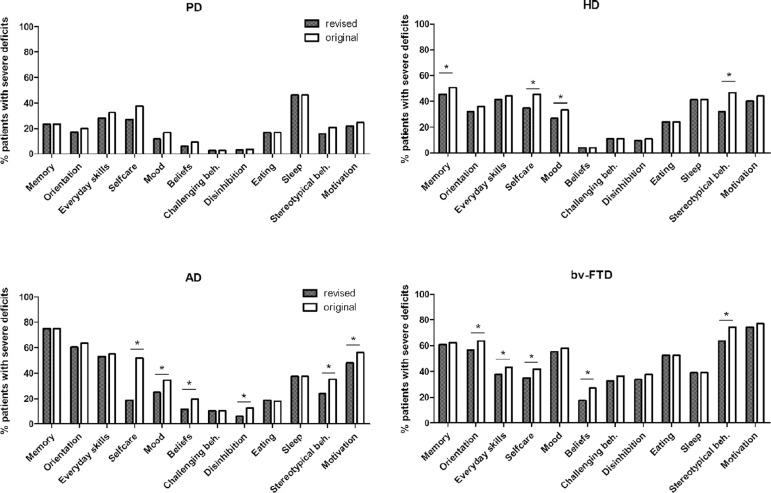
Abstract Neurobehavioural and psychiatric symptoms are common in a range of neurodegenerative disorders with distinct profiles which are helpful in the diagnosis and monitoring of these disorders. The Cambridge Behavioural Inventory (CBI) has been shown to distinguish frontotemporal dementia (FTD), Alzheimer's disease (AD), Huntington's disease (HD) and Parkinson's disease (PD), but it is lengthy. Objective: To develop a shorter version of the 81 item CBI. Methods: CBI data from 450 participants with behavioural variant frontotemporal dementia (bv-FTD) (64), AD (96), PD (215) and HD (75) were analysed using Principal Components Analysis and measures of internal consistency (Cronbach alpha). Results: A reduced 45-item questionnaire was developed. The instrument identified distinct behavioural profiles and performed as well as the original version. Conclusions: A shorter (45 item) version of the CBI is capable of differentiating bv-FTD and AD from PD and HD. It may be useful in delineating the type and extent of problems in these disorders as well as monitoring therapeutic interventions.
Overview
The claims and statistics of this paper haven’t been checked yet.
Free: it reads the open-access text and checks the first 5 claims that cite a source we can check. Create a free account to check every claim.
Integrity signals
Registry
Cites
Statistics
Figures
Verification
Claims the paper makes
The claims and statistics of this paper haven’t been checked yet.
Free: it reads the open-access text and checks the first 5 claims that cite a source we can check. Create a free account to check every claim.
Claims other papers make about this one
Each is checked against this paper’s own text: does it say what the citing paper says it does?
The cited source says what the claim attributes to it.
In the citing paper
“Similar to the FBI, the Cambridge Behavioral Inventory-Revised (CBI-R) assesses frequency of FTD-related symptoms (Nagahama et al., 2006; Wear et al., 2008).”
From The pursuit for markers of disease progression in behavioral variant frontotemporal dementia: a scoping review to optimize outcome measures for clinical trials (2024) · cites this paper as Wear et al., 2008
Self-check
Percentages, sums and reported differences re-computed from the paper’s own numbers.
The self-check needs the paper’s full text.
Citations
Cites
Folstein, M. F., Folstein, S. E., & McHugh, P. R. (1975) · Journal of Psychiatric Research · doi:10.1016/0022-3956(75)90026-6 · Cited by 88,282
McKhann, G., Drachman, D., Folstein, M., Katzman, R., Price, D., & Stadlan, E. M. (1984) · Neurology · doi:10.1212/wnl.34.7.939 · Cited by 27,915
Hirono, N., Mori, E., Ikejiri, Y., Imamura, T., Shimomura, T., Hashimoto, M., Yamashita, H., & Ikeda, M. (1997) · Brain and nerve · Cited by 21,039
Kok, J. S., Berg, I. J., & Scherder, E. J. A. (2013) · Dementia and Geriatric Cognitive Disorders Extra · doi:10.1159/000353441 · Cited by 20,589
Older Adults' Reasons for Using Technology while Aging in Place
Peek, S. T. M., Luijkx, K. G., Rijnaard, M. D., Nieboer, M. E., van der Voort, C. S., Aarts, S., van Hoof, J., Vrijhoef, H. J. M., & Wouters, E. J. M. (2016) · Gerontology · doi:10.1159/000430949 · Cited by 19,690
Sensitivity and False Alarm Rate of a Fall Sensor in Long-Term Fall Detection in the Elderly
Kangas, M., Korpelainen, R., Vikman, I., Nyberg, L., & Jämsä, T. (2015) · Gerontology · doi:10.1159/000362720 · Cited by 18,909
The Neuropsychiatric Inventory: Comprehensive assessment of psychopathology in dementia
Cummings, J. L., Mega, M., Gray, K., Rosenberg-Thompson, S., Carusi, D. A., & Gornbein, J. (1994) · Neurology · doi:10.1212/wnl.44.12.2308 · Cited by 7,568 · cited 1×
“Several scales are available to detect behavioural change, perhaps the best known of which is the Neuropsychiatric Inventory (NPI).(9) The NPI is a carer-based interview designed DOI: 10.”
BackgroundStatistics notes: Cronbach's alpha: Table 1
Bland, J. M., & Altman, D. G. (1997) · BMJ · doi:10.1136/bmj.314.7080.572 · Cited by 5,300
Frontotemporal lobar degeneration: A consensus on clinical diagnostic criteria
Neary, D., Snowden, J. S., Gustafson, L., Passant, U., Stuss, D., Black, S., Freedman, M., Kertesz, A., Robert, P. H., Albert, M., et al. (1998) · Neurology · doi:10.1212/wnl.51.6.1546 · Cited by 5,047
Non-motor symptoms of Parkinson's disease: diagnosis and management
Chaudhuri, K. R., Healy, D. G., & Schapira, A. H. (2006) · The Lancet Neurology · doi:10.1016/s1474-4422(06)70373-8 · Cited by 2,807 · cited 2×
“In PD, the overall rate of symptom endorsement by caregivers is low, although the high rate of sleep dysfunction deserves further exploration.(6) Seriously disruptive and challenging behaviour had a surprisingly low prevalence in HD except for stereotypic patterns of behaviour and poor motivation, which may reflect se…”
Background
Cited by
Items 201–249 of 249
Baker, J., Savage, S. A., & Zeman, A. Z. (2019) · Cambridge University Press eBooks · doi:10.1017/9781108593946.004 · Cited by 1
Is Carer Management Style Associated with Longitudinal Functional Decline in Dementia?
Puthusseryppady, V., Brígola, A. G., Camino, J., Backhouse, T., & Mioshi, E. (2023) · Journal of Alzheimer s Disease · doi:10.3233/jad-230075 · Cited by 1
“A questionnaire measuring dementia-related behavioral changes in the PLwD [25].”
Self-citationPerry, A., Hughes, L. E., Adams, N., Naessens, M., Kloosterman, N. A., Rouse, M. A., Murley, A. G., Street, D., Jones, P. S., & Rowe, J. B. (2024) · NeuroImage Clinical · doi:10.1016/j.nicl.2024.103671 · Cited by 2
Quantitative assessment of brain atrophy in bvFTD: Implications for diagnostic conversion
Beydoun, C., Quang, H., Matis, S., Hazelton, J. L., Carrick, J., Fumagalli, G., Piguet, O., & Landín-Romero, R. (2026) · Alzheimer s & Dementia Diagnosis Assessment & Disease Monitoring · doi:10.1002/dad2.70307 · Cited by 1
Changes in body composition in genetic C9orf72 carriers: The role of the hypothalamus and thalamus
Ahmed, R. M., Tse, N. Y., Bocchetta, M., Dobson‐Stone, C., Kwok, J. B., Hodges, J. R., Irish, M., Rohrer, J. D., Piguet, O., & Halliday, G. M. (2026) · Alzheimer s & Dementia · doi:10.1002/alz.71669 · Cited by 1
Self-citationJiang, J., Larsen, E. K., Levett, B. A., Core, L. B., Froud, S. A., della Monica, C., Hassanin, H., Atzori, G., Hardy, C. J. D., Busche, M. A., et al. (2026) · Alzheimer s & Dementia · doi:10.1002/alz.71686 · Cited by 1
Assessment with Non-cognitive Screening Instruments and Combinations of Scales
Larner, A. J. (2014) · Springer eBooks · doi:10.1007/978-1-4471-6371-8_5 · Cited by 1
Assessment with Non-Cognitive Screening Instruments
Larner, A. J. (2018) · Springer eBooks · doi:10.1007/978-3-319-75259-4_5 · Cited by 1
Cognitive Screeners (4): Informant Scales
Larner, A. J. (2020) · Springer eBooks · doi:10.1007/978-3-030-41636-2_7 · Cited by 1
Dysphagia in primary progressive aphasia: Clinical predictors and neuroanatomical basis
Mazzeo, S., Mulroy, E., Jiang, J., Lassi, M., Johnson, J. C. S., Hardy, C. J. D., Rohrer, J. D., Warren, J. D., & Volkmer, A. (2024) · European Journal of Neurology · doi:10.1111/ene.16370 · Cited by 1
“…at baseline"), in consultation with each patient's primary caregiver or equivalent close informant Patients underwent a comprehensive neuropsychological assessment (Table S1), and behavioural symptoms were assessed using the Cambridge Behavioural Inventory–Revised (CBI-R) [16] (Table 1).”
MethodEveryday Memory Disturbance in Primary Progressive Aphasia
Foxe, D., Ainkaran, G., Carrick, J., Cheung, S. C., Ahmed, R. M., Narasimhan, M., Burrell, J. R., Hwang, Y. T., Irish, M., & Piguet, O. (2024) · European Neurology · doi:10.1159/000540340 · Cited by 2
“It comprises 45 items that cover aspects of memory, behaviour, mood, cognition, and functional capacity (i.e., activities of daily living [ADLs]) [20].”
Frequency and neural correlates related to psychosis in motor neurone diseasePreprint
Wilcox, A., Jones, P. S., Roberts, R. C., & Rowe, J. B. (2021) · medRxiv · doi:10.1101/2021.03.31.21253701 · Cited by 1
So, I., Lombardi, J., Staffaroni, A. M., Coleman, K. K. L., Bouzigues, A., Ferry‐Bolder, E., Cullen, E., Russell, L. L., Foster, P. H., Farley, S., et al. (2026) · medRxiv · doi:10.64898/2026.06.08.26355165 · Cited by 2
Trends of the journal: letters, reviews, abstracts, and manuscripts from abroad
Nitríni, R. (2008) · Dementia & Neuropsychologia · doi:10.1590/s1980-57642009dn20200001
Rogers, K. (2018) · Minerva Access (University of Melbourne)
Neuropsychiatric manifestations of cognitively advanced idiopathic normal pressure hydrocephalus?
Önder, H. (2019) · Journal of Medical Sciences · doi:10.4103/jmedsci.jmedsci_38_19
Smith, C. (2020) · Enlighten: Theses (The University of Glasgow) · doi:10.5525/gla.thesis.77862
Frontotemporal Dementia-Motor Neuron Disease: disease continuum or distinct entity?
Long, Z. (2020) · The Sydney eScholarship Repository (The University of Sydney)
Wilson, N. (2021) · The Sydney eScholarship Repository (The University of Sydney)
Improving the Assessment of Practical Judgment Ability in Older Adults
Quinn, C. G. (2021) · CUNY Academic Works (City University of New York)
Uklanjanje otopljenog organskog ugljika iz površinskih voda postupkom modificirane koagulacije
Ahac, I. (2013) · Repository of Faculty of Mechanical Engineering and Naval Architecture University of Zagreb
I Encontro Acadêmico de Neurologia, Neurocirurgia e Neurociências
Gerais, U. F. D. M. (2021) · REVISTA CIÊNCIAS EM SAÚDE · doi:10.21876/rcshci.v11i3.1198
Advances in Primary Progressive Aphasia
Matías‐Guiu, J. A., Laforce, R. J., & Utianski, R. L. (2022) · MDPI eBooks · doi:10.3390/books978-3-0365-4407-6
Risky decision-making in dementia: Exploring neural correlates and related clinical symptoms
Day, M.-E., Foxe, D., Wei, G., Burrell, J. R., Piguet, O., Kumfor, F., & Wong, S. (2025) · Cognitive Affective & Behavioral Neuroscience · doi:10.3758/s13415-025-01291-3
“A significant group difference was observed on the CBI-R abnormal behaviour subscale H (2) = 62.47, p 0.001, with bvFTD patients, p 0.001, and AD patients, p 0.001, presenting with more symptoms of disinhibition relative to controls, and bvFTD patients showing more disinhibition than AD patients, p 0.001.”
InfluentialCrook, H., Swann, P., Fye, H. K. S., Kigar, S. L., Savulich, G., McKeever, A., Herrero, E. V., Turner, L., Aimola, L., Grey, G., et al. (2025) · BMJ Open · doi:10.1136/bmjopen-2025-107399
Liu, X. (2023) · Apollo (University of Cambridge) · doi:10.17863/cam.106430
Mechanisms of apathy in health and Parkinson's disease
Hezemans, F. H. (2020) · Apollo (University of Cambridge) · doi:10.17863/cam.63928
Henderson, S. K. (2024) · Apollo (University of Cambridge) · doi:10.17863/cam.114456
Whiteside, D. J. (2023) · Apollo (University of Cambridge) · doi:10.17863/cam.105517
Defining the stages of frontotemporal dementia
Samra, K. (2025) · UCL Discovery (University College London)
Santos, I. S. R. G. (2020) · Portuguese National Funding Agency for Science, Research and Technology (RCAAP Project by FCT)
Johnson, K. (2021) · The Sydney eScholarship Repository (The University of Sydney)
Early regional hypometabolism in presymptomatic MAPT carriers : a GENFI sub-study
St-Onge, F. (2019) · Corpus Université Laval (Université Laval)
Best, T. (2023) · eScholarship@McGill (McGill) · doi:10.82308/5468
Chiu, W.-H. M., Goh, A., Eratne, D., Malpas, C. B., Kang, M. J., Kelso, W. M., Walterfang, M., Velakoulis, D., & Loi, S. M. (2025) · Acta Neuropsychiatrica · doi:10.1017/neu.2025.10051
“NPS were assessed using two validated tools: the 21-item Depression Anxiety and Stress Scale (DASS-21) (Lovibond and Lovibond, 1995) and the revised Cambridge Behavioural Inventory (CBI-R) (Wear et al ., 2008).”
InfluentialLühr, L., & Wimmer, R. (2026) · psychopraxis neuropraxis · doi:10.1007/s00739-025-01143-2
Clinical Validation of the Behavioral Evaluation Scale of Frontotemporal Dementia: A Pilot Study
Monção, J., Diniz, L. T., Martins, A. P., Guimarães, H. C., Gambogi, L. B., Saraiva, L. D. A., Caramelli, P., & de Souza, L. C. (2026) · Journal of Neuropsychiatry · doi:10.1176/appi.neuropsych.20250120
Repetitive behaviors in syndromes associated with frontotemporal lobar degeneration
Cotelli, M. S., Bracca, V., Fasolato, D., Geviti, A., Alberici, A., Cagnin, A., & Borroni, B. (2026) · Journal of Alzheimer s Disease · doi:10.1177/13872877261418302
“Several instruments have been employed to assess the prevalence of RB in FTD, including the Neuropsychiatric Inventory, 20 the Cambridge Behavioral Inventory, 21 the Stereotypic and Ritualistic Behaviors subscale 22 of the Stereotypy Rating Inventory.”
Ioannidis, S., Katsarolis, A., & Ioannidis, P. (2026) · Journal of dementia and Alzheimer's disease · doi:10.3390/jdad3010008 · Cited by 1
van Dijk, F., Assendelft, L., van den Berg, E., & Jiskoot, L. C. (2026) · Alzheimer s & Dementia Diagnosis Assessment & Disease Monitoring · doi:10.1002/dad2.70232
“…symptoms in patients with bvFTD, whereas these symptoms remained stable in patients with PPD. 43 Other clinical assessment tools that can potentially aid the distinction between bvFTD and PPD are the Cambridge Behavioral Inventory-Revised (CBI-R) 50 and Frontal Behavioral Inventory (FBI).”
Influentialde Boer, L., Reichard, B., Poos, J. M., Houwer, J. F. H. D., Swartenbroekx, T., Aro, O. A., Rajicic, A., Brouwer, A., Dopper, E. G. P., Kaat, L. D., et al. (2026) · Journal of Neurology · doi:10.1007/s00415-026-13892-0
“Additionally, we used the Cambridge Behavioral Inventory-Revised (CBI-R), an 81-item, informant-based questionnaire, to measure cognitive, behavioral, affective symptoms, and activities of daily living across 13 domains [30].”
Development and validation of the Spatial Navigation and Memory Questionnaire (SPAM)
Boord, M. S., Morrissey, S., Keage, H. A. D., Schinazi, V. R., Hornberger, M., & Wong, S. (2026) · Alzheimer s & Dementia Diagnosis Assessment & Disease Monitoring · doi:10.1002/dad2.70441
Multimodal MRI Signatures of 22q11.2 Deletion Syndrome and genetic Frontotemporal Dementia
Pasternak, M. M. (2026) · TSpace (University of Toronto)
Kaur, L., Griffiths, A. W., Stokes, L., Harrison, J., Song, X., & Blackburn, D. J. (2026) · Journal of Geriatric Psychiatry and Neurology · doi:10.1177/08919887261486060
Chen, T., Sun, Q., Foxe, D., Narasimhan, M., Teng, C., Cheung, S. C., Carrick, J., Burrell, J. R., Hwang, Y. T., Ahmed, R. M., et al. (2026) · Journal of Neurology · doi:10.1007/s00415-026-14132-1
“First, we examined behaviour–burden associations leveraging the broad behavioural coverage of the Cambridge Behavioural Inventory—Revised (CBI-R) [20] to capture dimensions commonly reported by carers as disruptive in their daily lives.”
Plasma immune signatures associate with neurodegeneration in frontotemporal lobar degenerationPreprint
van Schaik, M., Lai, K. O., Shapiro, N. L., Jäck, A., Goddard, J., Crook, H., Frohn, R., Jones, P. S., Tan, S. Y., Swann, O., et al. (2026) · medRxiv · doi:10.64898/2026.09.28.26364155
Santos, I. S. R. G. (2020) · Portuguese National Funding Agency for Science, Research and Technology (RCAAP Project by FCT)
Sibley, J. M., Piguet, O., Landín-Romero, R., Wearne, T. A., & Kumfor, F. (2026) · Neuropsychology · doi:10.1037/neu0001134
Metadata
- Authors
- Wear, H. J., Wedderburn, C. J., Mioshi, E., Williams-Gray, C. H., Mason, S. L., Barker, R. A., & Hodges, J. R.
- Affiliations
- University of Cambridge (GB)
- Neuroscience Research Australia (AU)
- University of Cambridge, United Kingdom; Addenbrooke's Hospital, United Kingdom
- Corresponding author
- Hodges, John R.
- Venue
- Dementia & Neuropsychologia
- Publisher
- FapUNIFESP (SciELO)
- Published
- 2008-06
- Volume
- 2
- Issue
- 2
- Pages
- 102-107
- ISSN
- 1980-5764 (ISSN-L)
- PMC
- PMC5619578
- OpenAlex
- W2112275614
- Cited by
- 225
- References
- 29
- Citations by year
- 2026: 9 · 2025: 16 · 2024: 26 · 2023: 22 · 2022: 22 · 2021: 25 · 2020: 19 · 2019: 20 · 2018: 10 · 2017: 4 · 2016: 18 · 2015: 7 · 2014: 8 · 2013: 7 · 2012: 8
- FWCI
- 0.94
- Type
- journal article
- Language
- en
- Open access
- diamond
- doi.org
- Licence
- cc-by
- Locations
- Dementia & Neuropsychologia (publishedVersion, cc-by)
- Europe PMC (PubMed Central) (publishedVersion, cc-by)
- PubMed Central (publishedVersion, cc-by)
- PubMed (publishedVersion)
- LA Referencia (Red Federada de Repositorios Institucionales de Publicaciones Científicas) (publishedVersion, other-oa)
- Americanae (AECID Library) (submittedVersion, other-oa)
- DOAJ (DOAJ: Directory of Open Access Journals) (submittedVersion, cc-by-sa)
- Redalyc (Universidad Autónoma del Estado de México) (submittedVersion)
- UEA Digital Repository (University of East Anglia) (submittedVersion)
- Topics
- Health Sciences › Medicine › Psychiatry and Mental health › Dementia and Cognitive Impairment Research
- Social Sciences › Psychology › Clinical Psychology › Historical and Modern Theater Studies
- Social Sciences › Psychology › Applied Psychology › Psychological Testing and Assessment
- Keywords
- short-form questionnaire, behavioral variant frontotemporal dementia, Alzheimer's disease, Parkinson's disease, Huntington's disease, psychiatric symptoms, neurodegenerative diseases, behavioral profiles, instrument development, internal consistency
About these checks
Registry, retraction, Cites and statistics results are computed, not judged, with one exception: a printed reference that no index lists is read once by a model before it counts as a citation error. Claims are extracted by a model and kept only when their quote appears verbatim in the text; each cited source is then checked, with a model’s help, for whether it says what the claim relies on. Those verdicts can be wrong — read the claim’s quote and the cited source before relying on one.
Statistics and arithmetic are recomputed, not judged.
Confidence bands are shown only for fields calibrated on our annotated test set. None is calibrated yet, so no band is shown.
What counts as a claim ›How we measure confidence ›How we check this ›
Are you an author, or do you see a problem with this page? Request a review
Data sources
Bibliographic data: Semantic Scholar, OpenAlex, Crossref.
Contains information from the Semantic Scholar Academic Graph Datasets, made available under the ODC Attribution License (ODC-BY 1.0).
Semantic Scholar’s data is described in: Kinney, R., et al. (2023). The Semantic Scholar Open Data Platform. arXiv:2301.10140.
