

The Cambridge Behavioural Inventory revised
Open accessThe DOI matches its Crossref record; 29 of the 29 references it cites were found in a registry or an index.
Abstract
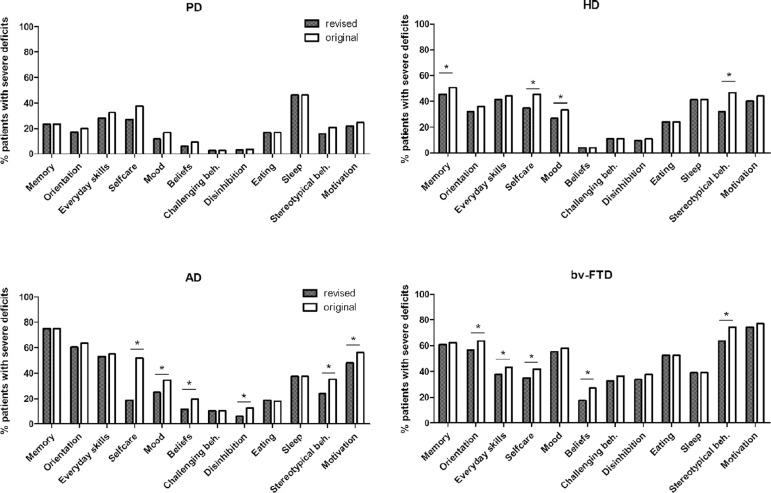
Abstract Neurobehavioural and psychiatric symptoms are common in a range of neurodegenerative disorders with distinct profiles which are helpful in the diagnosis and monitoring of these disorders. The Cambridge Behavioural Inventory (CBI) has been shown to distinguish frontotemporal dementia (FTD), Alzheimer's disease (AD), Huntington's disease (HD) and Parkinson's disease (PD), but it is lengthy. Objective: To develop a shorter version of the 81 item CBI. Methods: CBI data from 450 participants with behavioural variant frontotemporal dementia (bv-FTD) (64), AD (96), PD (215) and HD (75) were analysed using Principal Components Analysis and measures of internal consistency (Cronbach alpha). Results: A reduced 45-item questionnaire was developed. The instrument identified distinct behavioural profiles and performed as well as the original version. Conclusions: A shorter (45 item) version of the CBI is capable of differentiating bv-FTD and AD from PD and HD. It may be useful in delineating the type and extent of problems in these disorders as well as monitoring therapeutic interventions.
Overview
The claims and statistics of this paper haven’t been checked yet.
Free: it reads the open-access text and checks the first 5 claims that cite a source we can check. Create a free account to check every claim.
Integrity signals
Registry
Cites
Statistics
Figures
Verification
Claims the paper makes
The claims and statistics of this paper haven’t been checked yet.
Free: it reads the open-access text and checks the first 5 claims that cite a source we can check. Create a free account to check every claim.
Claims other papers make about this one
Each is checked against this paper’s own text: does it say what the citing paper says it does?
The cited source says what the claim attributes to it.
In the citing paper
“Similar to the FBI, the Cambridge Behavioral Inventory-Revised (CBI-R) assesses frequency of FTD-related symptoms (Nagahama et al., 2006; Wear et al., 2008).”
From The pursuit for markers of disease progression in behavioral variant frontotemporal dementia: a scoping review to optimize outcome measures for clinical trials (2024) · cites this paper as Wear et al., 2008
Self-check
Percentages, sums and reported differences re-computed from the paper’s own numbers.
The self-check needs the paper’s full text.
Citations
Cites
Folstein, M. F., Folstein, S. E., & McHugh, P. R. (1975) · Journal of Psychiatric Research · doi:10.1016/0022-3956(75)90026-6 · Cited by 88,282
McKhann, G., Drachman, D., Folstein, M., Katzman, R., Price, D., & Stadlan, E. M. (1984) · Neurology · doi:10.1212/wnl.34.7.939 · Cited by 27,915
Hirono, N., Mori, E., Ikejiri, Y., Imamura, T., Shimomura, T., Hashimoto, M., Yamashita, H., & Ikeda, M. (1997) · Brain and nerve · Cited by 21,039
Kok, J. S., Berg, I. J., & Scherder, E. J. A. (2013) · Dementia and Geriatric Cognitive Disorders Extra · doi:10.1159/000353441 · Cited by 20,589
Older Adults' Reasons for Using Technology while Aging in Place
Peek, S. T. M., Luijkx, K. G., Rijnaard, M. D., Nieboer, M. E., van der Voort, C. S., Aarts, S., van Hoof, J., Vrijhoef, H. J. M., & Wouters, E. J. M. (2016) · Gerontology · doi:10.1159/000430949 · Cited by 19,690
Sensitivity and False Alarm Rate of a Fall Sensor in Long-Term Fall Detection in the Elderly
Kangas, M., Korpelainen, R., Vikman, I., Nyberg, L., & Jämsä, T. (2015) · Gerontology · doi:10.1159/000362720 · Cited by 18,909
The Neuropsychiatric Inventory: Comprehensive assessment of psychopathology in dementia
Cummings, J. L., Mega, M., Gray, K., Rosenberg-Thompson, S., Carusi, D. A., & Gornbein, J. (1994) · Neurology · doi:10.1212/wnl.44.12.2308 · Cited by 7,568 · cited 1×
“Several scales are available to detect behavioural change, perhaps the best known of which is the Neuropsychiatric Inventory (NPI).(9) The NPI is a carer-based interview designed DOI: 10.”
BackgroundStatistics notes: Cronbach's alpha: Table 1
Bland, J. M., & Altman, D. G. (1997) · BMJ · doi:10.1136/bmj.314.7080.572 · Cited by 5,300
Frontotemporal lobar degeneration: A consensus on clinical diagnostic criteria
Neary, D., Snowden, J. S., Gustafson, L., Passant, U., Stuss, D., Black, S., Freedman, M., Kertesz, A., Robert, P. H., Albert, M., et al. (1998) · Neurology · doi:10.1212/wnl.51.6.1546 · Cited by 5,047
Non-motor symptoms of Parkinson's disease: diagnosis and management
Chaudhuri, K. R., Healy, D. G., & Schapira, A. H. (2006) · The Lancet Neurology · doi:10.1016/s1474-4422(06)70373-8 · Cited by 2,807 · cited 2×
“In PD, the overall rate of symptom endorsement by caregivers is low, although the high rate of sleep dysfunction deserves further exploration.(6) Seriously disruptive and challenging behaviour had a surprisingly low prevalence in HD except for stereotypic patterns of behaviour and poor motivation, which may reflect se…”
BackgroundThe Neuropsychiatric Inventory: Assessing psychopathology in dementia patients
Cummings, J. L. (1997) · Neurology · doi:10.1212/wnl.48.5_suppl_6.10s · Cited by 2,017 · cited 1×
“It is imperative that instruments are available for accurate detection and quantification of behavioural and neuropsychiatric disturbances, as these represent primary manifestations of dementia and cognitive dysfunction.(24) The CBI and the CBI-R have the advantage of evaluating a wider range of psychopathology than m…”
BackgroundApathy and the Functional Anatomy of the Prefrontal Cortex–Basal Ganglia Circuits
Levy, R., & Dubois, B. (2006) · Cerebral Cortex · doi:10.1093/cercor/bhj043 · Cited by 1,285 · cited 1×
“Seriously disruptive and challenging behaviour had a surprisingly low prevalence in HD except for stereotypic patterns of behaviour and poor motivation, which may reflect selective disruption of fronto-striatal circuits as a result of basal ganglia pathology.(21,22) Our study has some clear limitations.”
BackgroundBozeat, S. (2000) · Journal of Neurology, Neurosurgery & Psychiatry · doi:10.1136/jnnp.69.2.178 · Cited by 603 · cited 4×
“The CBI was developed to detect the unique constellation of symptoms seen in FTD and was based on an earlier questionnaire.(4) It has since been shown to distinguish between distinct profiles of behaviour seen in neurodegenerative disorders, notably FTD, AD, PD, and HD, and has been validated against the NPI.”
BackgroundMethodInfluentialIkeda, M. (2002) · Journal of Neurology, Neurosurgery & Psychiatry · doi:10.1136/jnnp.73.4.371 · Cited by 499 · cited 1×
“In frontotemporal dementia (FTD), changes in personality and social conduct are core to the diagnostic criteria, and include mental rigidity, stereotypical behaviour, disinhibition, apathy, and alteration in eating habits.(4,5) Parkinson’s disease (PD) is also associated with a range of neuropsychiatric symptoms such…”
BackgroundSelf-citationNeuroanatomical correlates of behavioural disorders in dementia
Rosen, H. J., Allison, S. C., Schauer, G. F., Gorno-Tempini, M. L., Weiner, M. W., & Miller, B. L. (2005) · Brain · doi:10.1093/brain/awh628 · Cited by 497 · cited 1×
“Recent brain imaging studies using voxel based morphometry have related these symptoms to involvement of the ventral and medial frontal cortex.(18,19) In AD, deficits in memory, orientation, everyday skills and self-care are dominant, reflecting medial temporal and posterior association cortical pathology.”
BackgroundProspective validation of Consensus criteria for the diagnosis of dementia with Lewy bodies
McKeith, I. G., Ballard, C. G., Perry, R. H., Ince, P. G., O’Brien, J. T., Neill, D., Lowery, K., Jaros, E., Barber, R., Thompson, P., et al. (2000) · Neurology · doi:10.1212/wnl.54.5.1050 · Cited by 459 · cited 2×
“Parkinson’s disease (PD) is also associated with a range of neuropsychiatric symptoms such as depression, anxiety, apathy, psychosis and visual hallucinations,(6) the last of which is predominant in dementia with Lewy Bodies.(7) Similarly, Huntington’s disease (HD) may present with depression, irritability and aggress…”
BackgroundPsychiatric Phenomena in Alzheimer's Disease. I: Disorders of Thought Content
Burns, A., Jacoby, R., & Levy, R. (1990) · British Journal of Psychiatry · doi:10.1192/bjp.157.1.72 · Cited by 417
Psychiatric Phenomena in Alzheimer's Disease. IV: Disorders of Behaviour
Burns, A., Jacoby, R., & Levy, R. (1990) · British Journal of Psychiatry · doi:10.1192/bjp.157.1.86 · Cited by 389
Declarative memory impairments in Alzheimer's disease and semantic dementia
Nestor, P. J., Fryer, T. D., & Hodges, J. R. (2006) · NeuroImage · doi:10.1016/j.neuroimage.2005.10.008 · Cited by 370 · cited 1×
“Apathy is also common and may reflect anterior cingulate involvement, perhaps as an indirect consequence of severe posterior cingulate pathology demonstrated by FDG-PET at the very early stage of the disease.(20) In PD, the overall rate of symptom endorsement by caregivers is low, although the high rate of sleep dysfu…”
BackgroundSelf-citationPrimary Progressive Aphasia: Longitudinal Course, Neuropsychological Profile, and Language Features
Weintraub, S. (1990) · Archives of Neurology · doi:10.1001/archneur.1990.00530120075013 · Cited by 310
Psychiatric Phenomena in Alzheimer's Disease. III: Disorders of Mood
Burns, A., Jacoby, R., & Levy, R. (1990) · British Journal of Psychiatry · doi:10.1192/bjp.157.1.81 · Cited by 234
Neuropsychiatry of Huntington’s Disease and Other Basal Ganglia Disorders
Rosenblatt, A., & Leroi, I. (2000) · Psychosomatics · doi:10.1016/s0033-3182(00)71170-4 · Cited by 223
Quality of life in essential tremor questionnaire (QUEST): development and initial validation
Tröster, A. I., Pahwa, R., Fields, J. A., Tanner, C. M., & Lyons, K. E. (2005) · Parkinsonism & Related Disorders · doi:10.1016/j.parkreldis.2005.05.009 · Cited by 217 · cited 2×
“The confirmation that items from the revised questionnaire loaded onto virtually identical factors to the original CBI in the PCA analysis suggests a stable solution.(16) Preliminary analyses demonstrated that the internal consistency remained high in the new questionnaire; although the ‘sleep’ subsection was below ad…”
MethodResultEvaluating dementia screening tests: Methodologic standards to rate their performance
Gifford, D. R., & Cummings, J. L. (1999) · Neurology · doi:10.1212/wnl.52.2.224 · Cited by 168 · cited 1×
“Further validation of the CBI-R against other instruments and the examination of inter-rater and test-retest reliability is desirable.(23) Validation should also be carried out in an independent cohort of patients.”
MethodNeural correlates of semantic and behavioural deficits in frontotemporal dementia
Williams, G. B., Nestor, P. J., & Hodges, J. R. (2005) · NeuroImage · doi:10.1016/j.neuroimage.2004.10.023 · Cited by 167 · cited 1×
“Recent brain imaging studies using voxel based morphometry have related these symptoms to involvement of the ventral and medial frontal cortex.(18,19) In AD, deficits in memory, orientation, everyday skills and self-care are dominant, reflecting medial temporal and posterior association cortical pathology.”
BackgroundSelf-citationThe utility of the Cambridge Behavioural Inventory in neurodegenerative disease
Wedderburn, C., Wear, H., Brown, J., Mason, S. J., Barker, R. A., Hodges, J., & Williams-Gray, C. (2008) · Journal of Neurology, Neurosurgery & Psychiatry · doi:10.1136/jnnp.2007.122028 · Cited by 166 · cited 6×
“The Cambridge Behavioural Inventory (CBI) is an informant-based questionnaire comprising 81-items aimed at assessing behavioural changes across a range of neurodegenerative disorders.(10) It was designed to capture cognitive, behavioural and affective symptoms as well as activities of daily living (ADL) and evaluates…”
BackgroundMethodInfluentialSelf-citationLévy, R., & Czernecki, V. (2006) · Journal of Neurology · doi:10.1007/s00415-006-7012-5 · Cited by 165 · cited 1×
“Seriously disruptive and challenging behaviour had a surprisingly low prevalence in HD except for stereotypic patterns of behaviour and poor motivation, which may reflect selective disruption of fronto-striatal circuits as a result of basal ganglia pathology.(21,22) Our study has some clear limitations.”
BackgroundThe Cambridge behavioral inventory: validation and application in a memory clinic
Nagahama, Y., Okina, T., Suzuki, N., & Matsuda, M. (2006) · Journal of Geriatric Psychiatry and Neurology · doi:10.1177/0891988706286545 · Cited by 45
Gibb, W. R. G., & Lees, A. J. (1989) · Neurology · doi:10.1212/wnl.39.6.878-a · Cited by 5
Cited by
Hsieh, S., Schubert, S., Hoon, C., Mioshi, E., & Hodges, J. R. (2013) · Dementia and Geriatric Cognitive Disorders · doi:10.1159/000351671 · Cited by 973
Self-citationRohrer, J. D., Nicholas, J. M., Cash, D. M., van Swieten, J., Dopper, E., Jiskoot, L., van Minkelen, R., Rombouts, S. A., Cardoso, M. J., Clegg, S., et al. (2015) · The Lancet Neurology · doi:10.1016/s1474-4422(14)70324-2 · Cited by 538
Ducharme, S., Dols, A., Laforce, R., Devenney, E., Kumfor, F., van den Stock, J., Dallaire-Théroux, C., Seelaar, H., Gossink, F., Vijverberg, E., et al. (2020) · Brain · doi:10.1093/brain/awaa018 · Cited by 320
Self-citationOn the right side? A longitudinal study of left- versus right-lateralized semantic dementia
Kumfor, F., Landin-Romero, R., Devenney, E., Hutchings, R., Grasso, R., Hodges, J. R., & Piguet, O. (2016) · Brain · doi:10.1093/brain/awv387 · Cited by 224
Self-citationPlasma extracellular vesicle tau and TDP-43 as diagnostic biomarkers in FTD and ALS
(2024) · doi:10.1038/s41591-024-02937-4 · Cited by 217
Metadata
- Authors
- Wear, H. J., Wedderburn, C. J., Mioshi, E., Williams-Gray, C. H., Mason, S. L., Barker, R. A., & Hodges, J. R.
- Affiliations
- University of Cambridge (GB)
- Neuroscience Research Australia (AU)
- University of Cambridge, United Kingdom; Addenbrooke's Hospital, United Kingdom
- Corresponding author
- Hodges, John R.
- Venue
- Dementia & Neuropsychologia
- Publisher
- FapUNIFESP (SciELO)
- Published
- 2008-06
- Volume
- 2
- Issue
- 2
- Pages
- 102-107
- ISSN
- 1980-5764 (ISSN-L)
- PMC
- PMC5619578
- OpenAlex
- W2112275614
- Cited by
- 225
- References
- 29
- Citations by year
- 2026: 9 · 2025: 16 · 2024: 26 · 2023: 22 · 2022: 22 · 2021: 25 · 2020: 19 · 2019: 20 · 2018: 10 · 2017: 4 · 2016: 18 · 2015: 7 · 2014: 8 · 2013: 7 · 2012: 8
- FWCI
- 0.94
- Type
- journal article
- Language
- en
- Open access
- diamond
- doi.org
- Licence
- cc-by
- Locations
- Dementia & Neuropsychologia (publishedVersion, cc-by)
- Europe PMC (PubMed Central) (publishedVersion, cc-by)
- PubMed Central (publishedVersion, cc-by)
- PubMed (publishedVersion)
- LA Referencia (Red Federada de Repositorios Institucionales de Publicaciones Científicas) (publishedVersion, other-oa)
- Americanae (AECID Library) (submittedVersion, other-oa)
- DOAJ (DOAJ: Directory of Open Access Journals) (submittedVersion, cc-by-sa)
- Redalyc (Universidad Autónoma del Estado de México) (submittedVersion)
- UEA Digital Repository (University of East Anglia) (submittedVersion)
- Topics
- Health Sciences › Medicine › Psychiatry and Mental health › Dementia and Cognitive Impairment Research
- Social Sciences › Psychology › Clinical Psychology › Historical and Modern Theater Studies
- Social Sciences › Psychology › Applied Psychology › Psychological Testing and Assessment
- Keywords
- short-form questionnaire, behavioral variant frontotemporal dementia, Alzheimer's disease, Parkinson's disease, Huntington's disease, psychiatric symptoms, neurodegenerative diseases, behavioral profiles, instrument development, internal consistency
About these checks
Registry, retraction, Cites and statistics results are computed, not judged, with one exception: a printed reference that no index lists is read once by a model before it counts as a citation error. Claims are extracted by a model and kept only when their quote appears verbatim in the text; each cited source is then checked, with a model’s help, for whether it says what the claim relies on. Those verdicts can be wrong — read the claim’s quote and the cited source before relying on one.
Statistics and arithmetic are recomputed, not judged.
Confidence bands are shown only for fields calibrated on our annotated test set. None is calibrated yet, so no band is shown.
What counts as a claim ›How we measure confidence ›How we check this ›
Are you an author, or do you see a problem with this page? Request a review
Data sources
Bibliographic data: Semantic Scholar, OpenAlex, Crossref.
Contains information from the Semantic Scholar Academic Graph Datasets, made available under the ODC Attribution License (ODC-BY 1.0).
Semantic Scholar’s data is described in: Kinney, R., et al. (2023). The Semantic Scholar Open Data Platform. arXiv:2301.10140.
