

SPECTER: Document-level Representation Learning using Citation-informed Transformers
Open accessThe DOI matches its Crossref record; 62 of the 62 references it cites were found in a registry or an index; 1 of the 26 sources its claims cite were checked for support.
Abstract
Representation learning is a critical ingredient for natural language processing systems.Recent Transformer language models like BERT learn powerful textual representations, but these models are targeted towards token-and sentence-level training objectives and do not leverage information on inter-document relatedness, which limits their document-level representation power.For applications on scientific documents, such as classification and recommendation, the embeddings power strong performance on end tasks.We propose SPECTER, a new method to generate document-level embedding of scientific documents based on pretraining a Transformer language model on a powerful signal of document-level relatedness: the citation graph.Unlike existing pretrained language models, SPECTER can be easily applied to downstream applications without task-specific fine-tuning.Additionally, to encourage further research on document-level models, we introduce SCIDOCS, a new evaluation benchmark consisting of seven document-level tasks ranging from citation prediction, to document classification and recommendation.We show that SPECTER outperforms a variety of competitive baselines on the benchmark.1
Overview
CoChat Summary
TL;DR
SPECTER learns document-level embeddings of scientific papers by pretraining a SciBERT Transformer on citation-informed triplets, using only title and abstract at inference. It introduces the SCIDOCS seven-task benchmark and reports an average score of 80.0 across tasks/metrics, a 3.1-point absolute improvement over the next-best baseline.
Key findings
- SPECTER achieves an average of 80.0 across all SCIDOCS tasks/metrics, 3.1 points absolute over the next-best baseline. On MeSH classification it reaches F1 86.4 (+2.3 over best baseline) and on MAG F1 82.0 (+1.5); on co-view MAP 83.8 and co-read MAP 84.5, improving over Citeomatic by 2.7 and 4.0 points; on co-citation nDCG 94.8, +2.3 over SGC; on recommendation nDCG 53.9.
- In an online A/B test with 4,113 clicks, the SPECTER-based ranker improved clickthrough rate over the baseline by 46.5%.
- Ablations show removing the abstract drops average performance to 68.1, adding authors drops it to 67.3, using no hard negatives drops it to 78.4, and initializing from BERT-Large instead of SciBERT drops it to 77.5. Fixed SPECTER embeddings also outperform SciBERT fine-tuned on task-specific signals (SPECTER average 80.0 vs. multitask fine-tuning 78.0).
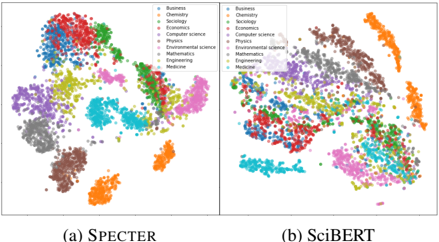
- t-SNE clustering quality for SPECTER is homogeneity 0.41 and completeness 0.72, compared with SciBERT’s 0.19 and 0.63.
Methods
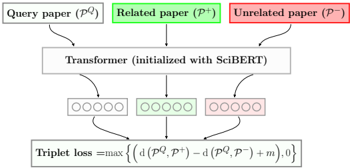
- SPECTER initializes from SciBERT, encodes the concatenated title and abstract, and uses the final [CLS] pooled output as the paper vector. It pretrains with a triplet margin loss on the citation graph: query paper, positive cited paper, and negative uncited paper, using L2 distance and margin m=1. Hard negatives are citations of citations; training uses 2 hard negatives and 3 easy negatives per query.
- Training data: a Semantic Scholar subset of about 146K query papers (~26.7M tokens) and 32K validation papers, yielding about 684K training triples and 145K validation triples. Training uses Adam with LR 2e-5, slanted triangular LR, 2 epochs, batch size 4 with gradient accumulation for effective batch size 32, on a single Titan V GPU.
- Evaluation: SCIDOCS covers seven tasks—MeSH classification (23K papers, 11 disease classes), MAG topic classification (25K papers, 19 level-1 classes), direct citation prediction (~30K total papers; 1K queries, up to 5 cited and 25 uncited candidates), co-citation (30K), co-views (~30K), co-reads (~30K), and recommendation (22K clickthrough events; 20K/1K/1K split; propensity-adjusted P@1 and nDCG). Baselines include SIF, SciBERT, Sent-BERT, Citeomatic, and SGC; classification uses a linear SVM, and recommendation uses a feedforward ranking network with ten features including cosine embedding distance.
Limitations
- Stated: SPECTER uses only title and abstract; adding full text could improve accuracy, but full text is often not freely available and Transformer memory limits would require new techniques. Venue metadata was not normalized, and author names were sparse/out-of-vocabulary; adding authors or venues did not help and authors hurt performance.
- Stated: On the recommendation task, differences between embedding methods are generally smaller because embeddings are used alongside several other informative features, limiting their impact on overall performance.
- Evident from the text: evaluation is limited to scientific documents and the released SCIDOCS tasks, with no evidence for other domains or languages; the online A/B test covers one production recommender and 4,113 clicks, so broader deployment evidence is not provided.
Model-written summary. Check it against the paper before relying on it.
Integrity signals
Registry
Cites
Statistics
Figures
Verification
Claims the paper makes
1 Valid · 2 Not valid · 17 Not checked · 56 Own results and interpretations
Every source the paper cites for this claim was checked and supports it.
In the paper
“This is because SciBERT, like other pretrained language models, is trained via language modeling objectives, which only predict words or sentences given their in-document, nearby textual context.”
§ SPECTER: Document-level Representation Learning using Citation-informed Transformers > Document Representation
What the sources say
- Supportedcites Beltagy et al., 2019 matched to “SciBERT: A Pretrained Language Model for Scientific Text” (2019) source
The Methods (Sec. 2, Background) states that SciBERT follows BERT's architecture and pretraining tasks — 'predicting randomly masked tokens and predicting whether two sentences follow each other' — i.e. word-level and sentence-level objectives. The Corpus paragraph of Sec. 2 and Sec. 3.3 show these instances are built from the full text of papers with sentences split and packed up to 128/512 tokens, so the context the objectives use is nearby, in-document text. The Introduction likewise groups SciBERT with ELMo, GPT and BERT as unsupervised pretrained language models, covering the 'like other pretrained language models' clause. (LLM, conf=0.85)
plainstates a cause- Asserted: passes — The authors put it forward as true.
- Checkable: passes — It can be checked against evidence.
- Load-bearing: passes — The paper’s conclusions depend on it.
- Based: passes — The paper gives a reason why it holds.
- Supported
A result the paper states — it cites no source for it, so there is none to check. The quote shows it is in the paper.
In the paper
“On the recommendations task, as opposed to previous experiments, the differences in method scores are generally smaller.”
§ SPECTER: Document-level Representation Learning using Citation-informed Transformers > 5 Results
plain- Asserted: passes — The authors put it forward as true.
- Checkable: passes — It can be checked against evidence.
- Load-bearing: unclear — It is unclear whether the paper’s conclusions depend on it.
- Based: passes — The paper gives a reason why it holds.
A result the paper reports from its own data — it cites no other source for it, so there is none to check. The quote shows it is in the paper.
In the paper
“We found that these pretrained embeddings substantially outperform alternative off-theshelf embeddings.”
§ SPECTER: Document-level Representation Learning using Citation-informed Transformers > 3. Fasttext-Sum
plainstates a cause- Asserted: passes — The authors put it forward as true.
- Checkable: passes — It can be checked against evidence.
- Load-bearing: unclear — It is unclear whether the paper’s conclusions depend on it.
- Based: passes — The paper gives a reason why it holds.
A result the paper reports from its own data — it cites no other source for it, so there is none to check. The quote shows it is in the paper.
In the paper
“As we show in our experiments ( §6), including hard negatives results in more accurate embeddings compared to using random negatives alone.”
§ SPECTER: Document-level Representation Learning using Citation-informed Transformers > 2.4 Selecting Negative Distractors
plainstates a cause- Asserted: passes — The authors put it forward as true.
- Checkable: passes — It can be checked against evidence.
- Load-bearing: passes — The paper’s conclusions depend on it.
- Based: passes — The paper gives a reason why it holds.
- Rests on an assumption not shown here.
A result the paper states — it cites no source for it, so there is none to check. The quote shows it is in the paper.
In the paper
“We achieve substantial improvements over the strongest of a wide variety of baselines, demonstrating the effectiveness of our model.”
§ SPECTER: Document-level Representation Learning using Citation-informed Transformers > 8 Conclusions and Future Work
boostedstates a cause- Asserted: passes — The authors put it forward as true.
- Checkable: passes — It can be checked against evidence.
- Load-bearing: passes — The paper’s conclusions depend on it.
- Based: passes — The paper gives a reason why it holds.
25 more claims
Create a free account to see all 76 claims and to verify the 18 references still open.
- It may state two separate claims as one. 22
- Probably not a substantial claim. 29
- The quote only partly states this claim. 1
Claims other papers make about this one
Each is checked against this paper’s own text: does it say what the citing paper says it does?
In the citing paper
“Covered model families span content-and embedding-based methods (e.g.,TF-IDF [63], BM25 [59] , SPECTER/SciBERT [17] ), graph-and HIN/GNN-based methods (GraphSAGE, Graph Attention Networks (GATs), meta-path reasoning), and hybrid/LLM pipelines (prompting, re-ranking, RAG).”
From A Critical Review on Citation Recommendation Systems Through a Graph-Centric Approach (2026) · cites this paper as [17]
Citations
Cites
Vaswani, A., Shazeer, N., Parmar, N., Uszkoreit, J., Jones, L., Gomez, A. N., Kaiser, L., & Polosukhin, I. (2017) · arXiv · doi:10.48550/arxiv.1706.03762 · Cited by 120,404
Adam: A Method for Stochastic Optimization
Kingma, D. P., & Ba, J. (2014) · arXiv · doi:10.48550/arxiv.1412.6980 · Cited by 98,946
BERT: Pre-training of Deep Bidirectional Transformers for Language Understanding
Devlin, J., Chang, M.-W., Lee, K., & Toutanova, K. (2018) · arXiv · doi:10.48550/arxiv.1810.04805 · Cited by 73,173
Scikit-learn: Machine Learning in Python
Pedregosa, F., Varoquaux, G., Gramfort, A., Michel, V., Thirion, B., Grisel, O., Blondel, M., Müller, A., Nothman, J., Louppe, G., et al. (2012) · arXiv · doi:10.48550/arxiv.1201.0490 · Cited by 71,016
BERT: Pre-training of Deep Bidirectional Transformers for Language Understanding
Devlin, J., Chang, M.-W., Lee, K., & Toutanova, K. (2019) · Proceedings of the 2019 Conference of the North American Chapter of the Association for Computational Linguistics: Human Language Technologies, Volume 1 (Long and Short Papers) · doi:10.18653/v1/n19-1423 · Cited by 54,325
Semi-supervised classification with graph convolutional networks
Kipf, T. N., & Welling, M. (2016) · arXiv · doi:10.48550/arxiv.1609.02907 · Cited by 24,853
(1996) · Cited by 20,179
RoBERTa: A Robustly Optimized BERT Pretraining Approach
Liu, Y., Ott, M., Goyal, N., Du, J., Joshi, M., Chen, D., Levy, O., Lewis, M., Zettlemoyer, L., & Stoyanov, V. (2019) · arXiv · doi:10.48550/arxiv.1907.11692 · Cited by 16,515
Sentence-BERT: Sentence Embeddings using Siamese BERT-Networks
Reimers, N., & Gurevych, I. (2019) · Proceedings of the 2019 Conference on Empirical Methods in Natural Language Processing and the 9th International Joint Conference on Natural Language Processing (EMNLP-IJCNLP) · doi:10.18653/v1/d19-1410 · Cited by 12,778
Deep Contextualized Word Representations
Peters, M., Neumann, M., Iyyer, M., Gardner, M., Clark, C., Lee, K., & Zettlemoyer, L. (2018) · Proceedings of the 2018 Conference of the North American Chapter of the Association for Computational Linguistics: Human Language Technologies, Volume 1 (Long Papers) · doi:10.18653/v1/n18-1202 · Cited by 11,983
Research works printed but not linked: 2
- William L. Hamilton, Zhitao Ying, and Jure Leskovec. 2017b. Inductive representation learning on large graphs. In NIPS.
- Alec Radford, Karthik Narasimhan, Tim Salimans, and Ilya Sutskever. 2018. Improving language under- standing by generative pre-training. arXiv.
Cited by
Items 901–1,000 of 1,111
Embedding-Based Topic Modeling for Strategic Research Portfolio Analysis
Silva, M. C. G. (2026) · Portuguese National Funding Agency for Science, Research and Technology (RCAAP Project by FCT)
Bilimsel makalelerin alıntı yapılarını dikkate alan gösterimlerin öğrenimi
Çelik, E. Y. (2024) · İYTE (İZMİR YÜKSEK TEKNOLOJİ ENSTİTÜSÜ)
Family engagement in Montessori early childhood education: perspectives and promise
Burbank, M. D., & Goldsmith, M. M. (2026) · International Journal of Early Years Education · doi:10.1080/09669760.2026.2654523
Hybrid Embedding-Based Recommendation System for Research Papers
(2026) · International Research Journal of Modernization in Engineering Technology and Science · doi:10.56726/irjmets80986
Relevance Supervision Can Teach Neural Retrievers to Prefer LLM-Generated Text
Huang, W., Bi, K., Cai, Y., Chen, W., Guo, J., & Cheng, X. (2026) · Findings of the Association for Computational Linguistics: EMNLP (Findings of EMNLP) · doi:10.48550/arxiv.2604.06163 · Cited by 1
Az-zahra, A. R., Prawira, A., Nugraha, M. S., Hodijah, A., Setijohatmo, U. T., Setiarini, S. D., & Wisnuadhi, B. (2025) · Media Jurnal Informatika · doi:10.35194/mji.v17i2.5672
Benchmarking MeSH-augmented embeddings for biomedical document similarity
Ravinder, R., Geist, L., Quiñones, N., Venkatesh, S., Castro, L. J., & Rebholz‐Schuhmann, D. (2026) · Journal of Biomedical Semantics · doi:10.1186/s13326-026-00365-6
Chen, X., Meng, X., Lv, S., Zhang, Y., & Chen, Y. J. (2026) · Scientometrics · doi:10.1007/s11192-026-05594-1
Kim, S., Hahn, H., & Kwon, T. (2025) · Journal of Society of Korea Industrial and Systems Engineering · doi:10.11627/jksie.2025.48.4.079
Tao, D. M. (2026) · arXiv (Cornell University) · doi:10.48550/arxiv.2604.16329
Tracing the Conceptual and Technical Embeddedness of Urban Digital TwinsPreprint
Hagemans, R., & Hilman, R. M. (2026) · SSRN Electronic Journal · doi:10.2139/ssrn.6635094
Choi, S. (2026) · arXiv (Cornell University) · doi:10.48550/arxiv.2604.23699
Hypencoder Revisited: Reproducibility and Analysis of Non-Linear Scoring for First-Stage Retrieval
Eichholtz, A., Li, Y., Vijverberg, J., Groot, T., & Aliannejadi, M. (2026) · International ACM SIGIR Conference on Research and Development in Information Retrieval (SIGIR) · doi:10.1145/3805712.3808549
A hybrid transformer architecture for unsupervised aspect‐based sentiment analysis
Puvvula, D., & Rodda, S. (2026) · ETRI Journal · doi:10.4218/etrij.2025-0094
Talk2Ref: A Dataset for Reference Prediction from Scientific Talks
Broy, F. Y., Züfle, M., & Niehues, J. (2026) · Language Resources and Evaluation Conference (LREC) · doi:10.63317/5axffrnj6tm8
INTELLIGENT RESEARCH NAVIGATOR: AN AI DRIVEN FRAMEWORK FOR AUTONOMOUS INNOVATION AND DISCOVERY
Lokesh, B., Yashaswini, C. V., Dasu, S., & Laxmi, K. V. (2026) · International Journal of Engineering Research and Science & Technology · doi:10.62643/ijerst.2026.v22.n2(2).3036
ExperMatch: A Unified Benchmark for Bidirectional and Cross-Domain Expertise Matching
Chen, W., Chen, K., Qiu, Y.-X., Zhang, W., Lu, M., Chen, Q., Liu, J., Chan, W. K., & Mao, R. (2026) · Lecture notes in computer science · doi:10.1007/978-981-92-0378-9_26
Topic Is Not Agenda: A Citation-Community Audit of Text EmbeddingsPreprint
Yoo, J. (2026) · arXiv (Cornell University) · doi:10.48550/arxiv.2605.07158
Historical ties shape fisheries research in West Africa
Macedo, T. P., Colonese, A. C., Back, H., & Ziveri, P. (2026) · Reviews in Fish Biology and Fisheries · doi:10.1007/s11160-026-10059-y
Semantic Similarity Analysis of Theses Using Sentence Embeddings and Knowledge Graphs
Cusi, I. J. D. P., Mamani, L. C., Zuñiga-Rojas, G., Alvarez-Mamani, E., & Olivera, H. V. (2026) · Communications in computer and information science · doi:10.1007/978-3-032-20322-9_7
LSHAlign: All-Pair Near-Duplicate Text Alignment via Locality-Sensitive Hashing
Zhang, Y., Peng, Z., Qiao, M., Zhang, W., Li, F., & Deng, D. (2026) · Proceedings of the ACM on Management of Data · doi:10.1145/3802083
PI-Embedding: Scientific Idea Representation Learning via Citation Intent and Paper Provenance
Wang, C., & Sun, Z. X. (2026) · International Conference on Generative Artificial Intelligence and Information Security (GAIIS) · doi:10.1109/gaiis69281.2026.11519295
From Node2Vec to GPT-based GraphRAG: scientific impact prediction across graph and language modelsPreprint
Vital, A., Silva, F. N., & Amancio, D. R. (2026) · arXiv (Cornell University) · doi:10.48550/arxiv.2605.18410
Lin, C., & Jiang, Z. (2026) · Research Square · doi:10.21203/rs.3.rs-9555741/v1
A global map of science according to a topic model of EU grants
Plazas, A., Bovenzi, N., Durán-Silva, N., Martí, E. F., & Ràfols, I. (2026) · Quantitative Science Studies · doi:10.1162/qss.a.489
“old wine in a new bottle”: Are different terminologies on dual processing conceptually the same?
Güss, C. D., & Powell, J. (2026) · Europe’s Journal of Psychology · doi:10.5964/ejop.18353
Morales, D., Gutierrez, A., Navarro, L., & Ríos, P. (2026) · Pharmacophore · doi:10.51847/rgdsedvjds
Vector Linking via Cross-Model Local Isometric ConsistencyPreprint
Chen, Z., Cao, Y., Sun, H., Yang, B., & Yang, T. (2026) · arXiv (Cornell University) · doi:10.48550/arxiv.2605.31100
Zikos, D. (2026) · Journal of Medical Internet Research · doi:10.2196/102159
AI-powered pipeline for generating European project proposals
Guridi, P. H. (2026) · UPCommons institutional repository (Universitat Politècnica de Catalunya)
Guo, R., Chang, Z., & Fu, L. (2026) · Applied Sciences · doi:10.3390/app16125780
Enhancing Semantic Patent Search Using Large Language Model Rerankers
Al-Murish, M. (2026) · Institutional Repository of Leibniz Universität Hannover (Leibniz Universität Hannover) · doi:10.15488/21504
Temporal Graph Refinement and Reasoning Path Extraction for Legal Document Retrieval
Nguyen, T. T., Nguyen, S. V., Nguyen, S. T. T., & Le, S. T. (2026) · Communications in computer and information science · doi:10.1007/978-981-92-0068-9_26
Castro, J. C. (2026) · UPCommons institutional repository (Universitat Politècnica de Catalunya)
Ghosh, A. (2026) · Research Square · doi:10.21203/rs.3.rs-10028443/v1
Castro, A. S., de Azevedo, L. S., Bajracharya, R., & de Oliveira, M. F. (2026) · SSRN Electronic Journal · doi:10.2139/ssrn.6959673
SproutRAG: Attention-Guided Tree Search with Progressive Embeddings for Long-Document RAG
Abaskohi, A., Laradji, I. H., West, P., & Carenini, G. (2026) · Findings of the Association for Computational Linguistics: EMNLP (Findings of EMNLP) · doi:10.18653/2026.findings-emnlp.2175
FeatureMSEA: Metabolic Feature-based Metabolite Set Enrichment AnalysisPreprint
Liu, Y., Wang, Y., Huan, T., & Shen, X. (2026) · bioRxiv (Cold Spring Harbor Laboratory) · doi:10.64898/2026.06.15.732313
Data at Scale: Using Bibliometrics to Understand a Growing Research Subfield
Risha, Z., & Roschelle, J. (2026) · ACM Conference on Learning @ Scale (L@S) · doi:10.1145/3774398.3811557
Muntakim, A., Khan, M. A. A. H., Hasan, S., & Pei, Y. (2026) · arXiv (Cornell University) · doi:10.48550/arxiv.2606.22342
Shen, D., & Zhao, L. (2026) · Research Square · doi:10.21203/rs.3.rs-10111189/v1
Alcalá-Espinosa, E., & Peña, A. (2026) · Agronomy · doi:10.3390/agronomy16131223
Chung, S., Kahi, C. J., & Singh, S. (2026) · Research Square · doi:10.21203/rs.3.rs-9772079/v1
Martínez-Cruz, R., López-López, Á. J., Portela, J., & Zayat, A. (2026) · SSRN Electronic Journal · doi:10.2139/ssrn.7247158
Citation-Aware Continual Pre-Training for Biomedical Language Models
Asada, M., Tsujimura, T., Ishigaki, T., Egami, S., Fukuda, K., & Takamura, H. (2026) · doi:10.18653/v1/2026.bionlp-1.32
Fine-grained Readability Controlled Summarization of Scientific Documents via Control Vectors
Cachola, I. A., Sasse, K., & Dredze, M. (2026) · Workshop on Customizable NLP: Progress and Challenges in Customizing NLP for a Domain, Application, Group, or Individual (CustomNLP4U) · doi:10.18653/v1/2026.customnlp4u-1.10
Training Biomedical Retrievers From Large-Scale Citation Contexts
Wang, X. D., Thanh, D. L., & Leser, U. (2026) · BioNLP@ACL · doi:10.18653/v1/2026.bionlp-1.7
AI Agents for the Science of Science: A Survey of Tasks, Architectures, Evaluations, and Challenges
Liu, Y., & Zhang, Y. (2026) · Findings of the Association for Computational Linguistics: ACL (Findings of ACL) · doi:10.18653/v1/2026.findings-acl.1804
EO-Agents: A Three-Agent LLM Pipeline for Earth Observation Hypothesis GenerationPreprint
Ghazanfari, M., Tabrizian, A., Mehrabian, A., & Wei, P. (2026) · arXiv (Cornell University) · doi:10.48550/arxiv.2607.01584
Incremental refinement of relevance rankings: Balancing relevance depth and scope
Akbulut, M., & Tonta, Y. (2026) · Journal of the Association for Information Science and Technology · doi:10.1002/asi.70101
Suman, A., Mukhopadhyay, A., & Joshi, P. K. (2026) · Journal of Environmental Management · doi:10.1016/j.jenvman.2026.130397
Mockus, A. (2026) · arXiv (Cornell University) · doi:10.48550/arxiv.2607.06183
MANILA26: SIGIR 2026 Tutorial on Information Retrieval for Climate Change Impact
de Rijke, M., & Salim, F. D. (2026) · International ACM SIGIR Conference on Research and Development in Information Retrieval (SIGIR) · doi:10.1145/3805712.3808642
Bituin, R. C., & Bokani, A. (2026) · bioRxiv (Cold Spring Harbor Laboratory) · doi:10.64898/2026.07.06.736558
Miao, Y., Luo, S., & Zhan, K. (2026) · Lecture notes in computer science · doi:10.1007/978-981-92-3432-5_31
Chen, W., Sun, K., Wen, J., Zhu, Y., & Fang, J. (2026) · Lecture notes in computer science · doi:10.1007/978-981-92-3444-8_19
What Score Distillation Transfers to Compact Dense RetrieversPreprint
Dubovikov, K., Takáč, M., & Lahlou, S. (2026) · arXiv (Cornell University) · doi:10.48550/arxiv.2607.11465
Tleubayeva, A., Meiramkhanov, T., Şeker, Ş. E., & Boluk, P. S. (2026) · IEEE International Conference on Smart Information Systems and Technologies (SIST) · doi:10.1109/sist61674.2026.11596111
Learning to Route Queries to Heads for Attention-based Re-ranking with Large Language Models
Tian, Y., Mo, F., Huang, Z., Zhang, W., & Nie, J. (2026) · International ACM SIGIR Conference on Research and Development in Information Retrieval (SIGIR) · doi:10.1145/3805712.3809945
Schmidt, L., Addis, P., Mattellone, E., O’Keefe, H., Nabiyeva, K., Huynh, U. K., Dehingia, N., Craig, D., & Campbell, F. (2026) · Campbell Systematic Reviews · doi:10.1177/18911803261462134
Logit Inflation in ListMLE: Theoretical Analysis and Mitigation Strategies
Bhat, R. A., & Sen, J. (2026) · International ACM SIGIR Conference on Research and Development in Information Retrieval (SIGIR) · doi:10.1145/3805712.3809676
Manoharan, J. (2026) · arXiv (Cornell University) · doi:10.48550/arxiv.2607.14157
Chatelain, I. B. C., Su, P., & Thierry, N. (2026) · Scientometrics · doi:10.1007/s11192-026-05755-2
Themes and Trends in SEC 10-K Filing Research: A Multi-Method Topic Modeling ApproachPreprint
Paydarzarnaghi, M., & Jannati, S. (2026) · SSRN Electronic Journal · doi:10.2139/ssrn.7156598
Semantic Embedding and Profile-Based Ranking for Automated Reviewer Recommendation
Bintang, A. L., & Nurhaida, I. (2026) · SinkrOn · doi:10.33395/sinkron.v10i3.16208
Adapting the transformer attention mechanism for efficient and effective information retrieval
Schlatt, F. (2026) · Common Library Network (Der Gemeinsame Bibliotheksverbund) · doi:10.22032/dbt.71291
Zhong, X., Shi, Y., Wei, Y., Shen, C., Zhou, T., & Wu, Z. (2026) · arXiv (Cornell University) · doi:10.48550/arxiv.2607.23006
Large Model Citation Illusion Detection Based on Multimodal Information Fusion
Yin, L., & Yin, S. (2026) · International Conference on Artificial Intelligence, Big Data and Algorithms (CAIBDA) · doi:10.1109/caibda70336.2026.11621108
Choosing a Text Embedding Model: A Practical Benchmarking and Decision FrameworkPreprint
Baidya, M. S. (2026) · arXiv (Cornell University) · doi:10.48550/arxiv.2607.23507
Harnessing Academic Science for Corporate Technology: Interpersonal Networks and Absorptive Capacity
Arts, S., Fleming, L., & Вадимовна, В. Е. (2026) · Organization Science · doi:10.1287/orsc.2025.20539
Guan, C., Ren, J., & Lim, T. (2026) · Analytics · doi:10.3390/analytics5030027
Meryem, G., Boudri, I., & Abdelkamel, A. (2026) · Journal of risk and financial management · doi:10.3390/jrfm19080582
Syntax Meets Semantics: Understanding Scientific FormulaePreprint
Susanti, Y., & Schubotz, M. (2026) · arXiv (Cornell University) · doi:10.48550/arxiv.2608.02457
RECO-Rank: A Compensatory Multi-Evidence Ranking Model for Cross-Domain Reviewer RecommendationPreprint
Chen, J., Xu, J., & Fang, Z. (2026) · Research Square · doi:10.21203/rs.3.rs-9558981/v1
Predicting Scholarly Impact with Temporal Preference Alignment
Hamouni, P., & Bagheri, E. (2026) · ACM Transactions on Intelligent Systems and Technology · doi:10.1145/3840302
Co-leading Teams Drive Scientific Novelty in Large-scale Research InfrastructuresPreprint
Zhang, M., Li, Y., Peng, H., & Li, Z. (2026) · arXiv (Cornell University) · doi:10.48550/arxiv.2608.13195
Howard, B. E., Mav, D., Balik-Meisner, M. R., Phadke, D. P., Scholl, E. H., Green, A. J., Truong, L., Tanguay, R., & Shah, R. (2026) · bioRxiv (Cold Spring Harbor Laboratory) · doi:10.64898/2026.08.07.743325
LLM-Assisted Reviewer Assignment via Auditable Expertise Matching
Bagheri, F., Buscaldi, D., & Recupero, D. R. (2026) · IEEE Access · doi:10.1109/access.2026.3724622
Graph-Based Discovery of Mathematical Software Communities and Publication-to-Community PredictionPreprint
Azzouz-Thuderoz, M., Susanti, Y., & Schubotz, M. (2026) · arXiv (Cornell University) · doi:10.48550/arxiv.2608.16455
Wei, Y., Guo, F., Zhou, Q., Fu, Z., Ding, M., Yang, K., & Zhang, Y. (2026) · arXiv (Cornell University) · doi:10.48550/arxiv.2608.15624
Joshi, N. (2026) · Research Square · doi:10.21203/rs.3.rs-10330873/v1
Task-Specific QLoRA Adaptation in RAG-Based Information Extraction from Research Articles
Dikilitaş, Y., Sayar, A., & Göz, F. (2026) · Applied Sciences · doi:10.3390/app16168294
Describing and Accessing Software Engineering Research Knowledge
Kaplan, A. (2026) · Repository KITopen (Karlsruhe Institute of Technology) · doi:10.5445/ir/1000196401
GRAFT: Graph-Distilled Generative Retrieval for Facet-Aware Scientific Literature ExplorationPreprint
da Silva, I. L., Yan, H., Wang, Y., Ye, J., Gui, L., & He, Y. (2026) · arXiv (Cornell University) · doi:10.48550/arxiv.2608.22381
DEPT: Document Embedding Preservation Tuning for Unified Query Expansion and RetrievalPreprint
Wang, J., Zhang, R., Nie, Z., Li, M., & Zhang, Y. (2026) · arXiv (Cornell University) · doi:10.48550/arxiv.2608.17632
Maurya, A. (2026) · Advances in computational intelligence and robotics book series · doi:10.4018/979-8-3373-7262-4.ch003
SQLite is Enough. Lexical, Semantic, and Hybrid Search with scrydbPreprint
Breuer, T. (2026) · arXiv (Cornell University) · doi:10.48550/arxiv.2608.24060
Pala, Ü., Birelli, B., & Yalçın, A. (2026) · Research Square · doi:10.21203/rs.3.rs-10615568/v1
MoganColBERT-TR: A Late-Interaction Multi-Vector Retrieval Model for TurkishPreprint
Yilmaz, F., Tasdemir, H. A., & Gozay, M. F. (2026) · arXiv (Cornell University) · doi:10.48550/arxiv.2608.26344
Algorithmic sensemaking: Developing an LLM-based approach to digital government literature reviews
Tsinovoi, A., Johansen, A. G., & Kristensen, L. U. (2026) · IFIP International Conference on Electronic Government, Electronic Participation and Open Government (EGOV-CeDEM-ePart) · doi:10.59490/6a91ad642e0d84c290662c0e
Asymmetric Within-Document Predictive Learning for Scientific Document RepresentationPreprint
Zuo, Y., de la Clergerie, É. V., & Sagot, B. (2026) · arXiv (Cornell University) · doi:10.48550/arxiv.2608.28625
ResearchHub: AI-Powered Research Paper Management System
., V., & M., L. S. H. (2026) · International Journal of Innovative Science and Research Technology (IJISRT) · doi:10.38124/ijisrt/26aug959
SciRep: A Ranking-Aware Representation Model for Scientific Text
Fu, B., & Wang, J. (2026) · Applied Sciences · doi:10.3390/app16178722
Generative artificial intelligence for reliable mechanistic reasoning for corrosionPreprint
N, B. M., Raman, R. K. S., & Alankar, A. (2026) · arXiv (Cornell University) · doi:10.48550/arxiv.2609.00099
Gender differences in early semantic trajectories and academic career persistence
Hu, L., Yang, A. J., & Deng, S. (2026) · Information Processing & Management · doi:10.1016/j.ipm.2026.105142
Riddle, P. (2026) · DalSpace (Dalhousie University)
Metadata
- Authors
- Cohan, A., Feldman, S., Beltagy, I., Downey, D., & Weld, D.
- Affiliations
- Allen Institute for Artificial Intelligence (US)
- University of Washington (US)
- Venue
- Proceedings of the 58th Annual Meeting of the Association for Computational Linguistics
- Published
- 2020
- Pages
- 2270-2282
- ISSN
- 0736-587X (ISSN-L)
- OpenAlex
- W3016913119
- Cited by
- 1,108
- References
- 62
- Citations by year
- 2026: 364 · 2025: 244 · 2024: 178 · 2023: 157 · 2022: 113 · 2021: 44 · 2020: 8
- FWCI
- 21.99
- Type
- conference paper
- Language
- en
- Open access
- hybrid
- doi.org
- Licence
- cc-by
- Locations
- Proceedings of the conference - Association for Computational Linguistics. Meeting (publishedVersion, cc-by)
- arXiv (Cornell University) (submittedVersion, cc-by)
- arXiv (Cornell University) (submittedVersion)
- arXiv (Cornell University) (cc-by)
- Zenodo (CERN European Organization for Nuclear Research) (cc-by)
- Funders
- National Science Foundation (1936940)
- University of Washington
- Office of Naval Research (N00014- 18-1-2193)
- Topics
- Physical Sciences › Computer Science › Artificial Intelligence › Topic Modeling
- Physical Sciences › Computer Science › Computer Vision and Pattern Recognition › Multimodal Machine Learning Applications
- Physical Sciences › Computer Science › Information Systems › Recommender Systems and Techniques
- Keywords
- citation networks, citation prediction, scientific documents, transformer language models, pre-training, document classification, recommendations
About these checks
Registry, retraction, Cites and statistics results are computed, not judged, with one exception: a printed reference that no index lists is read once by a model before it counts as a citation error. Claims are extracted by a model and kept only when their quote appears verbatim in the text; each cited source is then checked, with a model’s help, for whether it says what the claim relies on. Those verdicts can be wrong — read the claim’s quote and the cited source before relying on one.
A language model drew the claims from the paper on 2026-11-18, under version 3 of the claim definition (model deepseek-v4.1-flash, prompt extract-v3).
A second model labelled each claim on 2026-11-18 (model jev-1.13-20260917, definition revision gold-guideline-v0.2).
Cited sources are checked with a language model’s help (qwen3.8-omni-flash).
Statistics and arithmetic are recomputed, not judged.
Confidence bands are shown only for fields calibrated on our annotated test set. None is calibrated yet, so no band is shown.
What counts as a claim ›How we measure confidence ›How we check this ›
Are you an author, or do you see a problem with this page? Request a review
Data sources
Bibliographic data: Semantic Scholar, OpenAlex, Crossref.
Contains information from the Semantic Scholar Academic Graph Datasets, made available under the ODC Attribution License (ODC-BY 1.0).
Semantic Scholar’s data is described in: Kinney, R., et al. (2023). The Semantic Scholar Open Data Platform. arXiv:2301.10140.
