

SPECTER: Document-level Representation Learning using Citation-informed Transformers
Open accessThe DOI matches its Crossref record; 62 of the 62 references it cites were found in a registry or an index; 1 of the 26 sources its claims cite were checked for support.
Abstract
Representation learning is a critical ingredient for natural language processing systems.Recent Transformer language models like BERT learn powerful textual representations, but these models are targeted towards token-and sentence-level training objectives and do not leverage information on inter-document relatedness, which limits their document-level representation power.For applications on scientific documents, such as classification and recommendation, the embeddings power strong performance on end tasks.We propose SPECTER, a new method to generate document-level embedding of scientific documents based on pretraining a Transformer language model on a powerful signal of document-level relatedness: the citation graph.Unlike existing pretrained language models, SPECTER can be easily applied to downstream applications without task-specific fine-tuning.Additionally, to encourage further research on document-level models, we introduce SCIDOCS, a new evaluation benchmark consisting of seven document-level tasks ranging from citation prediction, to document classification and recommendation.We show that SPECTER outperforms a variety of competitive baselines on the benchmark.1
Overview
CoChat Summary
TL;DR
SPECTER learns document-level embeddings of scientific papers by pretraining a SciBERT Transformer on citation-informed triplets, using only title and abstract at inference. It introduces the SCIDOCS seven-task benchmark and reports an average score of 80.0 across tasks/metrics, a 3.1-point absolute improvement over the next-best baseline.
Key findings
- SPECTER achieves an average of 80.0 across all SCIDOCS tasks/metrics, 3.1 points absolute over the next-best baseline. On MeSH classification it reaches F1 86.4 (+2.3 over best baseline) and on MAG F1 82.0 (+1.5); on co-view MAP 83.8 and co-read MAP 84.5, improving over Citeomatic by 2.7 and 4.0 points; on co-citation nDCG 94.8, +2.3 over SGC; on recommendation nDCG 53.9.
- In an online A/B test with 4,113 clicks, the SPECTER-based ranker improved clickthrough rate over the baseline by 46.5%.
- Ablations show removing the abstract drops average performance to 68.1, adding authors drops it to 67.3, using no hard negatives drops it to 78.4, and initializing from BERT-Large instead of SciBERT drops it to 77.5. Fixed SPECTER embeddings also outperform SciBERT fine-tuned on task-specific signals (SPECTER average 80.0 vs. multitask fine-tuning 78.0).
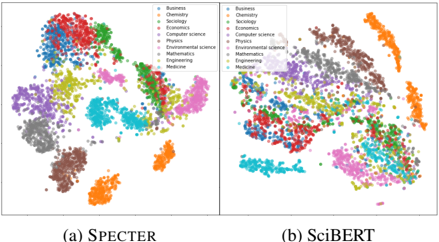
- t-SNE clustering quality for SPECTER is homogeneity 0.41 and completeness 0.72, compared with SciBERT’s 0.19 and 0.63.
Methods
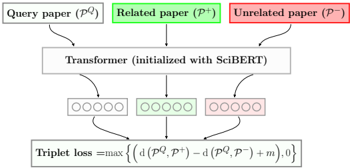
- SPECTER initializes from SciBERT, encodes the concatenated title and abstract, and uses the final [CLS] pooled output as the paper vector. It pretrains with a triplet margin loss on the citation graph: query paper, positive cited paper, and negative uncited paper, using L2 distance and margin m=1. Hard negatives are citations of citations; training uses 2 hard negatives and 3 easy negatives per query.
- Training data: a Semantic Scholar subset of about 146K query papers (~26.7M tokens) and 32K validation papers, yielding about 684K training triples and 145K validation triples. Training uses Adam with LR 2e-5, slanted triangular LR, 2 epochs, batch size 4 with gradient accumulation for effective batch size 32, on a single Titan V GPU.
- Evaluation: SCIDOCS covers seven tasks—MeSH classification (23K papers, 11 disease classes), MAG topic classification (25K papers, 19 level-1 classes), direct citation prediction (~30K total papers; 1K queries, up to 5 cited and 25 uncited candidates), co-citation (30K), co-views (~30K), co-reads (~30K), and recommendation (22K clickthrough events; 20K/1K/1K split; propensity-adjusted P@1 and nDCG). Baselines include SIF, SciBERT, Sent-BERT, Citeomatic, and SGC; classification uses a linear SVM, and recommendation uses a feedforward ranking network with ten features including cosine embedding distance.
Limitations
- Stated: SPECTER uses only title and abstract; adding full text could improve accuracy, but full text is often not freely available and Transformer memory limits would require new techniques. Venue metadata was not normalized, and author names were sparse/out-of-vocabulary; adding authors or venues did not help and authors hurt performance.
- Stated: On the recommendation task, differences between embedding methods are generally smaller because embeddings are used alongside several other informative features, limiting their impact on overall performance.
- Evident from the text: evaluation is limited to scientific documents and the released SCIDOCS tasks, with no evidence for other domains or languages; the online A/B test covers one production recommender and 4,113 clicks, so broader deployment evidence is not provided.
Model-written summary. Check it against the paper before relying on it.
Integrity signals
Registry
Cites
Statistics
Figures
Verification
Claims the paper makes
1 Valid · 2 Not valid · 17 Not checked · 56 Own results and interpretations
Every source the paper cites for this claim was checked and supports it.
In the paper
“This is because SciBERT, like other pretrained language models, is trained via language modeling objectives, which only predict words or sentences given their in-document, nearby textual context.”
§ SPECTER: Document-level Representation Learning using Citation-informed Transformers > Document Representation
What the sources say
- Supportedcites Beltagy et al., 2019 matched to “SciBERT: A Pretrained Language Model for Scientific Text” (2019) source
The Methods (Sec. 2, Background) states that SciBERT follows BERT's architecture and pretraining tasks — 'predicting randomly masked tokens and predicting whether two sentences follow each other' — i.e. word-level and sentence-level objectives. The Corpus paragraph of Sec. 2 and Sec. 3.3 show these instances are built from the full text of papers with sentences split and packed up to 128/512 tokens, so the context the objectives use is nearby, in-document text. The Introduction likewise groups SciBERT with ELMo, GPT and BERT as unsupervised pretrained language models, covering the 'like other pretrained language models' clause. (LLM, conf=0.85)
plainstates a cause- Asserted: passes — The authors put it forward as true.
- Checkable: passes — It can be checked against evidence.
- Load-bearing: passes — The paper’s conclusions depend on it.
- Based: passes — The paper gives a reason why it holds.
- Supported
A result the paper states — it cites no source for it, so there is none to check. The quote shows it is in the paper.
In the paper
“On the recommendations task, as opposed to previous experiments, the differences in method scores are generally smaller.”
§ SPECTER: Document-level Representation Learning using Citation-informed Transformers > 5 Results
plain- Asserted: passes — The authors put it forward as true.
- Checkable: passes — It can be checked against evidence.
- Load-bearing: unclear — It is unclear whether the paper’s conclusions depend on it.
- Based: passes — The paper gives a reason why it holds.
A result the paper reports from its own data — it cites no other source for it, so there is none to check. The quote shows it is in the paper.
In the paper
“We found that these pretrained embeddings substantially outperform alternative off-theshelf embeddings.”
§ SPECTER: Document-level Representation Learning using Citation-informed Transformers > 3. Fasttext-Sum
plainstates a cause- Asserted: passes — The authors put it forward as true.
- Checkable: passes — It can be checked against evidence.
- Load-bearing: unclear — It is unclear whether the paper’s conclusions depend on it.
- Based: passes — The paper gives a reason why it holds.
A result the paper reports from its own data — it cites no other source for it, so there is none to check. The quote shows it is in the paper.
In the paper
“As we show in our experiments ( §6), including hard negatives results in more accurate embeddings compared to using random negatives alone.”
§ SPECTER: Document-level Representation Learning using Citation-informed Transformers > 2.4 Selecting Negative Distractors
plainstates a cause- Asserted: passes — The authors put it forward as true.
- Checkable: passes — It can be checked against evidence.
- Load-bearing: passes — The paper’s conclusions depend on it.
- Based: passes — The paper gives a reason why it holds.
- Rests on an assumption not shown here.
A result the paper states — it cites no source for it, so there is none to check. The quote shows it is in the paper.
In the paper
“We achieve substantial improvements over the strongest of a wide variety of baselines, demonstrating the effectiveness of our model.”
§ SPECTER: Document-level Representation Learning using Citation-informed Transformers > 8 Conclusions and Future Work
boostedstates a cause- Asserted: passes — The authors put it forward as true.
- Checkable: passes — It can be checked against evidence.
- Load-bearing: passes — The paper’s conclusions depend on it.
- Based: passes — The paper gives a reason why it holds.
25 more claims
Create a free account to see all 76 claims and to verify the 18 references still open.
- It may state two separate claims as one. 22
- Probably not a substantial claim. 29
- The quote only partly states this claim. 1
Claims other papers make about this one
Each is checked against this paper’s own text: does it say what the citing paper says it does?
In the citing paper
“Covered model families span content-and embedding-based methods (e.g.,TF-IDF [63], BM25 [59] , SPECTER/SciBERT [17] ), graph-and HIN/GNN-based methods (GraphSAGE, Graph Attention Networks (GATs), meta-path reasoning), and hybrid/LLM pipelines (prompting, re-ranking, RAG).”
From A Critical Review on Citation Recommendation Systems Through a Graph-Centric Approach (2026) · cites this paper as [17]
Citations
Cites
Vaswani, A., Shazeer, N., Parmar, N., Uszkoreit, J., Jones, L., Gomez, A. N., Kaiser, L., & Polosukhin, I. (2017) · arXiv · doi:10.48550/arxiv.1706.03762 · Cited by 120,404
Adam: A Method for Stochastic Optimization
Kingma, D. P., & Ba, J. (2014) · arXiv · doi:10.48550/arxiv.1412.6980 · Cited by 98,946
BERT: Pre-training of Deep Bidirectional Transformers for Language Understanding
Devlin, J., Chang, M.-W., Lee, K., & Toutanova, K. (2018) · arXiv · doi:10.48550/arxiv.1810.04805 · Cited by 73,173
Scikit-learn: Machine Learning in Python
Pedregosa, F., Varoquaux, G., Gramfort, A., Michel, V., Thirion, B., Grisel, O., Blondel, M., Müller, A., Nothman, J., Louppe, G., et al. (2012) · arXiv · doi:10.48550/arxiv.1201.0490 · Cited by 71,016
BERT: Pre-training of Deep Bidirectional Transformers for Language Understanding
Devlin, J., Chang, M.-W., Lee, K., & Toutanova, K. (2019) · Proceedings of the 2019 Conference of the North American Chapter of the Association for Computational Linguistics: Human Language Technologies, Volume 1 (Long and Short Papers) · doi:10.18653/v1/n19-1423 · Cited by 54,325
Semi-supervised classification with graph convolutional networks
Kipf, T. N., & Welling, M. (2016) · arXiv · doi:10.48550/arxiv.1609.02907 · Cited by 24,853
(1996) · Cited by 20,179
RoBERTa: A Robustly Optimized BERT Pretraining Approach
Liu, Y., Ott, M., Goyal, N., Du, J., Joshi, M., Chen, D., Levy, O., Lewis, M., Zettlemoyer, L., & Stoyanov, V. (2019) · arXiv · doi:10.48550/arxiv.1907.11692 · Cited by 16,515
Sentence-BERT: Sentence Embeddings using Siamese BERT-Networks
Reimers, N., & Gurevych, I. (2019) · Proceedings of the 2019 Conference on Empirical Methods in Natural Language Processing and the 9th International Joint Conference on Natural Language Processing (EMNLP-IJCNLP) · doi:10.18653/v1/d19-1410 · Cited by 12,778
Deep Contextualized Word Representations
Peters, M., Neumann, M., Iyyer, M., Gardner, M., Clark, C., Lee, K., & Zettlemoyer, L. (2018) · Proceedings of the 2018 Conference of the North American Chapter of the Association for Computational Linguistics: Human Language Technologies, Volume 1 (Long Papers) · doi:10.18653/v1/n18-1202 · Cited by 11,983
Research works printed but not linked: 2
- William L. Hamilton, Zhitao Ying, and Jure Leskovec. 2017b. Inductive representation learning on large graphs. In NIPS.
- Alec Radford, Karthik Narasimhan, Tim Salimans, and Ilya Sutskever. 2018. Improving language under- standing by generative pre-training. arXiv.
Cited by
Items 801–900 of 1,111
Visualization of the Semantic Knowledge Landscape of Editing and Publishing Domain in China
Zhang, S., Liu, F., Li, W., & Xia, H. (2024) · Advances in economics, business and management research/Advances in Economics, Business and Management Research · doi:10.2991/978-94-6463-498-3_7
Beyond Retrieval: Topic-based Alignment of Scientific Papers to Research Proposal
Palit, R., Patwardhan, M. S., Vig, L., & Shroff, G. M. (2024) · Workshop on Scholarly Document Processing (SDP) · doi:10.18653/v1/2024.sdp-1.7
Bringing Artificial Intelligence to Research Analytics: Research Highlighter-MatchMaker
Huang, T., & Li, Y. (2024) · Journal of Knowledge Management and Practice · doi:10.62477/jkmp.v24i3.445
PseudoSeer: a Search Engine for Pseudocode
Toksoz, L., Srinath, M., Tan, G. P., & Giles, C. L. (2026) · Findings of the Association for Computational Linguistics: ACL (Findings of ACL) · doi:10.18653/v1/2026.findings-acl.1978
Alonso, O., & Baeza-Yates, R. (2024) · ACM eBooks · doi:10.1145/3674127.3674128
Searching Personal Collections
Bendersky, M., Metzler, D., Najork, M., & Wang, X. (2024) · ACM eBooks · doi:10.1145/3674127.3674142
Query-driven Search Functionality
Li, L. (2024) · ACM eBooks · doi:10.1145/3674127.3674133
Alonso, O., & Baeza-Yates, R. (2024) · ACM eBooks · doi:10.1145/3674127.3702962
Alonso, O., & Baeza-Yates, R. (2024) · ACM eBooks · doi:10.1145/3674127.3674129
Alonso, O., & Baeza-Yates, R. (2024) · ACM eBooks · doi:10.1145/3674127.3702961
Hersh, W., & Roberts, K. E. (2024) · ACM eBooks · doi:10.1145/3674127.3702960
Ruosch, F., Vasu, R., Wang, R., Rossetto, L., & Bernstein, A. (2025) · Lecture notes in computer science · doi:10.1007/978-3-031-78955-7_16
Davidov, E., Malgina, S., Farkhadov, M., & Blinova, O. (2024) · International Conference on Information, Control, and Communication Technologies (ICCT) · doi:10.1109/icct62929.2024.10874995
Optimizing SME Performance through ICT Diversification and Competence Development Strategies
Purnama, C., Fatmah, D., Rahmah, M., Hasani, S., Rahmah, Y., & Rahmah, Z. Z. (2024) · Journal of Management and Entrepreneurship Research · doi:10.34001/jmer.2024.12.05.2-50 · Cited by 1
Natural Language Processing in Environmental Health Research
Tiahi, M., Kumar, M., Feric, Z., & Kaeli, D. R. (2024) · IEEE MIT Undergraduate Research Technology Conference (URTC) · doi:10.1109/urtc65039.2024.10937629
A paper recommendation method based on SPECTER and graph convolutional networks
Guo, P., Zhou, G., Lu, J., Li, Z., & Zhu, T. (2025) · Advances in Engineering Innovation · doi:10.54254/2977-3903/2025.22028
Ochi, M., Shiro, M., Mori, J., & Sakata, I. (2025) · Communications in computer and information science · doi:10.1007/978-981-96-4613-5_9
Exploring similarity patterns in a large scientific corpus
Witschard, D., Jusufi, I., Kucher, K., & Kerren, A. (2025) · PLoS ONE · doi:10.1371/journal.pone.0321114
VICTORIOUS: A Visual Analytics System for Scoping Review of Document Sets
Haghighati, A., Haghverdi, A. R., & Sedig, K. (2025) · Multimodal Technologies and Interaction · doi:10.3390/mti9050037
Embedding-Based Retrieval Approaches for Automated Citation Prediction
Le, D., & Nguyen, S. (2025) · Lecture notes in computer science · doi:10.1007/978-981-96-7071-0_15
Improve Patent Representation through Citation-based Contrastive LearningPreprint
Liu, S. (2025) · SSRN Electronic Journal · doi:10.2139/ssrn.5268892
Karakuzu, A., Boudreau, M., & Stikov, N. (2025) · doi:10.55458/neurolibre.00021
Measuring research interest similarity with transition probabilities
Varga, A., Kojaku, S., & Silva, F. N. (2025) · Quantitative Science Studies · doi:10.1162/qss.a.13
Revisiting the Field Normalization Approaches/Practices
Lu, X., Li, L., & Shen, Z. (2025) · International Conference on Scientometrics and Informetrics (ISSI) · doi:10.51408/issi2025_065
“On-the-fly” citation recommendation based on content-dependent embeddings
Zhang, Y., & Ma, Q. (2026) · Knowledge-Based Systems · doi:10.1016/j.knosys.2026.116052
ERU-KG: Efficient Reference-aligned Unsupervised Keyphrase Generation
Thanh, L., Bodke, A., Akash, P. S., & Chang, K. C. (2025) · Proceedings of the conference - Association for Computational Linguistics. Meeting · doi:10.18653/v1/2025.acl-long.1398
Chakkaravarthy, A. P., & Jaganathan, D. (2025) · Advances in computational intelligence and robotics book series · doi:10.4018/979-8-3373-1414-3.ch001
Nurjahan, V. A., & Jancy, S. (2025) · Concurrency and Computation Practice and Experience · doi:10.1002/cpe.70224
Heo, S., Choi, W., & Lee, S. (2025) · Journal of the Computational Structural Engineering Institute of Korea · doi:10.7734/coseik.2025.38.4.257
HST-Rep: Hierarchical Semantic Representation Learning for Scientific Papers
Liao, J., Du, Z., & Liu, X. (2025) · Data Intelligence · doi:10.3724/2096-7004.di.2025.0123
A LEXICAL SIMPLIFICATION APPLICATION AND EFFECT IN INFORMATION RETRIEVAL
Göksel, G. (2025) · Eskişehir Technical University Journal of Science and Technology A - Applied Sciences and Engineering · doi:10.18038/estubtda.1716842
Comprehensive Manuscript Assessment with Text Summarization Using 69707 articlesPreprint
Sun, Q., Lu, Y., Xia, K., Chen, L., Sun, H., & Wang, J. (2025) · arXiv (Cornell University) · doi:10.48550/arxiv.2503.20835
Tran, Q.-K., & Pham, N.-K. (2025) · SN Computer Science · doi:10.1007/s42979-025-04411-5
Preprint Archives as Active Scholarly Communities: An Augmentation FrameworkPreprint
Lissack, M. R. (2025) · SSRN Electronic Journal · doi:10.2139/ssrn.5626649
Four Shades of Life Sciences: A Dataset for Disinformation Detection in the Life SciencesPreprint
Seidlmayer, E., Galke, L. P. A., & Förstner, K. U. (2025) · arXiv (Cornell University)
AI-Based Medical Imaging of COVID-19: A Visual and Textual Analysis of Scientific Literature
Zurlo, G., & Ronchieri, E. (2025) · EAI/Springer Innovations in Communication and Computing · doi:10.1007/978-3-031-96518-0_21
Semantic Embeddings for Literature Discovery: An AI Based Alternative to Keyword-Based SearchPreprint
Saknini, M., Hees, J., Jovanović, M., & Baaden, P. (2025) · SSRN Electronic Journal · doi:10.2139/ssrn.5716887
Novelty and Impact of Economics PapersPreprint
Wu, C. (2025) · arXiv (Cornell University) · doi:10.48550/arxiv.2511.01211
Gopalakrishnan, S., & Patra, S. (2025) · arXiv (Cornell University) · doi:10.48550/arxiv.2505.04732
A hidden network of gene relationships unifies behavioral and molecular researchPreprint
Connell, D. R., Gaiteri, C., & Tasaki, S. (2025) · bioRxiv (Cold Spring Harbor Laboratory) · doi:10.1101/2025.11.14.688547
Shi, Y., Gong, Y., Su, Y., Xiong, S., Han, J., & Miao, R. (2025) · arXiv (Cornell University) · doi:10.48550/arxiv.2506.16609
Odin: Oriented dual-module integration for text-rich network representation learning
Hong, K., Zhang, Y., Hong, X., Xia, X., & Xu, X. (2026) · Neurocomputing · doi:10.1016/j.neucom.2026.133018
Learned-Rule-Augmented Large Language Model EvaluatorsPreprint
Meng, J., & Jin, M. (2025) · arXiv (Cornell University) · doi:10.48550/arxiv.2512.01958
Mirror, Mirror on the Wall -- Which is the Best Model of Them All?Preprint
Sayed, D., & Schuldt, H. (2025) · arXiv (Cornell University) · doi:10.48550/arxiv.2512.02043
Extracting Information About Publication Venues Using Citation-Informed TransformersPreprint
Zimmerman, B. D., Folkins, J., & Vechtomova, O. (2025) · arXiv (Cornell University) · doi:10.48550/arxiv.2506.08199
AI-Orchestrated Active Learning for Insulin Delivery Material DiscoveryPreprint
Otun, M. (2025) · Research Square · doi:10.21203/rs.3.rs-8353835/v1
Intelligent Scientific Literature Explorer using Machine Learning (ISLE)Preprint
Jani, S., Heidari, A., Anvari, A., & Rahimi, Z. (2025) · arXiv (Cornell University) · doi:10.48550/arxiv.2512.12760
Text Tree Edit Distance: A Language Model-Based Metric for Text Hierarchies
Sobolevsky, F., & Vorontsov, K. V. (2025) · International Scientific-Technical Conference on Actual Problems of Electronic Instrument Engineering (APEIE) · doi:10.1109/apeie66761.2025.11289395
Addressing Data Availability and Document-to-Document Retrieval for Domain-specific Neural Rankers
Althammer, S. (2024) · reposiTUm (TU Wien) · doi:10.34726/hss.2024.123265
Argument Retrieval for Controversial Questions
Moreira, B. C. (2022) · Portuguese National Funding Agency for Science, Research and Technology (RCAAP Project by FCT) · doi:10.34626/hrd3-pq34
NeuroLit Navigator: A Neurosymbolic Approach to Scholarly Article Searches for Systematic Reviews
Khandelwal, V., Roy, K., Lookingbill, V., Garimella, R., Surana, H., Heckman, H., & Sheth, A. (2025) · arXiv (Cornell University) · doi:10.48550/arxiv.2503.00278
Saier, T. (2024) · Repository KITopen (Karlsruhe Institute of Technology) · doi:10.5445/ir/1000170262
A Dynamical Cartography of the Epistemic Diffusion of Artificial Intelligence in NeurosciencePreprint
Fontaine, S. (2025) · arXiv (Cornell University) · doi:10.48550/arxiv.2507.01651
Learning Label Relationships Using Deep Neural Networks for Hierarchical Text Classification
방진현 (2023) · Seoul National University Open Repository (Seoul National University)
Vickers, P. G. J. (2024) · White Rose eTheses Online (University of Leeds, The University of Sheffield, University of York)
Transformer-Based Multi-scale Technical Reports Analyser for Science Projects Cost Prediction
Bouquet, T. (2023) · KTH Publication Database DiVA (KTH Royal Institute of Technology)
Systematisch bio-geïnspireerd ontwerpen: van concept tot gevalideerde functionaliteit
Willocx, M. (2024) · Lirias
Análisis sintáctico totalmente incremental basado en redes neuronales
Pereira Ezquerro, A. X. (2023) · RUC (Universidade Da Coruña)
Song, H., & Song, H. (2024) · UA Campus Repository (The University of Arizona)
Rapid prototyping of a support system for patient selection in clinical trials
Naranjo González, R. (2024) · RUC (Universidade Da Coruña)
TrialMatch: A Transformer Architecture to Match Patients to Clinical Trials
Cardoso, B. D. (2022) · Portuguese National Funding Agency for Science, Research and Technology (RCAAP Project by FCT)
Förbättring av Informationssökning- A kvantitativ studie av förbättringsimplementationer
Walles Granberg, H., & Båvegård, A. (2024) · KTH Publication Database DiVA (KTH Royal Institute of Technology)
Trainable-parameter-free structural-diversity message passing for graph neural networks
Kong, M., Zhang, Y., Xu, C., Xia, X., & Xu, X. (2026) · Neural Networks · doi:10.1016/j.neunet.2026.108711
Analyzing and Predicting Cooperation Behavior in Bibliometric Data
Koopmann, T. (2025) · Online Publication Service of Würzburg University (Würzburg University) · doi:10.25972/opus-42514
Logic Mill - A Knowledge Navigation SystemPreprint
Erhardt, S., Ghosh, M., Buunk, E., Rose, M. E., & Harhoff, D. (2023) · RePEc: Research Papers in Economics
UC-FIRe: Approche efficace pour la recherche d'informations non supervisée
Hanus, M., Guignard, Q., & Rodrigues, C. (2025) · HAL
Talk2Ref: A Dataset for Reference Prediction from Scientific TalksPreprint
Broy, F. Y., Züfle, M., & Niehues, J. (2025) · arXiv (Cornell University) · doi:10.48550/arxiv.2510.24478
Tracking Citation Practices Across Disciplines: A SourceMapper Analysis of MICUSP
Kane, M. (2025) · The Journal of Writing Analytics · doi:10.37514/jwa-j.2025.8.1.01
Text Mining Approaches for Protein Function Annotation: Challenges and Opportunities
Hong, W., & Zhang, C. (2025) · Synthetic biology and engineering · doi:10.70322/sbe.2025.10022
The Knowledge Cosmos: An Immersive Platform for Interdisciplinary Research Discovery
McGail, A., Tajani, R., Sridhar, N., & Li, J. (2025) · IEEE VIS Arts Program (VISAP) · doi:10.1109/visap.2025.00007
Ekvall, M., Bergenstråhle, L., Truong, P., Murrell, B., & Lundeberg, J. (2025) · arXiv (Cornell University) · doi:10.48550/arxiv.2512.19360
Adaptive LLM Routing for Scientific Workflows: Predicting Query Complexity to Optimize Cost
Thierfeldt, J., Scheinert, D., Wittkopp, T., & Kao, O. (2025) · IEEE International Performance, Computing, and Communications Conference · doi:10.1109/ipccc66453.2025.11304643
RAGforCDPR: A RAG Framework for Cross-Domain Paper Recommendations
Yadav, N., & Gopinathan, D. (2025) · International Conference on Contemporary Computing · doi:10.1109/ic366947.2025.11290401
Mahalpure, A., Joshi, A., Marwade, A., & Kale, P. S. (2025) · INTERNATIONAL JOURNAL OF RESEARCH AND ANALYTICAL REVIEWS · doi:10.56975/ijrar.v12i4.323079
Kumar, S., Arora, H., Ghosal, T., & Ekbal, A. (2026) · Scientometrics · doi:10.1007/s11192-025-05529-2 · Cited by 1
Can we Predict Innovation? Narrow Experts Versus Competent Generalists
Hazem, A., & Motohashi, K. (2025) · International conference Recent advances in natural language processing · doi:10.26615/978-954-452-098-4-050
Attend to what I say: Highlighting relevant content on slidesPreprint
M, M. M. K., & Jawahar, C. V. (2026) · arXiv (Cornell University) · doi:10.48550/arxiv.2601.10244
QueRA: Query Synthesis and Resource Access Modelling in RAG
Kadkade, V., Mishra, M., Nambiar, M. K., & Singhal, R. (2025) · International Conference on AI-ML Systems (AIMLSystems) · doi:10.1109/aimlsystems67835.2025.11330990
The evolution of SSRI research: trajectories of knowledge domains across four decades
Westphal, L., Gräf, D. D., & Hallgreen, C. E. (2026) · BMC Psychiatry · doi:10.1186/s12888-026-07867-8
Computational Analysis for Philosophical Education: A Case Study in AI Ethics
Cline, A., Ball, B., Freeborn, D., Helliwell, A. C., & Loi-Heng, K. (2025) · Edukacja Filozoficzna · doi:10.14394/edufil.2025.0003
Scholar API: Search and Recommendations for Academic Search
Church, K., & Alonso, O. (2026) · ACM International Conference on Web Search and Data Mining (WSDM) · doi:10.1145/3773966.3779405
THE IMPACT OF AI TOOLS ON BOOSTING THE RESEARCHER’S ACADEMIC CULTURE: THEORETICAL APPROACH
Shevchenko, O., Sluchaina, L., Kapustina, O. A., & Aleksandrova, N. (2026) · Наука і техніка сьогодні · doi:10.52058/2786-6025-2026-1(55)-873-893
Causal Retrieval via Semantic Regularization
Shin, H., Choi, Y., & Hwang, W. (2026) · IEEE Access · doi:10.1109/access.2026.3668097
Contrastive Sentence Representation Learning: Retrieval, Reasoning and Perception
XIAO, C. (2026) · Durham e-Theses (Durham University)
THE IMPACT OF AI TOOLS ON BOOSTING THE RESEARCHER’S ACADEMIC CULTURE: THEORETICAL APPROACH
Shevchenko, O., Sluchaina, L., Kapustina, O. A., & Aleksandrova, N. (2026) · Суспільство та національні інтереси. · doi:10.52058/3041-1572-2026-2(22)-74-94
Roth, J. (2025) · Tampere University Institutional Repository (Tampere University)
Yee, B., Wang, L., & Kommini, K. (2026) · arXiv (Cornell University) · doi:10.48550/arxiv.2602.23665
Coric, R., Oloyede, E. F., & Cuayáhuitl, H. (2026) · Machine Learning and Knowledge Extraction · doi:10.3390/make8030064
Fang, X., Lee, K., & Li, Y. (2025) · IEEE International Conference on Big Data (BigData) · doi:10.1109/bigdata66926.2025.11401710
Fang, Q., Li, Y., Wu, J., Long, Y., Hu, J., & Qian, S. (2026) · Knowledge-Based Systems · doi:10.1016/j.knosys.2026.115711
SuSEF: Summarized Section Embedding with Fusion for Scientific Paper Recommendation
Westmoreland, J., & Liang, H. (2025) · International Conference on Robotics, Automation and Artificial Intelligence (RAAI) · doi:10.1109/raai67517.2025.11423046
Tobaly, L., & Zalevsky, Z. (2026) · IEEE Access · doi:10.1109/access.2026.3674233
Kiet, H. T., Minh, D. S. D., Nguyen, T. C., Quy, N. L. P., Hoa, P. P., Duong, N. D. H., Dien, D., & Long, N. H. B. (2025) · Workshop on Information Extraction from Scientific Publications (WIESP) · doi:10.18653/v1/2025.wasp-main.16
Rajit, D., McDonald, S. J., Mousa, A., Tay, C. T., Du, L., Teede, H. J., & Enticott, J. (2026) · Journal of Clinical Epidemiology · doi:10.1016/j.jclinepi.2026.112228
A SciBERT-Bipartite Graph Hybrid Model for Scientific Paper Recommendation
Smail, B., & Aliane, H. (2026) · INTERNATIONAL JOURNAL OF NEXT-GENERATION COMPUTING · doi:10.47164/ijngc.v16i3.1979
Xi, Y., Pi, O., Zhang, M., Xiong, R., Lane, J., & Shah, N. B. (2026) · Proceedings of the AAAI Conference on Artificial Intelligence · doi:10.1609/aaai.v40i47.41449
Afifi, B., Abu-Elkheir, M., & Abdennadher, S. (2026) · Procedia Computer Science · doi:10.1016/j.procs.2026.01.036
Tracing the Flow of Knowledge From Science to Technology Using Deep LearningPreprint
Rose, M. E., Ghosh, M., Erhardt, S., Li, C. K., Buunk, E., & Harhoff, D. (2025) · arXiv (Cornell University) · doi:10.48550/arxiv.2512.24259
Uncertainty quantification in data-centric machine learning
Rodemann, J. M. (2026) · Electronic Theses of LMU Munich (Ludwig-Maximilians-Universität München) · doi:10.5282/edoc.36738
事前学習済み言語モデルを用いた検索モデルに対する教師なしドメイン適応
飯田, 大., & Iida, H. (2024) · Institutional Repositories DataBase (IRDB)
Metadata
- Authors
- Cohan, A., Feldman, S., Beltagy, I., Downey, D., & Weld, D.
- Affiliations
- Allen Institute for Artificial Intelligence (US)
- University of Washington (US)
- Venue
- Proceedings of the 58th Annual Meeting of the Association for Computational Linguistics
- Published
- 2020
- Pages
- 2270-2282
- ISSN
- 0736-587X (ISSN-L)
- OpenAlex
- W3016913119
- Cited by
- 1,108
- References
- 62
- Citations by year
- 2026: 364 · 2025: 244 · 2024: 178 · 2023: 157 · 2022: 113 · 2021: 44 · 2020: 8
- FWCI
- 21.99
- Type
- conference paper
- Language
- en
- Open access
- hybrid
- doi.org
- Licence
- cc-by
- Locations
- Proceedings of the conference - Association for Computational Linguistics. Meeting (publishedVersion, cc-by)
- arXiv (Cornell University) (submittedVersion, cc-by)
- arXiv (Cornell University) (submittedVersion)
- arXiv (Cornell University) (cc-by)
- Zenodo (CERN European Organization for Nuclear Research) (cc-by)
- Funders
- National Science Foundation (1936940)
- University of Washington
- Office of Naval Research (N00014- 18-1-2193)
- Topics
- Physical Sciences › Computer Science › Artificial Intelligence › Topic Modeling
- Physical Sciences › Computer Science › Computer Vision and Pattern Recognition › Multimodal Machine Learning Applications
- Physical Sciences › Computer Science › Information Systems › Recommender Systems and Techniques
- Keywords
- citation networks, citation prediction, scientific documents, transformer language models, pre-training, document classification, recommendations
About these checks
Registry, retraction, Cites and statistics results are computed, not judged, with one exception: a printed reference that no index lists is read once by a model before it counts as a citation error. Claims are extracted by a model and kept only when their quote appears verbatim in the text; each cited source is then checked, with a model’s help, for whether it says what the claim relies on. Those verdicts can be wrong — read the claim’s quote and the cited source before relying on one.
A language model drew the claims from the paper on 2026-11-18, under version 3 of the claim definition (model deepseek-v4.1-flash, prompt extract-v3).
A second model labelled each claim on 2026-11-18 (model jev-1.13-20260917, definition revision gold-guideline-v0.2).
Cited sources are checked with a language model’s help (qwen3.8-omni-flash).
Statistics and arithmetic are recomputed, not judged.
Confidence bands are shown only for fields calibrated on our annotated test set. None is calibrated yet, so no band is shown.
What counts as a claim ›How we measure confidence ›How we check this ›
Are you an author, or do you see a problem with this page? Request a review
Data sources
Bibliographic data: Semantic Scholar, OpenAlex, Crossref.
Contains information from the Semantic Scholar Academic Graph Datasets, made available under the ODC Attribution License (ODC-BY 1.0).
Semantic Scholar’s data is described in: Kinney, R., et al. (2023). The Semantic Scholar Open Data Platform. arXiv:2301.10140.
