

SPECTER: Document-level Representation Learning using Citation-informed Transformers
Open accessThe DOI matches its Crossref record; 62 of the 62 references it cites were found in a registry or an index; 1 of the 26 sources its claims cite were checked for support.
Abstract
Representation learning is a critical ingredient for natural language processing systems.Recent Transformer language models like BERT learn powerful textual representations, but these models are targeted towards token-and sentence-level training objectives and do not leverage information on inter-document relatedness, which limits their document-level representation power.For applications on scientific documents, such as classification and recommendation, the embeddings power strong performance on end tasks.We propose SPECTER, a new method to generate document-level embedding of scientific documents based on pretraining a Transformer language model on a powerful signal of document-level relatedness: the citation graph.Unlike existing pretrained language models, SPECTER can be easily applied to downstream applications without task-specific fine-tuning.Additionally, to encourage further research on document-level models, we introduce SCIDOCS, a new evaluation benchmark consisting of seven document-level tasks ranging from citation prediction, to document classification and recommendation.We show that SPECTER outperforms a variety of competitive baselines on the benchmark.1
Overview
CoChat Summary
TL;DR
SPECTER learns document-level embeddings of scientific papers by pretraining a SciBERT Transformer on citation-informed triplets, using only title and abstract at inference. It introduces the SCIDOCS seven-task benchmark and reports an average score of 80.0 across tasks/metrics, a 3.1-point absolute improvement over the next-best baseline.
Key findings
- SPECTER achieves an average of 80.0 across all SCIDOCS tasks/metrics, 3.1 points absolute over the next-best baseline. On MeSH classification it reaches F1 86.4 (+2.3 over best baseline) and on MAG F1 82.0 (+1.5); on co-view MAP 83.8 and co-read MAP 84.5, improving over Citeomatic by 2.7 and 4.0 points; on co-citation nDCG 94.8, +2.3 over SGC; on recommendation nDCG 53.9.
- In an online A/B test with 4,113 clicks, the SPECTER-based ranker improved clickthrough rate over the baseline by 46.5%.
- Ablations show removing the abstract drops average performance to 68.1, adding authors drops it to 67.3, using no hard negatives drops it to 78.4, and initializing from BERT-Large instead of SciBERT drops it to 77.5. Fixed SPECTER embeddings also outperform SciBERT fine-tuned on task-specific signals (SPECTER average 80.0 vs. multitask fine-tuning 78.0).
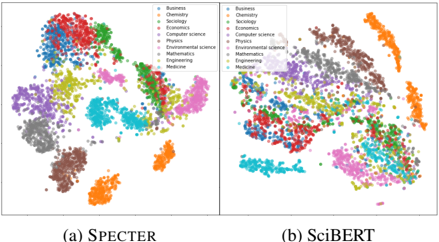
- t-SNE clustering quality for SPECTER is homogeneity 0.41 and completeness 0.72, compared with SciBERT’s 0.19 and 0.63.
Methods
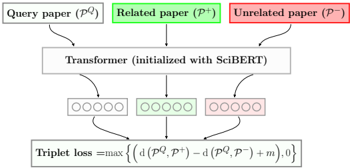
- SPECTER initializes from SciBERT, encodes the concatenated title and abstract, and uses the final [CLS] pooled output as the paper vector. It pretrains with a triplet margin loss on the citation graph: query paper, positive cited paper, and negative uncited paper, using L2 distance and margin m=1. Hard negatives are citations of citations; training uses 2 hard negatives and 3 easy negatives per query.
- Training data: a Semantic Scholar subset of about 146K query papers (~26.7M tokens) and 32K validation papers, yielding about 684K training triples and 145K validation triples. Training uses Adam with LR 2e-5, slanted triangular LR, 2 epochs, batch size 4 with gradient accumulation for effective batch size 32, on a single Titan V GPU.
- Evaluation: SCIDOCS covers seven tasks—MeSH classification (23K papers, 11 disease classes), MAG topic classification (25K papers, 19 level-1 classes), direct citation prediction (~30K total papers; 1K queries, up to 5 cited and 25 uncited candidates), co-citation (30K), co-views (~30K), co-reads (~30K), and recommendation (22K clickthrough events; 20K/1K/1K split; propensity-adjusted P@1 and nDCG). Baselines include SIF, SciBERT, Sent-BERT, Citeomatic, and SGC; classification uses a linear SVM, and recommendation uses a feedforward ranking network with ten features including cosine embedding distance.
Limitations
- Stated: SPECTER uses only title and abstract; adding full text could improve accuracy, but full text is often not freely available and Transformer memory limits would require new techniques. Venue metadata was not normalized, and author names were sparse/out-of-vocabulary; adding authors or venues did not help and authors hurt performance.
- Stated: On the recommendation task, differences between embedding methods are generally smaller because embeddings are used alongside several other informative features, limiting their impact on overall performance.
- Evident from the text: evaluation is limited to scientific documents and the released SCIDOCS tasks, with no evidence for other domains or languages; the online A/B test covers one production recommender and 4,113 clicks, so broader deployment evidence is not provided.
Model-written summary. Check it against the paper before relying on it.
Integrity signals
Registry
Cites
Statistics
Figures
Verification
Claims the paper makes
1 Valid · 2 Not valid · 17 Not checked · 56 Own results and interpretations
Every source the paper cites for this claim was checked and supports it.
In the paper
“This is because SciBERT, like other pretrained language models, is trained via language modeling objectives, which only predict words or sentences given their in-document, nearby textual context.”
§ SPECTER: Document-level Representation Learning using Citation-informed Transformers > Document Representation
What the sources say
- Supportedcites Beltagy et al., 2019 matched to “SciBERT: A Pretrained Language Model for Scientific Text” (2019) source
The Methods (Sec. 2, Background) states that SciBERT follows BERT's architecture and pretraining tasks — 'predicting randomly masked tokens and predicting whether two sentences follow each other' — i.e. word-level and sentence-level objectives. The Corpus paragraph of Sec. 2 and Sec. 3.3 show these instances are built from the full text of papers with sentences split and packed up to 128/512 tokens, so the context the objectives use is nearby, in-document text. The Introduction likewise groups SciBERT with ELMo, GPT and BERT as unsupervised pretrained language models, covering the 'like other pretrained language models' clause. (LLM, conf=0.85)
plainstates a cause- Asserted: passes — The authors put it forward as true.
- Checkable: passes — It can be checked against evidence.
- Load-bearing: passes — The paper’s conclusions depend on it.
- Based: passes — The paper gives a reason why it holds.
- Supported
A result the paper states — it cites no source for it, so there is none to check. The quote shows it is in the paper.
In the paper
“On the recommendations task, as opposed to previous experiments, the differences in method scores are generally smaller.”
§ SPECTER: Document-level Representation Learning using Citation-informed Transformers > 5 Results
plain- Asserted: passes — The authors put it forward as true.
- Checkable: passes — It can be checked against evidence.
- Load-bearing: unclear — It is unclear whether the paper’s conclusions depend on it.
- Based: passes — The paper gives a reason why it holds.
A result the paper reports from its own data — it cites no other source for it, so there is none to check. The quote shows it is in the paper.
In the paper
“We found that these pretrained embeddings substantially outperform alternative off-theshelf embeddings.”
§ SPECTER: Document-level Representation Learning using Citation-informed Transformers > 3. Fasttext-Sum
plainstates a cause- Asserted: passes — The authors put it forward as true.
- Checkable: passes — It can be checked against evidence.
- Load-bearing: unclear — It is unclear whether the paper’s conclusions depend on it.
- Based: passes — The paper gives a reason why it holds.
A result the paper reports from its own data — it cites no other source for it, so there is none to check. The quote shows it is in the paper.
In the paper
“As we show in our experiments ( §6), including hard negatives results in more accurate embeddings compared to using random negatives alone.”
§ SPECTER: Document-level Representation Learning using Citation-informed Transformers > 2.4 Selecting Negative Distractors
plainstates a cause- Asserted: passes — The authors put it forward as true.
- Checkable: passes — It can be checked against evidence.
- Load-bearing: passes — The paper’s conclusions depend on it.
- Based: passes — The paper gives a reason why it holds.
- Rests on an assumption not shown here.
A result the paper states — it cites no source for it, so there is none to check. The quote shows it is in the paper.
In the paper
“We achieve substantial improvements over the strongest of a wide variety of baselines, demonstrating the effectiveness of our model.”
§ SPECTER: Document-level Representation Learning using Citation-informed Transformers > 8 Conclusions and Future Work
boostedstates a cause- Asserted: passes — The authors put it forward as true.
- Checkable: passes — It can be checked against evidence.
- Load-bearing: passes — The paper’s conclusions depend on it.
- Based: passes — The paper gives a reason why it holds.
25 more claims
Create a free account to see all 76 claims and to verify the 18 references still open.
- It may state two separate claims as one. 22
- Probably not a substantial claim. 29
- The quote only partly states this claim. 1
Claims other papers make about this one
Each is checked against this paper’s own text: does it say what the citing paper says it does?
In the citing paper
“Covered model families span content-and embedding-based methods (e.g.,TF-IDF [63], BM25 [59] , SPECTER/SciBERT [17] ), graph-and HIN/GNN-based methods (GraphSAGE, Graph Attention Networks (GATs), meta-path reasoning), and hybrid/LLM pipelines (prompting, re-ranking, RAG).”
From A Critical Review on Citation Recommendation Systems Through a Graph-Centric Approach (2026) · cites this paper as [17]
Citations
Cites
Vaswani, A., Shazeer, N., Parmar, N., Uszkoreit, J., Jones, L., Gomez, A. N., Kaiser, L., & Polosukhin, I. (2017) · arXiv · doi:10.48550/arxiv.1706.03762 · Cited by 120,404
Adam: A Method for Stochastic Optimization
Kingma, D. P., & Ba, J. (2014) · arXiv · doi:10.48550/arxiv.1412.6980 · Cited by 98,946
BERT: Pre-training of Deep Bidirectional Transformers for Language Understanding
Devlin, J., Chang, M.-W., Lee, K., & Toutanova, K. (2018) · arXiv · doi:10.48550/arxiv.1810.04805 · Cited by 73,173
Scikit-learn: Machine Learning in Python
Pedregosa, F., Varoquaux, G., Gramfort, A., Michel, V., Thirion, B., Grisel, O., Blondel, M., Müller, A., Nothman, J., Louppe, G., et al. (2012) · arXiv · doi:10.48550/arxiv.1201.0490 · Cited by 71,016
BERT: Pre-training of Deep Bidirectional Transformers for Language Understanding
Devlin, J., Chang, M.-W., Lee, K., & Toutanova, K. (2019) · Proceedings of the 2019 Conference of the North American Chapter of the Association for Computational Linguistics: Human Language Technologies, Volume 1 (Long and Short Papers) · doi:10.18653/v1/n19-1423 · Cited by 54,325
Semi-supervised classification with graph convolutional networks
Kipf, T. N., & Welling, M. (2016) · arXiv · doi:10.48550/arxiv.1609.02907 · Cited by 24,853
(1996) · Cited by 20,179
RoBERTa: A Robustly Optimized BERT Pretraining Approach
Liu, Y., Ott, M., Goyal, N., Du, J., Joshi, M., Chen, D., Levy, O., Lewis, M., Zettlemoyer, L., & Stoyanov, V. (2019) · arXiv · doi:10.48550/arxiv.1907.11692 · Cited by 16,515
Sentence-BERT: Sentence Embeddings using Siamese BERT-Networks
Reimers, N., & Gurevych, I. (2019) · Proceedings of the 2019 Conference on Empirical Methods in Natural Language Processing and the 9th International Joint Conference on Natural Language Processing (EMNLP-IJCNLP) · doi:10.18653/v1/d19-1410 · Cited by 12,778
Deep Contextualized Word Representations
Peters, M., Neumann, M., Iyyer, M., Gardner, M., Clark, C., Lee, K., & Zettlemoyer, L. (2018) · Proceedings of the 2018 Conference of the North American Chapter of the Association for Computational Linguistics: Human Language Technologies, Volume 1 (Long Papers) · doi:10.18653/v1/n18-1202 · Cited by 11,983
Research works printed but not linked: 2
- William L. Hamilton, Zhitao Ying, and Jure Leskovec. 2017b. Inductive representation learning on large graphs. In NIPS.
- Alec Radford, Karthik Narasimhan, Tim Salimans, and Ilya Sutskever. 2018. Improving language under- standing by generative pre-training. arXiv.
Cited by
Items 701–800 of 1,111
The Effect of University Science on Corporate Innovation
Arora, A., Belenzon, S., Cioaca, L. C., Sheer, L., & Zhang, H. (2026) · Management Science · doi:10.1287/mnsc.2024.05723 · Cited by 1
Wang, J., Ding, Y., & Pan, R. (2026) · Scientometrics · doi:10.1007/s11192-026-05754-3 · Cited by 1
Buenstorf, G., Hindiyeh, A., Koenig, J., Neumann, L. P., & Özgun, B. (2026) · Scientometrics · doi:10.1007/s11192-026-05736-5 · Cited by 1
Taxonomy of fraud types in alternative finance using hybrid systematic review
Coita, I. F., Machado, M., Teijeiro, L. G., Wenzlaff, K., Gregoriades, A., Themistocleous, C., Bernard, F. S., Rupeika-Apoga, R., Teng, H.-W., Dzurovski, A., et al. (2026) · International Journal of Information Management Data Insights · doi:10.1016/j.jjimei.2026.100435 · Cited by 1
A semantic geometry for uncovering paradigm dynamics via scientific publications
Liu, J., Zhou, Q., Chen, H., & Bu, Y. (2026) · Journal of the Association for Information Science and Technology · doi:10.1002/asi.70111 · Cited by 1
Striełkowski, W., & Prokop, L. (2026) · Energy and AI · doi:10.1016/j.egyai.2026.100872 · Cited by 1
RAGXDoc: Structured Knowledge-Guided Retrieval and Explainable Re-ranking for Academic Documents
Kafle, D. S., Talhi, E., Coustaty, M., & Doucet, A. (2026) · Lecture notes in computer science · doi:10.1007/978-3-032-36039-7_5 · Cited by 1
Jahanshahi, A., Brandão, M., Ataee, S., Khalaj, M., & Lopes, M. (2026) · Cleaner Environmental Systems · doi:10.1016/j.cesys.2026.100513 · Cited by 1
Oh, Y., & Kim, G. (2026) · Conference on Empirical Methods in Natural Language Processing (EMNLP) · doi:10.18653/2026.emnlp-main.1204 · Cited by 1
CREATING LARGE REAL AND SYNTHETIC GRAPH DATASETS FOR GNN APPLICATIONS
Khatua, A. (2022) · Illinois Digital Environment for Access to Learning and Scholarship (University of Illinois at Urbana-Champaign) · Cited by 1
PREREVIEWBENCH: Benchmarking LLMs for Editorial Desk Screening in Scholarly Publishing
Chen, M., Ning, Z., & Du, Y. (2026) · Conference on Empirical Methods in Natural Language Processing (EMNLP) · doi:10.18653/2026.emnlp-main.1869 · Cited by 1
Auditable Multi-View Hosted Multimodal Judging for AstroCLIMB
Zhu, K., & Tan, J. (2026) · doi:10.18653/2026.wasp-1.5 · Cited by 1
Document Embedding using piped ELM-GAN Model
Yavary, A., & Sajedi, H. (2021) · International Conference on Ubiquitous Information Management and Communication (IMCOM) · doi:10.1109/imcom51814.2021.9377413 · Cited by 1
She is an Expert in this Research Field: The Signal of Recent Publications' Relevance
Zeevi, G., & Mokryn, O. (2023) · Northeast Journal of Complex Systems · doi:10.22191/nejcs/vol5/iss1/7/ · Cited by 1
Automatic author name disambiguation by differentiable feature selection
Fang, Z., Zhuo, Y., Xu, J., Tang, Z., Jia, Z., & Zhang, H. (2023) · Journal of Information Science · doi:10.1177/01655515231193859 · Cited by 1
An Article Similarity-Based Approach for Planning Conference Sessions
Gündoğan, E., & Kaya, M. (2023) · International Conference on Advanced Computer Information Technologies (ACIT) · doi:10.1109/acit58437.2023.10275336 · Cited by 1
DYANE: DYnamic Attributed Node rolEs Generative Model
Zeno, G., & Neville, J. (2023) · ACM International Conference on Information and Knowledge Management (CIKM) · doi:10.1145/3583780.3614858 · Cited by 1
Some Useful Things to Know When Combining IR and NLP: The Easy, the Hard and the Ugly
Alonso, O., & Church, K. (2024) · ACM International Conference on Web Search and Data Mining (WSDM) · doi:10.1145/3616855.3636452 · Cited by 1
A new ontological approach for multilingual scientific research
Meftah, M. C. E., & Kazar, O. (2023) · International Conference on Future Networks and Distributed Systems (ICFNDS) · doi:10.1145/3644713.3644729 · Cited by 1
IR-SenTransBio: Modèles Neuronaux Siamois pour la Recherche d'Information Biomédicale
Menad, S. (2023) · HAL · Cited by 1
Single-Label Multi-modal Field of Research Classification
Ruosch, F., Vasu, R., Wang, R., Rossetto, L., & Bernstein, A. (2024) · Lecture notes in computer science · doi:10.1007/978-3-031-65794-8_15 · Cited by 1
Link, Synthesize, Retrieve: Universal Document Linking for Zero-Shot Information Retrieval
Hwang, D. Y., Taha, B., Pande, H., & Nechaev, Y. (2024) · Conference on Empirical Methods in Natural Language Processing (EMNLP) · doi:10.18653/v1/2024.emnlp-main.1056 · Cited by 1
Baeza-Yates, R. A., Murgai, L., & Dudy, S. (2024) · ACM eBooks · doi:10.1145/3674127.3674138 · Cited by 1
Visually guided extraction of prevalent topics
Witschard, D., Jusufi, I., Kucher, K., & Kerren, A. (2025) · Information Visualization · doi:10.1177/14738716241312400 · Cited by 1
Enhancing Academic Profiling with Advanced NLP Techniques: SBERT + KeyBERT
Ayala-Tipan, C., Recalde, L., & Suntaxi, G. (2025) · Communications in computer and information science · doi:10.1007/978-3-031-91428-7_14 · Cited by 1
Chatrinan, K., Noraset, T., & Tuarob, S. (2025) · IEEE Access · doi:10.1109/access.2025.3586729 · Cited by 1
Bhutani, V., Toosi, F. G., & Buckley, J. (2025) · Applied Computer Systems · doi:10.2478/acss-2025-0013 · Cited by 1
Seo, W., An, H., & Lee, S. (2026) · ACM International Conference on Web Search and Data Mining (WSDM) · doi:10.1145/3773966.3779360 · Cited by 1
Caravale, A., Duran-Silva, N., Grimau, B., Moscati, P., & Rondelli, B. (2023) · Archeologia e Calcolatori · doi:10.19282/ac.34.2.2023.01 · Cited by 1
Powering COVID-19 community Q&A with Curated Side InformationPreprint
Verma, M., Thadani, K., & Mishra, S. (2021) · arXiv (Cornell University) · doi:10.48550/arxiv.2101.11556 · Cited by 1
Interpretable Self-supervised Multi-task Learning for COVID-19 Information Retrieval and ExtractionPreprint
Ebadi, N., & Najafirad, P. (2021) · arXiv (Cornell University) · doi:10.48550/arxiv.2106.08252 · Cited by 1
MOOCRep: A Unified Pre-trained Embedding of MOOC EntitiesPreprint
Pandey, S., & Srivastava, J. (2021) · arXiv (Cornell University) · doi:10.48550/arxiv.2107.05154 · Cited by 1
Portenoy, J., Radensky, M., West, J. D., Horvitz, E., Weld, D. S., & Hope, T. (2021) · arXiv (Cornell University) · Cited by 1
Self-citationPersonalized Online Self-Learning
Pandey, S. (2021) · University of Minnesota Digital Conservancy (University of Minnesota) · Cited by 1
An Efficient ‘Paper Mining’ System to Search Academic Papers Using SPECTER ModelPreprint
Yamazaki, Y., Suzuki, T., Kumar, A., Ayada, E. S., Reserva, R. L., Imai, M., Miyashiro, D., & Umemura, K. (2022) · SSRN Electronic Journal · doi:10.2139/ssrn.4191461 · Cited by 1
Aspect-based Document Similarity for Literature Recommender Systems
Ostendorff, M. (2023) · eDiss (Georg-August-Universität Göttingen) · doi:10.53846/goediss-9937 · Cited by 1
Citation Recommendation on Scholarly Legal ArticlesPreprint
Arslan, D., Erdoğan, S. S., & Eryiğit, G. (2023) · arXiv (Cornell University) · doi:10.48550/arxiv.2311.05902 · Cited by 1
Kubica, J., Kumar, R., Tan, G., Truong, V. Q., Enoma, D., Cooley, N., Jeon, M., Lin, C., Tran, M., Choudhury, A. R., et al. (2023) · doi:10.37044/osf.io/k4rh6 · Cited by 1
Measuring the Commercial Potential of SciencePreprint
Masclans, R., Hasan, S., & Cohen, W. M. (2024) · SSRN Electronic Journal · doi:10.2139/ssrn.4771238 · Cited by 1
URL: Universal Referential Knowledge Linking via Task-instructed Representation CompressionPreprint
Li, Z., Lin, H., Wang, T., Cao, B., Lu, Y., Zhou, W., Wang, H., Zeng, Z., Sun, L., & Han, X. (2024) · arXiv (Cornell University) · doi:10.48550/arxiv.2404.16248 · Cited by 1
Enhancing Text Corpus Exploration with Post Hoc Explanations and Comparative DesignPreprint
Gleicher, M. L., Leppenan, K., & Bai, Y. (2024) · arXiv (Cornell University) · doi:10.48550/arxiv.2406.09686 · Cited by 1
Schmidt, L., Addis, P., Mattellone, E., O’Keefe, H., Nabiyeva, K., Huynh, U. K., Dehingia, N., Craig, D., & Campbell, F. (2024) · medRxiv · doi:10.1101/2024.08.27.24312630 · Cited by 1
Towards a valid bibliometric measure of epistemic breadth of researchersPreprint
Donner, P., & Blümel, C. D. (2024) · arXiv (Cornell University) · doi:10.48550/arxiv.2411.02005 · Cited by 1
Enriching Social Science Research via Survey Item LinkingPreprint
Tsereteli, T., Ruffinelli, D., & Ponzetto, S. P. (2024) · arXiv (Cornell University) · doi:10.48550/arxiv.2412.15831 · Cited by 1
Comparable Corpora: Opportunities for New Research DirectionsPreprint
Church, K. (2025) · arXiv (Cornell University) · doi:10.48550/arxiv.2501.14721 · Cited by 1
Machine Understanding of Scientific LanguagePreprint
Wright, D. (2025) · VBN Forskningsportal (Aalborg Universitet) · doi:10.48550/arxiv.2506.23990 · Cited by 1
State of the Art of Novelty IndicatorsPreprint
Shibayama, S., Wu, Z. Y., Yin, D., & Yokota, K. (2025) · SSRN Electronic Journal · doi:10.2139/ssrn.5379973 · Cited by 1
ERU-KG: Efficient Reference-aligned Unsupervised Keyphrase GenerationPreprint
Do, L. T., Bodke, A., Akash, P. S., & Chang, K. C. (2025) · arXiv (Cornell University) · doi:10.48550/arxiv.2505.24219 · Cited by 2
CASPER: Concept-integrated Sparse Representation for Scientific RetrievalPreprint
Do, L. T., Van Nguyen, L., Li, J., Fu, D., & Chang, K. C. (2025) · arXiv (Cornell University) · doi:10.48550/arxiv.2508.13394 · Cited by 1
Xi, S., Pi, O., Zhang, M., Xiong, B., Lane, J. N., & Shah, N. B. (2025) · arXiv (Cornell University) · doi:10.48550/arxiv.2510.12692 · Cited by 1
Missing vs. Unused Knowledge Hypothesis for Language Model Bottlenecks in Patent UnderstandingPreprint
Wu, S., Bao, H., Kunievsky, N., & Evans, J. A. (2025) · arXiv (Cornell University) · doi:10.48550/arxiv.2505.12452 · Cited by 1
State of the Art of Novelty IndicatorsPreprint
Shibayama, S., Wu, Z. Y., Yin, D., Yokota, K., & Pelletier, P. (2025) · SSRN Electronic Journal · doi:10.2139/ssrn.5648547 · Cited by 1
Jang, Y., Hong, S., Son, J., Park, S., Park, C., & Lim, H. (2025) · arXiv (Cornell University) · doi:10.48550/arxiv.2507.07847 · Cited by 1
Density, asymmetry and citation dynamics in scientific literaturePreprint
Imel, N., & Hafen, Z. (2025) · arXiv (Cornell University) · doi:10.48550/arxiv.2506.23366 · Cited by 1
Research Paper Recommendation System Using Natural Language Processing
Gandhi, S. S. (2023) · mediaTUM (Technical University of Munich) · Cited by 1
González-Márquez, R., Berens, P., & Kobak, D. (2025) · Transactions on machine learning research · doi:10.48550/arxiv.2508.03453 · Cited by 1
Evidence synthesis methods to enhance climate policy evaluation for IPCC assessments
Döbbeling-Hildebrandt, N. (2024) · White Rose eTheses Online (University of Leeds, The University of Sheffield, University of York) · Cited by 1
Sternfeld, A., Kucharavy, A., David, D. P., Mermoud, A., Jang‐Jaccard, J., & Monnet, N. (2025) · arXiv (Cornell University) · doi:10.48550/arxiv.2510.25370 · Cited by 1
NeuroVLM: A generative vision-language framework for human neuroimagingPreprint
Hammonds, R., Aguirre-Chavez, J., Omoma-Edosa, B., Patel, A., & Voytek, B. (2026) · bioRxiv (Cold Spring Harbor Laboratory) · doi:10.64898/2026.02.06.704508 · Cited by 1
ReAttn: Improving Attention-based Re-ranking via Attention Re-weightingPreprint
Tian, Y., Mo, F., Zhang, W., Qi, Y., & Nie, J. (2026) · arXiv (Cornell University) · doi:10.48550/arxiv.2602.19969 · Cited by 1
UniFAR: A Unified Facet-Aware Retrieval Framework for Scientific DocumentsPreprint
Dou, Z., Zhang, Z., Wang, D., Ban, Y., & Zhuang, F. (2026) · arXiv (Cornell University) · doi:10.48550/arxiv.2602.23766 · Cited by 1
The Shape of Economics: Semantic Structure, Knowledge Flows, and SpecializationPreprint
Harris, T. (2026) · SSRN Electronic Journal · doi:10.2139/ssrn.6549201 · Cited by 1
Layer-wise Representation Dynamics: An Empirical Investigation Across Embedders and Base LLMsPreprint
Jiang, J., Yang, Y., & Tam, K. Y. (2026) · arXiv (Cornell University) · doi:10.48550/arxiv.2605.12714 · Cited by 1
ML-Embed: Inclusive and Efficient Embeddings for a Multilingual WorldPreprint
Zhang, Z., Liao, Z.-H., Yu, H., Di, P., & Wang, R. (2026) · arXiv.org · doi:10.48550/arxiv.2605.15081 · Cited by 1
Olivo, V. A., Jeřábková, T., Klencki, J., Carpenter, J., Malički, M., Patat, F., Strolger, L., & Kerzendorf, W. (2026) · arXiv (Cornell University) · doi:10.48550/arxiv.2605.18752 · Cited by 1
Vahidi, S. (2026) · Research Square · doi:10.21203/rs.3.rs-9335700/v1 · Cited by 1
Gao, T., Jiang, R., Fu, D., Li, Q., & Kenzie, M. (2026) · arXiv (Cornell University) · doi:10.48550/arxiv.2606.24725 · Cited by 1
Translation Readiness Index: Measuring the Semantic Proximity of Research to Patented SciencePreprint
McCarthy, P. X., Amarasiri, R., & Gong, X. (2026) · arXiv (Cornell University) · doi:10.48550/arxiv.2606.31102 · Cited by 1
Bias at the Borderline: Who Gets the Benefit of the Doubt in Peer Review?Preprint
Ibrahim, H., Rahwan, T., & Zaki, Y. (2026) · arXiv (Cornell University) · doi:10.48550/arxiv.2607.26280 · Cited by 1
SciRet: A Compute-Aware Empirical Study of Retrieval and Reranking for Scientific RAGPreprint
Apurba, K. A., Hasan, M. H., Shehab, R. A., & Azad, A. (2026) · arXiv (Cornell University) · doi:10.48550/arxiv.2608.03860 · Cited by 1
Tree-of-Ideas: Automated Research Ideation via Cross-Trajectory Reasoning over Scholarly EvolutionPreprint
Li, X., Yang, Y., Li, P., Yao, X., Liu, S., Ye, X., Lu, Z., Yao, Y., Li, Y., Li, Y., et al. (2026) · arXiv (Cornell University) · doi:10.48550/arxiv.2608.10740 · Cited by 1
Query Expansion Should Be Coordinated: Dense Expands, Sparse AnchorsPreprint
Zhang, C. (2026) · arXiv (Cornell University) · doi:10.48550/arxiv.2608.15851 · Cited by 1
Automatic Model Card Generation Using an LLMPreprint
Toma, T. R., Grewal, B., & Bezemer, C. (2026) · arXiv (Cornell University) · doi:10.48550/arxiv.2608.24807 · Cited by 1
MUSES: A Benchmark for Prospective Intellectual-Roots RetrievalPreprint
Pandey, R., Kwon, S., & Yu, H. (2026) · arXiv (Cornell University) · doi:10.48550/arxiv.2609.00313 · Cited by 1
NovGauge: A Fine-Grained Benchmark for Diagnosing LLMs' Capability in Paper Novelty AssessmentPreprint
Zhang, G., Tan, K., Zhang, M., Ju, L., Jing, W., Yue, Z., Chen, J., Wu, S., Liu, S., Zhang, Y., et al. (2026) · arXiv (Cornell University) · doi:10.48550/arxiv.2609.11234 · Cited by 1
Structure-enhanced text mining for science
Zhang, Y. (2024) · Illinois Digital Environment for Access to Learning and Scholarship (University of Illinois at Urbana-Champaign) · Cited by 1
AIM review tool: artificial intelligence for smarter systematic review screening
Mena, S., Rituerto-González, E., Coutts, F., von Trott, J., Jacobs, G. R., Bryant, L., Moles, L., Sirbu, N., Promet, L., Oliver, D., et al. (2026) · npj Artificial Intelligence · doi:10.1038/s44387-026-00080-8
From citation intent to knowledge contribution: Classifying what cited papers actually contribute
Quan, Z., Liang, Z., Ma, M., Wei, J., Li, G., & Mao, J. (2026) · Journal of the Association for Information Science and Technology · doi:10.1002/asi.70127
APRES: An Agentic Paper Revision and Evaluation System
Zhao, B., Zhang, J., Whitehouse, C., Jiang, M., Shvartsman, M., Charnalia, A., Magka, D., Shavrina, T., Dunfield, D., Mac Aodha, O., et al. (2026) · arXiv · doi:10.48550/arxiv.2603.03142
LIMEADE: A General Framework for Explanation-Based Human Tuning of Opaque Machine Learners.Preprint
Lee, B. C. G., Downey, D., Lo, K., & Weld, D. S. (2021) · arXiv (Cornell University)
Self-citationСходство документов на основе аспекта на примере научных статей
Ostendorff, M., РЕМ, Г., РУАС, Т., БЛЮМЕ, Т., & Gipp, B. (2021) · Международный форум по информации · doi:10.36535/0203-6460-2021-01-4
Designing An Information Framework For Semantic Search
Parlak, İ. B. (2022) · European Journal of Science and Technology · doi:10.31590/ejosat.1043441
Community-Driven Comprehensive Scientific Paper Summarization: Insight from cvpaper.challengePreprint
Yamamoto, S., Kataoka, H., Suzuki, R., Shinagawa, S., & Morishima, S. (2022) · arXiv (Cornell University) · doi:10.48550/arxiv.2203.09109
Continually Adaptive Neural Retrieval Across the Legal, Patent and Health Domain
Althammer, S. (2022) · Lecture notes in computer science · doi:10.1007/978-3-030-99739-7_55
Impact of COVID-19 on the workplace and employee behavior: A Topic Modeling StudyPreprint
Mishra, R. B., & Jiang, H. (2022) · SSRN Electronic Journal · doi:10.2139/ssrn.4096756
MetricBERT: Text Representation Learning via Self-Supervised Triplet TrainingPreprint
Malkiel, I., Ginzburg, D., Barkan, O., Caciularu, A., Weill, Y., & Koenigstein, N. (2022) · arXiv (Cornell University) · doi:10.48550/arxiv.2208.06610
Bovenzi, N., Durán-Silva, N., Massucci, F. A., Multari, F., & Pujol-Llatse, J. (2022) · Lecture notes in computer science · doi:10.1007/978-3-031-16802-4_52
D3.4 Service for document taxonomical classification
González-Agirre, A., Palao, J. L., Pàmies, M., Villegas, M., Kotitsas, S., & Pappas, D. (2022) · Zenodo (CERN European Organization for Nuclear Research) · doi:10.5281/zenodo.7119074
Seed-Guided Topic Discovery with Out-of-Vocabulary SeedsPreprint
Zhang, Y., Yu, M., Wang, X., Wang, S., & Han, J. (2022) · arXiv (Cornell University) · doi:10.48550/arxiv.2205.01845
Efficient and Effective Expert Finding based on Community Search: A Demonstration
Du, C., Gou, X., Wang, Y., & Xu, X. (2022) · International Conference on Advanced Cloud and Big Data · doi:10.1109/cbd58033.2022.00025
Discovering substantive disagreement with review articles?Preprint
Rosati, D., & Simboli, B. (2023) · arXiv (Cornell University) · doi:10.48550/arxiv.2303.04219
Donner, P. (2023) · International Conference on Science, Technology and Innovation Indicators (STI) · doi:10.55835/643fed628e529cfebf33f797
Bibliometric Analysis of NIME References and CitationsPreprint
Fasciani, S. (2023) · arXiv (Cornell University) · doi:10.5281/zenodo.13904768
Topic modelling and text classification models for applications within EFSA
Vandevoort, B., Bex, G. J., Crèvecoeur, J., & Neven, F. (2023) · EFSA Supporting Publications · doi:10.2903/sp.efsa.2023.en-8212
Kuznetsov, I., & Gurevych, I. (2023) · Proceedings of the conference - Association for Computational Linguistics. Meeting · doi:10.18653/v1/2023.acl-long.633
Some Useful Things to Know When Combining IR and NLP: the Easy, the Hard and the Ugly
Alonso, O., & Church, K. (2023) · ACM International Conference on Information and Knowledge Management (CIKM) · doi:10.1145/3583780.3615295
Tìm kiếm bằng sáng chế dựa trên tương đồng ngữ nghĩa
Minh, D. H. (2023) · Journal of Science and Technology · doi:10.55401/e70v2b16
PRIMED for the Future: Purposing Raw Intake for Machine Learning-Enabled Detection
Be, N. A., (NNSA), U. N. N. S. A., Sandholtz, S. H., Valdes, C., Mulakken, N., Torres, M. W., Avila-Herrera, A., Drocco, J., Martí, J. M., Allen, J., et al. (2023) · OSTI OAI (U.S. Department of Energy Office of Scientific and Technical Information) · doi:10.2172/2229022
Can machine learning algorithms predict publication outcomes? A case study of COVID-19 preprints
Koneru, S., Wei, X. S., Wu, J. F., & Rajtmajer, S. M. (2023) · IEEE ... International Conference on Data Mining workshops · doi:10.1109/icdmw60847.2023.00138
SPECTER-Based Transformer Model For Multi-Label Research Paper Classification
Lahoti, K., Ahuja, V., & Patil, A. (2023) · IEEE Pune Section International Conference (PuneCon) · doi:10.1109/punecon58714.2023.10450144
Metadata
- Authors
- Cohan, A., Feldman, S., Beltagy, I., Downey, D., & Weld, D.
- Affiliations
- Allen Institute for Artificial Intelligence (US)
- University of Washington (US)
- Venue
- Proceedings of the 58th Annual Meeting of the Association for Computational Linguistics
- Published
- 2020
- Pages
- 2270-2282
- ISSN
- 0736-587X (ISSN-L)
- OpenAlex
- W3016913119
- Cited by
- 1,108
- References
- 62
- Citations by year
- 2026: 364 · 2025: 244 · 2024: 178 · 2023: 157 · 2022: 113 · 2021: 44 · 2020: 8
- FWCI
- 21.99
- Type
- conference paper
- Language
- en
- Open access
- hybrid
- doi.org
- Licence
- cc-by
- Locations
- Proceedings of the conference - Association for Computational Linguistics. Meeting (publishedVersion, cc-by)
- arXiv (Cornell University) (submittedVersion, cc-by)
- arXiv (Cornell University) (submittedVersion)
- arXiv (Cornell University) (cc-by)
- Zenodo (CERN European Organization for Nuclear Research) (cc-by)
- Funders
- National Science Foundation (1936940)
- University of Washington
- Office of Naval Research (N00014- 18-1-2193)
- Topics
- Physical Sciences › Computer Science › Artificial Intelligence › Topic Modeling
- Physical Sciences › Computer Science › Computer Vision and Pattern Recognition › Multimodal Machine Learning Applications
- Physical Sciences › Computer Science › Information Systems › Recommender Systems and Techniques
- Keywords
- citation networks, citation prediction, scientific documents, transformer language models, pre-training, document classification, recommendations
About these checks
Registry, retraction, Cites and statistics results are computed, not judged, with one exception: a printed reference that no index lists is read once by a model before it counts as a citation error. Claims are extracted by a model and kept only when their quote appears verbatim in the text; each cited source is then checked, with a model’s help, for whether it says what the claim relies on. Those verdicts can be wrong — read the claim’s quote and the cited source before relying on one.
A language model drew the claims from the paper on 2026-11-18, under version 3 of the claim definition (model deepseek-v4.1-flash, prompt extract-v3).
A second model labelled each claim on 2026-11-18 (model jev-1.13-20260917, definition revision gold-guideline-v0.2).
Cited sources are checked with a language model’s help (qwen3.8-omni-flash).
Statistics and arithmetic are recomputed, not judged.
Confidence bands are shown only for fields calibrated on our annotated test set. None is calibrated yet, so no band is shown.
What counts as a claim ›How we measure confidence ›How we check this ›
Are you an author, or do you see a problem with this page? Request a review
Data sources
Bibliographic data: Semantic Scholar, OpenAlex, Crossref.
Contains information from the Semantic Scholar Academic Graph Datasets, made available under the ODC Attribution License (ODC-BY 1.0).
Semantic Scholar’s data is described in: Kinney, R., et al. (2023). The Semantic Scholar Open Data Platform. arXiv:2301.10140.
