

SPECTER: Document-level Representation Learning using Citation-informed Transformers
Open accessThe DOI matches its Crossref record; 62 of the 62 references it cites were found in a registry or an index; 1 of the 26 sources its claims cite were checked for support.
Abstract
Representation learning is a critical ingredient for natural language processing systems.Recent Transformer language models like BERT learn powerful textual representations, but these models are targeted towards token-and sentence-level training objectives and do not leverage information on inter-document relatedness, which limits their document-level representation power.For applications on scientific documents, such as classification and recommendation, the embeddings power strong performance on end tasks.We propose SPECTER, a new method to generate document-level embedding of scientific documents based on pretraining a Transformer language model on a powerful signal of document-level relatedness: the citation graph.Unlike existing pretrained language models, SPECTER can be easily applied to downstream applications without task-specific fine-tuning.Additionally, to encourage further research on document-level models, we introduce SCIDOCS, a new evaluation benchmark consisting of seven document-level tasks ranging from citation prediction, to document classification and recommendation.We show that SPECTER outperforms a variety of competitive baselines on the benchmark.1
Overview
CoChat Summary
TL;DR
SPECTER learns document-level embeddings of scientific papers by pretraining a SciBERT Transformer on citation-informed triplets, using only title and abstract at inference. It introduces the SCIDOCS seven-task benchmark and reports an average score of 80.0 across tasks/metrics, a 3.1-point absolute improvement over the next-best baseline.
Key findings
- SPECTER achieves an average of 80.0 across all SCIDOCS tasks/metrics, 3.1 points absolute over the next-best baseline. On MeSH classification it reaches F1 86.4 (+2.3 over best baseline) and on MAG F1 82.0 (+1.5); on co-view MAP 83.8 and co-read MAP 84.5, improving over Citeomatic by 2.7 and 4.0 points; on co-citation nDCG 94.8, +2.3 over SGC; on recommendation nDCG 53.9.
- In an online A/B test with 4,113 clicks, the SPECTER-based ranker improved clickthrough rate over the baseline by 46.5%.
- Ablations show removing the abstract drops average performance to 68.1, adding authors drops it to 67.3, using no hard negatives drops it to 78.4, and initializing from BERT-Large instead of SciBERT drops it to 77.5. Fixed SPECTER embeddings also outperform SciBERT fine-tuned on task-specific signals (SPECTER average 80.0 vs. multitask fine-tuning 78.0).
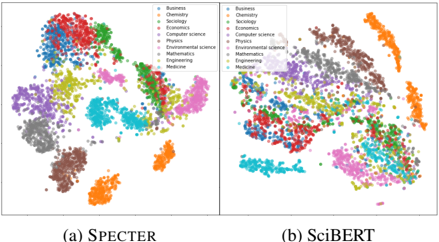
- t-SNE clustering quality for SPECTER is homogeneity 0.41 and completeness 0.72, compared with SciBERT’s 0.19 and 0.63.
Methods
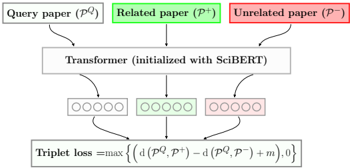
- SPECTER initializes from SciBERT, encodes the concatenated title and abstract, and uses the final [CLS] pooled output as the paper vector. It pretrains with a triplet margin loss on the citation graph: query paper, positive cited paper, and negative uncited paper, using L2 distance and margin m=1. Hard negatives are citations of citations; training uses 2 hard negatives and 3 easy negatives per query.
- Training data: a Semantic Scholar subset of about 146K query papers (~26.7M tokens) and 32K validation papers, yielding about 684K training triples and 145K validation triples. Training uses Adam with LR 2e-5, slanted triangular LR, 2 epochs, batch size 4 with gradient accumulation for effective batch size 32, on a single Titan V GPU.
- Evaluation: SCIDOCS covers seven tasks—MeSH classification (23K papers, 11 disease classes), MAG topic classification (25K papers, 19 level-1 classes), direct citation prediction (~30K total papers; 1K queries, up to 5 cited and 25 uncited candidates), co-citation (30K), co-views (~30K), co-reads (~30K), and recommendation (22K clickthrough events; 20K/1K/1K split; propensity-adjusted P@1 and nDCG). Baselines include SIF, SciBERT, Sent-BERT, Citeomatic, and SGC; classification uses a linear SVM, and recommendation uses a feedforward ranking network with ten features including cosine embedding distance.
Limitations
- Stated: SPECTER uses only title and abstract; adding full text could improve accuracy, but full text is often not freely available and Transformer memory limits would require new techniques. Venue metadata was not normalized, and author names were sparse/out-of-vocabulary; adding authors or venues did not help and authors hurt performance.
- Stated: On the recommendation task, differences between embedding methods are generally smaller because embeddings are used alongside several other informative features, limiting their impact on overall performance.
- Evident from the text: evaluation is limited to scientific documents and the released SCIDOCS tasks, with no evidence for other domains or languages; the online A/B test covers one production recommender and 4,113 clicks, so broader deployment evidence is not provided.
Model-written summary. Check it against the paper before relying on it.
Integrity signals
Registry
Cites
Statistics
Figures
Verification
Claims the paper makes
1 Valid · 2 Not valid · 17 Not checked · 56 Own results and interpretations
Every source the paper cites for this claim was checked and supports it.
In the paper
“This is because SciBERT, like other pretrained language models, is trained via language modeling objectives, which only predict words or sentences given their in-document, nearby textual context.”
§ SPECTER: Document-level Representation Learning using Citation-informed Transformers > Document Representation
What the sources say
- Supportedcites Beltagy et al., 2019 matched to “SciBERT: A Pretrained Language Model for Scientific Text” (2019) source
The Methods (Sec. 2, Background) states that SciBERT follows BERT's architecture and pretraining tasks — 'predicting randomly masked tokens and predicting whether two sentences follow each other' — i.e. word-level and sentence-level objectives. The Corpus paragraph of Sec. 2 and Sec. 3.3 show these instances are built from the full text of papers with sentences split and packed up to 128/512 tokens, so the context the objectives use is nearby, in-document text. The Introduction likewise groups SciBERT with ELMo, GPT and BERT as unsupervised pretrained language models, covering the 'like other pretrained language models' clause. (LLM, conf=0.85)
plainstates a cause- Asserted: passes — The authors put it forward as true.
- Checkable: passes — It can be checked against evidence.
- Load-bearing: passes — The paper’s conclusions depend on it.
- Based: passes — The paper gives a reason why it holds.
- Supported
A result the paper states — it cites no source for it, so there is none to check. The quote shows it is in the paper.
In the paper
“On the recommendations task, as opposed to previous experiments, the differences in method scores are generally smaller.”
§ SPECTER: Document-level Representation Learning using Citation-informed Transformers > 5 Results
plain- Asserted: passes — The authors put it forward as true.
- Checkable: passes — It can be checked against evidence.
- Load-bearing: unclear — It is unclear whether the paper’s conclusions depend on it.
- Based: passes — The paper gives a reason why it holds.
A result the paper reports from its own data — it cites no other source for it, so there is none to check. The quote shows it is in the paper.
In the paper
“We found that these pretrained embeddings substantially outperform alternative off-theshelf embeddings.”
§ SPECTER: Document-level Representation Learning using Citation-informed Transformers > 3. Fasttext-Sum
plainstates a cause- Asserted: passes — The authors put it forward as true.
- Checkable: passes — It can be checked against evidence.
- Load-bearing: unclear — It is unclear whether the paper’s conclusions depend on it.
- Based: passes — The paper gives a reason why it holds.
A result the paper reports from its own data — it cites no other source for it, so there is none to check. The quote shows it is in the paper.
In the paper
“As we show in our experiments ( §6), including hard negatives results in more accurate embeddings compared to using random negatives alone.”
§ SPECTER: Document-level Representation Learning using Citation-informed Transformers > 2.4 Selecting Negative Distractors
plainstates a cause- Asserted: passes — The authors put it forward as true.
- Checkable: passes — It can be checked against evidence.
- Load-bearing: passes — The paper’s conclusions depend on it.
- Based: passes — The paper gives a reason why it holds.
- Rests on an assumption not shown here.
A result the paper states — it cites no source for it, so there is none to check. The quote shows it is in the paper.
In the paper
“We achieve substantial improvements over the strongest of a wide variety of baselines, demonstrating the effectiveness of our model.”
§ SPECTER: Document-level Representation Learning using Citation-informed Transformers > 8 Conclusions and Future Work
boostedstates a cause- Asserted: passes — The authors put it forward as true.
- Checkable: passes — It can be checked against evidence.
- Load-bearing: passes — The paper’s conclusions depend on it.
- Based: passes — The paper gives a reason why it holds.
25 more claims
Create a free account to see all 76 claims and to verify the 18 references still open.
- It may state two separate claims as one. 22
- Probably not a substantial claim. 29
- The quote only partly states this claim. 1
Claims other papers make about this one
Each is checked against this paper’s own text: does it say what the citing paper says it does?
In the citing paper
“Covered model families span content-and embedding-based methods (e.g.,TF-IDF [63], BM25 [59] , SPECTER/SciBERT [17] ), graph-and HIN/GNN-based methods (GraphSAGE, Graph Attention Networks (GATs), meta-path reasoning), and hybrid/LLM pipelines (prompting, re-ranking, RAG).”
From A Critical Review on Citation Recommendation Systems Through a Graph-Centric Approach (2026) · cites this paper as [17]
Citations
Cites
Vaswani, A., Shazeer, N., Parmar, N., Uszkoreit, J., Jones, L., Gomez, A. N., Kaiser, L., & Polosukhin, I. (2017) · arXiv · doi:10.48550/arxiv.1706.03762 · Cited by 120,404
Adam: A Method for Stochastic Optimization
Kingma, D. P., & Ba, J. (2014) · arXiv · doi:10.48550/arxiv.1412.6980 · Cited by 98,946
BERT: Pre-training of Deep Bidirectional Transformers for Language Understanding
Devlin, J., Chang, M.-W., Lee, K., & Toutanova, K. (2018) · arXiv · doi:10.48550/arxiv.1810.04805 · Cited by 73,173
Scikit-learn: Machine Learning in Python
Pedregosa, F., Varoquaux, G., Gramfort, A., Michel, V., Thirion, B., Grisel, O., Blondel, M., Müller, A., Nothman, J., Louppe, G., et al. (2012) · arXiv · doi:10.48550/arxiv.1201.0490 · Cited by 71,016
BERT: Pre-training of Deep Bidirectional Transformers for Language Understanding
Devlin, J., Chang, M.-W., Lee, K., & Toutanova, K. (2019) · Proceedings of the 2019 Conference of the North American Chapter of the Association for Computational Linguistics: Human Language Technologies, Volume 1 (Long and Short Papers) · doi:10.18653/v1/n19-1423 · Cited by 54,325
Semi-supervised classification with graph convolutional networks
Kipf, T. N., & Welling, M. (2016) · arXiv · doi:10.48550/arxiv.1609.02907 · Cited by 24,853
(1996) · Cited by 20,179
RoBERTa: A Robustly Optimized BERT Pretraining Approach
Liu, Y., Ott, M., Goyal, N., Du, J., Joshi, M., Chen, D., Levy, O., Lewis, M., Zettlemoyer, L., & Stoyanov, V. (2019) · arXiv · doi:10.48550/arxiv.1907.11692 · Cited by 16,515
Sentence-BERT: Sentence Embeddings using Siamese BERT-Networks
Reimers, N., & Gurevych, I. (2019) · Proceedings of the 2019 Conference on Empirical Methods in Natural Language Processing and the 9th International Joint Conference on Natural Language Processing (EMNLP-IJCNLP) · doi:10.18653/v1/d19-1410 · Cited by 12,778
Deep Contextualized Word Representations
Peters, M., Neumann, M., Iyyer, M., Gardner, M., Clark, C., Lee, K., & Zettlemoyer, L. (2018) · Proceedings of the 2018 Conference of the North American Chapter of the Association for Computational Linguistics: Human Language Technologies, Volume 1 (Long Papers) · doi:10.18653/v1/n18-1202 · Cited by 11,983
Research works printed but not linked: 2
- William L. Hamilton, Zhitao Ying, and Jure Leskovec. 2017b. Inductive representation learning on large graphs. In NIPS.
- Alec Radford, Karthik Narasimhan, Tim Salimans, and Ilya Sutskever. 2018. Improving language under- standing by generative pre-training. arXiv.
Cited by
Items 1,001–1,100 of 1,111
Subedi, B. (2026) · arXiv (Cornell University) · doi:10.48550/arxiv.2609.03901
Arts, S., Melluso, N., & Veugelers, R. (2025) · Lirias (KU Leuven)
Looking for Bidding Teammates: A Game-Theoretic Model of Stranger Collusion in Peer ReviewPreprint
Xing, J., & Brian, C. (2026) · arXiv (Cornell University) · doi:10.48550/arxiv.2609.05444 · Cited by 1
The conservative turn in science: The changing character of knowledge recombinationPreprint
Zhang, C., Liang, X., Bu, Y., & Chen, H. (2026) · arXiv (Cornell University) · doi:10.48550/arxiv.2609.08468
TaxoConf: Taxonomy-Guided Automatic Conference Program OrganizationPreprint
Ji, D., Bao, Z., & Gan, J. (2026) · arXiv (Cornell University) · doi:10.48550/arxiv.2609.06604
ReCite: Agentic Reasoning for Faithful Citation
Huang, Y., Li, B., Song, J., Ding, Y., Teng, C., Li, F., & Ji, D. (2026) · Findings of the Association for Computational Linguistics: EMNLP (Findings of EMNLP) · doi:10.18653/2026.findings-emnlp.1477
Eckel, G. (2023) · The Atrium (University of Guelph)
Müller, S., Okasa, G., Strinzel, M., Jorstad, A., Milzow, K., & Egger, M. (2026) · PLoS ONE · doi:10.1371/journal.pone.0352900
HQA-Rec: Hyperbolic Quantization Alignment for Citation Recommendation
Liu, Y., Du, Y., Nguyen, T.-S., & Cambria, E. (2026) · Lecture notes in computer science · doi:10.1007/978-3-032-38410-2_40
ATTRICITE: Training an Open 4B Model for Citation Recovery toward Faithful AttributionPreprint
Choi, Y. M., Guo, X., Cai, S., Wang, Y., Fung, Y. R., & Wang, Q. (2026) · arXiv (Cornell University) · doi:10.48550/arxiv.2609.14248
Dataset repurposing and disruptive AI researchPreprint
Yu, Y., Ahn, Y., & Romero, D. M. (2026) · arXiv (Cornell University) · doi:10.48550/arxiv.2609.16736
Trong, T. M., Huynh, B., Nhi, H. N., Nguyen, T. T., Tai, N. P., Minh, N., Tran, T.-D., & Pham, V.-H. (2026) · International Conference on Multimedia Analysis and Pattern Recognition (MAPR) · doi:10.1109/mapr72750.2026.11685704
Towards reliable LLM evaluators: Discovering and internalizing explicit scoring logic
Meng, J., Mao, J., Ma, M., & Li, G. (2026) · Information Processing & Management · doi:10.1016/j.ipm.2026.105154
The concentration/dispersal debate: Swedish higher education institutions 2008–2020
Bautista‐Puig, N., & Sandström, U. (2026) · Journal of Informetrics · doi:10.1016/j.joi.2026.101879
Valijonov, J., Soar, P., Houx, J. L., & Tozzi, G. (2026) · bioRxiv (Cold Spring Harbor Laboratory) · doi:10.64898/2026.09.17.752482
Efficient training-free query routing framework for federated retrieval-augmented generation
Eoo, H., Yoo, Y., & Yang, G. (2026) · Scientific Reports · doi:10.1038/s41598-026-75918-x
Lei, M., & Sui, J. (2026) · International Conference on Artificial Intelligence, Internet of Things and Cloud Computing Technology (AIoTC) · doi:10.1109/aiotc71250.2026.11688544
The Undetected Damage of Quantization on Retrieval and How to Fix ItPreprint
Zhou, L., Zirilli, A., Solombrino, D., Dessì, R., & Rodolà, E. (2026) · arXiv (Cornell University) · doi:10.48550/arxiv.2609.24322
Shalaiev, A. (2026) · Electronic Kyiv-Mohyla Academy Institutional Repository (National University of Kyiv-Mohyla Academy)
ZooWork-ShopRanker: An Open, Preference-Aligned E-Commerce RerankerPreprint
Xue, S., Liu, S., & Hu, N. (2026) · arXiv (Cornell University) · doi:10.48550/arxiv.2609.31002
Huang, H., Dai, J., DeLucia, A., Joshi, S., Yarmohammadi, M., Gao, J., Gutiérrez, B. J., & Dredze, M. (2026) · arXiv (Cornell University) · doi:10.48550/arxiv.2609.30467
Improving Scholarly Knowledge Organization with Neuro-Symbolic and Human-in-the-Loop Approaches
Hussein, H. (2026) · Institutional Repository of Leibniz Universität Hannover (Leibniz Universität Hannover) · doi:10.15488/22598
Madeira, C., Dopke, L., Losch, G., Magnaguagno, M. C., & Griebler, D. (2026) · Lecture notes in computer science · doi:10.1007/978-3-032-39898-7_18
RenderRank: Learning to Rerank Text with Compressed Visual TokensPreprint
Hong, S., Jang, Y., Lee, J., Moon, H., & Lim, H. (2026) · arXiv (Cornell University) · doi:10.48550/arxiv.2609.35069
Inspire: Benchmarking Scientific Literature Search for Open Research ProblemsPreprint
Ding, J., Shi, Z., Zhong, J., Qiu, K., Dai, Q., Yang, Y., Luo, C., & Xu, Q. (2026) · arXiv (Cornell University) · doi:10.48550/arxiv.2609.33233
Defining the Boundaries: Research Objectives and Scope of an AI-Based Bibliometric Framework
Roy, H. N. (2026) · International Journal of Information Science and Computing · doi:10.30954/2348-7437.1.2026.9
Drift Inspector: Exploring and Measuring Scientific Drift with Atomic Contribution Claims
Karimov, V., Ostarkov, S., Poroshina, A., Анатолий, В. Ф., & Panchenko, A. (2026) · Conference on Empirical Methods in Natural Language Processing: System Demonstrations (EMNLP) · doi:10.18653/2026.emnlp-demos.13
Rathi, B., Chawla, E., & Andreopoulos, W. (2026) · arXiv (Cornell University) · doi:10.48550/arxiv.2609.38473
MetaPersona: Task-Grounded Synthetic Populations from Empirical Social SciencePreprint
Ye, J., Li, Y., Yu, C., Poddar, P., Dey, P., Ye, L., Wang, Z., Hu, X., Ferrara, E., & Zhao, Y. (2026) · arXiv (Cornell University) · doi:10.48550/arxiv.2609.38392
Doc2LoRA Provides Decodable Representations of Scientific IdeasPreprint
Mansuri, C. S., Zachariah, J., & Kojaku, S. (2026) · arXiv (Cornell University) · doi:10.48550/arxiv.2609.38374
Deshmukh, S. (2026) · American Journal of Capstone Research · doi:10.70251/141
Three-Way Topic Management with Explicit Boundary Region Export for Scientific Literature Mapping
Li, N., Li, L., Zhu, X., & Yue, Y. (2026) · International Conference on Automation and Computing (ICAC) · doi:10.1109/icac70325.2026.11712465
A Comparative Accuracy Analysis of Node2Vec and FastRP
Hodijah, A., Setijohatmo, U. T., Wulan, S. R., Hutahaean, J., Jumiyani, R., Mahesa, D., & Purnama, R. (2026) · Jurnal Informatika Polinema · doi:10.33795/jip.v12i4.10863
Efficient Adaptation of Large Language Models in Natural Language Processing
Braga, M. (2026) · PORTO@Iris
Fakroun, E., & Sullabi, M. (2026) · Al-Farooq Journal of Sciences · doi:10.65405/fw7nxs09
Seidl, D., Prokop, L., & Striełkowski, W. (2026) · SSRN Electronic Journal · doi:10.2139/ssrn.7570668
Exploring the power of text-rich graph representation learning
Zhu, Q. (2023) · Illinois Digital Environment for Access to Learning and Scholarship (University of Illinois at Urbana-Champaign)
A Comparative Evaluation of Topic Modeling Methods for Researcher-to-Research-Group Recommendation
Bratakusumah, D., Rumadi, & Ichwan, M. (2026) · International Conference on Computer, Control, Informatics and its Applications · doi:10.1109/ic3ina72033.2026.11714643
Trustworthy Domain-Specific AI for Structured Knowledge Retrieval and ReasoningPreprint
Barron, R. (2026) · arXiv (Cornell University) · doi:10.48550/arxiv.2610.08894
LLM4Impact: Integrating Heterogeneous Information for Scientific Impact PredictionPreprint
Cao, Y., Flicke, M., He, H., Renz, K., & Geiger, A. (2026) · arXiv (Cornell University) · doi:10.48550/arxiv.2610.10138
Seidl, D., Prokop, L., & Striełkowski, W. (2026) · SSRN Electronic Journal · doi:10.2139/ssrn.7583828
Shi, H., Noichl, M., & Horvát, E.-Á. (2026) · ACM Conference on Computer Supported Cooperative Work (CSCW) · doi:10.1145/3785651.3831567
Popello, V., Martinis, M. C., Lazzaro, I., Zucco, C., Milano, M., & Cannataro, M. (2026) · Proceedings - IEEE Symposium on Computer-Based Medical Systems · doi:10.1109/cbms69103.2026.00264
Seidl, D., Prokop, L., & Striełkowski, W. (2026) · SSRN Electronic Journal · doi:10.2139/ssrn.7593038
Gebhart, T., & Funk, R. J. (2026) · arXiv (Cornell University)
Shi, C., Luo, R., Zhao, S., Geng, Q., & Wu, D. (2026) · International Journal of Data Science and Analytics · doi:10.1007/s41060-026-01297-1
Zhang, Z. (2026) · Research Square · doi:10.21203/rs.3.rs-11087134/v1
Han, B. (2026) · ACM/IEEE Joint Conference on Digital Libraries · doi:10.1145/3805696.3847292
Markowitz, D. M. (2026) · arXiv (Cornell University) · doi:10.48550/arxiv.2610.13678
Marlita, R., Octavia, N. F., Maulida, H., Aisy, A. R., Febriana, A. F., & Setiadi, Y. F. (2026) · Journal of Informatics and Interactive Technology · doi:10.63547/jiite.v3i2.125
How much does the map of science depend on the embedding model?Preprint
Ortega, A. T. (2026) · arXiv (Cornell University) · doi:10.48550/arxiv.2610.16639
Ota, Y., Ogi, T., Nakawake, Y., Mochihashi, D., & Koizumi, A. (2026) · arXiv (Cornell University) · doi:10.48550/arxiv.2610.17997
FROM CITATION COUNTS TO COMPUTATIONAL SCIENCE: METHODS, DATA, AND APPLICATIONS IN SCIENTOMETRICS
Kuchanskyi, O., & Amangeldi, M. (2026) · doi:10.59787/2413-5488-2026-55-3-93-107
When Acknowledgements Don’t Match: Evidence from Horizon 2020
Müller, M. M. (2026) · Scientometrics · doi:10.1007/s11192-026-05834-4
Martinis, M. C., Popello, V., Lazzaro, I., Zucco, C., & Cannataro, M. (2026) · AI · doi:10.3390/ai7100424
Mapping the energy-transition innovation landscape with semantic patent embeddings
Mohammadi, N., & Maghsoudi, M. (2026) · Energy Nexus · doi:10.1016/j.nexus.2026.100885
Joshi, A., Mahalpure, A., & Marwade, A. (2026) · International Conference on Data Intelligence and Smart Communication (IC-DAIS) · doi:10.13052/rp-9788743817109a126
LASERAgent: Toward Highly Automated and Reliable Reproduction of LEO Networking Experiments
Tian, S., Wei, G., He, X., Liu, D., Ma, Y., Zhan, Y., & Xia, L. (2026) · SAE technical papers on CD-ROM/SAE technical paper series · doi:10.4271/2026-99-2991
Siswanto, E., & Danang, D. (2026) · Jurnal Teknik Informatika (Jutif) · doi:10.52436/1.jutif.2026.7.5.6468
Tian, Y., & Liang, H. (2026) · arXiv (Cornell University) · doi:10.48550/arxiv.2610.22703
EpiLens: Lightweight RAG for Epidemiological Knowledge AcquisitionPreprint
Perri, V., Cattuto, C., & Paolotti, D. (2026) · arXiv (Cornell University) · doi:10.48550/arxiv.2610.26730
Uddin, H. M. W., Progoti, Q. R. M., Mondal, M. C., Malitha, S. B., Saif, T., & Chowdhury, A. M. S. (2026) · Biomedical Materials & Devices · doi:10.1007/s44174-026-00796-w
SpecMRL: Redesign Matryoshka Representation Learning within Parametric SpectrumPreprint
Chen, Z., Wu, S., Cui, H., Li, C., Zhou, X., & Yan, R. (2026) · arXiv (Cornell University) · doi:10.48550/arxiv.2610.26824
Seidl, D., Prokop, L., & Striełkowski, W. (2026) · SSRN Electronic Journal · doi:10.2139/ssrn.7641083
Cross-Pollination Retrieval: Finding Transferable Ideas Across Fields in Scientific LiteraturePreprint
Jung, S., Kim, Y., Kim, Y., Rubinstein, A., Uselis, A., Park, S., Oh, S. J., & Yun, S. (2026) · arXiv (Cornell University) · doi:10.48550/arxiv.2610.25678
Weakly Supervised Adaptation of Scientific Embeddings for Exploratory Literature MappingPreprint
Neruda, R., Vidnerová, P., Šejnoha, J., Mihálik, J., & Marvan, T. (2026) · arXiv (Cornell University) · doi:10.48550/arxiv.2610.25413
Qi, S., & Feng, J. (2026) · Applied Soft Computing · doi:10.1016/j.asoc.2026.116715
ECHO: Revealing Review-to-Submission Linkage in Anonymous Peer ReviewPreprint
Wang, R., & Luo, M. (2026) · arXiv (Cornell University) · doi:10.48550/arxiv.2610.27044
InsightRAG: Aggregating Distributed Scholarly Judgments for Scientific Survey GenerationPreprint
Lin, Y., Zhang, W., Ye, Y., Xu, S., Chen, Z., Wang, W., & Qu, H. (2026) · arXiv (Cornell University) · doi:10.48550/arxiv.2610.28085
Han, H., Kang, R., Kim, Y., & Jeon, S.-H. (2026) · arXiv (Cornell University) · doi:10.48550/arxiv.2610.27397
RESEARCHHUB: A Personalized Literature Discovery System for Biomedical PreprintsPreprint
Manoranjan, V., Kim, T., Do, N., Kim, S. W., Li, D., Tan, Z., Chen, T., & Liu, Y. (2026) · arXiv (Cornell University) · doi:10.48550/arxiv.2610.28636
ResearchMatch: A Semantic-Bibliometric Prototype for Evidence-Supported Researcher Discovery
Emmanuel, D. S., & Emmanuel, I. (2026) · Journal of Information Systems and Informatics · doi:10.63158/journalisi.v8i5.1841
ARIC: A Multi-Source Framework for Detecting Hallucinated References in AI-Assisted Academic Writing
Taş, R. (2026) · International Artificial Intelligence and Data Processing Symposium (IDAP) · doi:10.1109/idap71869.2026.11728203
Conceptizer: Next-Token Prediction Is Not All You NeedPreprint
Zheng, H., & Shani, C. (2026) · arXiv (Cornell University) · doi:10.48550/arxiv.2610.33027
(4852828), I. I., Kapitonov, A., Filianin, I., Lesonen, M., & Chizhov, N. (2026) · arXiv (Cornell University) · doi:10.48550/arxiv.2610.34391
Preference-Graph Repair and Retrieval Effectiveness: An Empirical DecompositionPreprint
Vahidi, S. (2026) · Research Square · doi:10.21203/rs.3.rs-11518675/v1
Human-Centered Cognitive Data Architectures: Explainable AI for Next-Generation Environments
Said, N. A. (2026) · IGI Global eBooks · doi:10.4018/979-8-2600-1227-7.ch004
Geometry First: Shaping Sentence Embeddings with Controlled Singular Value Regularization
Li, S.-Y., Yu, H., Wang, Z.-Y., & Adelani, D. I. (2026) · Proceedings of the 2026 Conference on Empirical Methods in Natural Language Processing · doi:10.18653/2026.emnlp-main.682
Chai, R., Huang, S., Su, Y., Zhen, Y., Sun, Y., Zhao, M., Liu, S., Shen, R., Wang, R., & Li, J. (2026) · Conference on Empirical Methods in Natural Language Processing: System Demonstrations (EMNLP) · doi:10.18653/2026.emnlp-demos.59
SciEmbed: Citation-Context Supervision for Scientific Document Embeddings
Wilinski, J., & Färber, M. (2026) · Findings of the Association for Computational Linguistics: EMNLP (Findings of EMNLP) · doi:10.18653/2026.findings-emnlp.2057
When Queries Crowd: Diagnosing and Improving Spread-Out Regularization for Text Embeddings
Zhou, Z., Zeng, Q., Yang, R., Liu, J., Qi, H., Yu, P., Xuan, W., & Yokoya, N. (2026) · Conference on Empirical Methods in Natural Language Processing (EMNLP) · doi:10.18653/2026.emnlp-main.1585
Beyond Single Vector: Query-Aware Multi-Perspective Document Embeddings for Retrieval
Li, Z., Tao, C., Chen, Y.-H., Zhang, H.-S., & Zhao, D. (2026) · Conference on Empirical Methods in Natural Language Processing · doi:10.18653/2026.findings-emnlp.613
AnInter: Anti-Interference Training for Long Context Retrieval
Ye, L. (2026) · Conference on Empirical Methods in Natural Language Processing (EMNLP) · doi:10.18653/2026.emnlp-main.214
You Won’t Believe This Click: Content Rewriting for Agentic Choice
Jin, T., Wang, Z., & Chan, D. M. (2026) · Findings of the Association for Computational Linguistics: EMNLP (Findings of EMNLP) · doi:10.18653/2026.findings-emnlp.752
Анатольевич, Д. А., Галиев, А. Б., & Алексеевич, Б. О. (2026) · Economics and Management · doi:10.35854/1998-1627-2026-10-1338-1349
Domain-specific information retrieval
Verberne, S., Piroi, F., & Hanbury, A. (2026) · Foundations and Trends® in Information Retrieval · doi:10.1108/ftinr-09-2025-0088
Cognitive distance in scientific teams and innovative research outcomes
Yang, A. J., Peng, Z., Hu, H., & Deng, S. (2026) · Journal of Information Science · doi:10.1177/01655515261498142
Retrieve-then-Disambiguate: Scalable Reviewer DiscoveryPreprint
Olivo, V. A., Petrecca, J., & Kerzendorf, W. (2026) · arXiv (Cornell University) · doi:10.48550/arxiv.2610.40768
Federated Vector Retrieval across Heterogeneous VectorDBsPreprint
Lim, M., Hyeon, S., Chio, G., & Do, J. (2026) · arXiv (Cornell University) · doi:10.48550/arxiv.2611.01514
Multimodal Neural Framework for Interpretable Assessment of Scientific Manuscripts
Dong, S., Fan, M., & Zhou, W. (2026) · Lecture notes in computer science · doi:10.1007/978-981-92-7738-4_14
Maghsoudi, M. (2026) · Journal of Open Innovation Technology Market and Complexity · doi:10.1016/j.joitmc.2026.100905
Interpretable Text Embeddings Based on Hierarchical QuestionsPreprint
Oda, K., Chuang, P.-M., Shirai, K., & Kertkeidkachorn, N. (2026) · arXiv (Cornell University) · doi:10.48550/arxiv.2611.06402
Sumit, K., & Singh, M. (2026) · Research Square · doi:10.21203/rs.3.rs-11332556/v1
Multimodal Feature Integration for Pairwise Relationship Classification in Astronomy Literatures
Mane, R. M., Kalia, A., Shetty, A., Mahajan, R. S., & Pareek, P. (2026) · doi:10.18653/2026.wasp-1.24
PSGS@2026: From Figures to Citation Graphs: QLoRA Based Multimodal Linking for AstroCLIMB
Ghimire, P., Saud, S. R., Mahato, A., Dawadi, S., Saud, R., Regmi, S., & Shakya, M. (2026) · doi:10.18653/2026.wasp-1.21
Overview of the Fourth Workshop on Artificial Intelligence for Scientific Publications (WASP 2026)
Alkan, A. K., Grèzes, F., Lockhart, K., Accomazzi, A., & Ghosal, T. (2026) · doi:10.18653/2026.wasp-1.1
Metadata
- Authors
- Cohan, A., Feldman, S., Beltagy, I., Downey, D., & Weld, D.
- Affiliations
- Allen Institute for Artificial Intelligence (US)
- University of Washington (US)
- Venue
- Proceedings of the 58th Annual Meeting of the Association for Computational Linguistics
- Published
- 2020
- Pages
- 2270-2282
- ISSN
- 0736-587X (ISSN-L)
- OpenAlex
- W3016913119
- Cited by
- 1,108
- References
- 62
- Citations by year
- 2026: 364 · 2025: 244 · 2024: 178 · 2023: 157 · 2022: 113 · 2021: 44 · 2020: 8
- FWCI
- 21.99
- Type
- conference paper
- Language
- en
- Open access
- hybrid
- doi.org
- Licence
- cc-by
- Locations
- Proceedings of the conference - Association for Computational Linguistics. Meeting (publishedVersion, cc-by)
- arXiv (Cornell University) (submittedVersion, cc-by)
- arXiv (Cornell University) (submittedVersion)
- arXiv (Cornell University) (cc-by)
- Zenodo (CERN European Organization for Nuclear Research) (cc-by)
- Funders
- National Science Foundation (1936940)
- University of Washington
- Office of Naval Research (N00014- 18-1-2193)
- Topics
- Physical Sciences › Computer Science › Artificial Intelligence › Topic Modeling
- Physical Sciences › Computer Science › Computer Vision and Pattern Recognition › Multimodal Machine Learning Applications
- Physical Sciences › Computer Science › Information Systems › Recommender Systems and Techniques
- Keywords
- citation networks, citation prediction, scientific documents, transformer language models, pre-training, document classification, recommendations
About these checks
Registry, retraction, Cites and statistics results are computed, not judged, with one exception: a printed reference that no index lists is read once by a model before it counts as a citation error. Claims are extracted by a model and kept only when their quote appears verbatim in the text; each cited source is then checked, with a model’s help, for whether it says what the claim relies on. Those verdicts can be wrong — read the claim’s quote and the cited source before relying on one.
A language model drew the claims from the paper on 2026-11-18, under version 3 of the claim definition (model deepseek-v4.1-flash, prompt extract-v3).
A second model labelled each claim on 2026-11-18 (model jev-1.13-20260917, definition revision gold-guideline-v0.2).
Cited sources are checked with a language model’s help (qwen3.8-omni-flash).
Statistics and arithmetic are recomputed, not judged.
Confidence bands are shown only for fields calibrated on our annotated test set. None is calibrated yet, so no band is shown.
What counts as a claim ›How we measure confidence ›How we check this ›
Are you an author, or do you see a problem with this page? Request a review
Data sources
Bibliographic data: Semantic Scholar, OpenAlex, Crossref.
Contains information from the Semantic Scholar Academic Graph Datasets, made available under the ODC Attribution License (ODC-BY 1.0).
Semantic Scholar’s data is described in: Kinney, R., et al. (2023). The Semantic Scholar Open Data Platform. arXiv:2301.10140.
