

SPECTER: Document-level Representation Learning using Citation-informed Transformers
Open accessThe DOI matches its Crossref record; 62 of the 62 references it cites were found in a registry or an index; 1 of the 26 sources its claims cite were checked for support.
Abstract
Representation learning is a critical ingredient for natural language processing systems.Recent Transformer language models like BERT learn powerful textual representations, but these models are targeted towards token-and sentence-level training objectives and do not leverage information on inter-document relatedness, which limits their document-level representation power.For applications on scientific documents, such as classification and recommendation, the embeddings power strong performance on end tasks.We propose SPECTER, a new method to generate document-level embedding of scientific documents based on pretraining a Transformer language model on a powerful signal of document-level relatedness: the citation graph.Unlike existing pretrained language models, SPECTER can be easily applied to downstream applications without task-specific fine-tuning.Additionally, to encourage further research on document-level models, we introduce SCIDOCS, a new evaluation benchmark consisting of seven document-level tasks ranging from citation prediction, to document classification and recommendation.We show that SPECTER outperforms a variety of competitive baselines on the benchmark.1
Overview
CoChat Summary
TL;DR
SPECTER learns document-level embeddings of scientific papers by pretraining a SciBERT Transformer on citation-informed triplets, using only title and abstract at inference. It introduces the SCIDOCS seven-task benchmark and reports an average score of 80.0 across tasks/metrics, a 3.1-point absolute improvement over the next-best baseline.
Key findings
- SPECTER achieves an average of 80.0 across all SCIDOCS tasks/metrics, 3.1 points absolute over the next-best baseline. On MeSH classification it reaches F1 86.4 (+2.3 over best baseline) and on MAG F1 82.0 (+1.5); on co-view MAP 83.8 and co-read MAP 84.5, improving over Citeomatic by 2.7 and 4.0 points; on co-citation nDCG 94.8, +2.3 over SGC; on recommendation nDCG 53.9.
- In an online A/B test with 4,113 clicks, the SPECTER-based ranker improved clickthrough rate over the baseline by 46.5%.
- Ablations show removing the abstract drops average performance to 68.1, adding authors drops it to 67.3, using no hard negatives drops it to 78.4, and initializing from BERT-Large instead of SciBERT drops it to 77.5. Fixed SPECTER embeddings also outperform SciBERT fine-tuned on task-specific signals (SPECTER average 80.0 vs. multitask fine-tuning 78.0).
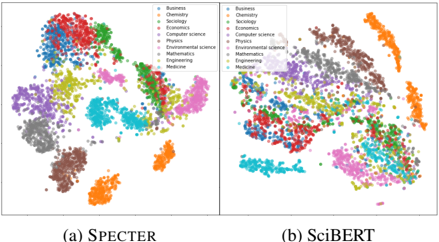
- t-SNE clustering quality for SPECTER is homogeneity 0.41 and completeness 0.72, compared with SciBERT’s 0.19 and 0.63.
Methods
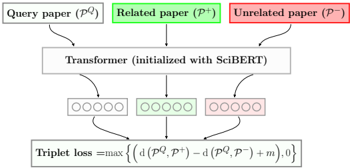
- SPECTER initializes from SciBERT, encodes the concatenated title and abstract, and uses the final [CLS] pooled output as the paper vector. It pretrains with a triplet margin loss on the citation graph: query paper, positive cited paper, and negative uncited paper, using L2 distance and margin m=1. Hard negatives are citations of citations; training uses 2 hard negatives and 3 easy negatives per query.
- Training data: a Semantic Scholar subset of about 146K query papers (~26.7M tokens) and 32K validation papers, yielding about 684K training triples and 145K validation triples. Training uses Adam with LR 2e-5, slanted triangular LR, 2 epochs, batch size 4 with gradient accumulation for effective batch size 32, on a single Titan V GPU.
- Evaluation: SCIDOCS covers seven tasks—MeSH classification (23K papers, 11 disease classes), MAG topic classification (25K papers, 19 level-1 classes), direct citation prediction (~30K total papers; 1K queries, up to 5 cited and 25 uncited candidates), co-citation (30K), co-views (~30K), co-reads (~30K), and recommendation (22K clickthrough events; 20K/1K/1K split; propensity-adjusted P@1 and nDCG). Baselines include SIF, SciBERT, Sent-BERT, Citeomatic, and SGC; classification uses a linear SVM, and recommendation uses a feedforward ranking network with ten features including cosine embedding distance.
Limitations
- Stated: SPECTER uses only title and abstract; adding full text could improve accuracy, but full text is often not freely available and Transformer memory limits would require new techniques. Venue metadata was not normalized, and author names were sparse/out-of-vocabulary; adding authors or venues did not help and authors hurt performance.
- Stated: On the recommendation task, differences between embedding methods are generally smaller because embeddings are used alongside several other informative features, limiting their impact on overall performance.
- Evident from the text: evaluation is limited to scientific documents and the released SCIDOCS tasks, with no evidence for other domains or languages; the online A/B test covers one production recommender and 4,113 clicks, so broader deployment evidence is not provided.
Model-written summary. Check it against the paper before relying on it.
Integrity signals
Registry
Cites
Statistics
Figures
Verification
Claims the paper makes
1 Valid · 2 Not valid · 17 Not checked · 56 Own results and interpretations
Every source the paper cites for this claim was checked and supports it.
In the paper
“This is because SciBERT, like other pretrained language models, is trained via language modeling objectives, which only predict words or sentences given their in-document, nearby textual context.”
§ SPECTER: Document-level Representation Learning using Citation-informed Transformers > Document Representation
What the sources say
- Supportedcites Beltagy et al., 2019 matched to “SciBERT: A Pretrained Language Model for Scientific Text” (2019) source
The Methods (Sec. 2, Background) states that SciBERT follows BERT's architecture and pretraining tasks — 'predicting randomly masked tokens and predicting whether two sentences follow each other' — i.e. word-level and sentence-level objectives. The Corpus paragraph of Sec. 2 and Sec. 3.3 show these instances are built from the full text of papers with sentences split and packed up to 128/512 tokens, so the context the objectives use is nearby, in-document text. The Introduction likewise groups SciBERT with ELMo, GPT and BERT as unsupervised pretrained language models, covering the 'like other pretrained language models' clause. (LLM, conf=0.85)
plainstates a cause- Asserted: passes — The authors put it forward as true.
- Checkable: passes — It can be checked against evidence.
- Load-bearing: passes — The paper’s conclusions depend on it.
- Based: passes — The paper gives a reason why it holds.
- Supported
A result the paper states — it cites no source for it, so there is none to check. The quote shows it is in the paper.
In the paper
“On the recommendations task, as opposed to previous experiments, the differences in method scores are generally smaller.”
§ SPECTER: Document-level Representation Learning using Citation-informed Transformers > 5 Results
plain- Asserted: passes — The authors put it forward as true.
- Checkable: passes — It can be checked against evidence.
- Load-bearing: unclear — It is unclear whether the paper’s conclusions depend on it.
- Based: passes — The paper gives a reason why it holds.
A result the paper reports from its own data — it cites no other source for it, so there is none to check. The quote shows it is in the paper.
In the paper
“We found that these pretrained embeddings substantially outperform alternative off-theshelf embeddings.”
§ SPECTER: Document-level Representation Learning using Citation-informed Transformers > 3. Fasttext-Sum
plainstates a cause- Asserted: passes — The authors put it forward as true.
- Checkable: passes — It can be checked against evidence.
- Load-bearing: unclear — It is unclear whether the paper’s conclusions depend on it.
- Based: passes — The paper gives a reason why it holds.
A result the paper reports from its own data — it cites no other source for it, so there is none to check. The quote shows it is in the paper.
In the paper
“As we show in our experiments ( §6), including hard negatives results in more accurate embeddings compared to using random negatives alone.”
§ SPECTER: Document-level Representation Learning using Citation-informed Transformers > 2.4 Selecting Negative Distractors
plainstates a cause- Asserted: passes — The authors put it forward as true.
- Checkable: passes — It can be checked against evidence.
- Load-bearing: passes — The paper’s conclusions depend on it.
- Based: passes — The paper gives a reason why it holds.
- Rests on an assumption not shown here.
A result the paper states — it cites no source for it, so there is none to check. The quote shows it is in the paper.
In the paper
“We achieve substantial improvements over the strongest of a wide variety of baselines, demonstrating the effectiveness of our model.”
§ SPECTER: Document-level Representation Learning using Citation-informed Transformers > 8 Conclusions and Future Work
boostedstates a cause- Asserted: passes — The authors put it forward as true.
- Checkable: passes — It can be checked against evidence.
- Load-bearing: passes — The paper’s conclusions depend on it.
- Based: passes — The paper gives a reason why it holds.
25 more claims
Create a free account to see all 76 claims and to verify the 18 references still open.
- It may state two separate claims as one. 22
- Probably not a substantial claim. 29
- The quote only partly states this claim. 1
Claims other papers make about this one
Each is checked against this paper’s own text: does it say what the citing paper says it does?
In the citing paper
“Covered model families span content-and embedding-based methods (e.g.,TF-IDF [63], BM25 [59] , SPECTER/SciBERT [17] ), graph-and HIN/GNN-based methods (GraphSAGE, Graph Attention Networks (GATs), meta-path reasoning), and hybrid/LLM pipelines (prompting, re-ranking, RAG).”
From A Critical Review on Citation Recommendation Systems Through a Graph-Centric Approach (2026) · cites this paper as [17]
Citations
Cites
Vaswani, A., Shazeer, N., Parmar, N., Uszkoreit, J., Jones, L., Gomez, A. N., Kaiser, L., & Polosukhin, I. (2017) · arXiv · doi:10.48550/arxiv.1706.03762 · Cited by 120,404
Adam: A Method for Stochastic Optimization
Kingma, D. P., & Ba, J. (2014) · arXiv · doi:10.48550/arxiv.1412.6980 · Cited by 98,946
BERT: Pre-training of Deep Bidirectional Transformers for Language Understanding
Devlin, J., Chang, M.-W., Lee, K., & Toutanova, K. (2018) · arXiv · doi:10.48550/arxiv.1810.04805 · Cited by 73,173
Scikit-learn: Machine Learning in Python
Pedregosa, F., Varoquaux, G., Gramfort, A., Michel, V., Thirion, B., Grisel, O., Blondel, M., Müller, A., Nothman, J., Louppe, G., et al. (2012) · arXiv · doi:10.48550/arxiv.1201.0490 · Cited by 71,016
BERT: Pre-training of Deep Bidirectional Transformers for Language Understanding
Devlin, J., Chang, M.-W., Lee, K., & Toutanova, K. (2019) · Proceedings of the 2019 Conference of the North American Chapter of the Association for Computational Linguistics: Human Language Technologies, Volume 1 (Long and Short Papers) · doi:10.18653/v1/n19-1423 · Cited by 54,325
Semi-supervised classification with graph convolutional networks
Kipf, T. N., & Welling, M. (2016) · arXiv · doi:10.48550/arxiv.1609.02907 · Cited by 24,853
(1996) · Cited by 20,179
RoBERTa: A Robustly Optimized BERT Pretraining Approach
Liu, Y., Ott, M., Goyal, N., Du, J., Joshi, M., Chen, D., Levy, O., Lewis, M., Zettlemoyer, L., & Stoyanov, V. (2019) · arXiv · doi:10.48550/arxiv.1907.11692 · Cited by 16,515
Sentence-BERT: Sentence Embeddings using Siamese BERT-Networks
Reimers, N., & Gurevych, I. (2019) · Proceedings of the 2019 Conference on Empirical Methods in Natural Language Processing and the 9th International Joint Conference on Natural Language Processing (EMNLP-IJCNLP) · doi:10.18653/v1/d19-1410 · Cited by 12,778
Deep Contextualized Word Representations
Peters, M., Neumann, M., Iyyer, M., Gardner, M., Clark, C., Lee, K., & Zettlemoyer, L. (2018) · Proceedings of the 2018 Conference of the North American Chapter of the Association for Computational Linguistics: Human Language Technologies, Volume 1 (Long Papers) · doi:10.18653/v1/n18-1202 · Cited by 11,983
Research works printed but not linked: 2
- William L. Hamilton, Zhitao Ying, and Jure Leskovec. 2017b. Inductive representation learning on large graphs. In NIPS.
- Alec Radford, Karthik Narasimhan, Tim Salimans, and Ilya Sutskever. 2018. Improving language under- standing by generative pre-training. arXiv.
Cited by
Items 501–600 of 1,111
Disambiguation of Implicit Scientific References on X
Hafid, S., Kartal, Y. S., Schellhammer, S., Jacot, V., Bringay, S., Dietze, S., & Todorov, K. (2025) · ACM Conference on Hypertext and Social Media (HT) · doi:10.1145/3720553.3746676 · Cited by 3
Personality Recognition in Social Media using Sentence Embeddings Based on Transformer Networks
Fatahian, M., & Ravanmehr, R. (2025) · SN Computer Science · doi:10.1007/s42979-025-04326-1 · Cited by 3
Khadka, A., & Sthapit, S. (2025) · Informatics · doi:10.3390/informatics12040108 · Cited by 3
Lee, S., & Kim, R. E. (2025) · Computer-Aided Civil and Infrastructure Engineering · doi:10.1111/mice.70101 · Cited by 3
Wang, R., Zhou, X., Qiu, L., Chang, J. C., Bragg, J., & Zhang, A. X. (2025) · ACM Conference on Computer Supported Cooperative Work (CSCW) · doi:10.1145/3715070.3757230 · Cited by 3
FLeW: Facet-Level and Adaptive Weighted Representation Learning of Scientific Documents
Dou, Z., Wang, D., Zhuang, F., Ren, J., & Hu, Y. (2026) · Lecture notes in computer science · doi:10.1007/978-981-95-3827-0_22 · Cited by 3
Ahemad, F. (2025) · ACM International Conference on Information and Knowledge Management (CIKM) · doi:10.1145/3746252.3761077 · Cited by 3
Остапенко, Г. А., Rozhkova, G. G., Feklin, V., & Kochkarov, R. A. (2025) · Digital Solutions and Artificial Intelligence Technologies · doi:10.26794/3033-7097-2025-1-3-69-76 · Cited by 3
Olivo, V. A., Kerzendorf, W., Lu, B., Shields, J., Flörs, A., & Chen, N. (2025) · Publications of the Astronomical Society of the Pacific · doi:10.1088/1538-3873/ae1e2d · Cited by 3
Reviewer No. 2: Old and New Problems in Peer Review (Dagstuhl Seminar 24052)
Gurevych, I., Rogers, A., Shah, N. B., & Wang, J. (2024) · DROPS (Schloss Dagstuhl – Leibniz Center for Informatics) · doi:10.4230/dagrep.14.1.130 · Cited by 3
A Comparative Study of Specialized LLMs as Dense Retrievers
Zhang, H., Bi, K., & Guo, J. (2026) · Lecture notes in computer science · doi:10.1007/978-981-95-5637-3_4 · Cited by 3
A citation recommendation model employing knowledge graph embedding
ali, Z., Qi, G., Hussain, S., Ullah, I., Khalid, S., Mohammed, A. A. Q., Ullah, I., Malik, A., & Kefalas, P. (2026) · Soft Computing · doi:10.1007/s00500-025-10928-x · Cited by 3
Chianumba, E. C., Liu, H., Varde, A. S., & Zhuang, Y. (2025) · IEEE International Conference on Bioinformatics and Biomedicine (BIBM) · doi:10.1109/bibm66473.2025.11357147 · Cited by 3
How Do LLM-Generated Texts Impact Term-Based Retrieval Models?
Huang, W., Bi, K., Cai, Y., Chen, W., Guo, J., & Cheng, X. (2026) · ACM International Conference on Web Search and Data Mining (WSDM) · doi:10.1145/3773966.3777988 · Cited by 3
Structural Chunking: A Semantic-Structural Integrated Method for Retrieval-Augmented Generation
Lee, S., Kim, N., & Lee, J. (2026) · International Conference on Electronics, Information, and Communication (ICEIC) · doi:10.1109/iceic69189.2026.11386163 · Cited by 3
Revealing MonoT5s Learning Mechanisms via Prompt-Token Adaptation
Braga, M., MacAvaney, S., Macdonald, C., & Pasi, G. (2026) · Lecture notes in computer science · doi:10.1007/978-3-032-21289-4_29 · Cited by 3
Rausser, G. C., Striełkowski, W., & Prokop, L. (2026) · Energy Conversion and Management X · doi:10.1016/j.ecmx.2026.102277 · Cited by 3
ZHANG, Y., & Ma, Q. (2022) · IEICE Transactions on Information and Systems · doi:10.1587/transinf.2022edp7034 · Cited by 3
Rae, A. R., Mork, J. G., & Demner‐Fushman, D. (2022) · Journal of the Association for Information Science and Technology · doi:10.1002/asi.24722 · Cited by 3
Integrating Linguistic and Citation Information with Transformer for Predicting Top-Cited Papers
Ochi, M., Shiro, M., Mori, J., & Sakata, I. (2023) · Lecture notes in business information processing · doi:10.1007/978-3-031-43088-6_7 · Cited by 3
Xie, Z. Y., Lv, Y., Song, Y., & Wang, Q. (2024) · Journal of Informetrics · doi:10.1016/j.joi.2024.101498 · Cited by 3
BATRACIO: BAsic, TRAnslational, Clinical, Research Phase Identification in BiOmedical Publications
Durán-Silva, N., Carrillo‐de‐Albornoz, J., Plaza, L., Ricardo, S., Massucci, F. A., Veiga, S. R., & Ramos-Prats, A. (2024) · IEEE Access · doi:10.1109/access.2024.3463717 · Cited by 5
Plot Retrieval as an Assessment of Abstract Semantic Association
Xu, S., Pang, L., Li, J., Yu, M., Meng, F., Shen, H., Cheng, X., & Zhou, J. (2024) · Proceedings of the conference - Association for Computational Linguistics. Meeting · doi:10.18653/v1/2024.acl-srw.14 · Cited by 3
Richins, G. (2025) · Accounting and Finance · doi:10.1111/acfi.70036 · Cited by 4
Graph-Assisted Culturally Adaptable Idiomatic Translation for Indic languages
Singh, P. K., Prasad, K., Zaki, M., & Wasnik, P. (2025) · Findings of the Association for Computational Linguistics: ACL (Findings of ACL) · doi:10.18653/v1/2025.findings-acl.367 · Cited by 3
Joint Inference of Retrieval and Generation for Passage Re-ranking
Fang, W., Chuang, Y.-S., & Glass, J. R. (2024) · Findings of the Association for Computational Linguistics: EACL · doi:10.18653/v1/2024.findings-eacl.151 · Cited by 3
IR2: Information Regularization for Information Retrieval
Wang, J., Wang, K., Wang, X., Cao, W., Paturi, R., & Bergen, L. (2024) · Language Resources and Evaluation Conference (LREC) · doi:10.63317/3yg2c9j4gpiu · Cited by 3
Galuščáková, P., Oard, D. W., & Nair, S. (2024) · ACM eBooks · doi:10.1145/3674127.3674136 · Cited by 3
The effective impact of behavioral shifts in energy, transport, and food
Hernandez, M., Kraft‐Todd, G., & Composto, J. W. (2025) · doi:10.46830/wriwp.21.00151 · Cited by 4
Encoder models at the European Patent Office: Pre-training and use cases
Hähnke, V. D., Wéry, A., Wirth, M., & Klenner-Bajaja, A. (2025) · World Patent Information · doi:10.1016/j.wpi.2025.102360 · Cited by 3
ruSciFact: Open Benchmark for Verifying Scientific Facts in Russian
Vatolin, A., Gerasimenko, N. A., Loukachevitch, N., Ianina, A., & Vorontsov, K. V. (2025) · Computational Linguistics and Intellectual Technologies · doi:10.28995/2075-7182-2025-23-435-459 · Cited by 3
Research Paper Recommender System by Considering Users’ Information Seeking Behaviors
Xu, Z., Yamamoto, S., & Joho, H. (2025) · International Joint Conference on Neural Networks (IJCNN) · doi:10.1109/ijcnn64981.2025.11228351 · Cited by 3
A Large-Scale Analysis of Cross-lingual Citations in English Papers
Saier, T., & Färber, M. (2020) · Lecture notes in computer science · doi:10.1007/978-3-030-64452-9_11 · Cited by 3
Moro, G., Valgimigli, L., Rossi, A., Casadei, C., & Montefiori, A. (2022) · Lecture notes in computer science · doi:10.1007/978-3-031-17849-8_23 · Cited by 3
Topical Grouping of Thousands of Biomimetics Articles According to Their Goals, Results and Methods
Carniel, T., Cazenille, L., Dalle, J., & Halloy, J. (2023) · Lecture notes in computer science · doi:10.1007/978-3-031-39504-8_18 · Cited by 3
Hierarchical Transformer-based Query by Multiple Documents
Huang, Z., Naseri, S., Bonab, H., Sarwar, S. M., & Allan, J. (2023) · ACM SIGIR International Conference on Theory of Information Retrieval (ICTIR) · doi:10.1145/3578337.3605130 · Cited by 3
CLMSM: A Multi-Task Learning Framework for Pre-training on Procedural Text
Nandy, A., Kapadnis, M. N., Goyal, P., & Ganguly, N. (2023) · Findings of the Association for Computational Linguistics: EMNLP (Findings of EMNLP) · doi:10.18653/v1/2023.findings-emnlp.589 · Cited by 3
Citation Recommendation Employing Proximity-Based Heterogeneous Network Embeddings
Ali, Z., Ullah, I., Kefalas, P., Thierry, N., Haq, K. U., & Sarkar, A. (2024) · Lecture notes in networks and systems · doi:10.1007/978-3-031-47721-8_32 · Cited by 3
Chen, C., Zhang, J., Ye, T., Roth, D., & Zhang, B. (2024) · Journal of Causal Inference · doi:10.1515/jci-2023-0052 · Cited by 3
Mokarrama, M. J., & Alhoori, H. (2024) · ACM/IEEE Joint Conference on Digital Libraries · doi:10.1145/3677389.3702603 · Cited by 3
Reviewer Agreement and Phrase-Based Profiles
Mazumder, A., Saha, S., Malempati, S., & Kodali, R. K. (2023) · PhilPapers (PhilPapers Foundation) · doi:10.5281/zenodo.20505256 · Cited by 3
Infrastructure for Rapid Open Knowledge Network Development
Cafarella, M., Anderson, M., Beltagy, I., Cattan, A., Chasins, S., Dagan, I., Downey, D., Etzioni, O., Feldman, S., Gao, T., et al. (2022) · AI Magazine · doi:10.1609/aimag.v43i1.19126 · Cited by 3
Self-citationIncorporating Visual Layout Structures for Scientific Text Classification.Preprint
Shen, Z., Lo, K., Wang, L. L., Kuehl, B., Weld, D. S., & Downey, D. (2021) · arXiv (Cornell University) · Cited by 3
Self-citationParagraph-level Citation Recommendation based on Topic Sentences as QueriesPreprint
Medić, Z., & Šnajder, J. (2023) · arXiv (Cornell University) · doi:10.48550/arxiv.2305.12190 · Cited by 3
Measuring the Commercial Potential of SciencePreprint
Masclans, R., Hasan, S., & Cohen, W. M. (2023) · SSRN Electronic Journal · doi:10.2139/ssrn.4481928 · Cited by 3
Mishra, S., Gauquier, A., & Senellart, P. P. (2023) · HAL · doi:10.48550/arxiv.2307.09047 · Cited by 3
Encoding Multi-Domain Scientific Papers by Ensembling Multiple CLS TokensPreprint
Seoh, R., Chang, H.-S., & McCallum, A. (2023) · arXiv (Cornell University) · doi:10.48550/arxiv.2309.04333 · Cited by 3
Sentence embeddings and their relation with sentence structures
Simoulin, A. (2022) · theses.fr (ABES) · doi:10.70675/b5607013zca2az42fez89e2z605415c0c2d7 · Cited by 3
Nechakhin, V., D’Souza, J., & Eger, S. (2024) · Preprints.org · doi:10.20944/preprints202405.0124.v1 · Cited by 3
Hierarchical Graph Topic Modeling with Topic Tree-based TransformerPreprint
Zhang, D. C., Yang, M., Wu, X., Zhang, J., & Lauw, H. W. (2025) · arXiv (Cornell University) · doi:10.48550/arxiv.2502.11345 · Cited by 3
Citation Recommendation using Deep Canonical Correlation AnalysisPreprint
McNamara, C., & Ramlan, E. I. (2025) · arXiv (Cornell University) · doi:10.48550/arxiv.2507.17603 · Cited by 3
GRIL: Knowledge Graph Retrieval-Integrated Learning with Large Language ModelsPreprint
Chen, J., Zhang, H., Yun, S., Mottini, A., Ying, R., Song, X., Ioannidis, V. N., Zheng, L., & Cui, Q. (2025) · arXiv (Cornell University) · doi:10.48550/arxiv.2509.16502 · Cited by 3
Ascione, G. S., & Tamagnone, N. (2025) · arXiv (Cornell University) · doi:10.48550/arxiv.2509.09303 · Cited by 3
Identifying Emerging Technologies in Research
Aiken, C., Dunham, J., Melot, J., & Arnold, Z. (2024) · doi:10.51593/20240050 · Cited by 3
Lacuna: A Research Map for Machine LearningPreprint
Weiß, M., Li, M. Q., Artiles, A. H., Mkhinini, Y., Pal, C., Larochelle, H., & Rahaman, N. (2026) · arXiv (Cornell University) · doi:10.48550/arxiv.2606.26246 · Cited by 3
Return of the solo author: The changing division of labor in science in the age of generative AIPreprint
Matsui, A. (2026) · arXiv (Cornell University) · doi:10.48550/arxiv.2607.10780 · Cited by 3
Calibration and Risk-Budgeted Decisions with System One ModelsPreprint
Messoudi, S., & Mansar, Y. (2026) · arXiv (Cornell University) · doi:10.48550/arxiv.2610.19811 · Cited by 3
Citation Polarity Identification in Scientific Research Articles Using Deep Learning Methods
Kundu, S., & Mercer, R. E. (2024) · Communications in computer and information science · doi:10.1007/978-3-031-66694-0_17 · Cited by 2
MISTI: Metadata-Informed Scientific Text and Image Representation through Contrastive Learning
Taechoyotin, P., & Acuna, D. E. (2024) · Workshop on Scholarly Document Processing (SDP) · doi:10.18653/v1/2024.sdp-1.15 · Cited by 2
Temporal Extraction and Retrieval
Alonso, O., & Spaniol, M. (2024) · ACM eBooks · doi:10.1145/3674127.3674137 · Cited by 2
From Research to Impact: Assessing a Decade of CDC’s Public Health Science by Topic Area, 2014-2023
Ortega, J., Knuth, M., Dunkley, V. E., Kim, C., Meites, E., Yoo, B. K., Wainwright, K., Zhu, B., & Reynolds, M. G. (2026) · Public Health Reports · doi:10.1177/00333549261451188 · Cited by 2
Internal and External Impacts of Natural Language Processing Papers
Zhang, Y. (2025) · Proceedings of the conference - Association for Computational Linguistics. Meeting · doi:10.18653/v1/2025.acl-short.37 · Cited by 2
Attend to What I Say: Highlighting Relevant Content on Slides
Mariam, K. M. M., & Jawahar, C. V. (2025) · Lecture notes in computer science · doi:10.1007/978-3-032-04627-7_2 · Cited by 2
NPL v. NLP: analysing the links between science and technology with citations and semantics
Liu, J., Amdaoud, M., Mescheba, W., Quemener, J., Sapinho, D., Deltorn, J., & Guellec, D. (2025) · Scientometrics · doi:10.1007/s11192-025-05460-6 · Cited by 2
Discourse Features Enhance Detection of Document-Level Machine-Generated Content
Li, Y.-P., Milling, M., Specia, L., & Schuller, B. (2024) · IEEE International Joint Conference on Neural Network · doi:10.1109/ijcnn64981.2025.11228879 · Cited by 2
Brinner, M., & Zarrieß, S. (2026) · Proceedings of the conference - Association for Computational Linguistics. Meeting · doi:10.18653/v1/2026.acl-long.1884 · Cited by 2
A Flexible and Configurable System to Author Name Disambiguation
Rodrigues, N. S., & Ralha, C. G. (2025) · IEEE Access · doi:10.1109/access.2025.3589957 · Cited by 2
From Keyterms to Context: Exploring Topic Description Generation in Scientific Corpora
Achkar, P., Murugaboopathy, S., Kreuter, A., Gollub, T., Potthast, M., & Campbell, Y. (2025) · Workshop on New Frontiers in Summarization (NewSum) · doi:10.18653/v1/2025.newsum-main.8 · Cited by 2
SPECTER-BS: effective citation recommendation using SPECTER with bibliographic scoring
Nguyen, S. N., Long, N. H., Dinh, T. N., Pham, P., & Vo, B. (2026) · Knowledge and Information Systems · doi:10.1007/s10115-025-02677-y · Cited by 2
Liu, C., Tang, D., Lv, B., Zhang, P., & Huang, Z. (2026) · Scientometrics · doi:10.1007/s11192-025-05518-5 · Cited by 2
Ye, Z., Hou, Y., Pan, R., Gao, T., & Wang, H. (2026) · Scientometrics · doi:10.1007/s11192-026-05839-z · Cited by 2
CC30k: A Citation Contexts Dataset for Reproducibility-Oriented Sentiment Analysis
Obadage, R. R., Rajtmajer, S. M., & Wu, J. (2025) · ACM/IEEE Joint Conference on Digital Libraries · doi:10.1109/jcdl67857.2025.00013 · Cited by 2
OpenMSD: Towards Multilingual Scientific Documents Similarity Measurement
Gao, Y., Ma, J., Korotkov, I., Hall, K., Alon, D., & Metzler, D. (2024) · Language Resources and Evaluation Conference (LREC) · doi:10.63317/3qxthejdaace · Cited by 2
A Representation Sharpening Framework for Zero Shot Dense Retrieval
Ashok, D., Nair, S., Al-Darabsah, M., Teo, C. H., Agarwal, T., & May, J. (2026) · Conference of the European Chapter of the Association for Computational Linguistics · doi:10.18653/v1/2026.eacl-long.173 · Cited by 2
Beyond Paper-to-Paper: Structured Profiling and Rubric Scoring for Paper-Reviewer Matching
Pan, Y., Ning, Z., Wang, L., & Du, Y. (2026) · International Joint Conference on Neural Networks (IJCNN) · doi:10.1109/ijcnn69854.2026.11729273 · Cited by 2
MasterSet: A Large-Scale Benchmark for Must-Cite Citation Recommendation in the AI/ML Literature
Ratul, M. T. R., Chen, Z., Fu, K., Ji, T., & Zhang, L. (2026) · Society for Industrial and Applied Mathematics eBooks · doi:10.1137/1.9781611979329.37 · Cited by 2
Bipartisan-cited science is rare, unevenly distributed, and disproportionately influential
Furnas, A. C., & Wang, D. (2026) · Proceedings of the National Academy of Sciences · doi:10.1073/pnas.2523760123 · Cited by 2
The Harder Text Embedding Benchmark (HTEB): Beyond One-dimensional Static Robustness
Frank, M., & Afli, H. (2026) · Conference on Empirical Methods in Natural Language Processing (EMNLP) · doi:10.18653/2026.emnlp-main.1044 · Cited by 2
MERIT: Matching Expertise via Rubric-Informed Training for Reviewer Assignment
Yang, Z., Zhao, Y., Liu, W., & Li, X. (2026) · Conference on Empirical Methods in Natural Language Processing (EMNLP) · doi:10.18653/2026.emnlp-main.2227 · Cited by 2
Rajit, D., McDonald, S. J., Du, L., Teede, H. J., & Enticott, J. (2026) · Journal of Clinical Epidemiology · doi:10.1016/j.jclinepi.2026.112349 · Cited by 2
Revisiting the field normalization approaches and practices
Lu, X., Li, L., & Shen, Z. (2026) · Scientometrics · doi:10.1007/s11192-026-05676-0 · Cited by 2
CITE: Benchmarking Heterogeneous Text-Attributed Graph Models
Zhang, C., Long, Q., Wang, L., Cui, W., Yu, J., & Du, Y. (2026) · Proceedings of the conference - Association for Computational Linguistics. Meeting · doi:10.18653/v1/2026.acl-long.1449 · Cited by 2
RATE: Reviewer Profiling and Annotation-free Training for Expertise Ranking in Peer Review Systems
Liu, W., Yang, Z., Zhao, Y., & Li, X. L. (2026) · Proceedings of the conference - Association for Computational Linguistics. Meeting · doi:10.18653/v1/2026.acl-long.2035 · Cited by 3
BioHiCL: Hierarchical Multi-Label Contrastive Learning for Biomedical Retrieval with MeSH Labels
Lan, M., Zheng, L., & Halil Kilicoglu, B. (2026) · Proceedings of the conference - Association for Computational Linguistics. Meeting · doi:10.18653/v1/2026.acl-short.62 · Cited by 2
Zhou, H., & Jia, G. (2026) · Knowledge-Based Systems · doi:10.1016/j.knosys.2026.116667 · Cited by 2
From Profiles to Promising Paths: A Semantic Group Recommender for Novel Academic Topic Discovery
Ayala-Tipan, C., Recalde, L., & Loza-Aguirre, E. (2026) · Information · doi:10.3390/info17070715 · Cited by 2
COVID-19 education policy often relied on older research despite available new evidence
Mahfouz, B., Capra, L., & Mulgan, G. (2026) · STAR Protocols · doi:10.1016/j.xpro.2026.104710 · Cited by 2
LitBench: A Graph-Centric Large Language Model Benchmarking Tool For Literature Tasks
Varvarigos, A., Maatouk, A., Zhang, J., Bui, N., Chen, J., Tassiulas, L., & Ying, R. (2026) · ACM SIGKDD Conference on Knowledge Discovery and Data Mining (KDD) · doi:10.1145/3770854.3785679 · Cited by 2
Post-Calibration Reliability Reranking of Relevance Decisions via Label-wise Monotone Projection
Tae, I., & Lee, Y. (2026) · ACM International Conference on Information and Knowledge Management (CIKM) · doi:10.1145/3799682.3840940 · Cited by 2
Kulikowski, E. (2026) · ACM/IEEE Joint Conference on Digital Libraries · doi:10.1145/3805696.3846016 · Cited by 2
Bang, M.-L., Nguyen-Lam, P.-Q., Dao-Sy, D.-M., Huynh, T.-K., Pham, P.-H., & Tran, C.-N. (2026) · doi:10.18653/2026.wasp-1.7 · Cited by 2
Graph-Enhanced Document Representation for Court Case Retrieval
Fink, T. (2022) · Lecture notes in computer science · doi:10.1007/978-3-030-99739-7_59 · Cited by 2
Neves, M., Schadock, I., Eusemann, B., Schnfelder, G., Bert, B., & Butzke, D. (2023) · Workshop on Biomedical Language Processing (BioNLP) · doi:10.18653/v1/2023.bionlp-1.11 · Cited by 2
Generating survey draft based on closeness of position distributions of key words
Sun, X., & Zhuge, H. (2023) · Expert Systems with Applications · doi:10.1016/j.eswa.2023.121422 · Cited by 2
Zurlo, G., & Ronchieri, E. (2024) · Lecture notes in computer science · doi:10.1007/978-3-031-51023-6_18 · Cited by 2
Privacy in Information Retrieval
Soboroff, I. M. (2024) · ACM eBooks · doi:10.1145/3674127.3674139 · Cited by 2
Thom, F., Beier, F., Gibson, M., Sundiang, M., Chen, D., de Lange, T., Luchtenbelt, H., Tassinari, G., Mishra, A., & Oliveira, T. D. (2025) · The Lancet Planetary Health · doi:10.1016/j.lanplh.2025.101303 · Cited by 2
Villamizar, N., Wahrman, J., & Villasana, M. (2023) · IFIP advances in information and communication technology · doi:10.1007/978-3-031-34111-3_30 · Cited by 2
A Simple Semantics and Topic-aware Method to Enhance Abstractive Summarization
Du, J., Fu, X., Li, J., Hou, C., Zhou, Q., & Zheng, H.-T. (2023) · International Joint Conference on Neural Networks (IJCNN) · doi:10.1109/ijcnn54540.2023.10191441 · Cited by 2
Metadata
- Authors
- Cohan, A., Feldman, S., Beltagy, I., Downey, D., & Weld, D.
- Affiliations
- Allen Institute for Artificial Intelligence (US)
- University of Washington (US)
- Venue
- Proceedings of the 58th Annual Meeting of the Association for Computational Linguistics
- Published
- 2020
- Pages
- 2270-2282
- ISSN
- 0736-587X (ISSN-L)
- OpenAlex
- W3016913119
- Cited by
- 1,108
- References
- 62
- Citations by year
- 2026: 364 · 2025: 244 · 2024: 178 · 2023: 157 · 2022: 113 · 2021: 44 · 2020: 8
- FWCI
- 21.99
- Type
- conference paper
- Language
- en
- Open access
- hybrid
- doi.org
- Licence
- cc-by
- Locations
- Proceedings of the conference - Association for Computational Linguistics. Meeting (publishedVersion, cc-by)
- arXiv (Cornell University) (submittedVersion, cc-by)
- arXiv (Cornell University) (submittedVersion)
- arXiv (Cornell University) (cc-by)
- Zenodo (CERN European Organization for Nuclear Research) (cc-by)
- Funders
- National Science Foundation (1936940)
- University of Washington
- Office of Naval Research (N00014- 18-1-2193)
- Topics
- Physical Sciences › Computer Science › Artificial Intelligence › Topic Modeling
- Physical Sciences › Computer Science › Computer Vision and Pattern Recognition › Multimodal Machine Learning Applications
- Physical Sciences › Computer Science › Information Systems › Recommender Systems and Techniques
- Keywords
- citation networks, citation prediction, scientific documents, transformer language models, pre-training, document classification, recommendations
About these checks
Registry, retraction, Cites and statistics results are computed, not judged, with one exception: a printed reference that no index lists is read once by a model before it counts as a citation error. Claims are extracted by a model and kept only when their quote appears verbatim in the text; each cited source is then checked, with a model’s help, for whether it says what the claim relies on. Those verdicts can be wrong — read the claim’s quote and the cited source before relying on one.
A language model drew the claims from the paper on 2026-11-18, under version 3 of the claim definition (model deepseek-v4.1-flash, prompt extract-v3).
A second model labelled each claim on 2026-11-18 (model jev-1.13-20260917, definition revision gold-guideline-v0.2).
Cited sources are checked with a language model’s help (qwen3.8-omni-flash).
Statistics and arithmetic are recomputed, not judged.
Confidence bands are shown only for fields calibrated on our annotated test set. None is calibrated yet, so no band is shown.
What counts as a claim ›How we measure confidence ›How we check this ›
Are you an author, or do you see a problem with this page? Request a review
Data sources
Bibliographic data: Semantic Scholar, OpenAlex, Crossref.
Contains information from the Semantic Scholar Academic Graph Datasets, made available under the ODC Attribution License (ODC-BY 1.0).
Semantic Scholar’s data is described in: Kinney, R., et al. (2023). The Semantic Scholar Open Data Platform. arXiv:2301.10140.
