

SPECTER: Document-level Representation Learning using Citation-informed Transformers
Open accessThe DOI matches its Crossref record; 62 of the 62 references it cites were found in a registry or an index; 1 of the 26 sources its claims cite were checked for support.
Abstract
Representation learning is a critical ingredient for natural language processing systems.Recent Transformer language models like BERT learn powerful textual representations, but these models are targeted towards token-and sentence-level training objectives and do not leverage information on inter-document relatedness, which limits their document-level representation power.For applications on scientific documents, such as classification and recommendation, the embeddings power strong performance on end tasks.We propose SPECTER, a new method to generate document-level embedding of scientific documents based on pretraining a Transformer language model on a powerful signal of document-level relatedness: the citation graph.Unlike existing pretrained language models, SPECTER can be easily applied to downstream applications without task-specific fine-tuning.Additionally, to encourage further research on document-level models, we introduce SCIDOCS, a new evaluation benchmark consisting of seven document-level tasks ranging from citation prediction, to document classification and recommendation.We show that SPECTER outperforms a variety of competitive baselines on the benchmark.1
Overview
CoChat Summary
TL;DR
SPECTER learns document-level embeddings of scientific papers by pretraining a SciBERT Transformer on citation-informed triplets, using only title and abstract at inference. It introduces the SCIDOCS seven-task benchmark and reports an average score of 80.0 across tasks/metrics, a 3.1-point absolute improvement over the next-best baseline.
Key findings
- SPECTER achieves an average of 80.0 across all SCIDOCS tasks/metrics, 3.1 points absolute over the next-best baseline. On MeSH classification it reaches F1 86.4 (+2.3 over best baseline) and on MAG F1 82.0 (+1.5); on co-view MAP 83.8 and co-read MAP 84.5, improving over Citeomatic by 2.7 and 4.0 points; on co-citation nDCG 94.8, +2.3 over SGC; on recommendation nDCG 53.9.
- In an online A/B test with 4,113 clicks, the SPECTER-based ranker improved clickthrough rate over the baseline by 46.5%.
- Ablations show removing the abstract drops average performance to 68.1, adding authors drops it to 67.3, using no hard negatives drops it to 78.4, and initializing from BERT-Large instead of SciBERT drops it to 77.5. Fixed SPECTER embeddings also outperform SciBERT fine-tuned on task-specific signals (SPECTER average 80.0 vs. multitask fine-tuning 78.0).
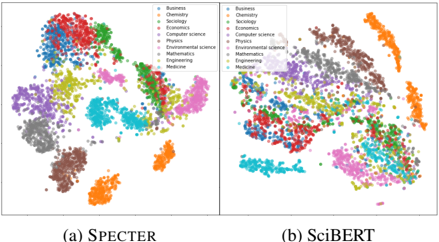
- t-SNE clustering quality for SPECTER is homogeneity 0.41 and completeness 0.72, compared with SciBERT’s 0.19 and 0.63.
Methods
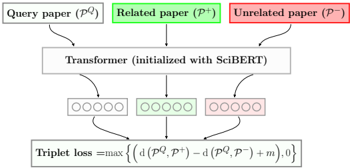
- SPECTER initializes from SciBERT, encodes the concatenated title and abstract, and uses the final [CLS] pooled output as the paper vector. It pretrains with a triplet margin loss on the citation graph: query paper, positive cited paper, and negative uncited paper, using L2 distance and margin m=1. Hard negatives are citations of citations; training uses 2 hard negatives and 3 easy negatives per query.
- Training data: a Semantic Scholar subset of about 146K query papers (~26.7M tokens) and 32K validation papers, yielding about 684K training triples and 145K validation triples. Training uses Adam with LR 2e-5, slanted triangular LR, 2 epochs, batch size 4 with gradient accumulation for effective batch size 32, on a single Titan V GPU.
- Evaluation: SCIDOCS covers seven tasks—MeSH classification (23K papers, 11 disease classes), MAG topic classification (25K papers, 19 level-1 classes), direct citation prediction (~30K total papers; 1K queries, up to 5 cited and 25 uncited candidates), co-citation (30K), co-views (~30K), co-reads (~30K), and recommendation (22K clickthrough events; 20K/1K/1K split; propensity-adjusted P@1 and nDCG). Baselines include SIF, SciBERT, Sent-BERT, Citeomatic, and SGC; classification uses a linear SVM, and recommendation uses a feedforward ranking network with ten features including cosine embedding distance.
Limitations
- Stated: SPECTER uses only title and abstract; adding full text could improve accuracy, but full text is often not freely available and Transformer memory limits would require new techniques. Venue metadata was not normalized, and author names were sparse/out-of-vocabulary; adding authors or venues did not help and authors hurt performance.
- Stated: On the recommendation task, differences between embedding methods are generally smaller because embeddings are used alongside several other informative features, limiting their impact on overall performance.
- Evident from the text: evaluation is limited to scientific documents and the released SCIDOCS tasks, with no evidence for other domains or languages; the online A/B test covers one production recommender and 4,113 clicks, so broader deployment evidence is not provided.
Model-written summary. Check it against the paper before relying on it.
Integrity signals
Registry
Cites
Statistics
Figures
Verification
Claims the paper makes
1 Valid · 2 Not valid · 17 Not checked · 56 Own results and interpretations
Every source the paper cites for this claim was checked and supports it.
In the paper
“This is because SciBERT, like other pretrained language models, is trained via language modeling objectives, which only predict words or sentences given their in-document, nearby textual context.”
§ SPECTER: Document-level Representation Learning using Citation-informed Transformers > Document Representation
What the sources say
- Supportedcites Beltagy et al., 2019 matched to “SciBERT: A Pretrained Language Model for Scientific Text” (2019) source
The Methods (Sec. 2, Background) states that SciBERT follows BERT's architecture and pretraining tasks — 'predicting randomly masked tokens and predicting whether two sentences follow each other' — i.e. word-level and sentence-level objectives. The Corpus paragraph of Sec. 2 and Sec. 3.3 show these instances are built from the full text of papers with sentences split and packed up to 128/512 tokens, so the context the objectives use is nearby, in-document text. The Introduction likewise groups SciBERT with ELMo, GPT and BERT as unsupervised pretrained language models, covering the 'like other pretrained language models' clause. (LLM, conf=0.85)
plainstates a cause- Asserted: passes — The authors put it forward as true.
- Checkable: passes — It can be checked against evidence.
- Load-bearing: passes — The paper’s conclusions depend on it.
- Based: passes — The paper gives a reason why it holds.
- Supported
A result the paper states — it cites no source for it, so there is none to check. The quote shows it is in the paper.
In the paper
“On the recommendations task, as opposed to previous experiments, the differences in method scores are generally smaller.”
§ SPECTER: Document-level Representation Learning using Citation-informed Transformers > 5 Results
plain- Asserted: passes — The authors put it forward as true.
- Checkable: passes — It can be checked against evidence.
- Load-bearing: unclear — It is unclear whether the paper’s conclusions depend on it.
- Based: passes — The paper gives a reason why it holds.
A result the paper reports from its own data — it cites no other source for it, so there is none to check. The quote shows it is in the paper.
In the paper
“We found that these pretrained embeddings substantially outperform alternative off-theshelf embeddings.”
§ SPECTER: Document-level Representation Learning using Citation-informed Transformers > 3. Fasttext-Sum
plainstates a cause- Asserted: passes — The authors put it forward as true.
- Checkable: passes — It can be checked against evidence.
- Load-bearing: unclear — It is unclear whether the paper’s conclusions depend on it.
- Based: passes — The paper gives a reason why it holds.
A result the paper reports from its own data — it cites no other source for it, so there is none to check. The quote shows it is in the paper.
In the paper
“As we show in our experiments ( §6), including hard negatives results in more accurate embeddings compared to using random negatives alone.”
§ SPECTER: Document-level Representation Learning using Citation-informed Transformers > 2.4 Selecting Negative Distractors
plainstates a cause- Asserted: passes — The authors put it forward as true.
- Checkable: passes — It can be checked against evidence.
- Load-bearing: passes — The paper’s conclusions depend on it.
- Based: passes — The paper gives a reason why it holds.
- Rests on an assumption not shown here.
A result the paper states — it cites no source for it, so there is none to check. The quote shows it is in the paper.
In the paper
“We achieve substantial improvements over the strongest of a wide variety of baselines, demonstrating the effectiveness of our model.”
§ SPECTER: Document-level Representation Learning using Citation-informed Transformers > 8 Conclusions and Future Work
boostedstates a cause- Asserted: passes — The authors put it forward as true.
- Checkable: passes — It can be checked against evidence.
- Load-bearing: passes — The paper’s conclusions depend on it.
- Based: passes — The paper gives a reason why it holds.
25 more claims
Create a free account to see all 76 claims and to verify the 18 references still open.
- It may state two separate claims as one. 22
- Probably not a substantial claim. 29
- The quote only partly states this claim. 1
Claims other papers make about this one
Each is checked against this paper’s own text: does it say what the citing paper says it does?
In the citing paper
“Covered model families span content-and embedding-based methods (e.g.,TF-IDF [63], BM25 [59] , SPECTER/SciBERT [17] ), graph-and HIN/GNN-based methods (GraphSAGE, Graph Attention Networks (GATs), meta-path reasoning), and hybrid/LLM pipelines (prompting, re-ranking, RAG).”
From A Critical Review on Citation Recommendation Systems Through a Graph-Centric Approach (2026) · cites this paper as [17]
Citations
Cites
Vaswani, A., Shazeer, N., Parmar, N., Uszkoreit, J., Jones, L., Gomez, A. N., Kaiser, L., & Polosukhin, I. (2017) · arXiv · doi:10.48550/arxiv.1706.03762 · Cited by 120,404
Adam: A Method for Stochastic Optimization
Kingma, D. P., & Ba, J. (2014) · arXiv · doi:10.48550/arxiv.1412.6980 · Cited by 98,946
BERT: Pre-training of Deep Bidirectional Transformers for Language Understanding
Devlin, J., Chang, M.-W., Lee, K., & Toutanova, K. (2018) · arXiv · doi:10.48550/arxiv.1810.04805 · Cited by 73,173
Scikit-learn: Machine Learning in Python
Pedregosa, F., Varoquaux, G., Gramfort, A., Michel, V., Thirion, B., Grisel, O., Blondel, M., Müller, A., Nothman, J., Louppe, G., et al. (2012) · arXiv · doi:10.48550/arxiv.1201.0490 · Cited by 71,016
BERT: Pre-training of Deep Bidirectional Transformers for Language Understanding
Devlin, J., Chang, M.-W., Lee, K., & Toutanova, K. (2019) · Proceedings of the 2019 Conference of the North American Chapter of the Association for Computational Linguistics: Human Language Technologies, Volume 1 (Long and Short Papers) · doi:10.18653/v1/n19-1423 · Cited by 54,325
Semi-supervised classification with graph convolutional networks
Kipf, T. N., & Welling, M. (2016) · arXiv · doi:10.48550/arxiv.1609.02907 · Cited by 24,853
(1996) · Cited by 20,179
RoBERTa: A Robustly Optimized BERT Pretraining Approach
Liu, Y., Ott, M., Goyal, N., Du, J., Joshi, M., Chen, D., Levy, O., Lewis, M., Zettlemoyer, L., & Stoyanov, V. (2019) · arXiv · doi:10.48550/arxiv.1907.11692 · Cited by 16,515
Sentence-BERT: Sentence Embeddings using Siamese BERT-Networks
Reimers, N., & Gurevych, I. (2019) · Proceedings of the 2019 Conference on Empirical Methods in Natural Language Processing and the 9th International Joint Conference on Natural Language Processing (EMNLP-IJCNLP) · doi:10.18653/v1/d19-1410 · Cited by 12,778
Deep Contextualized Word Representations
Peters, M., Neumann, M., Iyyer, M., Gardner, M., Clark, C., Lee, K., & Zettlemoyer, L. (2018) · Proceedings of the 2018 Conference of the North American Chapter of the Association for Computational Linguistics: Human Language Technologies, Volume 1 (Long Papers) · doi:10.18653/v1/n18-1202 · Cited by 11,983
Research works printed but not linked: 2
- William L. Hamilton, Zhitao Ying, and Jure Leskovec. 2017b. Inductive representation learning on large graphs. In NIPS.
- Alec Radford, Karthik Narasimhan, Tim Salimans, and Ilya Sutskever. 2018. Improving language under- standing by generative pre-training. arXiv.
Cited by
Items 401–500 of 1,111
Revealing the Blind Spot of Sentence Encoder Evaluation by HEROS
Chiang, C.-H., Lee, H.-Y., Chuang, Y.-S., & Glass, J. R. (2023) · Workshop on Representation Learning for NLP (RepL4NLP) · doi:10.18653/v1/2023.repl4nlp-1.24 · Cited by 7
Validating Synthetic Usage Data in Living Lab Environments
Breuer, T., Fuhr, N., & Schaer, P. (2023) · Journal of Data and Information Quality · doi:10.1145/3623640 · Cited by 6
HALvest-Contrastive: Retrieval-like Authorship Attribution with Patch-level Late Interaction
Kulumba, F., Antoun, W., Vimont, G., Romary, L., & Cafiero, F. (2026) · Conference on Empirical Methods in Natural Language Processing (EMNLP) · doi:10.18653/2026.emnlp-main.2660 · Cited by 6
SciXGen: A Scientific Paper Dataset for Context-Aware Text GenerationPreprint
Chen, H., Takamura, H., & Nakayama, H. (2021) · arXiv (Cornell University) · doi:10.48550/arxiv.2110.10774 · Cited by 6
Yousuf, R. B., Biswas, S., Kaushal, K. K., Dunham, J., Gelles, R., Muthiah, S., Self, N., Butler, P. J., & Ramakrishnan, N. (2022) · arXiv (Cornell University) · doi:10.48550/arxiv.2207.04029 · Cited by 6
Logic Mill -- A Knowledge Navigation SystemPreprint
Erhardt, S., Ghosh, M., Buunk, E., Rose, M. E., & Harhoff, D. (2023) · arXiv (Cornell University) · doi:10.48550/arxiv.2301.00200 · Cited by 6
Contrastive Retrieval Heads for Improved Attention-Based RerankingPreprint
Tran, L. Q., Li, Y., Florian, R., Patterson, S., Milanova, A., & Sun, W. (2025) · arXiv (Cornell University) · doi:10.48550/arxiv.2510.02219 · Cited by 6
Teaching Dense Retrieval Models to Specialize with Listwise Distillation and LLM Data AugmentationPreprint
Tamber, M. S., Kazi, S., Sourabh, V., & Lin, J. (2025) · arXiv (Cornell University) · doi:10.48550/arxiv.2502.19712 · Cited by 6
From Topology to Retrieval: Decoding Embedding Spaces with Unified SignaturesPreprint
Rottach, F., Rudman, W., Rieck, B., Scells, H., & Eickhoff, C. (2025) · arXiv (Cornell University) · doi:10.48550/arxiv.2511.22150 · Cited by 6
Semi-automating the Scoping Review Process: Is it Worthwhile? A Methodological Evaluation
Zhang, S., Palaguachi, C., Pitera, M., Jaldi, C. D., Schroeder, N. L., Botelho, A. F., & Gladstone, J. R. (2024) · Educational Psychology Review · doi:10.1007/s10648-024-09972-0 · Cited by 5
GRIL: Knowledge Graph Retrieval-Integrated Learning with Large Language Models
Chen, J., Zhang, H., Yun, S., Mottini, A., Ying, R., Song, X., Ioannidis, V. N., Zheng, L., & Cui, Q. (2025) · Findings of the Association for Computational Linguistics: EMNLP (Findings of EMNLP) · doi:10.18653/v1/2025.findings-emnlp.886 · Cited by 5
Learning Task-Agnostic Representations through Multi-Teacher Distillation
Formont, P., Darrin, M., Karimian, B., Granger, E., Cheung, J. C., Ayed, I. B., Shateri, M., & Piantanida, P. (2025) · neural information processing systems · doi:10.52202/085713-3664 · Cited by 5
EmoRAG: Evaluating RAG Robustness to Symbolic Perturbations
Zhou, X., Li, X., Peng, Y., Xu, M. S., Zhang, X., Yu, M., Wang, Y., Jia, X., Wang, K., Wen, Q., et al. (2026) · ACM SIGKDD Conference on Knowledge Discovery and Data Mining (KDD) · doi:10.1145/3770854.3780238 · Cited by 5
Citation importance-aware document representation learning for large-scale science mapping
Liang, Z., van Eck, N. J., Wu, X., Mao, J., & Li, G. (2025) · Information Processing & Management · doi:10.1016/j.ipm.2025.104557 · Cited by 5
FOS: a large-scale temporal graph benchmark for scientific interdisciplinary link prediction
Rezaee, K., Ziabakhsh, M., Nikfarjam, N., Ghassemi, M. M., Jouryabi, Y. R., Eskandari, S., & Lashgari, R. (2026) · Scientometrics · doi:10.1007/s11192-026-05851-3 · Cited by 5
Yin, D., Yu hai, W. A. N. G., Liu, H., Li, Z., & Tang, L. (2026) · Journal of Chinese Political Science · doi:10.1007/s11366-026-09932-1 · Cited by 5
Deepening citation understanding in scientific literature via LLM-powered context extraction
Nguyen, T. H., Pruski, C., & Silveira, M. D. (2026) · Scientometrics · doi:10.1007/s11192-026-05637-7 · Cited by 5
G$$^{{\textbf {2}}}$$rammar: Bilingual Grammar Modeling for Enhanced Text-Attributed Graph Learning
Zheng, H., You, H., Liu, Z., Zhang, Z., Gan, L., Zhang, H., Huang, W., & Huang, J. (2026) · Lecture notes in computer science · doi:10.1007/978-981-92-0366-6_28 · Cited by 5
Fight Against the Mandatory COVID-19 Immunity Passport on Twitter: Natural Language Processing Study
Gable, J. S. M., Sauvayre, R., & Chauvière, C. (2023) · Journal of Medical Internet Research · doi:10.2196/49435 · Cited by 5
Content- and Topology-Aware Representation Learning for Scientific Multi-Literature
Zhang, K., Song, K., Kang, Y., & Liu, X. (2023) · Conference on Empirical Methods in Natural Language Processing (EMNLP) · doi:10.18653/v1/2023.emnlp-main.465 · Cited by 5
Leto, A., Roy, S., Hoyle, A., Acuna, D. E., & Pacheco, M. L. (2024) · Workshop on Natural Language Processing and Computational Social Science (NLP+CSS) · doi:10.18653/v1/2024.nlpcss-1.11 · Cited by 5
GenGO: ACL Paper Explorer with Semantic Features
Takeshita, S., Ponzetto, S. P., & Eckert, K. (2024) · Proceedings of the conference - Association for Computational Linguistics. Meeting · doi:10.18653/v1/2024.acl-demos.12 · Cited by 5
Ferro, N., & Maistro, M. (2024) · ACM eBooks · doi:10.1145/3674127.3674132 · Cited by 6
Zhang, J., Gruber, S., & Frietsch, R. (2025) · Journal of Data and Information Science · doi:10.2478/jdis-2025-0028 · Cited by 5
tRAG: Term-level Retrieval-Augmented Generation for Domain-Adaptive Retrieval
Lee, D., Kim, J., Kim, J., Hwang, S.-W., & Park, J. (2025) · Conference of the North American Chapter of the Association for Computational Linguistics: Human Language Technologies (NAACL-HLT) · doi:10.18653/v1/2025.naacl-long.334 · Cited by 6
An active learning-based approach for screening scholarly articles about the origins of SARS-CoV-2
An, X., Zhang, M., & Xu, S. (2022) · PLoS ONE · doi:10.1371/journal.pone.0273725 · Cited by 5
Quantifying the Topic Disparity of Scientific Articles
Kim, M., Yoon, J., Jung, W., & Kim, H. (2022) · International World Wide Web Conference (WWW) · doi:10.1145/3487553.3524655 · Cited by 5
Graph Embedding for Mapping Interdisciplinary Research Networks
Cunningham, E., & Greene, D. (2023) · International World Wide Web Conference (WWW) · doi:10.1145/3543873.3587570 · Cited by 5
Newton, A. J. H., Chartash, D., Kleinstein, S. H., & McDougal, R. A. (2023) · BMC Bioinformatics · doi:10.1186/s12859-023-05397-8 · Cited by 5
Transitioning from benchmarks to a real-world case of information-seeking in Scientific Publications
Tahri, C., Bochnakian, A., Haouat, P., & Tannier, X. (2023) · Findings of the Association for Computational Linguistics: ACL (Findings of ACL) · doi:10.18653/v1/2023.findings-acl.68 · Cited by 5
Noisy Self-Training with Synthetic Queries for Dense Retrieval
Jiang, F., Drummond, T. W., & Cohn, T. (2023) · Findings of the Association for Computational Linguistics: EMNLP (Findings of EMNLP) · doi:10.18653/v1/2023.findings-emnlp.803 · Cited by 5
Real-Time Ideation Analyzer and Information Recommender
Blazevic, M., Sina, L. B., Secco, C. A., Siegel, M., & Nazemi, K. (2024) · Electronics · doi:10.3390/electronics13091761 · Cited by 5
Yang, S., Liu, J., Jin, F., & Lu, Y. (2024) · Chinese Science Bulletin (Chinese Version) · doi:10.1360/tb-2024-0404 · Cited by 5
Gómez, E., Cuesta, H., Gkiokas, A., Gómez-Cañón, J. S., Porcaro, L., & Yesiler, F. (2024) · ACM eBooks · doi:10.1145/3674127.3702959 · Cited by 5
Verberne, S. (2024) · ACM eBooks · doi:10.1145/3674127.3674141 · Cited by 5
Tonellotto, N. (2024) · ACM eBooks · doi:10.1145/3674127.3674130 · Cited by 5
SurveySum: A Dataset for Summarizing Multiple Scientific Articles into a Survey Section
Fernandes, L. C., Guedes, G. B., Laitz, T., Almeida, T. S., Nogueira, R. F., Lotufo, R., & Pereira, J. (2025) · Lecture notes in computer science · doi:10.1007/978-3-031-79032-4_30 · Cited by 5
Artificial Intelligence in Evidence-Based Medicine: On the Verge of Breakthrough
Nowak, A. J. (2021) · Springer eBooks · doi:10.1007/978-3-030-58080-3_43-1 · Cited by 5
Zaikis, D., Kokkas, S., & Vlahavas, I. P. (2023) · Communications in computer and information science · doi:10.1007/978-3-031-34204-2_47 · Cited by 5
COVID-KOP: Integrating Emerging COVID-19 Data with the ROBOKOP DatabasePreprint
Korn, D., Bobrowski, T., Li, M., Kebede, Y., Wang, P., Owen, P., Vaidya, G., Muratov, E. N., Chirkova, R. Y., Bizon, C., et al. (2020) · ChemRxiv · doi:10.26434/chemrxiv.12462623 · Cited by 5
A Bi-metric Framework for Fast Similarity SearchPreprint
Xu, H., Silwal, S., & Indyk, P. (2024) · arXiv (Cornell University) · doi:10.48550/arxiv.2406.02891 · Cited by 5
Hindi-BEIR : A Large Scale Retrieval Benchmark in HindiPreprint
Acharya, A., Murthy, R., Kumar, V., & Sen, J. (2024) · arXiv (Cornell University) · doi:10.48550/arxiv.2408.09437 · Cited by 5
Customized Information and Domain-centric Knowledge Graph Construction with Large Language ModelsPreprint
Wawrzik, F., Plaue, M., Vekariya, S., & Grimm, C. (2024) · arXiv (Cornell University) · doi:10.48550/arxiv.2409.20010 · Cited by 5
BEIR-NL: Zero-shot Information Retrieval Benchmark for the Dutch LanguagePreprint
Banar, N., Lotfi, E., & Daelemans, W. M. P. (2024) · arXiv (Cornell University) · doi:10.48550/arxiv.2412.08329 · Cited by 5
Overview of the Plagiarism Detection Task at PAN 2025Preprint
Greiner-Petter, A., Fröbe, M., Wahle, J. P., Ruas, T., Gipp, B., Aizawa, A., & Potthast, M. (2025) · arXiv (Cornell University) · doi:10.48550/arxiv.2510.06805 · Cited by 5
Hierarchical Memorization in Large Language Models: Evidence from Citation GenerationPreprint
Niimi, J. (2025) · arXiv (Cornell University) · doi:10.48550/arxiv.2511.08877 · Cited by 5
CS-PaperSum: A Large-Scale Dataset of AI-Generated Summaries for Scientific PapersPreprint
Liu, J., Vats, A., & He, Z. (2025) · arXiv (Cornell University) · doi:10.48550/arxiv.2502.20582 · Cited by 5
Navigating Ideation Space: Decomposed Conceptual Representations for Positioning Scientific IdeasPreprint
Liu, M., Shen, Y., Zhou, D., & Huang, L. (2026) · arXiv (Cornell University) · doi:10.48550/arxiv.2601.08901 · Cited by 5
A Critical Review on Citation Recommendation Systems Through a Graph-Centric Approach
Kefalas, P., Ali, Z., & Manolopoulos, Y. (2026) · SN Computer Science · doi:10.1007/s42979-026-04848-2 · Cited by 4
Usefulness of LLMs as an Author Checklist Assistant for Scientific Papers: NeurIPS'24 Experiment
Goldberg, A., Ullah, I., Khuong, T. G. H., Rachmat, B. K., Xu, Z., Guyon, I., & Shah, N. B. (2024) · arXiv · doi:10.48550/arxiv.2411.03417 · Cited by 4
Korkmaz, B. S., & del Rio‐Chanona, E. A. (2024) · Workshop on Scholarly Document Processing (SDP) · doi:10.18653/v1/2024.sdp-1.28 · Cited by 4
Liang, Y., Poesio, M., & Rezvani, R. (2025) · Workshop on Biomedical Language Processing (BioNLP) · doi:10.18653/v1/2025.bionlp-1.25 · Cited by 4
NSF-SciFy: Mining the NSF Awards Database for Scientific Claims
Rao, D., You, W., Wong, E., & Callison-Burch, C. (2025) · Proceedings of the conference - Association for Computational Linguistics. Meeting · doi:10.18653/v1/2025.newsum-main.13 · Cited by 5
Semantic search approach for information extraction from traffic crash narratives
Arteaga, C., Ray, U., Park, J., & Paz, A. (2026) · Transportation Research Interdisciplinary Perspectives · doi:10.1016/j.trip.2026.101888 · Cited by 4
ReAttn: Improving Attention-based Re-ranking via Attention Re-weighting
Tian, Y., Mo, F., Zhang, W., Qi, Y., & Nie, J. (2026) · Findings of the Association for Computational Linguistics: EACL · doi:10.18653/v1/2026.findings-eacl.66 · Cited by 4
Contradictions in Context: Challenges for Retrieval-Augmented Generation in Healthcare
Javadi, S., Mirabi, S., Gangar, M., & Ofoghi, B. (2026) · Lecture notes in computer science · doi:10.1007/978-3-032-21289-4_3 · Cited by 5
PeeriScope: A Multi-Faceted Framework for Evaluating Peer Review Quality
Ebrahimi, S., Sadeghian, S., Ghorbanpour, A., Arabzadeh, N., Salamat, S., Hosseini, S. M., Le, H. S., Bashari, M., & Bagheri, E. (2026) · International World Wide Web Conference (WWW) · doi:10.1145/3774905.3793128 · Cited by 4
ELICE: Embedding Language through Informative Contrastive-Encoder
Chiao, C.-S., & Lin, D.-T. (2023) · Expert Systems with Applications · doi:10.1016/j.eswa.2023.120523 · Cited by 4
Using similarity network analysis to improve text similarity calculations
Witschard, D., Kucher, K., Jusufi, I., & Kerren, A. (2025) · Applied Network Science · doi:10.1007/s41109-025-00699-7 · Cited by 4
Facilitating interdisciplinary knowledge transfer with research paper recommender systems
Cunningham, E., Smyth, B., & Greene, D. (2025) · Quantitative Science Studies · doi:10.1162/qss.a.9 · Cited by 5
GenGO Ultra: an LLM-powered ACL Paper Explorer
Takeshita, S., Tsereteli, T., & Ponzetto, S. P. (2025) · Proceedings of the conference - Association for Computational Linguistics. Meeting · doi:10.18653/v1/2025.acl-demo.24 · Cited by 4
LG4AV: Combining Language Models and Graph Neural Networks for Author Verification
Stubbemann, M., & Stumme, G. (2022) · Lecture notes in computer science · doi:10.1007/978-3-031-01333-1_25 · Cited by 4
The evolution of scientific literature as metastable knowledge states
Koneru, S., McCauley, D. R., Smith, M. C., Guarrera, D., Robinson, J., & Rajtmajer, S. M. (2023) · PLoS ONE · doi:10.1371/journal.pone.0287226 · Cited by 4
Menad, S., Abdeddaïm, S., & Soualmia, L. F. (2023) · Lecture notes in computer science · doi:10.1007/978-3-031-42935-4_3 · Cited by 4
Back, H. D. M., Pottmaier, D., Andreusi, C. K., & Alarcon, O. E. (2023) · Environmental Science Advances · doi:10.1039/d3va00106g · Cited by 4
Paper Recommendation Using SPECTER with Low-Rank and Sparse Matrix Factorization
Guo, P., Zhou, G., Lu, J., Li, Z., & Zhu, T. (2024) · KSII Transactions on Internet and Information Systems · doi:10.3837/tiis.2024.05.002 · Cited by 4
Artificial Intuition: Efficient Classification of Scientific Abstracts
Sakhrani, H., Pervez, N., Ravikumar, A., Morstatter, F., Graddy‐Reed, A., & Belz, A. P. (2024) · Workshop on Scholarly Document Processing (SDP) · doi:10.18653/v1/2024.sdp-1.18 · Cited by 4
DATA-CUBE: Data Curriculum for Instruction-based Sentence Representation Learning
Min, Y., Zhou, K., Gao, D., Zhao, X., Hu, H., & Li, Y. (2024) · Findings of the Association for Computational Linguistics: ACL (Findings of ACL) · doi:10.18653/v1/2024.findings-acl.816 · Cited by 4
Fields, Bridges, and Foundations: How Researchers Browse Citation Network Visualizations
Choe, K., Kim, E., Park, S., & Seo, J. (2024) · Visualization · doi:10.1109/vis55277.2024.00037 · Cited by 4
FedSum: Data-Efficient Federated Learning Under Data Scarcity Scenario for Text Summarization
Ma, Z., Li, Z.-P., Shi, Y., & Chen, J. (2025) · Proceedings of the AAAI Conference on Artificial Intelligence · doi:10.1609/aaai.v39i18.34129 · Cited by 4
The influence of grant renewal on research content: evidence from NIH-funded PIs
Li, B., & Bai, A. (2025) · Scientometrics · doi:10.1007/s11192-025-05295-1 · Cited by 4
Bibliographic network enhanced local citation recommendation
Jiang, T., Xu, Z., Wu, C., & Zhao, D. (2025) · The Electronic Library · doi:10.1108/el-08-2024-0251 · Cited by 4
Predicting the Trending Research Topics by Deep Neural Network Based Content Analysis
Yukselen, M., Mutlu, A., & Karagöz, P. (2022) · IEEE Access · doi:10.1109/access.2022.3202654 · Cited by 4
An Efficient Self-Supervised Cross-View Training For Sentence Embedding
Limkonchotiwat, P., Ponwitayarat, W., Lowphansirikul, L., Udomcharoenchaikit, C., Chuangsuwanich, E., & Nutanong, S. Y. (2023) · Transactions of the Association for Computational Linguistics · doi:10.1162/tacl_a_00620 · Cited by 4
LD Connect: A Linked Data Portal for IOS Press Scientometrics
Liu, Z., Shi, M., Janowicz, K., Regalia, B., Delbecque, S., Mai, G., Zhu, R., & Hitzler, P. (2022) · Lecture notes in computer science · doi:10.1007/978-3-031-06981-9_19 · Cited by 4
Improving Large-Scale k-Nearest Neighbor Text Categorization with Label Autoencoders
Ribadas, F. J., Cao, S., & Bilbao, V. M. D. (2022) · Mathematics · doi:10.3390/math10162867 · Cited by 4
Guan, S., & Jiang, T. (2022) · International Conference on Machine Learning, Big Data and Business Intelligence (MLBDBI) · doi:10.1109/mlbdbi58171.2022.00078 · Cited by 4
PGB: A PubMed Graph Benchmark for Heterogeneous Network Representation Learning
Lee, E. W., & Ho, J. C. (2023) · ACM International Conference on Information and Knowledge Management (CIKM) · doi:10.1145/3583780.3615128 · Cited by 4
Schoeberl, C., Toney, A., & Dunham, J. (2023) · doi:10.51593/20220030 · Cited by 4
Towards building a monitoring platform for a challenge-oriented smart specialisation with RIS3-MCATPreprint
Fuster, E., Fernández, T., Carretero, H., Durán-Silva, N., Guixé, R., Pujol, J., Rondelli, B., Rull, G., Cortijo-Arellano, M., & Romagosa, M. (2024) · arXiv (Cornell University) · doi:10.48550/arxiv.2401.10900 · Cited by 4
LLM-Oriented Retrieval TunerPreprint
Sun, S., Zhang, H., Liu, Z., Bao, J., & Song, D. (2024) · arXiv (Cornell University) · doi:10.48550/arxiv.2403.01999 · Cited by 4
Learning representations of learning representationsPreprint
González-Márquez, R., & Kobak, D. (2024) · arXiv (Cornell University) · doi:10.48550/arxiv.2404.08403 · Cited by 4
Menke, J. D., Ming, S., Radhakrishna, S., Kilicoglu, H., & Smalheiser, N. R. (2025) · medRxiv · doi:10.1101/2025.04.23.25326300 · Cited by 4
Evaluating Medical LLMs by Levels of Autonomy: A Survey Moving from Benchmarks to ApplicationsPreprint
Ye, X., Dineen, J., Li, Z., Xu, Z., Chen, W., Lu, S., Huang, Y., Shen, M., Tran, P., Yum, J.-E. I., et al. (2025) · arXiv (Cornell University) · doi:10.48550/arxiv.2510.17764 · Cited by 4
Wang, R., Xie, Y., Hu, X., Yang, C., & Lu, J. J.-Q. (2025) · arXiv (Cornell University) · doi:10.48550/arxiv.2511.12821 · Cited by 4
Horizon Scans can be accelerated using novel information retrieval and artificial intelligence toolsPreprint
Schmidt, L., Sharma, O., Marshall, C., & Gonzalez-Moral, S. G. (2025) · arXiv (Cornell University) · doi:10.48550/arxiv.2504.01627 · Cited by 4
VizCV: AI-assisted visualization of researchers' publications tracksPreprint
Lazárik, V., Agus, M., Kozlíková, B., & Vázquez, P. (2025) · arXiv (Cornell University) · doi:10.48550/arxiv.2505.08691 · Cited by 4
The Incomplete Bridge: How AI Research (Mis)Engages with PsychologyPreprint
Jiang, H., Wang, P., Yi, X., Xie, X., & Xiao, Z. (2025) · arXiv (Cornell University) · doi:10.48550/arxiv.2507.22847 · Cited by 4
Anastasiou, L. (2023) · Open Research Online (The Open University) · doi:10.21954/ou.ro.00017252 · Cited by 4
Kuo, T.-L., Chiu, W.-N., Ma, W.-Y., & Cheng, P.-J. (2025) · arXiv (Cornell University) · doi:10.48550/arxiv.2510.09557 · Cited by 4
SciNet: Evaluating AI Agents in Relation-Aware Scientific Literature RetrievalPreprint
Shao, C., Xu, F., & Li, Y. (2026) · arXiv (Cornell University) · doi:10.48550/arxiv.2601.03260 · Cited by 4
Col-Bandit: Query-Time Top-$K$ Estimation for Late-Interaction RetrievalPreprint
Pony, R., Goldfarb, A. R., Naparstek, O., Friedman, I., Barzelay, U., & Schwartz, E. (2026) · arXiv (Cornell University) · doi:10.48550/arxiv.2602.02827 · Cited by 4
Adaptive auditing of AI systems with anytime-valid guaranteesPreprint
Zhou, S., Vossler, P., Sivaraman, V., Mai, Y., & Feng, J. (2026) · arXiv (Cornell University) · doi:10.48550/arxiv.2605.07002 · Cited by 4
ResearchStudio-Idea: An Evidence-Grounded Research-Ideation Skill Suite from ML Conference OutcomesPreprint
Zhao, Q., Huang, Y., Dai, Y., Xiao, L., Gao, Zhang, X., Wu, W., Li, S., He, Y., Lu, Y., et al. (2026) · arXiv (Cornell University) · doi:10.48550/arxiv.2607.04439 · Cited by 4
Assisting Human Decisions in Document Matching
Kim, J. S., Chen, V., Pruthi, D., Shah, N. B., & Talwalkar, A. (2023) · arXiv · doi:10.48550/arxiv.2302.08450 · Cited by 3
Reviewer2: Optimizing Review Generation Through Prompt Generation
Gao, Z., Brantley, K., & Joachims, T. (2024) · arXiv · doi:10.48550/arxiv.2402.10886 · Cited by 3
Speculative Exploration on the Concept of Artificial Agents Conducting Autonomous Research
Takagi, S. (2023) · arXiv · doi:10.48550/arxiv.2312.03497 · Cited by 3
Xi, H., Zhang, C., & Zhang, H. (2024) · ACM/IEEE Joint Conference on Digital Libraries · doi:10.1145/3677389.3702489 · Cited by 3
Scholar Inbox: Personalized Paper Recommendations for Scientists
Flicke, M., Angrabeit, G., Iyengar, M., Protsenko, V., Shakun, I., Cicvaric, J., Kargi, B., He, H., Schuler, L., Scholz, L., et al. (2025) · Proceedings of the conference - Association for Computational Linguistics. Meeting · doi:10.18653/v1/2025.acl-demo.30 · Cited by 3
Metadata
- Authors
- Cohan, A., Feldman, S., Beltagy, I., Downey, D., & Weld, D.
- Affiliations
- Allen Institute for Artificial Intelligence (US)
- University of Washington (US)
- Venue
- Proceedings of the 58th Annual Meeting of the Association for Computational Linguistics
- Published
- 2020
- Pages
- 2270-2282
- ISSN
- 0736-587X (ISSN-L)
- OpenAlex
- W3016913119
- Cited by
- 1,108
- References
- 62
- Citations by year
- 2026: 364 · 2025: 244 · 2024: 178 · 2023: 157 · 2022: 113 · 2021: 44 · 2020: 8
- FWCI
- 21.99
- Type
- conference paper
- Language
- en
- Open access
- hybrid
- doi.org
- Licence
- cc-by
- Locations
- Proceedings of the conference - Association for Computational Linguistics. Meeting (publishedVersion, cc-by)
- arXiv (Cornell University) (submittedVersion, cc-by)
- arXiv (Cornell University) (submittedVersion)
- arXiv (Cornell University) (cc-by)
- Zenodo (CERN European Organization for Nuclear Research) (cc-by)
- Funders
- National Science Foundation (1936940)
- University of Washington
- Office of Naval Research (N00014- 18-1-2193)
- Topics
- Physical Sciences › Computer Science › Artificial Intelligence › Topic Modeling
- Physical Sciences › Computer Science › Computer Vision and Pattern Recognition › Multimodal Machine Learning Applications
- Physical Sciences › Computer Science › Information Systems › Recommender Systems and Techniques
- Keywords
- citation networks, citation prediction, scientific documents, transformer language models, pre-training, document classification, recommendations
About these checks
Registry, retraction, Cites and statistics results are computed, not judged, with one exception: a printed reference that no index lists is read once by a model before it counts as a citation error. Claims are extracted by a model and kept only when their quote appears verbatim in the text; each cited source is then checked, with a model’s help, for whether it says what the claim relies on. Those verdicts can be wrong — read the claim’s quote and the cited source before relying on one.
A language model drew the claims from the paper on 2026-11-18, under version 3 of the claim definition (model deepseek-v4.1-flash, prompt extract-v3).
A second model labelled each claim on 2026-11-18 (model jev-1.13-20260917, definition revision gold-guideline-v0.2).
Cited sources are checked with a language model’s help (qwen3.8-omni-flash).
Statistics and arithmetic are recomputed, not judged.
Confidence bands are shown only for fields calibrated on our annotated test set. None is calibrated yet, so no band is shown.
What counts as a claim ›How we measure confidence ›How we check this ›
Are you an author, or do you see a problem with this page? Request a review
Data sources
Bibliographic data: Semantic Scholar, OpenAlex, Crossref.
Contains information from the Semantic Scholar Academic Graph Datasets, made available under the ODC Attribution License (ODC-BY 1.0).
Semantic Scholar’s data is described in: Kinney, R., et al. (2023). The Semantic Scholar Open Data Platform. arXiv:2301.10140.
