

Is ChatGPT a General-Purpose Natural Language Processing Task Solver?
Open accessThe DOI matches its Crossref record; 42 of the 44 references it cites were found in a registry or an index, and 2 are not checked yet.
Abstract
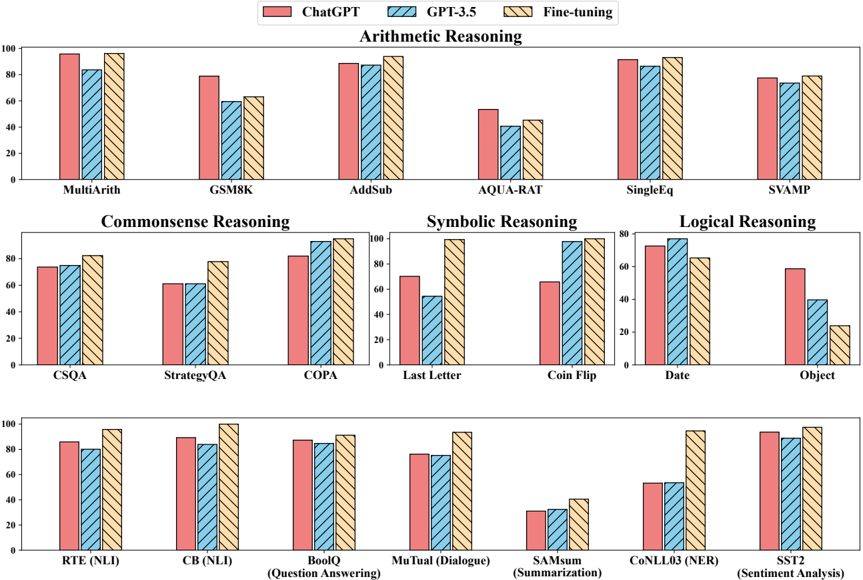
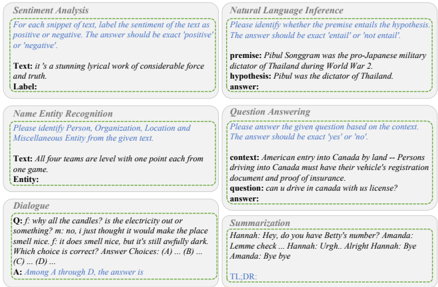
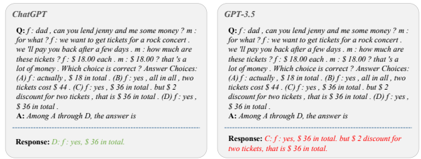
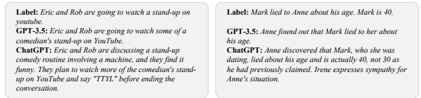
Spurred by advancements in scale, large language models (LLMs) have demonstrated the ability to perform a variety of natural language processing (NLP) tasks zero-shot-i.e., without adaptation on downstream data.Recently, the debut of ChatGPT 1 has drawn a great deal of attention from the natural language processing (NLP) community due to the fact that it can generate high-quality responses to human input and self-correct previous mistakes based on subsequent conversations.However, it is not yet known whether ChatGPT can serve as a generalist model that can perform many NLP tasks zero-shot.In this work, we empirically analyze the zero-shot learning ability of ChatGPT by evaluating it on 20 popular NLP datasets covering 7 representative task categories.With extensive empirical studies, we demonstrate both the effectiveness and limitations of the current version of ChatGPT.We find that ChatGPT performs well on many tasks favoring reasoning capabilities (e.g., arithmetic reasoning) while it still faces challenges when solving specific tasks such as sequence tagging.We additionally provide in-depth analysis through qualitative case studies.
Overview
The claims and statistics of this paper haven’t been checked yet.
Free: it reads the open-access text and checks the first 5 claims that cite a source we can check. Create a free account to check every claim.
Integrity signals
Registry
Cites
Statistics
Figures

Verification
Claims the paper makes
The claims and statistics of this paper haven’t been checked yet.
Free: it reads the open-access text and checks the first 5 claims that cite a source we can check. Create a free account to check every claim.
Claims other papers make about this one
Each is checked against this paper’s own text: does it say what the citing paper says it does?
In the citing paper
“Large Language Models (LLMs) are capable of successfully performing many language processing tasks zero-shot (without training data).”
From Can Large Language Models Transform Computational Social Science? (2024) · cites this paper as Qin et al. 2023
Self-check
Percentages, sums and reported differences re-computed from the paper’s own numbers.
The self-check needs the paper’s full text.
Citations
Cites
BERT: Pre-training of Deep Bidirectional Transformers for Language Understanding
Devlin, J., Chang, M.-W., Lee, K., & Toutanova, K. (2019) · Proceedings of the 2019 Conference of the North American Chapter of the Association for Computational Linguistics: Human Language Technologies, Volume 1 (Long and Short Papers) · doi:10.18653/v1/n19-1423 · Cited by 54,325
Deep reinforcement learning from human preferences
Christiano, P., Leike, J., Brown, T. B., Martic, M., Legg, S., & Amodei, D. (2017) · arXiv · doi:10.48550/arxiv.1706.03741 · Cited by 7,379
Recursive Deep Models for Semantic Compositionality Over a Sentiment Treebank
Socher, R., Perelygin, A., Wu, J., Chuang, J., Manning, C. D., Ng, A., & Potts, C. (2013) · Proceedings of the 2013 Conference on Empirical Methods in Natural Language Processing · doi:10.18653/v1/d13-1170 · Cited by 6,878
Chain-Of-Thought Prompting Elicits Reasoning in Large Language Models
Wei, J., Wang, X., Schuurmans, D., Bosma, M., Ichter, B., Xia, F., Chi, E., Le, Q. V., & Zhou, D. (2022) · Advances in Neural Information Processing Systems 35 · doi:10.52202/068431-1800 · Cited by 4,505
Chain-of-Thought Prompting Elicits Reasoning in Large Language Models
Wei, J., Wang, X., Schuurmans, D., Bosma, M., Ichter, B., Xia, F., Chi, E., Le, Q., & Zhou, D. (2022) · arXiv · doi:10.48550/arxiv.2201.11903 · Cited by 4,263
BoolQ: Exploring the Surprising Difficulty of Natural Yes/No Questions
Clark, C., Lee, K., Chang, M.-W., Kwiatkowski, T., Collins, M., & Toutanova, K. (2019) · North American Chapter of the Association for Computational Linguistics · doi:10.18653/v1/n19-1300 · Cited by 2,998
CommonsenseQA: A Question Answering Challenge Targeting Commonsense Knowledge
Talmor, A., Herzig, J., Lourie, N., & Berant, J. (2019) · North American Chapter of the Association for Computational Linguistics · doi:10.18653/v1/n19-1421 · Cited by 2,836
PaLM: Scaling Language Modeling with Pathways
Chowdhery, A., Narang, S., Devlin, J., Bosma, M., Mishra, G., Roberts, A., Barham, P., Chung, H. W., Sutton, C., Gehrmann, S., et al. (2022) · arXiv · doi:10.48550/arxiv.2204.02311 · Cited by 2,590
Contextual String Embeddings for Sequence Labeling
Akbik, A., Blythe, D. A. J., & Vollgraf, R. (2018) · International Conference on Computational Linguistics · Cited by 1,755
The PASCAL Recognising Textual Entailment Challenge
Dagan, I., Glickman, O., & Magnini, B. (2006) · Lecture Notes in Computer Science · doi:10.1007/11736790_9 · Cited by 1,628
Cited by
Items 101–200 of 1,016
LLM4Vis: Explainable Visualization Recommendation using ChatGPT
Wang, L., Zhang, S., Wang, Y., Lim, E., & Wang, Y. (2023) · Conference on Empirical Methods in Natural Language Processing (EMNLP) · doi:10.18653/v1/2023.emnlp-industry.64 · Cited by 102
Laskar, M. T. R., Fu, X.-Y., Chen, C., & Shashi Bhushan, T. N. (2023) · Conference on Empirical Methods in Natural Language Processing (EMNLP) · doi:10.18653/v1/2023.emnlp-industry.33 · Cited by 101
Leveraging ChatGPT As Text Annotation Tool For Sentiment AnalysisPreprint
Belal, M., She, J. P. M., & Wong, S. (2023) · arXiv (Cornell University) · doi:10.48550/arxiv.2306.17177 · Cited by 101
Evaluating the logical reasoning ability of chatgpt and GPT-4
Liu, H., Ning, R., Teng, Z., Liu, J., Zhou, Q., & Zhang, Y. (2023) · arXiv · doi:10.48550/arxiv.2304.03439 · Cited by 100
Protecting Privacy in Multimodal Large Language Models with MLLMU-Bench
Liu, Z., Dou, G., Jia, M., Tan, Z., Zeng, Q., Yuan, Y., & Jiang, M. (2025) · Conference of the North American Chapter of the Association for Computational Linguistics: Human Language Technologies (NAACL-HLT) · doi:10.18653/v1/2025.naacl-long.207 · Cited by 99
FakeGPT: Fake News Generation, Explanation and Detection of Large Language ModelsPreprint
Huang, Y. F., & Sun, L. (2023) · arXiv (Cornell University) · doi:10.48550/arxiv.2310.05046 · Cited by 99
Lu, L.-C., Chen, S.-J., Pai, T.-M., Yu, C.-H., Lee, H.-Y., & Sun, S.-H. (2024) · arXiv (Cornell University) · doi:10.48550/arxiv.2405.06373 · Cited by 99
Exploring ChatGPT Capabilities and Limitations: A Survey
Koubaa, A., Boulila, W., Ghouti, L., Alzahem, A., & Latif, S. (2023) · IEEE Access · doi:10.1109/access.2023.3326474 · Cited by 97
Cambria, E., Zhang, X., Mao, R., Chen, M., & Kwok, K. (2024) · Lecture notes in computer science · doi:10.1007/978-3-031-76827-9_11 · Cited by 97
Li, J., Li, H., Pan, Z., Sun, D., Wang, J., Zhang, W., & Pan, G. (2023) · Findings of the Association for Computational Linguistics: EMNLP (Findings of EMNLP) · doi:10.18653/v1/2023.findings-emnlp.184 · Cited by 97
Jo, H., & Park, D.-H. (2023) · International Journal of Human-Computer Interaction · doi:10.1080/10447318.2023.2278283 · Cited by 97
Testing the Reliability of ChatGPT for Text Annotation and Classification: A Cautionary Remark
Reiss, M. (2023) · doi:10.31219/osf.io/rvy5p · Cited by 94
LLM for SoC Security: A Paradigm Shift
Saha, D., Tarek, S., Yahyaei, K., Saha, S. K., Zhou, J., Tehranipoor, M., & Farahmandi, F. (2024) · IEEE Access · doi:10.1109/access.2024.3427369 · Cited by 93
Is ChatGPT Equipped with Emotional Dialogue Capabilities?
Zhao, W., Zhao, Y., Lu, X., Wang, S., Tong, Y., & Qin, B. (2023) · arXiv · doi:10.48550/arxiv.2304.09582 · Cited by 92
Pu, D., & Demberg, V. (2023) · Proceedings of the conference - Association for Computational Linguistics. Meeting · doi:10.18653/v1/2023.acl-srw.1 · Cited by 92
A Systematic Study and Comprehensive Evaluation of ChatGPT on Benchmark Datasets
Laskar, M. T. R., Bari, M. S., Rahman, M., Bhuiyan, M. A. H., Joty, S., & Huang, J. (2023) · Findings of the Association for Computational Linguistics: ACL 2023 · doi:10.18653/v1/2023.findings-acl.29 · Cited by 91
When brain-inspired AI meets AGI
Zhao, L., Zhang, L., Wu, Z., Chen, Y., Dai, H., Yu, X., Liu, Z., Zhang, T., Hu, X., Jiang, X., et al. (2023) · Meta-Radiology · doi:10.1016/j.metrad.2023.100005 · Cited by 89
Dolmestch, R. N. (2023) · Derecho PUCP · doi:10.18800/derechopucp.202302.007 · Cited by 89
Knowledge Solver: Teaching LLMs to Search for Domain Knowledge from Knowledge GraphsPreprint
Feng, C., Zhang, X., & Fei, Z. (2023) · arXiv (Cornell University) · doi:10.48550/arxiv.2309.03118 · Cited by 89
Abdollahi, M., Yeganli, S. F., Baharloo, M. M., & Baniasadi, A. (2024) · Electronics · doi:10.3390/electronics14010120 · Cited by 87
Jo, H., & Park, D.-H. (2024) · Scientific Reports · doi:10.1038/s41598-024-57977-0 · Cited by 87
Large Language Model Agentic Approach to Fact Checking and Fake News Detection
Li, X., Zhang, Y., & Malthouse, E. C. (2024) · Frontiers in artificial intelligence and applications · doi:10.3233/faia240787 · Cited by 87
Pan, L., Saxon, M., Xu, W., Nathani, D., Wang, X., & Wang, W. Y. (2024) · Transactions of the Association for Computational Linguistics · doi:10.1162/tacl_a_00660 · Cited by 86
On the Robustness of ChatGPT: An Adversarial and Out-of-distribution Perspective
Wang, J., Hu, X., Hou, W., Chen, H., Zheng, R., Wang, Y., Yang, L., Huang, H., Ye, W., Geng, X., et al. (2023) · arXiv · doi:10.48550/arxiv.2302.12095 · Cited by 86
DeID-GPT: Zero-shot Medical Text De-Identification by GPT-4
Liu, Z., Huang, Y., Yu, X., Zhang, L., Wu, Z., Cao, C., Dai, H., Zhao, L., Li, Y., Shu, P., et al. (2023) · arXiv (Cornell University) · doi:10.48550/arxiv.2303.11032 · Cited by 85
Sentiment Analysis through LLM NegotiationsPreprint
Sun, X., Li, X.-Y., Zhang, S., Wang, S.-H., Wu, F., Li, J., Zhang, T.-W., & Wang, G.-Y. (2023) · arXiv.org · doi:10.48550/arxiv.2311.01876 · Cited by 32
Exploring the Limits of ChatGPT for Query or Aspect-based Text Summarization
Yang, X., Li, Y., Zhang, X., Chen, H., & Cheng, W. D. (2023) · arXiv (Cornell University) · doi:10.48550/arxiv.2302.08081 · Cited by 84
A New Benchmark and Reverse Validation Method for Passage-level Hallucination Detection
Yang, S., Sun, R., & Wan, X. (2023) · Findings of the Association for Computational Linguistics: EMNLP (Findings of EMNLP) · doi:10.18653/v1/2023.findings-emnlp.256 · Cited by 84
The Art of SOCRATIC QUESTIONING: Recursive Thinking with Large Language Models
Qi, J., Xu, Z., Shen, Y., Liu, M., Jin, D., Wang, Q., & Huang, L. (2023) · Conference on Empirical Methods in Natural Language Processing (EMNLP) · doi:10.18653/v1/2023.emnlp-main.255 · Cited by 82
Čegiň, J., Šimko, J., & Brusilovsky, P. L. (2023) · Conference on Empirical Methods in Natural Language Processing (EMNLP) · doi:10.18653/v1/2023.emnlp-main.117 · Cited by 82
Rethinking the Evaluation for Conversational Recommendation in the Era of Large Language Models
Wang, X., Tang, X., Zhao, X., Wang, J., & Wen, J.-R. (2023) · Proceedings of the 2023 Conference on Empirical Methods in Natural Language Processing · doi:10.18653/v1/2023.emnlp-main.621 · Cited by 81
Zhang, X., Li, S., Hauer, B., Shi, N., & Kondrak, G. (2023) · Proceedings of the 2023 Conference on Empirical Methods in Natural Language Processing · doi:10.18653/v1/2023.emnlp-main.491 · Cited by 81
Atreja, S., Ashkinaze, J., Li, L., Mendelsohn, J., & Hemphill, L. (2025) · Proceedings of the International AAAI Conference on Web and Social Media · doi:10.1609/icwsm.v19i1.35807 · Cited by 81
SGP-TOD: Building Task Bots Effortlessly via Schema-Guided LLM Prompting
Zhang, X., Peng, B., Li, K., Zhou, J., & Meng, H. M. L. (2023) · Findings of the Association for Computational Linguistics: EMNLP (Findings of EMNLP) · doi:10.18653/v1/2023.findings-emnlp.891 · Cited by 80
TARJAMAT: Evaluation of Bard and ChatGPT on Machine Translation of Ten Arabic Varieties
Kadaoui, K., Magdy, S. M., Waheed, A., Khondaker, M. T. I., El-Shangiti, A. O., Nagoudi, E. M. B., & Abdul-Mageed, M. (2023) · Arabic Natural Language Processing Conference (ArabicNLP) · doi:10.18653/v1/2023.arabicnlp-1.6 · Cited by 80
An empirical study of pre-trained language models in simple knowledge graph question answering
Hu, N., Wu, Y., Qi, G., Min, D., Chen, J., Pan, J. Z., & Ali, Z. (2023) · World Wide Web · doi:10.1007/s11280-023-01166-y · Cited by 78
Self-citationSkill-Based Few-Shot Selection for In-Context Learning
An, S., Zhou, B., Lin, Z., Fu, Q., Chen, B., Zheng, N., Chen, W., & Lou, J. (2023) · Conference on Empirical Methods in Natural Language Processing (EMNLP) · doi:10.18653/v1/2023.emnlp-main.831 · Cited by 78
Intent Detection in the Age of LLMs
Arora, G. S., Jain, S., & Merugu, S. (2024) · Conference on Empirical Methods in Natural Language Processing (EMNLP) · doi:10.18653/v1/2024.emnlp-industry.114 · Cited by 78
InFoBench: Evaluating Instruction Following Ability in Large Language Models
Qin, Y., Song, K., Hu, Y., Yao, W., Cho, S., Wang, X., Wu, X., Liu, F., Liu, P., & Yu, D. (2024) · Findings of the Association for Computational Linguistics ACL 2024 · doi:10.18653/v1/2024.findings-acl.772 · Cited by 77
Yes but.. Can ChatGPT Identify Entities in Historical Documents?
González-Gallardo, C.-E., Boroş, E., Girdhar, N., Hamdi, A. T. E., Moreno, J. G., & Doucet, A. (2023) · ACM/IEEE Joint Conference on Digital Libraries · doi:10.1109/jcdl57899.2023.00034 · Cited by 77
Using ChatGPT and Persuasive Technology for Personalized Recommendation Messages in Hotel Upselling
Remountakis, M., Kotis, K., Kourtzis, B., & Tsekouras, G. E. (2023) · Information · doi:10.3390/info14090504 · Cited by 77
Do Large Language Models Know about Facts?Preprint
Hu, X., Chen, J.-Z., Li, X.-C., Guo, Y., Wen, L.-J., Yu, P. S., & Guo, Z. (2023) · arXiv.org · doi:10.48550/arxiv.2310.05177 · Cited by 81
Self-citationPromptcblue: A Chinese Prompt Tuning Benchmark for the Medical DomainPreprint
Zhu, W., Wang, X., Zheng, H., Chen, M., & Tang, B. (2024) · SSRN Electronic Journal · doi:10.2139/ssrn.4685921 · Cited by 77
Zhang, A., Lipton, Z. C., Mu, L., & Smola, A. J. (2021) · arXiv (Cornell University) · doi:10.48550/arxiv.2106.11342 · Cited by 76
Self-citationBattle of the Wordsmiths: Comparing ChatGPT, GPT-4, Claude, and BardPreprint
Borji, A., & Mohammadian, M. (2023) · SSRN Electronic Journal · doi:10.2139/ssrn.4476855 · Cited by 76
A Preliminary Evaluation of ChatGPT for Zero-shot Dialogue UnderstandingPreprint
Pan, W., Chen, Q., Xiao, X., Che, W., & Qin, L. (2023) · arXiv (Cornell University) · doi:10.48550/arxiv.2304.04256 · Cited by 76
Evaluating ChatGPT’s Decimal Skills and Feedback Generation in a Digital Learning Game
Nguyen, H. A., Stec, H., Hou, X., Di, S., & McLaren, B. M. (2023) · Lecture notes in computer science · doi:10.1007/978-3-031-42682-7_19 · Cited by 75
TextEE: Benchmark, Reevaluation, Reflections, and Future Challenges in Event Extraction
Huang, K.-H., Hsu, I.-H., Parekh, T., Xie, Z., Zhang, Z., Natarajan, P., Chang, K.-W., Peng, N.-Y., & Ji, H. (2023) · Annual Meeting of the Association for Computational Linguistics · doi:10.18653/v1/2024.findings-acl.760 · Cited by 56
Self-citationWang, Z., Mao, S., Wu, W., Ge, T., Wei, F., & Ji, H. (2024) · Proceedings of the 2024 Conference of the North American Chapter of the Association for Computational Linguistics: Human Language Technologies (Volume 1: Long Papers) · doi:10.18653/v1/2024.naacl-long.15 · Cited by 74
Does Synthetic Data Generation of LLMs Help Clinical Text Mining?
Tang, R., Han, X., Jiang, X., & Hu, X. (2023) · arXiv (Cornell University) · doi:10.48550/arxiv.2303.04360 · Cited by 74
DoRA: Weight-Decomposed Low-Rank Adaptation
Liu, S.-Y., Wang, C.-Y., Yin, H., Molchanov, P., Wang, Y.-C. F., Cheng, K.-T., & Chen, M.-H. (2024) · arXiv · doi:10.48550/arxiv.2402.09353 · Cited by 74
Fu, X.-Y., Laskar, M. T. R., Khasanova, E., Chen, C., & Shashi Bhushan, T. N. (2024) · Conference of the North American Chapter of the Association for Computational Linguistics: Human Language Technologies (NAACL-HLT) · doi:10.18653/v1/2024.naacl-industry.33 · Cited by 74
A systematic literature review on incomplete multimodal learning: techniques and challenges
Zhan, Y., Yang, R., You, J., Huang, M., Liu, W., & Liu, X. (2025) · Systems Science & Control Engineering · doi:10.1080/21642583.2025.2467083 · Cited by 74
Metaphor Understanding Challenge Dataset for LLMs
Tong, X., Choenni, R., Lewis, M., & Shutova, E. (2024) · Proceedings of the conference - Association for Computational Linguistics. Meeting · doi:10.18653/v1/2024.acl-long.193 · Cited by 73
Uncovering the Potential of ChatGPT for Discourse Analysis in Dialogue: An Empirical Study
Fan, Y., Jiang, F., Li, P., & Li, H. (2024) · Language Resources and Evaluation Conference (LREC) · doi:10.63317/4yjsgaa5swh9 · Cited by 72
Anatomy of an AI-powered malicious social botnet
Yang, K., & Menczer, F. (2024) · Journal of Quantitative Description: Digital Media · doi:10.51685/jqd.2024.icwsm.7 · Cited by 71
Is ChatGPT a Good Personality Recognizer? A Preliminary StudyPreprint
Ji, Y., Wu, W., Zheng, H. X., Hu, Y., Chen, X., & He, L. (2023) · arXiv (Cornell University) · doi:10.48550/arxiv.2307.03952 · Cited by 71
Lu, Q., Qiu, B., Ding, L., Xie, L., & Tao, D. (2023) · Preprints.org · doi:10.20944/preprints202303.0255.v1 · Cited by 71
Meta-Task Prompting Elicits Embeddings from Large Language Models
Lei, Y., Wu, D., Zhou, T., Shen, T., Cao, Y., Tao, C., & Yates, A. (2024) · Proceedings of the conference - Association for Computational Linguistics. Meeting · doi:10.18653/v1/2024.acl-long.546 · Cited by 71
Knowing What LLMs DO NOT Know: A Simple Yet Effective Self-Detection Method
Zhao, Y., Yan, L., Sun, W., Xing, G., Meng, C., Wang, S., Cheng, Z., Ren, Z., & Yin, D. (2024) · Conference of the North American Chapter of the Association for Computational Linguistics: Human Language Technologies (NAACL-HLT) · doi:10.18653/v1/2024.naacl-long.390 · Cited by 71
Pushing the Limits of ChatGPT on NLP TasksPreprint
Sun, X., Dong, L., Li, X., Wan, Z., Wang, S., Zhang, T., Li, J., Cheng, F., Lyu, L., Wu, F. Q., et al. (2023) · arXiv (Cornell University) · doi:10.48550/arxiv.2306.09719 · Cited by 71
Can ChatGPT Detect Intent? Evaluating Large Language Models for Spoken Language Understanding
He, M., & Garner, P. N. (2023) · Interspeech (USB) · doi:10.21437/interspeech.2023-1799 · Cited by 71
Leak, Cheat, Repeat: Data Contamination and Evaluation Malpractices in Closed-Source LLMs
Balloccu, S., Schmidtová, P., Lango, M., & Dusek, O. (2024) · Proceedings of the 18th Conference of the European Chapter of the Association for Computational Linguistics (Volume 1: Long Papers) · doi:10.18653/v1/2024.eacl-long.5 · Cited by 70
An Aspect-Based Review Analysis Using ChatGPT for the Exploration of Hotel Service Failures
Jeong, N., & Lee, J. (2024) · Sustainability · doi:10.3390/su16041640 · Cited by 70
SaLoRA: Safety-Alignment Preserved Low-Rank Adaptation
Li, M., Si, W. M., Backes, M., Zhang, Y. V., & Wang, Y. (2025) · International Conference on Learning Representations · doi:10.22028/d291-47482 · Cited by 70
Getting MoRE out of Mixture of Language Model Reasoning Experts
Si, C., Shi, W., Zhao, C., Zettlemoyer, L., & Boyd-Graber, J. L. (2023) · Findings of the Association for Computational Linguistics: EMNLP (Findings of EMNLP) · doi:10.18653/v1/2023.findings-emnlp.552 · Cited by 69
ChatGraph: Interpretable Text Classification by Converting ChatGPT Knowledge to Graphs
Shi, Y., Ma, H., Zhong, W., Tan, Q., Mai, G., Li, X., Liu, T., & Huang, J. (2023) · IEEE ... International Conference on Data Mining workshops · doi:10.1109/icdmw60847.2023.00073 · Cited by 69
Towards Making the Most of LLM for Translation Quality Estimation
Huang, H., Wu, S., Liang, X., Wang, B., Shi, Y., Wu, P., Yang, M., & Zhao, T. (2023) · Lecture notes in computer science · doi:10.1007/978-3-031-44693-1_30 · Cited by 68
Small Language Models Are Good Too: An Empirical Study of Zero-Shot Classification
Lepagnol, P., Gerald, T., Ghannay, S., Servan, C., & Rosset, S. (2024) · Language Resources and Evaluation Conference (LREC) · doi:10.63317/2ez6qsknsvwe · Cited by 68
Hellwig, N. C., Fehle, J., & Wolff, C. G. (2024) · Expert Systems with Applications · doi:10.1016/j.eswa.2024.125514 · Cited by 67
Compressing LLMs: The Truth is Rarely Pure and Never Simple
Jaiswal, A. K., Gan, Z., Du, X., Zhang, B., Wang, Z., & Yang, Y. (2024) · International Conference on Learning Representations · doi:10.48550/arxiv.2310.01382 · Cited by 67
MiLoRA: Efficient Mixture of Low-Rank Adaptation for Large Language Models Fine-tuning
Zhang, J., Zhao, Y., Chen, D., Tian, X., Zheng, H., & Zhu, W. (2024) · Findings of the Association for Computational Linguistics: EMNLP (Findings of EMNLP) · doi:10.18653/v1/2024.findings-emnlp.994 · Cited by 67
Assessing Hidden Risks of LLMs: An Empirical Study on Robustness, Consistency, and CredibilityPreprint
Ye, W., Ou, M., Li, T., chen, Y., Ma, X., Yanggong, Y., Wu, S., Fu, J., Chen, G., Wang, H., et al. (2023) · arXiv (Cornell University) · doi:10.48550/arxiv.2305.10235 · Cited by 66
Fighting Fire with Fire: Can ChatGPT Detect AI-generated Text?
Bhattacharjee, A., & Liu, H. (2024) · ACM SIGKDD Explorations Newsletter · doi:10.1145/3655103.3655106 · Cited by 65
A Preliminary Study of ChatGPT on News Recommendation: Personalization, Provider Fairness, Fake NewsPreprint
Li, X., Zhang, Y., & Malthouse, E. C. (2023) · arXiv (Cornell University) · doi:10.48550/arxiv.2306.10702 · Cited by 65
Huang, X., Liu, Z. Y., Zhang, M., 桂, 韬., 韩, 先., 户, 保., 黄, 民., 黄, 萱., 刘, 康., 刘, 挺., et al. (2023) · Scientia Sinica Informationis · doi:10.1360/ssi-2023-0113 · Cited by 65
Large sequence models for sequential decision-making: a survey
Wen, M., Lin, R., Wang, H., Yang, Y., Wen, Y., Mai, L., Wang, Y.-X., Zhang, H., & Zhang, W. (2023) · Frontiers of Computer Science · doi:10.1007/s11704-023-2689-5 · Cited by 65
Who is ChatGPT? Benchmarking LLMs' Psychological Portrayal Using PsychoBench
Huang, J.-T., Wang, W., Li, E. J., Lam, M. H., Ren, S., Yuan, Y., Jiao, W., Tu, Z., & Lyu, M. R.-T. (2024) · International Conference on Learning Representations · doi:10.48550/arxiv.2310.01386 · Cited by 64
A Survey of the Evolution of Language Model-Based Dialogue Systems: Data, Task and ModelsPreprint
Wang, H., Wang, L., Du, Y., Liang, C., Zhou, J., Wang, Y., & Wong, K. (2023) · arXiv (Cornell University) · doi:10.48550/arxiv.2311.16789 · Cited by 64
THE USE OF CHATGPT IN ACADEMIC WRITING: A BLESSING OR A CURSE IN DISGUISE?
Alberth, N. A. (2023) · TEFLIN Journal - A publication on the teaching and learning of English · doi:10.15639/teflinjournal.v34i2/337-352 · Cited by 63
Sakai, Y., Kamigaito, H., & Watanabe, T. (2024) · Findings of the Association for Computational Linguistics: ACL (Findings of ACL) · doi:10.18653/v1/2024.findings-acl.844 · Cited by 63
Mets, M., Karjus, A., Ibrus, I., & Schich, M. (2024) · PLoS ONE · doi:10.1371/journal.pone.0302380 · Cited by 62
Egashira, K., Vero, M., Staab, R., He, J., & Vechev, M. (2024) · Repository for Publications and Research Data (ETH Zurich) · doi:10.3929/ethz-b-000720052 · Cited by 62
Towards Empathetic Conversational Recommender Systems
Zhang, X., Xie, R., Lyu, Y., Xin, X., Ren, P., Liang, M., Zhang, B., Kang, Z., de Rijke, M., & Ren, Z. (2024) · ACM Conference on Recommender Systems (RecSys) · doi:10.1145/3640457.3688133 · Cited by 61
A comparative study of cross-lingual sentiment analysis
Přibáň, P., Šmíd, J., Steinberger, J., & Mištera, A. (2024) · Expert Systems with Applications · doi:10.1016/j.eswa.2024.123247 · Cited by 60
Leveraging Large Language Models to Detect NPM Malicious Packages
Zahan, N., Burckhardt, P., Lysenko, M., Aboukhadijeh, F., & Williams, L. A. (2025) · ACM/IEEE International Conference on Software Engineering: Companion Proceedings (ICSE-Companion) · doi:10.1109/icse55347.2025.00146 · Cited by 60
Zhang, Y., Cui, L., Cai, D., Huang, X., Fang, T., & Bi, W. (2023) · arXiv.org · doi:10.48550/arxiv.2305.13225 · Cited by 54
Pecher, B., Srba, I., & Bieliková, M. (2025) · Conference on Empirical Methods in Natural Language Processing (EMNLP) · doi:10.18653/v1/2025.emnlp-main.9 · Cited by 60
Synergistic Interplay between Search and Large Language Models for Information Retrieval
Feng, J., Tao, C., Geng, X., Shen, T., Xu, C., Long, G., Zhao, D., & Jiang, D. (2024) · Proceedings of the conference - Association for Computational Linguistics. Meeting · doi:10.18653/v1/2024.acl-long.517 · Cited by 60
Li, B., Fang, G., Yang, Y., Wang, Q., Ye, W., Zhao, W., & Zhang, S. (2023) · arXiv (Cornell University) · doi:10.48550/arxiv.2304.11633 · Cited by 59
Assessing Adversarial Robustness of Large Language Models: An Empirical StudyPreprint
Yang, Z., Zhao, M., Zheng, X., & Wattenhofer, R. P. (2024) · arXiv (Cornell University) · doi:10.48550/arxiv.2405.02764 · Cited by 59
Is ChatGPT a Highly Fluent Grammatical Error Correction System? A Comprehensive Evaluation
Fang, T., Yang, S., Lan, K., Wong, D. F., Hu, J., Chao, L. S., & Zhang, Y. (2023) · arXiv (Cornell University) · doi:10.48550/arxiv.2304.01746 · Cited by 58
SEAL: Safety-enhanced Aligned LLM Fine-tuning via Bilevel Data Selection
Shen, H., Chen, P., Das, P., & Chen, T. (2025) · International Conference on Learning Representations · doi:10.48550/arxiv.2410.07471 · Cited by 58
Jahan, I., Laskar, M. T. R., Peng, C., & Huang, J. (2023) · arXiv · doi:10.48550/arxiv.2306.04504 · Cited by 57
“Though ChatGPT has demonstrated strong zero-shot performance across various NLP tasks (Laskar et al., 2023; Qin et al., 2023; Bang et al., 2023; Yang et al., 2023), it is yet to be investigated in the biomedical domain.”
BackgroundWhat’s the Meaning of Superhuman Performance in Today’s NLU?
Tedeschi, S., Bos, J., Declerck, T., Hajič, J., Hershcovich, D., Hovy, E. H., Koller, A., Krek, S., Schockaert, S., Sennrich, R., et al. (2023) · Proceedings of the conference - Association for Computational Linguistics. Meeting · doi:10.18653/v1/2023.acl-long.697 · Cited by 57
Benchmarking Large Language Models on Controllable Generation under Diversified Instructions
Chen, Y., Xu, B., Wang, Q., Liu, Y., & Mao, Z. (2024) · Proceedings of the AAAI Conference on Artificial Intelligence · doi:10.1609/aaai.v38i16.29734 · Cited by 57
Large Language Model Agent as a Mechanical DesignerPreprint
Jadhav, Y., & Farimani, A. B. (2024) · arXiv (Cornell University) · doi:10.48550/arxiv.2404.17525 · Cited by 57
A survey of text classification based on pre-trained language model
Wu, Y., & Wan, J. (2024) · Neurocomputing · doi:10.1016/j.neucom.2024.128921 · Cited by 56
An Approach for Rapid Source Code Development Based on ChatGPT and Prompt Engineering
Li, Y., Shi, J., & Zhang, Z. (2024) · IEEE Access · doi:10.1109/access.2024.3385682 · Cited by 56
Self-citationCAR: Conceptualization-Augmented Reasoner for Zero-Shot Commonsense Question Answering
Wang, W., Fang, T., Ding, W., Xu, B., Liu, X., Song, Y., & Bosselut, A. (2023) · Findings of the Association for Computational Linguistics: EMNLP (Findings of EMNLP) · doi:10.18653/v1/2023.findings-emnlp.902 · Cited by 56
Metadata
- Authors
- Qin, C., Zhang, A., Zhang, Z., Chen, J., Yasunaga, M., & Yang, D.
- Venue
- Proceedings of the 2023 Conference on Empirical Methods in Natural Language Processing
- Published
- 2023
- Pages
- 1339-1384
- OpenAlex
- W4389523957
- Cited by
- 504
- References
- 38
- FWCI
- 95.27
- Type
- conference paper
- Language
- en
- Open access
- hybrid
About these checks
Registry, retraction, Cites and statistics results are computed, not judged, with one exception: a printed reference that no index lists is read once by a model before it counts as a citation error. Claims are extracted by a model and kept only when their quote appears verbatim in the text; each cited source is then checked, with a model’s help, for whether it says what the claim relies on. Those verdicts can be wrong — read the claim’s quote and the cited source before relying on one.
Statistics and arithmetic are recomputed, not judged.
Confidence bands are shown only for fields calibrated on our annotated test set. None is calibrated yet, so no band is shown.
What counts as a claim ›How we measure confidence ›How we check this ›
Are you an author, or do you see a problem with this page? Request a review
Data sources
Bibliographic data: Semantic Scholar, OpenAlex, Crossref.
Contains information from the Semantic Scholar Academic Graph Datasets, made available under the ODC Attribution License (ODC-BY 1.0).
Semantic Scholar’s data is described in: Kinney, R., et al. (2023). The Semantic Scholar Open Data Platform. arXiv:2301.10140.
