

Is ChatGPT a General-Purpose Natural Language Processing Task Solver?
Open accessThe DOI matches its Crossref record; 42 of the 44 references it cites were found in a registry or an index, and 2 are not checked yet.
Abstract
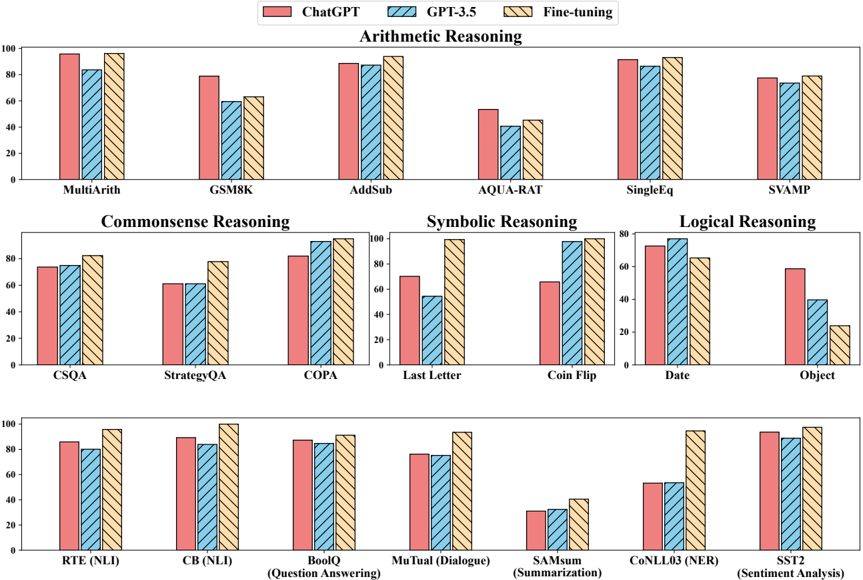
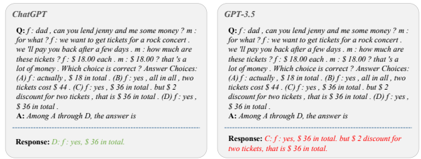
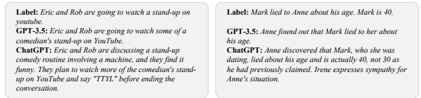
Spurred by advancements in scale, large language models (LLMs) have demonstrated the ability to perform a variety of natural language processing (NLP) tasks zero-shot-i.e., without adaptation on downstream data.Recently, the debut of ChatGPT 1 has drawn a great deal of attention from the natural language processing (NLP) community due to the fact that it can generate high-quality responses to human input and self-correct previous mistakes based on subsequent conversations.However, it is not yet known whether ChatGPT can serve as a generalist model that can perform many NLP tasks zero-shot.In this work, we empirically analyze the zero-shot learning ability of ChatGPT by evaluating it on 20 popular NLP datasets covering 7 representative task categories.With extensive empirical studies, we demonstrate both the effectiveness and limitations of the current version of ChatGPT.We find that ChatGPT performs well on many tasks favoring reasoning capabilities (e.g., arithmetic reasoning) while it still faces challenges when solving specific tasks such as sequence tagging.We additionally provide in-depth analysis through qualitative case studies.
Overview
The claims and statistics of this paper haven’t been checked yet.
Free: it reads the open-access text and checks the first 5 claims that cite a source we can check. Create a free account to check every claim.
Integrity signals
Registry
Cites
Statistics
Figures

Verification
Claims the paper makes
The claims and statistics of this paper haven’t been checked yet.
Free: it reads the open-access text and checks the first 5 claims that cite a source we can check. Create a free account to check every claim.
Claims other papers make about this one
Each is checked against this paper’s own text: does it say what the citing paper says it does?
In the citing paper
“Large Language Models (LLMs) are capable of successfully performing many language processing tasks zero-shot (without training data).”
From Can Large Language Models Transform Computational Social Science? (2024) · cites this paper as Qin et al. 2023
Self-check
Percentages, sums and reported differences re-computed from the paper’s own numbers.
The self-check needs the paper’s full text.
Citations
Cites
BERT: Pre-training of Deep Bidirectional Transformers for Language Understanding
Devlin, J., Chang, M.-W., Lee, K., & Toutanova, K. (2019) · Proceedings of the 2019 Conference of the North American Chapter of the Association for Computational Linguistics: Human Language Technologies, Volume 1 (Long and Short Papers) · doi:10.18653/v1/n19-1423 · Cited by 54,325
Deep reinforcement learning from human preferences
Christiano, P., Leike, J., Brown, T. B., Martic, M., Legg, S., & Amodei, D. (2017) · arXiv · doi:10.48550/arxiv.1706.03741 · Cited by 7,379
Recursive Deep Models for Semantic Compositionality Over a Sentiment Treebank
Socher, R., Perelygin, A., Wu, J., Chuang, J., Manning, C. D., Ng, A., & Potts, C. (2013) · Proceedings of the 2013 Conference on Empirical Methods in Natural Language Processing · doi:10.18653/v1/d13-1170 · Cited by 6,878
Chain-Of-Thought Prompting Elicits Reasoning in Large Language Models
Wei, J., Wang, X., Schuurmans, D., Bosma, M., Ichter, B., Xia, F., Chi, E., Le, Q. V., & Zhou, D. (2022) · Advances in Neural Information Processing Systems 35 · doi:10.52202/068431-1800 · Cited by 4,505
Chain-of-Thought Prompting Elicits Reasoning in Large Language Models
Wei, J., Wang, X., Schuurmans, D., Bosma, M., Ichter, B., Xia, F., Chi, E., Le, Q., & Zhou, D. (2022) · arXiv · doi:10.48550/arxiv.2201.11903 · Cited by 4,263
BoolQ: Exploring the Surprising Difficulty of Natural Yes/No Questions
Clark, C., Lee, K., Chang, M.-W., Kwiatkowski, T., Collins, M., & Toutanova, K. (2019) · North American Chapter of the Association for Computational Linguistics · doi:10.18653/v1/n19-1300 · Cited by 2,998
CommonsenseQA: A Question Answering Challenge Targeting Commonsense Knowledge
Talmor, A., Herzig, J., Lourie, N., & Berant, J. (2019) · North American Chapter of the Association for Computational Linguistics · doi:10.18653/v1/n19-1421 · Cited by 2,836
PaLM: Scaling Language Modeling with Pathways
Chowdhery, A., Narang, S., Devlin, J., Bosma, M., Mishra, G., Roberts, A., Barham, P., Chung, H. W., Sutton, C., Gehrmann, S., et al. (2022) · arXiv · doi:10.48550/arxiv.2204.02311 · Cited by 2,590
Contextual String Embeddings for Sequence Labeling
Akbik, A., Blythe, D. A. J., & Vollgraf, R. (2018) · International Conference on Computational Linguistics · Cited by 1,755
The PASCAL Recognising Textual Entailment Challenge
Dagan, I., Glickman, O., & Magnini, B. (2006) · Lecture Notes in Computer Science · doi:10.1007/11736790_9 · Cited by 1,628
Cited by
Items 301–400 of 1,016
Talking Mental Health: a Battle of Wits Between Humans and AI
Lopes, E., Jain, G., Carlbring, P., & Pareek, S. (2023) · Journal of Technology in Behavioral Science · doi:10.1007/s41347-023-00359-6 · Cited by 36
DelphiAgent: A trustworthy multi-agent verification framework for automated fact verification
Xiong, C. C., Zheng, G., Ma, X., Li, C., & Zeng, J. (2025) · Information Processing & Management · doi:10.1016/j.ipm.2025.104241 · Cited by 36
Hou, J. (2024) · OSF Preprints (OSF Preprints) · doi:10.31219/osf.io/d3nc6 · Cited by 36
Automatic Code Summarization via ChatGPT: How Far Are We?
Sun, W., Fang, C., You, Y., Miao, Y., Liu, Y., Li, Y., Deng, G., Huang, S., Chen, Y., Zhang, Q., et al. (2023) · arXiv (Cornell University) · doi:10.48550/arxiv.2305.12865 · Cited by 35
Evaluating ChatGPT and Bard AI on Arabic Sentiment Analysis
Al-Thubaity, A. O., Alkhereyf, S., Murayshid, H. S., Alshalawi, N., Omirah, M., Alateeq, R., Almutairi, R. E., Alsuwailem, R. I., Alhassoun, M., & Alkhanen, I. (2023) · Arabic Natural Language Processing Conference (ArabicNLP) · doi:10.18653/v1/2023.arabicnlp-1.27 · Cited by 35
How Robust is GPT-3.5 to Predecessors? A Comprehensive Study on Language Understanding Tasks
Chen, X., Ye, J., Zu, C., Xu, N., Zheng, R., Peng, M., Zhou, J., Gui, T., Zhang, Q., & Huang, X. (2023) · arXiv (Cornell University) · doi:10.48550/arxiv.2303.00293 · Cited by 35
Ye, X., Zhang, W., Zhou, Y., Li, X., & Zhou, Q. (2025) · Humanities and Social Sciences Communications · doi:10.1057/s41599-025-04846-4 · Cited by 35
Hybrid Reasoning Based on Large Language Models for Autonomous Car Driving
Azarafza, M., Nayyeri, M., Steinmetz, C., Staab, S., & Rettberg, A. (2024) · International Conference on Control, Mechatronics and Automation (ICCMA) · doi:10.1109/iccma63715.2024.10843921 · Cited by 35
GLoRE: Evaluating Logical Reasoning of Large Language ModelsPreprint
Liu, H., Teng, Z., Ning, R., Ding, Y., Li, X., Liu, X., & Zhang, Y. (2023) · arXiv (Cornell University) · doi:10.48550/arxiv.2310.09107 · Cited by 35
ChatGPT Rates Natural Language Explanation Quality like Humans: But on Which Scales?
Huang, F., Kwak, H., Park, K., & An, J. (2024) · Language Resources and Evaluation Conference (LREC) · doi:10.63317/34az2vmm6ttk · Cited by 35
Rasool, Z., Kurniawan, S., Balugo, S., Barnett, S., Vasa, R., Chesser, C., Hampstead, B. M., Belleville, S., Mouzakis, K., & Bahar-Fuchs, A. (2024) · Natural Language Processing Journal · doi:10.1016/j.nlp.2024.100083 · Cited by 34
Evaluation on ChatGPT for Chinese Language Understanding
Li, L., Zhang, H., Li, C., You, H., & Cui, W. (2023) · Data Intelligence · doi:10.1162/dint_a_00232 · Cited by 34
Liu, S., Kong, W., Liu, Z., Sun, J., Liu, S., & Gašević, D. (2025) · Expert Systems with Applications · doi:10.1016/j.eswa.2025.127339 · Cited by 34
The Battle of LLMs: A Comparative Study in Conversational QA TasksPreprint
Rangapur, A., & Rangapur, A. (2024) · arXiv (Cornell University) · doi:10.48550/arxiv.2405.18344 · Cited by 34
Mondshine, I., Paz-Argaman, T., & Tsarfaty, R. (2025) · Findings of the Association for Computational Linguistics: NAACL · doi:10.18653/v1/2025.findings-naacl.73 · Cited by 34
CleanCoNLL: A Nearly Noise-Free Named Entity Recognition Dataset
Rücker, S., & Akbik, A. (2023) · Conference on Empirical Methods in Natural Language Processing (EMNLP) · doi:10.18653/v1/2023.emnlp-main.533 · Cited by 34
An Evaluation of Reasoning Capabilities of Large Language Models in Financial Sentiment Analysis
Du, K., Xing, F., Mao, R., & Cambria, E. (2024) · IEEE Conference on Artificial Intelligence (CAI) · doi:10.1109/cai59869.2024.00042 · Cited by 33
Zero is Not Hero Yet: Benchmarking Zero-Shot Performance of LLMs for Financial TasksPreprint
Shah, A., & Chava, S. (2023) · SSRN Electronic Journal · doi:10.2139/ssrn.4458613 · Cited by 33
Leveraging Large Language Models for Exploiting ASR Uncertainty
Dighe, P., Su, Y., Zheng, S., Liu, Y., Garg, V., Niu, X., & Tewfik, A. H. (2024) · IEEE International Conference on Acoustics Speech and Signal Processing · doi:10.1109/icassp48485.2024.10446132 · Cited by 33
SeqGPT: An Out-of-the-box Large Language Model for Open Domain Sequence Understanding
Yu, T., Jiang, C., Lou, C., Huang, S., Wang, X.-B., Liu, W., Cai, J., Li, Y., Li, Y.-H., Tu, K., et al. (2023) · AAAI Conference on Artificial Intelligence · doi:10.1609/aaai.v38i17.29917 · Cited by 31
Is ChatGPT a Good Multi-Party Conversation Solver?
Tan, C.-H., Gu, J.-C., & Ling, Z.-H. (2023) · Findings of the Association for Computational Linguistics: EMNLP (Findings of EMNLP) · doi:10.18653/v1/2023.findings-emnlp.326 · Cited by 33
Zero-Shot Building Age Classification from Facade Image Using GPT-4
Zeng, Z., Goo, J. M., Wang, X., Chi, B., Wang, M., & Boehm, J. (2024) · The international archives of the photogrammetry, remote sensing and spatial information sciences/International archives of the photogrammetry, remote sensing and spatial information sciences · doi:10.5194/isprs-archives-xlviii-2-2024-457-2024 · Cited by 33
AI-enabled ChatGPT or LLM: a new algorithm is required for plagiarism-free scientific writing
Pal, S., Bhattacharya, M., Islam, M. A., & Chakraborty, C. (2023) · International Journal of Surgery · doi:10.1097/js9.0000000000000939 · Cited by 32
Large language model agent as a mechanical designer
Jadhav, Y., & Farimani, A. B. (2026) · Journal of Engineering Design · doi:10.1080/09544828.2026.2624356 · Cited by 32
Karjus, A. (2025) · Humanities and Social Sciences Communications · doi:10.1057/s41599-025-04503-w · Cited by 32
See What LLMs Cannot Answer: A Self-Challenge Framework for Uncovering LLM WeaknessesPreprint
Chen, Y., Liu, Y., Yan, J., Bai, X., Ming, Z., Yang, Y., Yang, Z., Zhu, C., & Zhang, Y. (2024) · arXiv (Cornell University) · doi:10.48550/arxiv.2408.08978 · Cited by 32
Bias in Emotion Recognition with ChatGPTPreprint
Wake, N., Kanehira, A., Sasabuchi, K., Takamatsu, J., & Ikeuchi, K. (2023) · arXiv (Cornell University) · doi:10.48550/arxiv.2310.11753 · Cited by 32
Fodor, J., Deyne, S. D., & Suzuki, S. (2025) · Computational Linguistics · doi:10.1162/coli_a_00536 · Cited by 31
A Prompt Learning Framework for Source Code SummarizationPreprint
Xu, T., Miao, Y., Fang, C., Qian, H., Feng, X., Chen, Z., Wang, C., Zhang, J., Sun, W., Chen, Z., et al. (2023) · arXiv (Cornell University) · doi:10.48550/arxiv.2312.16066 · Cited by 31
Pourkamali, N., & Shler, E. S. (2024) · arXiv (Cornell University) · doi:10.48550/arxiv.2401.08429 · Cited by 31
Constituency Parsing Using LLMs
Bai, X., Wu, J., Chen, Y., Wang, Z., Chen, K., Zhang, M., & Zhang, Y. (2025) · IEEE Transactions on Audio Speech and Language Processing · doi:10.1109/taslpro.2025.3600867 · Cited by 31
Instructive Dialogue Summarization with Query Aggregations
Wang, B., Liu, Z., & Chen, N. F. (2023) · Conference on Empirical Methods in Natural Language Processing (EMNLP) · doi:10.18653/v1/2023.emnlp-main.474 · Cited by 31
A Survey of Source Code Search: A 3-Dimensional Perspective
Sun, W., Fang, C., Ge, Y., Hu, Y., Chen, Y., Zhang, Q., Ge, X., Liu, Y., & Chen, Z. (2024) · ACM Transactions on Software Engineering and Methodology · doi:10.1145/3656341 · Cited by 31
IAPT: Instance-Aware Prompt Tuning for Large Language Models
Zhu, W. H., Tian, A. X., Yin, C., Ni, Y., Wang, X., & Xie, G. (2024) · Proceedings of the conference - Association for Computational Linguistics. Meeting · doi:10.18653/v1/2024.acl-long.771 · Cited by 31
Xu, T., Chen, L., Hu, Z., & Li, B. (2025) · Expert Systems with Applications · doi:10.1016/j.eswa.2025.127582 · Cited by 30
Kang, H., & Xiong, C. (2025) · Findings of the Association for Computational Linguistics: EMNLP (Findings of EMNLP) · doi:10.18653/v1/2025.findings-emnlp.303 · Cited by 30
The Fire Thief Is Also the Keeper: Balancing Usability and Privacy in PromptsPreprint
Shen, Z., Xi, Z., He, Y., Tong, W., Hua, J., & Zhong, S. (2024) · arXiv (Cornell University) · doi:10.48550/arxiv.2406.14318 · Cited by 30
The Two Word Test as a semantic benchmark for large language models
Riccardi, N., Yang, X., & Desai, R. H. (2024) · Scientific Reports · doi:10.1038/s41598-024-72528-3 · Cited by 9
Fairness Definitions in Language Models Explained
Yin, Z., Wang, Z., Palikhe, A., & Zhang, W. (2026) · Wiley Interdisciplinary Reviews Data Mining and Knowledge Discovery · doi:10.1002/widm.70063 · Cited by 30
Mitigating the Bias of Large Language Model Evaluation
Zhou, H., Huang, H., Long, Y., Xu, B., Zhu, C., Cao, H., Yang, M., & Zhao, T. (2024) · Lecture notes in computer science · doi:10.1007/978-981-97-8367-0_27 · Cited by 30
OneGen: Efficient One-Pass Unified Generation and Retrieval for LLMs
Zhang, J., Cheng, P., Sun, M., Chen, X., Liang, L., Zhang, Z., Zhou, J., Chen, H., & Zhang, N. (2024) · Findings of the Association for Computational Linguistics: EMNLP (Findings of EMNLP) · doi:10.18653/v1/2024.findings-emnlp.237 · Cited by 30
Self-citationEvaluating Large Language Models on Controlled Generation Tasks
Sun, J., Tian, Y., Zhou, W., Xu, N., Hu, Q., Gupta, R., Wieting, J., Peng, N., & Ma, X. (2023) · Proceedings of the 2023 Conference on Empirical Methods in Natural Language Processing · doi:10.18653/v1/2023.emnlp-main.190 · Cited by 29
Towards Generating Functionally Correct Code Edits from Natural Language Issue DescriptionsPreprint
Fakhoury, S., Chakraborty, S., Musuvathi, M., & Lahiri, S. K. (2023) · arXiv (Cornell University) · doi:10.48550/arxiv.2304.03816 · Cited by 29
Hamid, E. A. H. A., Maskur, H., & Mutalib, R. A. (2023) · Malaysian Journal of Information and Communication Technology (MyJICT) · doi:10.53840/myjict8-2-98 · Cited by 29
A noise audit of human-labeled benchmarks for machine commonsense reasoning
Kejriwal, M., Santos, H., Shen, K., Mulvehill, A. M., & McGuinness, D. L. (2024) · Scientific Reports · doi:10.1038/s41598-024-58937-4 · Cited by 29
A Comparative Analysis of Metaphorical Cognition in ChatGPT and Human Minds
Mao, R., Chen, G., Li, X., Ge, M., & Cambria, E. (2024) · Cognitive Computation · doi:10.1007/s12559-024-10393-y · Cited by 29
Li, X., Xu, W., Zhao, R., Jiao, F., Joty, S., & Bing, L. (2025) · Proceedings of the conference - Association for Computational Linguistics. Meeting · doi:10.18653/v1/2025.acl-long.1244 · Cited by 29
Li, S., Chen, X., Song, Y., Song, Y., & Zhang, C. (2024) · arXiv (Cornell University) · doi:10.48550/arxiv.2402.07909 · Cited by 29
prompt4vis: prompting large language models with example mining for tabular data visualization
Li, S., Chen, X., Song, Y., Song, Y., Zhang, C., Hao, F., & Chen, L. (2025) · The VLDB Journal · doi:10.1007/s00778-025-00912-0 · Cited by 28
Kastrati, M., Imran, A. S., Hashmi, E., Kastrati, Z., Daudpota, S. M., & Biba, M. (2025) · Engineering Applications of Artificial Intelligence · doi:10.1016/j.engappai.2025.110136 · Cited by 28
Building Stereotype Repositories with Complementary Approaches for Scale and Depth
Dev, S., Jha, A., Goyal, J., Tewari, D., Dave, S., & Prabhakaran, V. (2023) · Workshop on Cross-Cultural Considerations in NLP (C3NLP) · doi:10.18653/v1/2023.c3nlp-1.9 · Cited by 28
An ontology-based text mining dataset for extraction of process-structure-property entities
Durmaz, A. R., Thomas, A., Mishra, L., Murthy, R. N., & Straub, T. (2024) · Scientific Data · doi:10.1038/s41597-024-03926-5 · Cited by 28
MockLLM: A Multi-Agent Behavior Collaboration Framework for Online Job Seeking and Recruiting
Sun, H., Lin, H., Yan, H., Song, Y., Gao, X., & Yan, R. (2025) · ACM SIGKDD Conference on Knowledge Discovery and Data Mining (KDD) · doi:10.1145/3711896.3737051 · Cited by 28
Saleshat: A LLM-Based Social Robot for Human-Like Sales Conversations
Hanschmann, L., Gnewuch, U., & Maedche, A. (2024) · Lecture notes in computer science · doi:10.1007/978-3-031-54975-5_4 · Cited by 28
Liu, L., Wang, Y., Fang, Z., & Wu, S. (2021) · Production and Operations Management · doi:10.1177/10591478251349892 · Cited by 29
Exploiting Emotion-Semantic Correlations for Empathetic Response Generation
Yang, Z., Ren, Z., Yufeng, W., Zhu, X., Chen, Z., Cai, T., Wu, Y., Su, Y., Ju, S., & Liao, X. (2023) · Findings of the Association for Computational Linguistics: EMNLP (Findings of EMNLP) · doi:10.18653/v1/2023.findings-emnlp.320 · Cited by 28
Zhu, Q., Chen, X., Jin, Q., Hou, B., Mathai, T. S., Mukherjee, P., Gao, X., Summers, R. M., & Lu, Z. (2024) · IEEE International Conference on Healthcare Informatics (ICHI) · doi:10.1109/ichi61247.2024.00058 · Cited by 28
Global-Liar: Factuality of LLMs over Time and Geographic RegionsPreprint
Mirza, S., Coelho, B. G., Cui, Y., Pöpper, C., & McCoy, D. (2024) · arXiv (Cornell University) · doi:10.48550/arxiv.2401.17839 · Cited by 28
Exploring Fine-tuning ChatGPT for News RecommendationPreprint
Li, X., Zhang, Y., & Malthouse, E. C. (2023) · arXiv (Cornell University) · doi:10.48550/arxiv.2311.05850 · Cited by 28
Liu, S., Liu, S., Sha, L., Zeng, Z., Gašević, D., & Liu, Z. (2025) · IEEE Transactions on Learning Technologies · doi:10.1109/tlt.2025.3570775 · Cited by 27
A Glimpse in ChatGPT Capabilities and its impact for AI researchPreprint
Joublin, F., Ceravola, A., Deigmoeller, J., Gienger, M., Franzius, M., & Eggert, J. P. (2023) · arXiv (Cornell University) · doi:10.48550/arxiv.2305.06087 · Cited by 27
The Impact of LLM Hallucinations on Motor Skill Learning: A Case Study in Badminton
Qiu, Y. (2024) · IEEE Access · doi:10.1109/access.2024.3444783 · Cited by 27
Harnessing Multi-Role Capabilities of Large Language Models for Open-Domain Question Answering
Sun, H., Liu, Y., Wu, C., Yan, H., Tai, C., Gao, X., Shang, S., & Yan, R. (2024) · International World Wide Web Conference (WWW) · doi:10.1145/3589334.3645670 · Cited by 27
Quantitative evaluation of ChatGPT versus Bard responses to anaesthesia-related queries
Patnaik, S. S., & Hoffmann, U. (2023) · British Journal of Anaesthesia · doi:10.1016/j.bja.2023.09.030 · Cited by 27
PEDRO: Parameter-Efficient Fine-Tuning with Prompt DEpenDent Representation MOdification
Xie, T., Li, T., Zhu, W., & Han, W. (2025) · Lecture notes in computer science · doi:10.1007/978-981-96-6603-4_18 · Cited by 27
TrustScore: Reference-Free Evaluation of LLM Response TrustworthinessPreprint
Zheng, D., Liu, D., Lapata, M., & Pan, J. Z. (2024) · arXiv (Cornell University) · doi:10.48550/arxiv.2402.12545 · Cited by 27
Multidimensional Evaluation for Text Style Transfer Using ChatGPTPreprint
Lai, H., Toral, A., & Nissim, M. (2023) · arXiv (Cornell University) · doi:10.48550/arxiv.2304.13462 · Cited by 26
Assessing Logical Puzzle Solving in Large Language Models: Insights from a Minesweeper Case Study
Li, Y., Wang, H., & Zhang, C. (2024) · Conference of the North American Chapter of the Association for Computational Linguistics: Human Language Technologies (NAACL-HLT) · doi:10.18653/v1/2024.naacl-long.4 · Cited by 26
A step-by-step method for cultural annotation by LLMs
Dubourg, E., Thouzeau, V., & Baumard, N. (2024) · Frontiers in Artificial Intelligence · doi:10.3389/frai.2024.1365508 · Cited by 26
Basmov, V., Goldberg, Y., & Tsarfaty, R. (2024) · arXiv (Cornell University) · doi:10.48550/arxiv.2404.06283 · Cited by 26
Reliable Model Watermarking: Defending against Theft without Compromising on Evasion
Zhu, H., Liang, S., Hu, W., Li, F., Jia, J., & Wang, S. (2024) · ACM International Conference on Multimedia (ACM MM) · doi:10.1145/3664647.3681610 · Cited by 26
Lin, L., Wang, L., Zhao, X., Li, J., & Wong, K.-F. (2024) · Findings of the Association for Computational Linguistics: EACL · doi:10.18653/v1/2024.findings-eacl.70 · Cited by 26
Mapping the Challenges of HCI: An Application and Evaluation of ChatGPT for Mining Insights at Scale
Oppenlaender, J., & Hämäläinen, J. (2023) · International Journal of Human-Computer Interaction · doi:10.1080/10447318.2026.2647543 · Cited by 4
Improving Minimum Bayes Risk Decoding with Multi-Prompt
Heineman, D., Dou, Y., & Xu, W. (2024) · Conference on Empirical Methods in Natural Language Processing (EMNLP) · doi:10.18653/v1/2024.emnlp-main.1255 · Cited by 26
ChatGPT Role-play Dataset: Analysis of User Motives and Model Naturalness
Tao, Y., Agrawal, A., Dombi, J., Sydorenko, T., & Lee, J. I. (2024) · Language Resources and Evaluation Conference (LREC) · doi:10.63317/4b83xbcii87g · Cited by 26
Seo, J., Kamath, S. S., Zeidieh, A., Venkatesh, S., & McCurry, S. (2024) · The 26th International ACM SIGACCESS Conference on Computers and Accessibility · doi:10.1145/3663548.3675660 · Cited by 25
Enhance Multi-Domain Sentiment Analysis of Review Texts Through Prompting Strategies
Wang, Y., & Luo, Z. (2023) · International Conference on High Performance Big Data and Intelligent Systems (HPBD&IS) · doi:10.1109/hdis60872.2023.10499502 · Cited by 25
Prompting Large Language Models for Malicious Webpage Detection
Li, L., & Gong, B. (2023) · IEEE International Conference on Pattern Recognition and Machine Learning (PRML) · doi:10.1109/prml59573.2023.10348229 · Cited by 25
Code Prompting: a Neural Symbolic Method for Complex Reasoning in Large Language ModelsPreprint
Hu, Y., Yang, H., Lin, Z., & Zhang, M. (2023) · arXiv (Cornell University) · doi:10.48550/arxiv.2305.18507 · Cited by 25
Few-shot Event Detection: An Empirical Study and a Unified View
Ma, Y., Wang, Z., Cao, Y., & Sun, A. (2023) · Proceedings of the conference - Association for Computational Linguistics. Meeting · doi:10.18653/v1/2023.acl-long.628 · Cited by 25
He, L., Omranian, S., McRoy, S., & Zheng, K. (2024) · medRxiv · doi:10.1101/2024.03.19.24304544 · Cited by 25
Long, Q., Wu, Y., Wang, W., & Pan, S. J. (2024) · arXiv (Cornell University) · doi:10.48550/arxiv.2404.07546 · Cited by 25
Enhancing Large Language Model with Decomposed Reasoning for Emotion Cause Pair ExtractionPreprint
Wu, J., Shen, Y., Zhang, Z., & Cai, L. (2024) · arXiv (Cornell University) · doi:10.48550/arxiv.2401.17716 · Cited by 25
Self-citationEntGPT: Entity Linking with Generative Large Language ModelsPreprint
Ding, Y., Poudel, A., Zeng, Q., Weninger, T., Veeramani, B., & Bhattacharya, S. (2024) · arXiv (Cornell University) · doi:10.48550/arxiv.2402.06738 · Cited by 25
Emotions in the Loop: A Survey of Affective Computing for Emotional SupportPreprint
Hegde, K., & Jayalath, H. (2025) · arXiv (Cornell University) · doi:10.48550/arxiv.2505.01542 · Cited by 25
Wu, D. J., Lu, X., Zhao, Y., & Qin, B. (2025) · Findings of the Association for Computational Linguistics: ACL (Findings of ACL) · doi:10.18653/v1/2025.findings-acl.66 · Cited by 25
MNER-MI: A Multi-image Dataset for Multimodal Named Entity Recognition in Social Media
Huang, S., Xu, B., Li, C., Ye, J., & Lin, X. A. (2024) · Language Resources and Evaluation Conference (LREC) · doi:10.63317/26e4yx7gpgmd · Cited by 25
Can ChatGPT Understand Causal Language in Science Claims?
Kim, Y., Guo, L., Yu, B., & Li, Y. (2023) · Workshop on Computational Approaches to Subjectivity, Sentiment and Social Media Analysis (WASSA) · doi:10.18653/v1/2023.wassa-1.33 · Cited by 24
LLMChain: Blockchain-Based Reputation System for Sharing and Evaluating Large Language Models
Bouchiha, M. A., Telnoff, Q., Bakkali, S., Champagnat, R., Rabah, M., Coustaty, M., & Ghamri-Doudane, Y. M. (2024) · IEEE Annual International Computer Software and Applications Conference (COMPSAC) · doi:10.1109/compsac61105.2024.00067 · Cited by 24
AcTracer: Active Testing of Large Language Model via Multi-Stage Sampling
Huang, Y., Song, J., Hu, Q., Juefei-Xu, F., & Ma, L. (2026) · ACM Transactions on Software Engineering and Methodology · doi:10.1145/3744340 · Cited by 24
Reasoning as a Weapon: Adaptive Dual-Path Jailbreak Attack on Large Language ModelsPreprint
Lin, S., Qian, P., Yang, H., Sun, R., Kong, D., & Wang, X. (2024) · arXiv (Cornell University) · doi:10.48550/arxiv.2407.16205 · Cited by 24
XMainframe: A Large Language Model for Mainframe ModernizationPreprint
Dau, A. T. V., Dao, H., Nguyễn, A. T., Tran, H., Nguyen, P., & Bui, N. (2024) · arXiv.org · doi:10.48550/arxiv.2408.04660 · Cited by 13
Simple Linguistic Inferences of Large Language Models (LLMs): Blind Spots and BlindsPreprint
Basmov, V., Goldberg, Y., & Tsarfaty, R. (2023) · arXiv (Cornell University) · doi:10.48550/arxiv.2305.14785 · Cited by 24
The Two Word Test: A Semantic Benchmark for Large Language Models
Riccardi, N., & Desai, R. H. (2023) · arXiv · doi:10.48550/arxiv.2306.04610 · Cited by 23
Kong, D., Lin, S., Xu, Z., Wang, Z., Li, M., Li, Y., Zhang, Y., Peng, H., Chen, X., Sha, Z., et al. (2025) · arXiv · doi:10.48550/arxiv.2506.19676 · Cited by 23
Park, S.-I., & Lee, J.-Y. (2024) · Transactions of the Association for Computational Linguistics · doi:10.1162/tacl_a_00724 · Cited by 23
Learning to Plan with Natural LanguagePreprint
Guo, Y., Liang, Y., Wu, C., Wu, W., Zhao, D., & Duan, N. (2023) · arXiv (Cornell University) · doi:10.48550/arxiv.2304.10464 · Cited by 23
Ali, S. J., Reinhartz-Berger, I., & Bork, D. (2024) · Lecture notes in computer science · doi:10.1007/978-3-031-75872-0_14 · Cited by 23
Huang, L., Zhang, X., Wang, Q., Chen, Z., & Liu, Y. (2024) · Journal of the Knowledge Economy · doi:10.1007/s13132-024-01755-w · Cited by 23
Wang, L., & Lim, E. (2024) · Findings of the Association for Computational Linguistics: NAACL · doi:10.18653/v1/2024.findings-naacl.56 · Cited by 23
Metadata
- Authors
- Qin, C., Zhang, A., Zhang, Z., Chen, J., Yasunaga, M., & Yang, D.
- Venue
- Proceedings of the 2023 Conference on Empirical Methods in Natural Language Processing
- Published
- 2023
- Pages
- 1339-1384
- OpenAlex
- W4389523957
- Cited by
- 504
- References
- 38
- FWCI
- 95.27
- Type
- conference paper
- Language
- en
- Open access
- hybrid
About these checks
Registry, retraction, Cites and statistics results are computed, not judged, with one exception: a printed reference that no index lists is read once by a model before it counts as a citation error. Claims are extracted by a model and kept only when their quote appears verbatim in the text; each cited source is then checked, with a model’s help, for whether it says what the claim relies on. Those verdicts can be wrong — read the claim’s quote and the cited source before relying on one.
Statistics and arithmetic are recomputed, not judged.
Confidence bands are shown only for fields calibrated on our annotated test set. None is calibrated yet, so no band is shown.
What counts as a claim ›How we measure confidence ›How we check this ›
Are you an author, or do you see a problem with this page? Request a review
Data sources
Bibliographic data: Semantic Scholar, OpenAlex, Crossref.
Contains information from the Semantic Scholar Academic Graph Datasets, made available under the ODC Attribution License (ODC-BY 1.0).
Semantic Scholar’s data is described in: Kinney, R., et al. (2023). The Semantic Scholar Open Data Platform. arXiv:2301.10140.
