

Is ChatGPT a General-Purpose Natural Language Processing Task Solver?
Open accessThe DOI matches its Crossref record; 42 of the 44 references it cites were found in a registry or an index, and 2 are not checked yet.
Abstract
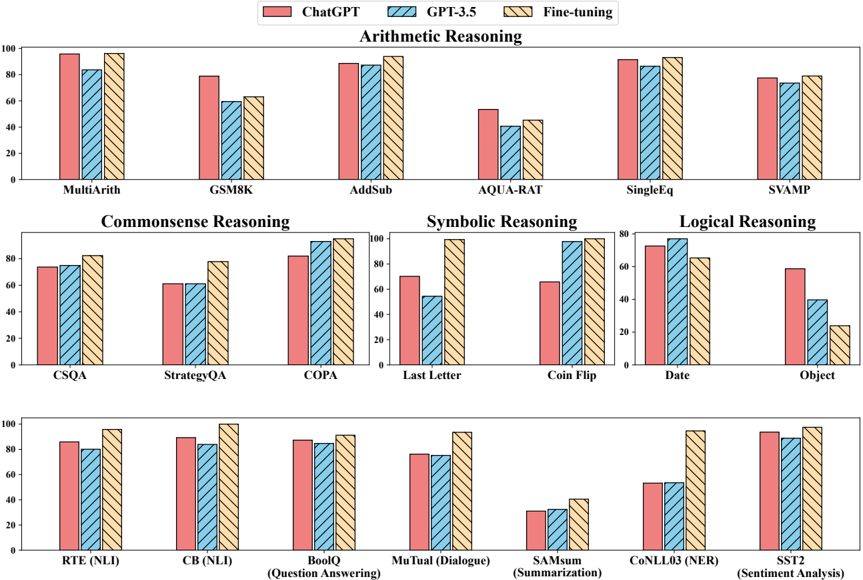
Spurred by advancements in scale, large language models (LLMs) have demonstrated the ability to perform a variety of natural language processing (NLP) tasks zero-shot-i.e., without adaptation on downstream data.Recently, the debut of ChatGPT 1 has drawn a great deal of attention from the natural language processing (NLP) community due to the fact that it can generate high-quality responses to human input and self-correct previous mistakes based on subsequent conversations.However, it is not yet known whether ChatGPT can serve as a generalist model that can perform many NLP tasks zero-shot.In this work, we empirically analyze the zero-shot learning ability of ChatGPT by evaluating it on 20 popular NLP datasets covering 7 representative task categories.With extensive empirical studies, we demonstrate both the effectiveness and limitations of the current version of ChatGPT.We find that ChatGPT performs well on many tasks favoring reasoning capabilities (e.g., arithmetic reasoning) while it still faces challenges when solving specific tasks such as sequence tagging.We additionally provide in-depth analysis through qualitative case studies.
Overview
The claims and statistics of this paper haven’t been checked yet.
Free: it reads the open-access text and checks the first 5 claims that cite a source we can check. Create a free account to check every claim.
Integrity signals
Registry
Cites
Statistics
Figures

Verification
Claims the paper makes
The claims and statistics of this paper haven’t been checked yet.
Free: it reads the open-access text and checks the first 5 claims that cite a source we can check. Create a free account to check every claim.
Claims other papers make about this one
Each is checked against this paper’s own text: does it say what the citing paper says it does?
In the citing paper
“Large Language Models (LLMs) are capable of successfully performing many language processing tasks zero-shot (without training data).”
From Can Large Language Models Transform Computational Social Science? (2024) · cites this paper as Qin et al. 2023
Self-check
Percentages, sums and reported differences re-computed from the paper’s own numbers.
The self-check needs the paper’s full text.
Citations
Cites
BERT: Pre-training of Deep Bidirectional Transformers for Language Understanding
Devlin, J., Chang, M.-W., Lee, K., & Toutanova, K. (2019) · Proceedings of the 2019 Conference of the North American Chapter of the Association for Computational Linguistics: Human Language Technologies, Volume 1 (Long and Short Papers) · doi:10.18653/v1/n19-1423 · Cited by 54,325
Deep reinforcement learning from human preferences
Christiano, P., Leike, J., Brown, T. B., Martic, M., Legg, S., & Amodei, D. (2017) · arXiv · doi:10.48550/arxiv.1706.03741 · Cited by 7,379
Recursive Deep Models for Semantic Compositionality Over a Sentiment Treebank
Socher, R., Perelygin, A., Wu, J., Chuang, J., Manning, C. D., Ng, A., & Potts, C. (2013) · Proceedings of the 2013 Conference on Empirical Methods in Natural Language Processing · doi:10.18653/v1/d13-1170 · Cited by 6,878
Chain-Of-Thought Prompting Elicits Reasoning in Large Language Models
Wei, J., Wang, X., Schuurmans, D., Bosma, M., Ichter, B., Xia, F., Chi, E., Le, Q. V., & Zhou, D. (2022) · Advances in Neural Information Processing Systems 35 · doi:10.52202/068431-1800 · Cited by 4,505
Chain-of-Thought Prompting Elicits Reasoning in Large Language Models
Wei, J., Wang, X., Schuurmans, D., Bosma, M., Ichter, B., Xia, F., Chi, E., Le, Q., & Zhou, D. (2022) · arXiv · doi:10.48550/arxiv.2201.11903 · Cited by 4,263
BoolQ: Exploring the Surprising Difficulty of Natural Yes/No Questions
Clark, C., Lee, K., Chang, M.-W., Kwiatkowski, T., Collins, M., & Toutanova, K. (2019) · North American Chapter of the Association for Computational Linguistics · doi:10.18653/v1/n19-1300 · Cited by 2,998
CommonsenseQA: A Question Answering Challenge Targeting Commonsense Knowledge
Talmor, A., Herzig, J., Lourie, N., & Berant, J. (2019) · North American Chapter of the Association for Computational Linguistics · doi:10.18653/v1/n19-1421 · Cited by 2,836
PaLM: Scaling Language Modeling with Pathways
Chowdhery, A., Narang, S., Devlin, J., Bosma, M., Mishra, G., Roberts, A., Barham, P., Chung, H. W., Sutton, C., Gehrmann, S., et al. (2022) · arXiv · doi:10.48550/arxiv.2204.02311 · Cited by 2,590
Contextual String Embeddings for Sequence Labeling
Akbik, A., Blythe, D. A. J., & Vollgraf, R. (2018) · International Conference on Computational Linguistics · Cited by 1,755
The PASCAL Recognising Textual Entailment Challenge
Dagan, I., Glickman, O., & Magnini, B. (2006) · Lecture Notes in Computer Science · doi:10.1007/11736790_9 · Cited by 1,628
Cited by
Items 801–900 of 1,016
A Response Generation Framework Based on Empathy Factors, Common Sense, and Persona
Li, W., Yang, Y., Tuerxun, P., Fan, X., & Diao, Y. (2024) · IEEE Access · doi:10.1109/access.2024.3365533 · Cited by 3
Aksoy, M., Weber, E., Rutinowski, J., Jost, N., & Pauly, M. (2026) · Applied Stochastic Models in Business and Industry · doi:10.1002/asmb.70078 · Cited by 3
A Lightweight Multi Aspect Controlled Text Generation Solution For Large Language Models
Zhang, C., Lin, J., Tong, H., Hou, B., Zhang, D., Li, J., & Wang, J. (2025) · Workshop on Trustworthy NLP (TrustNLP) · doi:10.18653/v1/2025.trustnlp-main.35 · Cited by 3
Syntax-Augmented Hierarchical Interactive Encoder for Zero-Shot Cross-Lingual Information Extraction
Ma, J.-Y., Gu, J.-C., Ling, Z.-H., Liu, Q., Liu, C., & Hu, G. (2024) · IEEE/ACM Transactions on Audio Speech and Language Processing · doi:10.1109/taslp.2024.3485547 · Cited by 3
The Ultimate Solution in Customer Engagement Using ChatGPT
Mukherjee, A., Mukherjee, G., Chatterjee, A., & Tudu, B. (2024) · Advances in business information systems and analytics book series · doi:10.4018/979-8-3693-0815-8.ch003 · Cited by 3
Chaudhary, S. (2024) · Conference on AI, Science, Engineering, and Technology (AIxSET) · doi:10.1109/aixset62544.2024.00014 · Cited by 3
Learning to Plan by Updating Natural Language
Guo, Y., Liang, Y., Wu, C., Wu, W., Zhao, D., & Duan, N. (2024) · Findings of the Association for Computational Linguistics: EMNLP (Findings of EMNLP) · doi:10.18653/v1/2024.findings-emnlp.589 · Cited by 3
PromISe: Releasing the Capabilities of LLMs with Prompt Introspective Search
Wang, M., Xu, N., Zhao, J., Luo, Y., & Mao, W. (2024) · Language Resources and Evaluation Conference (LREC) · doi:10.63317/4tifos9dmkgz · Cited by 3
Large Language Models Can Learn Representation in Natural Language
Guo, Y., Liang, Y., Zhao, D., & Duan, N. (2024) · Findings of the Association for Computational Linguistics: ACL (Findings of ACL) · doi:10.18653/v1/2024.findings-acl.542 · Cited by 3
AMAS: Adaptively Determining Communication Topology for LLM-based Multi-agent System
Leong, H. Y., Li, Y., Wu, Y., Ouyang, W., Zhu, W., Gao, J., & Han, W. (2025) · Proceedings of the 2025 Conference on Empirical Methods in Natural Language Processing: Industry Track · doi:10.18653/v1/2025.emnlp-industry.144 · Cited by 3
Hasan, M. M., Hasan, M. M., & Nayeem, J. U. (2023) · SSRN Electronic Journal · doi:10.2139/ssrn.4450320 · Cited by 3
Debiasing the Fine-Grained Classification Task in LLMs with Bias-Aware PEFT
Zhao, D., Yang, X., & Chen, H. (2025) · Proceedings of the conference - Association for Computational Linguistics. Meeting · doi:10.18653/v1/2025.acl-long.717 · Cited by 3
Chain-of-Thought Driven Adversarial Scenario Extrapolation for Robust Language ModelsPreprint
Rashid, M. R. U., Dasu, V. A., Wang, Y., Tan, G., & Mehnaz, S. (2025) · AAAI Publications (The Association for the Advancement of Artificial Intelligence (AAAI)) · doi:10.48550/arxiv.2505.17089 · Cited by 3
Mu, S., Liu, Y., Feng, S., Yang, X., Wang, D., & Zhang, Y. (2025) · arXiv (Cornell University) · doi:10.48550/arxiv.2507.14887 · Cited by 3
RepLoRA: Reparameterizing Low-Rank Adaptation via the Perspective of Mixture of ExpertsPreprint
Truong, T., Nguyen, C., Nguyen, H., Le, M., Le, T., & Ho, N. (2025) · arXiv (Cornell University) · doi:10.48550/arxiv.2502.03044 · Cited by 3
Improving ChatGPT’s emotional intelligence through prompt engineering
Belkhir, A. (2023) · Archipel (Université du Québec à Montréal) · Cited by 3
ChatGPT e a formação do professor de matemática: um ensaio sobre a prática didática
Moreira, J. C. P., Vieira, M. M. S., da Silva, T. M. R., & Santana, J. R. (2023) · Revista Práxis Pedagógica. · doi:10.69568/2237-5406.2023v9e7628 · Cited by 3
Improving Machine Translation for Faroese using ChatGPT-Generated Parallel Data
Simonsen, A. (2024) · Skemman · Cited by 3
VV., A., C. Orăsan, R. M., Orăsan, C., Mitkov, R., Pastor, G. C., & Monti, J. (2023) · ARCHIVIO ISTITUZIONALE DELLA RICERCA-UNIVERSITA DEGLI STUDI DI NAPOLI "LORIENTALE" · Cited by 3
Dynamic Skill Adaptation for Large Language ModelsPreprint
Chen, J., & Yang, D. (2024) · arXiv (Cornell University) · doi:10.48550/arxiv.2412.19361 · Cited by 3
Self-citationRasch-based comparison of items created with and without generative AI
Mendoza, K. K. R., & Zúñiga, L. H. P. (2025) · Journal of Technology and Science Education · doi:10.3926/jotse.3135 · Cited by 3
Beyond the Surface: Uncovering Implicit Locations with LLMs for Personalized Local NewsPreprint
Katz, G., Sitton, H., Gonen, G., & Kaplan, Y. (2025) · arXiv (Cornell University) · doi:10.48550/arxiv.2502.14660 · Cited by 3
Exploring chatgpt's performance in news recommendation: A multi-faceted analysis
Naffakh, H. A. H. A., Radhi, A. D., Hakim, B. A., Al-Ibraheemi, F. A., & Al-Attar, B. (2024) · BIO Web of Conferences · doi:10.1051/bioconf/20249700121 · Cited by 3
INNOVATION IN CYBER THREAT DETECTION: TRANSFORMER-BASED APPROACH
Gabin, D. B. D. G., Jérome, D. D., Koffi, K., & Oumtanaga, S. (2024) · International Journal of Advanced Research · doi:10.21474/ijar01/19953 · Cited by 3
SAMoRA: Semantic-Aware Mixture of LoRA Experts for Task-Adaptive Learning
Shi, B., Chen, W., Zhao, S., Shen, J., Guo, S., Wang, S., & Wan, H. (2026) · Findings of the Association for Computational Linguistics: ACL (Findings of ACL) · doi:10.18653/v1/2026.findings-acl.1404 · Cited by 3
TalkLoRA: Communication-Aware Mixture of Low-Rank Adaptation for Large Language Models
Mu, L., Wang, H., Ni, L., Sang, L., Wu, Z., Jin, P., & Zhang, Y. (2026) · Proceedings of the conference - Association for Computational Linguistics. Meeting · doi:10.18653/v1/2026.acl-long.840 · Cited by 3
Iraola, U., Martin, B., Vaccaro, S., Enrique, D., Aures-García, A., Antônio, Á., Moroco, F., & Antonio, J. (2023) · IEEE International Conference on Electronics, Electrical Engineering and Computing (INTERCON) · doi:10.1109/intercon59652.2023.10326083 · Cited by 3
Ajhari, A. A., Priambodo, D. F., & Yulianti, H. (2024) · JOIV International Journal on Informatics Visualization · doi:10.62527/joiv.8.2.2017 · Cited by 3
Manafi, S., Krishnaswamy, N., Ortega, F. R., Blanchard, N., & Chong, E. K. P. (2024) · Digital Collections of Colorado (Colorado State University) · doi:10.25675/3.04232 · Cited by 3
Prompt Learning for Source Code Summarization
Xu, T., Fang, C., Qian, H., Feng, X., & Sun, W. (2025) · IEEE International Conference on Software Quality, Reliability and Security (QRS) · doi:10.1109/qrs65678.2025.00028 · Cited by 2
Multi-Prompting Scenario-based Movie Recommendation with Large Language Models: Real User Case Study
Sun, R., Li, X., Akella, A., & Konstan, J. A. (2025) · CHI Conference Extended Abstracts on Human Factors in Computing Systems (CHI EA) · doi:10.1145/3706599.3706682 · Cited by 2
Tang, H., Wang, X., Zhang, Y., Ran, Q., & Gao, H. (2026) · International Journal of Cognitive Computing in Engineering · doi:10.1016/j.ijcce.2026.05.003 · Cited by 2
Trustworthiness Evaluation of Large Language Models
Chen, P., & Liu, S. (2025) · Springer eBooks · doi:10.1007/978-3-031-76770-8_12 · Cited by 2
Venturing ChatGPT's lens to explore human values in software artifacts: a case study of mobile APIs
Mougouei, D., Rafi, S., Fahmideh, M., Mougouei, E., Khan, J. A., Dam, H. K., Nurwidyantoro, A., & Chaudron, M. R. V. (2025) · Behaviour and Information Technology · doi:10.1080/0144929x.2025.2478278 · Cited by 2
Uncertainty in Sentiment Analysis with LLMs using QCM (Quantiles of Correlation Matrices) - DistancePreprint
Lefort, B., Benhamou, E., Ohana, J., Guez, B., & Saltiel, D. (2024) · Social Science Research Network · doi:10.2139/ssrn.4780192 · Cited by 1
ERGENE, B. Ç., Ergene, Ö., & Kontorovich, I. (2026) · International Journal of Mathematical Education in Science and Technology · doi:10.1080/0020739x.2026.2687118 · Cited by 2
Du, J., Liu, W., Zhou, D., Hong, S., & Liu, F. (2025) · Informatics · doi:10.3390/informatics12040139 · Cited by 2
Investigation of the Inference Capabilities and Memorization of Pre-trained Language Models
Sakai, Y., Kamigaito, H., Hayashi, K., & Watanabe, T. (2024) · Journal of Natural Language Processing · doi:10.5715/jnlp.31.1427 · Cited by 2
Retrieval-Augmented Meta Learning for Low-Resource Text Classification
Li, R., Li, Y., Li, Y., Luoyiching, C., Zhou, N., Su, H., & Zheng, H. (2024) · International Joint Conference on Neural Networks (IJCNN) · doi:10.1109/ijcnn60899.2024.10651119 · Cited by 2
Discourse-Aware Language Representation
Zhang, Z., Ouyang, S., & Zhao, H. (2025) · IEEE Transactions on Pattern Analysis and Machine Intelligence · doi:10.1109/tpami.2025.3621229 · Cited by 2
Self-citationLuo, Q., Shao, Q., Zhang, Z., Zhang, B., & Shi, J. D. (2025) · Engineering Research Express · doi:10.1088/2631-8695/add642 · Cited by 2
Self-citationBoosting LLM’s Continual Sentiment Understanding for Low-Resource Languages
Zhang, H., Wang, J., Luo, J., Zhang, M., & Zhou, G. (2025) · IEEE Transactions on Audio Speech and Language Processing · doi:10.1109/taslpro.2025.3581018 · Cited by 2
Multi-label and Multi-target Sampling of Machine Annotation for Computational Stance Detection
Liu, Z., Chieu, H. L., & Chen, N. F. (2023) · Findings of the Association for Computational Linguistics: EMNLP (Findings of EMNLP) · doi:10.18653/v1/2023.findings-emnlp.174 · Cited by 2
Huang, S., Xu, B., Li, C., Yu, Y., & Lin, X. A. (2025) · IEEE International Conference on Multimedia and Expo (ICME) · doi:10.1109/icme59968.2025.11209770 · Cited by 2
Towards General Error Diagnosis via Behavioral Testing in Machine Translation
Wu, J., Liu, L., & Yeung, D. (2023) · Findings of the Association for Computational Linguistics: EMNLP (Findings of EMNLP) · doi:10.18653/v1/2023.findings-emnlp.446 · Cited by 2
Does AI Reflect Human Behaviour? Exploring the Presence of Gender Bias in AI Translation Tools
Smacchia, M., Za, S., & Arenas, A. E. (2024) · Lecture notes in information systems and organisation · doi:10.1007/978-3-031-75586-6_19 · Cited by 2
Chu, D., Wan, B., Fang, F., & Zhou, S. (2025) · International Journal of Geographical Information Science · doi:10.1080/13658816.2025.2528954 · Cited by 2
Large language models for computational social science
Xu, F., Shao, C., Chen, L., Zeng, Q., Chen, Z., Sukiennik, N., Wang, J., Gao, C., Wang, H., Lian, J., et al. (2026) · Nature Human Behaviour · doi:10.1038/s41562-026-02539-9 · Cited by 2
TAG: Dialogue Summarization Based on Topic Segmentation and Graph Structures
Shen, Y., Hao, Q., Deng, G., Wang, S., & Zhang, E. (2025) · Lecture notes in computer science · doi:10.1007/978-981-95-2725-0_20 · Cited by 2
CarICL: Mitigating causal hallucinations to enhance event causality identification
Feng, Y., Li, L., Qin, X., & Li, Z. (2025) · Information Processing & Management · doi:10.1016/j.ipm.2025.104500 · Cited by 2
Scene generalization for biomedical fact verification via hierarchical mixture of experts
Si, J., Zhu, H., Zhao, Y., Zhang, W., Wang, T., Lü, W., & Zhou, D. (2025) · Information Sciences · doi:10.1016/j.ins.2025.122527 · Cited by 2
Liu, Z., Wang, Z., Niu, J., Li, Y., Sun, H., Xu, M., Wang, H., Wu, G., & Zhang, Y. (2025) · arXiv (Cornell University) · doi:10.48550/arxiv.2503.19482 · Cited by 2
Impact and implications of AI methods and tools for the future of education
Okoye, K., Hosseini, S., Hiran, K. K., & Nganji, J. (2024) · Frontiers research topics · doi:10.3389/978-2-8325-5013-7 · Cited by 2
REM: A Ranking-Based Automatic Evaluation Method for LLMs
Yang, J., Tan, Y., Hu, W., Yang, Z., Zhou, X., Luo, Z., & Luo, W. (2024) · Lecture notes in computer science · doi:10.1007/978-3-031-72344-5_25 · Cited by 2
Assessing the proficiency of large language models on funduscopic disease knowledge
Shao, Y., Wu, J.-Y., Zeng, Y.-M., Qian, X.-Z., Hong, Q., Hu, J.-Y., Wei, H., Zou, J., Chen, C., Wang, X.-Y., et al. (2025) · International Journal of Ophthalmology · doi:10.18240/ijo.2025.07.03 · Cited by 2
AI-Based Text Detection and Classification for Smart City Monitoring Using BERT and TextCNN Models
Liu, Y., Li, M., Ye, Z., Xiaoan, S., Wang, W., & Zhao, H. (2024) · International Symposium on Internet of Things and Smart Cities (ISITSC) · doi:10.1109/isitsc64373.2024.00014 · Cited by 2
Holtdirk, T., Saju, L., Fröhling, L., & Wagner, C. (2025) · Social Science Open Access Repository (GESIS – Leibniz Institute for the Social Sciences) · doi:10.60762/ggdbd25016.1.0 · Cited by 2
Thoms, C., Schrimpf, T., & Reich, A. (2026) · Studies in Communication and Media · doi:10.5771/2192-4007-2026-3-015 · Cited by 2
Look Before You Leap: Enhance Attention and Vigilance Regarding Harmful Content with GuidelineLLM
Zhang, S., Zhang, Z., Chen, K., Weng, R., Yang, M., Zhao, T., & Zhang, M. (2025) · Proceedings of the AAAI Conference on Artificial Intelligence · doi:10.1609/aaai.v39i24.34784 · Cited by 2
Self-citationCausal Representation Enhances Cross-Domain Named Entity Recognition in Large Language Models
Wu, J., Xu, J., Liu, X., Yang, G., & Liu, J. (2025) · Computers, materials & continua/Computers, materials & continua (Print) · doi:10.32604/cmc.2025.061359 · Cited by 2
Distilled Large Language Model in Confidential Computing Environment for System-on-Chip DesignPreprint
Ben, D., Feng, H., & Wang, Q. (2025) · arXiv (Cornell University) · doi:10.48550/arxiv.2507.16226 · Cited by 2
SAGEval: The frontiers of Satisfactory Agent based NLG Evaluation for reference-free open-ended textPreprint
Ghosh, R., Yao, T., Chen, L., Hasan, S. A., Chen, T., Bernal, D., Jiao, H., & Hossain, H. M. S. (2024) · arXiv (Cornell University) · doi:10.48550/arxiv.2411.16077 · Cited by 2
Identifying Task Groupings for Multi-Task Learning Using Pointwise V-Usable InformationPreprint
Li, Y., Miller, T., Bethard, S. J., & Savova, G. (2024) · arXiv (Cornell University) · doi:10.48550/arxiv.2410.12774 · Cited by 2
Pertsas, V., Kasapaki, M., & Constantopoulos, P. (2024) · Language Resources and Evaluation Conference (LREC) · doi:10.63317/2yjrddem4bmp · Cited by 2
Ni, M. (2024) · KTH Publication Database DiVA (KTH Royal Institute of Technology) · Cited by 2
Artificial Intelligence in Education. Part 1
Bobarchuk, O., Matviichuk-Yudina, O., Zavadetskyi, I. P., Mamonov, Y., Skyba, S. A., Бобро, Н., Дудко, Н., Гуралюк, А., Terentieva, N., Вараксіна, Н. В., et al. (2025) · Digital Library NAES of Ukraine (National Academy of Educational Sciences of Ukraine) · doi:10.33407/lib.naes.id/748336 · Cited by 2
Можливості чатботів на основі штучного інтелекту в контексті інклюзивного навчання
Озарчук, А., & Басараба, Н. (2025) · New pedagogical thought · doi:10.37026/2520-6427-2025-121-1-48-53 · Cited by 2
DataScout: Automatic Data Fact Retrieval for Statement Augmentation with an LLM-Based AgentPreprint
Chen, C., Liu, Y., Shi, D., Cao, S., & Cao, N. (2025) · arXiv (Cornell University) · doi:10.48550/arxiv.2504.17334 · Cited by 2
From Script to Stage: Automating Experimental Design for Social Simulations with LLMs
Guo, Y., Zhao, Z., Liu, X., Yu, X., Ma, Q., Zhou, D., & Xue, X. (2026) · Findings of the Association for Computational Linguistics: ACL (Findings of ACL) · doi:10.18653/v1/2026.findings-acl.780 · Cited by 2
Bigdata based university reputation measurement
Nuortimo, K. (2023) · Theseus (Ammattikorkeakoulujen) · Cited by 2
Investigating the Impact of Rationales for LLMs on Natural Language UnderstandingPreprint
Shi, W., Bian, S., Chen, Y., Zhang, X., Zhao, Z., Hu, P., Lu, W., & Du, X. (2025) · arXiv (Cornell University) · doi:10.48550/arxiv.2510.16686 · Cited by 2
Supporting Rule-Based Control with a Natural Language Model
Kernács, M., & Hornyák, O. (2025) · SMTS · doi:10.3390/engproc2025113056 · Cited by 2
de Melo, T., de Araújo, G., & Figueiredo, C. M. S. (2024) · Linguamática · doi:10.21814/lm.16.2.433 · Cited by 2
ChatAN: Interval Adaptive Normalization based on ChatGPT Knowledge Augmentation
Yang, H., Zhao, X., Wang, L., Zhang, J., & Li, J. (2023) · International Conference on Intelligent Computing and Signal Processing (ICSP) · doi:10.1109/icsp58490.2023.10248838 · Cited by 2
An Empirical Study of Benchmarking Chinese Aspect Sentiment Quad PredictionPreprint
Zhou, J., Yang, H., Junpeng, Y., He, Y., & Mou, H. (2023) · arXiv (Cornell University) · doi:10.48550/arxiv.2311.01713 · Cited by 2
Advancing sentiment understanding and safety in NLP systems
Deng, Y. (2025) · DR-NTU (Nanyang Technological University) · doi:10.32657/10356/183610 · Cited by 1
32715 Content analysis in quantitative communication research
Andreeva, I. N., Taggart, M., Lattimer, T. A., & Hahn, L. (2026) · De Gruyter eBooks · doi:10.1515/9783111087139-015 · Cited by 1
Feng, H., & Wang, X. (2026) · Frontiers in Physiology · doi:10.3389/fphys.2026.1846567 · Cited by 1
Can innovative prompt engineering with ChatGPT address imbalances in machine learning datasets?Preprint
Kochanek, M., Kazienko, P., Kocoń, J., Cichecki, I., Kaszyca, O., & Szydło, D. (2023) · doi:10.36227/techrxiv.170326689.99692093/v1 · Cited by 1
Structured List-Grounded Question AnsweringPreprint
Sung, M., Feng, S., Gung, J., Shu, R., Zhang, Y., & Mansour, S. (2024) · arXiv (Cornell University) · doi:10.48550/arxiv.2410.03950 · Cited by 1
Systematic evaluation of ChatGPT performance in providing renewable energy information
Ibrahim, M. S., Aljaaf, A. J., Al-khafajiy, M., Nafea, A. A., & Sani, N. S. (2025) · PeerJ Computer Science · doi:10.7717/peerj-cs.3295 · Cited by 1
MLRQA: A Dataset with Multimodal Logical Reasoning Challenges
Xiao, J., Lin, G., & Li, P. (2024) · Lecture notes in computer science · doi:10.1007/978-981-96-0122-6_1 · Cited by 1
News sentiment analysis using ChatGPT for Bitcoin price dynamics
Fiszeder, P., Orzeszko, W., & Pietrzyk, R. (2026) · Journal Of Big Data · doi:10.1186/s40537-026-01392-x · Cited by 1
Bouchiha, M. A. (2024) · theses.fr (ABES) · doi:10.70675/1bd1e48dz9b72z4edez9c7ez93ea4a000080 · Cited by 1
From evaluation to emulation: LLMs as agents of iterative pedagogical design
Yaşar, O., Kashyrskyy, A., Xie, C., & Bulseco, D. (2026) · International Journal of Artificial Intelligence in Education · doi:10.1016/j.ijaied.2026.100013 · Cited by 1
Chan, Y.-C., Huang, P., Chen, Z.-L., Wang, C.-N., Lin, W., Chiu, J.-P., Chiu, Y.-C., Lin, Y.-H., Huang, E. T. C., See, S. C. W., et al. (2025) · World Congress on Medical Physics and Biomedical Engineering, September 7 - 12, 2009, Munich, Germany · doi:10.1007/978-3-031-86323-3_38 · Cited by 1
The Future of ChatGPT: Exploring Features, Capabilities, and Challenges as a Leading Support Tool
Barua, R., & Datta, S. (2024) · Advances in computational intelligence and robotics book series · doi:10.4018/979-8-3693-6824-4.ch014 · Cited by 1
Unveiling the Potential of ChatGPT: Applications, Challenges, and Future Directions
Mohsin, H., & Masood, S. (2023) · International Journal of Computer Applications · doi:10.5120/ijca2023922945 · Cited by 1
Kim, W., & Kim, Y. (2024) · The Journal of Korean Association of Computer Education · doi:10.32431/kace.2024.27.3.002 · Cited by 1
Khasanova, E., Saini, H., Laskar, M. T. R., Fu, X.-Y., Chen, C., & Shashi Bhushan, T. N. (2025) · Conference on Empirical Methods in Natural Language Processing (EMNLP) · doi:10.18653/v1/2025.emnlp-industry.131 · Cited by 1
You Snooze, You Lose: Automatic Safety Alignment Restoration through Neural Weight TranslationPreprint
Arazzi, M., Kembu, V. K., Nocera, A., Picek, S., & Sakthidharan, S. (2026) · arXiv (Cornell University) · doi:10.48550/arxiv.2605.04992 · Cited by 1
Rethinking Reasoning in LLMs: Neuro-Symbolic Local RetoMaton Beyond ICL and CoT
Mamidala, R. S., Chhabra, A., & Mali, A. (2025) · Proceedings of Machine Learning Research · doi:10.48550/arxiv.2508.19271 · Cited by 1
Wei, Y., & Fan, J. (2025) · Journal Of Big Data · doi:10.1186/s40537-025-01236-0 · Cited by 1
DeepFeature: Guiding adversarial testing for deep neural network systems using robust features
Feng, L., Wang, X., Zhang, S., & Zhao, Z. (2024) · Journal of Systems and Software · doi:10.1016/j.jss.2024.112201 · Cited by 1
Eliminating Contextual Bias in Aspect-Based Sentiment Analysis
An, R., Zhang, C., & Song, D. (2024) · Lecture notes in computer science · doi:10.1007/978-3-031-56027-9_6 · Cited by 1
Zero-shot performance analysis of large language models in sumrate maximization
Shuvro, A. A., Bhuiyan, M. S. I., Hussain, F., & Hossen, M. S. (2025) · PLoS ONE · doi:10.1371/journal.pone.0329674 · Cited by 1
Word and Character Semantic Fusion by Pretrained Language Models for Text Classification
Wu, Y., & Wan, J. (2024) · International Joint Conference on Neural Networks (IJCNN) · doi:10.1109/ijcnn60899.2024.10651461 · Cited by 1
Are Human-generated Demonstrations Necessary for In-context Learning?
Li, R., Wang, G., & Li, J. (2023) · arXiv · doi:10.48550/arxiv.2309.14681 · Cited by 1
Deep learning-based text augmentation for named entity recognition
Surana, T. (2023) · DR-NTU (Nanyang Technological University) · doi:10.32657/10356/171105 · Cited by 1
Do Application-Specific AI Chatbots Weigh More Than ChatGPT for Real-Time Information Service?Preprint
Sai, A. M. A., Yadav, G. M., Srinivas, C. S., Khushwant, P., & Anand, S. (2024) · SSRN Electronic Journal · doi:10.2139/ssrn.4753735 · Cited by 1
Metadata
- Authors
- Qin, C., Zhang, A., Zhang, Z., Chen, J., Yasunaga, M., & Yang, D.
- Venue
- Proceedings of the 2023 Conference on Empirical Methods in Natural Language Processing
- Published
- 2023
- Pages
- 1339-1384
- OpenAlex
- W4389523957
- Cited by
- 504
- References
- 38
- FWCI
- 95.27
- Type
- conference paper
- Language
- en
- Open access
- hybrid
About these checks
Registry, retraction, Cites and statistics results are computed, not judged, with one exception: a printed reference that no index lists is read once by a model before it counts as a citation error. Claims are extracted by a model and kept only when their quote appears verbatim in the text; each cited source is then checked, with a model’s help, for whether it says what the claim relies on. Those verdicts can be wrong — read the claim’s quote and the cited source before relying on one.
Statistics and arithmetic are recomputed, not judged.
Confidence bands are shown only for fields calibrated on our annotated test set. None is calibrated yet, so no band is shown.
What counts as a claim ›How we measure confidence ›How we check this ›
Are you an author, or do you see a problem with this page? Request a review
Data sources
Bibliographic data: Semantic Scholar, OpenAlex, Crossref.
Contains information from the Semantic Scholar Academic Graph Datasets, made available under the ODC Attribution License (ODC-BY 1.0).
Semantic Scholar’s data is described in: Kinney, R., et al. (2023). The Semantic Scholar Open Data Platform. arXiv:2301.10140.
