

Is ChatGPT a General-Purpose Natural Language Processing Task Solver?
Open accessThe DOI matches its Crossref record; 42 of the 44 references it cites were found in a registry or an index, and 2 are not checked yet.
Abstract
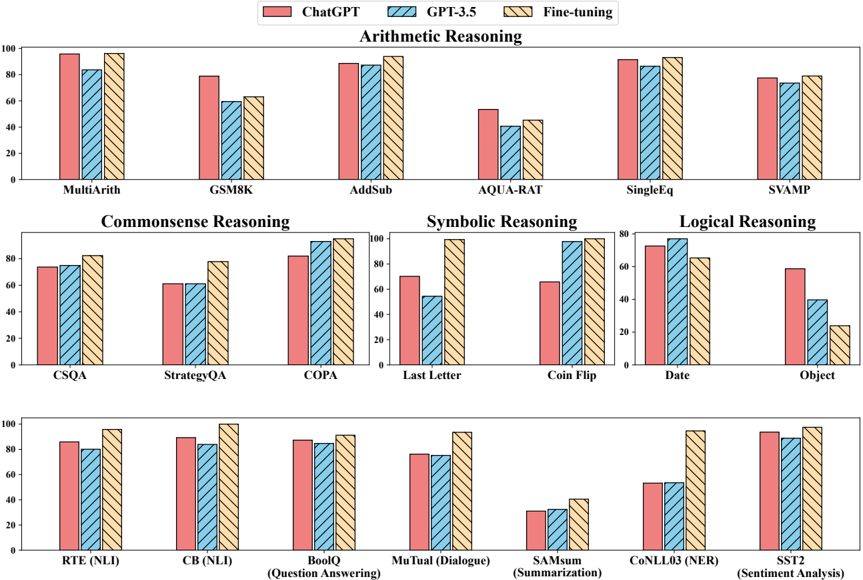
Spurred by advancements in scale, large language models (LLMs) have demonstrated the ability to perform a variety of natural language processing (NLP) tasks zero-shot-i.e., without adaptation on downstream data.Recently, the debut of ChatGPT 1 has drawn a great deal of attention from the natural language processing (NLP) community due to the fact that it can generate high-quality responses to human input and self-correct previous mistakes based on subsequent conversations.However, it is not yet known whether ChatGPT can serve as a generalist model that can perform many NLP tasks zero-shot.In this work, we empirically analyze the zero-shot learning ability of ChatGPT by evaluating it on 20 popular NLP datasets covering 7 representative task categories.With extensive empirical studies, we demonstrate both the effectiveness and limitations of the current version of ChatGPT.We find that ChatGPT performs well on many tasks favoring reasoning capabilities (e.g., arithmetic reasoning) while it still faces challenges when solving specific tasks such as sequence tagging.We additionally provide in-depth analysis through qualitative case studies.
Overview
The claims and statistics of this paper haven’t been checked yet.
Free: it reads the open-access text and checks the first 5 claims that cite a source we can check. Create a free account to check every claim.
Integrity signals
Registry
Cites
Statistics
Figures

Verification
Claims the paper makes
The claims and statistics of this paper haven’t been checked yet.
Free: it reads the open-access text and checks the first 5 claims that cite a source we can check. Create a free account to check every claim.
Claims other papers make about this one
Each is checked against this paper’s own text: does it say what the citing paper says it does?
In the citing paper
“Large Language Models (LLMs) are capable of successfully performing many language processing tasks zero-shot (without training data).”
From Can Large Language Models Transform Computational Social Science? (2024) · cites this paper as Qin et al. 2023
Self-check
Percentages, sums and reported differences re-computed from the paper’s own numbers.
The self-check needs the paper’s full text.
Citations
Cites
BERT: Pre-training of Deep Bidirectional Transformers for Language Understanding
Devlin, J., Chang, M.-W., Lee, K., & Toutanova, K. (2019) · Proceedings of the 2019 Conference of the North American Chapter of the Association for Computational Linguistics: Human Language Technologies, Volume 1 (Long and Short Papers) · doi:10.18653/v1/n19-1423 · Cited by 54,325
Deep reinforcement learning from human preferences
Christiano, P., Leike, J., Brown, T. B., Martic, M., Legg, S., & Amodei, D. (2017) · arXiv · doi:10.48550/arxiv.1706.03741 · Cited by 7,379
Recursive Deep Models for Semantic Compositionality Over a Sentiment Treebank
Socher, R., Perelygin, A., Wu, J., Chuang, J., Manning, C. D., Ng, A., & Potts, C. (2013) · Proceedings of the 2013 Conference on Empirical Methods in Natural Language Processing · doi:10.18653/v1/d13-1170 · Cited by 6,878
Chain-Of-Thought Prompting Elicits Reasoning in Large Language Models
Wei, J., Wang, X., Schuurmans, D., Bosma, M., Ichter, B., Xia, F., Chi, E., Le, Q. V., & Zhou, D. (2022) · Advances in Neural Information Processing Systems 35 · doi:10.52202/068431-1800 · Cited by 4,505
Chain-of-Thought Prompting Elicits Reasoning in Large Language Models
Wei, J., Wang, X., Schuurmans, D., Bosma, M., Ichter, B., Xia, F., Chi, E., Le, Q., & Zhou, D. (2022) · arXiv · doi:10.48550/arxiv.2201.11903 · Cited by 4,263
BoolQ: Exploring the Surprising Difficulty of Natural Yes/No Questions
Clark, C., Lee, K., Chang, M.-W., Kwiatkowski, T., Collins, M., & Toutanova, K. (2019) · North American Chapter of the Association for Computational Linguistics · doi:10.18653/v1/n19-1300 · Cited by 2,998
CommonsenseQA: A Question Answering Challenge Targeting Commonsense Knowledge
Talmor, A., Herzig, J., Lourie, N., & Berant, J. (2019) · North American Chapter of the Association for Computational Linguistics · doi:10.18653/v1/n19-1421 · Cited by 2,836
PaLM: Scaling Language Modeling with Pathways
Chowdhery, A., Narang, S., Devlin, J., Bosma, M., Mishra, G., Roberts, A., Barham, P., Chung, H. W., Sutton, C., Gehrmann, S., et al. (2022) · arXiv · doi:10.48550/arxiv.2204.02311 · Cited by 2,590
Contextual String Embeddings for Sequence Labeling
Akbik, A., Blythe, D. A. J., & Vollgraf, R. (2018) · International Conference on Computational Linguistics · Cited by 1,755
The PASCAL Recognising Textual Entailment Challenge
Dagan, I., Glickman, O., & Magnini, B. (2006) · Lecture Notes in Computer Science · doi:10.1007/11736790_9 · Cited by 1,628
Cited by
Items 201–300 of 1,016
Kuzman, T., Mozetič, I., & Ljubešić, N. (2023) · Machine Learning and Knowledge Extraction · doi:10.3390/make5030059 · Cited by 56
How Good Is ChatGPT in Giving Advice on Your Visualization Design?
Kim, N. W., Ahn, Y., Myers, G., & Bach, B. (2025) · ACM Transactions on Computer-Human Interaction · doi:10.1145/3745768 · Cited by 55
Kim, Y., Lee, J., Kim, S., Park, J., & Kim, J. (2024) · Proceedings of the 29th International Conference on Intelligent User Interfaces · doi:10.1145/3640543.3645148 · Cited by 55
A Survey of GPT-3 Family Large Language Models Including ChatGPT and GPT-4Preprint
Kalyan, K. S. (2023) · arXiv (Cornell University) · doi:10.48550/arxiv.2310.12321 · Cited by 55
Data-driven building load prediction and large language models: Comprehensive overview
Zhang, Y., Wang, D., Wang, G., Xu, P., & Zhu, Y. (2024) · Energy and Buildings · doi:10.1016/j.enbuild.2024.115001 · Cited by 55
YAYI-UIE: A Chat-Enhanced Instruction Tuning Framework for Universal Information ExtractionPreprint
Xiao, X., Wang, Y., Xu, N., Wang, Y., Yang, H., Wang, M., Luo, Y., Wang, L., Mao, W., & Zeng, D. D. (2023) · arXiv (Cornell University) · doi:10.48550/arxiv.2312.15548 · Cited by 55
Prompt Perturbation Consistency Learning for Robust Language Models
Qiang, Y., Nandi, S., Mehrabi, N., Steeg, G. V., Kumar, A., Rumshisky, A., & Galstyan, A. (2024) · Findings of the Association for Computational Linguistics: EACL · doi:10.18653/v1/2024.findings-eacl.91 · Cited by 54
ChatGPT as a Factual Inconsistency Evaluator for Text Summarization
Luo, Z., Xie, Q., & Ananiadou, S. (2023) · arXiv · doi:10.48550/arxiv.2303.15621 · Cited by 53
Unlearn What You Want to Forget: Efficient Unlearning for LLMs
Chen, J., & Yang, D. (2023) · Proceedings of the 2023 Conference on Empirical Methods in Natural Language Processing · doi:10.18653/v1/2023.emnlp-main.738 · Cited by 52
Self-citationAn Empirical Study on Information Extraction using Large Language Models
Han, R., Yang, C., Peng, T., Tiwari, P., Wan, X., Liu, L., & Wang, B. (2023) · arXiv · doi:10.48550/arxiv.2305.14450 · Cited by 52
Chain-of-Note: Enhancing Robustness in Retrieval-Augmented Language Models
Yu, W., Zhang, H., Pan, X., Cao, P., Ma, K., Li, J., Wang, H., & Yu, D. (2024) · Proceedings of the 2024 Conference on Empirical Methods in Natural Language Processing · doi:10.18653/v1/2024.emnlp-main.813 · Cited by 52
Alomari, E. A. (2024) · Computer Modeling in Engineering & Sciences · doi:10.32604/cmes.2024.052256 · Cited by 52
A survey of blockchain, artificial intelligence, and edge computing for Web 3.0
Zhu, J., Li, F., & Chen, J. (2024) · Computer Science Review · doi:10.1016/j.cosrev.2024.100667 · Cited by 53
Self-citationStruc-Bench: Are Large Language Models Good at Generating Complex Structured Tabular Data?
Tang, X.-R., Zong, Y.-M., Phang, J., Zhao, Y., Zhou, W., Cohan, A., & Gerstein, M. (2024) · North American Chapter of the Association for Computational Linguistics · doi:10.18653/v1/2024.naacl-short.2 · Cited by 44
User Interaction Patterns and Breakdowns in Conversing with LLM-Powered Voice Assistants
Mahmood, A., Wang, J., Yao, B., Wang, D., & Huang, C.-M. (2025) · International Journal of Human-Computer Studies · doi:10.1016/j.ijhcs.2024.103406 · Cited by 51
Zhang, Z., Yao, Y., Zhang, A., Tang, X., Ma, X., He, Z., Wang, Y., Gerstein, M., Wang, R., Liu, G., et al. (2025) · ACM Computing Surveys · doi:10.1145/3719341 · Cited by 51
Self-citationBRIDGE: benchmarking large language models for understanding real-world clinical practice texts
Wu, J., Gu, B., Zhou, R., Xie, K., Snyder, D., Jiang, Y., Carducci, V., Wyss, R., Desai, R. J., Alsentzer, E., et al. (2026) · Nature Biomedical Engineering · doi:10.1038/s41551-026-01719-2 · Cited by 51
Self-citationHumans are still better than ChatGPT: Case of the IEEEXtreme competition
Koubâa, A., Qureshi, B., Ammar, A., Khan, Z., Boulila, W., & Ghouti, L. (2023) · Heliyon · doi:10.1016/j.heliyon.2023.e21624 · Cited by 51
CAT: A Contextualized Conceptualization and Instantiation Framework for Commonsense Reasoning
Wang, W., Fang, T., Xu, B., Bo, C. Y. L., Song, Y., & Chen, L. (2023) · Proceedings of the conference - Association for Computational Linguistics. Meeting · doi:10.18653/v1/2023.acl-long.733 · Cited by 51
Evaluation and Analysis of Large Language Models for Clinical Text Augmentation and Generation
Latif, A., & Kim, J. (2024) · IEEE Access · doi:10.1109/access.2024.3384496 · Cited by 51
Hyperbolic Fine-Tuning for Large Language Models
Yang, M., Ram, B., Feng, A., Xiong, B., Liu, J. C., King, I., & Ying, R. (2025) · neural information processing systems · doi:10.52202/085713-0992 · Cited by 51
EvoPrompt: Connecting LLMs with Evolutionary Algorithms Yields Powerful Prompt Optimizers
Guo, Q., Wang, R., Guo, J., Li, B., Song, K., Tan, X., Liu, G., Bian, J., & Yang, Y. (2023) · arXiv · doi:10.48550/arxiv.2309.08532 · Cited by 50
Gao, Y., Song, Z., Wang, W., & Yin, J. (2023) · arXiv (Cornell University) · doi:10.48550/arxiv.2309.07418 · Cited by 50
Struc-Bench: Are Large Language Models Really Good at Generating Complex Structured Data?Preprint
Tang, X., Zong, Y.-M., Phang, J., Zhao, Y., Zhou, W., Cohan, A., & Gerstein, M. (2023) · arXiv.org · doi:10.48550/arxiv.2309.08963 · Cited by 33
Ai-Based Chatbot Interactions and Critical Thinking Skills: An Exploratory Study
Fabio, R. A., Plebe, A., & Suriano, R. (2025) · Current Psychology · doi:10.1007/s12144-024-06795-8 · Cited by 49
“The revolutionary adaptability of Chat-GPT to natural language is what sets it apart (Qin et al., 2023 ).”
Ethical Aspects of ChatGPT in Software Engineering Research
Akbar, M. A., Khan, A. A., & Liang, P. (2025) · IEEE Transactions on Artificial Intelligence · doi:10.1109/tai.2023.3318183 · Cited by 49
Definitions Matter: Guiding GPT for Multi-label Classification
Peskine, Y., Korenčić, D., Grubišić, I., Papotti, P., Troncy, R., & Rosso, P. (2023) · Findings of the Association for Computational Linguistics: EMNLP (Findings of EMNLP) · doi:10.18653/v1/2023.findings-emnlp.267 · Cited by 48
Self-contradictory Hallucinations of Large Language Models: Evaluation, Detection and Mitigation
Mündler, N., He, J., Jenko, S., & Vechev, M. (2023) · arXiv (Cornell University) · doi:10.3929/ethz-b-000719979 · Cited by 47
Exploring the Latest Applications of OpenAI and ChatGPT: An In-Depth Survey
Hong, Z., & Shao, H. (2024) · Computer Modeling in Engineering & Sciences · doi:10.32604/cmes.2023.030649 · Cited by 47
Knowledge Distillation with Segment Anything (SAM) Model for Planetary Geological Mapping
Julka, S., & Granitzer, M. (2024) · Lecture notes in computer science · doi:10.1007/978-3-031-53969-5_6 · Cited by 47
Zhang, Z., Gao, Y., & Lou, J. (2024) · Conference of the North American Chapter of the Association for Computational Linguistics: Human Language Technologies (NAACL-HLT) · doi:10.18653/v1/2024.naacl-long.68 · Cited by 47
Self-citationHigh-Dimension Human Value Representation in Large Language Models
Cahyawijaya, S., Chen, D., Bang, Y., Khalatbari, L., Wilie, B., Ji, Z., Ishii, E., & Fung, P. (2025) · Conference of the North American Chapter of the Association for Computational Linguistics: Human Language Technologies (NAACL-HLT) · doi:10.18653/v1/2025.naacl-long.274 · Cited by 47
Cribben, I., & Zeinali, Y. (2023) · doi:10.2139/ssrn.4404276 · Cited by 46
Smart microscopes of the future
Carpenter, A. E., Cimini, B. A., & Eliceiri, K. W. (2023) · Nature Methods · doi:10.1038/s41592-023-01912-0 · Cited by 46
Sen, I., Assenmacher, D., Samory, M., Augenstein, I., van der Aalst, W. M. P., & Wagner, C. (2023) · Conference on Empirical Methods in Natural Language Processing (EMNLP) · doi:10.18653/v1/2023.emnlp-main.649 · Cited by 46
Albrecht, S. (2023) · Repository KITopen (Karlsruhe Institute of Technology) · doi:10.5445/ir/1000158070 · Cited by 46
AI and narrative embeddings detect PTSD following childbirth via birth stories
Bartal, A., Jagodnik, K. M., Chan, S. J., & Dekel, S. (2024) · Scientific Reports · doi:10.1038/s41598-024-54242-2 · Cited by 45
“The performance of ChatGPT in identifying suicide and depression suggests a promising future for PLMs for mental health 15,20,21 .”
CHEAT: A Large-scale Dataset for Detecting ChatGPT-writtEn AbsTracts
Yu, P., Chen, J., Feng, X., & Xia, Z. (2023) · arXiv · doi:10.48550/arxiv.2304.12008 · Cited by 45
Self-citationMed-Flamingo: a Multimodal Medical Few-shot Learner
Moor, M., Huang, Q., Wu, S., Yasunaga, M., Zakka, C., Dalmia, Y., Reis, E. P., Rajpurkar, P., & Leskovec, J. (2023) · arXiv (Cornell University) · doi:10.48550/arxiv.2307.15189 · Cited by 45
Self-citationPsyEval: a comprehensive large language model evaluation benchmark for mental health
Jin, H., Chen, S., Dilixiati, D., Jiang, Y., Zhu, K. Q., & Wu, M. (2026) · npj Mental Health Research · doi:10.1038/s44184-026-00227-0 · Cited by 45
Specialist or Generalist? Instruction Tuning for Specific NLP Tasks
Shi, C., Su, Y., Yang, C. H., Yang, Y., & Cai, D. (2023) · Conference on Empirical Methods in Natural Language Processing (EMNLP) · doi:10.18653/v1/2023.emnlp-main.947 · Cited by 45
Natural language processing for social science research: A comprehensive review
Hou, Y., & Huang, J. (2025) · Chinese Journal of Sociology · doi:10.1177/2057150x241306780 · Cited by 45
Zheng, X., Zeng, Z., Wang, H., Bai, Y., Liu, Y., & Luo, M. (2025) · International World Wide Web Conference (WWW) · doi:10.1145/3696410.3714532 · Cited by 45
Modality-Aware Neuron Pruning for Unlearning in Multimodal Large Language Models
Liu, Z., Dou, G., Yuan, X., Zhang, C., Tan, Z., & Jiang, M. (2025) · Proceedings of the conference - Association for Computational Linguistics. Meeting · doi:10.18653/v1/2025.acl-long.295 · Cited by 45
Wang, C., Cheng, S., Guo, Q., Yue, Y., Ding, B., Xu, Z., Wang, Y., Hu, X., Zhang, Z., & Zhang, Y. (2023) · arXiv · doi:10.48550/arxiv.2305.12421 · Cited by 44
“We apply several evaluation methods to this benchmark, including Lexical Match, Neural-Score (Zhang* et al., 2020), and LLMs (Qin et al., 2023), to determine their ability to assess the correctness of the generated responses.”
BackgroundMethodInfluentialSelf-citationPrompt Stability Scoring for Text Annotation with Large Language Models
Barrie, C., Palaiologou, E., & Törnberg, P. (2024) · arXiv · doi:10.48550/arxiv.2407.02039 · Cited by 44
Computational Argumentation-based Chatbots: A Survey
Castagna, F., Kökciyan, N., Sassoon, I. K., Parsons, S., & Sklar, E. I. (2024) · Journal of Artificial Intelligence Research · doi:10.1613/jair.1.15407 · Cited by 44
Theory of Mind in Large Language Models: Assessment and Enhancement
Chen, R., Jiang, W., Qin, C., & Tan, C. (2025) · Proceedings of the conference - Association for Computational Linguistics. Meeting · doi:10.18653/v1/2025.acl-long.1522 · Cited by 44
Self-citationPhonologyBench: Evaluating Phonological Skills of Large Language Models
Suvarna, A., Khandelwal, H., & Peng, N. (2024) · doi:10.18653/v1/2024.knowllm-1.1 · Cited by 44
Hao, Z., Shi, Y., Huang, Y., Yang, J. J., & Liu, N. (2024) · Computers · doi:10.3390/computers13090232 · Cited by 44
Zhao, X., Wang, L., Wang, Z., Cheng, H., Zhang, R., & Wong, K.-F. (2024) · Language Resources and Evaluation Conference (LREC) · doi:10.63317/3pcdygr48ahs · Cited by 44
Evaluating Subjective Cognitive Appraisals of Emotions from Large Language Models
Zhan, H., Ong, D. C., & Li, J. (2023) · Findings of the Association for Computational Linguistics: EMNLP (Findings of EMNLP) · doi:10.18653/v1/2023.findings-emnlp.962 · Cited by 43
Ji, Y., Gong, Y., Peng, Y.-P., Ni, C., Sun, P., Pan, D., Ma, B., & Li, X.-G. (2023) · arXiv.org · doi:10.48550/arxiv.2303.07610 · Cited by 42
Unnatural Error Correction: GPT-4 Can Almost Perfectly Handle Unnatural Scrambled Text
Cao, Q., Kojima, T., Matsuo, Y., & Iwasawa, Y. (2023) · Conference on Empirical Methods in Natural Language Processing (EMNLP) · doi:10.18653/v1/2023.emnlp-main.550 · Cited by 43
Students’ Holistic Reading of Socio-Scientific Texts on Climate Change in a ChatGPT Scenario
Cheung, K. K. C., Pun, J., & Kenneth-Li, W. (2024) · Research in Science Education · doi:10.1007/s11165-024-10177-2 · Cited by 43
Prediction-Powered Ranking of Large Language Models
Chatzi, I., Straitouri, E., Thejaswi, S., & Gomez-Rodriguez, M. (2024) · neural information processing systems · doi:10.52202/079017-3594 · Cited by 43
CHEAT: A Large-Scale Dataset for Detecting CHatGPT-writtEn AbsTracts
Yu, P., Chen, J., Feng, X., & Xia, Z. (2025) · IEEE Transactions on Big Data · doi:10.1109/tbdata.2025.3536929 · Cited by 42
Self-citationTaqyim: Evaluating Arabic NLP Tasks Using ChatGPT ModelsPreprint
Alyafeai, Z., Al-shaibani, M. S., AlKhamissi, B., Luqman, H., Alareqi, E., & Fadel, A. (2023) · arXiv (Cornell University) · doi:10.48550/arxiv.2306.16322 · Cited by 42
Kabir, M., Islam, M. S., Laskar, M. T. R., Nayeem, M. T., Bari, M. S., & Hoque, E. (2024) · Language Resources and Evaluation Conference (LREC) · doi:10.63317/5i2sb9uio9fs · Cited by 42
ChatEL: Entity Linking with Chatbots
Ding, Y., Zeng, Q., & Weninger, T. (2024) · Language Resources and Evaluation Conference (LREC) · doi:10.63317/5iubq9omqbb4 · Cited by 42
Wu, J., Wu, X., Qiu, Z., Li, M., Lin, S., Zhang, Y., Zheng, Y., Yuan, C., & Yang, J. (2024) · Journal of the American Medical Informatics Association · doi:10.1093/jamia/ocae079 · Cited by 41
“44 Moreover, to verify the robustness and efficacy of our framework, we also evaluated the larger LLM (GPT-4) and the smaller LLM (Baichuan2-7B/13B).”
MethodKnowledge Graphs and Their Reciprocal Relationship with Large Language Models
Dehal, R. S., Sharma, M., & Rajabi, E. (2025) · Machine Learning and Knowledge Extraction · doi:10.3390/make7020038 · Cited by 41
“This reciprocal relationship between LLMs and KGs accelerates innovation in applications that consist of complex question-answering systems like ChatGPT [1,50,55].”
Evaluation of Question Answering Systems: Complexity of Judging a Natural Language
Farea, A., Yang, Z., Duong, K., Perera, N., & Emmert‐Streib, F. (2025) · ACM Computing Surveys · doi:10.1145/3744663 · Cited by 41
Professional Certification Benchmark Dataset: The First 500 Jobs for Large Language Models
Noever, D. A., & Ciolino, M. (2023) · doi:10.5121/csit.2023.131211 · Cited by 41
Hybrid Multi-Agent GraphRAG for E-Government: Towards a Trustworthy AI Assistant
Papageorgiou, G., Sarlis, V., Μaragoudakis, M., & Tjortjis, C. (2025) · Applied Sciences · doi:10.3390/app15116315 · Cited by 41
Towards Comprehensive Post Safety Alignment of Large Language Models via Safety Patching
Zhao, W., Hu, Y., Deng, Y., Guo, J., Sui, X., Zhao, Y., Qin, B., & Liu, T. (2026) · International Joint Conference on Artificial Intelligence · doi:10.24963/ijcai.2026/99 · Cited by 41
Why Does ChatGPT Fall Short in Providing Truthful Answers?
Zheng, S., Huang, J., & Chang, K. C.-C. (2023) · arXiv · doi:10.48550/arxiv.2304.10513 · Cited by 40
Do All Languages Cost the Same? Tokenization in the Era of Commercial Language Models
Ahia, O., Kumar, S., Gonen, H., Kasai, J., Mortensen, D., Smith, N., & Tsvetkov, Y. (2023) · Proceedings of the 2023 Conference on Empirical Methods in Natural Language Processing · doi:10.18653/v1/2023.emnlp-main.614 · Cited by 40
Esale: Enhancing Code-Summary Alignment Learning for Source Code Summarization
Fang, C., Sun, W., Chen, Y., Chen, X., Wei, Z., Zhang, Q., You, Y., Luo, B., Liu, Y., & Chen, Z. (2024) · IEEE Transactions on Software Engineering · doi:10.1109/tse.2024.3422274 · Cited by 40
Can ChatGPT’s Responses Boost Traditional Natural Language Processing?
Amin, M. M., Cambria, E., & Schuller, B. W. (2023) · IEEE Intelligent Systems · doi:10.1109/mis.2023.3305861 · Cited by 40
Jahan, I., Laskar, M. T. R., Peng, C., & Huang, J. (2023) · The 22nd Workshop on Biomedical Natural Language Processing and BioNLP Shared Tasks · doi:10.18653/v1/2023.bionlp-1.30 · Cited by 40
Evaluating Synthetic Data Generation from User Generated Text
Chim, J., Ive, J., & Liakata, M. (2025) · Computational Linguistics · doi:10.1162/coli_a_00540 · Cited by 40
Case-Based or Rule-Based: How Do Transformers Do the Math?Preprint
Hu, Y., Tang, X., Yang, H., & Zhang, M. (2024) · arXiv (Cornell University) · doi:10.48550/arxiv.2402.17709 · Cited by 40
Fair Abstractive Summarization of Diverse Perspectives
Zhang, Y., Zhang, N., Liu, Y., Fabbri, A. R., Liu, J., Kamoi, R., Lu, X., Xiong, C., Zhao, J., Radev, D., et al. (2024) · Conference of the North American Chapter of the Association for Computational Linguistics: Human Language Technologies (NAACL-HLT) · doi:10.18653/v1/2024.naacl-long.187 · Cited by 40
Occ-LLM: Enhancing Autonomous Driving with Occupancy-Based Large Language Models
Xu, T., Lu, H., Xu, Y., Cai, Y., Liu, B., & Chen, Y.-C. (2025) · Proceedings - IEEE International Conference on Robotics and Automation/Proceedings · doi:10.1109/icra55743.2025.11127665 · Cited by 39
Artificial Intelligence in archival and historical scholarship workflow: HTS and ChatGPT
Spina, S. (2023) · Umanistica Digitale · doi:10.48550/arxiv.2308.02044 · Cited by 39
Mathebula, M., Modupe, A., & Marivate, V. (2024) · IEEE Access · doi:10.1109/access.2024.3464374 · Cited by 19
Ravindran, J. S., Sermet, Y., Mount, J., Vald, G., Shrestha, S., Cwiertny, D. M., & Demir, İ. (2025) · Water Practice & Technology · doi:10.2166/wpt.2025.129 · Cited by 39
PPTC Benchmark: Evaluating Large Language Models for PowerPoint Task Completion
Guo, Y., Zhang, Z., Liang, Y., Zhao, D., & Duan, N. (2024) · Findings of the Association for Computational Linguistics: ACL (Findings of ACL) · doi:10.18653/v1/2024.findings-acl.514 · Cited by 39
Self-citationA Practical Guide for Supporting Formative Assessment and Feedback Using Generative AIPreprint
Prompiengchai, S., Narreddy, C., & Joordens, S. (2025) · arXiv (Cornell University) · doi:10.48550/arxiv.2505.23405 · Cited by 39
Generative AI, Quadruple Deception & Trust
Simon, J. (2025) · Social Epistemology · doi:10.1080/02691728.2025.2491087 · Cited by 38
Tajik, E., & Tajik, F. (2023) · TechRxiv · doi:10.36227/techrxiv.22589497 · Cited by 38
Alzboon, M. S., Qawasmeh, S., Alqaraleh, M. K. S., Abuashour, A., Bader, A. F., & Al-Batah, M. S. (2023) · International Conference on Emerging Smart Technologies and Applications (eSmarTA) · doi:10.1109/esmarta59349.2023.10293294 · Cited by 38
Deep Learning in ChatGPT - A Survey
Hashana, A. M. J., Brundha, P., Ayoobkhan, M. U. A., & Fazila, S. (2023) · International Conference on Trends in Electronics and Informatics (ICOEI) · doi:10.1109/icoei56765.2023.10125852 · Cited by 38
Efficient Continual Pre-training by Mitigating the Stability GapPreprint
Guo, Y., Fu, J., Zhang, H., Zhao, D., & Shen, Y. (2024) · arXiv (Cornell University) · doi:10.48550/arxiv.2406.14833 · Cited by 38
Copilot Evaluation Harness: Evaluating LLM-Guided Software ProgrammingPreprint
Agarwal, A., Chan, A., Chandel, S., Jang, J., Miller, S., Moghaddam, R. Z., Mohylevskyy, Y., Sundaresan, N., & Tufano, M. (2024) · arXiv (Cornell University) · doi:10.48550/arxiv.2402.14261 · Cited by 38
Fighting Fire with Fire: The Dual Role of LLMs in Crafting and Detecting Elusive Disinformation
Lucas, J., Uchendu, A., Yamashita, M., Lee, J., Rohatgi, S., & Lee, D. (2023) · Proceedings of the 2023 Conference on Empirical Methods in Natural Language Processing · doi:10.18653/v1/2023.emnlp-main.883 · Cited by 37
GPTEval: A Survey on Assessments of ChatGPT and GPT-4
Mao, R., Chen, G., Zhang, X., Guerin, F., & Cambria, E. (2024) · Proceedings of the 2024 Joint International Conference on Computational Linguistics, Language Resources and Evaluation (LREC-COLING 2024) · doi:10.63317/3dhqzf3tvt2z · Cited by 37
Key factors influencing intention to use ChatGPT: An empirical study of U.S. students
Pham, L. K., Klaus, T., & Bateh, J. (2025) · Acta Psychologica · doi:10.1016/j.actpsy.2025.105516 · Cited by 37
Winder, P. D., Hildebrand, C., & Hartmann, J. (2025) · PLoS ONE · doi:10.1371/journal.pone.0325459 · Cited by 37
Revisiting Conversation Discourse for Dialogue Disentanglement
Li, B., Fei, H., Li, F., Wu, S., Liao, L., Wei, Y., Chua, T., & Ji, D. (2024) · ACM Transactions on Information Systems · doi:10.1145/3698191 · Cited by 37
Laskar, M. T. R., Jahan, I., Dolatabadi, E., Peng, C., Hoque, E., & Huang, J. X. (2025) · Proceedings of the conference - Association for Computational Linguistics. Meeting · doi:10.18653/v1/2025.acl-long.1238 · Cited by 37
KnowTuning: Knowledge-aware Fine-tuning for Large Language Models
Lyu, Y., Yan, L., Wang, S., Shi, H., Yin, D., Ren, P., Chen, Z., de Rijke, M., & Ren, Z. (2024) · Conference on Empirical Methods in Natural Language Processing (EMNLP) · doi:10.18653/v1/2024.emnlp-main.805 · Cited by 37
Enhancing Empathetic Response Generation by Augmenting LLMs with Small-scale Empathetic ModelsPreprint
Zhou, Y., Ren, Z., Yufeng, W., Peng, S., Sun, H., Zhu, X., & Liao, X. (2024) · arXiv (Cornell University) · doi:10.48550/arxiv.2402.11801 · Cited by 37
Large Language Models Cannot Self-Correct Reasoning Yet
Huang, J., Chen, X., Mishra, S., Zheng, H. S., Yu, A. W., Song, X., & Zhou, D. (2023) · arXiv · doi:10.48550/arxiv.2310.01798 · Cited by 712
“These models, characterized by their expansive parameter counts and unparalleled capabilities in text generation, have showcased promising results across a multitude of applications (OpenAI, 2023; Anil et al., 2023; Qin et al., 2023; Bubeck et al., 2023).”
BackgroundJacovi, A., Caciularu, A., Goldman, O., & Goldberg, Y. (2023) · Proceedings of the 2023 Conference on Empirical Methods in Natural Language Processing · doi:10.18653/v1/2023.emnlp-main.308 · Cited by 36
Jacovi, A., Caciularu, A., Goldman, O., & Goldberg, Y. (2023) · arXiv · doi:10.48550/arxiv.2305.10160 · Cited by 36
“2 Such models are frequently used in research for various purposes (Wei et al., 2023; Qin et al., 2023; Moor et al., 2023), and thus they are also evaluated (Sri-vastava et al., 2022; Bubeck et al., 2023).”
BackgroundA survey on pragmatic processing techniques
Mao, R., Ge, M., Han, S., Wei, L., He, K., Zhu, L., & Cambria, E. (2024) · Information Fusion · doi:10.1016/j.inffus.2024.102712 · Cited by 36
CRT-QA: A Dataset of Complex Reasoning Question Answering over Tabular Data
Zhang, Z., Li, X., Gao, Y., & Lou, J. (2023) · Conference on Empirical Methods in Natural Language Processing (EMNLP) · doi:10.18653/v1/2023.emnlp-main.132 · Cited by 36
Self-citationExploring the applicability of large language models to citation context analysis
Nishikawa, K., & Koshiba, H. (2024) · Scientometrics · doi:10.1007/s11192-024-05142-9 · Cited by 30
Metadata
- Authors
- Qin, C., Zhang, A., Zhang, Z., Chen, J., Yasunaga, M., & Yang, D.
- Venue
- Proceedings of the 2023 Conference on Empirical Methods in Natural Language Processing
- Published
- 2023
- Pages
- 1339-1384
- OpenAlex
- W4389523957
- Cited by
- 504
- References
- 38
- FWCI
- 95.27
- Type
- conference paper
- Language
- en
- Open access
- hybrid
About these checks
Registry, retraction, Cites and statistics results are computed, not judged, with one exception: a printed reference that no index lists is read once by a model before it counts as a citation error. Claims are extracted by a model and kept only when their quote appears verbatim in the text; each cited source is then checked, with a model’s help, for whether it says what the claim relies on. Those verdicts can be wrong — read the claim’s quote and the cited source before relying on one.
Statistics and arithmetic are recomputed, not judged.
Confidence bands are shown only for fields calibrated on our annotated test set. None is calibrated yet, so no band is shown.
What counts as a claim ›How we measure confidence ›How we check this ›
Are you an author, or do you see a problem with this page? Request a review
Data sources
Bibliographic data: Semantic Scholar, OpenAlex, Crossref.
Contains information from the Semantic Scholar Academic Graph Datasets, made available under the ODC Attribution License (ODC-BY 1.0).
Semantic Scholar’s data is described in: Kinney, R., et al. (2023). The Semantic Scholar Open Data Platform. arXiv:2301.10140.
