

ERNIE: Enhanced Language Representation with Informative Entities
Open accessThe DOI matches its Crossref record; 58 of the 58 references it cites were found in a registry or an index.
Abstract
Neural language representation models such as BERT pre-trained on large-scale corpora can well capture rich semantic patterns from plain text, and be fine-tuned to consistently improve the performance of various NLP tasks.However, the existing pre-trained language models rarely consider incorporating knowledge graphs (KGs), which can provide rich structured knowledge facts for better language understanding.We argue that informative entities in KGs can enhance language representation with external knowledge.In this paper, we utilize both large-scale textual corpora and KGs to train an enhanced language representation model (ERNIE), which can take full advantage of lexical, syntactic, and knowledge information simultaneously.The experimental results have demonstrated that ERNIE achieves significant improvements on various knowledge-driven tasks, and meanwhile is comparable with the state-of-the-art model BERT on other common NLP tasks.The source code and experiment details of this paper can be obtained from https:// github.com/thunlp/ERNIE.
Overview
The claims and statistics of this paper haven’t been checked yet.
Free: it reads the open-access text and checks the first 5 claims that cite a source we can check. Create a free account to check every claim.
Integrity signals
Registry
Cites
Statistics
Figures
Verification
Claims the paper makes
The claims and statistics of this paper haven’t been checked yet.
Free: it reads the open-access text and checks the first 5 claims that cite a source we can check. Create a free account to check every claim.
Claims other papers make about this one
Each is checked against this paper’s own text: does it say what the citing paper says it does?
The cited source doesn’t support the claim as written.
In the citing paper
“However, akin to question answering (QA), modality interaction is frequently confined to feeding knowledge into language (Zhang et al. 2019; Shen et al. 2020; Donghan et al. 2022), rather than fostering interactions across multiple layers.”
From Large language models (LLMs): survey, technical frameworks, and future challenges (2024) · cites this paper as Zhang et al. 2019
Checked by a reasoning model — may be wrong.
Experimental — accuracy not yet measuredThe source backs part of the claim, not all of it — or backs it for a different population, condition or comparison.
In the citing paper
“THU-ERNIE (Zhang et al. 2019) is a pioneer in this direction by fusing entity information, but the relations between entities are ignored by it.”
From K-BERT: Enabling Language Representation with Knowledge Graph (2020) · cites this paper as Zhang et al. 2019
Experimental — accuracy not yet measuredIn the citing paper
“Experiments demonstrate that mBART produces significant performance gains across a wide variety of machine translation (MT) tasks.”
From Pre-trained models for natural language processing: A survey (2020) · cites this paper as [61]
In the citing paper
“Experiments demonstrated that mBART could significantly improve both supervised and unsupervised machine translation at both the sentence level and document level.”
From Pre-trained models for natural language processing: A survey (2020) · cites this paper as [61]
In the citing paper
“ERNIE-Tsinghua [189] fuses informative entities via aggregated pre-training and random masking.”
From A Survey on Knowledge Graphs: Representation, Acquisition, and Applications (2022) · cites this paper as [189]
Self-check
Percentages, sums and reported differences re-computed from the paper’s own numbers.
The self-check needs the paper’s full text.
Citations
Cites
Vaswani, A., Shazeer, N., Parmar, N., Uszkoreit, J., Jones, L., Gomez, A. N., Kaiser, L., & Polosukhin, I. (2017) · arXiv · doi:10.48550/arxiv.1706.03762 · Cited by 120,404 · cited 4×
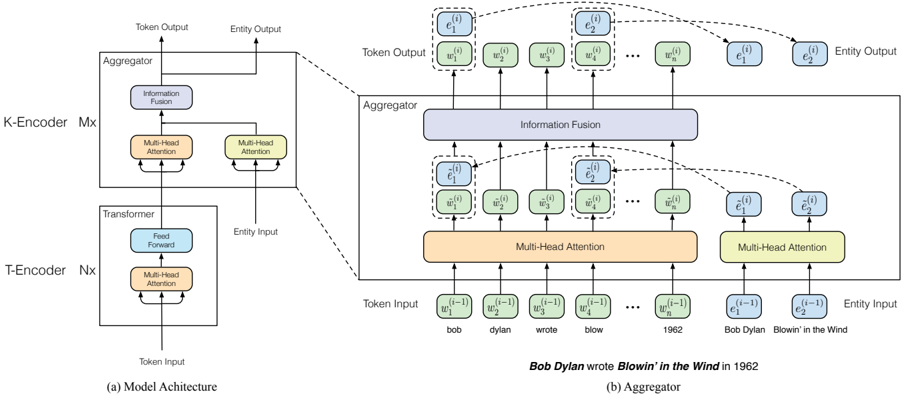
“For the large cost of training ERNIE from scratch, we adopt the parameters of BERT released by Google to initialize the Trans-former blocks for encoding tokens.”
BackgroundInfluentialExploiting Generative AI to Scale up Intelligent Tutoring Systems
Jakubův, J., Chvalovský, K., Goertzel, Z., Kaliszyk, C., Olšák, M., Piotrowski, B., Schulz, S., Suda, M., & Urban, J. (2023) · DROPS (Schloss Dagstuhl – Leibniz Center for Informatics) · doi:10.4230/lipics.itp.2023.19 · Cited by 76,658
BERT: Pre-training of Deep Bidirectional Transformers for Language Understanding
Devlin, J., Chang, M.-W., Lee, K., & Toutanova, K. (2018) · arXiv · doi:10.48550/arxiv.1810.04805 · Cited by 73,173 · cited 6×
“More details of these pre-training tasks can be found from Devlin et al. (2018).”
BackgroundInfluentialBERT: Pre-training of Deep Bidirectional Transformers for Language Understanding
Devlin, J., Chang, M.-W., Lee, K., & Toutanova, K. (2019) · Proceedings of the 2019 Conference of the North American Chapter of the Association for Computational Linguistics: Human Language Technologies, Volume 1 (Long and Short Papers) · doi:10.18653/v1/n19-1423 · Cited by 54,325 · cited 6×
“More details of these pre-training tasks can be found from Devlin et al. (2018).”
BackgroundInfluentialGlove: Global Vectors for Word Representation
Pennington, J., Socher, R., & Manning, C. (2014) · Proceedings of the 2014 Conference on Empirical Methods in Natural Language Processing (EMNLP) · doi:10.3115/v1/d14-1162 · Cited by 34,071 · cited 1×
“The early work (Collobert and Weston, 2008; Mikolov et al., 2013; Pennington et al., 2014) focuses on adopting feature-based approaches to transform words into distributed representations.”
BackgroundDistributed Representations of Words and Phrases and their Compositionality
Mikolov, T., Sutskever, I., Chen, K., Corrado, G., & Dean, J. (2013) · arXiv · doi:10.48550/arxiv.1310.4546 · Cited by 24,533
Deep Contextualized Word Representations
Peters, M., Neumann, M., Iyyer, M., Gardner, M., Clark, C., Lee, K., & Zettlemoyer, L. (2018) · Proceedings of the 2018 Conference of the North American Chapter of the Association for Computational Linguistics: Human Language Technologies, Volume 1 (Long Papers) · doi:10.18653/v1/n18-1202 · Cited by 11,983 · cited 4×
“There are three important directions remain for future research: (1) inject knowledge into feature-based pre-training models such as ELMo (Peters et al., 2018); (2) introduce diverse structured knowledge into language representation models such as Con-ceptNet (Speer and Havasi, 2012) which is different from world know…”
BackgroundMethodInfluentialExtracting and composing robust features with denoising autoencoders
Vincent, P., Larochelle, H., Bengio, Y., & Manzagol, P.-A. (2008) · Proceedings of the 25th international conference on Machine learning - ICML '08 · doi:10.1145/1390156.1390294 · Cited by 7,436
Recursive Deep Models for Semantic Compositionality Over a Sentiment Treebank
Socher, R., Perelygin, A., Wu, J., Chuang, J., Manning, C. D., Ng, A., & Potts, C. (2013) · Proceedings of the 2013 Conference on Empirical Methods in Natural Language Processing · doi:10.18653/v1/d13-1170 · Cited by 6,878 · cited 1×
“, 2018) is a collection of diverse natural language understanding tasks (Warstadt et al., 2018; Socher et al., 2013; Dolan and Brockett, 2005; Agirre et al., 2007; Williams et al., 2018; Rajpurkar et al., 2016; Dagan et al., 2006; Levesque et al., 2011), which is the main benchmark used in Devlin et al.”
BackgroundSQuAD: 100,000+ Questions for Machine Comprehension of Text
Rajpurkar, P., Zhang, J., Lopyrev, K., & Liang, P. (2016) · Proceedings of the 2016 Conference on Empirical Methods in Natural Language Processing · doi:10.18653/v1/d16-1264 · Cited by 6,208 · cited 2×
“…including feature-based (Mikolov et al., 2013; Pen-nington et al., 2014; Peters et al., 2017, 2018) and fine-tuning (Dai and Le, 2015; Howard and Ruder, 2018; Radford et al., 2018; Devlin et al., 2018) approaches, can capture rich language information from text and then benefit many NLP applications.”
Background
Research works printed but not linked: 4
- Eneko Agirre, Llu'is M'arquez, and Richard Wicen- towski. 2007. Proceedings of the fourth interna- tional workshop on semantic evaluations (semeval- 2007). In Proceedings of SemEval-2007.
- Tomas Mikolov, Ilya Sutskever, Kai Chen, Greg S Cor- rado, and Jeff Dean. 2013. Distributed representa- tions of words and phrases and their compositional- ity. In Proceedings of NIPS, pages 3111-3119.
- Matthew Peters, Mark Neumann, Mohit Iyyer, Matt Gardner, Christopher Clark, Kenton Lee, and Luke Zettlemoyer. 2018. Deep contextualized word rep- resentations. In Proceedings of NAACL-HLT, pages 2227-2237.
- Alec Radford, Karthik Narasimhan, Tim Salimans, and Ilya Sutskever. 2018. Improving language under- standing by generative pre-training. In Proceedings of Technical report, OpenAI.
Cited by
Han (2023) · doi:10.1109/tpami.2022.3152247 · Cited by 4,682
A Survey on Knowledge Graphs: Representation, Acquisition, and Applications
Ji, S., Pan, S., Cambria, E., Marttinen, P., & Yu, P. S. (2022) · IEEE Transactions on Neural Networks and Learning Systems · doi:10.1109/tnnls.2021.3070843 · Cited by 2,947
On the Opportunities and Risks of Foundation Models
Bommasani, R., Hudson, D. A., Adeli, E., Altman, R., Arora, S., von Arx, S., Bernstein, M. S., Bohg, J., Bosselut, A., Brunskill, E., et al. (2021) · arXiv · doi:10.48550/arxiv.2108.07258 · Cited by 2,676
Self-supervised Learning: Generative or Contrastive
Liu, X., Zhang, F., Hou, Z., Mian, L., Wang, Z., Zhang, J., & Tang, J. (2021) · IEEE Transactions on Knowledge and Data Engineering · doi:10.1109/tkde.2021.3090866 · Cited by 1,087
“ERNIE [114], [149] NLP G AE Masked words Sentence”
BackgroundSpanBERT: Improving Pre-training by Representing and Predicting Spans
Joshi, M., Chen, D., Liu, Y., Weld, D. S., Zettlemoyer, L., & Levy, O. (2020) · Transactions of the Association for Computational Linguistics · doi:10.1162/tacl_a_00300 · Cited by 1,827
SpanBERT: Improving Pre-training by Representing and Predicting Spans
Joshi, M., Chen, D., Liu, Y., Weld, D. S., Zettlemoyer, L., & Levy, O. (2019) · arXiv · doi:10.48550/arxiv.1907.10529 · Cited by 1,827
A Survey on Deep Learning for Named Entity Recognition
Li, J., Sun, A., Han, J., & Li, C. (2022) · IEEE Transactions on Knowledge and Data Engineering · doi:10.1109/tkde.2020.2981314 · Cited by 1,567
“applications such as text understanding [2], [3], information retrieval [4], [5], automatic text summarization [6], question answering [7], machine translation [8], and knowledge base construction [9] etc.”
BackgroundPre-trained models for natural language processing: A survey
Qiu, X., Sun, T., Xu, Y., Shao, Y., Dai, N., & Huang, X. (2020) · Science China Technological Sciences · doi:10.1007/s11431-020-1647-3 · Cited by 1,591
“The external knowledge ranges from linguistic [94, 83, 136, 191], semantic [99], commonsense [52], factual [214, 136, 111, 202, 195], to domain-specific knowledge [58, 111].”
BackgroundA primer in BERTology: What we know about how BERT works
Rogers, A., Kovaleva, O., & Rumshisky, A. (2020) · Transactions of the Association for Computational Linguistics · doi:10.1162/tacl_a_00349 · Cited by 1,552
“Liu et al. (2019c) explore the benefits 4New token-level tasks in ERNIE include prediction whether a token is capitalized and whether it occurs in other segments of the same document.”
BackgroundMethodInfluentialUnifying Large Language Models and Knowledge Graphs: A Roadmap
Pan, S., Luo, L., Wang, Y., Chen, C., Wang, J., & Wu, X. (2024) · IEEE Transactions on Knowledge and Data Engineering · doi:10.1109/tkde.2024.3352100 · Cited by 1,376
“The architecture and fusion approach is mostly similar to ERNIE [35] discussed in Section 6.1, except that GreaseLM does not use the text-only T-encoder to handle input text.”
BackgroundMethodInfluentialA Survey on Knowledge Graph-Based Recommender Systems
Guo, Q., Zhuang, F., Qin, C., Zhu, H., Xie, X., Xiong, H., & He, Q. (2022) · IEEE Transactions on Knowledge and Data Engineering · doi:10.1109/tkde.2020.3028705 · Cited by 926
How Can We Know What Language Models Know?
Jiang, Z., Xu, F. F., Araki, J., & Neubig, G. (2020) · Transactions of the Association for Computational Linguistics · doi:10.1162/tacl_a_00324 · Cited by 1,002
“Similar extensions have been applied to pre-trained LMs like BERT, where contextualized representations are enhancedwith entity embeddings (Zhang et al., 2019; Peters et al., 2019; Pörner et al., 2019).”
MethodInfluentialvon Rueden, L., Mayer, S., Beckh, K., Georgiev, B., Giesselbach, S., Heese, R., Kirsch, B., Walczak, M., Pfrommer, J., Pick, A., et al. (2021) · IEEE Transactions on Knowledge and Data Engineering · doi:10.1109/tkde.2021.3079836 · Cited by 793
“ERNIE [86], which are fed into language models like BERT [94], [119].”
MethodInfluentialPre-trained models: Past, present and future
Han, X., Zhang, Z., Ding, N., Gu, Y., Liu, X., Huo, Y., Qiu, J., Yao, Y., Zhang, A., Zhang, L., et al. (2021) · AI Open · doi:10.1016/j.aiopen.2021.08.002 · Cited by 994
Self-citationK-BERT: Enabling Language Representation with Knowledge Graph
Liu, W., Zhou, P., Zhao, Z., Wang, Z., Ju, Q., Deng, H., & Wang, P. (2020) · Proceedings of the AAAI Conference on Artificial Intelligence · doi:10.1609/aaai.v34i03.5681 · Cited by 894
“While the pre-trained LR model is an emerging direction, there is little work on its fusion with KG. THU-ERNIE (Zhang et al. 2019) is a pioneer in this direction by fusing entity information, but the relations between entities are ignored by it.”
BackgroundMethodRasmy, L., Xiang, Y., Xie, Z., Tao, C., & Zhi, D. (2021) · npj Digital Medicine · doi:10.1038/s41746-021-00455-y · Cited by 886
KG-BERT: BERT for Knowledge Graph Completion
Yao, L., Mao, C., & Luo, Y. (2019) · arXiv (Cornell University) · doi:10.48550/arxiv.1909.03193 · Cited by 366
“(Zhang et al. 2019) incorporated informative entities in KG to enhance BERT language representation.”
BackgroundGenerative artificial intelligence: a systematic review and applications
Sengar, S. S., Hasan, A. B., Kumar, S., & Carroll, F. (2024) · Multimedia Tools and Applications · doi:10.1007/s11042-024-20016-1 · Cited by 467
Retrieval-Augmented Generation for Large Language Models: A Survey
Gao, Y., Xiong, Y., Gao, X., Jia, K., Pan, J., Bi, Y., Dai, Y., Sun, J., Wang, M., & Wang, H. (2023) · arXiv · doi:10.48550/arxiv.2312.10997 · Cited by 876
“In a further stage of generator training, the model acknowledges the critical role of entity semantics in the representation learning of textual data for retrieval, as highlighted by [ Sciavolino et al. , 2021, Zhang et al. , 2019 ] .”
MethodLUKE: Deep Contextualized Entity Representations with Entity-aware Self-attention
Yamada, I., Asai, A., Shindo, H., Takeda, H., & Matsumoto, Y. (2020) · Proceedings of the 2020 Conference on Empirical Methods in Natural Language Processing (EMNLP) · doi:10.18653/v1/2020.emnlp-main.523 · Cited by 590
KEPLER: A Unified Model for Knowledge Embedding and Pre-trained Language Representation
Wang, X., Gao, T., Zhu, Z., Zhang, Z., Liu, Z., Li, J., & Tang, J. (2021) · Transactions of the Association for Computational Linguistics · doi:10.1162/tacl_a_00360 · Cited by 676
“These embeddings not only help with the KG completion task, but can also improve the performance of various NLP applications (Zaremoodi et al., 2018; Zhong et al., 2019).”
BackgroundSelf-citationSign Language Transformers: Joint End-to-End Sign Language Recognition and Translation
Camgöz, N. C., Koller, O., Hadfield, S., & Bowden, R. (2020) · IEEE Computer Society Conference on Computer Vision and Pattern Recognition/Proceedings - IEEE Computer Society Conference on Computer Vision and Pattern Recognition/Proceedings · doi:10.1109/cvpr42600.2020.01004 · Cited by 1,148
“In addition to NMT, transformers have achieved success in various other challenging tasks, such as language modelling [19, 77], learning sentence representations [21], multi-modal language understanding [68], activity [73] and speech recognition [34].”
BackgroundKnowledge Enhanced Contextual Word Representations
Peters, M. E., Neumann, M., Logan, R., Schwartz, R., Joshi, V., Singh, S., & Smith, N. A. (2019) · Proceedings of the 2019 Conference on Empirical Methods in Natural Language Processing and the 9th International Joint Conference on Natural Language Processing (EMNLP-IJCNLP) · doi:10.18653/v1/d19-1005 · Cited by 661
“As shown in Table 7, KnowBert-W+W shows an improvement of 0.6% F 1 over ERNIE and 2.5% over BERT BASE .”
MethodInfluentialK-Adapter: Infusing Knowledge into Pre-Trained Models with Adapters
Wang, R., Tang, D., Duan, N., Wei, Z., Huang, X., Ji, J., Cao, G., Jiang, D., & Zhou, M. (2021) · Findings of the Association for Computational Linguistics: ACL-IJCNLP 2021 · doi:10.18653/v1/2021.findings-acl.121 · Cited by 456
Lin, X., Xiong, G., Gou, G., Li, Z., Shi, J., & Yu, J. (2022) · Proceedings of the ACM Web Conference 2022 · doi:10.1145/3485447.3512217 · Cited by 599
“The extensions of the pre-training models include knowledge enhancement and model compression, ERNIE [43] introduces entity knowledge to improve language understanding, while DistilBERT [30] reduces the number of network layers and parameters through knowledge distillation techniques to significantly speed up model tr…”
MethodA Frustratingly Easy Approach for Entity and Relation Extraction
Zhong, Z., & Chen, D. (2021) · Proceedings of the 2021 Conference of the North American Chapter of the Association for Computational Linguistics: Human Language Technologies · doi:10.18653/v1/2021.naacl-main.5 · Cited by 477
“Furthermore, Zhang et al. (2019); Soares et al. (2019) only consider un-typed markers (e.g., (cid:104) S (cid:105) , (cid:104) /S (cid:105) ) and previous end-to-end models (e.g., (Wadden et al., 2019)) only inject the entity type information into the relation model through auxiliary losses.”
BackgroundA Frustratingly Easy Approach for Entity and Relation Extraction
Zhong, Z., & Chen, D. (2020) · arXiv · doi:10.48550/arxiv.2010.12812 · Cited by 531
“Furthermore, Zhang et al. (2019); Soares et al. (2019) only considered untyped markers (e.g., (cid:104) S (cid:105) , (cid:104) /S (cid:105) ) and previous end-to-end models e.g., (Wadden et al., 2019) inject the entity type information into the relation model through auxiliary losses.”
BackgroundMethodTaBERT: Pretraining for Joint Understanding of Textual and Tabular Data
Yin, P., Neubig, G., Yih, W.-T., & Riedel, S. (2020) · Proceedings of the 58th Annual Meeting of the Association for Computational Linguistics · doi:10.18653/v1/2020.acl-main.745 · Cited by 487
How Does NLP Benefit Legal System: A Summary of Legal Artificial Intelligence
Zhong, H., Xiao, C., Tu, C., Zhang, T., Liu, Z., & Sun, M. (2020) · Proceedings of the 58th Annual Meeting of the Association for Computational Linguistics · doi:10.18653/v1/2020.acl-main.466 · Cited by 367
Self-citationLinkBERT: Pretraining Language Models with Document Links
Yasunaga, M., Leskovec, J., & Liang, P. (2022) · Proceedings of the 60th Annual Meeting of the Association for Computational Linguistics (Volume 1: Long Papers) · doi:10.18653/v1/2022.acl-long.551 · Cited by 327
Pre-Trained Language Models and Their Applications
Wang, H., Li, J., Wu, H., Hovy, E., & Sun, Y. (2023) · Engineering · doi:10.1016/j.eng.2022.04.024 · Cited by 385
Learning Hierarchy-Aware Knowledge Graph Embeddings for Link Prediction
Zhang, Z., Cai, J., Zhang, Y., & Wang, J. (2020) · Proceedings of the AAAI Conference on Artificial Intelligence · doi:10.1609/aaai.v34i03.5701 · Cited by 421
Self-citationLarge language models (LLMs): survey, technical frameworks, and future challenges
Kumar, P. (2024) · Artificial Intelligence Review · doi:10.1007/s10462-024-10888-y · Cited by 395
On the Opportunities and Challenges of Foundation Models for GeoAI (Vision Paper)
Mai, G., Huang, W., Sun, J., Song, S., Mishra, D. R., Liu, N., Gao, S., Liu, T., Cong, G., Hu, Y., et al. (2024) · ACM Transactions on Spatial Algorithms and Systems · doi:10.1145/3653070 · Cited by 447
“— OpenFlamingo-9B : We use the pre-trained OpenFlamingo-9B model [11] provided by Hug-gingface 11 that consists of an image encoder (CLIP ViT-L/14 [68]) and an LLM (LLaMA-7B [178]).”
MethodAMMUS : A Survey of Transformer-based Pretrained Models in Natural Language ProcessingPreprint
Kalyan, K. S., Rajasekharan, A., & Sangeetha, S. (2021) · arXiv (Cornell University) · doi:10.48550/arxiv.2108.05542 · Cited by 432
“Some of the examples of knowledge enriched T-PTLMs are CasualBERT [197], KnowBERT [189], SenseBERT [204], LIMIT-BERT [199], LiBERT [198], SentiLARE [200], ERNINE [188], E-BERT [186] in the general domain and Clincal Kb-BERT [201], Clinical Kb-ALBERT [201], SapBERT [202], Sap-XLMR [202], UmlsBERT [127], CoderBERT [203]…”
BackgroundMethodInfluentialA Review of Current Trends, Techniques, and Challenges in Large Language Models (LLMs)
Patil, R., & Gudivada, V. (2024) · Applied Sciences · doi:10.3390/app14052074 · Cited by 290
“ERNIE [69] incorporated structured knowledge facts during pretraining using knowledge graphs to address this issue.”
BackgroundDocument-Level Relation Extraction with Adaptive Thresholding and Localized Context Pooling
Zhou, W., Huang, K., Ma, T., & Huang, J. (2021) · Proceedings of the AAAI Conference on Artificial Intelligence · doi:10.1609/aaai.v35i16.17717 · Cited by 316
SimKGC: Simple Contrastive Knowledge Graph Completion with Pre-trained Language Models
Wang, L., Zhao, W., Wei, Z., & Liu, J. (2022) · Proceedings of the 60th Annual Meeting of the Association for Computational Linguistics (Volume 1: Long Papers) · doi:10.18653/v1/2022.acl-long.295 · Cited by 264
A Comprehensive Study of Knowledge Editing for Large Language ModelsPreprint
Zhang, N., Yao, Y., Tian, B., Wang, P., Deng, S., Wang, M., Xi, Z., Mao, S., Zhang, J., Ni, Y., et al. (2024) · arXiv (Cornell University) · doi:10.48550/arxiv.2401.01286 · Cited by 413
“Knowledge Augmentation for LLMs LLMs still face unknown questions, and many knowledge-augmented methods are proposed to help the model deal with this task [105–107].”
MethodSelf-citationA Survey of Controllable Text Generation Using Transformer-based Pre-trained Language Models
Zhang, H., Song, H., Li, S., Zhou, M., & Song, D. (2024) · ACM Computing Surveys · doi:10.1145/3617680 · Cited by 317
SKEP: Sentiment Knowledge Enhanced Pre-training for Sentiment Analysis
Tian, H., Gao, C., Xiao, X., Liu, H., He, B., Wu, H., Wang, H., & wu, F. (2020) · Proceedings of the 58th Annual Meeting of the Association for Computational Linguistics · doi:10.18653/v1/2020.acl-main.374 · Cited by 272
Knowledgeable Prompt-tuning: Incorporating Knowledge into Prompt Verbalizer for Text Classification
Hu, S., Ding, N., Wang, H., Liu, Z., Wang, J., Li, J., Wu, W., & Sun, M. (2022) · Proceedings of the 60th Annual Meeting of the Association for Computational Linguistics (Volume 1: Long Papers) · doi:10.18653/v1/2022.acl-long.158 · Cited by 265
Self-citationA Review of Current Trends, Techniques, and Challenges in Large Language Models (LLMs)
Patil, R., & Gudivada, A. V. (2024) · doi:10.20944/preprints202402.0357.v1 · Cited by 296
Release Strategies and the Social Impacts of Language Models
Solaiman, I., Brundage, M., Clark, J., Askell, A., Herbert-Voss, A., Wu, J., Radford, A., Krueger, G., Kim, J. W., Kreps, S., et al. (2019) · arXiv · doi:10.48550/arxiv.1908.09203 · Cited by 292
Recent Advances in Natural Language Inference: A Survey of Benchmarks, Resources, and Approaches
Storks, S., Gao, Q., & Chai, J. Y. (2019) · arXiv (Cornell University) · doi:10.48550/arxiv.1904.01172 · Cited by 56
What is Semantic Communication? A View on Conveying Meaning in the Era of Machine Intelligence
Lan, Q., Wen, D., Zhang, Z., Zeng, Q., Chen, X., Popovski, P., & Huang, K. (2021) · Journal of Communications and Information Networks · doi:10.23919/jcin.2021.9663101 · Cited by 255
Self-citationStructured Pruning of Large Language Models
Wang, Z., Wohlwend, J., & Lei, T. (2020) · Proceedings of the 2020 Conference on Empirical Methods in Natural Language Processing (EMNLP) · doi:10.18653/v1/2020.emnlp-main.496 · Cited by 95
A Survey of Text Representation and Embedding Techniques in NLP
Patil, R., Boit, S., Gudivada, V., & Nandigam, J. (2023) · IEEE Access · doi:10.1109/access.2023.3266377 · Cited by 214
Large-scale Multi-modal Pre-trained Models: A Comprehensive Survey
Wang, X., Chen, G., Qian, G., Gao, P., Wei, X.-Y., Wang, Y., Tian, Y., & Gao, W. (2023) · Machine Intelligence Research · doi:10.1007/s11633-022-1410-8 · Cited by 223
“An enhanced language representation model ERNIE is trained by utilizing both large-scale textual corpora and knowledge graphs, so that it can simultaneously leverage lexical, syntactic and knowledge [222].”
MethodQuery2Label: A Simple Transformer Way to Multi-Label ClassificationPreprint
Liu, S., Zhang, L., Yang, X., Su, H., & Zhu, J. (2021) · arXiv (Cornell University) · doi:10.48550/arxiv.2107.10834 · Cited by 348
“Transformer [45] was first proposed to model long-range dependencies in sequence learning problems, and has been widely used in natural language processing tasks [15, 32, 13, 2, 31, 55].”
A Survey of Knowledge-enhanced Text Generation
Yu, W., Zhu, C., Li, Z., Hu, Z., Wang, Q., Ji, H., & Jiang, M. (2022) · ACM Computing Surveys · doi:10.1145/3512467 · Cited by 257
“Overall, these approaches can be grouped into two categories: The first one is to explicitly inject entity representation into PLMs, where the representations is pre-computed from external sources [76, 150].”
BackgroundMRQA 2019 Shared Task: Evaluating Generalization in Reading Comprehension
Fisch, A., Talmor, A., Jia, R., Seo, M., Choi, E., & Chen, D. (2019) · Proceedings of the 2nd Workshop on Machine Reading for Question Answering · doi:10.18653/v1/d19-5801 · Cited by 215
“The top system, which took advantage of newer pre-trained language models (Yang et al., 2019; Zhang et al., 2019), achieved an average F1 score of 72.”
BackgroundMethodInfluentialA Survey of Knowledge Enhanced Pre-Trained Language Models
Hu, L., Liu, Z., Zhao, Z., Hou, L., Nie, L., & Li, J. (2024) · IEEE Transactions on Knowledge and Data Engineering · doi:10.1109/tkde.2023.3310002 · Cited by 196
“Thethirdistochangethemodelstructure[60],[77],[78],[79], [80], [81].”
MethodSelf-citationA Survey on Contextual Embeddings
Coelho, J., Neto, A., Tavares, M., Coutinho, C., Ribeiro, R., & Batista, F. (2020) · arXiv (Cornell University) · doi:10.4230/oasics.slate.2021.12 · Cited by 109
Self-citationA Knowledge-Enhanced Pretraining Model for Commonsense Story Generation
Guan, J., Huang, F., Zhao, Z., Zhu, X., & Huang, M. (2020) · Transactions of the Association for Computational Linguistics · doi:10.1162/tacl_a_00302 · Cited by 228
Yang, L., Chen, H., Li, Z., Ding, X., & Wu, X. (2023) · arXiv · doi:10.48550/arxiv.2306.11489 · Cited by 239
“Building upon ERNIE, ERNIE 2.0 [106] proposes a continual multi-task learning framework that extracts valuable lexical, syntactic, and semantic information such as named entities, semantic closeness, and discourse relations.”
InfluentialYang, L., Chen, H., Li, Z., Ding, X., & Wu, X. (2024) · IEEE Transactions on Knowledge and Data Engineering · doi:10.1109/tkde.2024.3360454 · Cited by 238
“For instance, ERNIE [31] recognizes named entities in texts and aligns them with their corresponding entities in KGs.”
BackgroundMethodInfluentialCan Knowledge Graphs Reduce Hallucinations in LLMs? : A Survey
Agrawal, G., Kumarage, T., Alghamdi, Z., & Liu, H. (2024) · Conference of the North American Chapter of the Association for Computational Linguistics: Human Language Technologies (NAACL-HLT) · doi:10.18653/v1/2024.naacl-long.219 · Cited by 335
“ERNIE (Zhang et al., 2019) used the masked language model (MLM) and next sentence prediction (NSP) for model pre-training to capture the lexical and syntactical information from text tokens.”
InfluentialLongT5: Efficient Text-To-Text Transformer for Long Sequences
Guo, M., Ainslie, J., Uthus, D., Ontanon, S., Ni, J., Sung, Y.-H., & Yang, Y. (2022) · Findings of the Association for Computational Linguistics: NAACL 2022 · doi:10.18653/v1/2022.findings-naacl.55 · Cited by 230
LongT5: Efficient Text-To-Text Transformer for Long Sequences
Guo, M., Ainslie, J., Uthus, D., Ontanon, S., Ni, J., Sung, Y.-H., & Yang, Y. (2021) · arXiv · doi:10.48550/arxiv.2112.07916 · Cited by 230
“1.1 are (1) a new scalable attention mechanism called Transient Global attention, which is a drop-in replacement to the standard T5 attention mechanism, and hence can be used without needing additional side-inputs to the model or modifications to the model inputs; and (2) using a PEGASUS-style Principle Sentences Gener…”
InfluentialKnowledge Graph Embedding: A Survey from the Perspective of Representation Spaces
Cao, J., Fang, J., Meng, Z., & Liang, S. (2024) · ACM Computing Surveys · doi:10.1145/3643806 · Cited by 171
“Researchers always use machine learning methods [188, 189, 232] to infer potential relations between entity pairs and identify erroneous knowledge based on existing data automatically.”
BackgroundInformation Retrieval: Recent Advances and Beyond
Hambarde, K., & Proença, H. P. M. C. (2023) · IEEE Access · doi:10.1109/access.2023.3295776 · Cited by 291
“Future research should explore more efficient ways to model this knowledge for IR, as well as strive for greater interpretability in modeling knowledge for downstream tasks [270], [271], [272], [273], [274].”
MethodDIET: Lightweight Language Understanding for Dialogue SystemsPreprint
Bunk, T., Varshneya, D., Vlasov, V., & Nichol, A. (2020) · arXiv (Cornell University) · doi:10.48550/arxiv.2004.09936 · Cited by 251
“Top performing models (Liu et al., 2019a; Zhang et al., 2019) on language understanding benchmarks like GLUE (Wang et al.”
MethodLearning from Context or Names? An Empirical Study on Neural Relation Extraction
Peng, H., Gao, T., Han, X., Lin, Y., Li, P., Liu, Z., Sun, M., & Zhou, J. (2020) · Proceedings of the 2020 Conference on Empirical Methods in Natural Language Processing (EMNLP) · doi:10.18653/v1/2020.emnlp-main.298 · Cited by 185
Self-citationNeural entity linking: A survey of models based on deep learning
Sevgili, Ö., Shelmanov, A., Arkhipov, M., Panchenko, A., & Biemann, C. (2022) · Semantic Web · doi:10.3233/sw-222986 · Cited by 290
“ikidata and WordNet show that presented modifications in KnowBERT help it to slightly surpass other deep pre-trained language models in tasks of relationship extraction, WSD, and entity typing. ERNIE (Zhang et al., 2019) expands the BERT (Devlin et al., 2019) architecture with a knowledgeable encoder (K-Encoder), which…”
BackgroundPretrained Language Model for Text Generation: A Survey
Li, J., Tang, T., Zhao, W. X., & Wen, J.-R. (2021) · Proceedings of the Thirtieth International Joint Conference on Artificial Intelligence · doi:10.24963/ijcai.2021/612 · Cited by 118
LIU, P., Qian, L., Zhao, X., & Tao, B. (2024) · IEEE Transactions on Industrial Informatics · doi:10.1109/tii.2024.3366977 · Cited by 180
TURL: table understanding through representation learning
Deng, X., Sun, H., Lees, A., Wu, Y., & Yu, C. (2020) · Proceedings of the VLDB Endowment · doi:10.14778/3430915.3430921 · Cited by 271
Progressive Transformers for End-to-End Sign Language Production
Saunders, B., Camgoz, N. C., & Bowden, R. (2020) · Lecture Notes in Computer Science · doi:10.1007/978-3-030-58621-8_40 · Cited by 171
Transformer models used for text-based question answering systems
Nassiri, K., & Akhloufi, M. (2023) · Applied Intelligence · doi:10.1007/s10489-022-04052-8 · Cited by 164
“The ERNIE model [157] (Enhanced Representation via kNowledge IntEgration) is based on BERT’s masking strategy.”
MethodSentiLARE: Sentiment-Aware Language Representation Learning with Linguistic Knowledge
Ke, P., Ji, H., Liu, S., Zhu, X., & Huang, M. (2020) · Proceedings of the 2020 Conference on Empirical Methods in Natural Language Processing (EMNLP) · doi:10.18653/v1/2020.emnlp-main.567 · Cited by 143
“Thanks to the great success of BERT on various NLP tasks, many variants of BERT have been proposed, which mainly fall into four aspects: 1) Knowledge enhancement: ERNIE-Tsinghua (Zhang et al., 2019) / KnowBERT (Peters et al., 2019) explicitly introduces knowledge graph / knowledge base to BERT, while ERNIE-Baidu (Sun…”
BackgroundERNIE 3.0: Large-scale Knowledge Enhanced Pre-training for Language Understanding and Generation
Sun, Y., Wang, S., Feng, S., Ding, S., Pang, C., Shang, J., Liu, J., Chen, X., Zhao, Y., Lu, Y., et al. (2021) · arXiv · doi:10.48550/arxiv.2107.02137 · Cited by 186
“Many works ([24, 25, 26]) integrate entity and relation embedding from knowledge graph in pre-trained language models.”
BackgroundCoLAKE: Contextualized Language and Knowledge Embedding
Sun, T., Shao, Y., Qiu, X., Guo, Q., Hu, Y., Huang, X., & Zhang, Z. (2020) · Proceedings of the 28th International Conference on Computational Linguistics · doi:10.18653/v1/2020.coling-main.327 · Cited by 185
Self-citationKG-BART: knowledge graph-augmented BART for generative commonsense reasoning
Liu, Y., Wan, Y., He, L., Peng, H., & Yu, P. S. (2021) · Proceedings of the AAAI Conference on Artificial Intelligence · doi:10.1609/aaai.v35i7.16796 · Cited by 102
El Boukkouri, H., Ferret, O., Lavergne, T., Noji, H., Zweigenbaum, P., & Tsujii, J. (2020) · Proceedings of the 28th International Conference on Computational Linguistics · doi:10.18653/v1/2020.coling-main.609 · Cited by 131
Coreferential Reasoning Learning for Language Representation
Ye, D., Lin, Y., Du, J., Liu, Z., Li, P., Sun, M., & Liu, Z. (2020) · Proceedings of the 2020 Conference on Empirical Methods in Natural Language Processing (EMNLP) · doi:10.18653/v1/2020.emnlp-main.582 · Cited by 163
Self-citationEditing Factual Knowledge in Language Models
De Cao, N., Aziz, W., & Titov, I. (2021) · Proceedings of the 2021 Conference on Empirical Methods in Natural Language Processing · doi:10.18653/v1/2021.emnlp-main.522 · Cited by 180
“Approaches that incentivize memorization of factual knowledge show to be ben-eficial for many downstream tasks suggesting that research on methods that effectively edit the memory of a model is indeed important (Zhang et al., 2019; Sun et al., 2019, 2020).”
BackgroundYamada, I., Asai, A., Sakuma, J., Shindo, H., Takeda, H., Takefuji, Y., & Matsumoto, Y. (2020) · Proceedings of the 2020 Conference on Empirical Methods in Natural Language Processing: System Demonstrations · doi:10.18653/v1/2020.emnlp-demos.4 · Cited by 164
“Poerner et al. (2019) have recently demonstrated that by combining BERT with the entity embeddings trained by our tool outperforms BERT and knowledge-enhanced contextualized word embeddings (i.e., ERNIE (Zhang et al., 2019)) on unsupervised question answering and relation clas-sification tasks, without any computationa…”
BackgroundMethodWang, R., Jiang, Y., Jin, J., Yin, C., Yu, H., Wang, F., Feng, J., Su, R., Nakai, K., Zou, Q., et al. (2023) · Nucleic Acids Research · doi:10.1093/nar/gkad055 · Cited by 176
Enriching contextualized language model from knowledge graph for biomedical information extraction
Fei, H., Ren, Y., Zhang, Y., Ji, D., & Liang, X. (2021) · Briefings in Bioinformatics · doi:10.1093/bib/bbaa110 · Cited by 172
Zeng, W., Ren, X., Su, T., Wang, H., Liao, Y., Wang, Z., Jiang, X., Yang, Z., Wang, K., Zhang, X., et al. (2021) · arXiv · doi:10.48550/arxiv.2104.12369 · Cited by 172
Self-citationA comprehensive overview of knowledge graph completion
Shen, T., Zhang, F., & Cheng, J. (2022) · Knowledge-Based Systems · doi:10.1016/j.knosys.2022.109597 · Cited by 212
Prompt-learning for Fine-grained Entity Typing
Ding, N., Chen, Y., Han, X., Xu, G., Wang, X., Xie, P., Zheng, H., Liu, Z., Li, J., & Kim, H.-G. (2022) · Findings of the Association for Computational Linguistics: EMNLP 2022 · doi:10.18653/v1/2022.findings-emnlp.512 · Cited by 133
Self-citationNguyen, T. T. (2020) · doi:10.36227/techrxiv.12743933 · Cited by 161
LLMs Know More Than They Show: On the Intrinsic Representation of LLM Hallucinations
Orgad, H., Toker, M., Gekhman, Z., Reichart, R., Szpektor, I., Kotek, H., & Belinkov, Y. (2025) · International Conference on Learning Representations · doi:10.48550/arxiv.2410.02707 · Cited by 221
“The term “hallucinations” is widely used across various subfields such as conversational AI (Liu et al., 2022), abstractive summarization (Zhang et al., 2019), and machine translation (Wang & Sennrich, 2020), each interpreting the term differently.”
BackgroundTACRED Revisited: A Thorough Evaluation of the TACRED Relation Extraction Task
Alt, C., Gabryszak, A., & Hennig, L. (2020) · Proceedings of the 58th Annual Meeting of the Association for Computational Linguistics · doi:10.18653/v1/2020.acl-main.142 · Cited by 132
Zhong, Q., Ding, L., Liu, J., Du, B., Jin, H., & Tao, D. (2023) · IEEE Transactions on Knowledge and Data Engineering · doi:10.1109/tkde.2023.3250499 · Cited by 196
“Following the existing work [55], we keep the knowledge embeddings fixed during training.”
MethodOpenNRE: An Open and Extensible Toolkit for Neural Relation Extraction
Han, X., Gao, T., Yao, Y., Ye, D., Liu, Z., & Sun, M. (2019) · Proceedings of the 2019 Conference on Empirical Methods in Natural Language Processing and the 9th International Joint Conference on Natural Language Processing (EMNLP-IJCNLP): System Demonstrations · doi:10.18653/v1/d19-3029 · Cited by 139
“, 2018b), few-shot learning paradigm (Han et al., 2018c; Gao et al., 2019; Ye and Ling, 2019; Soares et al., 2019; Zhang et al., 2019), there still lack an effective and stable toolkit to support the implementation, deployment and evaluation of models.”
BackgroundMethodSelf-citationConvBERT: Improving BERT with Span-based Dynamic Convolution
Jiang, Z., Yu, W., Zhou, D., Chen, Y., Feng, J., & Yan, S. (2020) · arXiv (Cornell University) · doi:10.48550/arxiv.2008.02496 · Cited by 126
“There are also some works that extend pre-training by incorporating knowledge [73, 47, 37, 68], multiple languages [22, 9, 6], and multiple modalities [39, 58, 5, 59, 7].”
BackgroundEntities as Experts: Sparse Memory Access with Entity Supervision
Févry, T., Baldini Soares, L., FitzGerald, N., Choi, E., & Kwiatkowski, T. (2020) · Proceedings of the 2020 Conference on Empirical Methods in Natural Language Processing (EMNLP) · doi:10.18653/v1/2020.emnlp-main.400 · Cited by 130
Complex Knowledge Base Question Answering: A Survey
Lan, Y., He, G., Jiang, J., Jiang, J., Zhao, W. X., & Wen, J.-R. (2023) · IEEE Transactions on Knowledge and Data Engineering · doi:10.1109/tkde.2022.3223858 · Cited by 117
“Similar ideas were also adopted in knowledge-enhanced language model pre-training [98], [99].”
ResultHittER: Hierarchical Transformers for Knowledge Graph Embeddings
Chen, S., Liu, X., Gao, J., Jiao, J., Zhang, R., & Ji, Y. (2021) · Conference on Empirical Methods in Natural Language Processing (EMNLP) · doi:10.18653/v1/2021.emnlp-main.812 · Cited by 198
“…in the eu-clidean space (Nickel et al., 2011; Yang et al., 2015), numerous complicated transformations in various spaces have been hence proposed (Trouil-lon et al., 2016; Ebisu and Ichise, 2018; Sun et al., 2018; Zhang et al., 2019a; Chami et al., 2020; Tang et al., 2020; Chao et al., 2021).”
BackgroundE-BERT: Efficient-Yet-Effective Entity Embeddings for BERT
Poerner, N., Waltinger, U., & Schütze, H. (2019) · arXiv · doi:10.48550/arxiv.1911.03681 · Cited by 149
E-BERT: Efficient-Yet-Effective Entity Embeddings for BERT
Poerner, N., Waltinger, U., & Schütze, H. (2020) · Findings of the Association for Computational Linguistics: EMNLP 2020 · doi:10.18653/v1/2020.findings-emnlp.71 · Cited by 146
“This paper adds to recent work on entity-enhanced BERT models, most notably ERNIE (Zhang et al., 2019) and KnowBert (Peters et al., 2019).”
BackgroundMethodInfluentialTopology-Aware Correlations Between Relations for Inductive Link Prediction in Knowledge Graphs
Chen, J., He, H., Wu, F., & Wang, J. (2021) · Proceedings of the AAAI Conference on Artificial Intelligence · doi:10.1609/aaai.v35i7.16779 · Cited by 186
Packed Levitated Marker for Entity and Relation Extraction
Ye, D., Lin, Y., Li, P., & Sun, M. (2022) · Proceedings of the 60th Annual Meeting of the Association for Computational Linguistics (Volume 1: Long Papers) · doi:10.18653/v1/2022.acl-long.337 · Cited by 144
Self-citationJAKET: Joint Pre-training of Knowledge Graph and Language Understanding
Yu, D., Zhu, C., Yang, Y., & Zeng, M. (2022) · Proceedings of the AAAI Conference on Artificial Intelligence · doi:10.1609/aaai.v36i10.21417 · Cited by 126
TURL: Table Understanding through Representation Learning
Deng, X., Sun, H., Lees, A., Wu, Y., & Yu, C. (2022) · ACM SIGMOD Record · doi:10.1145/3542700.3542709 · Cited by 233
“We compare ourmodel with a state-of-the-art text based relation extraction model [49] which utilizes a pretrained BERT model to encode the table information.”
InfluentialMulti-Task Learning for Knowledge Graph Completion with Pre-trained Language Models
Kim, B., Hong, T., Ko, Y., & Seo, J. (2020) · International Conference on Computational Linguistics · doi:10.18653/v1/2020.coling-main.153 · Cited by 181
“, 2019a), question answering (Zhang et al., 2019; Huang et al., 2019), and machine reading (Yang and Mitchell, 2017).”
BackgroundExT5: Towards Extreme Multi-Task Scaling for Transfer LearningPreprint
Aribandi, V., Tay, Y., Schuster, T., Rao, J., Zheng, H., Mehta, S. V., Zhuang, H., Tran, V. Q., Bahri, D., Ni, J., et al. (2021) · arXiv (Cornell University) · doi:10.48550/arxiv.2111.10952 · Cited by 181
Metadata
- Authors
- Zhang, Z., Han, X., Liu, Z., Jiang, X., Sun, M., & Liu, Q.
- Affiliations
- State Key Laboratory of Intelligent Technology and Systems (CN)
- Tsinghua University (CN)
- Huawei Technologies (China) (CN)
- Corresponding author
- Zhang, Zhengyan
- Venue
- Proceedings of the 57th Annual Meeting of the Association for Computational Linguistics
- Published
- 2019
- Pages
- 1441-1451
- ISSN
- 0736-587X (ISSN-L)
- OpenAlex
- W2953356739
- Cited by
- 1,482
- References
- 56
- Citations by year
- 2026: 74 · 2025: 142 · 2024: 236 · 2023: 292 · 2022: 250 · 2021: 284 · 2020: 174 · 2019: 29
- FWCI
- 70.49
- Type
- conference paper
- Language
- en
- Open access
- hybrid
- doi.org
- Licence
- cc-by
- Locations
- Proceedings of the conference - Association for Computational Linguistics. Meeting (publishedVersion, cc-by)
- arXiv (Cornell University) (submittedVersion)
- arXiv (Cornell University)
- Funders
- China Association for Science and Technology (2016QNRC001)
- Deutsche Forschungsgemeinschaft (DFG TRR 169, TRR169, 61621136008, NSFC 61621136008)
- National Natural Science Foundation of China (61621136008, NSFC 61621136008, TRR-169, 2016QNRC001, 61572273)
- Topics
- Physical Sciences › Computer Science › Artificial Intelligence › Topic Modeling
- Physical Sciences › Computer Science › Artificial Intelligence › Advanced Graph Neural Networks
- Physical Sciences › Computer Science › Computer Vision and Pattern Recognition › Multimodal Machine Learning Applications
- Keywords
- ERNIE, linguistic representation, knowledge graphs, pre-trained language models, BERT, external knowledge integration
About these checks
Registry, retraction, Cites and statistics results are computed, not judged, with one exception: a printed reference that no index lists is read once by a model before it counts as a citation error. Claims are extracted by a model and kept only when their quote appears verbatim in the text; each cited source is then checked, with a model’s help, for whether it says what the claim relies on. Those verdicts can be wrong — read the claim’s quote and the cited source before relying on one.
Statistics and arithmetic are recomputed, not judged.
Confidence bands are shown only for fields calibrated on our annotated test set. None is calibrated yet, so no band is shown.
What counts as a claim ›How we measure confidence ›How we check this ›
Are you an author, or do you see a problem with this page? Request a review
Data sources
Bibliographic data: Semantic Scholar, OpenAlex, Crossref.
Contains information from the Semantic Scholar Academic Graph Datasets, made available under the ODC Attribution License (ODC-BY 1.0).
Semantic Scholar’s data is described in: Kinney, R., et al. (2023). The Semantic Scholar Open Data Platform. arXiv:2301.10140.
