

Assessing the Accuracy and Reliability of AI-Generated Medical Responses: An Evaluation of the Chat-GPT Model
Open accessThe DOI matches its Crossref record; 12 of the 12 references it cites were found in a registry or an index.
Abstract
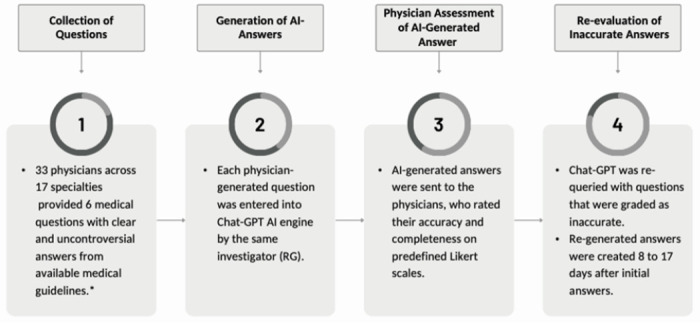
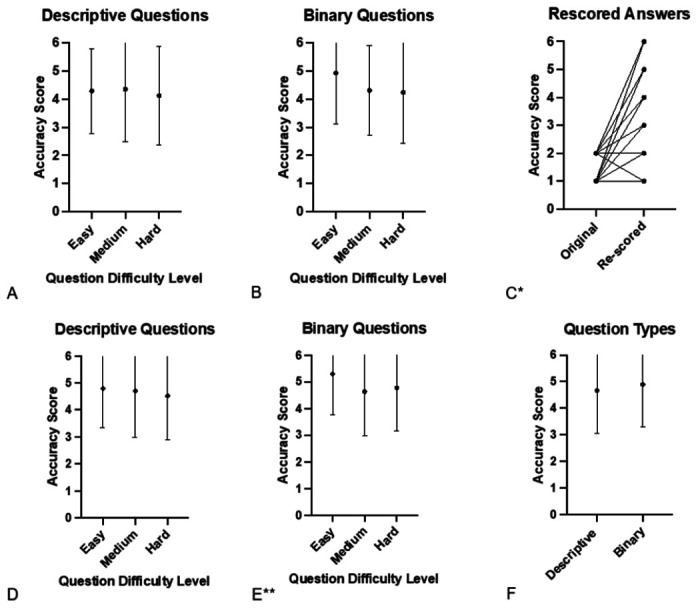
Background: Natural language processing models such as ChatGPT can generate text-based content and are poised to become a major information source in medicine and beyond. The accuracy and completeness of ChatGPT for medical queries is not known. Methods: Thirty-three physicians across 17 specialties generated 284 medical questions that they subjectively classified as easy, medium, or hard with either binary (yes/no) or descriptive answers. The physicians then graded ChatGPT-generated answers to these questions for accuracy (6-point Likert scale; range 1 – completely incorrect to 6 – completely correct) and completeness (3-point Likert scale; range 1 – incomplete to 3 - complete plus additional context). Scores were summarized with descriptive statistics and compared using Mann-Whitney U or Kruskal-Wallis testing. Results: Across all questions (n=284), median accuracy score was 5.5 (between almost completely and completely correct) with mean score of 4.8 (between mostly and almost completely correct). Median completeness score was 3 (complete and comprehensive) with mean score of 2.5. For questions rated easy, medium, and hard, median accuracy scores were 6, 5.5, and 5 (mean 5.0, 4.7, and 4.6; p=0.05). Accuracy scores for binary and descriptive questions were similar (median 6 vs. 5; mean 4.9 vs. 4.7; p=0.07). Of 36 questions with scores of 1-2, 34 were re-queried/re-graded 8-17 days later with substantial improvement (median 2 vs. 4; p<0.01). Conclusions: ChatGPT generated largely accurate information to diverse medical queries as judged by academic physician specialists although with important limitations. Further research and model development are needed to correct inaccuracies and for validation.
Overview
The claims and statistics of this paper haven’t been checked yet.
Free: it reads the open-access text and checks the first 5 claims that cite a source we can check. Create a free account to check every claim.
Integrity signals
Registry
Cites
Statistics
Figures
Verification
Claims the paper makes
The claims and statistics of this paper haven’t been checked yet.
Free: it reads the open-access text and checks the first 5 claims that cite a source we can check. Create a free account to check every claim.
Claims other papers make about this one
Each is checked against this paper’s own text: does it say what the citing paper says it does?
The source backs part of the claim, not all of it — or backs it for a different population, condition or comparison.
In the citing paper
“The same study reported that median accuracy scores were higher than mean scores in data analysis and that ChatGPT had a margin of error [29].”
From Is there any room for ChatGPT AI bot in speech-language pathology? (2025) · cites this paper as [29]
Experimental — accuracy not yet measuredThe source backs part of the claim, not all of it — or backs it for a different population, condition or comparison.
In the citing paper
“The output generated by Chat GPT is dependent on the complexity and clarity of the input, continuous evaluation of generated output will be required to ensure safe implementation in clinical settings [32, 33].”
From Artificial Intelligence (AI) – Powered Documentation Systems in Healthcare: A Systematic Review (2025) · cites this paper as [33]
Experimental — accuracy not yet measuredThe cited source says what the claim attributes to it.
In the citing paper
“it was found that more than 50% of ChatGPT responses to 180 questions created by 33 physicians had a high level of accuracy and comprehensiveness.”
From Is there any room for ChatGPT AI bot in speech-language pathology? (2025) · cites this paper as [29]
The cited source says what the claim attributes to it.
In the citing paper
“Despite some limited validation efforts, ChatGPT still requires further error correction [74].”
From Ethical Considerations of Using ChatGPT in Health Care (2023) · cites this paper as [74]
In the citing paper
“Overall, findings call into question previous claims that ChatGPT “has promise for providing accurate and comprehensive medical information” (18), and has “potential to provide first aid to young adults struggling with mental health issues” (19).”
From ChatGPT is not ready yet for use in providing mental health assessment and interventions (2024) · cites this paper as [18]
1 more claim about this paper
Create a free account to see every claim other papers make about this one.
Self-check
Percentages, sums and reported differences re-computed from the paper’s own numbers.
The self-check needs the paper’s full text.
Citations
Cites
Language Models are Few-Shot Learners
Brown, T. B., Mann, B., Ryder, N., Subbiah, M., Kaplan, J., Dhariwal, P., Neelakantan, A., Shyam, P., Sastry, G., Askell, A., et al. (2020) · arXiv · doi:10.48550/arxiv.2005.14165 · Cited by 23,372 · cited 2×
“5), an LLM with over 175 billion parameters (2).”
BackgroundAdvances in neural information processing systems 7
Cios, K., & Shields, M. (1997) · Neurocomputing · doi:10.1016/s0925-2312(97)90018-7 · Cited by 22,059
Kaugeranna, R., Kaugeranna, E., & Aion, (. S. 4. 6. (2023) · DROPS (Schloss Dagstuhl – Leibniz Center for Informatics) · doi:10.4230/lipics.giscience.2023.43 · Cited by 13,690
Kung, T. H., Cheatham, M., ChatGPT, Medenilla, A., Sillos, C., De Leon, L., Elepaño, C., Madriaga, M., Aggabao, R., Diaz-Candido, G., et al. (2022) · doi:10.1101/2022.12.19.22283643 · Cited by 4,115
Kung, T. H., Cheatham, M., Medenilla, A., Sillos, C., De Leon, L., Elepaño, C., Madriaga, M., Aggabao, R., Diaz-Candido, G., Maningo, J., et al. (2023) · PLOS Digital Health · doi:10.1371/journal.pdig.0000198 · Cited by 4,115 · cited 3×
“ChatGPT performed at or near the passing threshold for United States Medical Licensing Exam (USMLE) without any specialized training, suggesting its potential for medical education and clinical decision support (4, 5).”
BackgroundChatGPT is fun, but not an author
Thorp, H. H. (2023) · Science · doi:10.1126/science.adg7879 · Cited by 1,437
Deep reinforcement learning from human preferences
Christiano, P., Leike, J., Brown, T. B., Martic, M., Legg, S., & Amodei, D. (2017) · arXiv · doi:10.48550/arxiv.1706.03741 · Cited by 1,058
ChatGPT and other large language models are double-edged swords
Shen, Y., Heacock, L., Elias, J., Hentel, K. D., Reig, B., Shih, G., & Moy, L. (2023) · Radiology · doi:10.1148/radiol.230163 · Cited by 1,008 · cited 2×
“Compared to traditional supervised deep learning models, large language models can learn from data more e ciently with a two-stage training process, starting with self-supervised learning on vast amounts of unannotated data, then ne-tuned on smaller, task-speci c, annotated datasets so they can perform on end-user-spe…”
BackgroundChatGPT listed as author on research papers: many scientists disapprove
Stokel-Walker, C. (2023) · Nature · doi:10.1038/d41586-023-00107-z · Cited by 868
Flanagin, A., Bibbins-Domingo, K., Berkwits, M., & Christiansen, S. L. (2023) · JAMA · doi:10.1001/jama.2023.1344 · Cited by 420
Research works printed but not linked: 2
- [5]Gilson A, Safranek C, Huang T, Socrates V, Chi L, Taylor RA, How Well Does ChatGPT Do When Taking the Medical Licensing Exams? The Implications of Large Language Models for Medical Education and Knowledge Assessment. medRxiv. 2022: 2022.12. 23.22283901.
- [6]Shen Y, Heacock L, Elias J, Hentel KD, Reig B, Shih G, ChatGPT and Other Large Language Models Are Double-edged Swords. Radiology. 2023: 230163. 36700838
Cited by
Items 501–600 of 681
van der Lee, J. H., Kim, S.-A., Kim, T., Lee, S., Kim, T., & Kang, J. W. (2024) · European Journal of Integrative Medicine · doi:10.1016/j.eujim.2024.102422 · Cited by 2
Graul, S., Pais, M. A., Loucas, R., Rohrbach, T., Volkmer, E., Leitsch, S., & Holzbach, T. (2025) · Life · doi:10.3390/life15010066 · Cited by 2
“These functions can save significant time for clinicians, enabling them to focus on more complex tasks [5,11].”
An Automatic Nucleus Segmentation and Classification of White Blood Cell with ResUNet
Nasser, S., Belalem, G., & Mahmoudi, S. (2025) · Ingénierie des systèmes d information · doi:10.18280/isi.300102 · Cited by 3
Aguilar, J. S., Florido, M. V., Mayol, J. M., Cristóbal, L., & Maldonado, A. A. (2025) · Annals of Plastic Surgery · doi:10.1097/sap.0000000000004232 · Cited by 2
Buchman, Z. J., Savarino, V. R., Vinarski, B. M., Jay, L. F., Phrathep, D. D., & Boesler, D. R. (2025) · Cureus · doi:10.7759/cureus.81068 · Cited by 2
A preliminary exploration of ChatGPT’s potential in medical reasoning and patient care
Siddiqui, Z. H., Azeez, M. A., Sohail, S. S., Ahmed, J., & Madsen, D. Ø. (2025) · Critical Public Health · doi:10.1080/09581596.2025.2484344 · Cited by 2
“However, experts concur that before ChatGpt may be used in educational or clinical contexts (Johnson et al., 2023; Saleem et al., 2024), the validity of the information’s correctness, dependability, and source is required (tanzil et al., 2024).”
Agarwal, S., & Peta, S. B. (2025) · Scholars Journal of Applied Medical Sciences · doi:10.36347/sjams.2025.v13i08.005 · Cited by 2
Critical Information Literacy as a Compass: Using Generative AI in Academic Research and Writing
de Araújo, G. C. L., & Schneider, M. (2025) · Library trends · doi:10.1353/lib.2025.a968493 · Cited by 4
“The accuracy of AI-generated information is debated throughout the literature (Johnson et al. 2023; Kanjee et al. 2023; Tang et al. 2023; Zhao et al. 2023).”
Obstet-LLM: Large Language Model for Early Prediction of SGA-LGA Newborns
Xu, G.-X., Jiang, H., Nguyen, S. V., Wu, D., Liu, Z.-D., Sha, F., & Li, Y. (2026) · Journal of Computer Science and Technology · doi:10.1007/s11390-025-5020-0 · Cited by 2
Artificial intelligence and multiple sclerosis: ChatGPT model
Altunışık, E. (2023) · Multiple Sclerosis and Related Disorders · doi:10.1016/j.msard.2023.104851 · Cited by 2
ChatGPT: a new hope for sexual dysfunction sufferers?
Yığman, M., Üntan, İ., & Dogan, A. E. (2024) · Journal of Men s Health · doi:10.22514/jomh.2024.080 · Cited by 3
Using Llms for Corpus Linguistics Research: Promise, Disappointment and ProgressionPreprint
McCallum, L., & Mizumoto, A. (2025) · SSRN Electronic Journal · doi:10.2139/ssrn.5224441 · Cited by 2
Dale, R., Cheng, M., Pines, K. C., & Currie, M. E. (2025) · medRxiv · doi:10.1101/2025.05.20.25328009 · Cited by 2
Das, P., & Binoy, V. V. (2025) · bioRxiv (Cold Spring Harbor Laboratory) · doi:10.1101/2025.05.22.655491 · Cited by 2
The Impact of ChatGPT in Medical Education, Research, and Spine Care
Opara, O. A., Narayanan, R., Lee, Y. A., Ezeonu, T., Johnson, D., Juniewicz, R. C., & Vaccaro, A. R. (2024) · Contemporary Spine Surgery · doi:10.1097/01.css.0001012152.22999.a8 · Cited by 1
“8,11,28 Johnson et al 28 conducted a study assessing the accuracy and completeness of the answers provided by ChatGPT to questions that required either a binary or descriptive explanation.”
BackgroundSelf-citationثابت, م. (2024) · المجلة المصرية لعلوم المعلومات · doi:10.21608/jesi.2024.257032.1117 · Cited by 1
Abgin, Y., Umemoto, K. K., Goulian, A. J., Vasquez, M., Polster, S. P., Wu, A. W., Roxbury, C. R., Soni, P., Ahmed, O. G., & Tang, D. M. (2024) · Journal of Neurological Surgery Part B Skull Base · doi:10.1055/a-2436-4222 · Cited by 1
Malik, J., Afzal, M. W., Khan, S. S., Umer, M. R., Fakhar, B., & Mehmoodi, A. (2024) · Journal of Community Hospital Internal Medicine Perspectives · doi:10.55729/2000-9666.1402 · Cited by 1
Godke, C. D. F. G., da Silva, O. L., Colauto, R. D., da Cunha, J. V. A., & Durso, S. D. O. (2024) · Revista Catarinense da Ciência Contábil · doi:10.16930/2237-766220243525 · Cited by 1
CHATGPT DALAM PRAKTIK KEPERAWATAN: REVIEW LITERATUR LENGKAP
Simbolon, I., & Limbong, A. (2024) · JURNAL KEPERAWATAN TROPIS PAPUA · doi:10.47539/jktp.v7i2.382 · Cited by 3
Palomer, D. G., & SPOERER, M. A. (2025) · Rehabilitación Integral · doi:10.51230/ri.v18i1.98 · Cited by 1
“Por otra parte, en 2023, se publicó otro artículo con una metodología similar al nuestro, donde 33 médicos de 17 especiali-dades generaron 284 preguntas clínicas para ChatGPT y las catalogaron según precisión y lo completa de estas, utilizando una pauta de apreciación 32 .”
The Role of Artificial Intelligence in Medical Imaging: From Diagnosis to Ethical Frontiers
Abuhadi, N. (2025) · International Journal of Biomedicine · doi:10.21103/article15(1)_ra5 · Cited by 2
Fu, Z.-X., & Lee, C.-H. (2024) · International Conference on Natural Language Processing and Information Retrieval (NLPIR) · doi:10.1145/3711542.3711561 · Cited by 1
“For example, Safranek [31] has initiated the use of large language models in medical education, leveraging the inherent ability of models like GPT to respond to medical inquiries [32–34].”
AI-Enhanced Imaging Techniques for Disease Diagnosis and Monitoring
Vinothkumar, M., Ram, R. S., Vijila, J., & Priya, B. (2025) · Advances in computational intelligence and robotics book series · doi:10.4018/979-8-3373-1275-0.ch019 · Cited by 2
An Exploratory Study on the Use of AI Software Tools by Early Childhood Educators
Lin, S.-J., & Yang, C.-Y. (2025) · Communications in computer and information science · doi:10.1007/978-3-031-94162-7_40 · Cited by 2
Responses of ChatGPT-4 on intraocular lenses: an evolving artificial intelligence assessment
Aydın, F. O., & Ermiş, S. (2025) · Clinical and Experimental Optometry · doi:10.1080/08164622.2025.2515970 · Cited by 1
Karaaslan, M., Dalva, I., Akan, H., Şirin, M. E., Tonyalı, Ş., & Yilmaz, M. (2025) · Nigerian Journal of Clinical Practice · doi:10.4103/njcp.njcp_61_25 · Cited by 1
A hybrid deployment model for generative artificial intelligence in hospitals
Griot, M., Hemptinne, C., Vanderdonckt, J. M., & Yüksel, D. (2025) · Machine Learning Health · doi:10.1088/3049-477x/addb51 · Cited by 2
Comparing GPT-4o and o1 in Otolaryngology: An Evaluation of Guideline Adherence and Accuracy
Prasad, S., DiStefano, N., Khuu, N., DeLuca, N. J., & Thaller, S. R. (2025) · Journal of Craniofacial Surgery · doi:10.1097/scs.0000000000011779 · Cited by 1
Linnebur, L. A., Syed, S. B., Girolamo, N., & Reid, J. W. (2025) · The journal of college science teaching · doi:10.1080/0047231x.2025.2535962 · Cited by 1
Kulkarni, S. V., & Modi, A. (2025) · Journal of the Association of Physicians of India · doi:10.59556/japi.73.1057 · Cited by 1
Systematic evaluation of ChatGPT performance in providing renewable energy information
Ibrahim, M. S., Aljaaf, A. J., Al-khafajiy, M., Nafea, A. A., & Sani, N. S. (2025) · PeerJ Computer Science · doi:10.7717/peerj-cs.3295 · Cited by 1
He, X., Zhong, X., Wang, J., Zhen, K., Wu, J., Tian, B., Chen, L., Yan, H., & Lyu, G. (2026) · Digital Health · doi:10.1177/20552076261416336 · Cited by 1
Nabri, A., Alaboudi, Z. A., Dhaif, N. I. A., Alshalawi, K. S., Aljasser, D. A., Alrazoog, A. A., Alanazi, F. K., Alshaikh, S. A., Alanazi, M. F., Alanazi, A., et al. (2026) · Cureus · doi:10.7759/cureus.102374 · Cited by 1
“[20].”
Moreno, N. A., Dixon, A., Dream, S. Y., Hamrahian, A. H., Fishman, E. K., Cardenas, S. M. C., Rudin, A. V., Mathur, A., & Morris, L. F. (2026) · The American Journal of Surgery · doi:10.1016/j.amjsurg.2026.116859 · Cited by 1
ChatGPT vs Gemini: Which Digs Deeper into Arabic Semantics?
Zaimah, N. R., Rizqiyah, C., Hadi, S., Muthiah, R., & Putri, W. N. (2026) · Mantiqu Tayr Journal of Arabic Language · doi:10.25217/mantiqutayr.v6i1.7146 · Cited by 1
Pehlivan, S., Doğan, D. A., & Dallı, Ö. E. (2026) · Nursing Open · doi:10.1002/nop2.70441 · Cited by 1
Agrawal, A., Goodman, M., Schosheim, A., & Teitelbaum, J. E. (2026) · JPGN Reports · doi:10.1002/jpr3.70168 · Cited by 1
“14 Regarding patients asking AI questions about preparing for a colonoscopy, one study found that AI generated results were accurate and complete and offered a viable outlet for patients to ask medical questions.”
Comparing AI Chatbots to Live Practitioners of Homeopathy: A Comparative Retrospective Study
Doherty, R., Pracjek, P., Luketic, C. D., Straiges, D., & Gray, A. C. (2026) · Healthcare · doi:10.3390/healthcare14070909 · Cited by 1
“Furthermore, AI chatbots have a tendency to generate “seemingly credible but incorrect” outputs [18,24], which can generate a “perceived trustworthiness potentially obscuring factual inaccuracies” [20].”
Çetinkaya, F. İ., Mirza, A., EKİCİ, H., Eren, E. E., & Türe, Z. (2026) · Zoonoses and Public Health · doi:10.1111/zph.70059 · Cited by 1
Confirmation Bias in Large Language Models: Risks for Clinical Decision Support Systems
Jardim, R. R.-A. J., Gonçalves, G., Lopes, L. S., Dantas, T., Paulino, D., Netto, A. T. C., Guimarães, D., Teixeira, O., Rocha, A., Vivacqua, A. S., et al. (2026) · International Conference on Computer Supported Cooperative Work in Design (CSCWD) · doi:10.1109/cscwd68734.2026.11581664 · Cited by 1
“The questions were then designed to elicit perspectives on specific health topics, similar to the approaches used in studies by [20-22].”
Student Perceptions of Generative AI Supported Chatbots in Education
Hossen, M. S., & Salleh, S. F. B. (2026) · Business, management and economics · doi:10.5772/intechopen.1017516 · Cited by 1
Cornelisse, E., Kousa, D., Menz, B. D., Murphy-Reuter, B., Shahnam, A., Chin-Yee, B. H., Calabro, R., Li, L. X., Ramsey, I., Abuhelwa, A. Y., et al. (2026) · Journal of Medical Internet Research · doi:10.2196/100531 · Cited by 1
Bashah, A., Huixin, Q., Zaawari, H., Al-waqeerah, A., Ghaleb, E., Salem, A., Wahan, N., & Chen, G. (2026) · JMIR Medical Informatics · doi:10.2196/96731 · Cited by 1
“Therefore, evaluating the actual clinical accuracy, safety, and reliability of these AI models when presented with acute dental emergency scenarios is of paramount importance to prevent their misuse and establish clear boundaries for AI application in clinical dentistry [31,32].”
Coşkun, B., Bayrak, Ö., Ocakoğlu, G., Acar, H. M., & Kaygısız, O. (2023) · European Journal of Human Health · doi:10.29228/ejhh.71797 · Cited by 1
Transforming the Insurance Landscape: How ChatGPT's Proficiency Empowers the Industry
Jha, R. S., Sahoo, P. R., Mahapatra, B., Mohapatra, A., & Rajni, R. (2023) · International Conference on Contemporary Computing and Informatics (IC3I) · doi:10.1109/ic3i59117.2023.10397662 · Cited by 1
“…the accuracy of the knowledge, adaptability, and potential use cases of the ChatGPT in the Health Care industry (Benoit, 2023; Dahmen et al., 2023; Johnson et al., 2023; Park et al., 2023; Sajid and ul Hassan, 2022). the Education industry (Bishop, 2023; Raman et al., 2023; Zhai, 2023), the…”
BackgroundUtilizing ChatGPT to Improve Quantum Algorithms
Easttom, C. (2024) · IEEE Annual Computing and Communication Workshop and Conference (CCWC) · doi:10.1109/ccwc60891.2024.10427903 · Cited by 1
“ChatGPT has been shown to be effective in accurately answering medical questions [7].”
BackgroundGPT-4 vs Bard: A Performance Evaluation in Statistics
de Souza, A. F., & Balestrassi, P. P. (2024) · doi:10.29327/1342182.1-4 · Cited by 1
Accuracy and validity of common dental terms using chat GPT model: a cross-sectional study
Keerthanasree, V., Balasubramanian, K. R., D., M. K. P., & Sathish, M. (2024) · International Journal of Community Medicine and Public Health · doi:10.18203/2394-6040.ijcmph20240624 · Cited by 1
Unveiling the Reliability of ChatGPT Answers in the Biomedical Realm: An Assessment in the
Elbatanouny, H., Khater, T., Ansari, S., Khan, B., Khan, W., Almajali, E. R., Al‐Jumeily, D., & Hussain, A. J. (2023) · International Conference on Developments in eSystems Engineering (DeSE) · doi:10.1109/dese60595.2023.10469457 · Cited by 1
“In [14], 33 doctors from 17 different disciplines created 284 medical queries that they assessed as simple, moderate, or difficult and provided either binary (yes/no) or descriptive replies.”
BackgroundThe Future of ChatGPT: Exploring Features, Capabilities, and Challenges as a Leading Support Tool
Barua, R., & Datta, S. (2024) · Advances in computational intelligence and robotics book series · doi:10.4018/979-8-3693-6824-4.ch014 · Cited by 1
Next-Generation Content Development: The Impact of AI Augmentation Technologies
Gupta, S., Yadav, A., Kashyap, L., Gupta, A., Aeri, M., & Dhondiyal, S. A. (2024) · International Conference on Electrical Electronics and Computing Technologies (ICEECT) · doi:10.1109/iceect61758.2024.10739246 · Cited by 2
“This step is important for the efficientstorage and extraction of the embeddings created with the help of OpenAI GPT-3 Model [5].”
MethodChatGPT in Healthcare Writing: Advantages and Limitations
SeyedAlinaghi, S., Mirzapour, P., & Mehraeen, E. (2024) · Healthcare Informatics Research · doi:10.4258/hir.2024.30.4.416 · Cited by 1
Use of large language models to identify fake information
Lande, D., & Hyrda, V. (2024) · Collection Information technology and security · doi:10.20535/2411-1031.2024.12.2.315743 · Cited by 1
Hahn, A. K., Connors, G. M., Megalla, M., Grace, Z. T., Croen, B. J., Mancini, M. R., LeVasseur, M. R., Dwyer, C. R., & Coyner, K. J. (2025) · Seminars in Arthroplasty JSES · doi:10.1053/j.sart.2024.11.005 · Cited by 1
Accuracy and creativity analysis of ChatGPT in quantitative aptitude
Mane, P. C. (2025) · International Journal of Information and Learning Technology · doi:10.1108/ijilt-02-2024-0019 · Cited by 2
Akdeniz, G., Kul, H., & Demirci, H. (2025) · Cognitive Computation · doi:10.1007/s12559-025-10487-1 · Cited by 1
Zaimah, N. R., Hadi, S., Rizqiyah, C., Estu, R. K. W., & Zaman, A. R. B. (2025) · LISANIA Journal of Arabic Education and Literature · doi:10.18326/lisania.v9i1.41-59 · Cited by 1
“Many transformer models have shown resilience in addressing these challenges, with initial concerns arising in exact science fields such as STEM, healthcare, and many others (Carvalho et al., 2022; Johnson et al., 2023).”
Valentín-Bravo, F. J., Mateos-Álvarez, E., Usategui‐Martín, R., Andrés‐Iglesias, C., Pastor-Jimeno, J. C., & Pastor-Idoate, S. (2023) · Archivos de la Sociedad Española de Oftalmología (English Edition) · doi:10.1016/j.oftale.2023.06.010 · Cited by 1
Navigating Complexity: Enhancing Pediatric Diagnostics With Large Language Models*
Mitchell, J., & Bennett, T. D. (2024) · Pediatric Critical Care Medicine · doi:10.1097/pcc.0000000000003483 · Cited by 1
Cui, K., Lin, J., Hu, Z., Peng, H., Gao, Z., Tian, X., Wang, Y., Liu, F., Wei, G., & Shi, Q. (2024) · Research Square · doi:10.21203/rs.3.rs-4624109/v1 · Cited by 1
WITHDRAWN: EpiSemoLLM: A Fine-tuned Large Language Model for Epileptogenic ZonePreprint
Yang, S., Luo, Y., Jiao, M., Fotedar, N., Rao, V. R., Ju, X., Wu, S., Xian, X., Sun, H., Karakis, I., et al. (2024) · medRxiv · doi:10.1101/2024.09.16.24313764 · Cited by 1
“However, previous studies have raised concerns about the responses from LLM trained from the general public data, especially its poor performance in highly specialized domains due to limited data [12, 13].”
BackgroundIs it time for the neurologist to use Large Language Models in everyday practice?Preprint
Maiorana, N. V., Marceglia, S. R. F., Treddenti, M., Tosi, M., Guidetti, M., Creta, M. F., Bocci, T., Oliveri, S., Boneschi, F. M., & Priori, A. (2025) · medRxiv · doi:10.1101/2025.01.23.25320945 · Cited by 4
“It should be considered that LLMs rely on training data that could be biased thus influencing diagnostic suggestions, potentially resulting in skewed or less reliable outputs 14 .”
ChatGPT for responding to patient inquiries about otosclerosis: correspondence
Kleebayoon, A., & Wiwanitkit, V. (2025) · European Archives of Oto-Rhino-Laryngology · doi:10.1007/s00405-025-09210-5 · Cited by 1
Adaptive Generation of Bias-Eliciting Questions for LLMsPreprint
Staab, R., Dekoninck, J., Baader, M., & Vechev, M. (2025) · arXiv (Cornell University) · doi:10.48550/arxiv.2510.12857 · Cited by 1
Students Use of Generative Artificial Intelligence (ChatGPT) at Rikkyo University
Mok, J. (2024) · Rikkyo University academic repository (Rikko Roots) (Rikkyo University) · doi:10.14992/0002001290 · Cited by 2
Investor risk profiles of large language modelsPreprint
Cho, H., Bae, G., & Kim, J. H. (2026) · arXiv (Cornell University) · doi:10.48550/arxiv.2603.09303 · Cited by 1
Cannon, M. J., Bratulin, A., Kuzma, K., Puthawala, D., Corsmeier, D., Schieffer, K. M., Kelly, B., Cottrell, C. E., & Wagner, A. H. (2026) · medRxiv · doi:10.64898/2026.05.07.26352456 · Cited by 1
Villas romanas en Benalmádena Costa
Beato, G. P. D. L. I. (2007) · Mainake · Cited by 3
Valentín-Bravo, F. J., Mateos-Álvarez, E., Usategui‐Martín, R., Andrés‐Iglesias, C., Pastor-Jimeno, J. C., & Pastor-Idoate, S. (2023) · Archivos de la Sociedad Española de Oftalmología · doi:10.1016/j.oftal.2023.06.001
Can We Trust the Information on Allergic Rhinitis From Chat Generated Pre-Trained Transformer?
Lee, S. J., Choi, Y. S., Bae, C. H., Song, S., Kim, Y., & Na, H. G. (2023) · Korean Journal of Otorhinolaryngology - Head and Neck Surgery · doi:10.3342/kjorl-hns.2023.00451
Anterior mediastinal masses in children: A radiologic review by ChatGPT
Damar, Ç. (2023) · Journal of Artificial Intelligence in Health Sciences · doi:10.52309/jaihs.2023.16
Maze, K. J., Smith, B. P., Gulley, K., Hodges, S. C., Abdulla, A., Giri, O. A., Brock, B., Wadhwani, N., Jones, B. A., Wood, L. N., et al. (2023) · doi:10.2196/preprints.53413
Seth, I., Gracias, D., & Rozen, W. M. (2024) · The Journal Of Hand Surgery · doi:10.1016/j.jhsa.2023.12.005
Xu, S., Chen, S., & Chen, M. (2024) · Communications in computer and information science · doi:10.1007/978-981-97-1280-9_9
John, A., & Ponniah, R. J. (2024) · The Journal of AsiaTEFL · doi:10.18823/asiatefl.2024.21.1.10.179
Li, L., Marcelo, A. C., Yu, C. C. H., Law, A. T. P., & Ferreira, M. L. (2024) · doi:10.2196/preprints.60460
Wang, F., & Ricci, J. A. (2024) · Journal of Surgical Research · doi:10.1016/j.jss.2024.04.037
Bushuven, S., Bodenmüller, J., Trifunovic-Koenig, M., Büttner, R., & Salm, F. (2024) · Krankenhaushygiene up2date · doi:10.1055/a-2069-1429
ChatGPT in maternal-fetal medicine practice: comment
Horgan, R., Saade, G. A., & Kawakita, T. (2024) · American Journal of Obstetrics & Gynecology MFM · doi:10.1016/j.ajogmf.2024.101361
We Need New Thinking to Save Babies
Maheshwari, A., Motta, M., & Lui, K. (2024) · Newborn · doi:10.5005/newborn-3-2-iv
Capacidad resolutiva de ChatGPT en un examen de competencias médicas basado en la clínica ampliada
Badr, P. J., López, S. E., Bugatti, F. A., Bavio, J. M., & García, A. J. (2024) · Revista Mexicana de Educación Médica · doi:10.24875/rmem.23000013
Dr. Google in patient-physician interactions: Pros and Cons
Singh, B. P., Shah, P., Anamika, F., Kanagala, S. G., Gupta, V., & Jain, R. (2024) · Turkish Journal of Internal Medicine · doi:10.46310/tjim.1399792
Sidik, S., Wahyuari, W., Laratmase, A. J., & Suhendar, B. (2024) · Premium Insurance Business Journal · doi:10.35904/premium.v11i1.57 · Cited by 2
“( Shidiq, 2023; Ausat et al., 2023; Johnson et al., 2023; Xue & Wang, 2022; Yusriadi et al., 2023; Abdullayeva & Muzaffarovna, 2023; Kurniadi et al., 2023;).”
Bushuven, S., Bodenmüller, J., Trifunovic-Koenig, M., Büttner, R., & Salm, F. (2024) · OP-Management up2date · doi:10.1055/a-2357-9651
May AI Robots Provide Accurate Information About SSHL? A Comparative Analysis of ChatGPT and Gemini
Fatih, L., erifler, S., Bulut, K., & Babademez, M. A. (2024) · Annals of Medical Research · doi:10.5455/annalsmedres.2024.05.089 · Cited by 1
“The accuracy of answers was rated via two predefined scales of accuracy and completeness, as used by Johnson et al. [5].”
MethodRotem, R., Weintraub, A. Y., & Rottenstreich, M. (2024) · International Journal of Gynecology & Obstetrics · doi:10.1002/ijgo.15943
Frank, J., Merseburger, A. S., Landmesser, J., Brozat-Essen, S., Schramm, P., Freimann, L., Kleehaus, A., & Elsner, C. (2024) · TumorDiagnostik & Therapie · doi:10.1055/a-2421-9236
Assessing the Trustworthiness of Large Language Models on Domain-Specific Questions
Mitrović, S., Mazzola, M., Larcher, R., & Guzzi, J. (2024) · Lecture notes in computer science · doi:10.1007/978-3-031-73503-5_25 · Cited by 1
“Anecdotally, they work well, yet they do not provide guarantees on their performance when answering domain-specific questions [4].”
InfluentialInsightful exchange with ChatGPT on hyperthyroidism
Mohamed, A. (2024) · Scripta Medica · doi:10.5937/scriptamed55-49787
Collaborating Digital Twins for Health Coaching
Salman, S., & Richards, D. (2024) · Lecture notes in computer science · doi:10.1007/978-3-031-70415-4_20
Godke, C. D. F. G., da Silva, O. L., Colauto, R. D., da Cunha, J. V. A., & Durso, S. D. O. (2024) · Revista Catarinense da Ciência Contábil · doi:10.16930/2237-7662202435252
“Given this technological advancement, researchers from various fields have begun exploring and investigating the broad capabilities of AI (Biswas, 2023; Surameery & Shokor, 2023; Johnson et al., 2023).”
Partin, V. P., Hooberman-Pineiro, A. M., & Pace, A. A. (2025) · medRxiv · doi:10.1101/2025.02.09.25321967
“While the exact usage of AI in patient education is unclear, it is not unreasonable to assume that patients may be using these platforms to look for answers due to AI’s prevalence and accessibility (6).”
Doutor ChatGPT, você pode me ajudar nos cuidados com meu filho?
dos Santos, B. S. P., & Neto, T. M. (2025) · DELOS Desarrollo Local Sostenible · doi:10.55905/rdelosv18.n64-124
Hu, H.-W., Chen, F.-Y., Chen, Y.-C., Lee, M.-H., Yang, J.-Y., Lin, C., & Lin, W.-M. (2024) · IEEE Eurasia Conference on Biomedical Engineering, Healthcare and Sustainability (ECBIOS) · doi:10.1109/ecbios61468.2024.10885472
Fiedler, B., Hauck, J., Wilhelm, C., LeVasseur, M., Leinweber, K. A., Kurowicki, J., Haase, L. R., Nieboer, M. J., Boubekri, A. M., Hachadorian, M., et al. (2025) · Seminars in Arthroplasty JSES · doi:10.1053/j.sart.2025.02.003
Implications of ChatGPT as AI Tutoring System on Student Learning Outcome
Ama, A. C. G., Caragan, M. D. P. G., Collantes, A. R., Melicio, M. D. J. G., & Mole, C. J. B. (2025) · International Journal of Research Publication and Reviews · doi:10.55248/gengpi.6.0325.1290
Metadata
- Authors
- Johnson, D., Goodman, R., Patrinely, J., Stone, C., Zimmerman, E., Donald, R., Chang, S., Berkowitz, S., Finn, A., Jahangir, E., Scoville, E., Reese, T., Friedman, D., Bastarache, J., Heijden, Y. V. D., Wright, J., Carter, N., Alexander, M., Choe, J., Chastain, C., Zic, J., Horst, S., Turker, I., Agarwal, R., Osmundson, E., Idrees, K., Kiernan, C., Padmanabhan, C., Bailey, C., Schlegel, C., Chambless, L., Gibson, M., Osterman, T., & Wheless, L.
- Affiliations
- Vanderbilt University Medical Center (US)
- Vanderbilt University (US)
- Vanderbilt University Medical Center
- Corresponding author
- Johnson, Douglas
- ORCID
- Johnson, Douglas
- Goodman, Rachel
- Patrinely, J
- Stone, Cosby
- Donald, Rebecca
- Chang, Sam
- Berkowitz, Sean
- Finn, Avni
- Jahangir, Eiman
- Scoville, Elizabeth
- Reese, Tyler
- Friedman, Debra
- Bastarache, Julie
- Alexander, Matthew
- Choe, Jennifer
- Chastain, Cody
- Horst, Sara
- Turker, Isik
- Idrees, Kamran
- Padmanabhan, Chandrasekhar
- Bailey, Christina
- Schlegel, Cameron
- Chambless, Lola
- Osterman, Travis
- Wheless, Lee
- Venue
- Research Square
- Published
- 2023-02-28
- PMC
- PMC10002821
- OpenAlex
- W4322622443
- Cited by
- 598
- References
- 8
- Citations by year
- 2026: 63 · 2025: 185 · 2024: 249 · 2023: 100
- Type
- posted content
- Language
- en
- Open access
- green
- doi.org
- Locations
- Research Square (acceptedVersion, cc-by)
- PubMed (publishedVersion)
- PubMed Central (submittedVersion, cc-by)
- Funders
- National Heart, Lung, and Blood Institute (R01HL151523, U01HL156620)
- National Cancer Institute (UG3CA265846, R01CA225005, UG3CA260318, R01CA240093, R01CA227481, K12CA090625, P30CA068485, U54CA163072)
- National Institute of Diabetes and Digestive and Kidney Diseases (K08DK133691)
- Topics
- Health Sciences › Medicine › Health Informatics › Artificial Intelligence in Healthcare and Education
- Health Sciences › Health Professions › Health Information Management › Artificial Intelligence in Healthcare
- Physical Sciences › Computer Science › Information Systems › Information Retrieval and Search Behavior
- Keywords
- ChatGPT, large language models, medical question answering, AI-generated medical information, accuracy assessment
About these checks
Registry, retraction, Cites and statistics results are computed, not judged, with one exception: a printed reference that no index lists is read once by a model before it counts as a citation error. Claims are extracted by a model and kept only when their quote appears verbatim in the text; each cited source is then checked, with a model’s help, for whether it says what the claim relies on. Those verdicts can be wrong — read the claim’s quote and the cited source before relying on one.
Statistics and arithmetic are recomputed, not judged.
Confidence bands are shown only for fields calibrated on our annotated test set. None is calibrated yet, so no band is shown.
What counts as a claim ›How we measure confidence ›How we check this ›
Are you an author, or do you see a problem with this page? Request a review
Data sources
Bibliographic data: Semantic Scholar, OpenAlex, Crossref.
Contains information from the Semantic Scholar Academic Graph Datasets, made available under the ODC Attribution License (ODC-BY 1.0).
Semantic Scholar’s data is described in: Kinney, R., et al. (2023). The Semantic Scholar Open Data Platform. arXiv:2301.10140.
