

Assessing the Accuracy and Reliability of AI-Generated Medical Responses: An Evaluation of the Chat-GPT Model
Open accessThe DOI matches its Crossref record; 12 of the 12 references it cites were found in a registry or an index.
Abstract
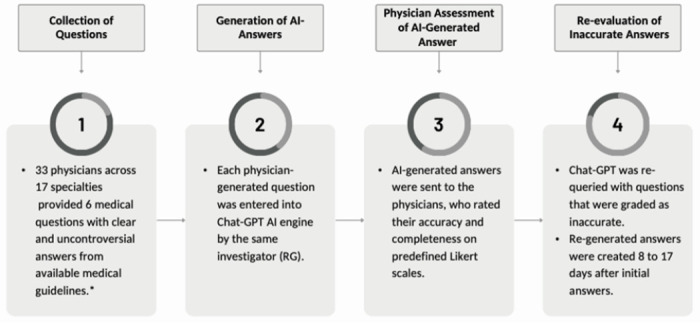
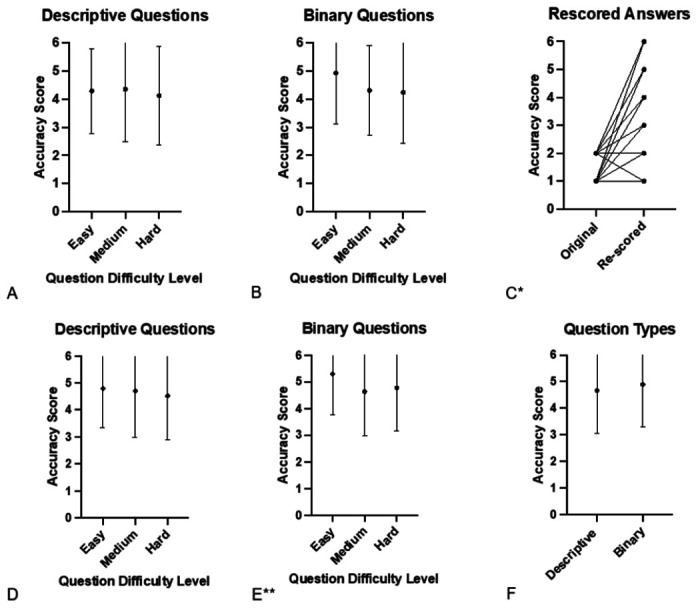
Background: Natural language processing models such as ChatGPT can generate text-based content and are poised to become a major information source in medicine and beyond. The accuracy and completeness of ChatGPT for medical queries is not known. Methods: Thirty-three physicians across 17 specialties generated 284 medical questions that they subjectively classified as easy, medium, or hard with either binary (yes/no) or descriptive answers. The physicians then graded ChatGPT-generated answers to these questions for accuracy (6-point Likert scale; range 1 – completely incorrect to 6 – completely correct) and completeness (3-point Likert scale; range 1 – incomplete to 3 - complete plus additional context). Scores were summarized with descriptive statistics and compared using Mann-Whitney U or Kruskal-Wallis testing. Results: Across all questions (n=284), median accuracy score was 5.5 (between almost completely and completely correct) with mean score of 4.8 (between mostly and almost completely correct). Median completeness score was 3 (complete and comprehensive) with mean score of 2.5. For questions rated easy, medium, and hard, median accuracy scores were 6, 5.5, and 5 (mean 5.0, 4.7, and 4.6; p=0.05). Accuracy scores for binary and descriptive questions were similar (median 6 vs. 5; mean 4.9 vs. 4.7; p=0.07). Of 36 questions with scores of 1-2, 34 were re-queried/re-graded 8-17 days later with substantial improvement (median 2 vs. 4; p<0.01). Conclusions: ChatGPT generated largely accurate information to diverse medical queries as judged by academic physician specialists although with important limitations. Further research and model development are needed to correct inaccuracies and for validation.
Overview
The claims and statistics of this paper haven’t been checked yet.
Free: it reads the open-access text and checks the first 5 claims that cite a source we can check. Create a free account to check every claim.
Integrity signals
Registry
Cites
Statistics
Figures
Verification
Claims the paper makes
The claims and statistics of this paper haven’t been checked yet.
Free: it reads the open-access text and checks the first 5 claims that cite a source we can check. Create a free account to check every claim.
Claims other papers make about this one
Each is checked against this paper’s own text: does it say what the citing paper says it does?
The source backs part of the claim, not all of it — or backs it for a different population, condition or comparison.
In the citing paper
“The same study reported that median accuracy scores were higher than mean scores in data analysis and that ChatGPT had a margin of error [29].”
From Is there any room for ChatGPT AI bot in speech-language pathology? (2025) · cites this paper as [29]
Experimental — accuracy not yet measuredThe source backs part of the claim, not all of it — or backs it for a different population, condition or comparison.
In the citing paper
“The output generated by Chat GPT is dependent on the complexity and clarity of the input, continuous evaluation of generated output will be required to ensure safe implementation in clinical settings [32, 33].”
From Artificial Intelligence (AI) – Powered Documentation Systems in Healthcare: A Systematic Review (2025) · cites this paper as [33]
Experimental — accuracy not yet measuredThe cited source says what the claim attributes to it.
In the citing paper
“it was found that more than 50% of ChatGPT responses to 180 questions created by 33 physicians had a high level of accuracy and comprehensiveness.”
From Is there any room for ChatGPT AI bot in speech-language pathology? (2025) · cites this paper as [29]
The cited source says what the claim attributes to it.
In the citing paper
“Despite some limited validation efforts, ChatGPT still requires further error correction [74].”
From Ethical Considerations of Using ChatGPT in Health Care (2023) · cites this paper as [74]
In the citing paper
“Overall, findings call into question previous claims that ChatGPT “has promise for providing accurate and comprehensive medical information” (18), and has “potential to provide first aid to young adults struggling with mental health issues” (19).”
From ChatGPT is not ready yet for use in providing mental health assessment and interventions (2024) · cites this paper as [18]
1 more claim about this paper
Create a free account to see every claim other papers make about this one.
Self-check
Percentages, sums and reported differences re-computed from the paper’s own numbers.
The self-check needs the paper’s full text.
Citations
Cites
Language Models are Few-Shot Learners
Brown, T. B., Mann, B., Ryder, N., Subbiah, M., Kaplan, J., Dhariwal, P., Neelakantan, A., Shyam, P., Sastry, G., Askell, A., et al. (2020) · arXiv · doi:10.48550/arxiv.2005.14165 · Cited by 23,372 · cited 2×
“5), an LLM with over 175 billion parameters (2).”
BackgroundAdvances in neural information processing systems 7
Cios, K., & Shields, M. (1997) · Neurocomputing · doi:10.1016/s0925-2312(97)90018-7 · Cited by 22,059
Kaugeranna, R., Kaugeranna, E., & Aion, (. S. 4. 6. (2023) · DROPS (Schloss Dagstuhl – Leibniz Center for Informatics) · doi:10.4230/lipics.giscience.2023.43 · Cited by 13,690
Kung, T. H., Cheatham, M., ChatGPT, Medenilla, A., Sillos, C., De Leon, L., Elepaño, C., Madriaga, M., Aggabao, R., Diaz-Candido, G., et al. (2022) · doi:10.1101/2022.12.19.22283643 · Cited by 4,115
Kung, T. H., Cheatham, M., Medenilla, A., Sillos, C., De Leon, L., Elepaño, C., Madriaga, M., Aggabao, R., Diaz-Candido, G., Maningo, J., et al. (2023) · PLOS Digital Health · doi:10.1371/journal.pdig.0000198 · Cited by 4,115 · cited 3×
“ChatGPT performed at or near the passing threshold for United States Medical Licensing Exam (USMLE) without any specialized training, suggesting its potential for medical education and clinical decision support (4, 5).”
BackgroundChatGPT is fun, but not an author
Thorp, H. H. (2023) · Science · doi:10.1126/science.adg7879 · Cited by 1,437
Deep reinforcement learning from human preferences
Christiano, P., Leike, J., Brown, T. B., Martic, M., Legg, S., & Amodei, D. (2017) · arXiv · doi:10.48550/arxiv.1706.03741 · Cited by 1,058
ChatGPT and other large language models are double-edged swords
Shen, Y., Heacock, L., Elias, J., Hentel, K. D., Reig, B., Shih, G., & Moy, L. (2023) · Radiology · doi:10.1148/radiol.230163 · Cited by 1,008 · cited 2×
“Compared to traditional supervised deep learning models, large language models can learn from data more e ciently with a two-stage training process, starting with self-supervised learning on vast amounts of unannotated data, then ne-tuned on smaller, task-speci c, annotated datasets so they can perform on end-user-spe…”
BackgroundChatGPT listed as author on research papers: many scientists disapprove
Stokel-Walker, C. (2023) · Nature · doi:10.1038/d41586-023-00107-z · Cited by 868
Flanagin, A., Bibbins-Domingo, K., Berkwits, M., & Christiansen, S. L. (2023) · JAMA · doi:10.1001/jama.2023.1344 · Cited by 420
Research works printed but not linked: 2
- [5]Gilson A, Safranek C, Huang T, Socrates V, Chi L, Taylor RA, How Well Does ChatGPT Do When Taking the Medical Licensing Exams? The Implications of Large Language Models for Medical Education and Knowledge Assessment. medRxiv. 2022: 2022.12. 23.22283901.
- [6]Shen Y, Heacock L, Elias J, Hentel KD, Reig B, Shih G, ChatGPT and Other Large Language Models Are Double-edged Swords. Radiology. 2023: 230163. 36700838
Cited by
Items 601–681 of 681
McGrath, S., & Benton, M. L. (2024) · Yearbook of Medical Informatics · doi:10.1055/s-0044-1800724
“Johnson et al. [2] developed an atlas detailing the enzyme specificity of more than 300 serine/thre - onine kinases, annotating the relationships between kinases and their substrate motifs.”
Dale, R., Cheng, M., Pines, K. C., & Currie, M. E. (2025) · doi:10.2196/preprints.76397
Challenges and Solutions in Securing AI Algorithms in Healthcare
Koshy, J. S. (2025) · Advances in computational intelligence and robotics book series · doi:10.4018/979-8-3373-2827-0.ch002
DeFrancisis, J. S., Richa, P., Oar, D. P., Henwood, L., Buchman, Z. J., & Grewal, G. (2025) · Cureus · doi:10.7759/cureus.84124 · Cited by 2
“In the field of orthopaedics specifically, previous research has demonstrated that AI chatbots provide inconsistent information on common orthopaedic conditions [25].”
Almusallam, N., & Hasnain, M. (2025) · Transactions on Emerging Telecommunications Technologies · doi:10.1002/ett.70151
ChatGPT in education: Its value, accuracy, and regulation
Pacala, F. A. (2024) · HO CHI MINH CITY OPEN UNIVERSITY JOURNAL OF SCIENCE - SOCIAL SCIENCES · doi:10.46223/hcmcoujs.soci.en.15.2.3159.2025
“According to academic physician specialists, the study by Johnson et al. (2023) has found that the data supplied by ChatGPT to various medical queries is generally reliable.”
Erimli, G., Kılıç, D., & Yıldırım, Y. A. (2025) · Research Square · doi:10.21203/rs.3.rs-6776535/v1
K.G.L.A.N.S.Jayawardhana, & Srihari, M. M. (2025) · International Journal for Research Trends and Innovation · doi:10.56975/ijrti.v10i6.204569
ChatGPT in complex adaptive healthcare systems: embrace with caution
Olsson, A.-K., Arakelian, E., Lindberg, M., Göras, C., & Erikson, M. S. (2025) · International Journal of Electronic Healthcare · doi:10.1504/ijeh.2025.10071817
Gül, H., Çınar, M. A., & Bayramlar, K. (2025) · Burns · doi:10.1016/j.burns.2025.107609
Is Stock Forecasting Viable with ChatGPT? Investigating Asset Management With Beginner Traders.
Lai, A., & McGrath, S. (2024) · Journal of Student Research · doi:10.47611/jsrhs.v13i3.7188
Levit, N. S., Kivity, S., Cohen, Y., & Saban, M. (2026) · Digital Health · doi:10.1177/20552076261502477
Artificial intelligence in pathology: from image analysis to clinical decision support
Pytel, M., Fiegler-Rudol, J., Kronenberg, M., Cogiel, K., Osikowicz, M. D., & Męcik-Kronenberg, T. (2025) · Medical Studies · doi:10.5114/ms.2025.154278
Credibility Assessment of Human–Generative AI Interaction
Zhao, Y., Song, S., & Jing, Y. (2025) · Cambridge University Press eBooks · doi:10.1017/9781009587877.005
Assessing the ability of ChatGPT 4.0 in generating check-up reports
Chen, Y., Liu, Y., Huang, Y., Huang, X., Zheng, Z., Yang, F., Lin, H., Lin, H., Li, X., Xie, A., et al. (2025) · Frontiers in Medicine · doi:10.3389/fmed.2025.1658561
Ashour, S. (2025) · The political economy of the Middle East/The political economy of the Middle East · doi:10.1007/978-981-96-7963-8_4
The Utility of ChatGPT in Subspecialty Consultation for Patients with Metastatic Cancers (Preprint)Preprint
Srivastava, A., Ji, R., Murdock, E. G., Gebrael, G., Özay, Z. İ., Lin, E., Hooper, G., Hardy, T., Ostrowski, M., Chehade, C. H., et al. (2025) · doi:10.2196/preprints.86201
Mitręga, A., Bielówka, M., Kaczyńska, D., Denisiewicz, N., Magiera, M., Rojek, M., Dreger, M., Kufel, J., & Zbroszczyk, M. (2025) · Polish Journal of Radiology · doi:10.5114/pjr/208356
Vicioso, C., Javier, J., Huang, J. J., Torres, R. B., Balachandran, U., Nietsch, K. S., Locke, A. R., Koehne, N. H., Ren, R., Tully, N., et al. (2025) · Journal of the Pediatric Orthopaedic Society of North America · doi:10.1016/j.jposna.2025.100296
Ranganatha, A., Ramanathan, V., Chitte, N. V., Chaudhari, M., Panchal, P., & Danish, M. (2025) · Cureus · doi:10.7759/cureus.97997
Lindbergh, R. (2023) · Theseus (Ammattikorkeakoulujen)
Next Generation Audit : Exploring the Potential of a Customized Audit Assistant for ISA Compliance
Lehikoinen, J. (2024) · Theseus (Ammattikorkeakoulujen)
Conversation with AI (Chat GPT) about counseling a patient with Sickle Cell Disease
Niraula, S. (2024) · Social Determinants of Health
Suarez, M. G. A. (2025) · International Journal of Research Publication and Reviews · doi:10.55248/gengpi.6.0925.3441
Health Financing Trends In Kenya, 2001–2022: Implications For Universal Health Coverage.
Odiyo, C. P. A., & Ghabon, Y. K. (2025) · International Journal of Research Publication and Reviews · doi:10.55248/gengpi.6.0925.34124 · Cited by 1
Muzaiek, S. (2024) · Diva portal (Dalarna University Library)
Retrospective Inference of Evolutionary Parameters in the Moran Process Using ChatGPT
Tan, F., Huang, I., & Huang, J. X. (2025) · ACM International Conference on Bioinformatics, Computational Biology, and Health Informatics (ACM-BCB) · doi:10.1145/3765612.3767800
Tayarer, A., & Kangal, K. (2025) · Eskisehir Medical Journal Eskisehir City Hospital · doi:10.48176/esmj.2025.228
TEKGÜNDÜZ, S. E., Gürol, A., & APAY, S. E. (2026) · Research Square · doi:10.21203/rs.3.rs-8558387/v1
Evolving Minds: Natural Learning vs. Artificial Learning in Ophthalmology Training
Balcı, A. S., Yazar, Z., Turgut, B. Ö., & Altan, Ç. (2026) · Turkish Journal of Ophthalmology · doi:10.4274/tjo.galenos.2025.16517
“14 While human learning is a gradual process shaped by experience, cognition, and context, large language models such as ChatGPT acquire knowledge through periodic large-scale retraining cycles.”
McMaster, B., Yanamala, S. R., Alshaibi, R. R., Okoroha, K. R., Hevesi, M., Saris, D. B. F., Krych, A. J., & Tagliero, A. J. (2026) · Journal of ISAKOS Joint Disorders & Orthopaedic Sports Medicine · doi:10.1016/j.jisako.2026.101085
Optimizing AI for surgical aftercare: Claude 3.5 Sonnet outperforms ChatGPT-5.0 in otoplasty
Sarı, E., Ahmadov, N., & Muradova, A. (2026) · The Egyptian Journal of Otolaryngology · doi:10.1186/s43163-026-01038-y
“This mirrors the approach used by Johnson et al., who evaluated ChatGPT’s accuracy and completeness across a diverse set of physician-generated questions and highlighted both its strengths and limitations [35].”
Basralian, G., Posner, K. M., Chester, G., Zeiman, M., Kissin, Y., SILVER, S. G., & Merchant, A. Y. (2026) · Journal of Orthopaedic Experience & Innovation · doi:10.60118/001c.145736
Beyatlı, M., Uzel, T., Şişik, N. M., Güngör, H. S., İnkaya, A., Sobay, R., Dağlı, İ., Tahra, A., & Küçük, E. V. (2026) · Medeniyet Medical Journal · doi:10.4274/mmj.galenos.2026.38586
“Similar trends have been observed in previous comparative studies of ChatGPT-based assessments and expert evaluations in medical education and the reliability of patient information 9-12 , 23 .”
Porreca, A., Proietti, S., Maturo, F., Bonassi, S., & Zanon, E. (2026) · Hemato · doi:10.3390/hemato7020010
“…studies of LLMs in pharmacology and oncology have already documented recurring weaknesses, including omission of key contraindications, inappropriate regimen sequencing, inaccurate toxicity profiles, and lack of attention to comorbid conditions that substantially modify treatment risk [30–33].”
SHITTU, I. O., & Dada, O. (2026) · Journal of Economics and Allied Research · doi:10.5281/zenodo.19489260 · Cited by 2
Wong, A. V.-K., Roslan, N. L., Ho, S., Tan, R. A., Noor, J. M., Via, G., & Corradi, F. (2026) · The Ultrasound Journal · doi:10.5826/tuj.2026.18495
Bilgin, M. H., & Hakan, H. (2026) · Thoracic research and practice · doi:10.4274/thoracrespract.2026.2026-1-2
“This suggests, as indicated by Johnson et al. 13 , that AI reliability is high in well-defined diseases.”
Sivapragasam, C., Vasudevan, M., Natarajan, N., & Saravanan, P. (2026) · Journal of Engineering Education Transformations · doi:10.16920/jeet/2026/v39is2/26067 · Cited by 2
Exploring the Challenges of LLMs in Higher Education: Is ChatGPT a Boon or Bane for the Students?
Sivapragasam, C., Vasudevan, M., Natarajan, N., & Saravanan, P. (2026) · Journal of Engineering Education Transformations · doi:10.16920/jeet/2026/v39is2/26068 · Cited by 3
Cacciatore, L., Minore, A., Contessa, P., Raso, G., Iannello, A. R., Papalia, R., & Esperto, F. (2026) · Urologia Journal · doi:10.1177/03915603261446425
When AI is wrong: the limits of human oversight in AI-assisted diagnostic decision-making
Xiao, F., Diao, K., Li, C., Gong, Y., Li, B., Chen, J., Xiu-Qiong, F. U., & Xie, J. Y. (2026) · Behaviour and Information Technology · doi:10.1080/0144929x.2026.2666286
Use and Perception of AI for Psychological Self-Help Among Medical Students in Morocco
Moumni, H., & Elghazouani, F. (2026) · Lecture notes in networks and systems · doi:10.1007/978-3-032-18894-6_2
Artificial Intelligence in Medical Writing: A Systematic Review of Current Practices
Charef, N., Ghazi, S. E., Qarmiche, N., Bourkhime, H., Omari, M., Fakir, S. E., & Otmani, N. (2026) · Lecture notes in networks and systems · doi:10.1007/978-3-032-18894-6_8
Demir, Ş., & Demir, M. (2026) · Endouroloji Bulteni · doi:10.54233/endourolbull-1792399
Geçer, A., Kaya, E., Kendirci, A. Ş., Paksoy, A., & Akgün, D. (2026) · Archives of Current Medical Research · doi:10.47482/acmr.1778992
Arza, R. A., Potluri, A. S., Thom, M. L., & Wera, G. D. (2026) · Hip & Pelvis · doi:10.5371/hp.2026.38.2.196
“Likewise, Johnson et al. 43) suggested that health disparities in receiving surgical treatment for acute orthopaedic trauma could play a role in prolonged LOS.”
Pereira, R. A. D. C., Schwingel, P. A., Estrada, L. C. N. C. D., & Gambassi, B. B. (2026) · Editora Científica Digital eBooks · doi:10.37885/260321502
Barbonus, C., Sultzer, R., & Bertsche, T. (2026) · JMIR AI · doi:10.2196/87803
“To close this gap, we developed a new score to evaluate the quality (AI quality output score [AQUOS]) of AI chatbot answers based on the literature, adapted for drug-related queries [10,11].”
Hamza, M. S., & Khafagy, A. (2026) · The Egyptian Journal of Neurosurgery : the official publication of the Egyptian Society of Neurological Surgeons/Egyptian journal of neurosurgery · doi:10.1186/s41984-026-00607-w
Eğilmez, G., & Khalid, M. S. (2026) · Business, management and economics · doi:10.5772/intechopen.1009590
The Effectiveness of Chatgpt-4o in the Evaluation of Traumatic Brain Ct Imaging
Öztürk, A., Yanarates, G., Günay, S., Komut, E., Komut, S., & Yiğit, Y. (2026) · Sakarya Medical Journal · doi:10.31832/smj.1855415
Singh, A., Shetty, D., Prakash, V. S., Sharma, P., & Kumar, P. (2026) · International Journal of Drug Delivery Technology · doi:10.25258/ijddt.16.59s.6
Uysal, U., Alma, E., Altunkol, A., Erçil, H., Özbilen, M. H., Anıl, H., Yelsel, K., Sağmak, B., & Çetinkökü, G. (2026) · BMC Urology · doi:10.1186/s12894-026-02248-5
“These AI-driven chatbots generate responses on the basis of a vast corpus of publicly available text data, including academic articles, websites, and other textual sources [9].”
Veylit, L., Stránský, P., Booth, A. M., Karl, C. W., & Mehta, S. (2026) · Cambridge Prisms Plastics · doi:10.1017/plc.2026.10055
rerankers: A Lightweight Unified Toolkit for Reranking Approaches
Clavié, B. (2026) · International ACM SIGIR Conference on Research and Development in Information Retrieval (SIGIR) · doi:10.1145/3805712.3808630
Williams, K., Lloyd, T., Mok, G., Ruffolo, I., Ben‐Yakov, M., & Vaillancourt, S. (2026) · Canadian Journal of Emergency Medicine · doi:10.1007/s43678-026-01221-3
Li, Z., Yuan, X., Chen, Y., Jin, R., Wei, Y., Liu, X., Weng, L., Su, H., & Chen, K. (2026) · Global Translational Medicine · doi:10.36922/gtm026200020
Giovannini, E., Santelli, S., Lenzi, J., Pelletti, G., Berti, L., Giorgetti, A., Pirani, F., Pelotti, S., & Fais, P. (2026) · Advances in Clinical and Experimental Medicine · doi:10.17219/acem/211777
Quality of AI‐Generated Patient Education for Pre‐ and Post‐Operative Tracheostomy Care
Zhang, K., Evans, L. K., Delavary, D., Wooten, C., Kim, M., Shiba, T. L., Kadin, N. E., Feintuch, J., & Chhetri, D. K. (2026) · Otolaryngology · doi:10.1002/ohn.70359
Ma, J., Wu, X., Feng, Z., Kuang, Y., Ding, Z., Li, M., & Yang, G. (2026) · Journal of Medical Internet Research · doi:10.2196/84086 · Cited by 1
“Moreover, LLMs obviate the need for extensive labeled datasets and are amenable to continuous refinement as new data becomes available [32].”
Çörekci, A. M., Devran, S., Yakal, S., Uyanık, A. F., & Metin, G. (2026) · International Journal of Sports Science & Coaching · doi:10.1177/17479541261478878
Performance of large language models as a source of clinical information on bacteriophage therapy
Walter, N., Amanatullah, D. F., Debarbieux, L., Doub, J. B., Ferry, T., Groß, J., Międzybrodzki, R., Mirzaei, M. K., Deng, L., Rācenis, K., et al. (2026) · npj Viruses · doi:10.1038/s44298-026-00224-2
“Importantly,thislevelofre fi nementneedisconsistentwithprior work demonstrating that expert review improves safety and clarity of AI-generated medical content, with physicians editing drafts to enhance personalization, empathy, and accuracy 26,27 .”
K.R, A., & James, E. (2026) · International journal of research and scientific innovation · doi:10.51244/ijrsi.2026.1308000078
Altunpak, B. (2026) · Surgical Innovation · doi:10.1177/15533506261488588
Ni, C., Park, J., Li, Y., Qadir, S., Huang, S. S., Powers, J. S., Hiner, J. A., Leung, V., Commiskey, P., Song, L., et al. (2026) · Proceedings of the ACM on Human-Computer Interaction · doi:10.1145/3816980
“Work on how people judge AI outputs emphasizes interpretability and perceived reliability cues [54], and studies of algorithm-mediated services show that users develop “folk theories” and strategies under uncertainty [75].”
Samaan, J. S., Nguyen, S. T., Hamamah, S., Tran, A., Ceasar, R. C., Wolfe, N., Yu, T., Chavez, D., Rajeev, N. D., Advani, R., et al. (2026) · medRxiv · doi:10.64898/2026.09.16.26363276
İlleez, Ö. G., Giray, E., Ateş, U., Keles, A., Turkyilmaz, S. G., & Yüksel, M. (2026) · Work · doi:10.1177/10519815261488805
Chai, B. S., Yim, M. M., Ranjbar, D., & Tang, D. T. (2026) · Global Surgical Education - Journal of the Association for Surgical Education · doi:10.21203/rs.3.rs-10198678/v1
Liang, J., Liu, D., Liao, W., Huang, M., Ye, Q., & Li, X. (2026) · Digital Health · doi:10.1177/20552076261493177
Aydemir, N. G., Yapar, D., Avcı, Y. D., Sonuvar, E. T., & Aydemir, M. (2026) · BMC Gastroenterology · doi:10.1186/s12876-026-05345-9
The Role of Artificial Intelligence (AI) in Medicine
Archambault, O. (2025) · Trinity Student Medical Journal
Ibrahim, A. H., & Ajlouni, A. O. (2024) · Journal of Social Studies Education Research · Cited by 11
Readability assessment of ChatGPT-4 and ChatGPT-5 responses to ear care questions
Özyılmaz, C., & Karakuş, M. F. (2026) · Northwestern Medical Journal · doi:10.54307/nwmj.2026.256
Durdu, H., & BAŞTÜRK, P. (2026) · Balıkesır Health Sciences Journal · doi:10.53424/balikesirsbd.1969540
Shim, H., & Kim, E. (2026) · International Journal of Human-Computer Interaction · doi:10.1080/10447318.2026.2739761
Aykaç, K., Çubuk, O., Demir, O. O., Choe, Y. J., Kawata, S., Ludwikowska, K. M., Kwan, M. Y. W., Aydin, M., & Özsürekçi, Y. (2026) · Pediatric Research · doi:10.1038/s41390-026-05578-0
Özer, E., & Pirim, G. G. (2026) · BMC Pulmonary Medicine · doi:10.1186/s12890-026-04903-x
“These systems should therefore be positioned as clinician-supervised adjuncts rather than autonomous patient-facing tools, with appropriate oversight and read-ability calibration [15, 20].”
Naqvi, M. M. H., Jawaid, M., Fatima, S. T., Ali, A., & Azhar, T. (2026) · Pakistan Armed Forces Medical Journal · doi:10.51253/pafmj.v76i6.12930
范丽萍, Liu, R., Wu, Z., Li, J., Lei, J., Zhang, Q., Li, X., & Yang, Y. (2026) · JMIR Medical Informatics · doi:10.2196/104836
Amin, K., Skaggs, D. L., Doshi, R. H., Khosla, P., Amin, S., & Mayes, L. C. (2026) · Preventing Chronic Disease · doi:10.5888/pcd23.260490 · Cited by 1
Metadata
- Authors
- Johnson, D., Goodman, R., Patrinely, J., Stone, C., Zimmerman, E., Donald, R., Chang, S., Berkowitz, S., Finn, A., Jahangir, E., Scoville, E., Reese, T., Friedman, D., Bastarache, J., Heijden, Y. V. D., Wright, J., Carter, N., Alexander, M., Choe, J., Chastain, C., Zic, J., Horst, S., Turker, I., Agarwal, R., Osmundson, E., Idrees, K., Kiernan, C., Padmanabhan, C., Bailey, C., Schlegel, C., Chambless, L., Gibson, M., Osterman, T., & Wheless, L.
- Affiliations
- Vanderbilt University Medical Center (US)
- Vanderbilt University (US)
- Vanderbilt University Medical Center
- Corresponding author
- Johnson, Douglas
- ORCID
- Johnson, Douglas
- Goodman, Rachel
- Patrinely, J
- Stone, Cosby
- Donald, Rebecca
- Chang, Sam
- Berkowitz, Sean
- Finn, Avni
- Jahangir, Eiman
- Scoville, Elizabeth
- Reese, Tyler
- Friedman, Debra
- Bastarache, Julie
- Alexander, Matthew
- Choe, Jennifer
- Chastain, Cody
- Horst, Sara
- Turker, Isik
- Idrees, Kamran
- Padmanabhan, Chandrasekhar
- Bailey, Christina
- Schlegel, Cameron
- Chambless, Lola
- Osterman, Travis
- Wheless, Lee
- Venue
- Research Square
- Published
- 2023-02-28
- PMC
- PMC10002821
- OpenAlex
- W4322622443
- Cited by
- 598
- References
- 8
- Citations by year
- 2026: 63 · 2025: 185 · 2024: 249 · 2023: 100
- Type
- posted content
- Language
- en
- Open access
- green
- doi.org
- Locations
- Research Square (acceptedVersion, cc-by)
- PubMed (publishedVersion)
- PubMed Central (submittedVersion, cc-by)
- Funders
- National Heart, Lung, and Blood Institute (R01HL151523, U01HL156620)
- National Cancer Institute (UG3CA265846, R01CA225005, UG3CA260318, R01CA240093, R01CA227481, K12CA090625, P30CA068485, U54CA163072)
- National Institute of Diabetes and Digestive and Kidney Diseases (K08DK133691)
- Topics
- Health Sciences › Medicine › Health Informatics › Artificial Intelligence in Healthcare and Education
- Health Sciences › Health Professions › Health Information Management › Artificial Intelligence in Healthcare
- Physical Sciences › Computer Science › Information Systems › Information Retrieval and Search Behavior
- Keywords
- ChatGPT, large language models, medical question answering, AI-generated medical information, accuracy assessment
About these checks
Registry, retraction, Cites and statistics results are computed, not judged, with one exception: a printed reference that no index lists is read once by a model before it counts as a citation error. Claims are extracted by a model and kept only when their quote appears verbatim in the text; each cited source is then checked, with a model’s help, for whether it says what the claim relies on. Those verdicts can be wrong — read the claim’s quote and the cited source before relying on one.
Statistics and arithmetic are recomputed, not judged.
Confidence bands are shown only for fields calibrated on our annotated test set. None is calibrated yet, so no band is shown.
What counts as a claim ›How we measure confidence ›How we check this ›
Are you an author, or do you see a problem with this page? Request a review
Data sources
Bibliographic data: Semantic Scholar, OpenAlex, Crossref.
Contains information from the Semantic Scholar Academic Graph Datasets, made available under the ODC Attribution License (ODC-BY 1.0).
Semantic Scholar’s data is described in: Kinney, R., et al. (2023). The Semantic Scholar Open Data Platform. arXiv:2301.10140.
