

Role of Advanced Glycation End Products in Carcinogenesis and their Therapeutic Implications
Open accessThe DOI matches its Crossref record; 102 of the 102 references it cites were found in a registry or an index.
Abstract
Aging is one of the biggest risk factors for the major prevalent diseases such as cardiovascular diseases, neurodegeneration and cancer, but due to the complex and multifactorial nature of the aging process, the molecular mechanisms underlying age-related diseases are not yet fully understood. Research has been intensive in the last years aiming to characterize the pathophysiology of aging and develop therapies to fight age-related diseases. In this context advanced glycation end products (AGEs) have received attention. AGEs, when accumulated in tissues, significantly increase the level of inflammation in the body which has long been associated with the development of cancer. Here we discuss the classical settings promoting AGE formation, as well as reduction strategies, occurrence and relevance of AGEs in cancer tissues and the role of AGE-interaction with the receptor for advanced glycation end products (RAGE) in cancer initiation and progression.
Overview
The claims and statistics of this paper haven’t been checked yet.
Free: it reads the open-access text and checks the first 5 claims that cite a source we can check. Create a free account to check every claim.
Integrity signals
Registry
Cites
Statistics
Figures
Verification
Claims the paper makes
The claims and statistics of this paper haven’t been checked yet.
Free: it reads the open-access text and checks the first 5 claims that cite a source we can check. Create a free account to check every claim.
Self-check
Percentages, sums and reported differences re-computed from the paper’s own numbers.
The self-check needs the paper’s full text.
Citations
Cites
Siegel, R. L., Miller, K. D., & Jemal, A. (2018) · CA: A Cancer Journal for Clinicians · doi:10.3322/caac.21442 · Cited by 16,579
Inflammation and cancer: back to Virchow?
Balkwill, F., & Mantovani, A. (2001) · The Lancet · doi:10.1016/s0140-6736(00)04046-0 · Cited by 7,746
Nuclear factor-κB in cancer development and progression
Karin, M. (2006) · Nature · doi:10.1038/nature04870 · Cited by 3,519
Advanced glycation end-products: A review
Singh, R., Barden, A., Mori, T., & Beilin, L. (2001) · Diabetologia · doi:10.1007/s001250051591 · Cited by 2,597
Advanced Glycation End Products and Diabetic Complications
Singh, V. P., Bali, A., Singh, N., & Jaggi, A. S. (2014) · The Korean Journal of Physiology & Pharmacology · doi:10.4196/kjpp.2014.18.1.1 · Cited by 1,518
Nishida, N., Yano, H., Nishida, T., Kamura, T., & Kojiro, M. (2006) · Vascular Health and Risk Management · doi:10.2147/vhrm.2006.2.3.213 · Cited by 1,434
Advanced protein glycosylation in diabetes and aging
Brownlee, M. D. (1995) · Annual Review of Medicine · doi:10.1146/annurev.med.46.1.223 · Cited by 1,312
Yan, S. D., Schmidt, A. M., Anderson, G. M., Zhang, J., Brett, J., Zou, Y. S., Pinsky, D., & Stern, D. (1994) · Journal of Biological Chemistry · doi:10.1016/s0021-9258(17)36966-1 · Cited by 1,306
Advanced glycation end products in foods and a practical guide to their reduction in the diet
Uribarri, J., Woodruff, S., Goodman, S., Cai, W., Chen, X., Pyzik, R., Yong, A., Striker, G. E., & Vlassara, H. (2010) · Journal of the American Dietetic Association · doi:10.1016/j.jada.2010.03.018 · Cited by 1,289
Wolff, S. P., & Dean, R. T. (1987) · Biochemical Journal · doi:10.1042/bj2450243 · Cited by 1,271
Cited by
Items 101–138 of 138
Panguluri, G. A., & Findlay, V. J. (2024) · Journal of young women's breast cancer and health. · doi:10.4103/ywbc.ywbc_11_24 · Cited by 2
“[47] The inflammatory markers increased in response to long-term consumption of AGEs include interleukin-6 IL-6, IL-1a, nuclear factor kappa B, intercellular adhesion molecule-1, and tissue inhibitor of metalloproteinases-1.”
Akhtar, A., Danish, M., Asif, A., Arshad, M. N., & Asiri, A. M. (2022) · Molecular Diversity · doi:10.1007/s11030-021-10366-5 · Cited by 2
“This oxidative stress cause DNA damage, cell proliferation, and genome variability that initiate cancer formation [67, 68].”
BackgroundYu, C., Qi-chang, L., Zhimin, Z., Zhongqiang, T., Yanrui, W., & Haiyan, X. (2023) · Cellular and Molecular Biology · doi:10.14715/cmb/2023.69.3.19 · Cited by 2
“In addition, sRAGE also has the binding site of transcriptional factor nuclear factor-κB (NF-κB) and has been proven to be the direct target gene of NFκB signal transduction (14, 15).”
BackgroundAguirre-Tello, M., Wade-González, Ó. E., Vargas-López, S. E., Martínez-Amador, V., Ley-Bernal, F., Flores-Romo, A. A., & Torres-Bugarín, O. (2024) · Salud Jalisco · doi:10.35366/115686 · Cited by 1
Carbohydrate Metabolism in Health and Diseases
Waiz, M., Rehman, K., Ahmad, P., & Khan, M. S. (2024) · Springer eBooks · doi:10.1007/978-981-97-4723-8_2 · Cited by 1
Li, L., Deng, P., Hou, S., Li, G., Suo, M., Xu, L., Wang, C., & Song, J. (2025) · Frontiers in Physiology · doi:10.3389/fphys.2025.1661054 · Cited by 1
Ferrero, G., Mastrocola, R., Tarallo, S., Pardini, B., Scheijen, J. L. J. M., van de Waarenburg, M. P. H., Gallo, G., Chatziioannou, A. C., Robinot, N. R., Keski‐Rahkonen, P., et al. (2026) · Free Radical Biology and Medicine · doi:10.1016/j.freeradbiomed.2026.01.034 · Cited by 1
Romeo, M., Basile, C., Martinelli, G., Nardo, F. D., Napolitano, C., Gregorio, A. D., Vaia, P., Puorto, L. D., Indipendente, M., Federico, A., et al. (2026) · Cancers · doi:10.3390/cancers18081316 · Cited by 1
Is there a link between fascia and cancer? From potential mechanisms to future treatment options
Otto, S., & Klingler, W. (2026) · Frontiers in Physiology · doi:10.3389/fphys.2026.1741526 · Cited by 1
“Non-enzymatic cross-linking in ECM (e.g., advanced glycation end products — AGEs) has also been linked to carcinogenesis, especially in the context of aging (Northey and Weaver, 2023; Rossi et al., 2023; Schröter and Höhn, 2018; Haque et al., 2019; Rojas et al., 2018).”
Kaźmierczak, O., Kozaczka, A., Kolonko, A., Kajor, M., Pająk, J., & Chudek, J. T. (2021) · American Journal of Case Reports · doi:10.12659/ajcr.933267 · Cited by 1
“AGEs then exert cancer-promoting effects, mediated by an interaction with the receptor for AGEs and increased oxidative stress, in addition to chronic inflammatory responses [17], which have been shown to be strong contributors of carcinogenesis [18,19].”
BackgroundEvaluation of advanced protein oxidation and RAGE gene variants in the risk of laryngeal cancer
Küçükhüseyin, Ö., Yanar, K., Hakan, M. T., Verim, A., Süoğlu, Y., Atukeren, P., Aydın, S., Çakatay, U., Yılmaz, H., & Yaylım, İ. (2022) · Biotechnology & Biotechnological Equipment · doi:10.1080/13102818.2022.2072236 · Cited by 1
Dawood, M. N., Younus, Z. M., Alnori, M. K., & Mahmood, S. (2022) · Open Access Macedonian Journal of Medical Sciences · doi:10.3889/oamjms.2022.9926 · Cited by 1
“…ongoing attempts to employ AGES and sRAGE as promising biomarkers for the individual’s risk of developing cancer linked with early recognition, assessment of the severity of illnesses, and the response to therapeutic intervention have the potential to be clinically beneficial [29], [14], [77].”
BackgroundCancer risk in 25—44-year-olds in Novosibirsk (cohort study)
Evdokimova, N. E., Khudyakova, A. D., Striukova, E. V., Щербакова, Л. В., Rymar, O. D., & Ragino, Y. I. (2022) · Russian Journal of Preventive Medicine · doi:10.17116/profmed20222508148 · Cited by 1
Sindhuja, A., Vimalavathini, R., Velu, V. K., & Vinayagam, V. (2023) · Research Journal of Pharmacy and Technology · doi:10.52711/0974-360x.2023.00582 · Cited by 1
Diabetes Mellitus and the Risk of Carcinogenesis: An Interdisciplinary Approach
Tkaczenko, H., Kamiński, P., & Kurhaluk, N. (2024) · Interdisciplinary cancer research · doi:10.1007/16833_2024_426 · Cited by 1
Recent Advances in the Associations of Advanced Glycation End Products (Ages) and Cancer
Wang, Q. (2019) · American Journal of Biomedical Science & Research · doi:10.34297/ajbsr.2019.05.000888
Glycation of Extracellular Matrix: A Solid-State NMR Study
Li, R. (2019) · Apollo (University of Cambridge) · doi:10.17863/cam.48559
Spontaneous Determinants of Protein Aging Mini ReviewPreprint
Dyakin, V. V., & Uversky, V. N. (2021) · Preprints.org · doi:10.20944/preprints202107.0623.v1
Kaźmierczak, K., Żuchowski, P., Łapińska-Duczmal, K., Zabel, K., Sikorska, Z., Pol, M., Seredyka-Burduk, M., Sikorski, B. L., & Malukiewicz, G. (2021) · Applied Sciences · doi:10.3390/app11177934
“A receptor for AGEs (RAGE) plays an important role in inflammatory processes and tumor cell invasion [21,22].”
BackgroundCorrelation between Diabetes and Diabetic Retinopathy and Cancer RiskPreprint
Chang, W., Hsieh, T., Hsu, W. L., Chang, F.-L., & He, M.-S. (2023) · SSRN Electronic Journal · doi:10.2139/ssrn.4564674
G2A as a key modulator of carbonyl stress and apoptosis resistance in glucose-loaded cancer cells
Hassan, M. A., Fukui, T., Shimizu, H., & Kishimoto, K. (2024) · Biochemical and Biophysical Research Communications · doi:10.1016/j.bbrc.2024.150516
Wang, Z., Liu, C., Wu, Y., Yao, H., He, S., Zhao, L., & Zeng, X. (2024) · Journal of Fluorescence · doi:10.1007/s10895-024-03994-1
Obesity, diabetes, and cancer; a triad of interconnected risks and emerging evidence
Mohammadhassanzadeh, H., & Serej, Z. A. (2025) · Journal of Renal Endocrinology · doi:10.34172/jre.2025.25196
“Similarly, high glucose levels contribute to the oxidative stress and the formation of advanced glycation end-products (AGEs), which can damage cells and promote carcinogenesis (66).”
Yalınız, K. (2021) · Dspace Repository (Marmara Üniversitesi)
Khalil, A., Babaev, M. S., Maksimov, F. E., & Petersen, E. V. (2025) · Plastic Surgery and Aesthetic Medicine · doi:10.17116/plast.hirurgia202504158
Advanced Glycation End Products— Physiology and Pathological Activity: A Literature Review
Ali, S. H., & Mhaibes, S. H. (2026) · Al-Rafidain Journal of Medical Sciences · doi:10.54133/ajms.v10i1.2593
“According to studies, AGEs have pro-inflammatory and pro-oxidant properties and may stimulate the receptor for advanced glycation end products (RAGEs), which may aid in the development of cancer [60,61].”
Teissier, T. (2019) · theses.fr (ABES) · doi:10.70675/f49bc069z5ee6z4c49zb46fz0a1413dbba95
Diabetes mellitus and ovarian cancer: Intersecting pathways and clinical outcomes
Patel, T., Ali, S. K., Jawad, Y., Haddad, S. H., Masri, L. M. A., Rimawi, A., Alraeesi, R. A., Alkaabi, H. S., Farhan, M., Zahid, M., et al. (2026) · World Journal of Clinical Oncology · doi:10.5306/wjco.v17.i5.117365
Wang, Y., Song, D., Wu, T., & Othman, E. M. (2026) · International Journal of Molecular Sciences · doi:10.3390/ijms27114734 · Cited by 1
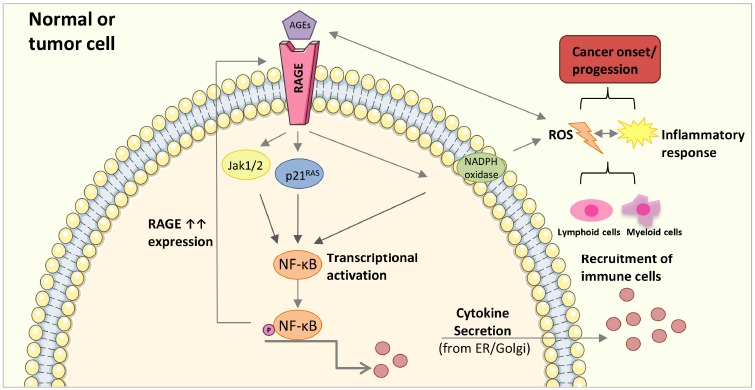
“…of NADPH oxidase leads to activation of transcriptional factor NF-κ B, which increases gene expression of pro-inflammatory cytokines and chemokines such as IL-6, TNF-α , and MCP-1 [133,135,136], and forms a chronic inflammatory microenvironment to facilitate cancer cell proliferation (Figure 9).”
Bardelčíková, A., Smolková, K., Špačková, J., Gotvaldová, K., Gardlík, R., Kovalčíková, A. G., Kudlicková, Z., Kello, M., & Mojžíš, J. (2026) · Chemico-Biological Interactions · doi:10.1016/j.cbi.2026.112189
Nath, A. D., Leclerc, E., & Vetter, S. W. (2026) · bioRxiv (Cold Spring Harbor Laboratory) · doi:10.64898/2026.07.09.737564
Kanojia, N., & tiku, A. (2026) · bioRxiv (Cold Spring Harbor Laboratory) · doi:10.64898/2026.07.09.737425
Integrated structural approaches in immunotherapy
Khan, H., Abidi, M., Habib, S., Husain, A., Khanam, A., Ahmad, R., Mustafa, M., & Moinuddin (2026) · Elsevier eBooks · doi:10.1016/b978-0-443-44988-8.00009-5
Advanced Glycation End Products and Metabolic-Mechanical Coupling in Diabetic Retinopathy
Wang, L., Zhao, X., Wang, Y., & Chen, W. (2026) · Clinical ophthalmology · doi:10.2147/opth.s635236
“13 AGEs are formed primarily through the Maillard reaction.”
Targeting extracellular matrix mechanobiology to suppress solid tumor progression
Boone, K., Kondapaneni, R. V., Libring, S., & Reinhart‐King, C. A. (2026) · Cancer Letters · doi:10.1016/j.canlet.2026.218856
Research on the Inflammatory Mechanism and New Treatment Strategies for Diabetic Foot Ulcers
Xing, J. (2026) · Advances in Clinical Medicine · doi:10.12677/acm.2026.16113624
Beyond conventional neurodiagnostic: quantum-enabled mapping of AGE-RAGE dynamics in type 3 diabetes
Verma, A., Khan, M. A., Anwer, T., Alam, O., & Sharma, M. (2026) · Neuroscience · doi:10.1016/j.neuroscience.2026.11.015
Metadata
- Authors
- Schröter, D., & Höhn, A.
- Affiliations
- German Institute of Human Nutrition (DE)
- Corresponding author
- Höhn, Annika
- Venue
- Current Pharmaceutical Design
- Publisher
- Bentham Science Publishers Ltd.
- Published
- 2019-03-29
- Volume
- 24
- Issue
- 44
- Pages
- 5245-5251
- ISSN
- 1381-6128 (ISSN-L)
- PMC
- PMC6635609
- OpenAlex
- W2913046669
- Semantic Scholar
- e4e2a73d78162e14c5abc152a1e5430aa6e8a68d
- Cited by
- 126
- References
- 101
- Citations by year
- 2026: 12 · 2025: 12 · 2024: 20 · 2023: 24 · 2022: 21 · 2021: 22 · 2020: 10 · 2019: 5
- FWCI
- 1.89
- Type
- journal article
- Language
- en
- Open access
- hybrid
- doi.org
- Locations
- Current Pharmaceutical Design (publishedVersion, cc-by)
- Europe PMC (PubMed Central) (publishedVersion, cc-by-nc)
- PubMed Central (publishedVersion, cc-by-nc)
- PubMed (publishedVersion)
- Funders
- German Ministry of Education and Research (82DZD00302)
- Topics
- Life Sciences › Biochemistry, Genetics and Molecular Biology › Clinical Biochemistry › Advanced Glycation End Products research
- Life Sciences › Agricultural and Biological Sciences › Food Science › Potato Plant Research
- Life Sciences › Immunology and Microbiology › Immunology › Galectins and Cancer Biology
- Keywords
- advanced glycation end products, carcinogenesis, receptor for advanced glycation end products, RAGE, aging, inflammation, AGE formation, tumor progression, tumor initiation, age-related diseases
- MeSH terms
- Receptor for Advanced Glycation End Products, Animals, Humans, Inflammation, Neoplasms, Glycation End Products, Advanced, Carcinogenesis
About these checks
Registry, retraction, Cites and statistics results are computed, not judged, with one exception: a printed reference that no index lists is read once by a model before it counts as a citation error. Claims are extracted by a model and kept only when their quote appears verbatim in the text; each cited source is then checked, with a model’s help, for whether it says what the claim relies on. Those verdicts can be wrong — read the claim’s quote and the cited source before relying on one.
Statistics and arithmetic are recomputed, not judged.
Confidence bands are shown only for fields calibrated on our annotated test set. None is calibrated yet, so no band is shown.
What counts as a claim ›How we measure confidence ›How we check this ›
Are you an author, or do you see a problem with this page? Request a review
Data sources
Bibliographic data: Semantic Scholar, OpenAlex, Crossref.
Contains information from the Semantic Scholar Academic Graph Datasets, made available under the ODC Attribution License (ODC-BY 1.0).
Semantic Scholar’s data is described in: Kinney, R., et al. (2023). The Semantic Scholar Open Data Platform. arXiv:2301.10140.
