

The DOI matches its Crossref record; 102 of the 102 references it cites were found in a registry or an index; none of the 97 sources its claims cite is checked for support yet.
Conversational Agents as Mediating Social Actors in Chronic Disease Management Involving Health Care Professionals, Patients, and Family Members: Multisite Single-Arm Feasibility Study
Open accessPublished version of a preprint
Abstract
Background: Successful management of chronic diseases requires a trustful collaboration between health care professionals, patients, and family members. Scalable conversational agents, designed to assist health care professionals, may play a significant role in supporting this collaboration in a scalable way by reaching out to the everyday lives of patients and their family members. However, to date, it remains unclear whether conversational agents, in such a role, would be accepted and whether they can support this multistakeholder collaboration. Objective: With asthma in children representing a relevant target of chronic disease management, this study had the following objectives: (1) to describe the design of MAX, a conversational agent–delivered asthma intervention that supports health care professionals targeting child-parent teams in their everyday lives; and (2) to assess the (a) reach of MAX, (b) conversational agent–patient working alliance, (c) acceptance of MAX, (d) intervention completion rate, (e) cognitive and behavioral outcomes, and (f) human effort and responsiveness of health care professionals in primary and secondary care settings. Methods: MAX was designed to increase cognitive skills (ie, knowledge about asthma) and behavioral skills (ie, inhalation technique) in 10-15-year-olds with asthma, and enables support by a health professional and a family member. To this end, three design goals guided the development: (1) to build a conversational agent–patient working alliance; (2) to offer hybrid (human- and conversational agent–supported) ubiquitous coaching; and (3) to provide an intervention with high experiential value. An interdisciplinary team of computer scientists, asthma experts, and young patients with their parents developed the intervention collaboratively. The conversational agent communicates with health care professionals via email, with patients via a mobile chat app, and with a family member via SMS text messaging. A single-arm feasibility study in primary and secondary care settings was performed to assess MAX. Results: Results indicated an overall positive evaluation of MAX with respect to its reach (49.5%, 49/99 of recruited and eligible patient-family member teams participated), a strong patient-conversational agent working alliance, and high acceptance by all relevant stakeholders. Moreover, MAX led to improved cognitive and behavioral skills and an intervention completion rate of 75.5%. Family members supported the patients in 269 out of 275 (97.8%) coaching sessions. Most of the conversational turns (99.5%) were conducted between patients and the conversational agent as opposed to between patients and health care professionals, thus indicating the scalability of MAX. In addition, it took health care professionals less than 4 minutes to assess the inhalation technique and 3 days to deliver related feedback to the patients. Several suggestions for improvement were made. Conclusions: This study provides the first evidence that conversational agents, designed as mediating social actors involving health care professionals, patients, and family members, are not only accepted in such a “team player” role but also show potential to improve health-relevant outcomes in chronic disease management.
Overview
AI snapshot
Written from the paper’s full text.
TL;DR
In a multisite single-arm feasibility study, MAX, a conversational agent designed as a mediating social actor for pediatric asthma, was feasible and positively evaluated across patients, family members, and health care professionals. It showed high reach, strong patient-agent working alliance, 75.5% completion, improved asthma knowledge, and scalable delivery with most conversational turns handled by the agent.
Key findings
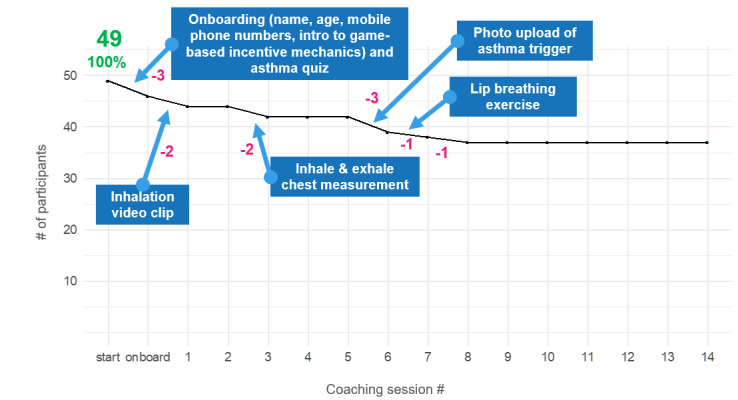
- Reach was 49.5% (49/99 recruited and eligible patient-family member teams started interacting with MAX); intervention completion was 75.5% (37/49).
- Patient-MAX working alliance was high across coaching sessions 2, 8, and 14 (means 6.34, 6.14, and 6.34, respectively), and acceptance ratings were above the neutral scale value of 4 (perceived usefulness 6.42, ease of use 6.75, enjoyment 6.47, control 5.53, intention to continue 5.58).
- Asthma knowledge increased significantly from pretest to posttest (7.73 to 8.79 with baseline observation carried forward, n=48, P<.001, d=0.91; 9.43 in complete cases, n=37, P<.001, d=1.19).
- Family members supported patients in 269/275 (97.8%) coaching sessions; 99.5% (15,078/15,152) of conversational turns were between patients and MAX versus 0.5% (74/15,152) between patients and health care professionals. Health care professionals took an average of 221 seconds to assess inhalation videos and 2.34 days to provide feedback.
Methods
- Single-arm feasibility study conducted in two home care settings and four secondary care settings in the German-speaking part of Switzerland; recruitment occurred January-April 2019.
- Participants were 10- to 15-year-old German-speaking patients with asthma who had smartphone access and a German-speaking family member able to receive SMS messages and support the patient every second intervention day; 99 patients were approached and 49 started interacting with MAX.
- Outcomes included reach, patient-conversational agent working alliance, acceptance, intervention completion, cognitive and behavioral skills, and human effort/responsiveness; analyses included descriptive statistics, paired-sample t tests for asthma knowledge, and qualitative feedback.
Limitations
- The paper states that this was a feasibility study with a limited sample, so results are not representative and must be interpreted with caution; only health care professionals from four hospitals and two cantonal patient organizations participated, leaving unclear whether MAX would work similarly with general practitioners.
- The paper states that qualitative open coding was performed by one author, social support was self-reported and incentivized and thus likely overestimated, and the MAX interface was not integrated into hospital or patient-organization information systems, likely overestimating efforts; only costs and efforts were reported, so no cost-effectiveness implications can be drawn.
- Evident from the text: the single-arm design without a control group limits causal conclusions about intervention effects, and the small, exploratory sample constrains generalizability.
Model-written summary. Check it against the paper before relying on it.
Integrity signals
Registry
Cites
Statistics
Figures
Verification
Claims the paper makes
38 Not checked yet · 34 Own result · 20 Own interpretation · 7 Own method · 3 No basis given
A result the paper reports from its own data — it cites no other source for it, so there is none to check. The quote shows it is in the paper.
In the paper
“Most of the conversational turns (99.5%) were conducted between patients and the conversational agent as opposed to between patients and health care professionals”
§ Conversational Agents as Mediating Social Actors in Chronic Disease Management Involving Health Care Professionals, Patients, and Family Members: Multisite Single-Arm Feasibility Study > Abstract > Results
plain- Asserted: passes — The authors put it forward as true.
- Checkable: passes — It can be checked against evidence.
- Load-bearing: passes — The paper’s conclusions depend on it.
- Based: passes — The paper gives a reason why it holds.
A result the paper reports from its own data — it cites no other source for it, so there is none to check. The quote shows it is in the paper.
In the paper
“an intervention completion rate of 75.5%”
§ Conversational Agents as Mediating Social Actors in Chronic Disease Management Involving Health Care Professionals, Patients, and Family Members: Multisite Single-Arm Feasibility Study > Abstract > Results
plain- Asserted: passes — The authors put it forward as true.
- Checkable: passes — It can be checked against evidence.
- Load-bearing: unclear — It is unclear whether the paper’s conclusions depend on it.
- Based: passes — The paper gives a reason why it holds.
A result the paper reports from its own data — it cites no other source for it, so there is none to check. The quote shows it is in the paper.
In the paper
“Family members supported the patients in 269 out of 275 (97.8%) coaching sessions.”
§ Conversational Agents as Mediating Social Actors in Chronic Disease Management Involving Health Care Professionals, Patients, and Family Members: Multisite Single-Arm Feasibility Study > Abstract > Results
plain- Asserted: passes — The authors put it forward as true.
- Checkable: passes — It can be checked against evidence.
- Load-bearing: passes — The paper’s conclusions depend on it.
- Based: passes — The paper gives a reason why it holds.
A result the paper reports from its own data — it cites no other source for it, so there is none to check. The quote shows it is in the paper.
In the paper
“it took health care professionals less than 4 minutes to assess the inhalation technique”
§ Conversational Agents as Mediating Social Actors in Chronic Disease Management Involving Health Care Professionals, Patients, and Family Members: Multisite Single-Arm Feasibility Study > Abstract > Results
plain- Asserted: passes — The authors put it forward as true.
- Checkable: passes — It can be checked against evidence.
- Load-bearing: unclear — It is unclear whether the paper’s conclusions depend on it.
- Based: passes — The paper gives a reason why it holds.
A result the paper reports from its own data — it cites no other source for it, so there is none to check. The quote shows it is in the paper.
In the paper
“a strong patient-conversational agent working alliance”
§ Conversational Agents as Mediating Social Actors in Chronic Disease Management Involving Health Care Professionals, Patients, and Family Members: Multisite Single-Arm Feasibility Study > Abstract > Results
boosted- Asserted: passes — The authors put it forward as true.
- Checkable: passes — It can be checked against evidence.
- Load-bearing: passes — The paper’s conclusions depend on it.
- Based: passes — The paper gives a reason why it holds.
A result the paper reports from its own data — it cites no other source for it, so there is none to check. The quote shows it is in the paper.
In the paper
“high acceptance by all relevant stakeholders”
§ Conversational Agents as Mediating Social Actors in Chronic Disease Management Involving Health Care Professionals, Patients, and Family Members: Multisite Single-Arm Feasibility Study > Abstract > Results
plain- Asserted: passes — The authors put it forward as true.
- Checkable: passes — It can be checked against evidence.
- Load-bearing: passes — The paper’s conclusions depend on it.
- Based: passes — The paper gives a reason why it holds.
A result the paper reports from its own data — it cites no other source for it, so there is none to check. The quote shows it is in the paper.
In the paper
“Results indicated an overall positive evaluation of MAX with respect to its reach (49.5%, 49/99 of recruited and eligible patient-family member teams participated)”
§ Conversational Agents as Mediating Social Actors in Chronic Disease Management Involving Health Care Professionals, Patients, and Family Members: Multisite Single-Arm Feasibility Study > Abstract > Results
hedged- Asserted: passes — The authors put it forward as true.
- Checkable: passes — It can be checked against evidence.
- Load-bearing: passes — The paper’s conclusions depend on it.
- Based: passes — The paper gives a reason why it holds.
A result the paper reports from its own data — it cites no other source for it, so there is none to check. The quote shows it is in the paper.
In the paper
“The session alliance inventory indicated high working alliance ratings between the young patients and the MAX conversational agent from the very beginning of the intervention until the end (Table 1).”
§ Conversational Agents as Mediating Social Actors in Chronic Disease Management Involving Health Care Professionals, Patients, and Family Members: Multisite Single-Arm Feasibility Study > Results > Session Alliance Inventory
hedged- Asserted: passes — The authors put it forward as true.
- Checkable: passes — It can be checked against evidence.
- Load-bearing: unclear — It is unclear whether the paper’s conclusions depend on it.
- Based: passes — The paper gives a reason why it holds.
A result the paper reports from its own data — it cites no other source for it, so there is none to check. The quote shows it is in the paper.
In the paper
“Out of 275 coaching sessions, in which a family member was asked to support the young patients, patients indicated 269 times (97.8%) that they were supported by a family member.”
§ Conversational Agents as Mediating Social Actors in Chronic Disease Management Involving Health Care Professionals, Patients, and Family Members: Multisite Single-Arm Feasibility Study > Results > Technology Acceptance
plain- Asserted: passes — The authors put it forward as true.
- Checkable: passes — It can be checked against evidence.
- Load-bearing: unclear — It is unclear whether the paper’s conclusions depend on it.
- Based: passes — The paper gives a reason why it holds.
A result the paper reports from its own data — it cites no other source for it, so there is none to check. The quote shows it is in the paper.
In the paper
“Paired-sample t tests revealed a significant increase in scores and large effects with two approaches: a complete case analysis (n=37, t36=–3.68, P<.001, d=1.19) and with the baseline observation carried forward (n=48, t47=–3.54, P<.001, d=0.91).”
§ Conversational Agents as Mediating Social Actors in Chronic Disease Management Involving Health Care Professionals, Patients, and Family Members: Multisite Single-Arm Feasibility Study > Results > Asthma Knowledge
plaindirectn = 37 ·- Asserted: passes — The authors put it forward as true.
- Checkable: passes — It can be checked against evidence.
- Load-bearing: passes — The paper’s conclusions depend on it.
- Based: passes — The paper gives a reason why it holds.
- The quote only partly states this claim. 2
- Probably not a substantial claim. 32
- It may state two separate claims as one. 29
A result the paper reports from its own data — it cites no other source for it, so there is none to check. The quote shows it is in the paper.
In the paper
“MAX led to improved cognitive and behavioral skills”
§ Conversational Agents as Mediating Social Actors in Chronic Disease Management Involving Health Care Professionals, Patients, and Family Members: Multisite Single-Arm Feasibility Study > Abstract > Results
plaindirect- Asserted: passes — The authors put it forward as true.
- Checkable: passes — It can be checked against evidence.
- Load-bearing: passes — The paper’s conclusions depend on it.
- Based: passes — The paper gives a reason why it holds.
The quote only partly states this claim.
A result the paper reports from its own data — it cites no other source for it, so there is none to check. The quote shows it is in the paper.
In the paper
“and 3 days to deliver related feedback to the patients”
§ Conversational Agents as Mediating Social Actors in Chronic Disease Management Involving Health Care Professionals, Patients, and Family Members: Multisite Single-Arm Feasibility Study > Abstract > Results
plain- Asserted: passes — The authors put it forward as true.
- Checkable: passes — It can be checked against evidence.
- Load-bearing: fails — The paper’s conclusions may not depend on it.
- Based: passes — The paper gives a reason why it holds.
Probably not a substantial claim. The paper’s conclusions may not depend on it.
A result the paper reports from its own data — it cites no other source for it, so there is none to check. The quote shows it is in the paper.
In the paper
“MAX led to improved cognitive and behavioral skills”
§ Conversational Agents as Mediating Social Actors in Chronic Disease Management Involving Health Care Professionals, Patients, and Family Members: Multisite Single-Arm Feasibility Study > Abstract > Results
plaindirect- Asserted: passes — The authors put it forward as true.
- Checkable: passes — It can be checked against evidence.
- Load-bearing: passes — The paper’s conclusions depend on it.
- Based: passes — The paper gives a reason why it holds.
The quote only partly states this claim.
A result the paper reports from its own data — it cites no other source for it, so there is none to check. The quote shows it is in the paper.
In the paper
“Participants who finished the intervention (n=37) did so on average within 3 weeks, which was within the incentivized duration of 4 weeks.”
§ Conversational Agents as Mediating Social Actors in Chronic Disease Management Involving Health Care Professionals, Patients, and Family Members: Multisite Single-Arm Feasibility Study > Results > Participant Characteristics
plainn = 37- Asserted: passes — The authors put it forward as true.
- Checkable: passes — It can be checked against evidence.
- Load-bearing: unclear — It is unclear whether the paper’s conclusions depend on it.
- Based: passes — The paper gives a reason why it holds.
It may state two separate claims as one.
A result the paper reports from its own data — it cites no other source for it, so there is none to check. The quote shows it is in the paper.
In the paper
“All mean values lie clearly above the neutral scale value of 4, indicating positive evaluations of the mobile app.”
§ Conversational Agents as Mediating Social Actors in Chronic Disease Management Involving Health Care Professionals, Patients, and Family Members: Multisite Single-Arm Feasibility Study > Results > Technology Acceptance
boosted- Asserted: passes — The authors put it forward as true.
- Checkable: passes — It can be checked against evidence.
- Load-bearing: unclear — It is unclear whether the paper’s conclusions depend on it.
- Based: passes — The paper gives a reason why it holds.
It may state two separate claims as one.
- Rests on an assumption: The single-item measures used to assess technology acceptance are sufficient to validly measure the constructs.
A result the paper reports from its own data — it cites no other source for it, so there is none to check. The quote shows it is in the paper.
In the paper
“For two video clips, three serious inhalation mistakes were identified, eliciting a feedback to resend a corrected video clip. After resubmission, no severe inhalation mistakes could be identified in the second video clip.”
§ Conversational Agents as Mediating Social Actors in Chronic Disease Management Involving Health Care Professionals, Patients, and Family Members: Multisite Single-Arm Feasibility Study > Results > Intervention Completion Rate
plaindirectn = 42- Asserted: passes — The authors put it forward as true.
- Checkable: passes — It can be checked against evidence.
- Load-bearing: fails — The paper’s conclusions may not depend on it.
- Based: passes — The paper gives a reason why it holds.
Probably not a substantial claim. The paper’s conclusions may not depend on it. It may state two separate claims as one.
A result the paper reports from its own data — it cites no other source for it, so there is none to check. The quote shows it is in the paper.
In the paper
“99.5% (15,078/15,152) took place between patients and the MAX conversational agent, and only 0.5% (74/15,152) occurred between patients and health care professionals (Table 1).”
§ Conversational Agents as Mediating Social Actors in Chronic Disease Management Involving Health Care Professionals, Patients, and Family Members: Multisite Single-Arm Feasibility Study > Results > Human Effort and Responsiveness of Health Care Professionals
plain- Asserted: passes — The authors put it forward as true.
- Checkable: passes — It can be checked against evidence.
- Load-bearing: passes — The paper’s conclusions depend on it.
- Based: passes — The paper gives a reason why it holds.
It may state two separate claims as one.
A result the paper reports from its own data — it cites no other source for it, so there is none to check. The quote shows it is in the paper.
In the paper
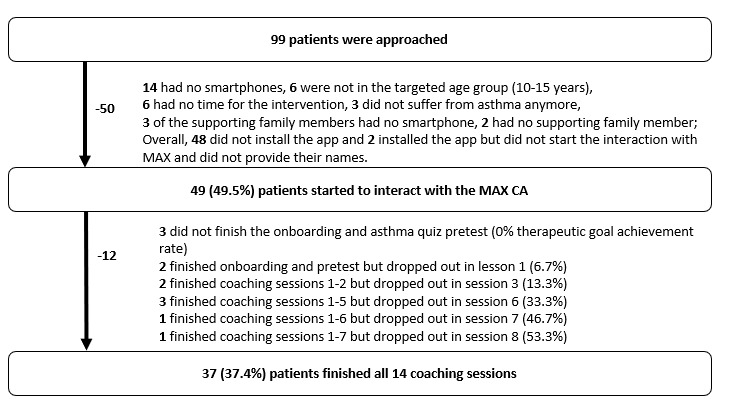
“The intervention completion rate was 75.5%, as 37 out the 49 patients finished the intervention.”
§ Conversational Agents as Mediating Social Actors in Chronic Disease Management Involving Health Care Professionals, Patients, and Family Members: Multisite Single-Arm Feasibility Study > Results > Intervention Completion Rate
plainn = 49- Asserted: passes — The authors put it forward as true.
- Checkable: passes — It can be checked against evidence.
- Load-bearing: unclear — It is unclear whether the paper’s conclusions depend on it.
- Based: passes — The paper gives a reason why it holds.
It may state two separate claims as one.
A result the paper reports from its own data — it cites no other source for it, so there is none to check. The quote shows it is in the paper.
In the paper
“Moreover, patients learned new aspects about asthma management and enjoyed the coaching sessions.”
§ Conversational Agents as Mediating Social Actors in Chronic Disease Management Involving Health Care Professionals, Patients, and Family Members: Multisite Single-Arm Feasibility Study > Results > Technology Acceptance
plain- Asserted: passes — The authors put it forward as true.
- Checkable: passes — It can be checked against evidence.
- Load-bearing: unclear — It is unclear whether the paper’s conclusions depend on it.
- Based: passes — The paper gives a reason why it holds.
It may state two separate claims as one.
- Rests on an assumption: The single-item measures used to assess technology acceptance are sufficient to validly measure the constructs.
A result the paper reports from its own data — it cites no other source for it, so there is none to check. The quote shows it is in the paper.
In the paper
“In addition, it took them less than 4 minutes to assess the inhalation technique and 3 days to deliver that feedback to the patients.”
§ Conversational Agents as Mediating Social Actors in Chronic Disease Management Involving Health Care Professionals, Patients, and Family Members: Multisite Single-Arm Feasibility Study > Discussion > Primary Findings
plain- Asserted: passes — The authors put it forward as true.
- Checkable: passes — It can be checked against evidence.
- Load-bearing: unclear — It is unclear whether the paper’s conclusions depend on it.
- Based: passes — The paper gives a reason why it holds.
It may state two separate claims as one.
A result the paper reports from its own data — it cites no other source for it, so there is none to check. The quote shows it is in the paper.
In the paper
“Overall, 42 inhalation video clips were recorded and submitted to the health care professionals (Table 2).”
§ Conversational Agents as Mediating Social Actors in Chronic Disease Management Involving Health Care Professionals, Patients, and Family Members: Multisite Single-Arm Feasibility Study > Results > Intervention Completion Rate
plainn = 42- Asserted: passes — The authors put it forward as true.
- Checkable: passes — It can be checked against evidence.
- Load-bearing: fails — The paper’s conclusions may not depend on it.
- Based: passes — The paper gives a reason why it holds.
Probably not a substantial claim. The paper’s conclusions may not depend on it.
A result the paper reports from its own data — it cites no other source for it, so there is none to check. The quote shows it is in the paper.
In the paper
“it took health care professionals an average of 221 seconds to assess the videos clips, with a clear difference observed between health care settings (average of 410 seconds in the primary care setting and 127 seconds in the secondary care setting; see Table 2).”
§ Conversational Agents as Mediating Social Actors in Chronic Disease Management Involving Health Care Professionals, Patients, and Family Members: Multisite Single-Arm Feasibility Study > Results > Human Effort and Responsiveness of Health Care Professionals
boostedcorrelational- Asserted: passes — The authors put it forward as true.
- Checkable: passes — It can be checked against evidence.
- Load-bearing: unclear — It is unclear whether the paper’s conclusions depend on it.
- Based: passes — The paper gives a reason why it holds.
It may state two separate claims as one.
A result the paper reports from its own data — it cites no other source for it, so there is none to check. The quote shows it is in the paper.
In the paper
“For the gender-specific choices of the MAX conversational agent, all participants chose the character corresponding to their own indicated gender.”
§ Conversational Agents as Mediating Social Actors in Chronic Disease Management Involving Health Care Professionals, Patients, and Family Members: Multisite Single-Arm Feasibility Study > Results > Technology Acceptance
plaincorrelational- Asserted: passes — The authors put it forward as true.
- Checkable: passes — It can be checked against evidence.
- Load-bearing: fails — The paper’s conclusions may not depend on it.
- Based: passes — The paper gives a reason why it holds.
Probably not a substantial claim. The paper’s conclusions may not depend on it.
A result the paper reports from its own data — it cites no other source for it, so there is none to check. The quote shows it is in the paper.
In the paper
“Reach was 49.5% with 49 out of 99 approached patients downloading the app and starting to interact with the MAX conversational agent.”
§ Conversational Agents as Mediating Social Actors in Chronic Disease Management Involving Health Care Professionals, Patients, and Family Members: Multisite Single-Arm Feasibility Study > Results > Participant Characteristics
plainn = 99- Asserted: passes — The authors put it forward as true.
- Checkable: passes — It can be checked against evidence.
- Load-bearing: unclear — It is unclear whether the paper’s conclusions depend on it.
- Based: passes — The paper gives a reason why it holds.
It may state two separate claims as one.
The paper states this without a source or data behind it here, so there is nothing to check it against. The quote shows it is in the paper.
In the paper
“For each patient, this intervention involved an average of 20 minutes of human effort, 10 automated SMS text messages, including three reminders, and additional costs for gift vouchers, including lottery winnings.”
§ Conversational Agents as Mediating Social Actors in Chronic Disease Management Involving Health Care Professionals, Patients, and Family Members: Multisite Single-Arm Feasibility Study > Discussion > Primary Findings
plain- Asserted: passes — The authors put it forward as true.
- Checkable: passes — It can be checked against evidence.
- Load-bearing: unclear — It is unclear whether the paper’s conclusions depend on it.
- Based: passes — The paper gives a reason why it holds.
It may state two separate claims as one.
A result the paper reports from its own data — it cites no other source for it, so there is none to check. The quote shows it is in the paper.
In the paper
“the text-based conversational agent was perceived as positive and engaging”
§ Conversational Agents as Mediating Social Actors in Chronic Disease Management Involving Health Care Professionals, Patients, and Family Members: Multisite Single-Arm Feasibility Study > Discussion > Primary Findings
plain- Asserted: passes — The authors put it forward as true.
- Checkable: passes — It can be checked against evidence.
- Load-bearing: unclear — It is unclear whether the paper’s conclusions depend on it.
- Based: passes — The paper gives a reason why it holds.
It may state two separate claims as one.
None of the sources cited for this claim have been checked yet.
In the paper
“therapeutic alliance [16,17]”
§ Conversational Agents as Mediating Social Actors in Chronic Disease Management Involving Health Care Professionals, Patients, and Family Members: Multisite Single-Arm Feasibility Study > Introduction
plaincorrelational- Asserted: passes — The authors put it forward as true.
- Checkable: passes — It can be checked against evidence.
- Load-bearing: fails — The paper’s conclusions may not depend on it.
- Based: passes — The paper gives a reason why it holds.
Probably not a substantial claim. The paper’s conclusions may not depend on it.
In the paper
“Chronic conditions present a significant risk to the global population, and cause substantial financial and health-related burdens, resulting in low quality of life of those affected [1].”
§ Conversational Agents as Mediating Social Actors in Chronic Disease Management Involving Health Care Professionals, Patients, and Family Members: Multisite Single-Arm Feasibility Study > Introduction
What the sources say
- Not checked yetcites [1] source
plaindirect- Asserted: passes — The authors put it forward as true.
- Checkable: passes — It can be checked against evidence.
- Load-bearing: fails — The paper’s conclusions may not depend on it.
- Based: passes — The paper gives a reason why it holds.
Probably not a substantial claim. The paper’s conclusions may not depend on it. It may state two separate claims as one.
In the paper
“Successful disease management often requires a trustful collaboration among health care professionals, patients, and their families [3].”
§ Conversational Agents as Mediating Social Actors in Chronic Disease Management Involving Health Care Professionals, Patients, and Family Members: Multisite Single-Arm Feasibility Study > Introduction
What the sources say
- Not checked yetcites [3] source
plaincorrelational- Asserted: passes — The authors put it forward as true.
- Checkable: passes — It can be checked against evidence.
- Load-bearing: passes — The paper’s conclusions depend on it.
- Based: passes — The paper gives a reason why it holds.
Probably not a substantial claim.
None of the sources cited for this claim have been checked yet.
In the paper
“Indeed, several recent studies have provided evidence supporting the patient benefits of such digital interventions, particularly in children and adolescents [10-14].”
§ Conversational Agents as Mediating Social Actors in Chronic Disease Management Involving Health Care Professionals, Patients, and Family Members: Multisite Single-Arm Feasibility Study > Introduction
What the sources say
plaincorrelational- Asserted: passes — The authors put it forward as true.
- Checkable: passes — It can be checked against evidence.
- Load-bearing: fails — The paper’s conclusions may not depend on it.
- Based: passes — The paper gives a reason why it holds.
Probably not a substantial claim. The paper’s conclusions may not depend on it.
In the paper
“conversational agents (ie, computer programs that imitate interaction with human beings) have shown promising results with respect to patient satisfaction [15]”
§ Conversational Agents as Mediating Social Actors in Chronic Disease Management Involving Health Care Professionals, Patients, and Family Members: Multisite Single-Arm Feasibility Study > Introduction
What the sources say
- Not checked yetcites [15] source
plaincorrelational- Asserted: passes — The authors put it forward as true.
- Checkable: passes — It can be checked against evidence.
- Load-bearing: fails — The paper’s conclusions may not depend on it.
- Based: passes — The paper gives a reason why it holds.
Probably not a substantial claim. The paper’s conclusions may not depend on it.
In the paper
“Asthma is associated with high financial and health costs, with total annual asthma costs in the United States estimated at US $56 billion in 2011 [23].”
§ Conversational Agents as Mediating Social Actors in Chronic Disease Management Involving Health Care Professionals, Patients, and Family Members: Multisite Single-Arm Feasibility Study > Introduction
What the sources say
- Not checked yetcites [23] source
hedgedcorrelational- Asserted: passes — The authors put it forward as true.
- Checkable: passes — It can be checked against evidence.
- Load-bearing: fails — The paper’s conclusions may not depend on it.
- Based: passes — The paper gives a reason why it holds.
Probably not a substantial claim. The paper’s conclusions may not depend on it. It may state two separate claims as one.
None of the sources cited for this claim have been checked yet.
In the paper
“The intervention was developed with the open-source software platform MobileCoach [67,83,84], which has already been used successfully for various clinical and public health interventions [17,68,77-79,85,86]”
§ Conversational Agents as Mediating Social Actors in Chronic Disease Management Involving Health Care Professionals, Patients, and Family Members: Multisite Single-Arm Feasibility Study > Methods > Technical Implementation
What the sources say
- Not checked yetcites [67] source
- Not checked yetcites [83] source
- Not checked yetcites [84] MobileCoach2021-02-06www.mobile-coach.eu
- Not checked yetcites [17] source
- Not checked yetcites [68] source
- Not checked yetcites [77] source
- Not checked yetcites [78] source
- Not checked yetcites [79] source
- Not checked yetcites [85] source
- Not checked yetcites [86] source
plain- Asserted: passes — The authors put it forward as true.
- Checkable: passes — It can be checked against evidence.
- Load-bearing: fails — The paper’s conclusions may not depend on it.
- Based: passes — The paper gives a reason why it holds.
Probably not a substantial claim. The paper’s conclusions may not depend on it.
In the paper
“Affecting approximately 235 million people, asthma is one of the most common chronic diseases worldwide [20].”
§ Conversational Agents as Mediating Social Actors in Chronic Disease Management Involving Health Care Professionals, Patients, and Family Members: Multisite Single-Arm Feasibility Study > Introduction
What the sources say
- Not checked yetcites [20] Asthma Fact SheetWorld Health Organization2020-04-13https://www.who.int/en/news-room/fact-sheets/detail/asthma
plain- Asserted: passes — The authors put it forward as true.
- Checkable: passes — It can be checked against evidence.
- Load-bearing: fails — The paper’s conclusions may not depend on it.
- Based: passes — The paper gives a reason why it holds.
Probably not a substantial claim. The paper’s conclusions may not depend on it. It may state two separate claims as one.
In the paper
“and treatment success [18].”
§ Conversational Agents as Mediating Social Actors in Chronic Disease Management Involving Health Care Professionals, Patients, and Family Members: Multisite Single-Arm Feasibility Study > Introduction
What the sources say
- Not checked yetcites [18] source
plaincorrelational- Asserted: passes — The authors put it forward as true.
- Checkable: passes — It can be checked against evidence.
- Load-bearing: fails — The paper’s conclusions may not depend on it.
- Based: passes — The paper gives a reason why it holds.
Probably not a substantial claim. The paper’s conclusions may not depend on it.
None of the sources cited for this claim have been checked yet.
In the paper
“Another common concern is poor technique during medication inhalation, leading to reduced dispersion of the drug in the lungs, and subsequent decreased asthma stability and lowered clinical effectiveness of the delivered drug [41-44].”
§ Conversational Agents as Mediating Social Actors in Chronic Disease Management Involving Health Care Professionals, Patients, and Family Members: Multisite Single-Arm Feasibility Study > Introduction
What the sources say
plaindirect- Asserted: passes — The authors put it forward as true.
- Checkable: passes — It can be checked against evidence.
- Load-bearing: passes — The paper’s conclusions depend on it.
- Based: passes — The paper gives a reason why it holds.
It may state two separate claims as one.
None of the sources cited for this claim have been checked yet.
In the paper
“Compared to very similar conversational agent research targeting childhood obesity [68], physical inactivity [77], or the management of chronic pain [17], this intervention resulted in a high overall therapeutic goal achievement rate (75.5%) but also in improved asthma knowledge test scores and behavioral skills (ie, no identified inhalation mistakes occurred after the feedback from health care”
§ Conversational Agents as Mediating Social Actors in Chronic Disease Management Involving Health Care Professionals, Patients, and Family Members: Multisite Single-Arm Feasibility Study > Discussion > Primary Findings
What the sources say
plaindirect- Asserted: passes — The authors put it forward as true.
- Checkable: passes — It can be checked against evidence.
- Load-bearing: passes — The paper’s conclusions depend on it.
- Based: passes — The paper gives a reason why it holds.
It may state two separate claims as one.
In the paper
“Digital health interventions in the form of mobile apps can be particularly effective for children as they provide an attractive channel for education and management through the possible integration of multimedia content such as audio or video [19].”
§ Conversational Agents as Mediating Social Actors in Chronic Disease Management Involving Health Care Professionals, Patients, and Family Members: Multisite Single-Arm Feasibility Study > Introduction
What the sources say
- Not checked yetcites [19] source
hedgedconditional- Asserted: passes — The authors put it forward as true.
- Checkable: passes — It can be checked against evidence.
- Load-bearing: fails — The paper’s conclusions may not depend on it.
- Based: passes — The paper gives a reason why it holds.
Probably not a substantial claim. The paper’s conclusions may not depend on it.
A conclusion the paper draws from its own results — it cites no other source for it, so there is none to check. The quote shows it is in the paper.
In the paper
“The results of this first feasibility study indicate an overall positive evaluation with respect to the reach of the intervention (ie, 49.5% of 99 young patients approached did install the app and started to interact with the MAX conversational agent), the strong working alliance between patients and the MAX conversational agent, and high acceptance of the intervention by all relevant stakeholders”
§ Conversational Agents as Mediating Social Actors in Chronic Disease Management Involving Health Care Professionals, Patients, and Family Members: Multisite Single-Arm Feasibility Study > Discussion > Primary Findings
hedgedn = 99- Asserted: passes — The authors put it forward as true.
- Checkable: passes — It can be checked against evidence.
- Load-bearing: passes — The paper’s conclusions depend on it.
- Based: passes — The paper gives a reason why it holds.
It may state two separate claims as one.
- Rests on an assumption: The single-item measures used to assess technology acceptance are sufficient to validly measure the constructs.
None of the sources cited for this claim have been checked yet.
In the paper
“Knowledge about asthma (ie, cognitive skill) was assessed at the beginning of the intervention (ie, at the end of the introductory chat with the conversational agent MAX) and in the last session by a validated health literacy quiz for children with asthma, with a quiz score ranging from 0 (no knowledge) to 11 (good knowledge) [80,94] (see Multimedia Appendix 19).”
§ Conversational Agents as Mediating Social Actors in Chronic Disease Management Involving Health Care Professionals, Patients, and Family Members: Multisite Single-Arm Feasibility Study > Methods > Evaluation of the Intervention
What the sources say
- Not checked yetcites [80] SchnyderMASantschiRAuf Spurensuche im FerienlagerEin Lerncomic über Asthma20122020-04-13https://www.lungenliga.ch/uploads/tx_pubshop/Lerncomic_Spurensuche.pdf
- Not checked yetcites [94] Schnyder, M, 2014, Begleitbericht Zur Entwicklung eines Lernmittels für Asthmakinder im Alter von 7 bis 12 Jahren
plain- Asserted: passes — The authors put it forward as true.
- Checkable: passes — It can be checked against evidence.
- Load-bearing: passes — The paper’s conclusions depend on it.
- Based: passes — The paper gives a reason why it holds.
Probably not a substantial claim.
In the paper
“It was previously suggested that conversational agents can be influential and engaging for young patients, and that open-text answers are highly appreciated [104].”
§ Conversational Agents as Mediating Social Actors in Chronic Disease Management Involving Health Care Professionals, Patients, and Family Members: Multisite Single-Arm Feasibility Study > Discussion > Primary Findings
What the sources say
- Not checked yetcites [104] source
hedged- Asserted: fails — The authors may not put it forward as true.
- Checkable: passes — It can be checked against evidence.
- Load-bearing: fails — The paper’s conclusions may not depend on it.
- Based: passes — The paper gives a reason why it holds.
Probably not a substantial claim. The authors may not put it forward as true. The paper’s conclusions may not depend on it. It may state two separate claims as one.
None of the sources cited for this claim have been checked yet.
In the paper
“perceived usefulness (“The app helped me to increase my knowledge about my asthma”), ease of use (“The app was easy to use”), enjoyment (“I found the app enjoyable”), control (“I could control many aspects of the app”), and usage intention (“How much would you like to continue working with MAX?”) were assessed by patients at the end of the intervention with instruments adapted from information”
§ Conversational Agents as Mediating Social Actors in Chronic Disease Management Involving Health Care Professionals, Patients, and Family Members: Multisite Single-Arm Feasibility Study > Methods > Evaluation of the Intervention
plain- Asserted: passes — The authors put it forward as true.
- Checkable: passes — It can be checked against evidence.
- Load-bearing: fails — The paper’s conclusions may not depend on it.
- Based: passes — The paper gives a reason why it holds.
Probably not a substantial claim. The paper’s conclusions may not depend on it.
None of the sources cited for this claim have been checked yet.
In the paper
“We minimized the risk for smartphone addiction [76] by limiting the amount of possible sessions to one per day and further including active exercises outside the digital environment of the app to increase social interaction and to counteract increasing smartphone usage among children [103].”
§ Conversational Agents as Mediating Social Actors in Chronic Disease Management Involving Health Care Professionals, Patients, and Family Members: Multisite Single-Arm Feasibility Study > Discussion > Primary Findings
plaindirect- Asserted: passes — The authors put it forward as true.
- Checkable: passes — It can be checked against evidence.
- Load-bearing: unclear — It is unclear whether the paper’s conclusions depend on it.
- Based: passes — The paper gives a reason why it holds.
It may state two separate claims as one.
What the paper did — it cites no source for this, so there is none to check. The quote shows it is in the paper.
In the paper
“The study was approved by the institutional review board of ETH Zurich (reference number: EK 2018-N-59).”
§ Conversational Agents as Mediating Social Actors in Chronic Disease Management Involving Health Care Professionals, Patients, and Family Members: Multisite Single-Arm Feasibility Study > Methods > Evaluation of the Intervention
plain- Asserted: passes — The authors put it forward as true.
- Checkable: passes — It can be checked against evidence.
- Load-bearing: fails — The paper’s conclusions may not depend on it.
- Based: passes — The paper gives a reason why it holds.
Probably not a substantial claim. The paper’s conclusions may not depend on it.
None of the sources cited for this claim have been checked yet.
In the paper
“Digital health interventions for asthma include numerous mobile health apps that provide patients with information and help them track symptoms or medications, often using a gamification component [45-47].”
§ Conversational Agents as Mediating Social Actors in Chronic Disease Management Involving Health Care Professionals, Patients, and Family Members: Multisite Single-Arm Feasibility Study > Discussion > Comparison With Prior Work
What the sources say
plain- Asserted: passes — The authors put it forward as true.
- Checkable: passes — It can be checked against evidence.
- Load-bearing: fails — The paper’s conclusions may not depend on it.
- Based: passes — The paper gives a reason why it holds.
Probably not a substantial claim. The paper’s conclusions may not depend on it. It may state two separate claims as one.
A conclusion the paper draws from its own results — it cites no other source for it, so there is none to check. The quote shows it is in the paper.
In the paper
“General ongoing costs include keeping the intervention content updated according to recent asthma management guidelines (at a cost of approximately US $10,000 every 3 years) and maintaining technical software (at a cost of approximately US $10,000 per year).”
§ Conversational Agents as Mediating Social Actors in Chronic Disease Management Involving Health Care Professionals, Patients, and Family Members: Multisite Single-Arm Feasibility Study > Discussion > Limitations and Future Work
hedged- Asserted: passes — The authors put it forward as true.
- Checkable: passes — It can be checked against evidence.
- Load-bearing: fails — The paper’s conclusions may not depend on it.
- Based: passes — The paper gives a reason why it holds.
Probably not a substantial claim. The paper’s conclusions may not depend on it.
- Rests on an assumption: The MAX project team's cost estimates are accurate.
What the paper did — it cites no source for this, so there is none to check. The quote shows it is in the paper.
In the paper
“Therefore, the study was exploratory by nature and did not include a detailed power analysis to determine a particular sample size.”
§ Conversational Agents as Mediating Social Actors in Chronic Disease Management Involving Health Care Professionals, Patients, and Family Members: Multisite Single-Arm Feasibility Study > Methods > Evaluation of the Intervention
plain- Asserted: passes — The authors put it forward as true.
- Checkable: passes — It can be checked against evidence.
- Load-bearing: passes — The paper’s conclusions depend on it.
- Based: passes — The paper gives a reason why it holds.
It may state two separate claims as one.
In the paper
“However, privacy issues with conversational agents and open-text answers were pointed out by prior work [105], as conversational agents that are responsive to such inputs could potentially and unintentionally retrieve more and more personal information.”
§ Conversational Agents as Mediating Social Actors in Chronic Disease Management Involving Health Care Professionals, Patients, and Family Members: Multisite Single-Arm Feasibility Study > Discussion > Primary Findings
What the sources say
- Not checked yetcites [105] source
plain- Asserted: passes — The authors put it forward as true.
- Checkable: passes — It can be checked against evidence.
- Load-bearing: fails — The paper’s conclusions may not depend on it.
- Based: passes — The paper gives a reason why it holds.
Probably not a substantial claim. The paper’s conclusions may not depend on it.
In the paper
“It was previously suggested that conversational agents can be influential and engaging for young patients, and that open-text answers are highly appreciated [104].”
§ Conversational Agents as Mediating Social Actors in Chronic Disease Management Involving Health Care Professionals, Patients, and Family Members: Multisite Single-Arm Feasibility Study > Discussion > Primary Findings
What the sources say
- Not checked yetcites [104] source
hedged- Asserted: passes — The authors put it forward as true.
- Checkable: passes — It can be checked against evidence.
- Load-bearing: fails — The paper’s conclusions may not depend on it.
- Based: passes — The paper gives a reason why it holds.
Probably not a substantial claim. The paper’s conclusions may not depend on it.
A conclusion the paper draws from its own results — it cites no other source for it, so there is none to check. The quote shows it is in the paper.
In the paper
“Specifically, some data had to be stored in a redundant way (eg, contact number, patient name) in the MAX system, which likely resulted in an overestimation of efforts (eg, the duration of the onboarding process).”
§ Conversational Agents as Mediating Social Actors in Chronic Disease Management Involving Health Care Professionals, Patients, and Family Members: Multisite Single-Arm Feasibility Study > Discussion > Limitations and Future Work
hedgedconditional- Asserted: passes — The authors put it forward as true.
- Checkable: passes — It can be checked against evidence.
- Load-bearing: unclear — It is unclear whether the paper’s conclusions depend on it.
- Based: passes — The paper gives a reason why it holds.
It may state two separate claims as one.
A conclusion the paper draws from its own results — it cites no other source for it, so there is none to check. The quote shows it is in the paper.
In the paper
“Based on our limited sample, it is clear that the results are not representative and must be interpreted with caution.”
§ Conversational Agents as Mediating Social Actors in Chronic Disease Management Involving Health Care Professionals, Patients, and Family Members: Multisite Single-Arm Feasibility Study > Discussion > Limitations and Future Work
boosted- Asserted: passes — The authors put it forward as true.
- Checkable: passes — It can be checked against evidence.
- Load-bearing: passes — The paper’s conclusions depend on it.
- Based: passes — The paper gives a reason why it holds.
It may state two separate claims as one.
A conclusion the paper draws from its own results — it cites no other source for it, so there is none to check. The quote shows it is in the paper.
In the paper
“Therefore, it is not clear whether and to what degree the MAX intervention would work the same way with other relevant health care professionals such as a general practitioner.”
§ Conversational Agents as Mediating Social Actors in Chronic Disease Management Involving Health Care Professionals, Patients, and Family Members: Multisite Single-Arm Feasibility Study > Discussion > Limitations and Future Work
hedgedn = 2- Asserted: passes — The authors put it forward as true.
- Checkable: passes — It can be checked against evidence.
- Load-bearing: passes — The paper’s conclusions depend on it.
- Based: passes — The paper gives a reason why it holds.
Probably not a substantial claim.
A conclusion the paper draws from its own results — it cites no other source for it, so there is none to check. The quote shows it is in the paper.
In the paper
“In case none of these additional intervention components or studies is considered, estimates of the MAX project team indicate that the development of the current MAX intervention into a “product” would cost another US $100,000.”
§ Conversational Agents as Mediating Social Actors in Chronic Disease Management Involving Health Care Professionals, Patients, and Family Members: Multisite Single-Arm Feasibility Study > Discussion > Limitations and Future Work
hedged- Asserted: passes — The authors put it forward as true.
- Checkable: passes — It can be checked against evidence.
- Load-bearing: fails — The paper’s conclusions may not depend on it.
- Based: passes — The paper gives a reason why it holds.
Probably not a substantial claim. The paper’s conclusions may not depend on it.
- Rests on an assumption: The MAX project team's cost estimates are accurate.
None of the sources cited for this claim have been checked yet.
In the paper
“For example, there is evidence that the number of nocturnal cough events is negatively correlated with asthma control [106,107], and that nocturnal cough in adult asthma patients can be detected reliably with the microphone of a smartphone [89,108].”
§ Conversational Agents as Mediating Social Actors in Chronic Disease Management Involving Health Care Professionals, Patients, and Family Members: Multisite Single-Arm Feasibility Study > Discussion > Limitations and Future Work
What the sources say
plain- Asserted: passes — The authors put it forward as true.
- Checkable: passes — It can be checked against evidence.
- Load-bearing: fails — The paper’s conclusions may not depend on it.
- Based: passes — The paper gives a reason why it holds.
Probably not a substantial claim. The paper’s conclusions may not depend on it.
A conclusion the paper draws from its own results — it cites no other source for it, so there is none to check. The quote shows it is in the paper.
In the paper
“We have demonstrated that conversational agents can take over the role of a mediating social actor in a complex health care setting with various stakeholders, and deliver a digital health intervention in a scalable way into the everyday life of patients and their family members.”
§ Conversational Agents as Mediating Social Actors in Chronic Disease Management Involving Health Care Professionals, Patients, and Family Members: Multisite Single-Arm Feasibility Study > Discussion > Conclusions
boosteddirect- Asserted: passes — The authors put it forward as true.
- Checkable: passes — It can be checked against evidence.
- Load-bearing: passes — The paper’s conclusions depend on it.
- Based: passes — The paper gives a reason why it holds.
It may state two separate claims as one.
- Rests on an assumption: The MAX intervention can be delivered in a scalable way into the everyday life of patients and their family members.
What the paper did — it cites no source for this, so there is none to check. The quote shows it is in the paper.
In the paper
“Finally, we have only reported the costs and efforts related to the MAX intervention, and therefore no implications regarding cost-effectiveness can be discussed.”
§ Conversational Agents as Mediating Social Actors in Chronic Disease Management Involving Health Care Professionals, Patients, and Family Members: Multisite Single-Arm Feasibility Study > Discussion > Limitations and Future Work
plain- Asserted: passes — The authors put it forward as true.
- Checkable: passes — It can be checked against evidence.
- Load-bearing: fails — The paper’s conclusions may not depend on it.
- Based: passes — The paper gives a reason why it holds.
Probably not a substantial claim. The paper’s conclusions may not depend on it. It may state two separate claims as one.
In the paper
“Working alliance between the patient and the conversational agent MAX was assessed with a German-adapted version of the Session Alliance Inventory [92] after coaching sessions 2, 8, and 14 (eg, “MAX and I respect each other” with answers anchored on a 7-point Likert scale ranging from 1 [“never”] to 8 [“always”]; see Multimedia Appendix 18).”
§ Conversational Agents as Mediating Social Actors in Chronic Disease Management Involving Health Care Professionals, Patients, and Family Members: Multisite Single-Arm Feasibility Study > Methods > Evaluation of the Intervention
What the sources say
- Not checked yetcites [92] source
plain- Asserted: passes — The authors put it forward as true.
- Checkable: passes — It can be checked against evidence.
- Load-bearing: fails — The paper’s conclusions may not depend on it.
- Based: passes — The paper gives a reason why it holds.
Probably not a substantial claim. The paper’s conclusions may not depend on it.
What the paper did — it cites no source for this, so there is none to check. The quote shows it is in the paper.
In the paper
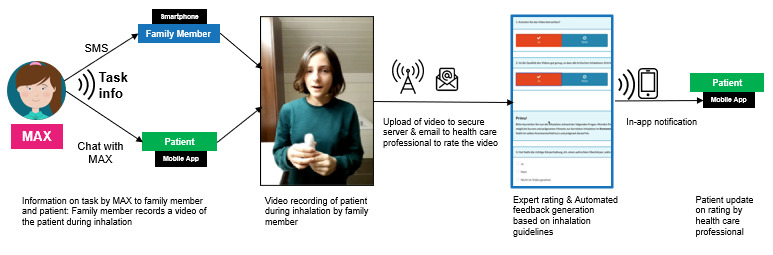
“The inhalation technique of each patient (ie, behavioral skill) was systematically assessed by the patient’s responsible health care professional with the help of predefined evaluation criteria These criteria were developed by health care professionals of the Swiss Lung Association and the participating pediatric pneumologists.”
§ Conversational Agents as Mediating Social Actors in Chronic Disease Management Involving Health Care Professionals, Patients, and Family Members: Multisite Single-Arm Feasibility Study > Methods > Evaluation of the Intervention
plain- Asserted: passes — The authors put it forward as true.
- Checkable: passes — It can be checked against evidence.
- Load-bearing: fails — The paper’s conclusions may not depend on it.
- Based: passes — The paper gives a reason why it holds.
Probably not a substantial claim. The paper’s conclusions may not depend on it.
- Rests on an assumption: The predefined evaluation criteria used by health care professionals validly assess inhalation technique.
- Rests on an assumption: The health care professionals' assessments of inhalation technique are reliable.
None of the sources cited for this claim have been checked yet.
In the paper
“For example, there is evidence that the number of nocturnal cough events is negatively correlated with asthma control [106,107], and that nocturnal cough in adult asthma patients can be detected reliably with the microphone of a smartphone [89,108].”
§ Conversational Agents as Mediating Social Actors in Chronic Disease Management Involving Health Care Professionals, Patients, and Family Members: Multisite Single-Arm Feasibility Study > Discussion > Limitations and Future Work
plaincorrelational- Asserted: passes — The authors put it forward as true.
- Checkable: passes — It can be checked against evidence.
- Load-bearing: fails — The paper’s conclusions may not depend on it.
- Based: passes — The paper gives a reason why it holds.
Probably not a substantial claim. The paper’s conclusions may not depend on it.
In the paper
“However, privacy issues with conversational agents and open-text answers were pointed out by prior work [105], as conversational agents that are responsive to such inputs could potentially and unintentionally retrieve more and more personal information.”
§ Conversational Agents as Mediating Social Actors in Chronic Disease Management Involving Health Care Professionals, Patients, and Family Members: Multisite Single-Arm Feasibility Study > Discussion > Primary Findings
What the sources say
- Not checked yetcites [105] source
hedgedconditional- Asserted: passes — The authors put it forward as true.
- Checkable: passes — It can be checked against evidence.
- Load-bearing: fails — The paper’s conclusions may not depend on it.
- Based: passes — The paper gives a reason why it holds.
Probably not a substantial claim. The paper’s conclusions may not depend on it.
A conclusion the paper draws from its own results — it cites no other source for it, so there is none to check. The quote shows it is in the paper.
In the paper
“With the MAX conversational agent, we were also able to show how to extend the reach of health care professionals into the everyday lives of patients in an efficient way without compromising the quality of care and working alliance.”
§ Conversational Agents as Mediating Social Actors in Chronic Disease Management Involving Health Care Professionals, Patients, and Family Members: Multisite Single-Arm Feasibility Study > Discussion > Primary Findings
boosteddirect- Asserted: passes — The authors put it forward as true.
- Checkable: passes — It can be checked against evidence.
- Load-bearing: passes — The paper’s conclusions depend on it.
- Based: passes — The paper gives a reason why it holds.
It may state two separate claims as one.
A conclusion the paper draws from its own results — it cites no other source for it, so there is none to check. The quote shows it is in the paper.
In the paper
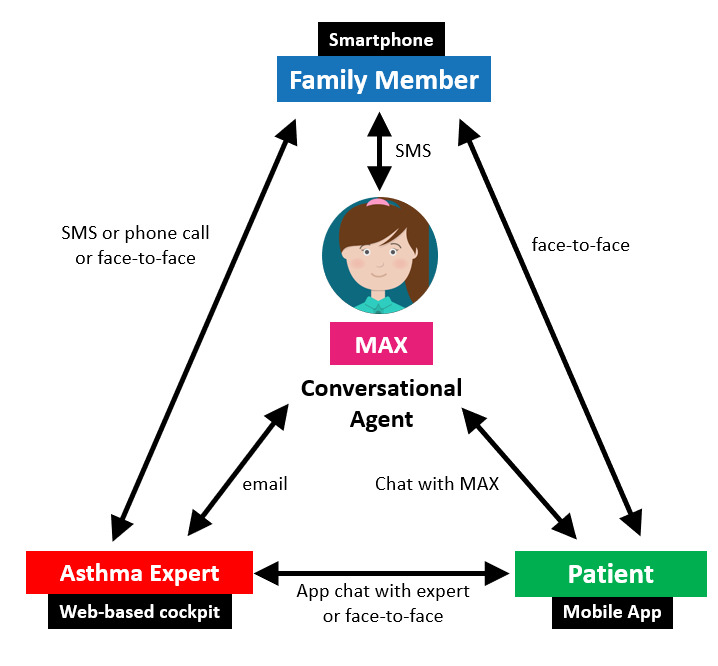
“For this purpose, the MAX conversational agent uses several communication channels (eg, in-app chat, email, and SMS), and therefore “lives” not only on a smartphone in the pocket of a patient but is rather omnipresent (ie, MAX appears on the phones of family members, such as via SMS, or on desktop or tablet computers of health care professionals, such as via emails and the web-based MAX interface”
§ Conversational Agents as Mediating Social Actors in Chronic Disease Management Involving Health Care Professionals, Patients, and Family Members: Multisite Single-Arm Feasibility Study > Discussion > Primary Findings
plaindirect- Asserted: passes — The authors put it forward as true.
- Checkable: passes — It can be checked against evidence.
- Load-bearing: passes — The paper’s conclusions depend on it.
- Based: passes — The paper gives a reason why it holds.
It may state two separate claims as one.
A conclusion the paper draws from its own results — it cites no other source for it, so there is none to check. The quote shows it is in the paper.
In the paper
“General ongoing costs include keeping the intervention content updated according to recent asthma management guidelines (at a cost of approximately US $10,000 every 3 years) and maintaining technical software (at a cost of approximately US $10,000 per year).”
§ Conversational Agents as Mediating Social Actors in Chronic Disease Management Involving Health Care Professionals, Patients, and Family Members: Multisite Single-Arm Feasibility Study > Discussion > Limitations and Future Work
hedged- Asserted: passes — The authors put it forward as true.
- Checkable: passes — It can be checked against evidence.
- Load-bearing: fails — The paper’s conclusions may not depend on it.
- Based: passes — The paper gives a reason why it holds.
Probably not a substantial claim. The paper’s conclusions may not depend on it.
- Rests on an assumption: The MAX project team's cost estimates are accurate.
What the paper did — it cites no source for this, so there is none to check. The quote shows it is in the paper.
In the paper
“This study was designed as a feasibility study with a limited number of participants.”
§ Conversational Agents as Mediating Social Actors in Chronic Disease Management Involving Health Care Professionals, Patients, and Family Members: Multisite Single-Arm Feasibility Study > Discussion > Limitations and Future Work
plain- Asserted: passes — The authors put it forward as true.
- Checkable: passes — It can be checked against evidence.
- Load-bearing: passes — The paper’s conclusions depend on it.
- Based: passes — The paper gives a reason why it holds.
It may state two separate claims as one.
A conclusion the paper draws from its own results — it cites no other source for it, so there is none to check. The quote shows it is in the paper.
In the paper
“These nonspecialized health care experts may require significantly more time for the assessment of the inhalation video clips or would not have the expertise to do so without additional educational efforts.”
§ Conversational Agents as Mediating Social Actors in Chronic Disease Management Involving Health Care Professionals, Patients, and Family Members: Multisite Single-Arm Feasibility Study > Discussion > Limitations and Future Work
hedgedconditional- Asserted: passes — The authors put it forward as true.
- Checkable: passes — It can be checked against evidence.
- Load-bearing: fails — The paper’s conclusions may not depend on it.
- Based: fails — The paper may give no reason why it holds.
Probably not a substantial claim. The paper’s conclusions may not depend on it. The paper may give no reason why it holds. It may state two separate claims as one.
The paper relies on this without support.
Children often face problems with technological solutions when they are not integrated into existing health care systems and do not allow for explicit support by health care professionals or family members.
“However, and in addition to shortcomings of asthma management related to cognitive and behavioral skills, children often face problems with such technological solutions when they are not integrated into existing health care systems and do not allow for explicit support by health care professionals or family members.”
The paper relies on this without support.
Without a dedicated party or mediator, it often becomes a challenge to integrate all relevant stakeholders (health care professionals, family members, and patients) into the disease management process.
“Without a dedicated party or mediator, it often becomes a challenge to integrate all of these relevant stakeholders (ie, health care professionals, family members, and the patients themselves) into the disease management process.”
The paper relies on this without support.
Conversational agents can act as mediating social actors, taking over a significant amount of intervention delivery in a scalable manner and coordinating communication among health care professionals, family members, and patients if required.
“Conversational agents, as part of such interventions, can act as mediating social actors; that is, they take over not only a significant amount of the intervention delivery in a scalable manner but also coordinate the communication among health care professionals, family members, and patients if required.”
The authors state this as an assumption.
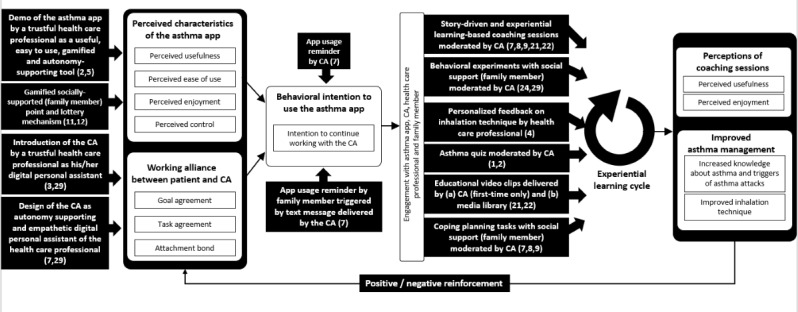
The four distinct intervention components enabled an experiential learning cycle and were assumed to influence the outcomes of the intervention.
“Four distinct intervention components as depicted in Figure 1 enabled an experiential learning cycle [66], and were assumed to influence the outcomes of the intervention”
The authors state this as an assumption.
The need to self-regulate one’s experiences and actions (as an important predictor of engagement) is also true for digital interventions.
“Assuming that the need to self-regulate one’s experiences and actions (as an important predictor of engagement [70], as posited by self-determination theory) is also true for digital interventions”
The authors state this as an assumption.
There is a positive/negative reinforcement link that connects the outcomes of the conceptual model with the perceived characteristics of the app and working alliance with the conversational agent.
“Finally, we assume that there is a positive/negative reinforcement link that connects the outcomes of the conceptual model with the perceived characteristics of the app and working alliance with the conversational agent.”
The paper relies on this without support.
Specific cognitive skills required for asthma management include knowledge about asthma triggers and the importance of medication inhalation adherence, as well as behavioral skills such as the application of correct inhalation techniques.
“For asthma, specific cognitive skills required for disease management include knowledge about asthma triggers and the importance of medication inhalation adherence, as well as behavioral skills such as the application of correct inhalation techniques.”
The paper relies on this without support.
The predefined evaluation criteria used by health care professionals validly assess inhalation technique.
“These criteria were developed by health care professionals of the Swiss Lung Association and the participating pediatric pneumologists.”
The paper relies on this without support.
The health care professionals' assessments of inhalation technique are reliable.
“The inhalation technique of each patient (ie, behavioral skill) was systematically assessed by the patient’s responsible health care professional with the help of predefined evaluation criteria”
The paper relies on this without support.
The single-item measures used to assess technology acceptance are sufficient to validly measure the constructs.
“Single-item measures were used to reduce the burden of the intervention and answers were anchored on 7-point Likert scales ranging from “strongly disagree” (1) to “strongly agree” (7).”
The paper relies on this without support.
The observed improvements in cognitive and behavioral skills are attributable to the MAX intervention rather than other factors.
“We have shown that conversational agents framed as digital assistants of health care professionals have the potential to improve cognitive and behavioral skills in chronic disease management, with asthma in children as one specific example.”
The paper relies on this without support.
The MAX intervention can be delivered in a scalable way into the everyday life of patients and their family members.
“We have demonstrated that conversational agents can take over the role of a mediating social actor in a complex health care setting with various stakeholders, and deliver a digital health intervention in a scalable way into the everyday life of patients and their family members.”
The paper relies on this without support.
The MAX project team's cost estimates are accurate.
“In case none of these additional intervention components or studies is considered, estimates of the MAX project team indicate that the development of the current MAX intervention into a “product” would cost another US $100,000.”
Claims other papers make about this one
Each is checked against this paper’s own text: does it say what the citing paper says it does?
The cited source says what the claim attributes to it.
In the citing paper
“relational agents—software that is designed to emulate conversations through voice or SMS text messages, also known as chatbots or digital coaches [31]—offer a compelling interface for delivering JITAIs.”
Self-check
Percentages, sums and reported differences re-computed from the paper’s own numbers.
Each contradiction between two passages listed here was confirmed by an independent check.
Rated minor: it would not touch a result — a value no result rests on, a p-value that stays on the same side of the significance level, or a conflict that is clerical, resolved elsewhere in the paper, or outside its own findings.
In the paper
§ Conversational Agents as Mediating Social Actors in Chronic Disease Management Involving Health Care Professionals, Patients, and Family Members: Multisite Single-Arm Feasibility Study > Results > Participant Characteristics
“| | Participants not finishing the intervention | 12 (25) | 129.58 (59.86) |”
§ Conversational Agents as Mediating Social Actors in Chronic Disease Management Involving Health Care Professionals, Patients, and Family Members: Multisite Single-Arm Feasibility Study > Results > Participant Characteristics
“| | Participants not finishing the intervention | 12 (24) | 20.75 (15.88) |”
Rated minor: it would not touch a result — a value no result rests on, a p-value that stays on the same side of the significance level, or a conflict that is clerical, resolved elsewhere in the paper, or outside its own findings.
In the paper
§ Conversational Agents as Mediating Social Actors in Chronic Disease Management Involving Health Care Professionals, Patients, and Family Members: Multisite Single-Arm Feasibility Study > Methods > Evaluation of the Intervention
“a 7-point Likert scale”
§ Conversational Agents as Mediating Social Actors in Chronic Disease Management Involving Health Care Professionals, Patients, and Family Members: Multisite Single-Arm Feasibility Study > Methods > Evaluation of the Intervention
“ranging from 1 [“never”] to 8 [“always”]”
Citations
Cites
The theory of planned behavior
Ajzen, I. (1991) · Organizational Behavior and Human Decision Processes · doi:10.1016/0749-5978(91)90020-t · Cited by 90,587
User Acceptance of Information Technology: Toward A Unified View1
Venkatesh, V., Morris, M. G., Davis, G. B., & Davis, F. D. (2003) · MIS Quarterly · doi:10.2307/30036540 · Cited by 45,035 · cited 3×
“To trigger engagement and in line with the theories of planned behavior [71], self-determination theory [69], and technology acceptance research [49,50,58], perceived characteristics of the asthma app (ie, perceived usefulness, ease of use, enjoyment, and control) and working alliance with the conversational agent (ie…”
Venkatesh, V., Thong, J. Y. L., & Xu, X. (2012) · MIS Quarterly · doi:10.2307/41410412 · Cited by 15,756 · cited 4×
“To trigger engagement and in line with the theories of planned behavior [71], self-determination theory [69], and technology acceptance research [49,50,58], perceived characteristics of the asthma app (ie, perceived usefulness, ease of use, enjoyment, and control) and working alliance with the conversational agent (ie…”
InfluentialInclusion of Other in the Self Scale and the structure of interpersonal closeness.
Aron, A., Aron, E. N., & Smollan, D. (1992) · Journal of Personality and Social Psychology · doi:10.1037/0022-3514.63.4.596 · Cited by 5,157 · cited 1×
“, asking about the participant’s age), and a linguistic style that evoke interpersonal closeness as this is assumed to be positively related to the attachment bond between patient and CA [59,74].”
User Acceptance of Hedonic Information Systems1
van der Heijden, H. (2004) · MIS Quarterly · doi:10.2307/25148660 · Cited by 3,850 · cited 1×
“The design of MAX was driven by an interdisciplinary effort that resulted in a conceptual model with intervention components informed by human behavior and experiential learning theories [61,65,66], findings from technology acceptance research [49,51,58,102], and prior experiences of the authors with conversational ag…”
Development and validation of the working alliance inventory
Horvath, A. O., & Greenberg, L. S. (1989) · Journal of Counseling Psychology · doi:10.1037//0022-0167.36.2.223 · Cited by 3,520 · cited 2×
“, asking about the participant’s age), and a linguistic style that evoke interpersonal closeness as this is assumed to be positively related to the attachment bond between patient and CA [59,74].”
Self-Determination Theory in Work Organizations: The State of a Science
Deci, E. L., Olafsen, A. H., & Ryan, R. M. (2017) · Annual Review of Organizational Psychology and Organizational Behavior · doi:10.1146/annurev-orgpsych-032516-113108 · Cited by 3,199 · cited 2×
“the need to self-regulate one’s experiences and actions as important predictor of engagement [70], the setup of this communication system allowed patients to independently decide with whom to interact and when, to establish relatedness to all involved stakeholders, and to ultimately increase their competence in the fo…”
Literacy and health outcomes: A systematic review of the literature
DeWalt, D. A., Berkman, N. D., Sheridan, S., Lohr, K. N., & Pignone, M. P. (2004) · Journal of General Internal Medicine · doi:10.1111/j.1525-1497.2004.40153.x · Cited by 2,309
Nahum-Shani, I., Smith, S. N., Spring, B. J., Collins, L. M., Witkiewitz, K., Tewari, A., & Murphy, S. A. (2018) · Annals of Behavioral Medicine · doi:10.1007/s12160-016-9830-8 · Cited by 2,171
Research works printed but not linked: 9
- 10.1043/1543-2165(2006)130[447:apap]2.0.co;2 · DOI
- Collins, LM, 2018, Optimization of Behavioral, Biobehavioral, and Biomedical Interventions
- Kolb, DA, 1984, Experience as the source of learning and development
- BoatengGSelsLKuppensPLüscherJScholzUKowatschTEmotion elicitation and capture among real couples in the lab2020ACM CHI Conference on Human Factors in Computing Systems2020Honolulu (cancelled)New York, NYAssociation for Computing Machinery
- NielsenJLandauerTKModel of the finding of usability problems1993ACM Conference on Human Factors in Computing Systems (CHI)1993Netherlands206213
- Schnyder, M, 2014, Begleitbericht Zur Entwicklung eines Lernmittels für Asthmakinder im Alter von 7 bis 12 Jahren
- 10.1145/3290607.3312853 · DOI · Paper page
- 10.2307/25148660 · DOI · Paper page
- HeilbronFCEscorciaVGhanemBNieblesJCActivityNet: A large-scale video benchmark for human activity understanding20152015 IEEE Conference on Computer Vision and Pattern RecognitionJune 7-12, 2015Boston, MA961970
Cited by
Sorted by citations
Jakob, R., Harperink, S., Rudolf, A. M., Fleisch, E., Haug, S., Mair, J. L., Salamanca-Sanabria, A., & Kowatsch, T. (2022) · Journal of Medical Internet Research · doi:10.2196/35371 · Cited by 446
Roles, Users, Benefits, and Limitations of Chatbots in Health Care: Rapid Review (Preprint)
Laymouna, M., Ma, Y., Lessard, D., Schuster, T., Engler, K., & Lebouché, B. (2024) · doi:10.2196/preprints.56930 · Cited by 302
Roles, Users, Benefits, and Limitations of Chatbots in Health Care: Rapid Review
Laymouna, M., Ma, Y., Lessard, D., Schuster, T., Engler, K., & Lebouché, B. (2024) · Journal of Medical Internet Research · doi:10.2196/56930 · Cited by 305
“%) of the 161 studies where the same original chatbot was presented under 5 different names [89,104,107,124,240].”
The Development and Use of Chatbots in Public Health: Scoping Review
Wilson, L., & Mărăşoiu, M. (2022) · JMIR Human Factors · doi:10.2196/35882 · Cited by 135
“%) of chatbots were deployed on existing social media platforms such as Facebook Messenger, Telegram, or Slack [39-44]; using SMS text messaging [42,45]; or the Google Assistant platform [18] (see Figure 4).”
Evaluation of chatbot-delivered interventions for self-management of depression: Content analysis.
Martinengo, L., Lum, E., & Car, J. (2022) · Journal of Affective Disorders · doi:10.1016/j.jad.2022.09.028 · Cited by 67
Review of artificial intelligence‐based question‐answering systems in healthcare
Cilar, L., Gosak, L., & Štiglic, G. (2023) · Wiley Interdisciplinary Reviews Data Mining and Knowledge Discovery · doi:10.1002/widm.1487 · Cited by 65
Martinengo, L., Jabir, A. I., Goh, W. W. T., Lo, N. Y. W., Ho, M. R., Kowatsch, T., Atun, R. A., Michie, S., & Car, L. T. (2022) · Journal of Medical Internet Research · doi:10.2196/39243 · Cited by 54
“Other studies focused on asthma [61], atrial fibrillation [52,53], HIV [49], hypertension [50], insomnia [60], irritable bowel syndrome [55], and prostate cancer [59].”
Self-citationKeller, R., Hartmann, S., Teepe, G. W., Lohse, K.-M., Alattas, A., Car, L. T., Müller‐Riemenschneider, F., von Wangenheim, F., Mair, J. L., & Kowatsch, T. (2021) · Journal of Medical Internet Research · doi:10.2196/33348 · Cited by 44
“Evidence from interventions using CAs show promising findings in terms of patient satisfaction [19], treatment success [20], and the capability to build work alliances with the patient [21-23].”
BackgroundSelf-citationWu, P. F., Summers, C., Panesar, A., Kaura, A., & Li, Z. (2024) · JMIR Human Factors · doi:10.2196/51086 · Cited by 43
“…adherence rates of patients with breast cancer [5]; enhanced the quality of life for people with type 2 diabetes [6]; reduced the severity of panic disorder symptoms [7]; and helped health care professionals, patients with asthma, and their family members build collaborative relationships [8].”
BackgroundCastro, Ó., Mair, J. L., Salamanca-Sanabria, A., Alattas, A., Keller, R., Zheng, S., Jabir, A. I., Lin, X., Frese, B. F., Lim, C. S., et al. (2023) · Frontiers in Digital Health · doi:10.3389/fdgth.2023.1039171 · Cited by 42
Self-citationUlrich, S., Gantenbein, A. R., Zuber, V., Von Wyl, A., Kowatsch, T., & Künzli, H. (2024) · Journal of Medical Internet Research · doi:10.2196/50132 · Cited by 36
Self-citationDhinagaran, D. A., Martinengo, L., Ho, M. R., Joty, S., Kowatsch, T., Atun, R. A., & Car, L. T. (2022) · JMIR mhealth and uhealth · doi:10.2196/38740 · Cited by 38
“educational, a knowledge test should be implemented [73].”
BackgroundMethodInfluentialSelf-citationTrustworthy Embodied Conversational Agents for Healthcare
Lupetti, M. L., Hagens, E., van der Maden, W., Steegers‐Theunissen, R. P. M., & Rousian, M. (2023) · ACM Conference on Conversational User Interfaces (CUI) · doi:10.1145/3571884.3597128 · Cited by 33
“Building on CAs literature [8, 11, 28, 33, 38, 47, 50], we expected that the ECA we developed would be perceived as trustworthy, as it would convey ability, benevolence, and integrity.”
BackgroundMethodInfluentialThe application of artificial intelligence in health communication development: A scoping review
Weingott, S., & Parkinson, J. E. (2024) · Health Marketing Quarterly · doi:10.1080/07359683.2024.2422206 · Cited by 42
“Kowatsch et al. (2021) use "MAX," a character that can be personalized based on the patient’s gender, to improve engagement in asthma management.”
InfluentialSalamanca-Sanabria, A., Jabir, A. I., Lin, X., Alattas, A., Kocaballi, A. B., Lee, J., Kowatsch, T., & Car, L. T. (2023) · Journal of Medical Internet Research · doi:10.2196/44542 · Cited by 32
“Although the scalability of an unguided and fully automated intervention is very promising [49], including human elements within the intervention may allay many of the concerns expressed by users about the technological limitations of the system [50].”
Self-citationWeeks, R., Cooper, L., Sangha, P., Sedoc, J., White, S., Toledo, A., Gretz, S., Lahav, D., Martin, N., Michel, A. E., et al. (2022) · Journal of Medical Internet Research · doi:10.2196/38418 · Cited by 30
“Chatbots have provided support on a range of health issues including chronic disease, addiction, reproductive health, depression, and anxiety, with promising adaptations of evidence-based interventions such as cognitive behavioral therapy [21-25].”
BackgroundDenecke, K., & May, R. (2022) · Journal of Medical Internet Research · doi:10.2196/41583 · Cited by 27
“In the latter systems, parents and physicians were enabled to join the system and review the conversation between the children and CAs or interact with the children [36,37].”
Language Use in Conversational Agent–Based Health Communication: Systematic Review
Shan, Y., Ji, M., Xie, W., Qian, X., Li, R., Zhang, X., & Hao, T. (2022) · Journal of Medical Internet Research · doi:10.2196/37403 · Cited by 25
“Language plays a crucial role in improving user engagement because perceived impersonal closeness, intention to use, user satisfaction, establishment of trust, and user self-disclosure or self-concealment are closely associated with the task- and social-based interactivity, interaction, politeness, and information qua…”
BackgroundKowatsch, T., & Fleisch, E. (2021) · Springer eBooks · doi:10.1007/978-3-030-76897-3_4 · Cited by 23
Self-citationHarnessing big data for tailored health communication: A systematic review of impact and techniques
Adegoke, B. O., Odugbose, T., & Adeyemi, C. (2024) · International Journal of Biology and Pharmacy Research Updates · doi:10.53430/ijbpru.2024.3.2.0024 · Cited by 27
“This segmentation enables healthcare providers to deliver targeted communication messages and interventions that are relevant and meaningful to specific patient cohorts, enhancing engagement and effectiveness (Kowatsch et al ., 2021).”
Ollier, J., Suryapalli, P., Fleisch, E., von Wangenheim, F., Mair, J. L., Salamanca-Sanabria, A., & Kowatsch, T. (2023) · Frontiers in Public Health · doi:10.3389/fpubh.2023.1185702 · Cited by 20
Self-citationSmriti, D., Kao, T. A., Rathod, R., Shin, J. Y., Peng, W., Williams, J. R., Mujib, M. I., Colosimo, M. M., & Huh, J. (2022) · JMIR Human Factors · doi:10.2196/38908 · Cited by 20
“Studies have discussed CAs serving as social actors to mediate communication between family members [31,82,83].”
BackgroundOllier, J., Nißen, M., & von Wangenheim, F. (2022) · Frontiers in Public Health · doi:10.3389/fpubh.2021.691595 · Cited by 17
Tian, J., Wang, H. Y., Peng, S. H., Tao, Y. M., Cao, J. M., & Zhang, X. (2024) · International Journal of Nursing Practice · doi:10.1111/ijn.13289 · Cited by 16
de Buisonjé, D. R., Reijnders, T., Rodrigues, T. C., Santhanam, P., Kowatsch, T., Lipman, S. A., Bijmolt, T. H. A., Breeman, L. D., Janssen, V. R., Kraaijenhagen, R. A., et al. (2022) · Journal of Medical Internet Research · doi:10.2196/38339 · Cited by 20
“The Benefit Move app was implemented using MobileCoach [42,43], an open-source software platform for smartphone-based and chatbot-delivered behavioral interventions (eg, study by Kowatsch et al [44]) and ecological momentary assessments (eg, study by Tinschert et al [45]).”
Self-citationSenek, M., Drummond, D., Pinnock, H., Hansen, K., Ankolekar, A., O'Connor, Ú., Gonsard, A., Mazulov, O., Sreter, K. B., Thornton, C. S., et al. (2025) · Journal of Medical Internet Research · doi:10.2196/70970 · Cited by 16
Simonovic, N., Taber, J. M., Scherr, C. L., Dean, M., Hua, J., Howell, J. L., Chaudhry, B. M., Wain, K. E., & Politi, M. C. (2022) · Journal of Behavioral Medicine · doi:10.1007/s10865-022-00384-5 · Cited by 16
“Further, the examples and situations used throughout the review are influenced by the disciplines and professionals in certain situations (Kowatsch et al., 2021, Islam & Chaudhry, 2022).”
MethodMair, J. L., Castro, Ó., Salamanca-Sanabria, A., Frese, B. F., von Wangenheim, F., Tai, E. S., Kowatsch, T., & Müller‐Riemenschneider, F. (2023) · BMC Public Health · doi:10.1186/s12889-023-15598-8 · Cited by 14
Self-citationThe group mind of hybrid teams with humans and intelligent agents in knowledge-intense work
Hopf, K., Nahr, N., Staake, T., & Lehner, F. (2024) · Journal of Information Technology · doi:10.1177/02683962241296883 · Cited by 15
“The application received three Media Awards at the WorldMediaFestival (2018 and 2019) and was validated in a medial study (Kowatsch et al., 2021).”
Уэтова, Е., Hederman, L., Ross, R., & O’Sullivan, D. M. (2024) · Digital Health · doi:10.1177/20552076241277693 · Cited by 13
“45,47,50,51,59,71 Four studies targeted young adults.”
BackgroundInfluentialDauletbaev, N., Oftring, Z. S., Akik, W., Michaelis-Braun, L., Korel, J., Lands, L. C., Waldmann, S., Müller, B. S., Dreher, M., Rohde, G. G. U., et al. (2022) · Paediatric Respiratory Reviews · doi:10.1016/j.prrv.2022.01.002 · Cited by 11
“Finally, at least 7 (28%) publications [38,39,42,43,45,49,52] presented descriptions of online platforms which comprised mHealth apps and web portals.”
Investigating conversational agents in healthcare: Application of a technical-oriented taxonomy
Denecke, K., & May, R. (2023) · Procedia Computer Science · doi:10.1016/j.procs.2023.01.413 · Cited by 12
Vinay, R., Уэтова, Е., Tommila, N. C., Biller‐Andorno, N., & Kowatsch, T. (2025) · JMIR Aging · doi:10.2196/76489 · Cited by 11
“To extend our earlier work, we added the constructs of perceived control (PC) and intention to continue interacting (ITI) [23,28], which have also been applied in related studies of conversational agents [25-27].”
Self-citationUse of Telemedicine in Pediatric Services for 4 Representative Clinical Conditions: Scoping Review
Southgate, G., Yassaee, A., Harmer, M., Livesey, H. F., Pryde, K., & Roland, D. (2022) · Journal of Medical Internet Research · doi:10.2196/38267 · Cited by 14
Skvortsova, A., Rodrigues, T. C., de Buisonjé, D. R., Kowatsch, T., Santhanam, P., Veldhuijzen, D. S., van Middendorp, H., & Evers, A. W. M. (2021) · Journal of Medical Internet Research · doi:10.2196/32130 · Cited by 11
“Similar to other MobileCoach-based interventions [23,24], participants could communicate with the chatbot and type their responses in the app or use predefined answer options.”
Self-citationConversational agents on smartphones and the web
Bickmore, T., & O’Leary, T. K. (2022) · Elsevier eBooks · doi:10.1016/b978-0-323-90045-4.00010-1 · Cited by 9
O'Sullivan, M., Curtin, M., Flynn, R., Cronin, C., O’Mahony, J., & Trujillo, J. (2023) · Allergy · doi:10.1111/all.15963 · Cited by 10
“Adolescents interacted with family members in two studies, 50,53 such as in the ‘MAX’ intervention, in which a family member (mostly parents) were invited to take part in certain coaching sessions.”
BackgroundInfluentialIio, M., Sato, M., Narita, M., Yamamoto‐Hanada, K., Oishi, T., Kishino, A., Kawaguchi, T., Nishi, R., Nagata, M., & Ohya, Y. (2022) · JMIR Formative Research · doi:10.2196/34509 · Cited by 8
“Children and adolescents aged 8-17 years and their caregivers preferred the use of technology to facilitate medication and disease management, and children had a strong willingness and ability to actively engage in their care [26].”
BackgroundCastro, Ó., Salamanca-Sanabria, A., Alattas, A., Teepe, G. W., Leidenberger, K., Fleisch, E., Car, L. T., Müller‐Riemenschneider, F., & Kowatsch, T. (2024) · Archives of Public Health · doi:10.1186/s13690-024-01424-z · Cited by 11
“Moreover, conversational agents are a rapidly growing approach to digital health in which users interact with computer programs that facilitate a human-like dialogue through auditory or textual methods, with the potential to improve uptake and engagement [29].”
BackgroundSelf-citationReceptivity to mobile health interventions
Keller, R., von Wangenheim, F., Mair, J. L., & Kowatsch, T. (2022) · Elsevier eBooks · doi:10.1016/b978-0-323-90045-4.00006-x · Cited by 7
Self-citationCalvo, R. A., Peters, D., Moradbakhti, L., Cook, D., Rizos, G., Schuller, B. W., Kallis, C., Wong, E., & Quint, J. K. (2023) · JMIR Research Protocols · doi:10.2196/42965 · Cited by 8
Productivity of incident management with conversational bots-a review
Iparraguirre-Villanueva, O., Obregon-Palomino, L., Pujay-Iglesias, W., Sierra-Liñan, F., & Cabanillas-Carbonell, M. (2023) · IAES International Journal of Artificial Intelligence · doi:10.11591/ijai.v12.i4.pp1543-1556 · Cited by 12
“[25], [27], [29], [40], [46], [47], [55], [66 [23], [30], [31], [33], [35], [41], [42], [44], [45], [49], [56]–[58], [68 4.5.”
InfluentialA text-based conversational agent for asthma support: Mixed-methods feasibility study
Cook, D., Peters, D., Moradbakhti, L., Su, T., Re, M. D., Schuller, B. W., Quint, J. K., Wong, E., & Calvo, R. A. (2024) · Digital Health · doi:10.1177/20552076241258276 · Cited by 11
“Most recently, Kowatsch et al. 13 described a chatbot called MAX, designed to promote asthma education and self-management skills (such as inhalation technique) for 10 – 15-year-olds.”
Pedagogical agents in K-12 education: a scoping review
Zhang, S., Jaldi, C. D., Schroeder, N. L., & Gladstone, J. R. (2024) · Journal of Research on Technology in Education · doi:10.1080/15391523.2024.2381229 · Cited by 8
Devittori, G., Akeddar, M., Retevoi, A., Schneider, F., Cvetkova, V., Dinacci, D., Califfi, A., Rossi, P., Petrillo, C., Kowatsch, T., et al. (2024) · IEEE/RAS-EMBS International Conference on Biomedical Robotics and Biomechatronics (BioRob) · doi:10.1109/biorob60516.2024.10719881 · Cited by 5
“MobileCoach-based interventions have already been applied and validated in different populations and applications [23], [24], but never in people after stroke, who might present additional challenges (e.g., cognitive deficits, hand impairments affecting the use of some smartphone features)…”
Self-citationMair, J. L., Jabir, A. I., Salamanca-Sanabria, A., Castro, Ó., Zheng, S., Keller, R., Frese, B. F., Lim, C. S., Alattas, A., Negi, S., et al. (2025) · Scientific Reports · doi:10.1038/s41598-025-30960-z · Cited by 5
Self-citationVinay, R., Tommila, N. C., Schlögl, M., Klöppel, S., Biller‐Andorno, N., & Kowatsch, T. (2024) · Mensch und Computer (MuC) · doi:10.1145/3670653.3677521 · Cited by 5
Self-citationThe Development of Virtual Worlds as a Tool for Providing Virtual Grocery Store Tours
Lanningham‐Foster, L., Wolff, M. M., Woodall, S., & Hollis, J. (2022) · Dietetics · doi:10.3390/dietetics1020007 · Cited by 5
“A recent study found that a conversational agent, which communicated with patients via email, mobile chat app, or text messaging, was accepted by patients [52].”
BackgroundBrill, E., Vinay, R., Nißen, M., Joshi, P., Klöppel, S., & Kowatsch, T. (2025) · JMIR Formative Research · doi:10.2196/66885 · Cited by 5
“In this context, relational agents—software that is designed to emulate conversations through voice or SMS text messages, also known as chatbots or digital coaches [31]— offer a compelling interface for delivering JITAIs.”
Self-citationGenerative AI for Elderly Well-being through the Computer as Social Actor Paradigm
Pramod, D., & Patil, K. P. (2024) · International Conference on Contemporary Computing · doi:10.1145/3675888.3676033 · Cited by 4
Fallah, M., Bickmore, T., Ólafsson, S., Paasche‐Orlow, M. K., Mrkva, A., & Magnani, J. W. (2024) · ACM International Conference on Intelligent Virtual Agents (IVA) · doi:10.1145/3652988.3673955 · Cited by 4
“Kowatsch et al. described a Virtual Agent designed as a mediating social actor involving health care professionals, patients, and family members in chronic disease management [23], with users accepting the agent as a member of their healthcare team.”
HEALTHI: Workshop on Intelligent Healthy Interfaces
Hänsel, K., Sobolev, M., Kowatsch, T., & Calvo, R. A. (2022) · ACM International Conference on Intelligent User Interfaces (IUI) · doi:10.1145/3490100.3511169 · Cited by 4
Self-citationPsico Bot: a robot for psychological assessment of children and adolescents
de Lima, E. D. S., Scortegagna, S. A., & Marchi, A. C. B. D. (2024) · Ciencias Psicológicas · doi:10.22235/cp.v18i2.3428 · Cited by 4
“Although some studies already point to positive results in interventions in children using conversational agents (Dosovitsky & Bunge, 2023; Kowatsch et al, 2021), the psychological assessment of this population through chatbots is very incipient, and almost nonexistent.”
ResultLee, D. J., Agarwal, A. K., Ali, Z. S., Xiong, R. A., Spencer, E. A., Hemmons, J. E., Lacko, H., & Delgado, M. K. (2022) · Urology · doi:10.1016/j.urology.2022.07.059 · Cited by 4
A Survey on Conversational Search and Applications in Biomedicine
Adatrao, N. S. K., Gadireddy, G. R., & Noh, J. (2023) · ACM Southeast Regional Conference (ACMSE) · doi:10.1145/3564746.3587001 · Cited by 4
“[44] demonstrated the potential of chatbots as a social mediator between healthcare professionals, patients, and family members.”
BackgroundTeepe, G. W., Lukic, Y. X., Kleim, B., Jacobson, N. C., Schneider, F., Santhanam, P., Fleisch, E., & Kowatsch, T. (2023) · BMC Psychology · doi:10.1186/s40359-023-01215-1 · Cited by 8
“To improve daily reported symptoms and biweekly reported severity, we implemented intervention components observed to be effective in related work, namely the slow-paced breathing training Breeze [39, 48–50] and a conversational agent [51–54].”
MethodSelf-citationRodrigues, T. C., Reijnders, T., de Buisonjé, D. R., Santhanam, P., Kowatsch, T., Breeman, L. D., Janssen, V. R., Kraaijenhagen, R. A., Atsma, D. E., & Evers, A. W. M. (2021) · doi:10.2196/preprints.30057 · Cited by 4
Self-citationBarth, J., Schläpfer, S., Schneider, F., Santhanam, P., Kowatsch, T., Heinz, P., Held, U., Eicher, M., & Witt, C. M. (2025) · npj Digital Medicine · doi:10.1038/s41746-025-01688-x · Cited by 4
Self-citationScoping review: multiple stakeholders and child asthma management interventions
Adabla, S., Nabors, L., Sanyaolu, O., Olaniyan, A. C., & Bernstein, J. A. (2023) · Journal of Asthma · doi:10.1080/02770903.2023.2176775 · Cited by 3
“Outcomes In studies where change in knowledge was a key outcome variable, it was evident that parent and child knowledge improved after asthma education (20,21,24).”
BackgroundInfluentialTowards a Design Framework for Conversational Agents for Diabetes Prevention
Sawad, A. B., Alakhtar, R. A., Alturki, B., Narayan, B., Lin, S., Prasad, M., & Kocaballi, A. B. (2023) · Australian Conference on Computer-Human Interaction (OzCHI) · doi:10.1145/3638380.3638421 · Cited by 3
“Utilising CAs presents a promising opportunity to enhance Human-Computer Interaction (HCI), such as handling inquiries, conserving human efforts and offering immediate replies [20, 24].”
BackgroundA Systematic Literature Review on How Conversational Agents are Transforming Healthcare
Antulay, N., & Adebesin, F. (2024) · Communications in computer and information science · doi:10.1007/978-3-031-71412-2_2 · Cited by 3
Khan, F., Wu, Y., Dray, J., Hemsley, B., & Kocaballi, A. B. (2025) · CHI Conference Extended Abstracts on Human Factors in Computing Systems (CHI EA) · doi:10.1145/3706599.3719800 · Cited by 3
“Simply incorporating some gamification elements [23] may not be sufficient.”
(Social) Trouble on the Road: Understanding and Addressing Social Discomfort in Shared Car Trips
Bremers, A. W. D., Friedman, N., Lee, S., Wu, T., Laurier, É., Jung, M. F., Ortiz, J., & Ju, W. G. (2024) · ACM Conference on Conversational User Interfaces (CUI) · doi:10.1145/3640794.3665580 · Cited by 3
“Another approach is to collect naturalistic data and filter this data afterward for moments of interest.”
BackgroundDigital Therapeutics for Healthy Longevity: A Roadmap
Leistner, T., & Kowatsch, T. (2023) · International Joint Conference on Biomedical Engineering Systems and Technologies (BIOSTEC) · doi:10.5220/0011778500003414 · Cited by 2
“Virtual or augmented reality, healthcare robots, or smart speakers allow for a new way of delivering personalized support with conversational agents (CAs) such as chatbots or virtual assistants like Amazon’s Alexa or Apple’s Siri (Kowatsch and Fleisch, 2021).”
BackgroundSelf-citationSchläpfer, S., Barth, J., Heinz, P., Held, U., Kowatsch, T., & Witt, C. M. (2026) · Internet Interventions · doi:10.1016/j.invent.2026.100929 · Cited by 2
“Participants generally evaluated the working alliance with the Can-Relax app 2.0 positively, similar to previous studies with rule-based conversational agents (Kowatsch et al., 2021a, 2021b), though differences emerged across the three subscales.”
InfluentialSelf-citationEmpowering mental health professionals in asynchronous online psychotherapy with GenAI
Bucher, A. M., Vashkite, I., Staehelin, D., Dolata, M., & Schwabe, G. (2026) · International Journal of Mental Health Systems · doi:10.1186/s13033-026-00700-5 · Cited by 3
Han, G. I., Lee, H. J., & Son, Y.-J. (2026) · Digital Health · doi:10.1177/20552076261450385 · Cited by 2
“10 13 However, the current evidence base remains fragmented, partly due to heterogeneity in study designs, relatively short intervention durations, and the absence of standardized outcome measures.”
Reengineering eADVICE for Long Waitlists: A Tale of Two Systems and Conditions
Richards, D., Caldwell, P. H. Y., Abdulrahman, A., Huben, A. V., Waters, K. A., & Scott, K. M. (2024) · Electronics · doi:10.3390/electronics13142785 · Cited by 2
Integrating Waiting into the Experience: A Study on Visual Feedback Design for AI Doctor Agents
Chen, C., & He, J.-W. (2025) · International Journal of Human-Computer Interaction · doi:10.1080/10447318.2025.2527847 · Cited by 2
“Among these applications, the demand for chronic disease management is especially pronounced (Griffin et al., 2020; Kowatsch et al., 2021).”
Rodrigues, T. C., de Buisonjé, D. R., Reijnders, T., Santhanam, P., Kowatsch, T., Breeman, L. D., Janssen, V. R., Kraaijenhagen, R. A., Atsma, D. E., & Evers, A. W. M. (2024) · Internet Interventions · doi:10.1016/j.invent.2024.100726 · Cited by 1
“The establishment of a working alliance in eHealth interventions can also lead to more positive treatment outcomes (Hauser-Ulrich et al., 2020; Kowatsch et al., 2021a; Bickmore et al., 2010; Clarke et al., 2016; Kowatsch et al., 2021b).”
BackgroundSelf-citationConversational Agents for Managing Chronic Diseases: A Systematic Review
Zakerabasali, S., Amiri, P., & Alipour, J. (2025) · Health Scope · doi:10.5812/healthscope-163131 · Cited by 1
Features of mobile health applications (mHealth apps) for asthma
Nikolov, P., & Petrova, G. (2026) · Pharmacia · doi:10.3897/pharmacia.73.e180488 · Cited by 1
Lucchini, A., Bozzon, A., & Colombo, S. (2026) · CHI Conference on Human Factors in Computing Systems · doi:10.1145/3772318.3790698 · Cited by 1
“Health literacy aimed to help patients avoid negative health outcomes by helping them understand their illness further [9, 41, 44, 72, 76].”
InfluentialVankit, S. A., Shama, N. S., Kadam, J., Motti, V., Laviola, J., Duchowski, A. T., & Volonte, M. (2026) · Computer Animation and Virtual Worlds · doi:10.1002/cav.70140 · Cited by 1
Cheng, S. C., Kopelovich, S. L., Si, D., Divina, M., Gao, N. S., Wang, M. Y., Kim, J. J., Li, Z., Blank, J. M., Brian, R., et al. (2024) · Journal of Technology in Behavioral Science · doi:10.1007/s41347-023-00378-3 · Cited by 2
“…with conversational agents represents a low-cost and user-friendly means of increasing health literacy (Ben-Zeev et al., 2021), supporting the delivery of home-based caregiving activities, enhancing communication, and improving caregiving outcomes (Kowatsch et al., 2021; Lindeman et al., 2020).”
Smriti, D., Kao, T. A., Rathod, R., Shin, J. Y., Peng, W., Williams, J. R., Mujib, M. I., Colosimo, M. M., & Huh, J. (2022) · doi:10.2196/preprints.38908
de Buisonjé, D. R., Reijnders, T., Rodrigues, T. C., Santhanam, P., Kowatsch, T., Lipman, S. A., Bijmolt, T. H. A., Breeman, L. D., Janssen, V. R., Kraaijenhagen, R. A., et al. (2022) · doi:10.2196/preprints.38339
Self-citationExploring the role of health apps in supporting young people with depression: a mixed methods study
Martinengo, L. (2021) · DR-NTU (Nanyang Technological University) · doi:10.32657/10356/157124
Martinengo, L., Jabir, A. I., Goh, W. W. T., Lo, N. Y. W., Ho, M. R., Kowatsch, T., Atun, R. A., Michie, S., & Car, L. T. (2022) · doi:10.2196/preprints.39243
Self-citationMair, J. L., Castro, Ó., Salamanca-Sanabria, A., Frese, B. F., von Wangenheim, F., Tai, E. S., Kowatsch, T., & Müller‐Riemenschneider, F. (2022) · Research Square · doi:10.21203/rs.3.rs-2068852/v1
Self-citationOllier, J., Mishra, R., Mair, J. L., Salamanca-Sanabria, A., Fleisch, E., von Wangenheim, F., & Kowatsch, T. (2022) · doi:10.2196/preprints.41296
Self-citationOllier, J., Suryapalli, P., Fleisch, E., von Wangenheim, F., Mair, J. L., Salamanca-Sanabria, A., & Kowatsch, T. (2022) · doi:10.2196/preprints.41300
Self-citationDhinagaran, D. A. (2022) · DR-NTU (Nanyang Technological University) · doi:10.32657/10356/163179
Rodrigues, T. C., de Buisonjé, D. R., Reijnders, T., Santhanam, P., Kowatsch, T., Breeman, L. D., Janssen, V. R., Kraaijenhagen, R. A., Atsma, D. E., & Evers, A. W. M. (2023) · SSRN Electronic Journal · doi:10.2139/ssrn.4592380
Self-citationSato, T., Sano, T., Kumakawa, E., Fujimura, K., & Yamashita, N. (2025) · CHI Conference Extended Abstracts on Human Factors in Computing Systems (CHI EA) · doi:10.1145/3706599.3720143
“Chatbots not only have the advantage of being able to collect user’s data and provide valuable information 24 hours a day, 365 days a year through question-and-answer interactions and reminders [4, 13], even when human staff are unavailable, but also possess anthropomorphism.”
CHATBOT APLICADO EM CRIANÇAS VÍTIMAS DE VIOLÊNCIA SEXUAL: Estudo piloto
de Lima, E. D. S., Scortegagna, S. A., & Marchi, A. C. B. D. (2025) · Psicologia e Saúde em Debate · doi:10.22289/2446-922x.v11a2a14
Mair, J. L., Castro, Ó., Salamanca-Sanabria, A., Frese, B. F., von Wangenheim, F., Tai, E. S., Kowatsch, T., & Müller‐Riemenschneider, F. (2023) · Figshare · doi:10.6084/m9.figshare.22688898
Self-citationMair, J. L., Castro, Ó., Salamanca-Sanabria, A., Frese, B. F., von Wangenheim, F., Tai, E. S., Kowatsch, T., & Müller‐Riemenschneider, F. (2023) · Figshare · doi:10.6084/m9.figshare.22688895
Self-citationMair, J. L., Castro, Ó., Salamanca-Sanabria, A., Frese, B. F., von Wangenheim, F., Tai, E. S., Kowatsch, T., & Müller‐Riemenschneider, F. (2023) · Figshare · doi:10.6084/m9.figshare.22688901
Self-citationTeepe, G. W., Lukic, Y. X., Kleim, B., Jacobson, N. C., Schneider, F., Santhanam, P., Fleisch, E., & Kowatsch, T. (2024) · Figshare · doi:10.6084/m9.figshare.26599091
Self-citationDhinagaran, D. A., Martinengo, L., Ho, M.-H. R., Joty, S., Kowatsch, T., Atun, R. A., & Car, L. T. (2022) · doi:10.2196/preprints.38740
Self-citationFareedi, A. A., Ismail, M., Ahmed, S., Gagnon, S., Ghazawneh, A., Arooj, Z., & Nazir, H. (2025) · Knowledge · doi:10.3390/knowledge6010002
Shenoi, A., Li, T., Jabir, A. I., Pitkethly, A. J., Fleisch, E., Kowatsch, T., & Mair, J. L. (2026) · doi:10.2196/preprints.94036
Self-citationMoradbakhti, L., Peters, D., Quint, J. K., Schuller, B., Cook, D., & Calvo, R. A. (2026) · JMIR Human Factors · doi:10.2196/80979
“Mobile technology (broadly; eg, apps, bespoke, and so on) Ramsey et al [14] and Whittamore [2] MAX (Kowatsch et al [26]) and ASTHMAXcel (Hsia et al [18,20]) WhatsApp (Meta; specific chat technology) Saeed Tayeb [31] Calderón et al [33] and Cumella et al [32] Conversational agents (automated…”
Shenoi, A., Li, T., Jabir, A. I., Pitkethly, A. J., Fleisch, E., Kowatsch, T., & Mair, J. L. (2026) · JMIR Formative Research · doi:10.2196/94036
“Rule-based CAs, built on scripted dialogue trees, have been used to deliver health literacy support [15,16] and evidence-based strategies such as MI [17,18] for a range of health care challenges [19].”
Self-citationUse and Efficacy of Conversational AI in Health Management: An Integrative Review
Wang, Z., & Kamarudin, S. (2026) · Journal of Health Communication · doi:10.1080/10810730.2026.2682496
“Conversational AI does not directly provide health advice but rather helps users align with institutional processes (Fareedi et al., 2025; Kowatsch et al., 2021).”
ElshikhIdris, M. A. M., Ali, A. S. H., Mahmoud, S. Y., Aziz, Y. M. S., Ali, I., Farah, S., & Altayeb, W. F. M. (2026) · Cureus · doi:10.7759/cureus.111334 · Cited by 1
“Geographically, the studies were conducted across nine countries: South Korea [17], Canada [18,21], New Zealand [19], Spain [20,26], Italy [22], South Africa [23], Norway [24], Switzerland [25], and France [27].”
InfluentialBoateng, G., Santhanam, P., Fleisch, E., Lüscher, J., Pauly, T., Scholz, U., Bodenmann, G., & Kowatsch, T. (2026) · ACM Transactions on Computing for Healthcare · doi:10.1145/3833380
“When the mobile app is opened for the first time, it can show information to the user about the app and let the user pick a conversational agent, i.e. a computer program that imitates the conversation with a human being [52].”
Self-citation
Metadata
- Authors
- Kowatsch, T., Schachner, T., Harperink, S., Barata, F., Dittler, U., Xiao, G., Stanger, C., v Wangenheim, F., Fleisch, E., Oswald, H., & Möller, A.
- Affiliations
- University of St.Gallen (CH)
- ETH Zurich (CH)
- Furtwangen University (DE)
- Johns Hopkins University (US)
- Dartmouth College (US)
- Kantonsspital Winterthur (CH)
- Corresponding author
- Kowatsch, Tobias
- ORCID
- Venue
- Journal of Medical Internet Research
- Publisher
- JMIR Publications Inc.
- Published
- 2021-02-17
- Volume
- 23
- Issue
- 2
- Pages
- e25060
- ISSN
- 1438-8871 (ISSN-L)
- PMC
- PMC7929753
- OpenAlex
- W3122673691
- Semantic Scholar
- 85bb70a2f7f6a60e2b1aba483a3e298c4e2f1dd1
- Cited by
- 103
- References
- 102
- Citations by year
- 2026: 15 · 2025: 11 · 2024: 23 · 2023: 20 · 2022: 29 · 2021: 5
- FWCI
- 21.63
- Type
- journal article
- Language
- en
- Open access
- gold
- doi.org
- Licence
- cc-by
- Locations
- Journal of Medical Internet Research (publishedVersion, cc-by)
- PubMed Central (publishedVersion, cc-by)
- PubMed (publishedVersion)
- Zurich Open Repository and Archive (University of Zurich) (acceptedVersion, cc-by)
- Repository of Futwangen University of Applied Sciences (Furtwangen University) (submittedVersion, cc-by)
- Repository for Publications and Research Data (ETH Zurich) (submittedVersion, cc-by)
- Alexandria (UniSG) (University of St.Gallen) (submittedVersion)
- DOAJ (DOAJ: Directory of Open Access Journals) (submittedVersion, cc-by-sa)
- Zurich Open Repository and Archive (University of Zurich) (submittedVersion, cc-by)
- ETH Zürich Research Collection (cc-by)
- Zurich Open Repository and Archive (University of Zurich)
- Funders
- National Institute on Drug Abuse (P30DA029926)
- National Institute of Diabetes and Digestive and Kidney Diseases (R01DK124428)
- Topics
- Health Sciences › Health Professions › General Health Professions › Mobile Health and mHealth Applications
- Social Sciences › Psychology › Applied Psychology › Digital Mental Health Interventions
- Social Sciences › Psychology › Social Psychology › Social Robot Interaction and HRI
- Keywords
- chatbots, chronic disease management, childhood asthma, asthma self-management, therapeutic relationship, healthcare workers, inhaler technique, text messaging, intervention acceptance, feasibility, primary and secondary care, patient-centered design, family involvement in care, patient knowledge and skills
- MeSH terms
- Chronic Disease, Communication, Family, Feasibility Studies, Female, Health Personnel, Humans, Male, Patients
About these checks
Registry, retraction, Cites and statistics results are computed, not judged, with one exception: a printed reference that no index lists is read once by a model before it counts as a citation error. Claims are extracted by a model and kept only when their quote appears verbatim in the text; each cited source is then checked, with a model’s help, for whether it says what the claim relies on. Those verdicts can be wrong — read the claim’s quote and the cited source before relying on one.
A language model drew the claims from the paper on 2026-10-10, under version 3 of the claim definition (model deepseek-v4.1-flash, prompt extract-v3).
A second model labelled each claim on 2026-10-10 (model jev-1.13-20260917, definition revision gold-guideline-v0.2).
Statistics and arithmetic are recomputed, not judged.
Confidence bands are shown only for fields calibrated on our annotated test set. None is calibrated yet, so no band is shown.
What counts as a claim ›How we measure confidence ›How we check this ›
Are you an author, or do you see a problem with this page? Request a review
