

Depression and Anxiety in Adolescents During the COVID-19 Pandemic in Relation to the Use of Digital Technologies: Longitudinal Cohort Study
Open accessPublished version of a preprint
The DOI matches its Crossref record; 42 of the 42 references it cites were found in a registry or an index.
Abstract
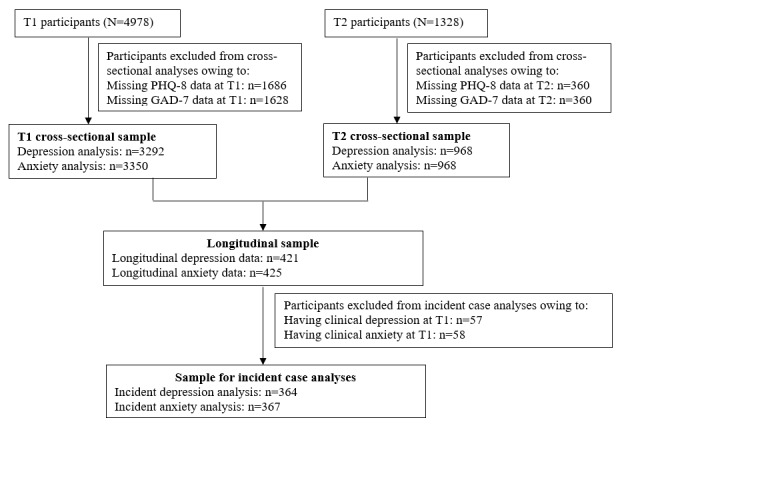
Background: Adolescents are susceptible to mental illness and have experienced substantial disruption owing to the COVID-19 pandemic. The digital environment is increasingly important in the context of a pandemic when in-person social connection is restricted. Objective: This study aims to estimate whether depression and anxiety had worsened compared with the prepandemic period and examine potential associations with sociodemographic characteristics and behavioral factors, particularly digital behaviors. Methods: We analyzed cross-sectional and longitudinal data from a large, representative Greater London adolescent cohort study: the Study of Cognition, Adolescents and Mobile Phones (SCAMP). Participants completed surveys at T1 between November 2016 and July 2018 (N=4978; aged 13 to 15 years) and at T2 between July 2020 and June 2021 (N=1328; aged 16 to 18 years). Depression and anxiety were measured using the Patient Health Questionnaire and Generalized Anxiety Disorder scale, respectively. Information on the duration of total mobile phone use, social network site use, and video gaming was also collected using questionnaires. Multivariable logistic regression was used to assess the cross-sectional and longitudinal associations of sociodemographic characteristics, digital technology use, and sleep duration with clinically significant depression and anxiety. Results: The proportion of adolescents who had clinical depression and anxiety significantly increased at T2 (depression: 140/421, 33.3%; anxiety: 125/425, 29.4%) compared with the proportion of adolescents at T1 (depression: 57/421, 13.5%; anxiety: 58/425, 13.6%; P for 2-proportion z test <.001 for both depression and anxiety). Depression and anxiety levels were similar between the summer holiday, school opening, and school closures. Female participants had higher odds of new incident depression (odds ratio [OR] 2.5, 95% CI 1.5-4.18) and anxiety (OR 2.11, 95% CI 1.23-3.61) at T2. A high level of total mobile phone use at T1 was associated with developing depression at T2 (OR 1.89, 95% CI 1.02-3.49). Social network site use was associated with depression and anxiety cross-sectionally at T1 and T2 but did not appear to be associated with developing depression or anxiety longitudinally. Insufficient sleep at T1 was associated with developing depression at T2 (OR 2.26, 95% CI 1.31-3.91). Conclusions: The mental health of this large sample of adolescents from London deteriorated during the pandemic without noticeable variations relating to public health measures. The deterioration was exacerbated in girls, those with preexisting high total mobile phone use, and those with preexisting disrupted sleep. Our findings suggest the necessity for allocating resources to address these modifiable factors and target high-risk groups.
Overview
The claims and statistics of this paper haven’t been checked yet.
Free: it reads the open-access text and checks the first 5 claims that cite a source we can check. Create a free account to check every claim.
Integrity signals
Registry
Cites
Statistics
Figures
Verification
Claims the paper makes
The claims and statistics of this paper haven’t been checked yet.
Free: it reads the open-access text and checks the first 5 claims that cite a source we can check. Create a free account to check every claim.
Claims other papers make about this one
Each is checked against this paper’s own text: does it say what the citing paper says it does?
In the citing paper
“Median social media use resembles previous data from 2020 to 2021 from the UK and the US [6, 43, 44].”
From Adolescent social media use and its association with mental health: a cross-sectional study in Bradford, England (2026) · cites this paper as [44]
Self-check
Percentages, sums and reported differences re-computed from the paper’s own numbers.
The self-check needs the paper’s full text.
Citations
Cites
A Brief Measure for Assessing Generalized Anxiety Disorder: The GAD-7
Spitzer, R. L., Kroenke, K., Williams, J. B. W., & Löwe, B. (2006) · Archives of Internal Medicine · doi:10.1001/archinte.166.10.1092 · Cited by 31,765
The PHQ-8 as a measure of current depression in the general population
Kroenke, K., Strine, T. W., Spitzer, R. L., Williams, J. B. W., Berry, J. T., & Mokdad, A. H. (2009) · Journal of Affective Disorders · doi:10.1016/j.jad.2008.06.026 · Cited by 5,121
National Sleep Foundation's sleep time duration recommendations: methodology and results summary.
Hirshkowitz, M., Whiton, K., Albert, S. M., Alessi, C., Bruni, O., DonCarlos, L., Hazen, N., Herman, J., Katz, E. S., Kheirandish-Gozal, L., et al. (2015) · Sleep Health · doi:10.1016/j.sleh.2014.12.010 · Cited by 4,404 · cited 1×
“At T1 and T2, a sleep duration of <7 hours and >10 hours per day was defined as insufficient sleep and oversleep, respectively [22].”
Loades, M. E., Chatburn, E., Higson-Sweeney, N., Reynolds, S., Shafran, R., Brigden, A., Linney, C., McManus, M. N., Borwick, C., & Crawley, E. (2020) · Journal of the American Academy of Child & Adolescent Psychiatry · doi:10.1016/j.jaac.2020.05.009 · Cited by 2,906 · cited 1×
“Social isolation from peers and loneliness are related to depressive symptoms, suicidal ideation, and anxiety [5].”
Magson, N. R., Freeman, J. Y. A., Rapee, R. M., Richardson, C. E., Oar, E. L., & Fardouly, J. (2021) · Journal of Youth and Adolescence · doi:10.1007/s10964-020-01332-9 · Cited by 1,498
Sex differences in anxiety and depression clinical perspectives
Altemus, M., Sarvaiya, N., & Neill Epperson, C. (2014) · Frontiers in Neuroendocrinology · doi:10.1016/j.yfrne.2014.05.004 · Cited by 1,413
The effects of social deprivation on adolescent development and mental health
Orben, A., Tomova, L., & Blakemore, S.-J. (2020) · The Lancet Child & Adolescent Health · doi:10.1016/s2352-4642(20)30186-3 · Cited by 1,383 · cited 1×
“Adolescence is a sensitive period when social connection is particularly vital for brain development and mental health [42].”
Bethlehem, J. (2010) · International Statistical Review · doi:10.1111/j.1751-5823.2010.00112.x · Cited by 1,315 · cited 1×
“Participation in the T2 assessment might have been self-selected, given that data collection was mostly undertaken in a remote setting [27].”
La Greca, A. M., & Harrison, H. M. (2005) · Journal of Clinical Child & Adolescent Psychology · doi:10.1207/s15374424jccp3401_5 · Cited by 1,136
Islam, M. A., Barna, S. D., Raihan, H., Khan, M. N. A., & Hossain, M. T. (2020) · PLOS ONE · doi:10.1371/journal.pone.0238162 · Cited by 834 · cited 1×
“Previous cross-sectional studies found a high prevalence of depression and anxiety in young people during the pandemic [10-12].”
Ellis, W. E., Dumas, T. M., & Forbes, L. M. (2020) · Canadian Journal of Behavioural Science / Revue canadienne des sciences du comportement · doi:10.1037/cbs0000215 · Cited by 830 · cited 1×
“Physical isolation and restricted interaction with peers, teachers, and the community posit a negative effect on coping strategies commonly used by girls [36].”
Richardson, L. P., McCauley, E., Grossman, D. C., McCarty, C. A., Richards, J., Russo, J. E., Rockhill, C., & Katon, W. (2010) · Pediatrics · doi:10.1542/peds.2010-0852 · Cited by 806 · cited 1×
“To our knowledge, no previous study has examined the validity of the PHQ-8 in adolescents, but the PHQ-9 has demonstrated good validity in adolescents [24].”
Gender differences in anxiety disorders and anxiety symptoms in adolescents.
Lewinsohn, P. M., Gotlib, I. H., Lewinsohn, M., Seeley, J. R., & Allen, N. B. (1998) · Journal of Abnormal Psychology · doi:10.1037//0021-843x.107.1.109 · Cited by 741
Adolescent depression: Why more girls?
Petersen, A. C., Sarigiani, P. A., & Kennedy, R. E. (1991) · Journal of Youth and Adolescence · doi:10.1007/bf01537611 · Cited by 691 · cited 1×
“Cognitive vulnerabilities, biological mechanisms (eg, sex hormones), and psychosocial factors may explain these differences [32-34].”
Gender Differences in Coping Strategies in Children and Adolescents
Eschenbeck, H., Kohlmann, C.-W., & Lohaus, A. (2007) · Journal of Individual Differences · doi:10.1027/1614-0001.28.1.18 · Cited by 483
Mossman, S. A., Luft, M. J., Schroeder, H. K., Varney, S. T., Fleck, D. E., Barzman, D. H., Gilman, R., DelBello, M. P., & Strawn, J. R. (2017) · Annals of Clinical Psychiatry · doi:10.1177/104012371702900404 · Cited by 471 · cited 1×
“Evidence from current literature has indicated good validity and reliability of the GAD-7 in adolescents [26].”
The development of social cognition in adolescence: An integrated perspective
Kilford, E. J., Garrett, E., & Blakemore, S.-J. (2016) · Neuroscience & Biobehavioral Reviews · doi:10.1016/j.neubiorev.2016.08.016 · Cited by 412
Long, J., Liu, T.-Q., Liao, Y.-H., Qi, C., He, H.-Y., Chen, S.-B., & Billieux, J. (2016) · BMC Psychiatry · doi:10.1186/s12888-016-1083-3 · Cited by 384 · cited 1×
“However, high mobile phone use may also carry the risk of displacement of sleep [45], enhancing social comparison [46], driving perfectionism [47], and increasing potential exposure to cyberbullying including social exclusion [48].”
Child and adolescent mental illness during COVID-19: A rapid review
Racine, N., Cooke, J. E., Eirich, R., Korczak, D. J., McArthur, B., & Madigan, S. (2020) · Psychiatry Research · doi:10.1016/j.psychres.2020.113307 · Cited by 383 · cited 1×
“Female gender, older age, and lower socioeconomic status (SES; eg, financial strain and living in rural areas) were associated with more mental health problems [13].”
Forced Social Isolation and Mental Health: A Study on 1,006 Italians Under COVID-19 Lockdown
Pancani, L., Marinucci, M., Aureli, N., & Riva, P. (2021) · Frontiers in Psychology · doi:10.3389/fpsyg.2021.663799 · Cited by 375
Sex differences in recent first-onset depression in an epidemiological sample of adolescents
Breslau, J., Gilman, S. E., Stein, B. D., Ruder, T., Gmelin, T., & Miller, E. (2017) · Translational Psychiatry · doi:10.1038/tp.2017.105 · Cited by 304
Al Omari, O., Al Sabei, S., Al Rawajfah, O., Abu Sharour, L., Aljohani, K., Alomari, K., Shkman, L., Al Dameery, K., Saifan, A., Al Zubidi, B., et al. (2020) · Depression Research and Treatment · doi:10.1155/2020/8887727 · Cited by 199
Bruni, O., Malorgio, E., Doria, M., Finotti, E., Spruyt, K., Melegari, M. G., Villa, M. P., & Ferri, R. (2022) · Sleep Medicine · doi:10.1016/j.sleep.2021.02.003 · Cited by 189
Chen, X., Qi, H., Liu, R., Feng, Y., Li, W., Xiang, M., Cheung, T., Jackson, T., Wang, G., & Xiang, Y.-T. (2021) · Translational Psychiatry · doi:10.1038/s41398-021-01271-4 · Cited by 184
Identifying Critical Points of Trajectories of Depressive Symptoms from Childhood to Young Adulthood
Kwong, A. S. F., Manley, D., Timpson, N. J., Pearson, R. M., Heron, J., Sallis, H., Stergiakouli, E., Davis, O. S. P., & Leckie, G. (2019) · Journal of Youth and Adolescence · doi:10.1007/s10964-018-0976-5 · Cited by 179
Gender Differences in Cognitive Vulnerability to Depression and Behavior Problems in Adolescents
Calvete, E., & Carde�oso, O. (2005) · Journal of Abnormal Child Psychology · doi:10.1007/s10802-005-1826-y · Cited by 174
Riehm, K. E., Brenneke, S. G., Adams, L. B., Gilan, D., Lieb, K., Kunzler, A. M., Smail, E. J., Holingue, C., Stuart, E. A., Kalb, L. G., et al. (2021) · Journal of Affective Disorders · doi:10.1016/j.jad.2020.12.071 · Cited by 172
Colder Carras, M., Van Rooij, A. J., Van de Mheen, D., Musci, R., Xue, Q.-L., & Mendelson, T. (2017) · Computers in Human Behavior · doi:10.1016/j.chb.2016.11.060 · Cited by 166 · cited 1×
“Although video gaming is associated with more depressive symptoms and behavioral difficulties in adolescents, web-based video gaming has a social component, that is, players are connected to each other, which might also mitigate social isolation during lockdown [43,44].”
Screen Use and Mental Health Symptoms in Canadian Children and Youth During the COVID-19 Pandemic
Li, X., Vanderloo, L. M., Keown-Stoneman, C. D. G., Cost, K. T., Charach, A., Maguire, J. L., Monga, S., Crosbie, J., Burton, C., Anagnostou, E., et al. (2021) · JAMA Network Open · doi:10.1001/jamanetworkopen.2021.40875 · Cited by 135
Girela-Serrano, B. M., Spiers, A. D. V., Ruotong, L., Gangadia, S., Toledano, M. B., & Di Simplicio, M. (2024) · European Child & Adolescent Psychiatry · doi:10.1007/s00787-022-02012-8 · Cited by 123
Self-citationCultural-based biases of the GAD-7
Parkerson, H. A., Thibodeau, M. A., Brandt, C. P., Zvolensky, M. J., & Asmundson, G. J. G. (2015) · Journal of Anxiety Disorders · doi:10.1016/j.janxdis.2015.01.005 · Cited by 115 · cited 1×
“It is also possible that our measures of anxiety and depression have measurement variance with respect to ethnicity or gender, reflecting limitations in how the items capture symptoms across groups (eg, owing to language) rather than differences in symptoms themselves [40,41].”
Telecommunication devices use, screen time and sleep in adolescents
Cabré-Riera, A., Torrent, M., Donaire-Gonzalez, D., Vrijheid, M., Cardis, E., & Guxens, M. (2019) · Environmental Research · doi:10.1016/j.envres.2018.10.036 · Cited by 115 · cited 1×
“However, high mobile phone use may also carry the risk of displacement of sleep [45], enhancing social comparison [46], driving perfectionism [47], and increasing potential exposure to cyberbullying including social exclusion [48].”
COVID-19, mental health and ethnic minorities
Smith, K., Bhui, K., & Cipriani, A. (2020) · Evidence Based Mental Health · doi:10.1136/ebmental-2020-300174 · Cited by 99
Nkire, N., Mrklas, K., Hrabok, M., Gusnowski, A., Vuong, W., Surood, S., Abba‐Aji, A., Urichuk, L., Cao, B., Greenshaw, A. J., et al. (2021) · Frontiers in Psychiatry · doi:10.3389/fpsyt.2021.553468 · Cited by 94
Esposito, S., Giannitto, N., Squarcia, A., Neglia, C., Argentiero, A., Minichetti, P., Cotugno, N., & Principi, N. (2021) · Frontiers in Pediatrics · doi:10.3389/fped.2020.628072 · Cited by 90
The mental health and social media use of young Australians during the COVID-19 pandemic
Bailey, E., Boland, A., Bell, I., Nicholas, J., La Sala, L., & Robinson, J. (2022) · International Journal of Environmental Research and Public Health · doi:10.3390/ijerph19031077 · Cited by 69 · cited 1×
“In addition, other factors related to mental health including increased digital technology use (particularly the use of social network sites [SNSs]) and more sleep problems were reported during the pandemic [14,15].”
Sexuality and gender invariance of the PHQ-9 and GAD-7: Implications for 16 identity groups
Borgogna, N. C., Brenner, R. E., & McDermott, R. C. (2021) · Journal of Affective Disorders · doi:10.1016/j.jad.2020.09.069 · Cited by 62
Tsimtsiou, Z., Haidich, A.-B., Drontsos, A., Dantsi, F., Sekeri, Z., Drosos, E., Trikilis, N., Dardavesis, T., Nanos, P., & Arvanitidou, M. (2018) · International Journal of Adolescent Medicine and Health · doi:10.1515/ijamh-2016-0115 · Cited by 56
He, D., Shen, X., & Liu, Q.-Q. (2020) · Children and Youth Services Review · doi:10.1016/j.childyouth.2020.105232 · Cited by 36
Cohort Profile: The Study of Cognition, Adolescents and Mobile Phones (SCAMP)
Toledano, M. B., Mutz, J., Röösli, M., Thomas, M. S. C., Dumontheil, I., & Elliott, P. (2019) · International Journal of Epidemiology · doi:10.1093/ije/dyy192 · Cited by 34
Self-citationBarendse, M., Flannery, J. E., Cavanagh, C., Aristizabal, M., Becker, S. P., Berger, E., Breaux, R., Campione-Barr, N., Church, J. A., Crone, E. A., et al. (2021) · doi:10.31234/osf.io/hn7us · Cited by 25
Shen, C., Mireku, M. O., Di Simplicio, M., Dumontheil, I., Thomas, M. S. C., Röösli, M., Elliott, P., & Toledano, M. B. (2022) · JCPP Advances · doi:10.1002/jcv2.12098 · Cited by 19 · cited 1×
“The details have been reported elsewhere [21].”
Self-citation
Cited by
Goodyear, V. A., Randhawa, A., Adab, P., Al-Janabi, H., Fenton, S., Jones, K., Michail, M., Morrison, B., Patterson, P., Quinlan, J., et al. (2025) · The Lancet Regional Health - Europe · doi:10.1016/j.lanepe.2025.101211 · Cited by 111
“Similar to other studies, 10,21,22 future research should measure other features of phone use (e.g., gaming and calling) and speci fi c uses across multiple devices (e.g., social media use on phones, tablets, laptops) to provide further data about the interactions between phones/social media and…”
Shen, C., Girela-Serrano, B. M., Di Simplicio, M., Spiers, A., Dumontheil, I., Thomas, M. S. C., Röösli, M., Elliott, P., Smith, R. B., & Toledano, M. B. (2026) · BMC Medicine · doi:10.1186/s12916-026-04667-5 · Cited by 6
Self-citationPickavance, J., O’Nions, E., Hammad, M., Jackson, L., Lightfoot, K., McEachan, R. R. C., Orben, A., Ryan, D., Shire, K., Wood, M. L., et al. (2026) · BMC Public Health · doi:10.1186/s12889-026-27547-2 · Cited by 1
Metadata
- Authors
- Shen, C., Smith, R. B., Heller, J., Spiers, A. D. V., Thompson, R., Ward, H., Roiser, J. P., Nicholls, D., & Toledano, M. B.
- Affiliations
- National Institute for Health and Care Research (GB)
- Imperial College London (GB)
- Corresponding author
- Toledano, Mireille B
- ORCID
- Venue
- Journal of Medical Internet Research
- Publisher
- JMIR Publications Inc.
- Published
- 2024-02-07
- Volume
- 26
- Pages
- e45114
- ISSN
- 1438-8871 (ISSN-L)
- PMC
- PMC10882466
- OpenAlex
- W4391040232
- Cited by
- 14
- References
- 42
- Citations by year
- 2026: 7 · 2025: 5 · 2024: 2
- FWCI
- 7.02
- Type
- journal article
- Language
- en
- Open access
- gold
- doi.org
- Licence
- cc-by
- Locations
- Journal of Medical Internet Research (publishedVersion, cc-by)
- PubMed Central (publishedVersion, cc-by)
- PubMed (publishedVersion)
- DOAJ (DOAJ: Directory of Open Access Journals) (submittedVersion)
- Funders
- National Institute for Health Research Health Protection Research Unit
- National Institute for Health and Care Research (NIHR200922, 091/0212)
- Imperial College London (MR/S019669/1)
- MRC-PHE Centre for Environment and Health ((MR/S019669/1))
- Medical Research Council (MR/S019669/1, MR/V028472/1, MR/V004190/1, COVID-19)
- NIHR Imperial Biomedical Research Centre
- Topics
- Social Sciences › Psychology › Clinical Psychology › COVID-19 and Mental Health
- Social Sciences › Sociology and Political Science › Impact of Technology on Adolescents
- Social Sciences › Psychology › Clinical Psychology › Child and Adolescent Psychosocial and Emotional Development
- Keywords
- adolescent depression, adolescent anxiety, COVID-19 pandemic, digital technology use, mobile phone use, video gaming, sleep duration, sex differences, school closures, mental health, longitudinal cohort, sociodemographic factors, behavioral factors, screen time, gender differences in depression, gender differences in anxiety
- MeSH terms
- Digital Technology, COVID-19, Adolescent, Anxiety, Cross-Sectional Studies, Depression, Female, Humans, Longitudinal Studies, Cohort Studies, Pandemics
About these checks
Registry, retraction, Cites and statistics results are computed, not judged, with one exception: a printed reference that no index lists is read once by a model before it counts as a citation error. Claims are extracted by a model and kept only when their quote appears verbatim in the text; each cited source is then checked, with a model’s help, for whether it says what the claim relies on. Those verdicts can be wrong — read the claim’s quote and the cited source before relying on one.
Statistics and arithmetic are recomputed, not judged.
Confidence bands are shown only for fields calibrated on our annotated test set. None is calibrated yet, so no band is shown.
What counts as a claim ›How we measure confidence ›How we check this ›
Are you an author, or do you see a problem with this page? Request a review
Data sources
Bibliographic data: Semantic Scholar, OpenAlex, Crossref.
Contains information from the Semantic Scholar Academic Graph Datasets, made available under the ODC Attribution License (ODC-BY 1.0).
Semantic Scholar’s data is described in: Kinney, R., et al. (2023). The Semantic Scholar Open Data Platform. arXiv:2301.10140.
