

Financialization and the Labor Share of Income
Open accessThe DOI matches its Crossref record; 117 of the 118 references it cites were found in a registry or an index; 5 of the 50 sources its claims cite were checked for support.
Abstract
Abstract Financialization has been growing importance in macroeconomic perspectives since the finance-dominated capitalist relations have captured many of the specific positions in an aggregate economy. However, the empirical literature has substantially ignored the examination of the link between an increasing scale of financialization and the rising income inequality. In this study, a major hypothesis is based on the fact that the finance-dominated capitalism has a considerable effect on distributional practices through the channels of bargaining power. By applying the Kaleckian approach, the paper investigates the relationship between financialization and the labor share of national income using a panel dataset of 52 countries over the 1992-2012 period. The results suggest that a higher level of stock market development leads to a more unequal distribution of income and, thus, to the decline of wage share in the national income. Other factors such as globalization and technical change can also exacerbate the decline of wages, coupled with a decrease in the bargaining position of labor measured by unemployment rate and labor force participation rate.
Overview
CoChat Summary
## TL;DR
This paper argues that financialization, especially stock market development, is associated with a lower labor share of national income in a panel of 52 countries over 1992–2012. Using a Kaleckian framework and panel regressions, it finds negative effects for stock market measures, trade openness, financial openness, and unemployment on labor’s share, with some evidence that more developed stock markets can condition the effect of financial liberalization.
## Key findings
- In the baseline estimations, stock market capitalization and stock market total value traded are negative and significant for labor share; for example, in Table 1, STOCK_CAP is -0.000 and STOCK_TRADE is -0.000* to -0.001*, while STOCK_TURN is mostly insignificant.
- The abstract states that the sample covers 52 countries over 1992–2012, and the dataset contains 1,092 observations in the balanced panel; Table 1 reports 1,029 observations in the main level regressions, while first-difference models use 980.
- Globalization measures are also negative: the paper says real trade openness has a negative and significant effect on labor share, and financial openness “harms the labor’s share in almost all specifications.”
- Labor bargaining-power proxies matter: unemployment is negative and significant in almost all regressions, while labor force participation is mostly insignificant; the conclusion says the results validate Hypotheses 1, 2, and 3.
## Methods
- The paper uses a Kaleckian approach and tests hypotheses about financialization, globalization, and development against labor share of income.
- It analyzes panel data for 52 OECD and non-OECD countries from 1992 to 2012, with labor share measured as compensation of employees adjusted for self-employment from Penn World Tables 9.0.
- Main estimation methods include fixed-effects with Driscoll-Kraay standard errors, plus FGLS and PCSE in first differences; robustness checks use economic globalization, lagged regressors, and 3-year averages.
## Limitations
- The paper itself states that the literature on the financialization–income share relationship is “very missing and limited,” which restricts comparison across empirical studies.
- It also says the measurement of financialization is not straightforward because alternative definitions exist.
- Evident from the text: some key results are sensitive to specification—for example, the interaction of financialization and financial liberalization is not significant in many specifications, and some coefficients differ across levels, differences, lags, and averages.
Model-written summary. Check it against the paper before relying on it.
Integrity signals
Registry
Cites
Statistics
Figures
Verification
Claims the paper makes
4 Valid · 3 Not valid · 36 Not checked · 87 Own results and interpretations
Every source the paper cites for this claim was checked and supports it.
In the paper
“Although there are different types of measurement techniques in the empirical literaturefoot_5 , the major drawback of this traditional method depends on the fact that the unadjusted use of employees' compensation may bias over time by excluding the self-employment issue (Krueger, 1999;Gollin, 2002).”
§ Financialization and the Labor Share of Income > 4. Data
What the sources say
- Supportedcites Krueger, 1999 matched to “Measuring Labor's Share” (1999) source
In Conceptual Issues (p. 4), Krueger explains that some self-employed proprietors’ income is labor income rather than employee compensation. Basic NIPA Data (pp. 6–7) compares measures that include and exclude proprietors’ income and reports that the postwar trend differs, supporting the claim that an unadjusted measure can bias labor-share trends. (LLM, conf=0.93)
- Supportedcites Gollin, 2002 matched to ““Getting Income Shares Right”” (2002) source
Section 3, “Recalculating labor shares” (page unavailable), says employee compensation omits the labor income of self-employed people and considers whether changes in the importance of self-employment affect observed compensation shares. This supports the claim that using employee compensation without adjustment may bias labor-share estimates over time. (LLM, conf=0.90)
hedgedstates a possible cause- Asserted: passes — The authors put it forward as true.
- Checkable: passes — It can be checked against evidence.
- Load-bearing: passes — The paper’s conclusions depend on it.
- Based: passes — The paper gives a reason why it holds.
- Supported
In the paper
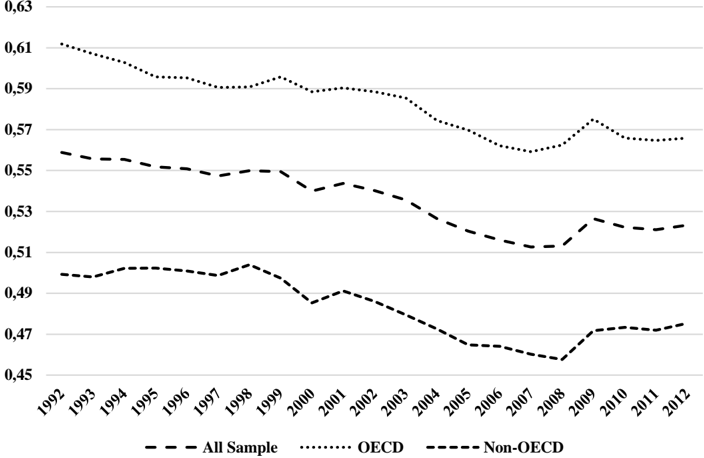
“For instance, the share accruing to the labor was shrinking in most OECD and non-OECD countries, as can be seen from Figure 1 for the 1992-2012 period.”
§ Financialization and the Labor Share of Income > 1. Introduction
What the sources say
- Not matchedcites Penn World Tables 9.0
This doesn’t read as a citation we can look up.
plain- Asserted: passes — The authors put it forward as true.
- Checkable: passes — It can be checked against evidence.
- Load-bearing: passes — The paper’s conclusions depend on it.
- Based: passes — The paper gives a reason why it holds.
- Not matched
A result the paper reports from its own data — it cites no other source for it, so there is none to check. The quote shows it is in the paper.
In the paper
“the estimations results showed that there is a U-curve relationship between GDP per capita and income distribution”
§ Financialization and the Labor Share of Income > 7. Conclusion
hedgedstates an association- Asserted: passes — The authors put it forward as true.
- Checkable: passes — It can be checked against evidence.
- Load-bearing: passes — The paper’s conclusions depend on it.
- Based: passes — The paper gives a reason why it holds.
A result the paper states — it cites no source for it, so there is none to check. The quote shows it is in the paper.
In the paper
“Although distributional outcomes are compatible with the hypothesized relationship, the coefficient of labor force participation rate is insignificant in many specifications.”
- Also stated in: § 6. Estimation Results · plain
“the variable of labor force participation rate is insignificant.”
§ Financialization and the Labor Share of Income > 6. Estimation Results
plain- Asserted: passes — The authors put it forward as true.
- Checkable: passes — It can be checked against evidence.
- Load-bearing: unclear — It is unclear whether the paper’s conclusions depend on it.
- Based: passes — The paper gives a reason why it holds.
- Also stated in: § 6. Estimation Results · plain
A result the paper reports from its own data — it cites no other source for it, so there is none to check. The quote shows it is in the paper.
In the paper
“Third, the next variable of globalization -FDI outflows as a share of GDPis not significant under the baseline estimations.”
§ Financialization and the Labor Share of Income > 6. Estimation Results
plain- Asserted: passes — The authors put it forward as true.
- Checkable: passes — It can be checked against evidence.
- Load-bearing: unclear — It is unclear whether the paper’s conclusions depend on it.
- Based: passes — The paper gives a reason why it holds.
48 more claims
Create a free account to see all 130 claims and to verify the 2 references still open.
- Probably not a substantial claim. 45
- It may state two separate claims as one. 51
Citations
Cites
(2010) · Intellectum (Universidad de La Sabana) · doi:10.1111/j.1467- · Cited by 16,131
Testing for unit roots in heterogeneous panels
Im, K. S., Pesaran, M. H., & Shin, Y. (2003) · Journal of Econometrics · doi:10.1016/s0304-4076(03)00092-7 · Cited by 15,435
Unit root tests in panel data: asymptotic and finite-sample properties
Levin, A., Lin, C.-F., & James Chu, C.-S. (2002) · Journal of Econometrics · doi:10.1016/s0304-4076(01)00098-7 · Cited by 12,849
Great transformation: The political and economic origins of our time
Polanyi, K., Stiglitz, J. E., & Block, F. (1944) · Cited by 10,600
Economic Growth and Income Inequality
Kuznets, S. (2019) · The Gap between Rich and Poor · doi:10.4324/9780429311208-4 · Cited by 8,064 · cited 1×
“In that sense, the empirical part also considers the relationship between economic development and income distribution in the presence of Kuznets (1955) hypothesis and the control of other variables.”
BackgroundConsistent Covariance Matrix Estimation with Spatially Dependent Panel Data
Driscoll, J. C., & Kraay, A. C. (1998) · Review of Economics and Statistics · doi:10.1162/003465398557825 · Cited by 6,865 · cited 1×
“Deviating from the previous empirical studies such as Dünhaupt (2017), I use Driscoll and Kraay‘s (1998) method to examine the linear relationship between financialization and the labor share of national”
MethodWhat To Do (and Not to Do) with Time-Series Cross-Section Data
Beck, N., & Katz, J. N. (1995) · American Political Science Review · doi:10.2307/2082979 · Cited by 6,840 · cited 3×
“Beck and Katz (1995) range three kinds of problems that the errors might have as follows: (i) panel heteroscedasticity; (ii) contemporaneous correlations; and (iii) the serial correlation. In that case, the use of Driscoll-Kraay method provides robust theoretical means to adjust for these diagnostic issues through the…”
BackgroundMethodPolanyi, K. (2002) · Readings in Economic Sociology · doi:10.1002/9780470755679.ch4 · Cited by 6,208
The Next Generation of the Penn World Table
Feenstra, R. C., Inklaar, R., & Timmer, M. P. (2015) · American Economic Review · doi:10.1257/aer.20130954 · Cited by 4,799
Skills, Tasks and Technologies: Implications for Employment and Earnings
Acemoglu, D., & Autor, D. (2011) · Handbook of Labor Economics · doi:10.1016/s0169-7218(11)02410-5 · Cited by 3,799
Does globalization affect growth? Evidence from a new index of globalization
Dreher, A. (2006) · Applied Economics · doi:10.1080/00036840500392078 · Cited by 3,178 · cited 3×
“Rightfully, Norris (2000: 155; quoted in Dreher, 2006: 1092) intends to understand the globalization as “…a process that erodes national boundaries, integrates national economies, cultures, technologies, and governance, and produces complex relations of mutual interdependence”.”
InfluentialManias, Panics, and Crashes: A History of Financial Crises
Romansco, A. U., & Kindleberger, C. P. (1979) · The American Historical Review · doi:10.2307/1855147 · Cited by 2,838
Skills, Tasks and Technologies: Implications for Employment and Earnings
Acemoglu, D., & Autor, D. (2010) · doi:10.3386/w16082 · Cited by 2,180 · cited 1×
“Therefore, the income distribution becomes dependent on the changes in the skill composition of workers and skill-biased nature of technological progress (see, for instance, Berman et al., 1994; Autor et al., 1998; Piva and Vivarelli, 2004; Acemoglu and Autor, 2011).”
BackgroundFinancialization and the World Economy
(2005) · Edward Elgar Publishing eBooks · doi:10.4337/9781781008263 · Cited by 2,095
Gollin, D. (2002) · Journal of Political Economy · doi:10.1086/338747 · Cited by 1,977
Maximizing shareholder value: a new ideology for corporate governance
Lazonick, W., & O'Sullivan, M. (2000) · Economy and Society · doi:10.1080/030851400360541 · Cited by 1,970 · cited 1×
“For instance, Lazonick and O’Sullivan (2000) note that the behaviors of firms in the post-1980s have changed towards more oriented to the maximization of shareholder value and have entrenched as a principle of corporate governance.”
BackgroundBerman, E., Bound, J., & Griliches, Z. (1994) · The Quarterly Journal of Economics · doi:10.2307/2118467 · Cited by 1,870 · cited 1×
“Therefore, the income distribution becomes dependent on the changes in the skill composition of workers and skill-biased nature of technological progress (see, for instance, Berman et al., 1994; Autor et al., 1998; Piva and Vivarelli, 2004; Acemoglu and Autor, 2011).”
Computing inequality: have computers changed the labor market?
Autor, D. H., Katz, L. F., & Krueger, A. B. (1998) · The Quarterly Journal of Economics · doi:10.1162/003355398555874 · Cited by 1,830
Globalization, Outsourcing, and Wage Inequality
Feenstra, R., & Hanson, G. (1996) · National Bureau of Economic Research · doi:10.3386/w5424 · Cited by 1,618 · cited 2×
“…of international trade theory, the classical dichotomy of these arguments are critically assessed by including multiple skill-related categories of workers (Wood, 1994) in North-South distinction, countrygroups analysis (Davis, 1996), and categorization of traded goods (Feenstra and Hanson, 1996).”
BackgroundForeign direct investment and relative wages: Evidence from Mexico's maquiladoras
Feenstra, R. C., & Hanson, G. H. (1997) · Journal of International Economics · doi:10.1016/s0022-1996(96)01475-4 · Cited by 1,607 · cited 1×
“…flows to range the causes of production shift of the least skill-intensive Northern products to the Southern countries in response to the model of Feenstra and Hanson (1996, 1997) which is based on a continuum of goods with differing proportions of skill intensity, and find that technological…”
BackgroundComputing Inequality: Have Computers Changed the Labor Market?
Autor, D., Katz, L., & Krueger, A. (1997) · National Bureau of Economic Research · doi:10.3386/w5956 · Cited by 1,586
Trade, Quality Upgrading, and Wage Inequality in the Mexican Manufacturing Sector *
Verhoogen, E. A. (2008) · Quarterly Journal of Economics · doi:10.1162/qjec.2008.123.2.489 · Cited by 1,528
1 Distributional Effects of Globalization in Developing Countries*
Koujianou, P., & Pavcnik, G. N. (2006) · Cited by 1,418
Maximizing Shareholder Value: A New Ideology for Corporate Governance
Lazonick, W., & O’Sullivan, M. (2002) · Corporate Governance and Sustainable Prosperity · doi:10.1057/9780230523739_2 · Cited by 1,237
Financialization of daily life
(2003) · Choice Reviews Online · doi:10.5860/choice.40-5307 · Cited by 1,203 · cited 1×
“…2010); Foster and McChesney (2009); Glyn (2006); Hilferding ([1981] 2006); Kindleberger and Aliber (2005); Krippner (2011); Lapavitsas (2010); Martin (2002); Polanyi (2001); Stockhammer (2004, 2009, 2010). bution, there may be other channels in which the distribution of total income is…”
BackgroundParks, R. W. (1967) · Journal of the American Statistical Association · doi:10.1080/01621459.1967.10482923 · Cited by 1,188 · cited 1×
“Hence, Driscoll-Kraay method is produced as an alternative to Panel-Corrected Standard Errors (PCSE) method developed by Beck and Katz (1995), Parks (1967), and Kmenta (1986), which are produced weak robust covariance matrix estimators when T is small.”
MethodIs a finance-led growth regime a viable alternative to Fordism? A preliminary analysis
Boyer, R. (2000) · Economy and Society · doi:10.1080/030851400360587 · Cited by 1,159 · cited 1×
“3 To get a comprehensive outlook for financialization please see Baran (1957); Boyer (2000); Crotty (2005); Dumenil ve Lévy (2004, 2011); Fine (2010); Foster (2006, 2010); Foster and McChesney (2009); Glyn (2006); Hilferding ([1981] 2006); Kindleberger and Aliber (2005); Krippner (2011); Lapavitsas…”
BackgroundFinancialisation and the slowdown of accumulation
Stockhammer, E. (2004) · Cambridge Journal of Economics · doi:10.1093/cje/beh032 · Cited by 1,103 · cited 1×
“…(2009); Glyn (2006); Hilferding ([1981] 2006); Kindleberger and Aliber (2005); Krippner (2011); Lapavitsas (2010); Martin (2002); Polanyi (2001); Stockhammer (2004, 2009, 2010). bution, there may be other channels in which the distribution of total income is negatively affected through the…”
BackgroundNorth-South trade, employment and inequality: changing fortunes in a skill-driven world
(1994) · Choice Reviews Online · doi:10.5860/choice.32-2262 · Cited by 1,053
Alcala, F., & Ciccone, A. (2004) · The Quarterly Journal of Economics · doi:10.1162/0033553041382139 · Cited by 949
Panel Models in Sociological Research: Theory into Practice
Halaby, C. N. (2004) · Annual Review of Sociology · doi:10.1146/annurev.soc.30.012703.110629 · Cited by 946 · cited 1×
“These estimators exploit the within-country variation as a means of eliminating unit heterogeneity and therefore provide unbiased and consistent estimates of the parameters in cases where unit-effects are randomly correlated with estimated independent variables (Halaby, 2004; Kristal, 2010).”
BackgroundKindleberger, C. P., & Aliber, R. Z. (2005) · doi:10.1057/9780230628045 · Cited by 821
Wood, A. (1997) · The World Bank Economic Review · doi:10.1093/wber/11.1.33 · Cited by 808 · cited 1×
“In addition, technology upgrading in response to international openness might exert a significant impact on wage dispersion by leading to develop new technologies, subject to new ideas and innovations, which are more biased towards skilled labor (Wood, 1997).”
BackgroundGlobalization and the Great U-Turn: Income Inequality Trends in 16 OECD Countries
Alderson, A. S., & Nielsen, F. (2002) · American Journal of Sociology · doi:10.1086/341329 · Cited by 759
Capital resurgent: roots of the neoliberal revolution
(2005) · Choice Reviews Online · doi:10.5860/choice.42-2917 · Cited by 757
Lavoie, M. (2014) · Edward Elgar Publishing eBooks · doi:10.4337/9781783475827 · Cited by 700 · cited 1×
“6 For more information about the effects of overhead costs, including the interest and dividend payments, in an empirical framework, please see Lavoie, 1993, 2014; Hein, 2006, 2007, 2008, 2010a, 2010b; Hein and van Treeck, 2010a, 2010b. 7 In the empirical part, some of these factors (e.g.,…”
BackgroundDuménil, G., & Lévy, D. (2010) · doi:10.1017/9781108381413.006 · Cited by 693
North-South Trade, Employment and Inequality: Changing Fortunes in a Skill-Driven World
Wood, A. (1995) · doi:10.1093/0198290152.001.0001 · Cited by 679
Acemoglu, D. (2003) · Review of Economic Studies · doi:10.1111/1467-937x.00242 · Cited by 666
Capitalizing on Crisis: The Political Origins of the Rise of Finance
(2017) · The SHAFR Guide Online · doi:10.1163/2468-1733_shafr_sim280020435 · Cited by 638
Explaining Movements in the Labor Share
Bentolila, S., & Saint-Paul, G. (2003) · Contributions in Macroeconomics · doi:10.2202/1534-6005.1103 · Cited by 582 · cited 1×
“In this regard, this is particularly occurred due to a decrease in the bargaining power of labor (Bentolila and Saint-Paul, 2003; Harrison, 2005; Jayadev, 2007).”
BackgroundDistributional Effects of Globalization in Developing Countries
Goldberg, P. K., & Pavcnik, N. (2007) · Journal of Economic Literature · doi:10.1257/jel.45.1.39 · Cited by 539
Capitalizing on crisis: the political origins of the rise of finance
(2011) · Choice Reviews Online · doi:10.5860/choice.49-0403 · Cited by 511
Outsourcing Economics: Outsourcing Economics
Milberg, W., & Winkler, D. (2013) · doi:10.1017/cbo9781139208772.009 · Cited by 499
Detecting Learning by Exporting
Loecker, J. D. (2013) · American Economic Journal: Microeconomics · doi:10.1257/mic.5.3.1 · Cited by 489 · cited 1×
“…country-based and firm-based studies which of those examine the arguments whether there is a positive effect of firms’ export activities and opening export markets on productivity level and efficiency gains pursuant to exportby-learning hypothesis (Crespi et al., 2008; Ito, 2012; De Loecker, 2013).”
BackgroundBerman, E., Bound, J., & Griliches, Z. (1993) · National Bureau of Economic Research · doi:10.3386/w4255 · Cited by 466
Outsourcing Economics: Global Value Chains in Capitalist Development
Milberg, W., & Winkler, D. (2013) · Cambridge University Press eBooks · doi:10.1017/cbo9781139208772 · Cited by 445
Duménil, G., Duménil, G., & Lévy, D. (2013) · Harvard University Press eBooks · doi:10.4159/harvard.9780674059306 · Cited by 406
Capitalizing on Crisis: The Political Origins of the Rise of Finance
KRIPPNER, G. R. (2012) · Harvard University Press eBooks · doi:10.2307/j.ctvjk2x23 · Cited by 396
Trade and Income Inequality in Developing Countries
Meschi, E., & Vivarelli, M. (2009) · World Development · doi:10.1016/j.worlddev.2008.06.002 · Cited by 394
Financialization: What it is and Why it Matters
Palley, T. I. (2007) · SSRN Electronic Journal · doi:10.2139/ssrn.1077923 · Cited by 384
Trade and inequality in developing countries: a general equilibrium analysis
Zhu, S. C., & Trefler, D. (2005) · Journal of International Economics · doi:10.1016/j.jinteco.2003.11.005 · Cited by 372 · cited 1×
“In particular, Zhu and Trefler (2005) focus on technological catch-up in case of increasing trade flows to range the causes of production shift of the least skill-intensive Northern products to the Southern countries in response to the model of Feenstra and Hanson (1996, 1997) which is based on a…”
BackgroundFinance Capital. A Study of the Latest Phase of Capitalist Development.
Brewer, A., Hilferding, R., Bottomore, T., Watnick, M., & Gordon, S. (1983) · Economica · doi:10.2307/2554129 · Cited by 365
Outsourcing economics global value chains in capitalist development
Milberg, W. S., & Winkler, D. E. (2013) · Cited by 357
Post-Keynesian economics: new foundations
(2015) · Choice Reviews Online · doi:10.5860/choice.187297 · Cited by 352
A Theory of Defensive Skill-Biased Innovation and Globalization
Thoenig, M., & Verdier, T. (2003) · American Economic Review · doi:10.1257/000282803322157052 · Cited by 340
The Macroeconomics of Finance-Dominated Capitalism – and its Crisis
Hein, E. (2012) · doi:10.4337/9781781009161 · Cited by 317 · cited 2×
“…explains the theoretical specifications between financialization and the labor share of national income, which are based on the Kaleckian model of growth and distribution, acquiring from the work of Hein (2012), and categorizes the major reasons why the income is unequally distributed for workers.”
BackgroundKrueger, A. B. (1999) · American Economic Review · doi:10.1257/aer.89.2.45 · Cited by 312 · cited 1×
“…Although there are different types of measurement techniques in the empirical literature 11 , the major drawback of this traditional method depends on the fact that the unadjusted use of employees’ compensation may bias over time by excluding the self-employment issue (Krueger, 1999; Gollin, 2002).”
From shareholder value to present-day capitalism
Williams, K. (2000) · Economy and Society · doi:10.1080/030851400360532 · Cited by 311 · cited 1×
“9 For more information and the critiques about the term of “shareholder value” please see Williams (2000).”
BackgroundForeign Direct Investment, inequality, and growth
Basu, P., & Guariglia, A. (2007) · Journal of Macroeconomics · doi:10.1016/j.jmacro.2006.02.004 · Cited by 305
Capital Account Liberalization, Institutions and Financial Development: Cross Country Evidence
Chinn, M., & Ito, H. (2002) · National Bureau of Economic Research · doi:10.3386/w8967 · Cited by 300
Financialization: What It Is and Why It Matters
Palley, T. I. (2013) · Financialization · doi:10.1057/9781137265821_2 · Cited by 299
Capital account openness and the labour share of income
Jayadev, A. (2007) · Cambridge Journal of Economics · doi:10.1093/cje/bel037 · Cited by 293 · cited 2×
“In this regard, this is particularly occurred due to a decrease in the bargaining power of labor (Bentolila and Saint-Paul, 2003; Harrison, 2005; Jayadev, 2007).”
BackgroundCapitalism Unleashed: Finance, Globalization, and Welfare
Glyn, A. (2006) · Cited by 285
The financialization of capitalism: ‘Profiting without producing’
Lapavitsas, C. (2013) · City · doi:10.1080/13604813.2013.853865 · Cited by 258 · cited 1×
“Alternatively, from the point of Marxian perspective, it can be defined as follows (Lapavitsas, 2013: 802): “Financialization represents a transformation of mature capitalism resting on the altered conduct of non-financial enterprises, banks, and households.””
BackgroundForeign direct investment and income inequality: Further evidence
Pan-Long, T. (1995) · World Development · doi:10.1016/0305-750x(95)00136-z · Cited by 245 · cited 1×
“…of internationalization, the link between FDI (including both inflows and outflows) and income inequality has been investigated by numerous studies (Tsai, 1995; Basu and Guariglia, 2007) and has been extended in the context of increasing wage dispersion between skilled and unskilled workers and of…”
BackgroundIntroduction: Financialization and the World Economy
Epstein, G. A. (2005) · Financialization and the World Economy · doi:10.4337/9781781008263.00009 · Cited by 232
Good Times, Bad Times: Postwar Labor’s Share of National Income in Capitalist Democracies
Kristal, T. (2010) · American Sociological Review · doi:10.1177/0003122410382640 · Cited by 228 · cited 3×
“More specifically, Kristal (2010) examines the effects of FDI inflows on labor’s share and finds that there is a negative correlation between each other.”
BackgroundGoldberg, P., & Pavcnik, N. (2004) · National Bureau of Economic Research · doi:10.3386/w10593 · Cited by 220
Sawyer, M. (2013) · International Journal of Political Economy · doi:10.2753/ijp0891-1916420401 · Cited by 217 · cited 1×
“However, the literature on financialization has not been produced a common definition yet but includes some basic common points (Sawyer, 2013).”
BackgroundOpenness and inequality in developing countries: A review of theory and recent evidence
Anderson, E. (2005) · World Development · doi:10.1016/j.worlddev.2005.04.003 · Cited by 209 · cited 1×
“Anderson (2005), for example, ranges five different channels through which a higher trade openness could lead to a change in income distribution: (i) relative factor returns; (ii) allocational/distributional composition of real incomes among groups in society; (iii) regional distribution of…”
BackgroundFinance-dominated capitalism and re-distribution of income: a Kaleckian perspective
Hein, E. (2015) · Cambridge Journal of Economics · doi:10.1093/cje/bet038 · Cited by 206 · cited 3×
“In addition to these characteristics of financialization, Hein (2015) also notes on the characteristics of neoliberalism by focusing on two factors as the deregulation of the labor markets and the downsizing of government, which are all crucial for an understanding of the functional income…”
PRODUCTIVITY AND THE DENSITY OF HUMAN CAPITAL*
Abel, J. R., Dey, I., & Gabe, T. M. (2012) · Journal of Regional Science · doi:10.1111/j.1467-9787.2011.00742.x · Cited by 201 · cited 3×
“20 For more information on technical details of the relationship between human capital and productivity growth see Abel et al. (2012); Schwerdt and Turunen (2007); Söderbom and Teal (2004).”
BackgroundProductivity, exporting, and the learning‐by‐exporting hypothesis: direct evidence from UK firms
Crespi, G., Criscuolo, C., & Haskel, J. E. (2008) · Canadian Journal of Economics/Revue canadienne d économique · doi:10.1111/j.1540-5982.2008.00479.x · Cited by 197 · cited 3×
“…country-based and firm-based studies which of those examine the arguments whether there is a positive effect of firms’ export activities and opening export markets on productivity level and efficiency gains pursuant to exportby-learning hypothesis (Crespi et al., 2008; Ito, 2012; De Loecker, 2013).”
BackgroundTrade Liberalization and Income Distribution
Davis, D. (1996) · National Bureau of Economic Research · doi:10.3386/w5693 · Cited by 197 · cited 1×
“…of international trade theory, the classical dichotomy of these arguments are critically assessed by including multiple skill-related categories of workers (Wood, 1994) in North-South distinction, countrygroups analysis (Davis, 1996), and categorization of traded goods (Feenstra and Hanson, 1996).”
BackgroundFinancialization and the global economyPreprint
Stockhammer, E. (2010) · RePEc: Research Papers in Economics · Cited by 192
Capitalism Unleashed: Finance, Globalization, and Welfare
Glyn, A. (2007) · doi:10.1093/acprof:oso/9780199226795.001.0001 · Cited by 188 · cited 1×
“…please see Baran (1957); Boyer (2000); Crotty (2005); Dumenil ve Lévy (2004, 2011); Fine (2010); Foster (2006, 2010); Foster and McChesney (2009); Glyn (2006); Hilferding ([1981] 2006); Kindleberger and Aliber (2005); Krippner (2011); Lapavitsas (2010); Martin (2002); Polanyi (2001); Stockhammer…”
Does foreign direct investment affect domestic income inequality?
Choi, C. (2006) · Applied Economics Letters · doi:10.1080/13504850500400637 · Cited by 181 · cited 1×
“…and outflows) and income inequality has been investigated by numerous studies (Tsai, 1995; Basu and Guariglia, 2007) and has been extended in the context of increasing wage dispersion between skilled and unskilled workers and of labor market segmentation (Gopinath and Chen, 2003; Choi, 2006).”
BackgroundCapital account liberalization, financial development and industry growth: A synthetic view
Eichengreen, B. J., Gullapalli, R., & Panizza, U. G. (2011) · Journal of International Money and Finance · doi:10.1016/j.jimonfin.2011.06.007 · Cited by 172 · cited 1×
“13 For the studies that focus on the joint effect of capital account openness and finance-based measures please see Bumann and Lensink (2016), Eichengreen et al. (2011), Chinn and Ito (2002), Reinhardt et al. (2013), Haan et al. (2018). on the extent of the tradable and non-tradable sectors.”
BackgroundInequality, stock market participation, and the equity premium
Favilukis, J. (2013) · Journal of Financial Economics · doi:10.1016/j.jfineco.2012.10.008 · Cited by 156 · cited 2×
“Favilukis (2013) notes that labor income inequality has been on the rise while returns on equity have been high, which opens debate for the disproportion of the distribution of gains to the wealthy and the concentration of total assets.”
Capital account liberalization and income inequality
Bumann, S., & Lensink, R. (2015) · Journal of International Money and Finance · doi:10.1016/j.jimonfin.2015.10.004 · Cited by 153 · cited 1×
“13 For the studies that focus on the joint effect of capital account openness and finance-based measures please see Bumann and Lensink (2016), Eichengreen et al. (2011), Chinn and Ito (2002), Reinhardt et al. (2013), Haan et al. (2018). on the extent of the tradable and non-tradable sectors.”
BackgroundWu, J.-Y., & Hsu, C.-C. (2012) · Economic Modelling · doi:10.1016/j.econmod.2012.06.013 · Cited by 144 · cited 1×
“In addition, Wu and Hsu (2012) find a similar result that an increase in FDI leads to an unequal distribution of income and support the results of Basu and Guariglia (2007).”
ResultINTEREST RATE, DEBT, DISTRIBUTION AND CAPITAL ACCUMULATION IN A POST‐KALECKIAN MODEL
Hein, E. (2007) · Metroeconomica · doi:10.1111/j.1467-999x.2007.00270.x · Cited by 143 · cited 1×
“…about the effects of overhead costs, including the interest and dividend payments, in an empirical framework, please see Lavoie, 1993, 2014; Hein, 2006, 2007, 2008, 2010a, 2010b; Hein and van Treeck, 2010a, 2010b. 7 In the empirical part, some of these factors (e.g., liberalization and…”
BackgroundDeterminants of labour’s income share in the era of financialisation
Dünhaupt, P. (2017) · Cambridge Journal of Economics · doi:10.1093/cje/bew023 · Cited by 133 · cited 2×
“Deviating from the previous empirical studies such as Dünhaupt (2017), I use Driscoll and Kraay‘s (1998) method to examine the linear relationship between financialization and the labor share of national 14 Many of these countries are classified as the advanced economies in terms of their aggregate…”
BackgroundMethod‘Financialisation’ in Post-Keynesian Models of Distribution and Growth: A Systematic Review
Hein, E., & van Treeck, T. (2010) · Edward Elgar Publishing eBooks · doi:10.4337/9781849805582.00022 · Cited by 129 · cited 2×
“For instance, Herzer and Nunnenkamp’s (2013) findings point out that the long-run effects of FDI on income inequality, on average, are negative.”
BackgroundResultInternational capital flows and development: Financial openness matters
Reinhardt, D. B. S., RICCI, L. A., & Tressel, T. (2013) · Journal of International Economics · doi:10.1016/j.jinteco.2013.07.006 · Cited by 110
Trade, Inequality, and Poverty: What Do We Know?
Goldberg, P. K., & Pavcnik, N. (2004) · Brookings Trade Forum · doi:10.1353/btf.2005.0006 · Cited by 106 · cited 1×
“In this regard, as Goldberg and Pavcnik (2004) note that the form of exports should be evaluated in case of quality whether it reflects “firm productivity” or “product quality”.”
BackgroundHein, E. (2009) · Metroeconomica · doi:10.1111/j.1467-999x.2009.04072.x · Cited by 104 · cited 1×
“…about the effects of overhead costs, including the interest and dividend payments, in an empirical framework, please see Lavoie, 1993, 2014; Hein, 2006, 2007, 2008, 2010a, 2010b; Hein and van Treeck, 2010a, 2010b. 7 In the empirical part, some of these factors (e.g., liberalization and…”
BackgroundThe Labor Share of Income Around the World: Evidence from a Panel Dataset
Guerriero, M. (2019) · ADB institute series on development economics · doi:10.1007/978-981-13-7803-4_3 · Cited by 102
Foreign direct investment and wages: a cross-country analysis
Gopinath, M., & Chen, W. (2003) · Journal of International Trade & Economic Development · doi:10.1080/0963819032000132067 · Cited by 101 · cited 1×
“…and outflows) and income inequality has been investigated by numerous studies (Tsai, 1995; Basu and Guariglia, 2007) and has been extended in the context of increasing wage dispersion between skilled and unskilled workers and of labor market segmentation (Gopinath and Chen, 2003; Choi, 2006).”
Background(2005) · Medical Entomology and Zoology · Cited by 100
The Financialization of Accumulation
Foster, J. B. (2010) · Monthly Review · doi:10.14452/mr-062-05-2010-09_1 · Cited by 95 · cited 1×
“…To get a comprehensive outlook for financialization please see Baran (1957); Boyer (2000); Crotty (2005); Dumenil ve Lévy (2004, 2011); Fine (2010); Foster (2006, 2010); Foster and McChesney (2009); Glyn (2006); Hilferding ([1981] 2006); Kindleberger and Aliber (2005); Krippner (2011); Lapavitsas…”
BackgroundHein, E., & Van Treeck, T. (2010) · Review of Political Economy · doi:10.1080/09538251003665628 · Cited by 91
Interest, Debt and Capital Accumulation—A Kaleckian Approach
Hein, E. (2006) · International Review of Applied Economics · doi:10.1080/02692170600736128 · Cited by 80 · cited 4×
“…about the effects of overhead costs, including the interest and dividend payments, in an empirical framework, please see Lavoie, 1993, 2014; Hein, 2006, 2007, 2008, 2010a, 2010b; Hein and van Treeck, 2010a, 2010b. 7 In the empirical part, some of these factors (e.g., liberalization and…”
BackgroundInfluentialFoster, J. B. (2006) · Monthly Review · doi:10.14452/mr-058-07-2006-11_1 · Cited by 77
Inward and outward FDI and income inequality: evidence from Europe
Herzer, D., & Nunnenkamp, P. (2013) · Review of World Economics · doi:10.1007/s10290-013-0148-3 · Cited by 76
Income inequality: the aftermath of stock market liberalization in emerging markets
Das, M., & Mohapatra, S. (2003) · Journal of Empirical Finance · doi:10.1016/s0927-5398(02)00025-7 · Cited by 76 · cited 1×
“Das and Mohapatra (2003) examine the effects of stock market development for specific income groups subject to the equity-market liberalization and find that the gains from stock market liberalization are much higher for upper quintile income groups at the expense of middle quintile income groups.”
BackgroundTechnological change and employment: some micro evidence from Italy
Piva, M., & Vivarelli, M. (2004) · Applied Economics Letters · doi:10.1080/1350485042000228222 · Cited by 75 · cited 1×
“Therefore, the income distribution becomes dependent on the changes in the skill composition of workers and skill-biased nature of technological progress (see, for instance, Berman et al., 1994; Autor et al., 1998; Piva and Vivarelli, 2004; Acemoglu and Autor, 2011).”
BackgroundRobbins, D. J. (2003) · RePEc: Research Papers in Economics · Cited by 70
(2009) · RePEc: Research Papers in Economics · Cited by 67
A modern reincarnation of Mundell-Fleming's trilemma
Aizenman, J. (2018) · Economic Modelling · doi:10.1016/j.econmod.2018.03.008 · Cited by 65 · cited 2×
“13 The financial openness index is taken from Aizenman (2018), which is a de-jure measure of financial liberalization in which the data has two distinctive features: (i) covering a large time period of 1970- 2015 for 182 countries; and (ii) comparable with other measures of cross-border financial…”
BackgroundMethodde Haan, J., Pleninger, R., & Sturm, J. (2017) · Applied Economics Letters · doi:10.1080/13504851.2017.1319554 · Cited by 64 · cited 1×
“13 For the studies that focus on the joint effect of capital account openness and finance-based measures please see Bumann and Lensink (2016), Eichengreen et al. (2011), Chinn and Ito (2002), Reinhardt et al. (2013), Haan et al. (2018). on the extent of the tradable and non-tradable sectors.”
BackgroundCrotty, J. R. (2005) · Edward Elgar Publishing eBooks · doi:10.4337/9781781008263.00013 · Cited by 63
Capital Account Liberalization, Institutions and Financial Development: Cross Country EvidencePreprint
Chinn, M., & Ito, H. (2002) · SSRN Electronic Journal · doi:10.2139/ssrn.315865 · Cited by 63
Money, Distribution Conflict and Capital Accumulation: Contributions to 'Monetary Analysis'
Hein, E. (2007) · Cited by 62
Money, Distribution Conflict and Capital Accumulation
Hein, E. (2008) · doi:10.1057/9780230595606 · Cited by 59
Income inequality, poverty, and the liquidity of stock markets
Blau, B. M. (2018) · Journal of Development Economics · doi:10.1016/j.jdeveco.2017.10.006 · Cited by 49
Openness and Wage Inequality in Developing Countries
Wood, A. (2012) · The World Bank Economic Review · Cited by 45
GROWTH IN EURO AREA LABOR QUALITY
Schwerdt, G., & Turunen, J. (2007) · Review of Income and Wealth · doi:10.1111/j.1475-4991.2007.00252.x · Cited by 42
Monopoly-Finance Capital and the Paradox of Accumulation
Foster, J. B., & McChesney, R. W. (2010) · Palgrave Macmillan US eBooks · doi:10.1057/9780230117457_13 · Cited by 40
A Keynesian Perspective on ‘Financialisation’
Hein, E. (2010) · Palgrave Macmillan UK eBooks · doi:10.1057/9780230285415_4 · Cited by 36 · cited 1×
“…about the effects of overhead costs, including the interest and dividend payments, in an empirical framework, please see Lavoie, 1993, 2014; Hein, 2006, 2007, 2008, 2010a, 2010b; Hein and van Treeck, 2010a, 2010b. 7 In the empirical part, some of these factors (e.g., liberalization and…”
BackgroundA Post-Classical View of Money, Interest, Growth and Distribution
Lavoie, M. (1993) · Edward Elgar Publishing eBooks · doi:10.4337/9781035305858.00009 · Cited by 30
Openness and Human Capital as Sources of Productivity Growth: An Empirical InvestigationPreprint
Söderbom, M., & Teal, F. (2003) · RePEc: Research Papers in Economics · Cited by 28
Full Report ‐ World of Work Report 2011: Making markets work for jobs
International Institute for Labour Studies (2011) · World of Work Report · doi:10.1002/wow3.30 · Cited by 26
3 Financialization and capitalist accumulation: a structural account of the crisis of 2007–09
Boyer, R. (2013) · Routledge eBooks · doi:10.4324/9780203072950-11 · Cited by 24
Monopoly-Finance Capital and the Paradox of Accumulation
Foster, J. B., & McChesney, R. W. (2009) · Monthly Review · doi:10.14452/mr-061-05-2009-09_1 · Cited by 20
Schiff, M., & Wang, Y. (2004) · World Bank, Washington, DC eBooks · doi:10.1596/1813-9450-3190 · Cited by 16
A Modern Reincarnation of Mundell-Fleming's TrilemmaPreprint
Aizenman, J. (2018) · SSRN Electronic Journal · doi:10.2139/ssrn.3135405 · Cited by 12
Research works printed but not linked: 4
- 9. BARAN, P. (1957). The Political Economy of Growth. London and New York: Month- ly Review Press.
- 37. FINE, B. (2010). Neoliberalism as financialisation, Alfredo Saad-Filho and Galip L. Yalman (eds.), Economic Transitions to Neoliberalism in Middle-income Countries: Policy dilemmas, economic crises, forms of resistance, London and New York: Routledge, 11-23.
- 82. NORRIS, P. (2000). Global governance and cosmopolitan citizens, In J. S. NYE and J. D. DONAHUE (eds.), Governance in a Globalizing World, Washington DC: Brookings Institution Press, 155-177.
- 89. SAWHNEY, B. L. and DIPETRO, W. R. (2006). Stock Market Wealth and Income Inequality, The Journal of Business and Economic Studies, 12(1), 74-77.
Cited by
Pariboni, R., Meloni, W. P., & Tridico, P. (2020) · Review of Political Economy · doi:10.1080/09538259.2020.1769282 · Cited by 43
Unemployment and Income Distribution: Some Extensions of Shaikh’s Analysis
Meloni, W. P., & Stirati, A. (2020) · Institute for New Economic Thinking Working Paper Series · doi:10.36687/inetwp137 · Cited by 7
“, 2013) and/or to portfolio investments (Jayadev, 2007); and v) the effects of increasing financialization, a phenomenon that can be observed from different perspectives (Stockhammer, 2009; Hein, 2015; Dünhaupt, 2017; Özdemir, 2019; Pariboni and Tridico, 2019b; Pariboni et al., 2020), including the influence of the re…”
Poles Apart? Alternative Welfare Trajectories under Finance-Dominated Capitalism
Antenucci, F., Meloni, W. P., & Tridico, P. (2023) · International Journal of Political Economy · doi:10.1080/08911916.2023.2189864 · Cited by 4
“It is hard to find an all-encompassing definition for that, as pointed out by Sawyer (2014), Palley (2013, 2016) and van der Zwan (2014).”
BackgroundGelişmekte Olan Ülkelerde Gelir Dağılımına Etki Eden Faktörler
ÇELİK, D., & Erkişi, K. (2022) · Erciyes Akademi · doi:10.48070/erciyesakademi.1060779 · Cited by 3
Vieira, R., Azevedo, G., & Oliveira, J. D. S. (2023) · International Journal of Disclosure and Governance · doi:10.1057/s41310-023-00203-6 · Cited by 6
“Such as Dünhaupt (2016) and Kohler et al. (2018), Ozdemir (2019) demonstrates that the phenomenon of globalization and technological advancements has a significant impact on the decline of ages.”
Influential
Metadata
- Authors
- Özdemir, O.
- Affiliations
- İstanbul Gelişim Üniversitesi (TR)
- Corresponding author
- Özdemir, Onur
- ORCID
- Özdemir, Onur
- Venue
- Review of Economic Perspectives
- Publisher
- Walter de Gruyter GmbH
- Published
- 2019-12-01
- Volume
- 19
- Issue
- 4
- Pages
- 265-306
- ISSN
- 1213-2446 (ISSN-L)
- 1804-1663
- OpenAlex
- W2998480753
- Cited by
- 7
- References
- 116
- Citations by year
- 2026: 1 · 2025: 1 · 2023: 2 · 2022: 1 · 2020: 2
- FWCI
- 1.61
- Type
- journal article
- Language
- en
- Open access
- diamond
- doi.org
- Licence
- Locations
- Review of Economic Perspectives (publishedVersion, cc-by-nc-nd)
- DOAJ (DOAJ: Directory of Open Access Journals) (submittedVersion, cc-by-sa)
- Econstor (Econstor) (submittedVersion, cc-by-nc-nd)
- Topics
- Social Sciences › Economics, Econometrics and Finance › General Economics, Econometrics and Finance › Economic Theory and Policy
- Social Sciences › Economics, Econometrics and Finance › Finance › Housing, Finance, and Neoliberalism
- Social Sciences › Sociology and Political Science › Political Economy and Marxism
- Keywords
- financialization, wage share, wage share decline, income inequality, stock market development, bargaining power, globalization, technological change, unemployment rate, labour force participation rate
About these checks
Registry, retraction, Cites and statistics results are computed, not judged, with one exception: a printed reference that no index lists is read once by a model before it counts as a citation error. Claims are extracted by a model and kept only when their quote appears verbatim in the text; each cited source is then checked, with a model’s help, for whether it says what the claim relies on. Those verdicts can be wrong — read the claim’s quote and the cited source before relying on one.
The claim verdicts this report counts are experimental: their accuracy is not yet measured.
A language model drew the claims from the paper on 2026-10-10, under version 3 of the claim definition (model deepseek-v4.1-flash, prompt extract-v3).
A second model labelled each claim on 2026-10-10 (model jev-1.13-20260917, definition revision gold-guideline-v0.2).
Cited sources are checked with a language model’s help (gpt-6-sol).
Statistics and arithmetic are recomputed, not judged.
Confidence bands are shown only for fields calibrated on our annotated test set. None is calibrated yet, so no band is shown.
What counts as a claim ›How we measure confidence ›How we check this ›
Are you an author, or do you see a problem with this page? Request a review
Data sources
Bibliographic data: Semantic Scholar, OpenAlex, Crossref.
Contains information from the Semantic Scholar Academic Graph Datasets, made available under the ODC Attribution License (ODC-BY 1.0).
Semantic Scholar’s data is described in: Kinney, R., et al. (2023). The Semantic Scholar Open Data Platform. arXiv:2301.10140.
