

Student experience using synchronous and asynchronous instruction in mathematics classes
Open accessThe DOI matches its Crossref record; 46 of the 47 references it cites were found in a registry or an index; 10 of the 41 sources its claims cite were checked for support.
Abstract
This paper aims to study the effects that asynchronous and synchronous instructional methods have on student perceptions and attitudes towards online education. We analyze both qualitative and quantitative survey responses from 496 students in three large (greater than 200 enrolled students) first-year calculus classes at the University of Guelph. The survey results show significant differences among the three online instructional formats in students’ attitudes toward asking questions, the similarity of each instructional modality to face-to-face delivery, technology issues encountered, students’ perceived ability to keep up with course content, how collaborative the course felt, and student preferences for mode of delivery. There were no significant differences reported in relation to time-management skills or communication with instructors. Qualitative analysis of student comments also revealed perceived strengths and weaknesses of each mode of instruction. The results are used to make suggestions for improving student experience in online, post-secondary mathematical teaching.
Overview
CoChat Summary
TL;DR
This mixed-methods survey of 496 first-year calculus students at the University of Guelph found significant differences across synchronous and asynchronous online formats in attitudes toward questions, perceived similarity to face-to-face learning, technology issues, ability to keep up, collaboration, and delivery preferences, but not time management or communication challenges. Synchronous lectures were generally rated more favorably for asking questions, collaboration, keeping up, and preference, while also associated with more technology issues.
Key findings
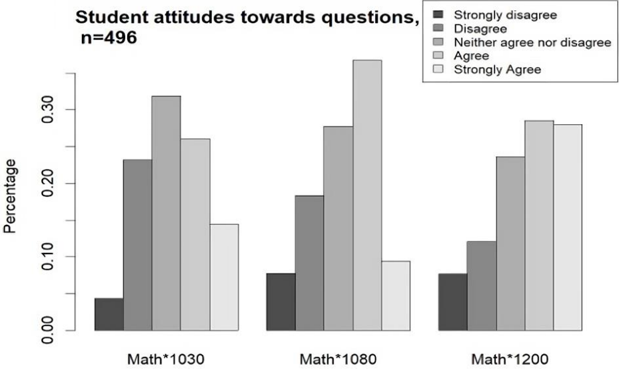
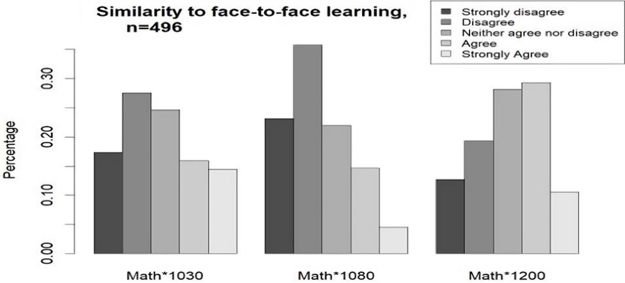
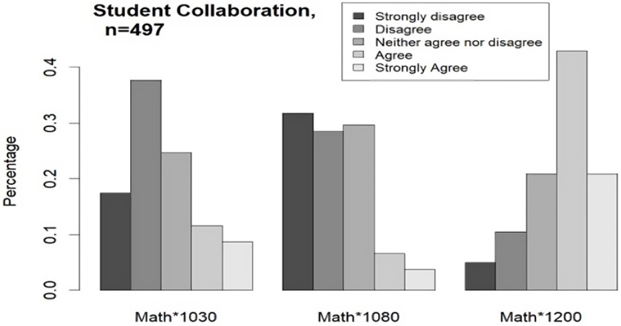
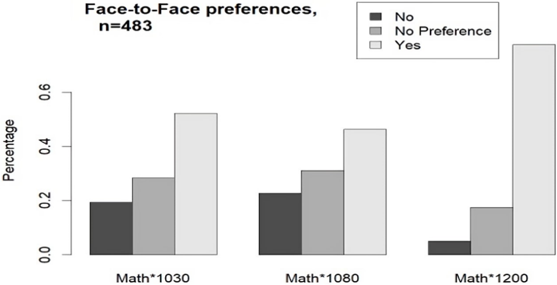
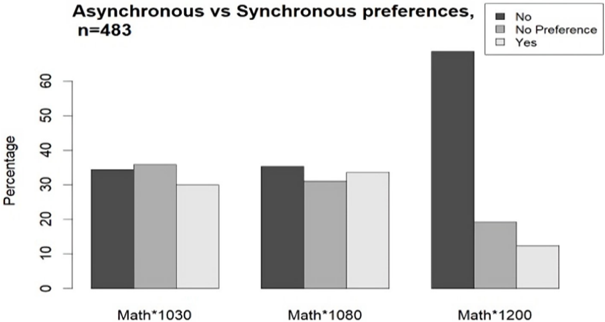
- Significant differences were found among the three course formats for student attitudes toward questions (H=12.268, df=2, p=0.002168), similarity to face-to-face learning (H=30.62, df=2, p=2.243e-07), technology issues (H=31.681, df=2, p=1.32e-07), ability to keep up with course material (H=19.275, df=2, p=6.524e-05), student-student collaboration (H=135.63, df=2, p<2.2e-16), face-to-face preferences (H=45.875, df=2, p=1.092e-10), and asynchronous/synchronous preferences (H=50.215, df=2, p=1.247e-11).
- In the synchronous MATH*1200 group, 29% agreed and 28% strongly agreed they felt comfortable asking questions in real-time, versus MATH*1080DE students who rated lower (18% disagree, 8% strongly disagree); MATH*1200 also rated similarity to face-to-face higher (29% agree, 10% strongly agree) than MATH*1080DE (36% disagree, 23% strongly disagree).
- MATH*1200 students reported more technology issues (15% agree, 6% strongly agree) than MATH*1080DE (40% disagree, 36% strongly disagree) and MATH*1030 (39% disagree, 43% strongly disagree); MATH*1200 also had the strongest sense of collaboration (43% agree, 21% strongly agree), while MATH*1080DE had the least (28% disagree, 32% strongly disagree).
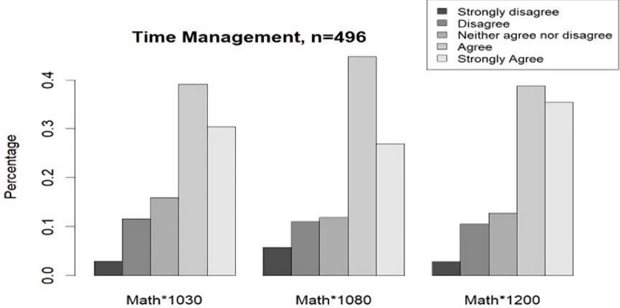
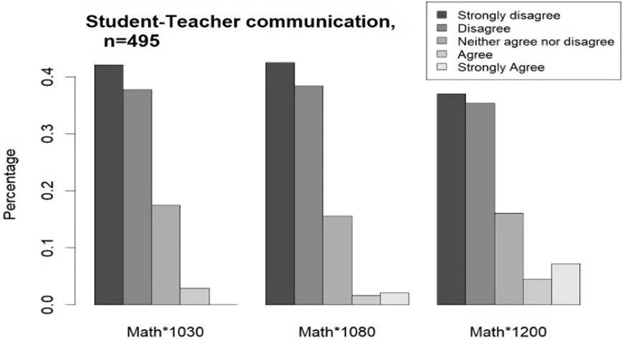
- No significant differences were found for time-management abilities (H=2.7045, df=2, p=0.2587) or student-teacher communication challenges (H=4.2241, df=2, p=0.121); 78% of MATH*1200 students preferred face-to-face classes, and synchronous delivery was generally more preferred across the three courses.
Methods
- Mixed-methods online survey of 496 first-year students in three large (>200 enrolled) first-year calculus classes at the University of Guelph during Fall 2020; the survey included Likert-scale items (mostly 1=strongly disagree to 5=strongly agree; some 1=no to 3=yes), demographic questions, and two open-ended written-response questions.
- The three course designs varied in synchronous/asynchronous components: MATH*1030 was primarily asynchronous with pre-recorded lectures and synchronous office hours; MATH*1080DE used asynchronous links to existing online videos with synchronous office hours and virtual coffee breaks; MATH*1200 used synchronous Zoom lectures with clickers, fill-in-the-blank notes, and a devoted question period.
- Quantitative analysis used Kruskal-Wallis tests with post-hoc Dunn’s tests and Bonferroni correction (p<0.05 considered significant) in R; open-ended responses were grouped by key topics and themes.
Limitations
- Stated: the study focuses on first-year mathematics students in large classes, so implementation is restricted to colleges with similar student bodies and academic majors.
- Stated: the observational design is expected to include many confounding variables, such as instructor attitude across formats and differences in major or student level.
- Evident: the study relies on self-reported survey responses rather than grades or achievement outcomes, and the text reports inconsistent sample denominators (approximately 800 students invited in one place, 2,689 enrolled in another), which limits clarity about response rate and generalizability.
Model-written summary. Check it against the paper before relying on it.
Integrity signals
Registry
Cites
Statistics
Figures


Verification
Claims the paper makes
10 Valid · 0 Not valid · 28 Not checked · 74 Own results and interpretations
Every source the paper cites for this claim was checked and supports it.
In the paper
“However, it must be noted that most of the existing literature regarding online learning has been situated in the context of students who have chosen this medium for themselves (Al-Areibi et al., 2022).”
§ Student experience using synchronous and asynchronous instruction in mathematics classes > LITERATURE REVIEW Online Learning
What the sources say
- Supportedcites Al-Areibi et al., 2022 source
The Abstract states that the literature on online learning has traditionally focused on students who choose it. This directly supports the citing sentence’s paraphrase. (LLM, conf=0.95)
plain- Asserted: passes — The authors put it forward as true.
- Checkable: passes — It can be checked against evidence.
- Load-bearing: unclear — It is unclear whether the paper’s conclusions depend on it.
- Based: passes — The paper gives a reason why it holds.
- Supported
Every source the paper cites for this claim was checked and supports it.
In the paper
“who offer that “students' needs to feel competent as well as socially related cannot be taken for granted, especially for asynchronous settings””
§ Student experience using synchronous and asynchronous instruction in mathematics classes > CONCLUSIONS
What the sources say
- Supportedcites Fabriz et al. (2021) source
The Discussion of Results states the attributed point almost verbatim: the authors say their findings confirm that students’ needs to feel competent and socially related cannot be taken for granted, especially in asynchronous settings. (LLM, conf=0.95)
plain- Asserted: passes — The authors put it forward as true.
- Checkable: passes — It can be checked against evidence.
- Load-bearing: passes — The paper’s conclusions depend on it.
- Based: passes — The paper gives a reason why it holds.
- Supported
Every source the paper cites for this claim was checked and supports it.
In the paper
“This is consistent with the findings of Fabriz et al. (2021), who argue that synchronous instructional settings inherently facilitate the student-student and student-teacher interactions that provide informative feedback to students.”
§ Student experience using synchronous and asynchronous instruction in mathematics classes > CONCLUSIONS
What the sources say
- Supportedcites Fabriz et al. (2021) source
In the Discussion of Results, the paper says synchronous environments allow group work and video discussions that inherently support student–student and student–teacher interaction. It also reports that students in mostly synchronous settings experienced more feedback and discusses the importance of informative feedback. The paper notes that feedback is possible in both synchronous and asynchronous settings; the claim does not say otherwise. (LLM, conf=0.89)
plainstates a cause- Asserted: passes — The authors put it forward as true.
- Checkable: passes — It can be checked against evidence.
- Load-bearing: passes — The paper’s conclusions depend on it.
- Based: passes — The paper gives a reason why it holds.
- Supported
A result the paper reports from its own data — it cites no other source for it, so there is none to check. The quote shows it is in the paper.
In the paper
“Next, the post-hoc Dunn's test results indicated that the synchronously-lectured (MATH*1200) group differed from the group instructed by links to existing online videos (MATH*1080DE) (p=1.23e-07).”
§ Student experience using synchronous and asynchronous instruction in mathematics classes > Similarity to face-to-face learning
hedged- Asserted: passes — The authors put it forward as true.
- Checkable: passes — It can be checked against evidence.
- Load-bearing: passes — The paper’s conclusions depend on it.
- Based: passes — The paper gives a reason why it holds.
A result the paper reports from its own data — it cites no other source for it, so there is none to check. The quote shows it is in the paper.
In the paper
“The results of KW test indicated that there were statistically significant differences among the three learning groups (H=12.268,df=2, p=0.002168).”
§ Student experience using synchronous and asynchronous instruction in mathematics classes > Student attitudes toward questions
hedgedstates an association- Asserted: passes — The authors put it forward as true.
- Checkable: passes — It can be checked against evidence.
- Load-bearing: passes — The paper’s conclusions depend on it.
- Based: passes — The paper gives a reason why it holds.
44 more claims
Create a free account to see all 112 claims and every source verdict.
- Probably not a substantial claim. 38
- It may state two separate claims as one. 34
- The quote only partly states this claim. 3
Self-check
Percentages, sums and reported differences re-computed from the paper’s own numbers.
Each contradiction between two passages listed here was confirmed by an independent check.
Rated major: it would touch a result — a value a result rests on, reported and recomputed p-values on opposite sides of the significance level, two passages that conflict with no sign which is right, or a cited work retracted before this paper was published.
In the paper
§ Student experience using synchronous and asynchronous instruction in mathematics classes > Participants
“The survey was open for students to complete in the last three weeks of the Fall 2020 semester.”
§ Student experience using synchronous and asynchronous instruction in mathematics classes > Funding
“the study was approved by the Research Ethics Board at the University of Guelph on 19 March 2021 (Approval code: REB #: 20-06-035).”
Rated major: it would touch a result — a value a result rests on, reported and recomputed p-values on opposite sides of the significance level, two passages that conflict with no sign which is right, or a cited work retracted before this paper was published.
In the paper
§ Student experience using synchronous and asynchronous instruction in mathematics classes > METHODOLOGY
“we conducted an online survey available to approximately 800 students in three calculus courses Fall 2020”
§ Student experience using synchronous and asynchronous instruction in mathematics classes > Data Analysis
“A total of 496 students participated in an online survey out of 2,689 students enrolled in three large first-year mathematics classes.”
Rated minor: it would not touch a result — a value no result rests on, a p-value that stays on the same side of the significance level, or a conflict that is clerical, resolved elsewhere in the paper, or outside its own findings.
In the paper
§ Student experience using synchronous and asynchronous instruction in mathematics classes > Interactivity
“A total of 497 students answered this question of the survey (182 from MATH*1200, 246 from MATH*1080DE, and 69 from MATH*1030).”
§ Student experience using synchronous and asynchronous instruction in mathematics classes > Participants
“The participants of the study were 496 first-year students in three large mathematics classes at the University of Guelph.”
Citations
Cites
Ryan, R. M., & Deci, E. L. (2000) · American Psychologist · doi:10.1037//0003-066x.55.1.68 · Cited by 54,599 · cited 4×
“Ryan and Deci (2000) offered that student who had access to synchronous settings reported more peer feedback than their counterparts who studied in an asynchronous setting.”
BackgroundResultInfluentialCritical Inquiry in a Text-Based Environment: Computer Conferencing in Higher Education
Garrison, D. R., Anderson, T., & Archer, W. (1999) · The Internet and Higher Education · doi:10.1016/s1096-7516(00)00016-6 · Cited by 6,619 · cited 1×
“Perhaps one of the most influential pieces of literature produced on the topic of online learning is the community of inquiry (COI) theoretical framework (Garrison et al., 2000).”
BackgroundCritical thinking, cognitive presence, and computer conferencing in distance education
Garrison, D. R., Anderson, T., & Archer, W. (2001) · American Journal of Distance Education · doi:10.1080/08923640109527071 · Cited by 3,044 · cited 2×
“Cognitive presence is achieved through discussion, the acquisition of meaningful feedback, and reflection (Garrison et al., 2001).”
BackgroundOnline learning amid the COVID-19 pandemic: Students perspectives
Adnan, M. (2020) · Journal of Pedagogical Sociology and Psychology · doi:10.33902/jpsp.2020261309 · Cited by 1,920 · cited 2×
“This conclusion is supported by the findings of Adnan and Anwar (2020) who contend that internet access problems, a lack of interaction between teachers and students and a lack of technological facilities challenge the efficacy of online learning.”
BackgroundResultThe role of e-learning, the advantages and disadvantages of its adoption in Higher Education.
Arkorful, V., & Abaidoo, N. (2014) · Cited by 1,840
Bernard, R. M., Abrami, P. C., Lou, Y., Borokhovski, E., Wade, A., Wozney, L., Wallet, P. A., Fiset, M., & Huang, B. (2004) · Review of Educational Research · doi:10.3102/00346543074003379 · Cited by 1,761 · cited 1×
“Many studies can be found in the literature extolling the virtues of certain synchronous and asynchronous online course components (Beldarrain, 2006; Bernard et al., 2004; Cavanaugh et al., 2004; Giancola et al., 2009; Jaques & Salmon, 2012), but only a limited number of these studies have compared…”
Adding immersive virtual reality to a science lab simulation causes more presence but less learning
Makransky, G., Terkildsen, T. S., & Mayer, R. E. (2019) · Learning and Instruction · doi:10.1016/j.learninstruc.2017.12.007 · Cited by 1,484 · cited 1×
“While numerous studies have compared different online learning formats (Chen & Shaw, 2006; Makransky et al., 2019; Shahabadi & Uplane, 2015; Strang, 2011; Walker, 2021; Yamagata-Lynch, 2014) across different disciplines, the literature currently lacks pedagogical research focused specifically on…”
BackgroundProjecting the Potential Impact of COVID-19 School Closures on Academic Achievement
Kuhfeld, M., Soland, J., Tarasawa, B., Johnson, A., Ruzek, E., & Liu, J. (2020) · Educational Researcher · doi:10.3102/0013189x20965918 · Cited by 997
Beldarrain, Y. (2006) · Distance Education · doi:10.1080/01587910600789498 · Cited by 866 · cited 1×
“Many studies can be found in the literature extolling the virtues of certain synchronous and asynchronous online course components (Beldarrain, 2006; Bernard et al., 2004; Cavanaugh et al., 2004; Giancola et al., 2009; Jaques & Salmon, 2012), but only a limited number of these studies have compared…”
BackgroundOnline Learning: Adoption, Continuance, and Learning Outcome—A Review of Literature
Panigrahi, R., Srivastava, P. R., & Sharma, D. (2018) · International Journal of Information Management · doi:10.1016/j.ijinfomgt.2018.05.005 · Cited by 607 · cited 2×
“Asynchronous delivery has the ability to reach a greater number of students at the same time, while maintaining uniformity of content (Panigrahi et al., 2018).”
BackgroundFabriz, S., Mendzheritskaya, J., & Stehle, S. (2021) · Frontiers in Psychology · doi:10.3389/fpsyg.2021.733554 · Cited by 453 · cited 5×
“This is consistent with the findings of Fabriz et al. (2021), who argue that synchronous instructional settings inherently facilitate the student-student and student-teacher interactions that provide informative feedback to students.”
BackgroundResultInfluentialTeachers’ Elementary School in Online Learning of COVID-19 Pandemic Conditions
Fauzi, I., & Sastra Khusuma, I. H. (2020) · Jurnal Iqra' : Kajian Ilmu Pendidikan · doi:10.25217/ji.v5i1.914 · Cited by 428 · cited 1×
“Among these, are studies conducted by Adnan and Anwar (2020), Fauzi and Khusuma (2020), Najib et al. (2017), Saidon et al. (2020), and Wargadinata et al. (2020).”
Background(2004) · Cited by 377
Communities of Inquiry in Online Learning
Garrison, D. R. (2009) · Encyclopedia of Distance Learning, Second Edition · doi:10.4018/978-1-60566-198-8.ch052 · Cited by 371 · cited 13×
“The encouragement of course programming of peer-to-peer teaching of mathematical concepts in a synchronous or asynchronous setting (COI pillar: Cognitive presence) 3.”
BackgroundInfluentialBates, A. W. (2015) · Bibliothèque et Archives nationales du Québec (Québec government) · Cited by 277
Blending online asynchronous and synchronous learning
Yamagata-Lynch, L. C. (2014) · The International Review of Research in Open and Distributed Learning · doi:10.19173/irrodl.v15i2.1778 · Cited by 276 · cited 1×
“…have compared different online learning formats (Chen & Shaw, 2006; Makransky et al., 2019; Shahabadi & Uplane, 2015; Strang, 2011; Walker, 2021; Yamagata-Lynch, 2014) across different disciplines, the literature currently lacks pedagogical research focused specifically on the delivery of…”
Student’s Responses on Learning in the Early COVID-19 Pandemic
Wargadinata, W., Maimunah, I., Dewi, E., & Rofiq, Z. (2020) · Tadris: Jurnal Keguruan dan Ilmu Tarbiyah · doi:10.24042/tadris.v5i1.6153 · Cited by 264 · cited 1×
“Among these, are studies conducted by Adnan and Anwar (2020), Fauzi and Khusuma (2020), Najib et al. (2017), Saidon et al. (2020), and Wargadinata et al. (2020).”
BackgroundSynchronous and Asynchronous e-learning Styles and Academic Performance of e-learners
Shahabadi, M. M., & Uplane, M. (2015) · Procedia - Social and Behavioral Sciences · doi:10.1016/j.sbspro.2015.01.453 · Cited by 248 · cited 1×
“While numerous studies have compared different online learning formats (Chen & Shaw, 2006; Makransky et al., 2019; Shahabadi & Uplane, 2015; Strang, 2011; Walker, 2021; Yamagata-Lynch, 2014) across different disciplines, the literature currently lacks pedagogical research focused specifically on…”
BackgroundA Critical look at Educational Technology from a Distance Education Perspective
Anderson, T. D., & Rivera-Vargas, P. (2020) · Digital Education Review · doi:10.1344/der.2020.37.208-229 · Cited by 247 · cited 3×
“DE courses are designed to be implemented in the case, where teacher and learner are separated by distance, and oftentimes also separated by time (Anderson & Rivera-Vargas, 2020).”
BackgroundEncyclopedia of Distance Learning, Second Edition
Rogers, P., Berg, G., Boettcher, J., Howard, C., Justice, L., & Schenk, K. (2009) · IGI Global eBooks · doi:10.4018/978-1-60566-198-8 · Cited by 189
Dealing With the Stress of College: A Model for Adult Students
Kohler Giancola, J., Grawitch, M. J., & Borchert, D. (2009) · Adult Education Quarterly · doi:10.1177/0741713609331479 · Cited by 184 · cited 1×
“…the virtues of certain synchronous and asynchronous online course components (Beldarrain, 2006; Bernard et al., 2004; Cavanaugh et al., 2004; Giancola et al., 2009; Jaques & Salmon, 2012), but only a limited number of these studies have compared different online education methods,…”
BackgroundRach, S., & Heinze, A. (2016) · International Journal of Science and Mathematics Education · doi:10.1007/s10763-016-9744-8 · Cited by 169
Synchronous versus asynchronous e-learning in teaching word processing: An experimental approach
Department of Computer and Robotics Education, U. O. N., Ogbonna, C. G., Ibezim, N. E., Department of Computer and Robotics Education, U. O. N., Obi, C. A., & Department of Business Education, U. O. N. (2019) · South African Journal of Education · doi:10.15700/saje.v39n2a1383 · Cited by 118 · cited 1×
“Of particular note in the field of post-graduate mathematics teachings were the findings of Nsa et al. (2012) and Ogbonna et al. (2019), who found that students acquire practical skills (e.g., mathematical problem-solving) better when they are taught in a synchronous online setting, as compared to…”
BackgroundKunin, M., Julliard, K. N., & Rodriguez, T. E. (2014) · Journal of Dental Education · doi:10.1002/j.0022-0337.2014.78.6.tb05739.x · Cited by 101 · cited 1×
“A study conducted by the Department of Dental Medicine of Lutheran Medical Center compared three learning formats for first-year dental residents, including face-to-face, synchronous, and asynchronous methods (Kunin et al. 2014).”
BackgroundOnline Distance Learning Amidst Covid-19 Pandemic Among University Students
Samat, M. F., Awang, N. A., Hussin, S. N. A., & Nawi, F. A. M. (2020) · Asian Journal of University Education · doi:10.24191/ajue.v16i3.9787 · Cited by 93 · cited 1×
“Samat et al. (2020) supported that the readily available online platforms that encourage social learning is found beneficial to enhance learning engagement between teachers and students, and students to students (Samat et al., 2020).”
BackgroundBedenlier, S., Wunder, I., Gläser-Zikuda, M., Kammerl, R., Kopp, B., Ziegler, A., & Händel, M. (2021) · International Journal of Educational Research Open · doi:10.1016/j.ijedro.2021.100068 · Cited by 93
Blau, I., Weiser, O., & Eshet-Alkalai, Y. (2017) · Research in Learning Technology · doi:10.25304/rlt.v25.1974 · Cited by 83 · cited 1×
“Blau et al. (2017) suggest that the virtues of synchronous online learning as it facilitates the use of natural language, the opportunity for immediate feedback, and the encouragement of real-time interpersonal dialogue.”
BackgroundCommunication Conventions in Instructional Electronic Chats
Murphy, K. L., & Collins, M. P. (1997) · First Monday · doi:10.5210/fm.v2i11.558 · Cited by 74 · cited 1×
“In fact, it has been suggested that cognitive presence, realized in this context through online course interactivity, is best achieved by promoting “ active synchronous discussion ” (Murphy & Collins, 1997).”
BackgroundThe relative learning benefits of synchronous and asynchronous text‐based discussion
Johnson, G. (2008) · British Journal of Educational Technology · doi:10.1111/j.1467-8535.2007.00739.x · Cited by 73 · cited 1×
“Johnson ’ s (2008) comparison study focused only on text-based discussions and concludes that both asynchronous and synchronous forms of online discussion contribute to students ’ cognitive and affective outcomes.”
BackgroundA comparison of outcomes of virtual school courses offered in synchronous and asynchronous formats
Roblyer, M. D., Freeman, J., Donaldson, M. B., & Maddox, M. (2007) · The Internet and Higher Education · doi:10.1016/j.iheduc.2007.08.003 · Cited by 50 · cited 1×
“Another study done as part of the Alabama ACCESS Distance Learning Program looked at comparisons between online (asynchronous) and interactive videoconferencing (synchronous) (Roblyer et al., 2007).”
BackgroundAsynchronous, digital teaching in times of COVID-19: a teaching example from general practice
van der Keylen, P., Lippert, N., Kunisch, R., et al. (2020) · PubMed · doi:10.3205/zma001391 · Cited by 43 · cited 1×
“Asynchronous learning refers to the instructional methods that are time-delayed such that instructors and students do not engage with the course materials at the same time, usually in the interest of making course materials accessible to students at their own pace (van der Keylen et al., 2020).”
BackgroundShaping classroom social experiences through collaborative small‐group discussions
Lin, T., Kraatz, E., Ha, S. Y., Hsieh, M., Glassman, M., Nagpal, M., Sallade, R., & Shin, S. (2022) · British Journal of Educational Psychology · doi:10.1111/bjep.12442 · Cited by 41 · cited 3×
“Social constructivist theories suggest that learning is effective when students feel they are part of a community of positively interacting peers who learn from and with each other (Lin et al., 2021).”
BackgroundInfluentialChen, C. C., & Shaw, R.-S. (2006) · International Journal of Distance Education Technologies · doi:10.4018/jdet.2006100107 · Cited by 37 · cited 1×
“While numerous studies have compared different online learning formats (Chen & Shaw, 2006; Makransky et al., 2019; Shahabadi & Uplane, 2015; Strang, 2011; Walker, 2021; Yamagata-Lynch, 2014) across different disciplines, the literature currently lacks pedagogical research focused specifically on…”
BackgroundResearch on Negative Effect on E-Learning
Nazarlou, M. M. (2013) · International Journal of Mobile Network Communications & Telematics · doi:10.5121/ijmnct.2013.3202 · Cited by 37 · cited 1×
“Over time, both teachers and students may experience various negative effects from Online learning, such as sight problems (due to long periods in front of the screen) or back pain, and, at the same time, they may feel the lack of activities in open spaces (Nazarlou, 2013).”
BackgroundLearning in groups a handbook for face-to-face and online environments
Jaques, D., & Salmon, G. (2007) · Cited by 36
E-Pembelajaran Dalam Kalangan Pelajar di Sebuah Institusi Pengajian Tinggi Selangor
Najib, H. M., Bakar, N. R. A., & Othman, N. (2017) · ATTARBAWIY Malaysian Online Journal of Education · doi:10.53840/attarbawiy.v1i1.121 · Cited by 32 · cited 1×
“This conclusion is supported by the finding of Najib et al. (2020) that students ’ motivation during online learning was low as this learning required students to be self-motivated and independent in their learning.”
ResultStudent Feedback on the Experience of Higher Education
Williams, J. (2014) · Using Data to Improve Higher Education · doi:10.1007/978-94-6209-794-0_5 · Cited by 26
Asynchronous Online Instruction Leads to Learning Gaps When Compared to a Flipped Classroom
Jensen, J., Smith, C. M., Bowers, R., Kaloi, M., Ogden, T. H., Parry, K. A., Payne, J. S., Fife, P., & Holt, E. (2022) · Journal of Science Education and Technology · doi:10.1007/s10956-022-09988-7 · Cited by 20 · cited 1×
“Recent research by Jensen et al. (2022) indicates that students ’ performance was worse in an asynchronous online course as compared to the equivalent in-person experience.”
Middle School Student Knowledge of and Attitudes Toward Synthetic Biology
Walker, J. T. (2021) · Journal of Science Education and Technology · doi:10.1007/s10956-021-09919-y · Cited by 15 · cited 1×
“…numerous studies have compared different online learning formats (Chen & Shaw, 2006; Makransky et al., 2019; Shahabadi & Uplane, 2015; Strang, 2011; Walker, 2021; Yamagata-Lynch, 2014) across different disciplines, the literature currently lacks pedagogical research focused specifically on the…”
BackgroundStrang, K. D. (2011) · International Journal of Virtual and Personal Learning Environments · doi:10.4018/jvple.2011070104 · Cited by 13 · cited 1×
“While numerous studies have compared different online learning formats (Chen & Shaw, 2006; Makransky et al., 2019; Shahabadi & Uplane, 2015; Strang, 2011; Walker, 2021; Yamagata-Lynch, 2014) across different disciplines, the literature currently lacks pedagogical research focused specifically on…”
BackgroundRewriting a History of Open Universities
Lee, K. (2019) · The International Review of Research in Open and Distributed Learning · doi:10.19173/irrodl.v20i3.4070 · Cited by 10 · cited 2×
“Its emergence and consolidation must be understood not only as an evolution of traditional DE, but also as a modality capable of dealing with the new formative demands of a technologically infused world (Lee, 2019) and a networked and connected society (Selwyn, 2019).”
BackgroundThe Pandemic Pivot: The Impact of COVID-19 on Mathematics and Statistics Post-Secondary Educators
Lopez, S. R., Bruun, G. R., Mader, M. J., & Reardon, R. F. (2021) · International Journal for Cross-Disciplinary Subjects in Education · doi:10.20533/ijcdse.2042.6364.2021.0535 · Cited by 10 · cited 1×
“…need to bridge the gap in the quality of post-secondary mathematical instruction between in-Mohammad class and online settings is well-documented, Lopez et al. (2021) concluded that many post-secondary mathematics faculty members “ felt that online instruction could not produce learning outcomes…”
BackgroundAn Analysis of Synchronous and Asynchronous Online Undergraduate Learning During the COVID Pandemic
Al-Areibi, I., Dickson, B., & Kotsopoulos, D. (2022) · International Journal of E-Learning & Distance Education / Revue internationale du e-learning et la formation à distance · doi:10.55667/ijede.2022.v37.i1.1213 · Cited by 8 · cited 4×
“This is not only critical to support students during a pandemic, but also for future situations, where students are unable to attend in-person classes for various reasons (Al-Areibi et al., 2022).”
BackgroundResultInfluentialAmalan Kemahiran Penyesuaian dalam kalangan Pelajar Universiti: Suatu Pemerhatian Awal
Saidon, N. H., Zaini, M. I. A., Sukry, M. A. A., et al. (2020) · Malaysian Journal of Social Sciences and Humanities (MJSSH) · doi:10.47405/mjssh.v5i7.436 · Cited by 6 · cited 1×
“Among these, are studies conducted by Adnan and Anwar (2020), Fauzi and Khusuma (2020), Najib et al. (2017), Saidon et al. (2020), and Wargadinata et al. (2020).”
BackgroundMuller, E. (2009) · International Journal of Mathematical Education in Science and Technology · doi:10.1080/00207390903199202 · Cited by 4 · cited 2×
“According to Muller (2009), this causes students to feel overwhelmed with information.”
BackgroundChanging Trends and Emerging Themes: Teaching and Learning in Post-Secondary Mathematics Classrooms
Baldwin, S., & Squires, V. (2019) · The Mathematics Enthusiast · doi:10.54870/1551-3440.1450 · Cited by 2 · cited 2×
“While the issue of post-secondary mathematics teaching is already complicated (Baldwin & Squires, 2019), the subject area is particularly vulnerable to the disruptions that COVID-19 has caused (Kuhfeld & Tarasawa, 2020).”
Background(2014)
Research works printed but not linked: 8
- Creswell, J. W. (2012). Educational research: Planning, conducting, evaluating quantitative and qualitative research. Pearson.
- Garnham, C., & Kaleta, R. (2002). Introduction to hybrid courses. Teaching With Technology Today, 8(6), 1-5.
- Graziano, A., & Raulin, M. (2013). Research methods: A process of inquiry. Pearson.
- Grosso, S. S., Teresa, S. L., & Grosso, J. E. (2012). Interactive questions concerning online classes: Engaging students to promote active learning. International Journal of Education Research, 7(1), 49-59.
- Hrastinski, S. (2008). Asynchronous and synchronous e-learning. Educause Quarterly, 31(4), 51-55.
- Morrison, G. R., Ross, S. J., Morrison, J. R., & Kalman, H. K. (2019). Designing eEffective instruction. John Wiley & Sons.
- Nsa, S. O., Akpan, E. O., & Williams, P. S. (2012). Instructional strategies and students’ skills acquisition in vegetable crop production. Pakistan Journal of Business and Economic Review, 3(1), 126-141.
- Selwyn, N. (2019). Whats is digital sociology? Polity Press.
Cited by
Metaverse-enabled Learning Using a 6C Model-based Framework
Lam, P. H., Cheung, F., Chan, H. C. B., et al. (2025) · IEEE Annual Computers, Software, and Applications Conference (COMPSAC) · doi:10.1109/compsac65507.2025.00331 · Cited by 3
“Interactions between students, teachers, and the learning context significantly influence the learning process [22].”
Metadata
- Authors
- Mohammad, N. M., Nica, M., Kraus, D., Levere, K. M., & Okner, R.
- Affiliations
- University of Guelph (CA)
- Corresponding author
- Mohammad, Nagham M.
- Venue
- Pedagogical Research
- Publisher
- Modestum Ltd
- Published
- 2024-04-01
- Volume
- 9
- Issue
- 2
- Pages
- em0194
- ISSN
- 2468-1989 (ISSN-L)
- 2468-4929
- OpenAlex
- W4391963338
- Cited by
- 1
- References
- 46
- Citations by year
- 2025: 1
- FWCI
- 1.26
- Type
- journal article
- Language
- en
- Open access
- diamond
- doi.org
- Licence
- cc-by
- Locations
- Pedagogical Research (publishedVersion, cc-by)
- Topics
- Social Sciences › Education › Online and Blended Learning
- Social Sciences › Education › Education during COVID-19 pandemic
- Social Sciences › Education › Mathematics Education and Programs
- Keywords
- synchronous teaching, asynchronous teaching, online learning, student perceptions, student attitudes, first-year calculus, mathematics education, student experience, technology issues, cooperative learning, mode of delivery preference, time management
About these checks
Registry, retraction, Cites and statistics results are computed, not judged, with one exception: a printed reference that no index lists is read once by a model before it counts as a citation error. Claims are extracted by a model and kept only when their quote appears verbatim in the text; each cited source is then checked, with a model’s help, for whether it says what the claim relies on. Those verdicts can be wrong — read the claim’s quote and the cited source before relying on one.
A language model drew the claims from the paper on 2026-10-01, under version 3 of the claim definition (model deepseek-v4.1-flash, prompt extract-v3).
A second model labelled each claim on 2026-10-01 (model jev-1.13-20260917, definition revision gold-guideline-v0.2).
Cited sources are checked with a language model’s help (gpt-6-sol).
Statistics and arithmetic are recomputed, not judged.
Confidence bands are shown only for fields calibrated on our annotated test set. None is calibrated yet, so no band is shown.
What counts as a claim ›How we measure confidence ›How we check this ›
Are you an author, or do you see a problem with this page? Request a review
Data sources
Bibliographic data: Semantic Scholar, OpenAlex, Crossref.
Contains information from the Semantic Scholar Academic Graph Datasets, made available under the ODC Attribution License (ODC-BY 1.0).
Semantic Scholar’s data is described in: Kinney, R., et al. (2023). The Semantic Scholar Open Data Platform. arXiv:2301.10140.
